Original Research Article
Association between sociodemographic status and pulmonary
tuberculosis: a case control study
Amandeep Kaur Ratta
1, Sanjay S. Kubde
2*, Rupali Patle
3INTRODUCTION
Today’s is the era where best diagnostic techniques and almost 100% curative treatment regimens for tuberculosis are available. But, still this disease contributes a major part to the morbidity and mortality figures affecting almost all age groups.
All this has made the researchers in health field rethink upon whether it is just the bacterium which is responsible for the disease or there are the factors which make a person susceptible for occurrence of the disease. This thought is strengthened by the fact that two out of every 5 Indians are infected with TB Bacillus. But, it is not that all of them develop the disease. Once infected, there is 10% life time risk of developing the disease.1
The case control study, an analytical approach of epidemiology is a very important tool to detect the strength of association of risk factors with a disease. Present study was carried out to evaluate association between sociodemographic profile and pulmonary tuberculosis. Results were drawn with two sets of controls separately i.e. hospital controls and community controls to find out an appropriate control group in case control studies.
Objective
To evaluate association between sociodemographic profile and pulmonary tuberculosis.
ABSTRACT
Background: The case control study, an analytical approach of epidemiology is a very important tool to detect the
strength of association of risk factors with a disease. The objective of the study was to evaluate association between sociodemographic profile and pulmonary tuberculosis.
Methods: This was case control study carried out in tertiary care hospital and urban field practice area from July 2010 to November 2012. Total 150 cases, 150 hospital control and 150 community controls were included in the study according to predefined inclusion and exclusion criteria. The study participants were interviewed and examined according to the preformed and pretested proforma in the respective OPDs.
Results: Mean age of cases was found to be 35.94 years and those of hospital controls and community controls were
36.12 and 36.08 years respectively. Maximum cases and controls were Hindu, married, from urban area and belongs to upper lower socioeconomic class. Low socioeconomic status was found to be associated with risk of pulmonary tuberculosis and this association was statistically significant (OR=4.45, 95% CI 2.53–7.82, p<0.0001).
Conclusions: Low socioeconomic status showed significant association with pulmonary TB with both the control
groups.
Keywords: Socioeconomic status, Tuberculosis, Case-control
1
Jhpiego, Okhla Industrial Area, New Delhi, India
Department of Community Medicine, 2GMC, Chandrapur, 3IGGMC Nagpur,Maharashtra, India
Received: 19 August 2018
Accepted: 01 October 2018
*Correspondence:
Dr. Sanjay S. Kubde,
E-mail: [email protected]
Copyright: © the author(s), publisher and licensee Medip Academy. This is an open-access article distributed under
the terms of the Creative Commons Attribution Non-Commercial License, which permits unrestricted non-commercial use, distribution, and reproduction in any medium, provided the original work is properly cited.
METHODS
Study design
Case-control study
Study participants
Cases: New cases of smear positive pulmonary tuberculosis attending TB and Chest OPD.
Hospital controls: Patients attending medicine OPD.
Community controls: Residents of Urban Health Field Practice Area.
Duration of study period
July 2010 to November 2012
Study setting
For cases: TB and chest OPD of the Medical College and Hospital.
For hospital controls: Medicine OPD of the Medical College and Hospital.
For community controls: Urban health field practice area of the Medical College.
Selection of cases and controls
Case definition:A ≥15 years old patient with c/o cough
for more than 2 weeks and found to be positive for tubercle bacilli on sputum smear examination.2
Control definition:Aperson matched for age (±5 years) and sex who were not having c/o cough for more than 2 weeks and were ≥15 years old. Two controls were taken against every case, one hospital control from Medicine OPD and the other community control from the urban health field practice area. One to one age and sex matching was done.
Inclusion criteria
The participants who fulfilled the criteria mentioned in case and control definitions.
Exclusion criteria
Persons having H/O tuberculosis were excluded from the study.
Sample size estimation2
On the basis of findings of pilot study, proportion of exposure (history of contact with case of tuberculosis) in
cases was found to be 18% and in hospital controls it was 8%.
p1–Proportion of exposure in the diseased
population=0.18.
p2–Proportion of exposure in the control population=0.06.
q1=1–p1
q2=1–p2
α–level of significance=0.05
β–claiming that exposure is not associated with disease when in fact it is=0.01
Zα=1.96, Zβ=1.28
Sample size was determined by the following formula:
N=(Zα + Zβ)2 -(p1q1 + p2q2)/(p2–p1)2
N=137.
Approval from institutional ethics committee and Maharashtra University of Health Sciences (MUHS), Nashik was taken before commencing the study. After informed and written consent was sought, the study participants were interviewed and examined according to the preformed and pretested proforma in the respective OPDs.
The TB and chest OPD was visited daily for cases. Visit was given to the Medicine OPD for matched controls. The community controls were taken within 7 days of the interview of the cases. The proforma included detailed information about demographic characteristics (such as age, gender, marital status, education, occupation and socioeconomic status).
Statistical analysis
Statistical analysis was done by percentages, odds ratio, 95% confidence intervals, and chi square test as a test of significance. P<0.05 was taken as statistically significant. Software Epiinfo version 7.1 was used for statistical analysis.
RESULTS
Table 1 shows that there were total 107 (71.33%) males and 43 (28.67%) females in each group giving a male to female ratio of 2.5:1. Most of the cases i.e. 133 (88.67%) belonged to age group of 15 to 55 years. Mean age of cases was found to be 35.94 years and those of hospital controls and community controls were 36.12 and 36.08 years respectively.
from rural region. All the community controls belonged to the urban area.
Among cases, total 120 (80%) cases belonged to upper lower class, of the 150 hospital controls 97 (64.67%) study participants belonged to upper lower class and of the 150 community controls, total 87 (58%) study participants belonged to upper lower class.
Table 4 shows that of 150 cases, hospital controls and community controls maximum belonged to Hindu religion i.e. 88 (58.67%), 81 (54%) and 111 (74%) respectively.
Table 5 shows that of 150 cases, hospital controls and community controls maximum belonged to married group i.e. 92 (61.33%), 92 (61.33%) and 101 (67.33%) respectively.
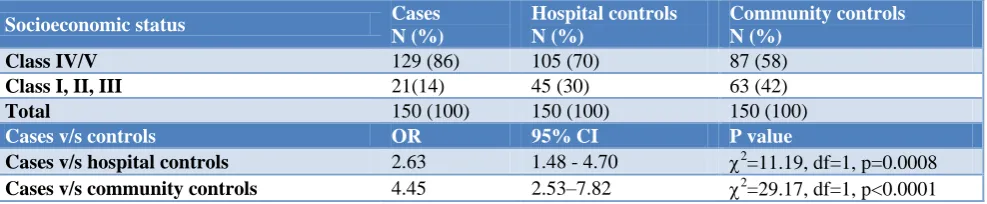
There were 129 (86%) cases, 105 (70%) hospital controls and 87 (58%) community controls in the category IV and V SES. Low socioeconomic status (class IV and V) was found to be associated with risk of pulmonary tuberculosis and this association was statistically significant (OR=2.63, 95% CI 1.48 - 4.70, p=0.0008).
Table 1: Age and sex wise distribution of the study participants.
Age groups (in years)
Cases (N=150) Hospital controls (N=150) Community controls (N=150)
Male Female Male Female Male Female
No. % No. % No. % No. % No. % No. %
15–25 20 18.69 21 48.84 19 17.76 19 44.19 25 23.36 19 44.19
25–35 22 20.56 8 18.60 21 19.63 10 23.25 22 20.56 10 23.25
35–45 29 27.10 4 9.30 29 27.10 4 9.30 27 25.23 5 11.63
45–55 24 22.43 5 11.63 22 20.56 5 11.63 21 19.63 3 6.98
55–65 6 5.61 3 6.98 9 8.41 3 6.98 8 7.48 2 4.65
≥65 6 5.61 2 4.65 7 6.54 2 4.65 4 3.74 4 9.30
Total 107 100 43 100 107 100 43 100 107 100 43 100
Table 2:Distribution of study participants according to the place of residence.
Place of residence Cases Hospital controls Community controls
No. % No. % No. %
Urban 140 93.33 137 91.33 150 100
Rural 10 6.67 13 8.67 0 0
Total 150 100 150 100 150 100
Table 3:Distribution of study participants according to their socio-economic class.*
Socioeconomic class Cases Hospital controls Community controls
No. % No. % No. %
Upper (I) 1 0.67 0 0 1 0.67
Upper middle (II) 5 3.33 21 14 15 10
Lower middle (III) 15 10 24 16 47 31.33
Upper lower (IV) 120 80 97 64.67 87 58
Lower (V) 9 6 8 5.33 0 0
Total 150 100 150 100 150 100
*Modified kuppuswamy scale (Urban) and B. G. Prasad’s classification (Rural).3
Table 4:Religion wise distribution of the study participants.
Religion Cases Hospital controls Community controls
No. % No. % No. %
Hindu 88 58.67 81 54 111 74
Muslim 38 25.33 47 31.33 0 0
Buddha 22 14.67 21 14 39 26
Others 2 1.33 1 0.67 0 0
Table 5:Distribution of study participants according to their marital status.
Marital status Cases Hospital controls Community controls
No. % No. % No. %
Unmarried 47 31.33 48 32 45 30
Married 92 61.33 92 61.33 101 67.33
Widowed 10 6.67 8 5.34 4 2.67
Separated 1 0.67 2 1.33 0 0
Total 150 100 150 100 150 100
Table 6: Association of pulmonary tuberculosis with socioeconomic status.
Socioeconomic status Cases
N (%)
Hospital controls N (%)
Community controls N (%)
Class IV/V 129 (86) 105 (70) 87 (58)
Class I, II, III 21(14) 45 (30) 63 (42)
Total 150 (100) 150 (100) 150 (100)
Cases v/s controls OR 95% CI P value
Cases v/s hospital controls 2.63 1.48 - 4.70 2=11.19, df=1, p=0.0008
Cases v/s community controls 4.45 2.53–7.82 2=29.17, df=1, p<0.0001
On analysis of cases versus community controls, low socioeconomic status was found to be associated with risk of pulmonary tuberculosis and this association was statistically significant (OR=4.45, 95% CI 2.53–7.82, p<0.0001).
DISCUSSION
Age and sex of the study participants
In the present study, age (±5 years) and sex matching was done. Study participants were aged ≥15 years. Male to female ratio was found to be 2.5:1. Maximum age of the study participant was 75 years. In a study conducted by Hill et al on study participants ≥15 years, male to female ratio was found to be 1.86:1.4 Gupta et al found male to female ratio of 3.7:1.5 Shetty et al conducted a study on participants in the range of 15 to 83 years and the sex distribution was 58% men and 42% women.6 It is evident from the above findings that prevalence of the disease is more in males as compared to females. In most of the studies, minimum age limit considered was 15 years because some risk factors like smoking, alcohol intake and chronic diseases like diabetes mellitus arise after this age only. Same holds true for the present study.
Place of residence
In the present study, 140 (93.33%) cases and 137 (91.33%) hospital controls and 150 (100%) community controls belonged to urban area. Only 10 (6.67%) cases and 13 (8.67%) hospital controls were from rural area. In a study conducted by Behera et al, there were 44 (46.3%) cases and 46 (42.2%) controls from rural area and 51 (53.7%) cases and 63 (57.8%) controls from urban area.7 Kaulagekar et al conducted a study using data obtained from NFHS–2 and found that prevalence of TB in urban
and it was 0.73% and 0.54% in rural males and females respectively.8 There were 50 (81.90%) cases and 104 (85.20%) controls from urban region and 11 (18.10%) cases and 18 (14.80%) controls from rural area in a study conducted by Alavi et al.9
Religion
In this study, maximum cases, hospital controls and community controls belonged to Hindu religion i.e. 88 (58.67%), 81 (54%) and 111 (74%) respectively. In a study conducted by Shetty et al, there were136 (72%) study participants of Hindu religion among cases and 128 (67.70%) in controls.6 53 (28%) cases and 61 (32.30%) controls were from other (Christian and Muslim) religions.
Marital status
In this study, most of the study participants among cases, hospital controls as well as community controls were married i.e. 92 (61.33%), 92 (61.33%) and 101 (67.33%) respectively. In a study conducted by Hill et al, 48 (48%) cases and 118 (59%) controls were married, 43 (43%) cases and 74 (37%) controls were single and 9 (9%) cases and 8 (4%) controls were widowed/ divorced.4 In a study by Behera et al, 98 (89.9%) controls and 80 (84.2%) cases were married.7 Shetty et al conducted a case control study.6 In their study, 118 (62.4%) cases and 117 (61.9%) controls were married and 71 (37.6%) cases and 72 (38.1%) controls were unmarried, widowed or separated. Present also yielded similar findings.
Socioeconomic status
the study participants were clubbed into 2 groups. Study participants in the category IV and V of socioeconomic class were kept in one group and those in the category I, II and III in in another. 129 (86%) cases were in the category IV and V SES against the 105 (70%) hospital controls and this difference was found to be statistically highly significant with risk of pulmonary tuberculosis more with low socioeconomic status (OR=2.63, 95% CI 1.48-4.70, p=0.0008). 87 (58%) community controls were found to be in category IV and V socioeconomic status. The difference between cases and community controls was also found to be statistically significant with risk of pulmonary tuberculosis more with low socioeconomic status (OR=4.45, 95% CI 2.53–7.82, p<0.0001). But, on multivariable analysis, it remained significant only on comparison with hospital controls after adjustment for hypertension, smoking, alcohol intake, H/O TB contact, BCG scar (adjusted OR=2.47, 95% CI 1.31–4.66, p=0.005).
Clark et al, in their study concluded that rise in community household income appeared to decrease risk by four times (parameter estimate= –1.4285, OR=0.24, 95% CI 0.10–0.56, p=0.0010).10 Gupta et al found that odds ratio (OR) increased by 3.14 (95% CI 2.48-3.98) for every decrease of Rs. 500/- in the income level per person per month below Rs. 2000/-, showing the association to be statistically significant (p<0.001).11 Shetty et al found that socioeconomic status was found to be a non-significant risk factor after adjustment for other factors (adjusted OR=0.52, 95% CI 0.25-1.10, p=0.08).6
CONCLUSION
Most of study participants were Hindu, married and resided in urban area. Low socioeconomic status showed significant association with pulmonary TB with both the control groups.
Funding: No funding sources Conflict of interest: None declared
Ethical approval: The study was approved by the Institutional Ethics Committeeof IGGMC Nagpur
REFERENCES
1. Park K. Park’s Textbook of preventive and social
medicine 21st ed. M/s Banarsidas Bhanot
publishers; 2011: 164-165.
2. Juneja A, Agarwal SS, Murthy NS. Design of case control studies, in Rao KV. Biostatistics. A manual of statistical methods for use in health, nutrition and anthropology. 2nd ed. Jaypee Brothers Medical Publishers; 2007: 388-398.
3. Lal S, Adarsh, Pankaj. Textbook of Community Medicine Preventive and Social Medicine. 2nd ed. CBS Publishers and Distributors; 2009: 150-156. 4. Hill PC, Jackson-Sillah D, Donkor SA, Otu J,
Adegbola RA, Lienhardt C. Risk factors for pulmonary tuberculosis: a clinic-based case control study in the Gambia. BMC Public Health. 2006;6:156.
5. Gupta S, Shenoy VP, Mukhopadhyay C, Bairy I and Sethumadhav, Muralidharan S. Role of risk factors
and socio-economic status in pulmonary
tuberculosis: a search for the root cause in patients in a tertiary care hospital, South India. Trop Med Int Health. 2011;16(1):74–8.
6. Shetty N, Shemko M, Vaz M, D'Souza G. An epidemiological evaluation of risk factors for tuberculosis in South India: a matched case control study. Int J Tuberc Lung Dis. 2006;10(1):80-6. 7. Behera D, Aggarwal G. Domestic cooking fuel
exposure and tuberculosis in Indian women. Indian J Chest Dis Allied Sci. 2010;52(3):139-43.
8. Kaulagekar A, Radkar A. Social status makes a difference: tuberculosis scenario during National Family Health Survey-2. Indian J Tuberc. 2007;54(1):17-23.
9. Alavi SM, Ershadian S. Association between cigarette smoking and pulmonary tuberculosis. Pak J Med Sci. 2009;25(6):912-5.
10. Clark M, Riben P, Nowgesic E. The association of housing density, isolation and tuberculosis in Canadian First Nations communities. Int J Epidemiol. 2002;31(5):940-5.
11. Gupta D, Das K, Balamughesh T, Aggarwal AN and Jindal SK. Role of socio-economic factors in tuberculosis prevalence. Indian J Tuberc. 2004;51:27-31.
Cite this article as: Ratta AK, Kubde SS, Patle R.