Original Research Article
A study to assess the clean hospital initiative and quality of health
services using kayakalp tool in a first referral unit, of Khordha
district of Odisha, India
Mayadhar Panda, Sikata Nanda*
INTRODUCTION
Cleanliness is important not only from the aesthetic point of view, but also lack of cleanliness and hygiene is a major cause of ill-health. Govt. of India launched “Swachh Bharat Abhiyaan” on 2nd
October 2014, with the emphasis on promoting cleanliness in public area. Maintenance of cleanliness and hygiene in hospitals is necessary with strict adherence to the guideline for infection control practices.1 This is very much essential to prevent hospital acquired infections. Health care organizations are complex environments that contain a large diversity of microbial flora, many of which may constitute a risk to the patients, staff and visitors in the
environment. Consistently high cleaning standards must be maintained in the high risk areas. Both informal monitoring and formal evaluation of cleanliness should take place continuously. Patient care areas and other facilities designated as high- risk category should be evaluated at least once a week until the Officer I/C Sanitation and Infection Control Team are satisfied that consistently high standards are being maintained, after which the frequency of evaluation may be reduced to once monthly.2 Besides, knowledge and awareness among the patients and visitors regarding their co-operation towards clean initiatives of the health institution is also needed.
ABSTRACT
Background: As a part of “Swachh Bharat Abhiyaan” campaign, the Ministry of Health and Family welfare, Govt. of India had launched “Kayakalp” in 2015, an initiative to promote cleanliness and enhance the quality of public health facilities. Our aim was to study the situational analysis of the health institution using Kayakalp tool; to assess the level of cleanliness, hygiene and infection control practices in the facility and to assess the status of Bio-medical waste management in the health care facility and to suggest remedial measures based on the study finding.
Methods: It is a hospital based snapshot study done during a period of one year from April 2016 to March 2017. Kayakalp assessment tool was used for analysis.
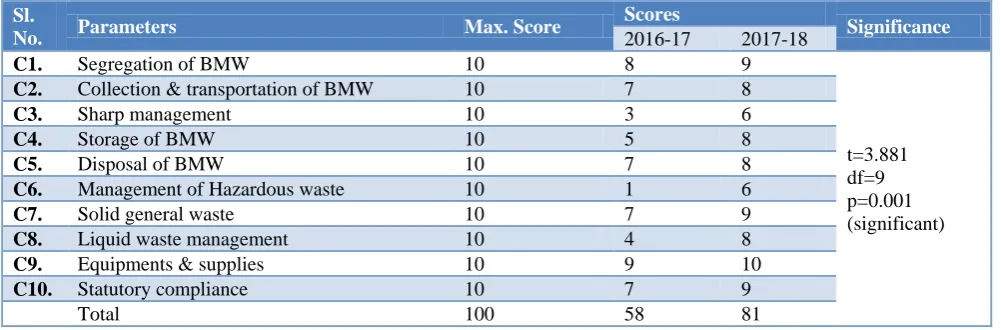
Results: The total scores for upkeep maintenance obtained in 2016-17 was 69 and for the year 2017-18 was 81. There was an increase of total score in the year 2017-18 and it was found to be statistically significant. On assessment in the year 2016-17, for BMW the total score obtained was 58 and in the year 2017-18 it was 81. There was a statistically significant increase in the scores (p=0.001) obtained in the year (2017-18).
Conclusions: Improvements in Biomedical waste management can be made by increasing the knowledge, awareness and practices of the health care providers as well as the beneficiaries with regular periodic monitoring.
Keywords: BMW, Kayakalp, Swachh Bharat Abhiyaan
Department ofCommunity Medicine, SCBMCH, Cuttack, Odisha, India
Received: 14 October 2018
Accepted: 15 November 2018
*Correspondence:
Dr. Sikata Nanda,
E-mail: [email protected]
Copyright: © the author(s), publisher and licensee Medip Academy. This is an open-access article distributed under the terms of the Creative Commons Attribution Non-Commercial License, which permits unrestricted non-commercial use, distribution, and reproduction in any medium, provided the original work is properly cited.
To complement this effort, the Ministry of Health & Family Welfare, Government of India on 15th May 2015 launched “Kayakalp” a National initiative to give awards to those public health facilities that demonstrate high level of cleanliness, hygiene and infection control.3 “Kayakalp” initiative will encourage every public health facility in the country to work towards standards of excellence in order to help the facilities to maintain cleanliness and hygiene.
Criteria for application to the awards scheme: Following are the prerequisites to apply for award 1. Constitution of cleanliness and infection control committee. 2. A mechanism of periodic internal assessment / peer assessment based on defined criteria 3. Achieve at least 70% score in the criteria during the peer assessment process.
The “Swachh Bharat Abhiyan” was launched by the Prime-minister of India, which focuses on promoting cleanliness in public spaces. As the first principle of health care is “to do no harm” it is therefore essential for the health care facilities to be clean and ensure strict adherence to the infection control practices.
The main objectives of the Kayakalp initiative is to promote cleanliness, hygiene, infection control practices in public health care facilities.At the same time to incentivize and organize such public health care facilities that show exemplary performance in adhering to the standard protocols of cleanliness and infection control.
To inculcate a culture of ongoing assessment and peer review of performance related to hygiene, cleanliness and sanitation. Besides this the other aims of an institution should be to create and share sustainable practices related to improved cleanliness in different health care facilities or establishments and to have a positive health outcome.
It is very important to have proper biomedical waste management and handling system as prescribed in the Biomedical Waste (Management and Handling Rules) 2016 otherwise it exposes the patients, visitors and staff to following hazards. 5
(a) Transmission of infections e.g., hepatitis B, HIV, other microbes etc. (b) Mechanical injury (c) Re-circulation of waste (d) Air pollution (e) Water pollution (f) Land pollution(g) Fire (h) Breeding of flies and insects (i) Proliferation of rodents (j) Loss of aesthetics (k) Nuclear waste hazards & carcinogenic effects.
In this context it was necessary to conduct an assessment on the level of knowledge and practice among the health care providers as well as the quality of health service having in mind the following objectives like to study the situational analysis of the health institution using Kayakalp tool, to assess the level of cleanliness, hygiene and infection control practices in the facility ,to assess the
status of Bio-medical waste management in the health care facility and to suggest remedial measures based on study finding.
METHODS
Study design
A hospital based snapshot study
Study tools
Kayakalp assessment tool.
Methods used
Direct observation (OB), Staff interview (SI) , review of records (RR) & documents.
Place and duration
The study was conducted in the first referral unit (FRU) Jatni of Khordha District, Odisha on two occasions, during the period (December 2016- January 2017) and December 2017 – January 2018.
Study instruments
Basing on the OB, SI & RR scores were applied as fully compliant (2), Partially compliant (1) and Non compliant (0). The observations & documentations were conducted using a check list provided under Kayakalp Program.
Data collection
Initially prior to the training ,data were collected in the prescribed format in respect of all the thematic areas and appropriate scores were applied using the study instruments during the December 2016. After the doctors, staff nurses, had undergone orientation training regarding Kayakalp at DHH, they provided training to the class IV employees. In a similar way to the previous year, data was again collected in December 2017 and scores in different activities were given.
Data analysis
Data analysis was done with IBM SPSS version -21. Pre and post training scores of the two different time period were compared. Statistical package like Paired „t‟ test was applied.
Different Means of verification: OB – direct observation, SI-Staff interview, PI-Patient/relatives interview, PR- Review of records & documents.
An assessment protocol and scoring system for kayakalp includes 3 categories i.e. 1: Thematic area, 2: Criteria, 3: Checkpoint. The thematic area includes broader aspect of swachhta, called as pillars of Kayakalp namely, „A‟ – Hospital /facility upkeep, „B‟- Sanitation & hygiene, „C‟- Waste management, „D‟- Infection control, „E‟-Support services and „F‟- Hygiene Promotion.
Criteria - There are fixed number of criteria that have specific attributes in respect to individual themes.
Checkpoint – It in the lowest and most tangible unit of assessment. A score is awarded by assessors on checkpoints into specific requirements in the facility. Each checkpoint has an unique criteria. Secondary health care facilities like a FRU have 5 checkpoints in each criterion. At the same time it is wise to know that additional PHC/UPHC have 3 to 2 checkpoint criterion.
Figure 1: (A) Hospital upkeep; (B) sanitation & hygiene; (C) waste management; (D) infection control;
(E) support services; (F) hygiene promotion.
The Kayakalp assessment tool includes a checklist comprising of a compilation of themes, criteria and checkpoints.
Assessment method
There are 4 assessment methods.
1. OB (Observation): – These information is gathered through direct observation i.e. level of cleanliness, display of protocols, landscaping, signage etc.
2. SI (Staff Interview): - Information is obtained by interaction with concerned staff to understand the current practices being undertaken, competencies of various types like wearing gloves, hand-washing and cleansing of floor.
3. RR (Record Keeping): - Where information can be created from the records available at the facility. Ex : Availability of housekeeping checklist, BMW management registers, culture report for microbial surveillance, meetings of Infection Control Committee (ICC).
4. PI (Patient Interview): - Interaction / discussion / interview with either patients or their attendants i.e. counseling of patients on hygiene.
Verification methods
Each checkpoint is accompanied by means of verification which is given in next column assessment method. At the same time an assessor is guided as to what to look for, decision on content of compliance.
The general principle of giving a numerical score of 02 marks for full compliance means that at all requirements of check point, verifications are made.
For partial compliance at least 50% or more requirements should be met. For partial compliance a score of 01 mark is given.
For non-compliance of any assigned criteria in the facility, when it fails to (achieve) reach at least 50% of its standard requirement in the checkpoint, then in such a case „0‟ score is given.
RESULTS
Table 1 depicts the hospital upkeep maintenance in the CHC Jatni. The different parameters, 10 in number from A1 to A10 includes pest and animal control, landscaping to workplace management wherein the maximum score allotted against each parameter is 10 and the total maximum score from A1 to A10 that can be scored is 100. From our observation the total scores obtained in 2016-17 was 69 and for the year 2017-18 was 81. There was an increase of total score in the year 2017-18 and it was found to be statistically significant. This shows that there was an increase in the level of hospital upkeep maintenance in the year 2017-18 compared the previous year 2016-17 because of orientation training. Initiatives have been taken by the hospital for gardening, cleaning of open areas of the hospital, facility for water conservation and maintenance of furniture etc.
Table 2 elaborates on the sanitation & hygiene measures adopted in the hospital over the during the study period of 1 year. As per the different parameters adopted for maintenance of sanitation and hygiene, there are 10 parameters which include cleanliness of circulation area to drainage & sewage management. The maximum score against each parameter is 10, so a total score of 100.
Table 1: Scoring pattern in hospital upkeep.
Sl. No. Parameters Max. Score Scores Significance
2016-17 2017-18
A1. Pest & animal control 10 7 8
t=3.674 df=9 p=0.005 (significant)
A2. Landscaping & gardening 10 7 8
A3. Maintenance of open areas 10 7 8
A4. Hospital / Facility appearance 10 10 10
A5. Infrastructure maintenance 10 7 8
A6. Illumination 10 10 10
A7. Maintenance of furniture & fixtures 10 6 8
A8. Removal of junk material 10 5 7
A9. Water conservation 10 3 6
A10. Workplace management 10 7 7
Total 100 69 81
Table 2: Scoring pattern in sanitation and hygiene.
Sl. No. Parameters Max. Score Scores Significance
2016-17 2017-18
B1. Cleanliness of circulation area 10 7 8
t=3.881 df=9 p=0.004 (significant)
B2. Cleanliness of wards 10 6 8
B3. Cleanliness of procedure areas 10 8 9
B4. Cleanliness of ambulatory areas (OPD,
Emergency Lab) 10 7 8
B5. Cleanliness of auxiliary area 10 6 7
B6. Cleanliness of toilets 10 6 7
B7. Use of standards materials & equipment for
cleaning 10 7 8
B8. Use of standard methods cleaning 10 6 7
B9. Monitoring of cleanliness activities 10 1 5
B10. Drainage & sewage management 10 9 9
Total 100 66 76
Table 3: Scoring pattern in biomedical waste management.
Sl.
No. Parameters Max. Score
Scores
Significance
2016-17 2017-18
C1. Segregation of BMW 10 8 9
t=3.881 df=9 p=0.001 (significant)
C2. Collection & transportation of BMW 10 7 8
C3. Sharp management 10 3 6
C4. Storage of BMW 10 5 8
C5. Disposal of BMW 10 7 8
C6. Management of Hazardous waste 10 1 6
C7. Solid general waste 10 7 9
C8. Liquid waste management 10 4 8
C9. Equipments & supplies 10 9 10
C10. Statutory compliance 10 7 9
Total 100 58 81
Table 3 deals with the biomedical waste management of the CHC. The parameters from C1 to C10 include segregation BMW to statutory compliance. A total of 10 parameters include 10 ranks each. On assessment in the year 2016-17, the total score obtained was 58 and in the
infectious as well as hazardous wastes. For liquid waste management provision for a septic tank was made as per the guideline. Although the scoring for sharp waste
management was improved, but the staff were not aware properly about the PEP (post exposure prophylaxis) for accidental needle stick injury.
Table 4: Scoring pattern in infection control.
Sl.
No. Parameters Max. Score
Scores
Significance
2016-17 2017-18
D1. Hand hygiene 10 6 8
t=2.648 df=9 p=0.027 (significant)
D2. Personal protective equipment (PPE) 10 4 6
D3. Personal protective practices 10 6 7
D4. Decontamination cleaning of instruments 10 8 8
D5. Disinfection & sterilization of instruments 10 6 7
D6. Spill management 10 0 7
D7. Isolation & barrier nursing 10 8 10
D8. Infection control programme 10 4 3
D9. Hospital acquired infection surveillance 10 1 4
D10. Environment control 10 8 9
Total 100 51 69
Table 5: Scoring pattern in support services.
Sl.
No. Parameters Max. Score
Scores
Significance
2016-17 2017-18
E1. Laundry services & linen management 10 5 6
t=2.449 p=(not significant)
E2. Water sanitation 10 7 8
E3. Kitchen services 10 0 0
E4. Security services 10 3 4
E5. Out-sourced service management 10 1 1
Total 50 16 19
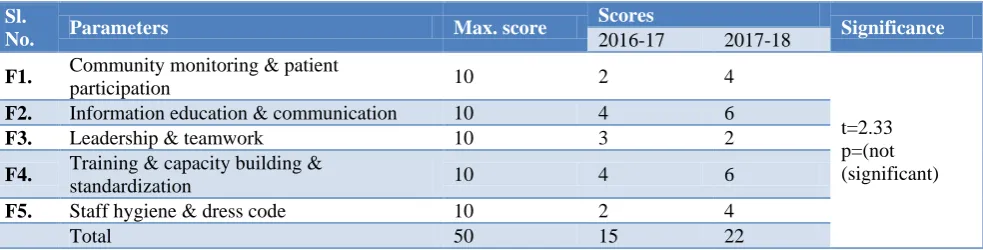
Table 6: Scoring pattern in hygiene promotion.
Sl.
No. Parameters Max. score
Scores
Significance
2016-17 2017-18
F1. Community monitoring & patient
participation 10 2 4
t=2.33 p=(not (significant)
F2. Information education & communication 10 4 6
F3. Leadership & teamwork 10 3 2
F4. Training & capacity building &
standardization 10 4 6
F5. Staff hygiene & dress code 10 2 4
Total 50 15 22
Table 4 deals with infection control measures adopted in the institution. The different parameters include hand hygiene, personal protective equipment (PPE) to environmental control. The maximum score of 10 in each parameter and the total maximum score is 100 which include all the 10 parameters. Interestingly, on assessment the score obtained was 51 in the year (2016-2017) and 69 in the year 2017-18. There was a significant increase in the score for the year (2017-2018) (p=0.027). This was due to awareness among the staff regarding personal protective practices and use of PPE during any kind of hospital procedures as well as strict adherence to hand hygiene. There was restriction to the visitors & external foot wears to the isolation and critical areas.
Similarly the staffs were also aware about spill management. Spill management kit was available. Raghuvansi et al in her study revealed that majority 489 (80%) of respondents said that they maintained a record of sterilization and only 125 (20%) said that did not maintain any record.
due to un-availability of kitchen services, security services also proper laundry services.
Table 6 on hygiene promotion includes 5 parameters. Each is given a score of 10 and maximum of 50 is the marks out of which in the year (2016-17) 15 was obtained and in the year (2017-18) 22 was obtained. The field of hygiene promotion was also lagging due to improper monitoring and deficit in routine review of the cleanliness initiatives. No feedback system was there for the public regarding maintenance of cleanliness of the facility. IEC display regarding use of toilets, maintaining hygiene and its importance were not in place.
DISCUSSION
Average Kayakalp score obtained in 2016-17=275/5 = 55. Total Average score for 2017-18 = 348/5 = 69.6. Amount of BMW generated in the hospital on an Avg. 4.5 kg – 5 kg per day. Segregation of waste was performed in appropriate colour coding bags at the site of origin. Separation of infectious waste and general wastes were followed in all working areas. All staff was aware of the segregation protocols. The score for “collection and transportation” on BMW as 7 in 2016 and 8 in 2017-18, showing minimal deficit in the system. Management of sharps has a good score of 60% in the hospital for year 2017-18 showing improvement as compared to previous year. Similarly significant improvement was noticed in case of hazardous waste and liquid waste management. A septic tank has been constructed inside the hospital campus for treatment of infected liquid waste before disposal.
Raghuvanshi et al in her study aimed to obtain information about knowledge, execution and attitude towards (BMW) biomedical waste and its management between dentists associated with the institution and private practitioners.5 In the study 76% of respondents were not aware that untreated human and anatomical waste should not be stored for >48 hrs. Awareness of different categories of the waste was as high as in 549(89%) of respondents. A total of 468 (76% respondents) segregated waste before disposal whereas 146(24%) did not segregate. Regarding human anatomical waste, 298 (48%) respondents were aware of its disposal in the yellow colored non-chlorinated plastic bag, whereas 316 (51%) were not aware. Regarding sharps & needles, 513(84%) respondents gave correct answer of disposal.
Chudasana et al in his study at Rajkot revealed that 102(97%) paramedics maintained records on BMW at work place, 102 (97%) practiced disinfection and segregation of BMW at work place. 103 (98%) were using personal protective measures while handling BMW.7 This was significantly more than the doctors. In this same study, 76.4% of resident doctors had heard about BMW act/rule. Another study conducted at Delhi by Saini S had similar results.8
Another similar study done at Agra by Sharma et al represented lack of knowledge about the legislation among health personel.9 In the study, in the third stratum (private health care facilities) out of 82 personnel, 14 (17.07%) were only aware of BMW rules. There can only be improvement if the importance of training on sanitation, hygiene practices, cleanliness and BMW management in a health care facility is emphasized. Besides this these training sessions should not merely be a onetime activity instead it should be continuous cyclical process with inclusion of pre and post test training questionnaire. There should be in-house training for health care personnel and which should be made compulsory from accredited training centers.
Mohapatra et al in his study undertaken on doctors by an online snapshot assessment found that (75%) of medical graduates had proper adequate up to date knowledge on BMW than the post graduates. It was significantly higher (p<0.001) among under graduate students. It was probably due to education regarding BMW which was incorporated in Community Medicine Class. Hence their knowledge was most updated.10
Mir et al in his cross sectional study found that there was a higher level of awareness, attitude as well as practice adopted regarding biomedical waste management concept for the injury report which was as low as 30%.11 In a hospital the nursing professionals form the backbone of any hospital and play a vital role in imparting health services i.e. protection, prevention, promotion and treatment. It is good that their level of knowledge can help towards safe disposal of hazardous wastes.
Anand et al in a similar study on health personnel in a teaching institution in Haryana found that doctors, nurses and lab technician had good knowledge, attitude and practice regarding biomedical waste management, however it was found to be very low in class IV employees.12 None of the respondents could answer correctly the different categories according to Pandit et al in a study in Gujurat.13 However 56% of the study population in a study by Basu et al know about different BMW categories.14
CONCLUSION
Workshop, seminar, exhibition must be organized in these hospitals by representatives from various units with special emphasis on risks involved in health care wastes involved due to health care providers and unclean environment in the hospital. Poster exhibition in hospitals at strategic points, using colorful diagram which will explicitly convey messages to even illiterate people who make regular, frequent visits to hospitals.
awareness and in practice. So the SOP (Standard operative procedure and defined management techniques like TQM (total quality management) needs to be highlighted and with supportive supervision.
Funding: No funding sources Conflict of interest: None declared
Ethical approval: The study was approved by the Institutional Ethics Committee
REFERENCES
1. KAYAKALP :National Guidelines for Clean Hospitals; Ministry of health and family welfare , Government of India; 2015: 25-26
2. Lowbury EJL, Ayliffe GAJ, Geddes AM, Willams JD. Control of hospital infection: A practical handbook; 1998: 13-25.
3. Award to public health facilities KAYAKALP, 2015; NHM, Ministry of H&FW, Govt. of India; 1-5.
4. National AIDS control Organization. Manual for control of Hospital Associated Infections. Standard Operative Procedures, New Delhi : National AIDS control organization; 1999: 50-66.
5. Park K. Textbook of Preventive Medicine 24th edition, Jabalpur: Barandas Bharat Publisher; 2005: 826.
6. Raghuvanshi M, Sinha S, Mohiddin G, Panda A, Dash KC, Bhuyan L. Awareness of Biomedical Waste Management among dentists associated with Institution and Private Practicess of North India : A comparative study. J Contemp Dent Pract. 2018;19(3):273-7.
7. Chudasana RK, Sheth A, Rangoonwala M, Joshi N, Zalavadiya D, Bhela C. Awareness and practice of Biomedical waste management among different health care personnel at Tertiary care centre, Rajkot India. Online J Health Sci. 2014;13(1):1.
8. Saini S, Nagaranjan SS, Sharma RK. Knowledge, attitude and practices of biomedical waste management among staff of a tertiary level hospital in India. J Acad Hosp Admin. 2005;17:1-12. 9. Sharma S. Awareness about biomedical waste
management among health care personnel of some important medical centers in Agra. Int J Environment Science Div. 2010;1(3):251-5.
10. Mohapatra A, Gupta M, Shivalli S, Mishra CP, Mohapatra SC. Biomedical waste management Practices of doctors: An online Snapshot. National J Comm Med. 2012;3(2):227-31.
11. Rafiq M, Ahamad J, Ahmad A, Jan R. Knowledge, attitude and practices about Biomedical waste management among nursing professionals of SKIMS medical college hospital, Bemina: A cross sectional study. IOSR J Nursing Health sci. 2013;1(5):47-8.
12. Anand P, Jain R, Dhyani A. Knowledge, attitude and practice of biomedical waste management among health care personnel in a teaching institution in Haryana, India. Int J Res Med Sci. 2016;4(10):4246–50.
13. Pandit NB, Mehta HK, Kartha GP, Choudhury SK. Management of biomedical waste : Awareness and practices in a district of Gujurat, India J. Public Health. 2005;49:245-7.
14. Basu M, Das P, Pal R. Assessment of future technicians on biomedical waste management in a tertiary care hospital of West Bengal. J National Sci Biol Med. 2012;3(1):38-42.