Original Research Article
Study on morbidity pattern of neonates admitted to special new born
care unit of M.K.C.G. medical college hospital with special
reference to hypoglycemia
Geetanjali Sethy
1, Dhaneswari Jena
2*, Santosh Pradhan
1, Pravati Jena
3, Debasish Sethy
2INTRODUCTION
Children under 5 years are the most vulnerable population. Globally under -five mortality rate has dropped from 93/1000 live births in 1990 to 41/1000 live births in 2016.1 With the global burden of 2.6 million neonatal death, approximately 7,000 deaths occurs every day – majority of them occurring in the first week, about
1 million dying on the first day and nearly 1 million within the next six days.2 First 28 days of life are the most crucial time for child survival. Current global infant mortality rate is 30.5/1000 live births.3 A global rate of neonatal death rate is19 per 1000 live births.2Almost a quarter of these deaths occur in India. As per statistics 2016, the under-five mortality rate of India is 50/1000 live birth and infant mortality rate is 41/1000 live birth
ABSTRACT
Background: Children under five are most fragile group of population and so subjected to high mortality and morbidity. Among them, neonatal group is highly suseptible due to poor adaptation of their premature organ system. Neonatal hypoglycemia is a common co-morbid condition contributing to mortality. The objective of the study was to assess the etiology and clinical profile of neonatal hypoglycemia among the neonates admitted to special newborn care unit and to assess the co-morbidity pattern among them.
Methods: Type of study was hospital based cross-sectional study at SNCU of MKCG Medical College Berhampur, Odisha. Sample size was 204 neonates who developed hypoglycaemia (blood glucose level <40 mg/dl). Study period was 2016-2017 statistical tests used-percentage and proportion. Statisticalsoftware used- SPSS 16 version.
Results: Out of total 2616 admission during study period, the incidence of hypoglycemia was 7.79%.52% were male babies and 58% were out borns. Among the maternal causes, anemia was the most common cause (37.7%). Low birth weight was highest (55.8%) among neonatal factors. Jitteriness and tremor were the major symptoms (32.5% cases). Lethargy and poor feeding were presenting symptoms (19.6% cases). On analysing the outcome, 7.8% neonate died and 78.4% recovered.
Conclusions: Being a common co morbid condition and presented with other neonatal problems it is more seen among outborn males and anemic mothers. Cause may be delay in initiation of feeding and interruption of feeding on the way during referral. However proper counseling should be given to caretaker of referral case about feeding on the way. Early detection of hypoglycemia is important to reduce mortality and prevent future sequelae in sick newborns.
Keywords: Hypoglycemia, Neonates,Morbidity
1
Department of Pediatrics, 2Department of Community Medicine, 3School of Nursing, MKCG Medical College, Berhampur, Odisha, India
Received: 16 August 2018
Revised: 17 September 2018 Accepted: 18 September 2018
*Correspondence:
Dr. Dhaneswari Jena,
E-mail: [email protected]
Copyright: © the author(s), publisher and licensee Medip Academy. This is an open-access article distributed under the terms of the Creative Commons Attribution Non-Commercial License, which permits unrestricted non-commercial use, distribution, and reproduction in any medium, provided the original work is properly cited.
and neonatal mortality rate is 25/1000 live birth.4Of all those infants dying before their first birthday, almost 2/3rd die in the first 28 days of life. Neonatal mortality rate contribute to half of under-five mortality rate. As per NFHS4, under-five mortality rate of Odisha is 49 and IMR is 40 per 1000 live birth respectively.5 NMR of the state has declined from 53 (2005) to 37 (2013) keeping pace with Infant mortality rate as estimated by SRS.6 The SDG aims at reducing neonatal mortality rate to atleast 12/1000 live births by 2030.7 The high neonatal morbidity and mortality is a result of poor adaptation to the environment following premature birth, low birth weight, intra uterine growth retardation, birth asphyxia, sepsis. Majority of these are also results of poor status of maternal health and lack of care during delivery or immediate post-partum, as the health status and survival of the mother and newborn are intrinsically related.
Hypoglycemia is a common co-morbid condition reported in association with prematurity, birth asphyxia, intra uterine growth retardation, infant of diabetic mother, sepsis. Neonatal hypoglycemia is challenge for child health which needs urgent attention failing which adverse consequences, like damage to CNS resulting in abnormal neuro-developmental outcome, decreased overall IQ, reading and learning ability, arithmetic proficiency and motor performance may result over long term.8 Though it is a common metabolic disorder it is often underestimated and overlooked. It is now recognized as an important cause of neonatal morbidity and mortality though the definition, significance and management of neonatal hypoglycemia remains still remain ambiguous. The brain depends on a normal supply of glucose for its energy needs. In a country like India with explosive population growth, the emergence of more mentally or physically h andicapped children in the society is a mental trauma to the parents and also is a burden for the country.
The present study was carried out with objective to assess the morbidity pattern in newborn care centre of M.K.C.G. Medical College and Hospital as well as the incidence and etiology of neonatal hypoglycemia among the admitted neonates.
METHODS
This is a hospital based cross sectional study carried out in SNCU of MKCG Medical College Berhampur, Odisha. All neonates having low blood glucose level (<40 mg/dl) admitted during the study period 2016-2017 were taken as study participants. As per above criteria 204 cases were selected. After taking IEC approval, verbal consent from parents was taken for participation in the study. Detailed history of all cases was recorded giving due importance to maternal factors such as age, parity, history of gestational diabetes, hypertension, infection, medication like corticosteroid therapy, obstetric complications like fetal distress, mode of delivery and natal history such as APGAR scores, resuscitation, birth weight, gestational age was recorded. All neonates after
admission were screened for blood glucose level by glucometer and confirmed in laboratory by glucose-oxidase method. Other relevant investigations were done in the central Laboratory of M.K.C.G. Medical College, Berhampur to diagnose the co-morbidities associated with hypoglycemia. Statistical data was analysed with use of SPSS 16 version.
The babies were examined thoroughly soon after delivery and again on frequent intervals and the result of clinical examination noted in the proforma. Blood sample was collected at 1, 3, 12, 24 hrs and 72 hrs, for determination of blood glucose levels. Other relevant Investigations were also done taking into consideration the detailed history including antenatal, natal and post natal history and clinical presentation. Sepsis screening was done in whom there is h/o PROM, Maternal fever, foul smelling liquor, severe birth asphyxia with active resuscitation, prolonged labour or who presented with poor feeding, Lethargy, seizure, abdominal distension, bleeding. Treatment was given and later modified basing on culture report.
The parameters tested in the sepsis screen were CRP, TLC, ANC and IT ratio. Lumbar puncture was done in all case of late-onset neonatal sepsis and those having clinical features consistent of bacterial meningitis. Those children who presented with tachypnea, respiratory distress, chest x-ray P-A view was done to look for opacities and ground glass appearance in case of RDS, especially in preterm.
RESULTS
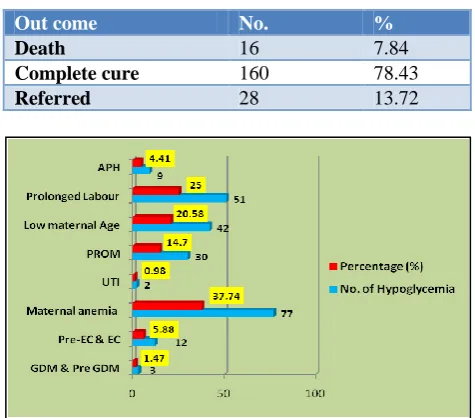
The most common form of presentation in present study were jitteriness and tremor, lethargy and poor feeding, tachypnea, cyanosis, apnea, seizure and weak high pitched cry in that order. Analyzing the outcomes 78.43% of all hypoglycemic cases were completely cured, 13.72% were referred and death occurred in 7.84% cases.
Table 1: Clinico demographic profiles of neonates.
No. %
Place of delivery
Inborn 85 41.66
Out born 119 58.34
Sex
Female 96 47.06
Male 108 52.94
Type of delivery
NVD 162 79.41
CS 42 20.59
Birth weight
Normal 90 44.1
Low 114 55.8
Status according to gestational age
SGA 29 14.21
AGA 175 85.7
Development time after birth
Within 24 hrs 111 54.41
≥24 hrs 93 45.5
APGAR score
<7 122 59.8
≥7 82 40.1
Table 2: Neonatal factors associated with hypoglycemia.
Parameter No. of
hypoglycemia %
Prematurity 100 49.01
SGA (Term +Preterm) 29 14.21
Sepsis excluding preterm 15 7.35
Birth asphyxia excluding
preterm 79 38.72
IDM 3 1.47
IEM 6 2.94
LBW
(Preterm+TermSGA) 114 55.88
Table 3: Presenting symptoms of hypoglycemia.
Clinical features No. of cases %
Jitteriness and tremor, 66 32.57
Lethargy and poor feeding 40 19.6
Tachypnea 22 10.78
cyanosis, Apnea 18 8.82
seizure 11 5.39
weak high pitched cry 10 4.90
Asymptomatic 120 58.82
Table 4: Outcome of hypoglycemia.
Out come No. %
Death 16 7.84
Complete cure 160 78.43
Referred 28 13.72
Figure 1: Profile of associated maternal factors.
DISCUSSION
As the admitted cases were associated with different high risk factors, the incidence for hypoglycemia was little high. It is also higher than the observation in study done by Kiran, Dhanjaya et al where the incidence was 4.2%.9 The variability in incidence could also be due to different nursery practice, feeding practice and different degree of neonatal sickness. Lubchenco and Bardhas found in their study that 11.4% of all nursery admissions were hypoglycemic.10 This high incidence may be due to use of higher threshold for hypoglycemia (<50 mg/dl).
The difference of hypoglycemia in different sex group may be due to the demographic trend of the country. More percentage of hypoglycemic cases had history of normal delivery. As more number of normal cases delivered in tertiary health care level counseling of mothers in normal delivery cases could have been deficient or absent. Lack of proper awareness of early feeding, lack of feeding or IV glucose during transport or variation in the level of care may have resulted in more number of hypoglycemia.
and Bard has found that 20.3% of preterm babies have hypoglycemia, taking blood glucose level of 50 mg/dl as the cut off.10
In present study, incidence of hypoglycemia in SGA was 14.21.8% which is lower than (26%) of Mishra et al and the observation (32.8%) of Lubchanco and Bard.10,13 The reason of high incidence may be high cut off value for hypoglycemia i.e. 50 mg/dl or due to the discouragement of early feeding practices. In their study they found that 67% of preterm 7.64% of neonatal sepsis have hypoglycemia. But in case of neonatal sepsis with preterm, the incidence of hypoglycemia increased to 18.13%. Similarly, 38% neonates asphyxiatedat birth were hypoglycemic, but with preterm along with birth asphyxia, the incidence increased to 13.07%. In present study 15.21% of term SGA babies were hypoglycemic. But term SGA babies when suffered from sepsis, the incidence increased to 22.22%. This shows that multiple risk factors in neonates make them more susceptible for hypoglycemia.
In preterm, SGA babies, cause of hypoglycemia is mainly due to inadequate substrate (Low glycogen store) and immaturity of enzymes of gluconeogensis, If these babies also suffer from stressful conditions like birth Asphyxia, sepsis, the glucose demand is increased complicating the already lowered blood glucose levels. Considering the contribution of different morbid conditions or risk factors for developing hypoglycemia, the LBW (both preterm and term SGA) babies contributed the highest (55.88%). Prematurity as an independent factor contributing 49.01% of all hypoglycemia cases. 38.72% of all hypoglycemic babies were asphyxiated at birth with SGA babies contributing 14.21% of all hypoglycemics.
In the study by Najati and Saboktakin the underlying cause of hypoglycemia were prematurity (61.5%), diabetic mother (13.6%), septicemia (9.6%).15 The higher percentage babies of birth asphyxia contributing to hypoglycemia in present study may be due to presence of more number of asphyxiated neonates. The study by Mishra and Sharma in 1983 shows that new born of complicated pregnancies and delivery (48.2%), low birth weight 41.1% and asphyxia (10.7%) comprises of hypoglycemic babies.13
The fact that various indirect antenatal risk factor contributing to hypoglycemia like delivering more preterm, IUGR, presence of birth asphyxia and neonatal sepsis, has been reported in different studies.(Ali Beard; 1971, Sigh et al, 1991, NRC Robertson et al, 1999).15-17 The study by Mishra et al also shows that 48.2% of all symptomatic hypoglycemic cases were associated with complicated pregnancies and deliveries.11 Relation of hypoglycemia with APGAR score was assessed and it was found that babies having low APGAR score were more hypoglycemic. 48.03% of all hypoglycemic babies had APGAR score between 0-3 and 11.76% had APGAR score between 3-7. This is due to the fact that low
APGAR score is common in birth Asphyxia and preterm babies. As in our series we have more number of birth asphyxiated and preterm babies, So it was found that 59.79% of all hypoglycemic babies have low APGAR scores between 0-7.58.82% of all hypoglycemic babies were symptomatic having varied clinical presentation. 41.18% were asymptomatic. In the study by Kiran et al in 2011 the incidence of symptomatic hypoglycemia is 40%.13 The high incidence of symptomatic hypoglycemia may be due to different neonatal conditions and more no of preterm, LBW neonates in present study and other associated risk factors like birth asphyxia and sepsis.
Several studies reported secondary hypoglycemia as a result of asphyxia, prematurity, respiratory distress, infection as observed by anderson et al.18 Even 38% of uncomplicated term infants had low blood glucose concentration during first fifty hours of life.18
Comparing the most common form of presentation in present study Jitteriness and Tremor, Lethargy and Poor feeding, etc. Mishra et al also found the similar incidence of clinical presentations i.e. jitteriness and tremor 78.6%, lethargy 48.2% tachypnea 26.8%, cyanosis 21.4%, convulsion 7.1% Although none of the signs and symptoms of hypoglycemia are pathognomic, Jitteriness and Tremor were the most common feature also been found by Cornblath et al and Kumari et al.11 Many have multiple combination of above presentations. The above signs may be found in other neonatal conditions like birth asphyxia, sepsis, hypothermia. Cornblath et al described 8 infants whose symptoms were apnea, cyanosis, coma, convulsions and were attributed to reduced blood glucose concentrations.
Funding: No funding sources Conflict of interest: None declared
Ethical approval: The study was approved by the Institutional Ethics Committee
REFERENCES
1. Global Health Observatory (GHO) data. Child Health. Available at: http://www.who.int/gho/ child_health/en/. Accessed 10 June 2018.
2. United Nations Children’s Fund (UNICEF) Data: Monitoring the situation of children and women. Available at: https://data.unicef.org/topic/child-survival/neonatal-mortality/. Accessed 10 June 2018.
3. Global Health Observatory (GHO) data: Infant mortality Situation and trends. Available at: http://www.who.int/gho/child_health/mortality/neon atal_infant_text/en/. Accessed 10 June 2018. 4. NFHS4 fact sheet INDIA data. Available at:
http:/rchiips.org/NFHS/pdf/NFHS4/India.pdf. Accessed 10 June 2018.
5. NFHS4 fact sheet ODISHA data. Available at: http://rchiips.org/NFHS/pdf/NFHS4/OR_FactSheet. pdf. Accessed 10 June 2018.
6. Annual health survey 2012-13 fact sheet. Available at: http://www.nrhmorissa.gov.in/writereaddata/ Upload/Documents/AHS%20FACTSHEET-2012-13Odisha.pdf. Accessed 10 June 2018.
7. United Nations Children’s Fund (UNICEF) Data: Monitoring the situation of children and women. Sustainable development goals. Available at- https://data.unicef.org/topic/child-survival/child-survival-sdgs. Accessed 10 June 2018.
8. Lucas A, Morley R, Cole TJ. Adverse neurodevelopmental outcome of moderate neonatal hypoglycemia. BMJ. 1988;297:1304-8.
9. Kiran B, Dhanjaya CD. Prevalence and underline etiologies of neonatal hypoglycemia. Int J Biological Med Res. 2011;2(4);1110-4.
10. Lubchencho LO, Bald H. Incidence of hypoglycemia in newborn infants classified by birth
weight and gestational age. Pediatrics. 1971;47;831-8.
11. Holtrop PC. The frequency of hypoglycemia in full term large and small for gestational age newborns. American J Perinatol. 1993;10;150-4.
12. Hawdon JM, Ward Platt MP, Aynsley Green A. Pattern of metabolic adaptation for preterm and term infants in the first neonatal week. Arch Dis Childhood. 1992;67;357-65.
13. Mishra PK, Sharma B. Hypoglyceia in newborn, a prospective study. Indian Pediatr. 1977;14;129-35. 14. Najati N, Saboktakin L. Prevalence and underlying
etiologies of neonatal hypoglycemia. Pakistan J Biological Sci. 2010;13;753-6.
15. Beard AG, Panos TC, Marasigan BV, Eminians J, Kennedy HF, Lamb J. Perinatal stress and the premature neonates, effect of fluid and calorie deprivation on blood gucose. J Pediatr. 1966;68;329-43.
16. Singh M, Singhal PK, Paul VK, Deorari AK, Sundaram KR, Ghorpade MD, et al. Neuro developmental outcome of asymptomatic and symptomatic babies with neonatal hypoglycemia. Indian J Med Res. 1991;94:6-10.
17. NRC Robertson. Textbook of neonatology 3rd Edition; 1999: 1281-1284.
18. Anderson S, Shakya KN, Shrestha LN, Costello AM. Hypoglycemia, a common problem among uncomplicated newborn infants in Nepal. 1988;24:699-707.
19. Cornblath M, Schwartz R, Aynsley-Green A, Lloyd JK. Hypoglycemia in infancy: the need for a rational definition. Pediatrics. 1990;85;834-7.
20. Kumari S, Bhargava SK, Ahmad SH. Transient symptomatic hypoglycemia in newborn. Indian J Pediatr. 1971;8;768.