Original Research Article
A study on work characteristics and morbidity pattern
of coal mine workers in South India
Rajashekar Neelakanti
1, Priyanka Sriramula
2*
INTRODUCTION
Globally, coal mining is one of the dangerous occupation’s which leads to hazardous effects to coal mine workers due to production and dispersion of coal dust.1 Coal mine workers are one of the special groups having greater work intensity than the general group of workers. These workers face more survival and working pressure than normal workers.2 Heavy physical work, the severity of working conditions, workplace injuries and
exposure to coal dust produced are the major causes of morbidity and mortality in coal mine workers.3
Physical hazards like trauma, noise-induced hearing loss, heat and humidity effects, Muckers mange, Hand–arm vibration syndrome, radiation, and pressure induce effects are seen. Chemical hazards mainly due to coal dust inhalation causing pneumoconiosis and methane gas explosions in underground mining are common. Biological hazards like tropical disease (Malaria and
ABSTRACT
Background: Globally, coal mining is one of the dangerous occupations which leads to hazardous effects to coal mine workers due to production and dispersion of coal dust. These workers face more survival and working pressure than normal workers. Hypertension, diabetes and chronic respiratory symptoms are more prevalent in coal miners than normal population. This study was conducted with the objective to know the working pattern of coal mine workers and to know their habits and morbidity pattern.
Methods: A descriptive study was conducted in one of the coal mines during October 2016 to December 2017. 846 coal mine workers were included in the study.
Results: 480 (56.74%) workers belong to the age group of 50-60 yrs. Present study includes 696 underground mine workers and 150 surface workers. 222 (26.23%) workers had a habit of smoking, alcohol consumption is seen in 96 (11.35%) of surface workers and 480 (56.73%) of underground workers. In present study prevalence of hypertension is 19.15%, prevalence of diabetes is 16.31% and the prevalence of symptoms of chronic respiratory disease is 28.38%.
Conclusions: The current study has shown a higher prevalence of diabetes than national prevalence and showed a lesser prevalence of hypertension than national prevalence which may be probably due to other causes rather than occupational stress alone. Morbidity is more than the normal population hence health education is done among workers regarding chronic diseases and their risk factors.
Keywords: Coal miners, Morbidity, Underground and surface workers
Department of Community Medicine, 1Chalmeda Ananda Rao Institute of Medical Sciences, Karimnagar, 2Kamineni Institute of Medical Sciences, Narketpally, Nalgonda, Telangana, India
Received: 15 June 2019
Revised: 20 June 2019
Accepted: 01 July 2019
*Correspondence:
Dr. Priyanka Sriramula, E-mail: [email protected]
Copyright: © the author(s), publisher and licensee Medip Academy. This is an open-access article distributed under the terms of the Creative Commons Attribution Non-Commercial License, which permits unrestricted non-commercial use, distribution, and reproduction in any medium, provided the original work is properly cited.
Dengue) are quite common in miners. Leptospirosis and Ankylostomiasis are also common in underground miners. Psychological hazards like addiction to alcohol and drugs are seen along with depression which is common in coal mine workers. Most mines operate 24hr per day, 7 days per week, so shift work pattern is common as it results in fatigue and sleeps deficits which impair cognitive and motor performance of coal miners.4 In India, coal deposits are primarily found in eastern and south-central India. Jharkhand, Odisha, Chhattisgarh, West Bengal, Madhya Pradesh, Telangana, and Maharashtra accounted for 98.58% of the total known coal reserves in India.5 In Telangana, SCCL is currently operating 17 opencast and 30 underground mines in 4 districts of Telangana (Adilabad, Karimnagar, Warangal and Khammam) with a manpower around 48,942 and produced 64.40 million tons of coal in the year 2018-19. Hypertension, diabetes and chronic respiratory symptoms are more prevalent in coal miners than normal population.9,13 There is limited literature regarding morbidity pattern in coal mines. This study was conducted with the objective to know the working pattern of coal mine workers and to know their habits and morbidity pattern.
METHODS
A descriptive study was conducted in one of the coal mines during October 2016- December 2017. 846 coal mine workers were interviewed in local language by a single unbiased interviewer using a structured pre-tested questionnaire near a mining place, who had given consent out of 974 workers present in one mine which was selected through random sampling. Present study includes all the coal mine workers who had given consent for the study and excluded those who are not given consent for the study and workers of other coal mine. Ethical clearance was obtained from the ethical committee of Kakatiya Medical College, Warangal. Data collected and analyzed using SPSS (statistical package of social sciences) version 20.0.
RESULTS
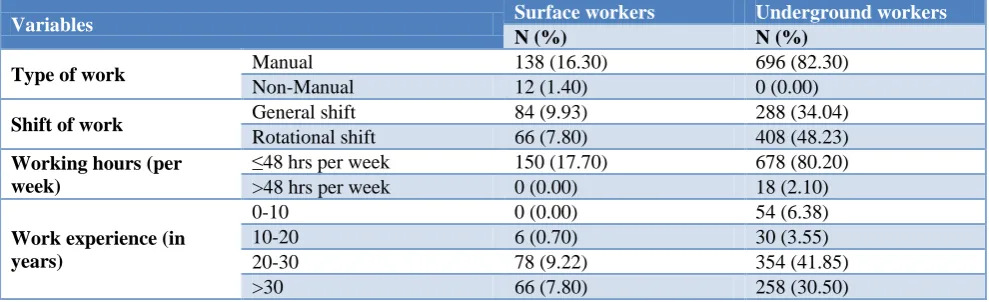
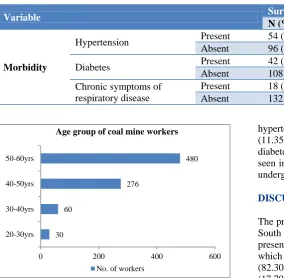
Out of 846 coal mine workers, who were included in the study, 480 (56.74%) workers belong to the age group of 50-60 yrs, 276 (32.62%) workers belong to age group 40-50 yrs, 60 (7.10%) workers belong to 30-40 yrs and 30 (3.54%) workers belong to age group 20-30 yrs as shown in Figure 1. Present study includes 696 underground mine workers and 150 surface workers as shown in Figure 2. According to the type of work done, all 696 (82.30%) underground workers perform manual work but out of the 150 surface workers, 138 (16.30%) perform manual work and 12 (1.40%) do non-manual work like the use of machinery. 408 (48.23%) workers out of 696 underground workers do rotational shifts (6 am-2 pm, 2 pm-10 pm & 10 pm- 6 am) and 288 (34.04%) workers does general shift (8 am-5 pm). Similarly, 66 (7.80%) workers and 84 (9.93%) workers who do work on the surface do rotational and general shifts respectively as shown in Table 1.
If we consider working hours per week, all 150 (17.70%) coal mine workers who are working on the surface are working for less than or equal to 48 hrs per week and among underground workers 678 (80.20%) are working for less than or equal to 48 hrs per week and remaining 12 (2.10%) workers are working for more than 48hrs per week. According to work experience, 354 (41.85%) of underground workers and 78 (9.22%) of surface workers had 20-30 yrs of work experience similarly 258 (30.50%) underground workers and 66 (7.80%) surface workers had greater than 30 year work experience as shown in Table 1.
Table 2 depicts that 222 (26.23%) workers had a habit of smoking of which 168 (19.85%) workers are underground workers and 54 (6.38%) are surface workers. Alcohol consumption is seen in 96 (11.35%) of surface workers and 480 (56.73%) of underground workers. There are 18 (2.12%) workers who were working on surface and 36 (4.25%) underground workers had a habit of smokeless tobacco intake.
Table 1: Working characteristics of coal mine workers.
Variables Surface workers Underground workers
N (%) N (%)
Type of work Manual 138 (16.30) 696 (82.30)
Non-Manual 12 (1.40) 0 (0.00)
Shift of work General shift 84 (9.93) 288 (34.04)
Rotational shift 66 (7.80) 408 (48.23)
Working hours (per week)
≤48 hrs per week 150 (17.70) 678 (80.20) >48 hrs per week 0 (0.00) 18 (2.10)
Work experience (in years)
0-10 0 (0.00) 54 (6.38)
10-20 6 (0.70) 30 (3.55)
20-30 78 (9.22) 354 (41.85)
Table 2: Habits of coal mine workers.
Variable Surface worker Underground worker
N (%) N (%)
Habits
Smoking Present 54 (6.38) 168 (19.85)
Absent 96 (11.35) 528 (62.42) Alcoholism Present 96 (11.35) 480 (56.73) Absent 54 (6.38) 216 (25.54) Smokeless tobacco intake Present 18 (2.13) 36 (4.25)
Absent 132 (15.60) 660 (78.01)
Table 3: Morbidity pattern of coal mine workers.
Variable Surface worker Underground worker
N (%) N (%)
Morbidity
Hypertension Present 54 (6.38) 108 (12.77) Absent 96 (11.35) 588 (69.50)
Diabetes Present 42 (4.96) 96 (11.35)
Absent 108 (12.77) 600 (70.92) Chronic symptoms of
respiratory disease
Present 18 (2.13) 222 (26.25) Absent 132 (15.60) 474 (56.02)
Figure 1: Age wise distribution of coal mine workers.
Figure 2: Coal mine workers according to their place of work.
Morbidity pattern of coal mine workers in the present study shows that 54 (6.38%) of surface workers and 108 (12.77%) underground workers are suffering from
hypertension. 42 (4.96%) of surface workers and 96 (11.35%) of underground workers are suffering from diabetes. Chronic respiratory symptoms of the disease is seen in 18 (2.13%) surface workers and 222 (26.25%) of underground workers as shown in Table 3.
DISCUSSION
The present study is conducted in one of the coal mine in South India. 846 coal mine workers out of 974 workers present in the coal mine were included in the study of which all are males. Out of 846 coal mine workers 692 (82.30%) are underground workers and remaining 150 (17.70%) are surface workers whereas in Considine et al study done Australia among 1457 coal mine workers there was 53.10% are surface or open cast workers and 46.90% were underground workers.7 In the present study, majority of workers 480 (56.74%) belongs to age group 50-60 yrs and 276 (32.62%) workers belong to age group 40-50 yrs and very less number of workers 90 (10.64%) are in between 20-40 yrs age group. There will more risk for 50-60 yrs age group workers as they work in hazardous environmental conditions, but in Considine et al out of 1457 workers study majority of workers 61.30% belong to age group 25-45 yrs where the risk comparatively less for this age group.7
Current study shows that all underground workers do manual work without using any machinery and 92% of surface workers does manual work and the remaining 8% does non-manual work using machinery. Most of the underground workers and small number of surface workers who are nearly 56.03% does work in rotational shifts and are more prone to sleep deprivation and shift work disorder which is slightly greater than Considine et 30
60
276
480
0 200 400 600
20-30yrs 30-40yrs 40-50yrs 50-60yrs
Age group of coal mine workers
No. of workers
696 150
Place of work
al study which is 49.10% of workers doing rotational shifts and 47.80% workers doing regular shifts.
80.20% of underground workers and 17.70% of surface, workers do work less than or equal to 48 hrs per week and only small portion of underground workers (2.10%) does work for more than 48 hrs per week who are more prone to physical and psychological stress in work by working overtime. Similarly in Yu et al study done in Shanxi, China among 540 workers 52.46% of workers out of 305 workers included in their study, work for more than 8hrs per day which is very high compared to our study were as in Considine study 86.5% of workers out of 1457 workers do work for more than 8 hrs per day which is very high compared to our study.7,8 The probable reason could be strict labor laws in India to work not more than 8hrs per day or 48 hrs per week.
According to work experience 51.07% (41.85% underground workers + 9.22% surface workers) workers are having experience of working for 20-30 yrs and 38.30% (30.50% underground workers + 7.80%) workers are having experience of working for more than 30 yrs which shows that these workers are more exposed to coal dust for a long period and are more prone for chronic diseases when compared to Rajashekar et al.9 A study was done in 493 mine workers where there are no workers who had work experience for more than 20yrs and there are only 4.40% of workers having work experience for 11-20 yrs who are very less compared to our study also in Considine et al study there are only 37.7% of workers having work experience for more than 10 yrs.7
In the current study, 26.23% (19.85% underground workers and 6.38% surface workers) of workers had a habit of smoking, 68.08% (56.73% underground workers and 11.35% of surface workers) had a habit of regular consumption of alcohol and 6.37% (4.25% underground workers and 2.12% surface workers) of workers had an habit of intake of smokeless tobacco which are the major risk factors causing chronic diseases. Percentage of smokers and alcohol consumption is more than national average which is 10.7% and 30% respectively which may be due to social and cultural differences probably rather than occupation alone.10,11 Smokeless tobacco intake is less than the national average which is almost nearly 24%.10 When compared with Yu et al study, our study shows a lesser percentage of smokers than their study which is 70.49% and a higher percentage of alcohol consumers which is 65.24%.8 Similarly in a study done by Rajashekar et alin which there are 34.1% of smokers and 41.4% of alcohol consumers.9 The percentage of smokeless tobacco intake in Rajashekar study was more than our study which is 34.9%.9 Other study done by Dhamodhar in 603 coal mine workers had 32.67% of smokers which is higher than our study and zero consumption of smokeless tobacco intake.12
Among 846 workers included in our study overall morbidity present with various chronic diseases were 55.3% which is slightly greater than morbidity level of opencast workers and lower than underground workers according to Bhelkar et al study.13 In present study prevalence of hypertension is 19.15% (12.77% and 6.38% in underground and surface workers respectively), the prevalence of diabetes is 16.31% (11.35% and 4.96% in underground and surface workers respectively) and the prevalence of symptoms of chronic respiratory disease is 28.38% (26.25% and 2.13% in underground and surface workers respectively). When compared to the national prevalence of hypertension and diabetes is 26.5% and 9.7% respectively,the current study has shown a higher prevalence of diabetes than national prevalence and showed a lesser prevalence of hypertension than national prevalence which may be probably due to other causes rather than occupational stress alone.14 Another study in Rajashekar et al prevalence of hypertension is 12% which is less than our study.9 In a study done by Nandi et al, on lignite workers shows the prevalence of hypertension and diabetes as 6.29% and 0.69% respectively.15 Also in the study done by Mawaw et al on 2749 mine workers shows the prevalence of hypertension and diabetes as 18.2% and 11.7% respectively.16 Prevalence of chronic respiratory symptoms in Bhelkar et al is lower than our study which is 21.56%.13 Prevalence of peptic ulcer in coal mine workers in our study shows 2.84% and which are seen only in an underground coal mine workers may be due to stress and irregular food habits which is lower than a study conducted by Zahorski et al among 9361 coal mine workers shows the prevalence of peptic ulcer disease as 7.92%.17
CONCLUSION
Coal mine workers are one of the special groups having greater work intensity than the general group of workers. 56.74% of workers belong to a 50-60 yrs age group who are more prone to physical hazards. 89.37% of workers had work experience more than 20 yrs who are exposed to coal dust chronically for more than 20yrs and more prone to chronic diseases. Percentage of coal mine workers who were smokers are 26.03%, alcoholics are 68.08% and smokeless tobacco intake is 6.37%. Prevalence of hypertension and diabetes in the current study is 19.15% and 16.31% respectively whereas the prevalence of chronic respiratory disease symptoms and peptic ulcers in coal mine workers is 28.38% and 2.84% respectively. Morbidity is more than the normal population hence health education is done among workers regarding chronic diseases and their risk factors.
ACKNOWLEDGEMENTS
Chalmeda Ananda Rao Institute of Medical Sciences, Karimnagar, Telangana. India.
Funding: No funding sources Conflict of interest: None declared
Ethical approval: The study was approved by the Institutional Ethics Committee
REFERENCES
1. Ishtiaq M, Hussain H, Gul S, Jehan N, Ahmad I, Masud K, et al. Frequency of occupational health problems among coal miners. Gomal J Med Sci. 2014;12:52-5.
2. Cho KS, Lee SH. Occupational health hazards of mine workers. Bull World Health Organization. 1978;56(2):205–18.
3. David R. Faces of coal. The Federation of American Coal, Energy and Security. 2009: 65-78.
4. Donoghue AM. Occupational health hazards in mining: an overview. Occupational Med. 2004;54:283-9.
5. National geographic. Robb Kendrick: Life in India’s coal mines. Available at: http://proof.national- geographic.com/2014/03/28/robb-kendrick-life-in-indias-coal-mines. Accessed on 3 January 2019. 6. The Singareni collieries company limited. About us
Available at: https://scclmines.com/scclnew/ company_about-us.asp. Accessed on 3 January 2019.
7. Considine R, Tynan R, James C, Wiggers J, Lewin T, Inder K, et al. The Contribution of Individual, Social and Work Characteristics to Employee Mental Health in a Coal Mining Industry Population. PLoS ONE. 2017;12(1):e0168445. 8. Yu HM, Ren XW, Chen Q, Zhao JY, Zhu TJ, Guo
ZX. Quality of life of coal dust workers without pneumoconiosis in Mainland China. J Occup Health. 2008;50:505-11.
9. Rajashekar S, Sharma P. Morbidity among mine workers: a cross sectional study in Chitradurga, Karnataka, India. Int J Community Med Public Health. 2017;4(2):378-84.
10. WHO. Global Adult Tobacco Survey. Fact sheet: GATS 2 Highlights, 2016-17; Available at https://www.who.int/tobacco/surveillance/survey/ga ts/GATS_India_2016-17_FactSheet.pdf. Accessed on 3 January 2019.
11. Mid-day.com. Alcohol consumption in India on the rise: WHO report, 2014. Available at: https://www. mid-day.com/articles/alcohol-consumption-in-india-on-the-rise-who-report/15299173. Accessed on 3 January 2019.
12. Dhamodhar D. Prevalence of Tobacco Consumption Among Coal Mine Workers in Neyveli Lignite Corporation, Cuddalore District, Tamil Nadu, India. J Global Oncol. 2018;4(2).
13. Bhelkar SM, Ughade SN, Thakre S, Jogdand G. A Comparative Study of Morbid Conditions amongst opencast and Underground Coal Miners. J Evol Med Dent Sci. 2015;4(7):1132-7.
14. Geldsetzer P, Manne-Goehler J, Theilmann M, Davies JI, Awasthi A, Vollmer S, et al. Diabetes and Hypertension in India:A Nationally Representative Study of 1.3 Million Adults. JAMA Int Med. 2018;178(3):363–72.
15. Nandi SS, Dhatrak SV, Chaterjee DM, Dhumne UL, Ingole SV. A study on morbidity profile of lignite miners in western India. International J Occupational Safety Health. 2015;5:14-6.
16. Mawaw PM, Yav T, Mukuku O, Lukanka O, MumbaKazadi P, Tambwe D. Prevalence of obesity, diabetes mellitus, hypertension and associated risk factors in a mining workforce, Democratic Republic of Congo. Pan Afr Med J. 2017;28:282.
17. Zahorski W, Marek K, Kujawska A. Epidemiological examinations for peptic ulcers in miners of pit-coal mines. I. Effect of socioeconomic factors. Med Pr. 1977;28(5):337-47.