Original Research Article
Development of diabetes register in low-mid income country VII:
summary of series
Ezekiel U. Nwose
1*, Eunice O. Igumbor
1, Otovwe Agofure
1, Phillip T. Bwititi
2, Echinei J.
Oshionwu
3, Alex Odufu
3, John N. Okuzo
3INTRODUCTION
Based on previous research on diabetes and cardiovascular complications, a translational program was envisioned and one perspective of the proposal focuses on Nigeria.1-4 This was because of the prevalence and
projected incidence being higher than the world’s average.4 It is known that some of the burdens or deaths
from cardio vascular diseases are preventable, especially since they are due to avoidable lifestyle risk factors such as unhealthy diet, physical inactivity and smoking.5 Four
years into the project, the vision to develop diabetes register was developed as an imperative.6
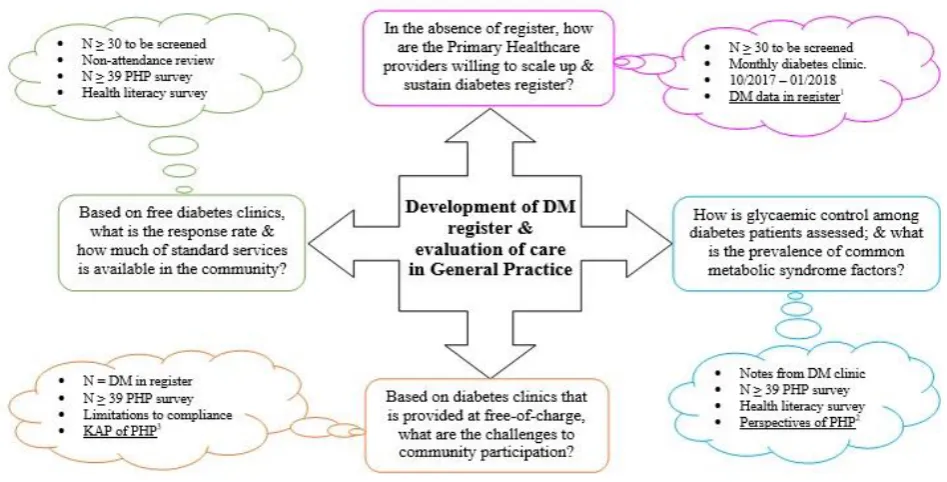
Thus, the add-on piece of project aimed to establish diabetes register and determine data collection on all aspects of the disease, completeness of documentation, standard of diabetes care inclusive of available service, and incidence rate. The levels of morbidity and mortality were also investigated. The agenda of background pilot is graphically presented below (Figure 1). For the purpose of this summarizing discuss, focus was on availability of contact details (phone and home addresses) that enable patient recall and extent of basic standard diabetes services as defined by the World Diabetes Foundation.
ABSTRACT
Background: This is a summarizing discussion of the series. Six pieces of articles have been presented including two pilot studies and survey of the perception of healthcare professionals. The other four presented case observations from the different levels of health facilities.
Methods: In this summary, a comparison between the four grades of facilities is presented with focus on completeness of patients’ contact details and clinical information regarding basic anthropometric data that can be easily collected anywhere.
Results: It shows evidence that capacity and scope of diabetes services are in tandem i.e., least at the primary level and most at the tertiary facility. It also shows albeit anecdotal that the private general practices may be doing best in what they have capacity to do.
Conclusions: The capacity for diabetes service in all tiers of the healthcare system. The need to advocate for diabetes register as a means to improve quality of service is highlighted.
Keywords: Blood pressure, Body mass index, Diabetes register, Medical records, Patient follow-up
1Department of Public and Community Health, Novena University, Nigeria 2Biomedical Sciences, Charles Sturt University, NSW, Australia
3GMRDO group; Catholic Hospital Abbi, Delta State, Nigeria
Received: 16 October 2019
Revised: 28 November 2019
Accepted: 03 December 2019
*Correspondence:
Dr. Ezekiel U. Nwose, E-mail: [email protected]
Copyright: © the author(s), publisher and licensee Medip Academy. This is an open-access article distributed under the terms of the Creative Commons Attribution Non-Commercial License, which permits unrestricted non-commercial use, distribution, and reproduction in any medium, provided the original work is properly cited.
Figure 1: Summary of pilot plan.
METHODS
Study design
This was a purposive observational descriptive study.
Study setting
All the three tiers of private and public hospitals in Delta State Nigeria (Table 1). Similar to the work of other authors; this was in order to evaluate the capacity to develop and sustain diabetes register in different healthcare facility settings of low-mid income country.7
Selection criteria
In all the case settings, only patients identified as diagnosed and living with diabetes were selected for entry vis-à-vis inclusion onto the diabetes register.
Data collection
Sampling methods and procedure involved development of diabetes registers with simultaneous audit of medical records. First, at the Catholic hospital Abbi (CHA), the Australian diabetes register proforma was adopted and edited together with the medical team including resident medical officer, nursing matron, laboratory and medical records personnel as well as hospital administrator. Considering applicability to Nigeria, 44 pieces of clinical and demographic information were selected to be put into Excel sheet on computer. Afterwards, the scaling up study involved audit of screening program at the hospital as briefly described for the various pieces of the series. At the public hospitals, medical records were audited and clinic attendees followed-up to identify diabetes cases. All data collection in this series of work occurred during October 2017-February 2019.
Table 1: Settings of the health facilities where works were performed tier level.
Management The facility setting Geographical type
Primary Government Ogume Primary Health Care Rural
Non-governmental Novena University Health Centre Rural
Secondary
Government General Hospital Obiaruku Suburban Non-governmental Catholic hospital Abbi Rural
Donak Hospital Kwale Suburban
Tertiary Government Eku Baptist Government Hospital Suburban
Statistical analysis
The data were entered into the register and evaluated, descriptively.
being developed. At the other facilities, diabetes patients were identified from medical records or our diabetes screening follow-up.
RESULTS
Firstly, a remarkable opportunistic observation was in March 2018 when a non-governmental organization (NGO) organized medical screening in collaboration with our research team at Catholic hospital Abbi. One hundred lipid profile tests were performed, but by the time test reports were ready, there were no patients’ files to associate and enter the results. One year running, tracing of patients is still going.
Secondly, at the public hospitals, approximately 52% of the 44 itemized information are being collected, of which completeness of data/documentation was as low as 3%. Otherwise zero in many of the items. Blood pressure assessment was done on 70% of patients, while height and weight of patients for body mass index (BMI) assessment was done only on 16% of patients at the secondary facility (Figure 2).
Figure 2: Percentage of blood pressure and BMI monitoring among patients in the records.
Lifestyle regimen monitoring was not documented (if assessed). Capability for standard service (including foot, lipid profile, renal and retinal assessment) was available at the tertiary health facility i.e., for referral from other hospitals. Neither incidence nor morbidity and mortality rate could be definitively ascertained.
A total of ‘n=295’ files were audited across the four facilities. The private practice performed best in completeness of contact details documentation (96%) and recall capacity 91% of patients through their phones. This is followed sequentially by the tertiary, secondary and primary healthcare facilities (Figure 3).
Figure 3: Available contact details in medical records.
It was observed at one of the health facilities that 62/93 patients missed blood sugar tests, out of which 29% had missing phone numbers. This implies 71% of the patients could be follow-up by phone. In terms of complications, the tertiary facility performs best, as expected, with evidence of eye and foot examinations. However, there was indication of absolute failure to assess obesity/BMI of the patients, except at the secondary facility with 16% record. One intriguing observation is that capabilities for lipid profile assessment are available, but yet to be performed on any of the clients among the records audited (Table 2).
Table 2: Complications monitoring rate in the health facilities among records audited.
Private GP (%) Primary (%) Secondary (%) Tertiary (%) Average (%)**
Lipid profile 0 0 0 0 0
Retinal exam 0 0 0 3 1
Foot exam 0 0 0 16 4
Average (facility)* 20 9 13 21 16
*: Including levels of blood pressure and BMI shown on Figure 2; **: Cross-sectional average.
DISCUSSION
The focus of this summarizing discuss is to articulate: firstly the availability of contact details (phone and home addresses) that enable patient recall, and secondly the
extent of basic standard diabetes services as defined by the World Diabetes Foundation. This report highlights poor adherence to diabetes care practices by stakeholders, including NGOs that run medical programs at health facilities. It underscores the need to improve the quality
Blood pressure Obesity (BMI) 100%
0% 45%
0% 47%
16% 87%
0% 70%
4% Private practice Primary healthcare
Secondary care Tertiary care
Average
100%
0%
65%
86% 98%
19%
100% 91%
91%
38%
54%
79%
0% 20% 40% 60% 80% 100% 120%
Private practice
Primary care Secondary care
Tertiary care
of data vis-à-vis documentation that enables prediction of diabetes epidemiology, especially in rural areas.
The opportunistic observation indicates where NGO may run health fair and leave no record of participants at the health facility. There has been debate over ethics of health fair services.8-12 The core concern of the
proponents of ethical oversight borders on failure of companies and hospital systems to inform potential consumers all that they need to know in advertisement-driven fairs.13 Perhaps the need to go a bit beyond
‘ticking the box’ in ethical compliance,9 and think
follow-up.14,15
On the first main objective of this discourse, quality of medical records is found to be poor in rural low and middle-income countries due to limited resources. However, abysmal 4% of accessible data being the average of patients with complete documentation indicate an issue of lapse in diabetes care practice. In particular, some of the health facilities are not collecting data to manage obesity, at least in the case files audited (Figure 2). Also, there is capacity to perform lipid profile tests (even if by referral to reference laboratories), but none of the audited patients’ case files has a result (Table 2). The importance of improved medical record system cannot be overemphasized and has been hallmarked by development of electronic medical record system.16,17
Suffice to say that challenges as well as relevance to diabetes services are also known.18 Therefore, this report
advance a measure of community needs assessment from research sites in Delta State Nigeria; and advocates developing diabetes register that constitutes application of known idea to address the issue.
With regards to the second objective bordering on “basic standard diabetes services as defined by the World Diabetes Foundation” private general practice seems to perform better than public in what they have capacity to do – e.g., blood pressure assessment (Figure 2); and documentation of contact details that would enable patient follow up (Figure 3). The present level of information technology has equipped the global diabetes society with plethora of management apps. Beside the capacity to follow-up a patient by phone, it is pertinent to advocate that lifestyle with mobile phone, including the reminders and task planner capacities, can be integrated into diabetes self-management plans. This report advances the discourse on chronic disease care model, as well as translating knowledge attitude and practice to improve diabetes self-management.19-22 The observations
reported in this series underscore the need to advocate establishment of diabetes register as a means to improve clinical data collection and diabetes care at all levels of healthcare.23-26
CONCLUSION
Standard protocols need to be entrenched through the use of diabetes register to improve care including assessment
and documentation of accessible and affordable tests. Healthcare personnel should be given continuous educational updates including the importance of patients’ follow-up, especially using the phone. The situation is more daring where medical records are missing and/or some clinical assessments need to be completed. This underlies the need to develop proposal for healthcare service improvement, especially diabetes care.
Funding: No funding sources Conflict of interest: None declared
Ethical approval: The study was approved by the Institutional Ethics Committee
REFERENCES
1. Nwose EU, Jelinek HF, Richards RS, Kerr PG. Erythrocyte oxidative stress in clinical management of diabetes and its cardiovascular complication. Br J Biomed Sci. 2007;64:35-43.
2. Nwose EU, Richards RS, Cann NG, Butkowski E. Cardiovascular risk assessment in prediabetes: A hypothesis. Med Hypotheses. 2009;72:271-5. 3. Nwose EU, Jelinek HF, Richards RS, Kerr PG. The
'vitamin E regeneration system' (VERS) and an algorithm to justify antioxidant supplementation in diabetes--a hypothesis. Med Hypotheses. 2008;70:1002-8.
4. Nwose EU, Richards RS, Digban K, Bwititi PT, Ennis G, Yee KC, et al. Cardiovascular risk assessment in prediabetes and undiagnosed diabetes mellitus study: International collaboration research overview. North Am J Med Sci. 2013;5:625-30. 5. Oguoma VM, Nwose EU, Bwititi PT.
Cardiovascular disease risk prevention: preliminary survey of baseline knowledge, attitude and practices of a Nigerian rural community. North Am J Med Sci. 2014;6:466-71.
6. Nwose EU, Richards RS, Bwititi PT, Igumbor EO, Oshionwu EJ, Okolie K, et al. Prediabetes and cardiovascular complications study (PACCS): international collaboration 4 years' summary and future direction. BMC Res Notes. 2017;10:730. 7. Khan L, Mincemoyer S, Gabbay RA. Diabetes
registries: where we are and where are we headed?. Diabetes Technol Ther. 2009;11:255-62.
8. Borror K, Carome M, McNeilly P, Weil C. A review of OHRP compliance oversight letters. IRB. 2003;25:1-4.
9. Taylor HA. Moving beyond compliance: measuring ethical quality to enhance the oversight of human subjects research. IRB. 2007;29:9-14.
10. Keller DL. Ethics of commercial screening tests. Ann Intern Med. 2013;158:499-500.
11. Wallace EA, Schumann JH, Weinberger SE. Ethics of commercial screening tests. Ann Intern Med. 2012;157:747-8.
13. Wallace EA, Schumann JH, Weinberger SE. Direct-to-consumer screening companies--reply. JAMA. 2015;313:202-3.
14. Bramante CT, Song J. Follow-up after a health fair. The virtual mentor: VM. 2012;14:422-5.
15. Squiers JJ, Purmal C, Silver M, Gimpel N. Community health fair with follow-up. Med Educ. 2015;49:526-7.
16. Nwose EU. Implementing an electronic medical record system - success, failures, lessons. Aust J Med Sci. 2008;29:21.
17. Levy S. Implementing an electronic medical record system: successes, failures, lessons. Available at: http://www.rcn.org.uk/development/communities/rc n_forum_communities/information_in_nursing_gro up/resources/bookreviews/implementing_an_electro nic_medical_record_system_successes,_failures,_les sons 2011. Accessed 12th March 2019.
18. Boyle DIR, Versace VL, Dunbar JA, Scheil W, Janus E, Oats JJN, et al. Results of the first recorded evaluation of a national gestational diabetes mellitus register: Challenges in screening, registration, and follow-up for diabetes risk. PloS One. 2018;13:e0200832.
19. Stellefson M, Chaney B, Barry AE, Chavarria E, Tennant B, Walsh-Childers K, et al. Web 2.0 chronic disease self-management for older adults: a systematic review. J Med Internet Res. 2013;15:35. 20. Ghannadi S, Amouzegar A, Amiri P, et al.
Evaluating the effect of knowledge, attitude, and practice on self-management in type 2 diabetic patients on dialysis. J Diabetes Res. 2016;2016:3730875.
21. Powers MA, Bardsley J, Cypress M, Duker P, Funnell MM, Fischl AH, et al. Diabetes
self-management education and support in type 2 diabetes: A joint position statement of the American Diabetes Association, the American Association of Diabetes Educators, and the Academy of Nutrition and Dietetics. Clin Diab. 2016;34:70-80.
22. Hollis M, Glaister K and Lapsley JA. Do practice nurses have the knowledge to provide diabetes self-management education?. Contemp Nurse. 2014;46:234-41.
23. Pierce M, Agarwal G, Ridout D. A survey of diabetes care in general practice in England and Wales. Br J Gen Pract. 2000;50:542-5.
24. Cook JA. Using a diabetes register to improve care and outcomes. Collaborative support Programs of New Jersey Wellness Symposium: Diabetes preventtion and wellness self-management. Edison, NJ; 2012.
25. Brinks R, Hoyer A, Landwehr S. Surveillance of the Incidence of Non-Communicable Diseases (NCDs) with Sparse Resources: A Simulation Study Using Data from a National Diabetes Registry, Denmark, 1995-2004. PLoS One. 2016;11:e0152046.
26. Health Service Executive. Setting up a diabetes register using GP practice management system. Available at: https://www.hse.ie/eng/health/hl/ living/diabetes/Diabetesregister.html. Accessed 01 October 2019.