Original Research Article
Knowledge, attitude and practices of hand hygiene among nurses and
nursing students in a tertiary health care center of Central India:
a questionnaire based study
Abhishek Mehta, Kiran Tripathi*
INTRODUCTION
Health care associated infections is an evolving problem globally and is being perceived as a serious threat to the health care system.1-3
It is well evident that most often nursing care requires direct or close contact with the patients which serve as a channel for the transfer of pathogens if proper hand hygiene is not followed. Most of the health care associated infections (HCAIs) are acquired via the contaminated hands of health care workers (HCWs).
Effective hand hygiene practices are simplest proven instrument in reducing prevalence of HCAI. But most of the HCWs do not adhere to hand hygiene recommendations.1,2,4-6
Guidelines for hand hygiene practices have been issued by World Health Organisation (WHO) and centers for disease control and prevention (CDC), Atlanta but lack of awareness amongst HCWs result in poor compliance which could have serious after effects on a health care system. Adherence to standard guidelines could be determined by level of awareness, threat perceptions,
ABSTRACT
Background: Health care associated infections and emerging multi drug resistance in nosocomial pathogens is perceived as a serious public health threat with grievous concerns. Hand hygiene if practiced properly is cheapest, simplest and most effective tool in tackling this problem. The objective of this study was conducted to assess levels of knowledge, attitude and practice in various aspects of hand hygiene in nurses and nursing students in the study area for identifying gaps for planning necessary corrective measures.
Methods: A cross sectional study involving self-administered pre-structured anonymous questionnaires administered to 50 staff nurses and 80 nursing students posted at a tertiary health care center of Central India. Z test of proportions was used to compare the percentages for each of the appropriate responses between the two study groups.
Results: Most of the study participants exhibited moderate levels of knowledge and practice with marginal difference between two study groups. While nursing students were found to exhibit a remarkably higher level of attitude than staff nurses, difference being statistically significant.
Conclusions: This study stresses upon the growing need for prompt interventions at institutional level for addressing the gaps evident from the study.
Keywords: Knowledge, Attitude, Practice, Nurses, Nursing students, Hand hygiene, Questionnaire, Health care associated infections
Department of Microbiology, Government Medical College, Datia, Madhya Pradesh, India
Received: 19 September 2019
Revised: 14 November 2019
Accepted: 16 November 2019
*Correspondence:
Dr. Kiran Tripathi,
E-mail: [email protected]
Copyright: © the author(s), publisher and licensee Medip Academy. This is an open-access article distributed under the terms of the Creative Commons Attribution Non-Commercial License, which permits unrestricted non-commercial use, distribution, and reproduction in any medium, provided the original work is properly cited.
individual’s attitude, availability of resources, workload and work culture.2,6-8
To formulate a proper strategy to minimize HCAI it is very important to assess the level of adherence to standard hand hygiene practices and factors resulting in poor compliance could be accordingly dealt with.
Nursing students are considered as the health care workers in training. As they have direct contact with patients during their clinical posting, they can also serve as vehicles of cross-contamination within the hospital. Nursing instructors should train students in appropriate hand hygiene practices during clinical postings, for improving the compliance. Assessing the factors affecting hand hygiene compliance in nursing students also provide a chance to address any gaps in knowledge and practices before the students complete their course and enter into the medical community.6,9
Under the light of above facts, the current questionnaire based study was planned and undertaken in order to assess knowledge, attitude and practices of staff nurses and nursing students regarding hand hygiene at a tertiary care teaching hospital of Central India.
METHODS
This questionnaire based cross sectional study was carried out to assess knowledge, attitude, and practices (KAP Survey) of staff nurses and nursing students of Government Medical College and associated District Hospital, Datia, Madhya Pradesh from October to November 2018 after obtaining clearance from Institutional ethics committee. The content, purpose, scope and nature of the study was very well explained to both target groups and they were told that participation was voluntary, and that their responses were anonymous. Only those who volunteered to participate were included in the study after obtaining informed consent.
A total of 130 subjects (50 staff nurses and 80 nursing students) were targeted for the study through convenience sampling. A self-administered pre structured anonymous questionnaire was administered to each participant. Whenever the subjects felt difficulty in understanding the questions their doubts were cleared and questions were explained properly.
Questionnaire was designed on the basis of related relevant literature.2-4,7,10 Questions were checked for their relevance, clarity, understandability and necessary changes were made to make them simple and easily understandable in order to improve the face validity of the questionnaire before their final use in the survey.
Questionnaires don’t reveal any personal identification details of participants and confidentiality was maintained in this regard.
Questionnaire consisted of total 66 questions divided in four parts:
Demographic information (six questions).
Assessment of knowledge (27 questions).
Assessment of attitudes/perceptions (20 questions).
Assessment of practices (13 questions).
Knowledge was assessed using 27 questions which included MCQs (multiple choice questions) and yes/no type questions.
Attitudes/beliefs were assessed on the basis of 20 questions and practices on the basis of 13 questions where the respondents have the choice to give their opinion on a 1 to 5 point Likert scale ranging from strongly agree to strongly disagree for attitude and from never to always for assessing practices.
Assessment of knowledge, attitudes and practices was done on the basis of a scoring system where 1 point was given for each correct response to knowledge, positive attitude and correct practices; 0 was given for incorrect knowledge, negative attitude and puny practices. For each of the three sections, a score of 75% and above was considered good, 50-74% as moderate and below 50% as poor.
Statistical analysis
Tabulation and compilation of data was done using Microsoft Excel 2010 software. Appropriate statistical tools were used as per requirement. Z test of proportions was used to compare the percentages for each of the appropriate responses between the two study groups. P value of 0.05 was considered as statistically significant. Mean scores of the knowledge, attitudes and practices of the two study groups were compared using paired t test and the significance level was set to 0.05.5,7,11,12
RESULTS
Out of total 130 participants (50 nurses and 80 nursing students) 97% were females. Only 40% of all participants (52) claimed to have received a formal training in hand hygiene practices. All nursing students and 50% of staff nurses participating in the study were in 19-25 yrs age group. While 44% of nurses were in 26-35 yrs. group and only 6% in 36-45 yrs age group.
Knowledge on hand hygiene
Out of 27 questions asked, significant difference in knowledge levels between the two study groups was seen
in only eight questions (Table 1).
Table 1: Comparison of knowledge between nurses and nursing students regarding hand hygiene.
Question/Item Nurses
(n=50)
Nursing students
(n=80) P value
N % N %
Which of the following is the main route of transmission of harmful germs between patients? (health-care worker’s hands when not clean)
37 74 58 46.4 *0.002
What is most frequent source of germs responsible for health care associated infections (germs already present on or within the patient)
20 40 18 22.5 *0.0328
According to WHO how many steps of hand washing do
you know? 20 40 24 30 NS
What is the minimum time needed for alcohol based hand
rub to kill most germs on your hands? (20 sec.) 17 34 20 25 NS The most appropriate timing for Hand hygiene to prevent transmission of germs to patients
Before touching a patient 49 98 77 96.25 NS
Immediately after a risk of body fluid exposure 45 90 69 86.25 NS
Immediately before a clean/aseptic procedure 45 90 60 75 *0.0348
After exposure to the immediate surroundings of a patient 18 36 24 30 NS
The most appropriate timing for hand hygiene to prevent transmission of germs to health care workers?
After touching a patient 48 96 75 93.75 NS
Immediately after a risk of body fluid exposure 45 90 70 87.5 NS
Immediately before a clean/aseptic procedure 24 48 32 40 NS
After exposure to the immediate surroundings of a patient 38 76 72 90 *0.0314
Which of the following statements on alcohol based hand rub and hand washing are true?
Hand rubbing is more rapid for hand cleansing than hand
washing (true) 41 82 64 80 NS
Hand rubbing causes skin dryness more than hand washing
(false) 23 46 18 22.5 *0.005
Hand rubbing is more effective against germs than hand
washing (false) 23 46 27 33.75
NS
Which type of hand hygiene method is required in the following situations?
Before palpating abdomen (rubbing) 30 60 29 36.25 *0.0081
Before giving an injection (rubbing) 32 64 24 30 **0.0001
After emptying a bed pan (washing) 42 84 64 80 NS
After removing examination gloves (rubbing / washing) 35 70 58 72.5 NS
After making a patient’s bed (rubbing) 8 16 10 12.5 NS
After visible exposure to blood (washing) 42 84 58 72.5 NS
Which of the following should be avoided as associated with increased likelihood of colonization of hands with harmful germs?
Wearing jewellery (Yes) 40 80 60 75 NS
Damaged skin (Yes) 42 84 56 80 NS
Artificial fingernails (Yes) 44 88 67 83.75 NS
Regular use of a hand cream (No) 34 68 39 48.75 *0.0314
If hands are not visibly soiled/contaminated which method is most effective for reducing number of pathogenic bacteria on the hands of personnel (applying 1.5 ml to 3 ml of ABHR to the hands & rubbing hands together until dry)
14 28 16 20 NS
Which of the following hand hygiene actions prevents infection of the patient by his/her own germs? (hand hygiene immediately before an aseptic procedure)
48 96 78 97.5 NS
Table 2: Comparison of positive attitudes between nurses and nursing students regarding hand hygiene.
Question/Item Nurses
(n=50)
Nursing students (n=80)
P value
N % N %
Every HCW should have sufficient knowledge and training
about hand hygiene 45 90 77 96 NS
Correct hand hygiene practices should be adhered at all times 32 64 59 73.75 NS
Following hand hygiene is difficult in case of emergencies 05 10 20 25 *0.0348
Wearing gloves reduce the need for hand hygiene 28 56 32 40 **0.0007
I feel uncomfortable when others omit hand hygiene 15 30 44 55 *0.0053
I feel guilty when I omit hand hygiene 30 60 64 80 *0.0132
I am reluctant to ask others to engage in hand hygiene 10 20 36 45 *0.0024
Hand hygiene practices should be an acquired personal habit in
life 47 94 75 93.75 NS
Hand hygiene should be a part of the curriculum for
paramedical students 45 90 80 100 *0.0039 It is gross negligence not to perform hand hygiene practices 44 88 78 97.5 *0.0283
Hand hygiene is an essential part of my role 42 84 72 90 NS
I feel disappointed if my supervisors don’t implement hand
hygiene policy 25 50 56 70 *0.0221
I have sufficient knowledge to properly practice hand hygiene 40 80 36 45 **<0.0001
Adhering to hand hygiene practices is easy in the current set up 20 40 40 50 NS
I practice hand hygiene only in presence of my
colleagues/supervisors 35 70 48 50 *0.0247 I feel safe and secure from getting any infection after practicing
hand hygiene 30 60 69 86 **0.0007
Sometimes I miss out hand hygiene simply because I forget it 20 40 40 50 NS
Sometimes I had more important tasks to do than hand hygiene 21 42 48 60 *0.0454
I have the capability to curb poor practices in my work place 25 50 20 25 *0.0036
Proper hand hygiene practices can reduce medical costs associated with hosp. acq. infections and can reduce patient’s mortality
47 94 77 96 NS
Significance calculated using Z-test of proportions. *p<0.05 (significant), **p<0.001 (highly significant), p>0.05 (NS: not significant).
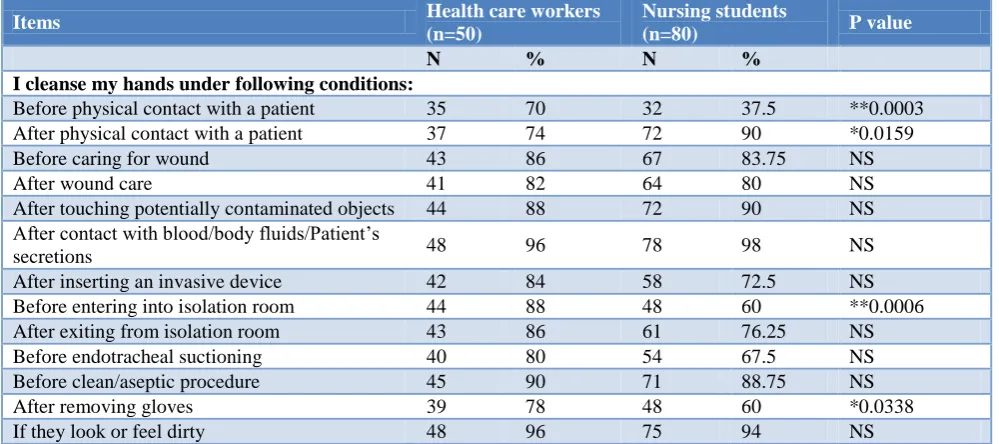
Table 3: Comparison of good practices between health care workers and nursing students regarding hand hygiene.
Items Health care workers
(n=50)
Nursing students
(n=80) P value
N % N %
I cleanse my hands under following conditions:
Before physical contact with a patient 35 70 32 37.5 **0.0003
After physical contact with a patient 37 74 72 90 *0.0159
Before caring for wound 43 86 67 83.75 NS
After wound care 41 82 64 80 NS
After touching potentially contaminated objects 44 88 72 90 NS After contact with blood/body fluids/Patient’s
secretions 48 96 78 98 NS
After inserting an invasive device 42 84 58 72.5 NS
Before entering into isolation room 44 88 48 60 **0.0006
After exiting from isolation room 43 86 61 76.25 NS
Before endotracheal suctioning 40 80 54 67.5 NS
Before clean/aseptic procedure 45 90 71 88.75 NS
After removing gloves 39 78 48 60 *0.0338
If they look or feel dirty 48 96 75 94 NS
Attitudes on hand hygiene
The nursing students had significantly better attitude than nurses in terms of hand hygiene. 62% of nurses and 45% of nursing students showed moderate attitude. Good attitude level was seen in 50% of nursing students and 20% of nurses. 18% of Nurses and only 5% nursing students showed poor attitude. Out of 20 questions asked for assessing attitude, a significant difference in attitude levels between two study groups was seen in 13 questions (Table 2).
Practices of hand hygiene
Most of nurses (74%) and nursing students (74.5%) showed moderate level of correct practices of Hand hygiene. While poor level of practices was seen in 8% of staff nurses and 11.25% of nursing students. Regarding good practices staff nurses were ahead of nursing students by a margin of 3.75%. There were significant differences in level of practices between two study groups regarding cleansing hands before and after physical contact with a patient, before entering into isolation room and after removing gloves (Table 3).
DISCUSSION
The knowledge level on hand hygiene was almost same i.e., moderate in both study groups with no significant difference. The nursing students had significantly better attitude than nurses in terms of hand hygiene. Good attitude level was seen in half of nursing students and only 20% of nurses. Most of nurses and nursing students (75%) showed moderate level of correct practices in hand hygiene.
Most of the nurses (78%) and nursing students (75%) showed moderate levels of knowledge regarding different aspects of hand hygiene. Similar findings were reported in a number of studies conducted in the recent past.
3-5,7,13,14
In this study 16% of nursing students showed poor levels of knowledge, the same was reported in only 6% of Staff nurses. Only 40% of study participants had received formal training in hand hygiene in any form and 26% of respondents showing good level of knowledge in this study had received such training in recent past. This shows the importance and growing need for such sensitization programmes to increase the level of knowledge among nursing staff as a strategic move for increasing compliance to hand hygiene practices.
In our study a majority of staff nurses (74%) correctly opined that the unclean hands of health care worker were the main route of transmission of harmful germs between patients. Our finding is in agreement to other studies by Zakeri et al (79.3%), Shinde et al (75%), Maheshwari et al (75%), Nair et al (76.2%) and Ariyaratne et al (72.4%).3,4,7,14,15
Most of the respondents (80%) found Hand rubbing to be more rapid for hand cleansing than hand washing but majority carried wrong notions like hand rubbing being more effective against germs than hand washing and former causing more skin dryness than later. This finding is in accordance with other studies (Mahmood et al, Ariyaratne et al, Nair et al).4,7,13
In this study, only 46.4% of nursing students were able to tell the main route of cross transmission of germs which is similar to the study by Zakeri et al and in contrast with other studies by Ariyaratne et al (73.1%), Nair et al (76.2%), Nawab et al (73.8%), Shinde et al (76%).5,4,7,14,15 Most of the study participants were not able to tell the most frequent source of germs responsible for health care associated infections. Only 40% of nurses and 22.5% of nursing students were able to answer this correctly which is in agreement with the studies conducted by Shinde et al, Nair et al.4,14
More than half of the participants were not able to answer the questions regarding steps of hand washing and minimum time required for alcohol based hand rub to kill most of the germs. Similar findings were reported by previous studies by Maheshwari et al, Shinde et al, Khaled et al, Nair et al and Gunasekara et al.3,4,7,14,16 The nursing students had significantly better attitude than nurses in terms of hand hygiene.74% of nursing students and 64% of nurses strongly agreed that correct hand hygiene practices should be adhered to at all times. Similar findings were reported in other studies too.3,4,7 It is good to know that 80% of nursing students in this study felt guilty on omitting hand hygiene which is comparable to similar study by Nawab et al (83%) but was higher than other studies by Ariyaratne et al (69%), Nair et al (69%), Shinde et al (68%).4,7,14
But only 60% of nurses felt so in this study which was higher than other studies by Aledilah et al (33%), Shinde et al (39%), but lower than a study by Nawab et al.5,12,14 As evident from this study one of the most important reason for missing hand hygiene in routine health care is simply forgetfulness to do so. Similar findings were seen in other studies (Hussain et al, Pittet et al, Larson et al). Forgetfulness factor can be dealt by displaying posters on walls, Sensitisation programmes, CMEs and regular onsite and offsite training sessions.11,17,18
In a similar study by Aledielah et al most of the Nursing students found it difficult to attend hand hygiene courses/workshop due to time pressure. So, rather than conducting separate training programmes on Hand hygiene it will be far better to incorporate the hand hygiene practices more comprehensively into the course curriculum itself.12
Most of the study participants felt that following hand hygiene is difficult in case of emergencies. Similar finding was reported in studies conducted by Maheshwari et al, Nair et al, Ariyaratne et al, Shinde et al, Nawab et al, Aledeilah et al. Whenever health care providers are busy in emergency sevices, they are more likely to omit hand hygiene if proper facilities are not easily accessible to them which is not possible without institutional support. 3-5,7,12,14
It is a very well established fact that Hand hygiene if practiced properly in a health care system is most important infection control measure in curbing health care associated infections.20
Though it is very effective, simple and much publicized measure, still awareness level, compliance rates and adherence to proper hand hygiene practices is reported to be unsatisfactorily low in the health care workers as evident from number of studies in the recent past.
Knowledge on hand hygiene is considered as a predictor of good hand hygiene practices. Instilling correct knowledge and attitude towards hand hygiene among the nursing students can play a major role in ensuring compliance to good practices among the future health care providers. It is imperative to address the gaps in knowledge during training sessions to nurture better hand hygiene practices.5
Assessing the factors affecting hand hygiene adherence provide a chance to address any gaps in knowledge and practices and help in formulating strategy and necessary interventions for minimizing the risk of health care associated infections to health care workers as well as patients.
An important limitation of this study is using self-administered questionnaires to assess the levels of practice among the respondents. Although self-reporting may be the simplest, easiest and less time consuming but there is always a risk of bias on the part of respondent who will intend to report better practice than what they actually do.
CONCLUSION
There is a need to raise the awareness about hand hygiene practices among HCWs to minimize HAIs. The study highlights the need for improving the existing hand hygiene training programs to address the gaps in knowledge, attitude and practices. It will be better to
incorporate it in the course curriculum of nursing students.
We recommend monitoring and periodic surveillance of hand hygiene practices under strict supervision so that necessary corrective measures can be taken promptly to fulfill the deficits.
Hospital authorities should ensure adequate availability of resources and easy access to hand hygiene facilities including water, soap, tissue papers, hand rubs, sanitizers etc. as any deficit of resources and facilities could be a major deterrent in implementing hand hygiene policy. It is recommended a quantitative measure of hand hygiene facilities be done for planning better access to the available resources.
A multi-pronged approach of availing resources/facilities, sensitization, regular training sessions, educational and motivational activities should be adopted for improving hand hygiene compliance.
Funding: No funding sources Conflict of interest: None declared
Ethical approval: The study was approved by the Institutional Ethics Committee
REFERENCES
1. Nabavi M, Alavi-Moghaddam M, Gachkar L, Moeinian M. Knowledge, Attitudes, and Practices Study on Hand Hygiene Among Imam Hossein Hospital’s Residents in 2013. Iran Red Crescent Med J. 2015;17:e19606.
2. Kudavidnange BP, Gunasekara TDCP, Hapuarachchi S. Knowledge, attitudes and practices on hand hygiene among ICU staff in Anuradhapura Teaching hospital. Anuradhapura Med J. 2011;1:29 -40.
3. Maheshwari V, Kaore NCM, Ramnani VK, Gupta SK, Borle A, Kaushal R. A Study to Assess. Knowledge and Attitude Regarding Hand Hygiene amongst Residents and Nursing Staff in a Tertiary Health Care Setting of Bhopal City. J Clin Diag Res. 2014;8:4-7.
4. Nair S, Hanumantappa R, Hiremath S, Siraj MA, Raghunath P. Knowledge, Attitude and Practice of Hand Hygiene among Medical and Nursing Students at a Tertiary Health Care Centre in Raichur, India. ISRN Prev Med. 2014;1-4.
5. Nawab T, Mehnaz S, Abedi AJ, Safwi SR, Khalique N, Ansari MA, et al. KAP study of hand hygiene among medical and nursing students in a tertiary teaching hospital. Int J Sci App Res. 2015;2:29-39. 6. Cruz JP, Bashtawi MA. Predictors of hand hygiene
practice among Saudi nursing students: Across-sectional self-reported study. J Inf Pub Health. 2016;9:485-9.
SSN. Knowledge, attitudes and practices of hand hygiene among final year medical and nursing students at the University of Sri Jayewardenepura. Sri Lankan J Infec Dis. 2013;3:15-25.
8. Li Y, Wang Y, Yanb D, Rao CY. Self-reported hand hygiene practices, and feasibility and acceptability of alcohol-based hand rubs among village healthcare workers in Inner Mongolia, China. J Hosp Inf. 2015;90:338-43.
9. Karadag M, Iseri OP, Yildirim N, Etikhan I. Knowledge, Beliefs and Practices of Nurses and Nursing Students for Hand Hygiene. Jundishapur J Health Sci. 2016;8:1-7.
10. WHO Guidelines on Hand Hygiene in Health Care First Global Patient Safety Challenge Clean Care is Safer Care (2009). Available from: http://whqlibdoc.who.Int/publications/2009/
9789241597906_eng.pdf. Accessed on 1st September 2018.
11. Hussein K, Dessouki E, Hassane SMA. Awareness and application of hospital infection control measures among healthcare professionals in the hospitals of an urban area in El- Minia governorate. Int J Adv Res. 2018;6:516-22.
12. Aledeilah RD, El-Fetoh ANM, Albaker AF. Assessment of Knowledge, Attitude and Practice of Hand Hygiene among Health Care Workers in Arar City, Saudi Arabia. The Egyp J Hosp Med. 2018;70:491-8.
13. Mahmood SE, Verma R, Khan MB. Hand hygiene practices among nursing students: n importance of improving current training programs. Int J Community Med Public Health. 2015;2(4):466-71. 14. Shinde MB, Mohite VR. A Study to assess
knowledge, attitude and practices of five moments of hand hygiene among nursing staff and students at
a tertiary care hospital at Karad. Int J Sci Res. 2014;3:311-21.
15. Zakeri H, Ahmadi F, Rafeemanesh E. The knowledge of hand hygiene among the healthcare workers of two teaching hospitals in Mashhad. Electronic Physician. 2017;9:5159-65.
16. Khaled M, Elaziz A, Bakr IM. Assessment of knowledge, attitude and practice of hand washing among health care workers in Ain Shams University hospitals in Cairo. Egyptian J Community Med. 2008;26:1-12.
17. Pittet D, Mourouga P, Perneger TV. Compliance with hand washing in a teaching hospital Infection control program. Ann Intern Med. 1999;130:126–30.
18. Larson EL, Bryan JL, Adler LM. A multifaceted approach to changing hand washing behavior. Am J Infect Control. 1997;25:3–10.
19. Ansari SK, Gupta P, Jais M, Nangia S, Gogoi S, Satia S. Assessment of the Knowledge, Attitude and Practices Regarding Hand Hygiene amongst the Healthcare Workers in a Tertiary Health Care Centre. Int J Pharm Res Health Sci. 2015;3:720-6. 20. Chaudhuri S, Baidya OP, Singh TG. Practice and its
determinants of universal precaution among nursing staff in a tertiary hospital of Manipur. Int J Med Sci Public Health. 2016;5:1596-9.
Cite this article as: Mehta A, Tripathi K.