Published by Oriental Scientific Publishing Company © 2019
This is an Open Access article licensed under a Creative Commons license: Attribution 4.0 International (CC-BY).
Multiple Image Compression in Medical Imaging Techniques
using Wavelets for Speedy Transmission and Optimal Storage
Ruchi Agarwal*, C.S. Salimath and Khursheed Alam
Department of Mathematics, School of Basic Sciences and Research, Sharda University, Greater Noida - 201306, India.
*Corresponding author E-mail: [email protected] http://dx.doi.org/10.13005/bpj/1627
(Received: 02 June 2018; accepted: 13 March 2019)
Multiple image compression using wavelet based methods including DiscreteWavelet Transform (DWT) through sub band coding (SBC) and decoding are reviewed for their comparative study. True color image compression measuring parameters like compression ratio (CR), peak to signal noise ratio (PSNR), mean square error (MSE), bits per pixel (BPP) are computed using MATLAB code for each algorithm employed. Gray scale image like Magnetic Resonance Imaging (MRI)is chosen for wavelet transform to achieve encoding and decoding using multiple wavelet families and resolutionsto examine their relative merits and demerits. Our main objective is to establish advantages of multiple compression techniques (compressions using multiresolution) helpful in transmittingbulk of compressedmedical images via different gadgets facilitating early detection and diagnosisfollowed by treatments or referrals to specialists residing in different parts of the world.Contemporary compression techniquesbased on wavelet transform can serve as revolutionary idea in medical field forthe overall benefit of humanity.
Keywords: Double and triple image compression, discrete wavelet transform, Gray scale images, lossy compression, wavelet difference reduction, JPEG2000.
An image is the most important and popular medium of presenting information of every kind. It plays major role in medical field for diagnosis and treatment of almost every disease. An image is formed from pixels that are significantly correlated to each other. Due to this correlation three types of redundancies are observed that play major role in occupying major storage space and slow transmission speed. These redundancies are- Spatial, Temporal, and Spectral Redundancy. Image compression is the solution to overcome these redundancies.
Many algorithm and methods for still image compression are known now days and several articles are published on it. These methods can be selected on the basis of lossy and lossless
image compression characterization1. As the name
wavelet contains transformation, quantization, and entropy coding. The transformation part includes discrete wavelet transform and lifting schemes. Some of the quantitative and qualitativeimage measures involved are: compression rate or bit rate, bits per pixel ratio (BPP), peak signal to noise ratio (PSNR), maximum error, mean square error (MSE), L2-Norm ratio. Other than this,image compression algorithms require different amount of processing power for encoding and decoding the image. Therefore, it is dependent on the machine and choice ofcompression algorithm. Selection of algorithm for compression depends on viewer's judgement also which is most important factor in measuring compression in terms of quality, cost, storage, and time.
From last few decades medical imaging has turned out to be a major clinical toolfor diagnosis in biomedical field. Large volume of data is executed on per day basis in hospitals and health care institutions through different techniques, like Computed Tomography (CT), Magnetic resonance Imaging (MRI), Positron Emission tomography (PET), Digital Subtraction Angiography (DSA), and Radiography are few to mention. Medical images are termed as combination of lowand high frequency data that are highly correlated. Edges present in the image are important perceptually and are presented via high frequency information.In the coming age of telemedicine storing, transmission and reception of digital data without multiple compression would be a tragedy. Therefore, in the following sections medical image is taken as illustrations, which can provide an insight for future technology.
This article is organized as follows: Section 2 presents brief description of different image compression methods employed currently. Section 3 provides a brief outline of the mathematical aspect related to compression using wavelet technology and various parameters to examine the quality of compressed image. Alternative strategies for the enhancement of image quality are also suggested. Section 4 discusses tools and techniques used for compression. Section 5 presents experimental result(s) ofmultiplecompressionsusing true color and gray scale image using different wavelet families.Finally,section 6 is devoted to results and discussion.
Standardizedmethods and algorithms in image compression
With wavelet as the main ingredient, we enter into a dynamic contemporary research environment, what is now referred to as image compression and pattern recognition in medical imaging. Some of the well-known procedures, in practice, for image compression are briefly described below.
Embedded Zero Tree Wavelet(EZW):The algorithm EZW isbased on lossless image compressiontechnique,and enables ascalable image transmission.In EZW embedding process uses bit-plane encoding. In bit plane encoding, image have little bit of significant bits situated in high level sub bands and for this reason wavelet transform is a best choice2. A key concept of EZW
includes hierarchical sub-band decomposition that uses compact multire solution representation in the image using zero tree coding. During sub-band transformation using wavelet transform, coefficients of filters at low bit rates are zero or almost zero. If the coefficients are represented in the form of a tree then there exists a sub tree in which entire coefficients are zero or approximately equal to zero. These sub trees are termed as zero trees. Non zero coefficients are quantized and then entropy coding is performed using adaptive multilevel arithmetic coding. While encoding a coefficient of significant map, threshold value (T) is pre-decided and coefficients are represented by different symbols that make the coding less complicated.
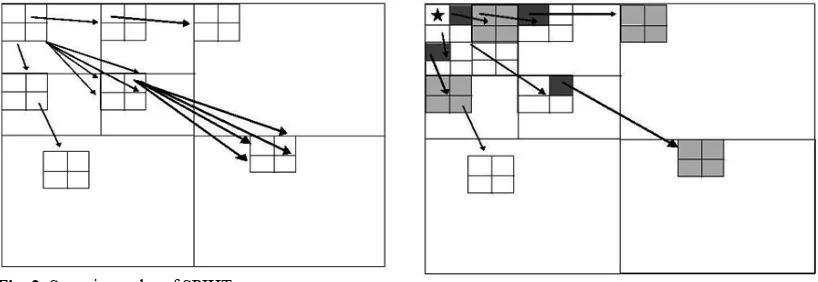
The main advantage of this algorithm is that it controls bit stream rate precisely, resulting in effective representation of image compression. Scanning order of algorithm EZW is presented in figure 1.
Fig. 1. Scanning order of EZW
Fig. 2. Scanning order of SPIHT Fig. 3. Scanning order of STW
performed in two passes namely sorting pass and refinement pass. In sorting pass as the name defines position of the significant coefficients in the subtree of coefficient node are identified3. Left
out insignificant coefficients isthen shifted into a separate list. In refinement pass if the significant bit is greater than T then it is separated form list and decoded. This process is repeated until desired bit rate is achieved. In entire process three lists are used namely: List of insignificant pixels (LIP), List of significant pixels (LSP), List of insignificant sets (LIS). SPIHT executes fast as ordering of coefficients is from maximum to minimum value that makes it energy efficient. Scanning order of algorithm SPIHT is presented below in figure 2.
Spatial Orientation Tree Wavelet (STW): Said et al. (1993)4 proposed this algorithm STW
that employs method of partitioning of wavelet coefficients. It can be considered as modified
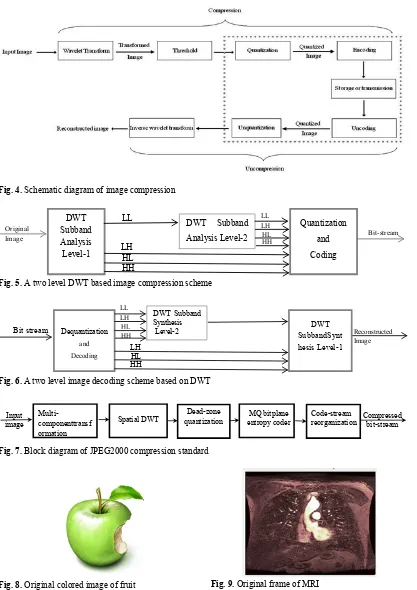
Fig. 4. Schematic diagram of image compression
Fig. 5. A two level DWT based image compression scheme
HL DWT
Subband Analysis Level-1
Quantization and Coding DWT Subband
Analysis Level-2 LL
LH LL HL HH
LH LL HH LL
Bit-stream Original
Image
Fig. 6. A two level image decoding scheme based on DWT
HL
HL
Dequantization
and Decoding
DWT SubbandSynt hesis Level-1 DWT Subband
Synthesis Level-2 LH
LL HH
LH
LL
HH LL
Reconstructed Image
Bit stream
Fig. 7. Block diagram of JPEG2000 compression standard
Spatial DWT quantizationDead-zone Code-stream reorganization
Multi-componenttransf ormation
MQ bitplane
entropy coder Compressed bit-stream
Input image
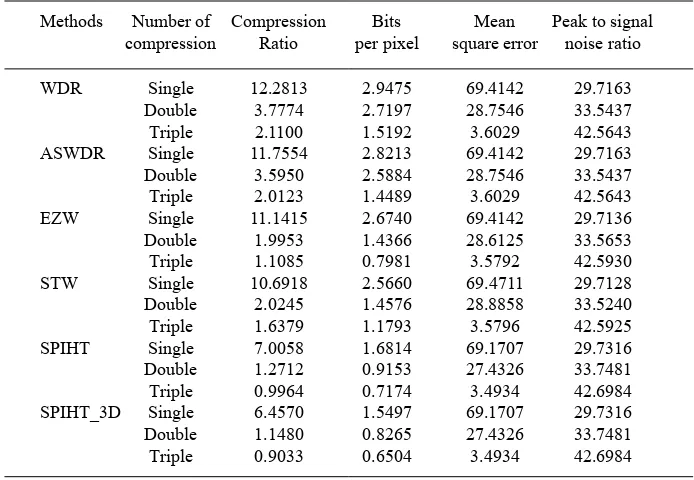
Table 1. Different methods used for multiple compressions and their respective quality and performance measures
Methods Number of Compression Bits Mean Peak to signal compression Ratio per pixel square error noise ratio
WDR Single 12.2813 2.9475 69.4142 29.7163
Double 3.7774 2.7197 28.7546 33.5437 Triple 2.1100 1.5192 3.6029 42.5643 ASWDR Single 11.7554 2.8213 69.4142 29.7163 Double 3.5950 2.5884 28.7546 33.5437 Triple 2.0123 1.4489 3.6029 42.5643
EZW Single 11.1415 2.6740 69.4142 29.7136
Double 1.9953 1.4366 28.6125 33.5653 Triple 1.1085 0.7981 3.5792 42.5930
STW Single 10.6918 2.5660 69.4711 29.7128
Double 2.0245 1.4576 28.8858 33.5240 Triple 1.6379 1.1793 3.5796 42.5925
SPIHT Single 7.0058 1.6814 69.1707 29.7316
Double 1.2712 0.9153 27.4326 33.7481 Triple 0.9964 0.7174 3.4934 42.6984
SPIHT_3D Single 6.4570 1.5497 69.1707 29.7316
Double 1.1480 0.8265 27.4326 33.7481 Triple 0.9033 0.6504 3.4934 42.6984 condensed number of bits for encoding, as spatial
portion of transformed value changes its state frequently. Scanning order of algorithm STW is represented in figure 3.
Set Partioning In Hierarchical Trees3D (SPIHT_3D): Kim et al (1997) extended SPIHT coding algorithm to SPIHT_3D. In this algorithm coefficient presents in different frequency bands are related in the form of octal tree structure. This algorithm has two passes namely sorting pass and refinement pass5. All the coefficients forming
a spatial orientation tree from all sub bands are basically in appropriate sync with same spatial location in an image. Starting from low sub bands to high sub bands these coefficients are scanned column wise. After this threshold value is selected and correlated to highest coefficient value. Tree containing the biggest value of coefficient set becomes significant. After executing passes and recursive partioning, descendant coefficient which is significant is recognized.
This SPIHT_3D algorithm is found efficient in terms of high performance, precise rate regulator, real time applicability for image and video compression6. The important argument for
the thoughtful of the usefulness of these methods, resides in the ability of the wavelets bases, to
characterize comprehensive classes of functions in a very tight-fisted way.
Wavelet Difference Reduction (WDR)
James Walker in 2000 developed an image compression coding method based on wavelet. This method can be viewed as advancement over SPIHT because SPIHT deals with the location of significant coefficients that makes the execution of transformed values location identificationdifficult. WDR involves region of high resolution instead of coefficients and then transformation is obtained. WDR considerindices difference successively instead of location value of significant coefficients. This method uses significant pass that means output of WDR with the sequence of bits, which describes the location of significant coefficients, also contains bits that represent the sign of significant values. It is not capable of giving high PSNR values at low bit rates when compared to SPIHT.This method gives good quality image at high compression ratio, better performance at low bit rates and resolution scalability3.
Adaptively Scanned Wavelet Difference Reduction (ASWDR)
Multiple compression using STW method
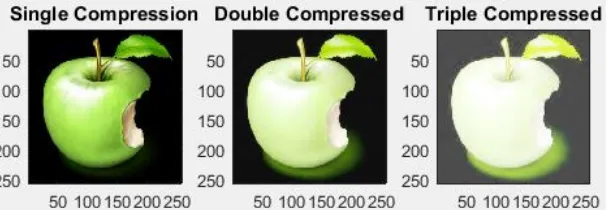
Table 2. Multiply compressed images using different compression methods.
Multiple compression using WDR method
Multiple compression using ASWDR method
Multiple compression using EZW method
stores the new wavelet coefficients by scanning adaptively to specific image features. This algorithm acclimatizes the scanning order so
Multiple compression using SPIHT method
Multiple compression using SPIHT_3D method
information of new significant coefficient value. ASWDR adapts the scanning procedure at run time so that location of edge details in an image can be executed properly. In result it increases the edge details in the compressed image. This improves the perceptual quality at low bit rates after compression and advances effects of alteration measure.
JPEG and JPEG2000
The first and well known image compression standard given by working group WG1 of the ISO/IEC joint technical committee 1 is "Joint Photographic Experts Group" mostly identified as JPEG in short. This method is widely known for its lossy compression mode. It was mostly used for storing, transferring compressed images, communicating and editing digital video sequences. In this method sample of 8×8 blocks are formed and are transformed using discrete cosine transform. Thenewly formed transformed coefficients are then quantized and coded using Huffman coding. The image compression standard JPEG2000 is advancement over JPEG standard. All facilities provided by JPEG are integrated in JPEG2000 with significant option oflossless and lossy mode,resulting into good quality reconstructed image. It incorporates wavelet based algorithm that executes large blocks in compression
process. Precisely, JPEG2000 uses lifting scheme with discrete wavelet transform and biorthogonal basis of Daubechie's wavelet.
This JPEG2000 standard is currently considered as international standard because of its resolution scalability, multiresolution analysis of discrete wavelet transform, and flexibility of code stream8. The scalable nature of code stream
helps decoding of bits in number of ways like truncation of code stream at any point, using bit plane encoding, resulting into gracefully degraded compressed image with lower resolution9. In
last step, compression is produced using bit stream reassembling that gives desired higher compression. Current computer applications using JPEG2000 algorithm are good in processing large images with low contrast edges for example medical images.The scheme of the algorithm is explained in Figure 7.
Mathematical Framework
here 0 < p_(i,j) < 255 defined on a square shaped block. Now, consider an orthonormal wavelet basis of L2(ℝ) denoted simply by{gm },m e N. A
function f can be represented in basis as follows: f=Smeg<f,gm> gm , here coefficients of function
f will be <f, gm> meg. Let hm denotes all the
coefficients for easier process. The compression task is carried out by selecting a fixed number of coefficients say M. This selection represents that the compression carried out is lossy compression. Let K bethe set of indices of the M selected coefficients and fM be the compression obtained.
Then,
For compression purpose, wavelet transform can be used in several ways. Nowadays image compression method is built on 2D product basis created from Daubechie's wavelet. However, fundamental norm of image compression is to reflect compression as an approximation problem. In this regard fix an orthogonal wavelet say y. Each wavelet picks information about an image f using its spatial and scaling characteristic,which makes it potentially useful. This gives an idea that focus on the most relevant parts of f. To get the depth of best approximation of f we have to calculate error measure. For this let's find optimal approximation minimizing the error ||f-fM ||2. Value
of approximation because of the orthogonality of wavelets equals to S(|<f,yi,j>-bi,j |2)1/2) . To
minimize error non-zero coefficients M those who have largest absolute value should be hand-picked, hence setting b(i,j)=<f,yi,j >. This then
surely yields the desired optimal approximation of f.
To apply wavelet transform we consider image in 2D version. The discrete wavelet transform (DWT)is applied to get wavelet coefficient matrix separately in horizontal and vertical directions.To obtain entries of matrixa particular set of wavelet or member of a wavelet family is selected by particular set of numbers, called wavelet filter,coefficientsthen arearranged in a specified pattern. These data array aredecomposed into four sub-bands LL- low pass horizontal and vertical filter, LH- low pass vertical and high pass horizontal filter, HH- high pass vertical and horizontal filter, HL- high pass vertical and low
pass horizontal filter. The order of horizontal and vertical filters can be switched to get different representation but it yields same effect on final image. The schematic diagrams of decomposition (analysis) and reconstruction (synthesis) of a signal are provided in Figures 5 and 6.
If it is required to assess the quality of compression, then following performance (measurement) indices are used.
Measuring Quantities(Qualitative and quantitative analysis)
Mean Square Error (MSE): As the name implies, it is square of difference between original and image approximation divided by the number of elements. Mathematically it is given as:
Maximum Error
Absolute deviation taken as maximum in the image compression is termed as maximum error or max error.
Bits per pixel ratio (BPP): Taking one byte per pixel (8 bits), BPP is calculated by multiplying compression ratio with 8. It is basically the number of bits required to store one pixel of any image. For true color image BPP is 24. If the bit rate increases, it results into improvement in quality of the reconstructed image.
Compression Ratio (CR)
It is the ratio defined by number of elements present in original image by number of elements present in compressed image. It represents that CR% of original size is stored in the form of compressed image.
L2-Norm Ratio
It is a ratio of the squared L2 norm of the compressed image to the input image. The image is altered in the form of column vector before executing the L2-norm.
Peak Signal to Noise Ratio (PSNR)
It measures peak error and is expressed in decibels. It is the ratio between greatest attainable power of signal and the power of noisy signal10.
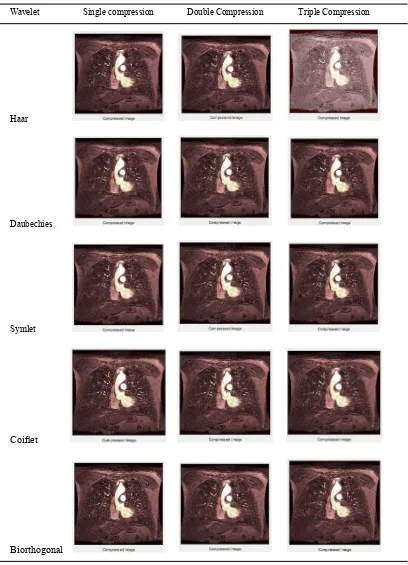
Table 3. Multiple compression of MRI using different wavelet families (qualitative analysis)
Wavelet Single compression Double Compression Triple Compression
Haar
Daubechies
Symlet
Coiflet
Table 4. Performance indices using different wavelet families with wavelet difference reduction compression scheme (quantitative analysis)
Wavelets Frequency MSE Max L2- Norm PSNR BPP Comp.
Error Ratio Ratio
Haar Single 1.696 48 99.94% 45.84 7.7216 96.52%
Double 1.244 20 99.96% 47.18 7.5136 93.92%
Triple 0.4 17 100.00% 52.11 7.4144 92.68%
Daubechies Single 1.696 48 99.94% 45.84 7.7216 96.52%
Double 1.244 20 99.96% 47.18 7.5136 93.92%
Triple 0.4 17 100.00% 52.11 7.4144 92.68%
Symlet Single 1.778 67 99.92% 45.63 5.744 71.80%
Double 0.8477 33 99.96% 48.85 5.3722 67.15% Triple 0.6385 30 99.97% 50.08 5.1025 63.78% Coiflet Single 1.533 41 99.94% 46.27 5.7141 71.43% Double 0.8249 34 99.96% 48.97 5.3391 66.74% Triple 0.5604 24 99.98% 50.65 5.0655 63.32% Bi-orthogonal Single 1.696 48 99.94% 45.84 7.7218 96.52%
Double 1.244 20 99.96% 47.181 7.5138 93.92%
Triple 0.44 17 100.00% 52.11 7.4146 92.68%
Table 5. Multiple compression images using Haar wavelet packet method (qualitative analysis)
Wavelet Single compression Double Compression Triple Compression
Haar wavelet packet
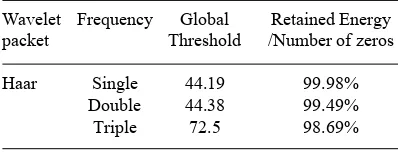
Table 6. Multiple compression performance measuring details (quantitative analysis)
Wavelet Frequency Global Retained Energy packet Threshold /Number of zeros
Haar Single 44.19 99.98%
Double 44.38 99.49%
Triple 72.5 98.69%
Here, MSE represents Mean Square Error and n represents bits per sample.
Compression using wavelet packets
O t h e r t h a n w a v e l e t s f u r t h e r recommendations are given for the use of wavelet packets. All the choices definitely play an effective role in performance of image compression ratio, other performance measures and finally on
Table 7. Multiply compressed images using JPEG2000 algorithm
Single Compression Double Compression Triple Compression
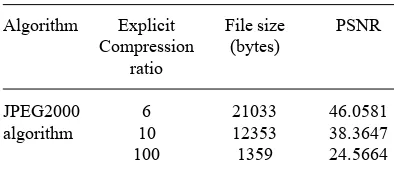
Table 8. Image Compression using JPEG2000 algorithm by explicitly giving compression ratio
Compression Ratio:06 Compression ratio:10 Compression Ratio:100
Table 9. Measuring parameters of multiple compressions of MRI using JPEG2000 algorithm
Algorithm Frequency Compression File size PSNR ratio (bytes)
JPEG2000 Single 3.85 33452 51.9064
algorithm Double 1.02 32867 14.4034 Triple 0.99 33056 14.4037
Table 10. Measuring parameters of multiple compressions of MRI(CR mentioned explicitly)
using JPEG2000 algorithm
Algorithm Explicit File size PSNR Compression (bytes)
ratio
JPEG2000 6 21033 46.0581
algorithm 10 12353 38.3647
100 1359 24.5664
Compression using bi-orthogonal wavelets
There are wavelet bases in which the restriction of ortho-normality is relaxed. In this case one typically uses two different "dual" wavelets ψ
and ψ ̂ such that unless j = j′ and
k = k′. The approximation order of the scheme that approximates functions f by linear combinations of the ψj,k is then governed by the number of vanishing
moments of ψ ̂, such wavelet bases are called biorthogonal. They have the advantage that the basic wavelets ψ and ψ ̂ can both be symmetric and concentrated on an interval, which is impossible for orthonormal wavelet bases other than the Haar wavelets.
Tools and Techniques
each resolution level into coarse approximation and detailed information. It further decomposes the approximation into next stage containing approximation and detail. This procedure goes on till the desired level is achieved. DWT for many natural image classes provides good compaction properties with low implementation cost 11. Basic
requirement in multiple image compression is decomposition of images up to certain level. Therefore, Different wavelets are employed in decomposition of MRI images. General method applicable for multiple compressions is described in figure 4.
Verbally, to start with image compression, firstly decomposition took place on an orthogonal or biorthogonal wavelet basis with the help of discrete wavelet transform. Using threshold parameters certain part of coefficients are selected, while preserving intact the approximation coefficients of an appropriately selected level. Quantization of selected coefficients finishes off compression and in the end for storage or transmission purpose these are encoded. Image decompression process inverts these operations as far as possible. From the decoded and un-quantized coefficients an image is rebuilt by applying inverse discrete transform. The image obtained is thus the reconstructed image. It has been known that compression of image reduces number of bits for minimal storing, speedy transmission, less correlation between neighboring pixels and hence decreases redundant information. These compressed images are decompressed to get the reconstructed image using inverse coding.
Transformation
As mentioned before, input image neighboring pixels are correlated this increases lot of redundant and irrelevant data which results into increase in size of image. Therefore, first step is to reduce the image size by removing redundant information and de-correlating the pixels through thresholding. Transformation of image using some pre-defined methods is utilized for this purpose. Some of the transformations reduce the size in such a way that only few bits are required to represent the image.Various applications are employed directly and indirectly to serve this purpose, some of them are: Discrete Fourier Transform (DFT), Short Fourier Transform (SFT), Discrete Cosine Transform (DCT), Hadamard-Haar Transform (HHT), Slant-Haar Transform (SHT),
Karhune-Loeve Transform (KLT), and Discrete Wavelet Transform (DWT)12. In this article DWT
is employed anddifferent wavelet familiesare considered for the purpose of comparative study. This could help in selecting appropriate wavelet basis to achieve twin goals: to economize on memory space and to accelerate transmission.
Thresholding and Quantization
Once DWT is performed, the next task is thresholding which is neglecting certain wavelet coefficients. For fulfilling this purpose one has to decide the value of the threshold and how to apply the same. This is an important step, which affects the quality of the compressed image. The basic idea is to truncate the insignificant coefficients, since the amount of information obtained from them is negligible.Remaining samples are quantized spatially and amplitude wise, by quantization factor. Basically, it is the process of mapping continuous set of input values of image data to countable small set of output values. In thresholding process some samples are eliminated if the amplitude of samples is below threshold predefined value13.
Because of these two factors quality of an image degrades every time,wheneverthese processes are repeated. Predefined threshold value is responsible mainly for image quality and so is quantization factor. Lots of data is neglected if these processes possess higher predefined values. Values should be chosen in a manner such that it gives good perceptual quality of an image, better compression ratio and minimal loss of information. For multiple compressionsthese values must be chosen carefully.
Entropy Encoding
to symbols. Next it converts the input stream into reduced output code stream utilizing suitable code related to assigned probabilities. Thus, it reduces number of bits into optimal bits that are helpful in representing the image14. Entropy coders mainly
used are: Arithmetic encoder and Huffman encoder. Algorithms employing wavelets uses arithmetic code as it allows fractional number of bits in encoding. The Huffman encoder uses integral number of bits for each code. For reconstruction of image decoder step is involved that exactly reverses the encoding operation.
Let image decomposition coefficients of animage for particular choice of the wavelet packet basis be {vi}. Non negative quantity ∈2
({vi} ) defined as entropy, associated with each set of decomposition coefficients{vi }is defined as follows:
Here, . In terms of entropy,
basis is said to be best if it produces least entropy. This defined entropy gives a measure of a number of components needed to represent the image in a particular basis. For example, if decomposition in a particular basis produces all zero coefficients except one, showing that image coincides with a waveform then it means that entropy reaches its minimum value of zero. On the other hand, ifin some basis, the decomposed non-zero coefficients are all equally important say vi=1/√N, then entropy
in this case is N which is maximum. Here N is the length of data. These are two extreme cases in between which other decomposition will fall. Eventually, what matters mostissmaller entropy that leads to fewer significant coefficients required to represent the image.
Experimental results
Implementation of triple compression
Let us consider a true color image of a fruit given below in figure 8. Multiple compressions is implemented on true color fruit image using code that employs Haar wavelet transform at decomposition level 4 with 12 maximum loops in MATLAB software. Results of different compression algorithms with Haar wavelet transform decomposition (initiated in early stage) applied ona fruit imageare compiled in the form of a table 1shown below.
Different algorithms used are: Wavelet
Difference reduction (WDR), Adaptively scanned wavelet difference reduction (ASWDR), Embedded zero tree wavelet (EZW), Spatial - orientation Tree wavelet (STW), Set partitioning in hierarchical trees (SPIHT), Set partitioning in hierarchical trees 3D for truecolor images (SPIHT_3D).
From table 1, it is clear that in multiple compressions PSNR value increasesdown the column,for every algorithm used on the image. Value above 40 is considered to be good however images in table 2 depicts that major part of reconstructed image fades away. Compression ratio in increasing compression frequency does not hold good percentages; however mean square error is reduced drastically in further compressions. Bits per pixel values are reaching to approximate zero. All these numbers show that there will be considerable loss of data if further compression is followed. This could be taken as an advantage in a scenario where lossy data is preferred. Following table 2 depicts the reconstructed image at every intermittent compression frequency.
Compression in medical imaging (triple compression)
Dataset
For the illustration purpose MRI database is considered15. This MRI database is a
comprehensive collection of many images of stable and unstable patients in intensive care units.
A study was performed on magnetic resonance angiography of cardiopulmonary vasculature with the help of 1.5T General Electric (GE) signal imaging system. Derived imagesdepict coronal slices obtained from consecutive anteroposterior positions within torso. These images contain many frames one of them is taken randomly for compression application, presented in figure 9.
Table 3 shows single, double and triple compression of MRI image using Haar, Daubechies, Symlet, Coiflet, and Biorthogonal wavelet families. Method employed for compression is WDR with 12 maximum loops. With the help of Matlab coding and decoding software, details related to these compressionsare summarized in table 4.
Compression using Haar wavelet packet
and selecting balance sparsity-norm thresholding method,multiple compression observations are recorded that are presented in table 6. In similar manner other wavelet family member can be used in place of Haar wavelet.
RESuLTS AND DISCuSSIoN
In results obtained in Table 1, the emphasis is on the algorithms employed rather than the role played by wavelets. It could be seen that Peak to Signal Noise Ratio (PSNR) and Mean Square Error (MSE) values remain almost same for different frequency of compression in different methods. However,in a solo algorithm,values of MSE in successive frequency of compression have shown major change resulting into increased value of PSNR irrespective of method employed. As the value of PSNR increases picture quality becomes better. Values of Bits per pixel (BPP) do not show much variation when compared to other measures. Another important aspect of measure is compression ratio (CR) which shows considerable deviation in successive compression in all the algorithms. From the value of CR it can be understood that further compression will not be of good practice as picture quality will degrade and final output will not be of any use. Above all reconstructed image is dependent on the input of picture quality. Clear and original picture will have good results irrespective of any wavelet methods employed for first few compression frequencies.
From table 4we examine the choice among wavelets, to rate most appropriate mother wavelet for multiple image compression. Following three wavelets - Haar wavelet, Daubechies type 4 and Bi-orthogonal wavelets are the best performers when compared with other wavelets. These wavelets give almost similar results in all aspects of measure.Biorthogonal wavelets are mainly resourceful for compression because the examination part (decomposition) and the synthesis part (reconstruction) are treated by two distinct wavelets.
It is known that PSNR values for lossy compression lies between 30 and 50 dB.It can be perceivedfrom table 4 that PSNR value is greater than 40 dB, this concludes that compressed images of MRI are indistinguishable. During triple compression mean square error is reduced to
almost zero, maximum error between compressed and original image is also considerably low when compared with single and double compression values. Further values of measuring parameters at triple compression also show appreciable enhancements. Quality wise images at multiple compressions can be considered as faultless, and seamless for treatment purpose. However, further frequency of compression can lead to loss of considerable amount of data that can be a big loss in terms of consultation procedure. Therefore few frequencies of compressions can be considered in terms of storage, transmission and speedy procedures.
From images obtained multiple compressions in table 5, it can be concluded that single compression is better as compared to further compressions. Triple compression shows slightly blurry picture, this gives an idea that further compression with Haar wavelet packet will loose considerable amount of data and hence advisable to hold on the compression frequency until the data is easily reflected from image. This fact can be clearly grasped from table 6. As global threshold value increases, number of zeros or retained energy is reduced.
Recent standard of image compression JPEG2000 is also applied on MRIsampleimage and it was found, when compression rate is specified explicitly then significant quality and rate of measurement at certain level is degraded, refer table 8 and 10. However, when compression is performed considering CR values(randomly taken by software) implicitly, quality of image and measuring parameter doesn't show much change, refer table 7 and 9. In both the scenario PSNR value after single compression is high, depicting acceptable compression in both procedures.
Conclusion and scope for future work
results when high frequency detail of the image is neglected. This is unavoidable at very low bit rates, however if visual and important part of the image gives the good understanding of content then this part of detail that is giving blurry information can be neglected.Some of the advantages and disadvantages of compression methods used in this article are as follows:
EZW uses predefined scanning order and concept of zero treeshowever transmissionof spatial property of coefficient is absent. From table 1it can be viewed that compression ratio, using EZW method,formultiple compression decreases leisurely that gives the idea of less compression made to images in multiple calls. SPIHT: It is widely used for image compression. It employs advanced and rooted transmission but still perceptual quality is not up to the mark. Due to this memory utilization is additional. Spatial property of significant positions is recorded implicitly. Because of its hierarchical trees are set portioned, this method is also applicable to natural images. WDR: This method is advancement over SPIHT in terms of better quality of image perceptually, algorithm complexity, higher edge association and better edge safeguarding. Best part is that it suits medical images having low resolution and hence operational on compression process at low bit rate. Only disadvantage is that this method has PSNR either equal or less than SPIHT method. ASWDR: This method is modified version of WDR and has better appreciable qualities like encoding more significant values, better PSNR, better perceptual image quality, presentation of slightly more fine details, higher edge correlation. It is applicable on high compression ratio images like medical images.
The advantages of DWT have resulted in its acceptance as the coding technique in JPEG-2000, the latest standard in still image compression.JPEG-2000: Although JPEG-2000 has started gaining popularity globally in multiple compression process, simulation shows that if MSE for intermittent compression of two images are same then in some conditions further compression procedure degrades the quality of reconstructed image when compared to JPEG procedure16.
Quality of reconstructed image after multiple compression process of JPEG -2000 totally depends on the choice of wavelet filters.
Enormous literature on compression using different wavelet based algorithms is made available in the last coupleof decades. Very recently new method is developed based on wavelet known as Geometric wavelet (GW). GW has better PSNR values when compared to earlier methods. Due to advancement in computational cost and efficiency, execution time and code operation complexities can be removed in near future that arises in new developed algorithms.
Main aimof comparative study was storing and transmitting large volume of data that can be helpful in health care sector. Techniquesbased on wavelet transform occupies less computer memory than conventional methods for image storage, this is noticeably good part for storage of bulk of medical images. These applications due to their versatility can be used in mobile technologies, laptop, desktop, palmtopand notepadsin future for speedy treatment. E-health services will become the option for medical communication system that will be successful, inevitable and cost effective.
REFERENCES
1. David Salomon; Data Compression: The Complete Reference, Springer international Edition, (2005).
2. C. D. Creusere; A new method of robust image compression based on the embedded zerotree wavelet algorithm, IEEE Trans. on Image Processing, 6(10): 1436-1442 (1997).
3. D.Ravichandran, R. Nimmatoori, A. Dhivakar MR; Performance Analysis of Wavelet based Medical Image Compression using EZW, SPIHT, STW and WDR Algorithms for Cloud Computing; Journal ijacect;5(2 ): (2016). 4. A. Said and W. A. Pearlman; A new, fast, and
efficient image codec based on set partitioning in hierarchal trees (SPIHT); IEEE Trans. on Circuits and Systems for Video Technology, 6(3): 243-250 (1996).
5. Kim B.J., Pearlman W.A.; An Embedded Wavelet Video Coder Using 3-Dimensional Set Partitioning in Hierarchical Trees (3D-SPIHT). In Proc. of Data Compression Conference 1997, Snowbird, USA, 251:260 (1997).
7. J. S. Walker, T. Q. Nguyen; Adaptive scanning methods for wavelet difference reduction in lossy image compression; Proc. International Conf. Image Processing, 2000, Vancouver, Canada pp. 182-185.
8. Chandrasekhar Salimath: Wavelets: Algorithms and Applications in Science and Technology ICMSDPA12, Conference Proceedings (2012). 9. Juan Jose B,R,; The JPEG 2000 Compression
standard; Advanced Mathematics Master Universitat de Barcelona, Barcelona; Thesis; (2015).
10. Usman A.K. , Sahar A., Tahir R. S. and Shayan Q.; Wavelet Based Image Compression Using Different Techniques: A Comparative Study; International Journal of Electronics & Communication Technology, Signal Processing, 3: pp. 144- 149 (2014).
11. Alfred Mertins; Image compression via edge-based wavelet transform; Optical Engineering 38(6): (1999).
12. Marc Antonini, Michel Barlaud, Pierre Mathieu & Ingrid Daubechies; Image coding using
wavelet transform; IEEE Transactions on image processing,1(2): (1992).
13. Rehna V. J and Jeya Kumar M. K;Wavelet Based Image Coding Schemes: A Recent Survey; International Journal on Soft Computing (IJSC) 3(3): (2012).
14. David Salomon; Data Compression: The Complete Reference; Springer international Edition, (2005).
15. Goldberger AL, Amaral LAN, Glass L, Hausdorff JM, Ivanov PCh, Mark RG, Mietus JE, Moody GB, Peng C-K, Stanley HE. PhysioBank, PhysioToolkit, and PhysioNet: Components of a new research resource for complex physiologic signals. Circulation 101(23):e215-e220; http:// circ.ahajournasls.org/cgi/content/full/101/23/ e215; June 2000; doi: 10.13026/C2001G. 16. Rajan L.J., Majid Rabbani, Margaret A.L;