* To whom all correspondence should be addressed.
Simultaneous Saccharification and Fermentation (SSF), An
Efficient Process for Bio-Ethanol Production: An Overview
Dey Pinaki*, Wangyal Lhakpa and Singh Joginder
School of Biotechnology and Biosciences, Lovely Professional University, Phagwara, Panjab, India. DOI: http://dx.doi.org/10.13005/bbra/1639
(Received: 15 January 2015; accepted: 10 February 2015)
Excessive exploitation of conventionally used fossil fuel has been the major root cause of depletion of its reserves. Additionally, environmental concern, energy security, short supply with an increasing demand for fuel lead to adoption of sustainable energy resources such as solar, wind, biofuel, etc. Among all, ethanol was proved as a promising biofuel with various advantages. Sugarcane and corn which are considered as conventional raw material for ethanol production, hardly meets the current global demand for biofuel. Search for most promising feed stock for ethanol production, pioneered the use of lignocellulosic biomass and starch based materials. But low ethanol yield of lignocellulosic biomass without technological breakthrough forced researchers to opt for the starchy based routes. In recent years, only microbe based simultaneous saccharification and fermentation (SSF) has been evolved successfully as a starch based bio-ethanol production process while overcoming the problems associated with using harmful chemical and expensive enzymes. The principal advantage of microbial SSF process is starch hydrolysis and sugar fermentation can be processed in a single vessel while minimizing the substrate inhibition effects and overall reaction time. This review discusses the multiple aspects of Simultaneous Saccharification and Fermentation (SSF) process in the context of existing ethanol production routes.
Key word: Saccharification, Fermentation, Ethanol, Starch, Glucose.
In the recent years, demand of energy has increased drastically due to transportation, heating and industrial processing1. The conventional source of energy alone is insufficient to meet the growing energy demand. Dependence and unplanned exploitation of non-renewable fossil fuel leads to depletion of its reserve2. Hossain et al.3 and Prasad et al.4 reported that global energy crisis, political crisis, depletion of fossil reserve lead to adoption of ethanol as viable, economical, efficient, safer, eco-friendly, and renewable alternate to conventionally used fossil fuel. In addition to fuel grade ethanol, ethanol has broad
assimilated by growing feed stock plant for carbohydrate production. Due to these advantages, ethanol is blended in gasoline in a range of 5-20 % 3, 7.
Various agricultural based raw materials like sugar crops, starch-containing plants and lignocellulosic biomass can be utilized for ethanol fermentation. In order to select the cost effective process, lignocellulosic biomass has been the primary choice for ethanol fermentation. But lignocellulosic biomass has to undergo the most complicated pre-treatment process prior to fermentation which includes removal of lignin followed by the hydrolysis of cellulose. However, research effort to reduce the production cost of bio-ethanol was successful when starchy raw materials were introduced in simultaneous saccharification and fermentation (SSF) process with improved starch hydrolysis efficiency. The SSF process was first introduced by Gulf Oil Company, US and the University of Arkansas. Bio-ethanol production using the same process has been successfully implemented by different researchers8-17 using different starch based material. Among all the researchers, Purohit and Mishra7, Srichuwong et al.13 implemented potato based starchy material while Li et al. 16 and Arasaratnam et al.17 used rice based starchy material for the production of ethanol. Olukotun et al.10, Itelima et al.15 developed the overall cost effective microbial based saccharification and fermentation process in SSF by using Aspergillus niger and Saccharomyces cerevisiae while reducing the dependency of direct enzymatic use for first stage saccharification. Among all, Lu et al.11 and Moon et al.9 adopted fed batch and continuous fermentation approach to improve the productivity of ethanol in SSF. Hence it is transparent that microbe based SSF process using food waste starch can be evolved with a novel and promising concept for cost effective, environment friendly, large scale industrial production process for ethanol which has not been largely implemented. Potential Feed stocks used for bio-ethanol production
Bio-ethanol is mainly produced by fermentation of various raw materials. The commonly used feed stocks for ethanol production are sugar crops (sugar cane molasses, sugar beet), starchy crops (corn, wheat, potato and Cassava)
and lignocellulosic biomass (soft wood). Sugarcane, sugar beets and corn are most feasible for ethanol production and have been used extensively though these are valuable food sources 8, 9. As a by product of sugar industries, molasses contain high amount of impurities which necessitate a long pre-treatment steps. In order to select the cost effective process, lignocellulosic biomass is another option for ethanol fermentation. Important feed stocks for bio-ethanol production have been represented in Table1. But lignocellulosic biomass (grasses, soft woods, bamboo, forest residue and agricultural residues; straw, corn stover, rice husk, corn cobs, corn stover, etc.) has to undergo the most complicated time taking pre-treatment processes prior to fermentation accompanied by removal of lignin followed and hydrolysis of cellulose. The hydrolysis of cellulose is far more difficult than the saccharification of starch. To avoid such complications in the process and bring down the overall production cost of bio-ethanol, starchy based raw materials like corn starch, wheat starch and potato starch were introduced with improved and efficient hydrolysis.
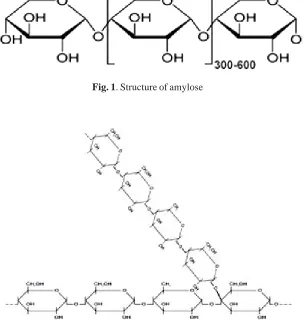
Starch is a polysaccharide, largely present in plants. It is found in the leaves, seeds, roots and fibres as food reserve. Native starch measures small globules 1 to 100 µm. It is composed of mixture of two structurally different polyglucans – amorphous amylase (20-30%) and crystalline amylopectin (75-80 %) 18. Amylose (shown in Figure1) is linear chain of D-glucose units bonded by ±-1, 4-linkages with an average degree of polymerization (DP) up to 6,000, making its molecular mass of 105 to 106 g/mol. Amylopectin (shown in Figure 2) is highly branched polymer with average degree of polymerisation of 2 million and consists of short 1, 4-oligomers linked by -1, 6-bonds making its molecular mass of 107 to 109 g/mol 12. To make SSF based ethanol production process economically feasible attention has been given more on starchy based waste materials which are largely available in the environment in different forms.
products and 1.3 Gtonnes of edible part of 6 Gtonnes of the agricultural production (for food and non-food uses). Food wastes damages environment and causes economic loss of US $ 750 billion annually to food producers. Wasted edible starchy foods are generally potatoes, bread, cereals, rice and pasta. In India, about 40 per cent fresh fruit and vegetables costing $8.3bn annually perish before reaching consumers. Each year, 21m metric tonnes of wheat rots in India due to improper storage facilities in government regulated Food Corporation 20. Instead of wasting one-third food produced when 870 million people go hungry every day, the most innovative way to recover is use of these food wastes as a feedstock in ethanol production. By chemical and biological methods, food waste can be hydrolysed to glucose, free amino nitrogen and phosphate, which can be utilised as nutrients by many microorganisms production of wide range of diversified products like ethanol. This would be an innovative waste
management and secures both energy and fuel crisis.
Starchy potato waste could be potential feedstock for production of bio-ethanol. In India, 5 to 20% of potato crops (starch content in a range of 11.2% to over 19.3%) were wasted as by products from potato cultivation and due to poor storage facility 20-22. Yamada et al.23 also reported that 18% of the starchy potatoes are wasted in potato industry. Arumugam and Manikandan24 obtained high ethanol yield from dilute acid pre-treated waste mango and banana by enzymatic saccharification. Similarly, modified kitchen garbage having high sugar content, low cost, requiring short fermentation time could be used to produce ethanol in an optimised fermentation process25. High starch content rice, barley, corn and wheat are also wasted in huge amount which could be used for cheaper ethanol production.
produce by anaerobic yeast fermentation of simple sugars. In such fermentation, natural yeast had been grown on fruits to produce wines. Normally fermented beer is made by using amylases of germinating grain to hydrolyse the grain starches to fermentable sugars12. As depicted in Figure 3, Ethanol was also produced chemically by hydration of ethylene (IUPAC name: ethene) using phosphoric acid embedded on to porous silica gel as catalyst at 300 °C and 60-70 atm pressure 26.
Ethanol is produced in large scale by fermentation of different feed stocks like sugar crops, starchy materials or lignocellulosic biomass using various technologies with action of anaerobic and ethanologenic Saccharomyces cerevisiae like microorganisms27, 28. The overall process of fermentative ethanol production involves: (1) preparing of solution of fermentable
sugars, (2) fermentation of sugars into ethanol at 25-30 °C for 6-72 hours depending on nature of substrate, cell density, physiological activity and yeast species and (3) separation and purification of ethanol. Based on various sources for bio-ethanol production, different processes are employed for obtaining fermentable sugars. Usually, for starch and lignocellulosic ethanol productions necessitate milling, liquefaction and saccharification processes to prepare fermentable sugars unlike direct fermentation of sugar juice in case of sucrose based feed stocks29. Different amylases (-amylase, -amylase and glucoamylase) are utilised for obtaining fermentable sugars (Dextrose or D-glucose) from starch instead of energy consuming acid hydrolysis although acid hydrolysis has been implemented. Similarly,
Fig. 1. Structure of amylose
cellulases are used for saccharification of cellulosic biomass where as xylanases are utilised for generating fraction of glucose from hemicelluloses to achieve comparatively higher yield of ethanol from complex hemicelluloses and lignocellulosic biomass12.
Some time sugar crop based ethanol production is advantageous for its low cost of production. The short supply during non-seasonal months is main problem associated with sucrose based feedstock. Generally, sugar cane based ethanol production involves crushing of stalks after initial process after harvest by specialised rollers to extract sugar juice. Calcium hydroxide is added to the juice extract to precipitate the fiber and sludge and the mixture is filtered. The filtrate solution is evaporated to crystallise sugar. The non crystallised sugar mixture is called blackstrap molasses which is used for ethanol production by fermentation using Saccharomyces cerevisiae at 33-35 °C. Ethanol can be directly produced from processed sugar juice. Similarly, sugar beets and sweet sorghum are also used for ethanol production 29. Two different pretreatment processes are normally employed for production of ethanol from
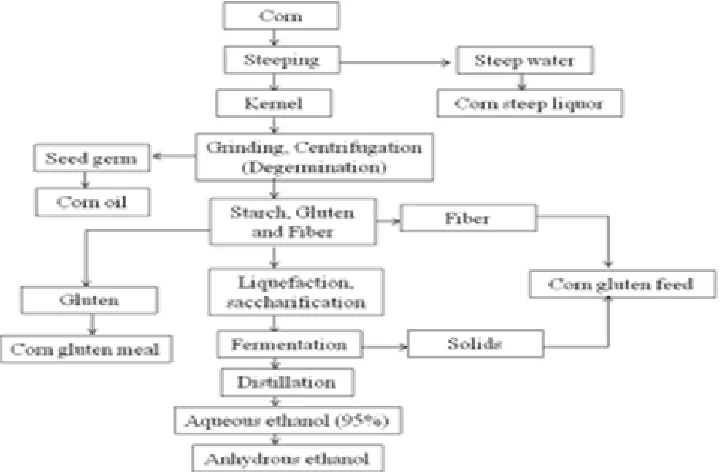
starch biomass like corn namely: (i) dry grinding and (i) wet milling30. In dry grinding, corn is processed in sequence of steps viz. (i) milling or mechanical grinding by hammer mills into fine powder (ii) liquefaction i.e. gelatinisation of corn starch by cooking of powdered corn and water slurry at 85 °C and subsequent heating at 150 °C for an hour on addition of -amylase and adding more -amylase to the cooled intermediate at 85 ÚC for 1 hour (iii) saccharification or enzymatic hydrolysis of corn starch to dextrose at room temperature by gluco-amylase (iv) fermentation of sugars into ethanol for 40-50 hours operated in
Fig. 3. Chemical synthesis pathway of ethanol
Fig. 5. Diagrammatic representation of corn wet milling process
Fig. 6. Diagrammatic representation of SHF Process Fig. 7. Diagrammatic representation of microbial SSF process
either batch or continuous process, and (v) distillation and recovery ethanol29. A typical dry grinding plant has incorporation of simultaneous saccharification and fermentation (SSF) to lower contamination and cost31. Flow sheet of corn dry milling process has been represented in Figure 4. By-products of the process like distillers dried grains with solubles (DDGS) containing protein, oil and fibre, Carbon dioxide and others products are used as animal feeds. In wet milling process of corn, initially shelled corns are supplied into mechanical cleaners in wet mill to remove undesirable parts like stones, meal, pieces of cobs, husk and sticks. The detail of the process has been represented in Figure 5. The clean corns are
-amylase. Liquefaction is followed by saccharification at pH of 4.5 and 65OC using glucoamylase. The enzymatically produced sugars are then fermented in continuous process by S. Cerevisiae for 20-60 hours29. The wet milling process is relatively more flexible than dry milling process of corn starch12. The comparative disadvantages of conventional processes of ethanol production are those are non environment friendly, heat involving processes or costly process due to involvement of enzymes.
Cellulosic bio-ethanol production and drawbacks Cellulosic ethanol produced from second generation feedstock could be an alternative to the ethanol produced from energy crops. But, conversion of non-edible lignocellulosic biomass constituted by cellulose (40-50%), hemicelluloses (20-30%), and lignin (20-30%) into ethanol is more complex, expensive and yield relatively less ethanol compared to starch hydrolysis and fermentation12. Lignocellulosic ethanol is produced either by29; (i) Biochemical conversion/sugar platform and (ii) Thermochemical conversion/syngas platform (not commercialised): Involves gasification of lignocellulosic biomass and catalytic or microbial conversion of syngas into ethanol.
Lignocellulosic ethanol production involves intense pre-treatment by physical, biological, chemical or combination of these followed by saccharification into pentose sugars (like xylose, rhamnose and arabinose) and hexose sugars (like glucose, mannose and galactose) and fermentation of sugars obtained 12. Among the various pre-treatment methods like use of dilute acid of H2SO4 or HCl, alkaline (like NaOH or CaOH), liquid ammonia (ammonia fiber explosion), SO2, CO2, Sulfite (Sodium bisulfite, Calcium bisulfite or Magnesium bisulfite) and steam explosion, use of cheaper acids like H2SO4 in large quantity in an efficient acid recycling system achieves economic operation 32. But, steam explosion is an economical, efficient, eco-friendly and offers complete sugar recovery of all pre-treatment processes33.
Enzymatic hydrolysis (EH) is also an extensively studied pre-treatment. It employs different fungal cellulolytic enzymes for conversion of cellulose in to glucose namely; 12, 29 1. Endo-1, 4-- glucanases (EC 3.2.1.4), hydrolyse soluble and insoluble 1,
4--glucan substrates.
2. Exo-1, 4--glucanases hydrolyze D-cellobiose.
3. -D-glucosidases (EC 3.2.1.21) which catalyse cellobiose and soluble cellodextrins to release D-glucose units.
All these biodegradable and synergistic enzymes efficiently decrystallise and hydrolyse cellulose to achieve high yields under mild conditions with low supply of catalyst 29, 32. However, enzyme hydrolysis yield is affected by thermostability of enzyme, effect of pH and temperature of system, nature of substrate and enzyme, substrate concentration, etc. This problem was minimized when saccharification and fermentation processes are employed simultaneously using co-culture of Aspergillus niger or Aspergillus oryzae and yeast 10, 15. Moreover, simultaneous saccharification and fermentation starch is cheaper, efficient and higher ethanol yielding process compared to cellulosic ethanol production.
SSF process, current trend for bio-ethanol production
consuming, two organisms with synergistic relationships are co-cultured together in the same vessel. The process has been diagrammatically represented in Figure 7.This process assures less contamination by microorganism as ethanol is produced in the single tank 36. Many reports on bio-ethanol production stating that SSF is superior in terms of ethanol yield and productivity than bio-ethanol produced by SHF process 12. Simultaneous Saccharification and Co-fermentation (SSCF) is another alternate process to SSF which allows pentose fermentation. In SSCF configuration, microorganisms used for fermentation should have similar operating pH and temperature. Successful co-culturing of C. shehatae and S. Cerevisiae by SSCF process was successfully reported by Cardona and Sanchez37. Consolidated bioprocessing (CBP) is also known as direct microbial conversion (DMC) and it integrates maximum biotransformation of biomass into ethanol in a single reactor by a single microorganism community38. It promises use of one microbial community in maximum production of cellulases and fermentation, i.e., cellulase production, cellulose hydrolysis, and fermentation are accomplished in one step. This process saves operation expenditures needed for enzyme production within the process 36,39. Thermophilic cellulolytic anaerobic bacteria like Thermoanaerobacter ethanolicus, Clostridium thermohydrosulfuricum, Thermoanaerobacter mathranii, Thermoanaerobium brockii, Clostridium thermosaccharolyticum strain, etc have been explored for bioethanol production by consolidated bioprocessing (CBP). These anaerobic bacteria are superior than conventionally used yeasts for bioethanol production for their ability to direct conversion of various cheaper biomass feedstocks for bioethanol production at extreme temperature. Low bioethanol tolerance of thermophilic cellulolytic anaerobic bacteria (<2%, v/v) is a major problem for their bioethanol production35, 39. Cell surface modification by genetic engineering of the yeast K. marxianus has been explored for the production of cellulolytic enzymes on the cell surface. Recombinant K. marxianus strain produce both endoglucanase and b-glucosidase on the cell surface survive at 48 OC and produce ethanol from cellulosic material b-glucan with a yield of 0.47 g
ethanol from one gram of carbohydrate 29. Ethanol production from syngas is emerging technology in which syngas is produced from various biomass including lignin through a process called gasification. Gasification is a thermochemical conversion process where biomass comprising mainly carbonaceous materials like oil or coal is reacted with oxygen, air or steam to produce syngas (also called producer gas). The syngas is composed of mixture of gases like CO, H2, CO2, CH4 and N2 in various proportions37. The clean syngas is used for metal-catalytic or bio-catalytic methods of production of ethanol and other biofuels like methanol, hydrogen. Rhodium, Cobalt, Molybdenum are some components of catalysts used. Syngas catalytic conversion is energy intensive process requiring catalytic conversion under high pressure and temperature 29.
Microorganism involved in SSF process
Numerous bacteria and fungi which can produce -amylases and glucoamylase are used for bio-ethanol production by SSF process. In general, ±-amylase is produced by most of Bacillus species like Bacillus amyloliquefaciens, Bacillus licheniformis, Bacillus subtilis and Bacilus megaterium. Amylases are also produced by various fungus species like Aspergillus oryzae and Aspergillus niger. Details of microorganisms participated in SSF processes are presented in Table 3. It has been reported that Aspergillus amylase produces more degraded sugar than Bacillus amylase. In the similar way, glucoamylase can be produced by bacterial Rhizopus species, Endomyces species and few Bacillus species. Fungal resources for the same are Aspergillus niger, Aspergillus oryzae, Aspergillus saitai and Aspergillus awamori 40. For fermentation process of ethanol production, Saccharomyces cerevisiae and Zymomonas mobilis are most promising microorganisms.
Distillation method of purification requires much energy for recover and dehydrate ethanol. Distillation utilises the differences of volatilities of components in a mixture. The fundamental principle of distillation is that by heating a mixture, more volatile components mainly ethanol with low boiling point vaporises to form vapour phase. Condensation of the vapour phase is obtained in liquid phase as distillate in a separate chamber. The distillate is mostly an azeotropic mixture composed of 95.5% alcohol and 4.5% water. As the distillate usually carries impurities with similar boiling points to ethanol, it is limitation of this separation technique. Moreover it is expensive, energy intensive separation 29, 41.
Some of proposed alternative separation and purification of ethanol to distillation are (i) non-heating fractional distillation by ultrasonic irradiation, (ii) oxidation of impurities by ozone and (iii) adsorption of impurities by activated carbon or zeolite. The purification technique for ethanol is less studied area and search for alternative methods to replace distillation are still under progress. It is expected that typical water purification techniques such as adsorption, ozonation, and gas stripping could be used to purify ethanol 41.
Ozonation
Ozone (O3) has strong oxidation potential which makes it capable of decomposing various compounds. Decomposition of compound increases volatility, biodegradability, and decrease toxicity. As ethanol oxidation does not occur under the atmospheric condition, ozone can be used to remove impurities with least damage on ethanol41. Major problem associated with ozonation is generation of ozonolysis by-products and lodging of non oxidisable compounds. These compounds should be removed after ozonation by post-ozonation treatments.
Adsorption
Adsorption utilises large surface area of adsorbent to absorb compounds depending on their physical and chemical properties. Usually, bigger particles and compounds having similar polarity to the adsorbent surface are adsorbed more. For purification of ethanol, non-polar surface with varying pore distribution are favourable as ethanol is polar compound mixed with varying particles of impurities. From water treatment, activated carbon and activated alumina are the
most expectable adsorbents 41. Gas stripping
Separation by gas stripping technique utilise the differences of volatilities among compounds. The separation efficiency is simply governed by Henry’s law constant.
Pvap H = . Csat
Where, H = Henry’s constant (moles/L atm) Pvap= Partial pressure of a pure compound (atm), and
Csat = Saturation concentration of the pure compound in the liquid phase (moles/L or mg/L)
Henry’s law constant varies depending on the vapour and liquid phases. As the compounds with lower boiling points are stripped more easily, major impurity in ethanol like acetaldehyde is stripped more easily 41.
Quantitative estimation of Bio-ethanol
There is different analysis techniques used to determine quality of ethanol and optimise steps in production. Some of common analytical methods are used earlier for quality control of alcoholic beverages use distillation and picnometry, electronic densimetry, colorimetry, photometry, by fluorescent chemical sensor. At present, advanced analytical techniques are used. These can be either (i) Chemical analyses for identification and quantification of components of ethanol or (ii) sensory analyses. Chemical analyses includes Infrared spectroscopy (IR), Near-infrared (NIR) spectrometry, high performance liquid chromatography (HPLC), Gas chromatography (GC) or mostly Gas chromatography with flame ionisation detector (GC-FID), and mass spectrometry (MS). The typical sensory analyses technique is olfactometry. Olfactometry coupled with GC is used for better flavour analysis of alcoholic beverages 41-43.
Usually, flame ionisation detector is used to analyse ethanol. Results are interpreted from a chromatogram generated by data system attached to the apparatus 44. Gas chromatography-mass spectrometry (GC-MS) is used for fast ethanol analysis with its simultaneous separation and identification capacities.
High performance liquid chromatography (HPLC) uses liquid as the mobile phase unlike gas in case of Gas chromatography (GC). Though non-volatile compounds or heat sensitive compounds can be analyzed by HPLC, it is more expensive and less sensitive compared to GC. The ethanol analysis with HPLC has been studied extensively 45.
Infrared spectroscopy (IR) utilises infrared adsorption characteristics of different compounds. Varying wavelengths of infrared are passed through the liquid sample, and the absorbability of infrared by components of compound at different infrared wavelengths is measured. Results are interpreted from IR spectra generated by data system coupled with the apparatus. IR does not have as high resolution like GC or HPLC, but it is cheap with simple and quick analysis technique46. This technique is utilised more for quality assurance and analytical purposes.
Olfactometry is a typical sensory analysis mostly integrated with GC. In GC-Olfactometry (GCO) system, a Gas chromatography column is connected to a separator where samples are directed into two paths, one of olfactometry and other of detector such as FID, PID, and MS. Olfactometry is a simple system with an open-end column, and a panelist that sniffs analytes coming from the column. The odour characteristics and intensity of the analytes are measured by panelist that corresponds with a peak in chromatogram. Olfactometry provides flavour data rather and is used for analysis of alcoholic beverage. GC is advantageous for its high resolution of analysis where as HPLC is useful for heat sensitive sample. IR is usually used for routine analysis for quality assurance. The olfactometry technique is useful for flavour analysis of alcoholic beverages 41. Advances and development through bio-ethanol
Ethanol is widely used as (i) sole solvent in production of perfumes and varnishes, (ii) preservative for biological specimens, (iii) agent in the preparation of flavourings, (iv) ingredient in
numerous medicines and drugs, disinfectant and in tinctures and (v) fuel or gasoline additive. Many U.S. automobiles manufactured since 1998 were equipped with either gasoline or E85 engine 47.
In 2013, US alone produced 13,300 million gallons while the second largest producer, Brazil, produced about 6,267 million gallons of ethanol. China has invested much in the production of ethanol and is now producing over 696 million gallons, becoming Asia’s largest ethanol producer 48, 49. Worldwide bioethanol production is expected to increase up to 100 x109 litres in 2015 50. In the United States, dry milling and wet milling are the two primary processes used for production of ethanol. The U.S. ethanol industry is not only helping to meet demands for energy, it also helps to meet the growing food and feed needs of the world. In 2013 alone, US exported 9.7 million metric tons of distillers grains to China, Mexico, Canada, Vietnam and South Korea. The country also exported approximately 1.9 million metric tons of corn gluten feed and corn gluten meal to Ireland, Israel, Turkey, Morocco, Indonesia, Egypt, Chile, Colombia and Mexico51.
food wastes of potato, rice, wheat etc could be used as alternative sources for bioethanol production 54. Simultaneous Saccharification and Fermentation (SSF) of these sustainable starch rich wastes could efficiently produce bio-ethanol with least impact on environment.
Socio-economic aspects
In recent advances and development through bioethanol, studies were aimed to evaluate the social and economic aspects of ethanol production by many international organizations. Generally, bioethanol production cost is given by total annual costs of a system divided by amount of fuel produced. The total annual cost comprises of annual capital investments, operating and maintenance expenses, cost of biomass feedstock and electricity charges55. The expenses for production are liable to decrease through time due to different reasons like installation cost, price of feedstock used and availability of feedstock, process improvement, etc which in turn affect the final price of fuel in the market56.
The expansion of bioethanol industry and a like biofuels industries have been major socio-economic impact especially in developing countries. Generally, in most of developing countries bioethanol industry has been the major or only source of income to many farmers and increase job opportunities for both skilled workers, reduce regional income difference, reduce poverty and develop country’s economy. Among developing countries, the Brazilian fuel-ethanol program (Pro-alcool) started in 1975, overseeing the reduction in regional income differences, and an increase in job opportunities for both skilled and unskilled workers, the sugarcane agro-industry has generated more than 700,000 jobs in the country 57.
Biofuel production leads to soaring of prices of agricultural products which has become major concern for governmental agencies and many nations. There is emphasis about careful monitoring of inflation of agricultural commodities caused by expansion of biofuels business58. So, major efforts have been directed towards better use of non-edible, diverse agricultural products for bioethanol production 59. Large amounts of renewable agro-industrial wastes generated during industrial processing of agricultural products which
can be for economical production of biofuels50. n US, one-third of each bushel of grain input for ethanol process is usually supplied to the animal feed market in the form of distiller’s grains, corn gluten meal and corn gluten feed. These nutrient rich co-products are used to feed beef cattle, cows, poultry, swine, and fish. In 2013-14 marketing year, about 39.2 million metric tons of high-quality feed having estimated market value of U.S $7.2 billion was produced by the US ethanol industry, making the industry one of the largest feed producing sector in the US. There is no doubt that ethanol industry is well positioned to meet the increasing demand of renewable fuels in the near future as well as to help satisfy growing global demand for food and feed 60.
CONCLUSION
ACKNOWLEDGEMENTS
Authors are thankful to each other for their continuous contribution towards the research paper. Authors are also thankful to the Lovely Professional University for providing basic research facilities and infrastructure.
REFERENCES
1. Hahn-Hagerdal B, Galbe M, Growa-Grawuslund M.F, Liden G., G. Zacchi. Bio-ethanol - the fuel of tomorrow from the residues of today. Trends Biotechnol. 2006; 24(12): 549-56.
2. Ruchi Mutreja, Debasish Das Dinesh Goyal, Arun Goyal. Bioconversion of Agricultural Waste to Ethanol by SSF Using Recombinant Cellulase from Clostridium thermocellum. Enzyme Research. 2011; 340279. doi:10.4061/2011/ 340279
3. Hossain Zabed Golam Faruq, Jaya Narayan Sahu, Mohd Sofian Azirun, Rosli Hashim, Amru Nasrulhaq Boyce. Bioethanol Production from Fermentable Sugar Juice. ScientificWorldJournal.
2014; 2014: 957102. doi: 10.1155/2014/957102 4. Prasad S, Singh A, Joshi H. C. Ethanol production from sweet sorghum syrup for utilization as automotive fuel in India. Energ Fuel. 2007; 21(4):2415–2420.
5. F.O. Licht. Ethanol Industry Outlook 2008-2013 reports. [internet]. 2010 [cited 2014 October 14]. Available from: www.ethanolrfa.org/pages/ annual-industry-outlook
6. Sanchez OJ, Carlos AC. Trends in biotechnological production of fuel ethanol from different feedstock. Biores. Technol. 2008;
99(13): 5270-5295.
7. S.R. Purohit, B.K. Mishra. Simultaneous Saccharification and Fermentation of Overnight Soaked Sweet Potato for Ethyl Alcohol Fermentation. Advance Journal of Food Science and Technology. 2012; 4(2):56-59.
8. PowaBowska D. S, Lewandowicz Z, Kubiak P, BBaszczak W. Stability of the process of simultaneous saccharification and fermentation of corn flour. The effect of structural changes of starch by stillage recycling and scaling up of the process. Fuel. 2014; 119: 328–334.
9. Moon S.K, Kim S. W, Choi G.W. Simultaneous saccharification and continuous fermentation of sludge-containing mash for bioethanol production by Saccharomyces cerevisiae
CHFY0321, J Biotechnol. 2012; 157(4): 584–
589.
10. Olukotun B.G, A Ado S, B. Ameh J, A. Yabaya, Bioconversion of cassava starch to ethanol in a simultaneous saccharification and fermentation process by co-cultures of Aspergillus niger and
Saccharomyces cerevisiae, Science World Journal. 2009; 4(4): 19-22.
11. Lu Jie, Li Xuezhi, Yang R, Yang L, Zhao J, Liu Y, Qu Y. Fed-batch semi-simultaneous saccharification and fermentation of reed pretreated with liquid hot water for bio-ethanol production using Saccharomyces cerevisiae,
Bioresource Technol. 2013; 144: 539–547. 12. Das Neves M.A, Kimura Toshinori, Shimizu
Naoto, Nakajima. State of the art and future trends of bioethanol production. Dynamic biochemistry, Process biotechnology and molecualar biology. 2007; 1(1): 1-14.
13. Srichuwong S, Fujiwara M, Wang X, Seyama T, Shiroma R, Arakane M, Mukojima N, Tokuyasu K. Simultaneous saccharification and fermentation (SSF) of very high gravity (VHG) potato mash for the production of ethanol.
Biomass Bioenerg. 2009; 33(5):890-898. 14. Kadar Z, Szengyel Z, Reczey K. Simultaneous
saccharification and fermentation (SSF) of industrial wastes for the production of ethanol.
Ind Crop Prod. 2004; 20(1): 103-10.
15. Itelima J, Ogbonna A, Pandukur S, Egbere J, Salami A. Simultaneous Saccharification and Fermentation of Corn Cobs to Bio-Ethanol by Co-Culture of Aspergillus Niger and
Saccharomyces Cerevisia.IJESD. 2013; 4(2): 239-242.
16. Li H, Jiao A, Xu X, Wu C, Wei B, Hu X, Jin Z, Tian Y. Simultaneous saccharification and fermentation of broken rice: an enzymatic extrusion liquefaction pretreatment for Chinese rice wine production. Bioprocess Biosyst Eng.
2013; 36(8): 1141–1148.
17. Arasaratnam V, Nihiyanantharajha K, Nithiyanantharajah N. Recycling of yeast cells for simultaneous saccharification and fermentation of liquefied starch of rice flour. Eur J Exp Biol. 2012; 2(1): 127-134.
18. Kadar Z, Szengyel Z, Réczey K. Simultaneous saccharification and fermentation (SSF) of industrial wastes for the production of ethanol. Ind Crop Prod. 2004; 20(1): 103-10.
19. UN FAO. Food wastage footprint: Impacts on natural resources summary report: Food wastage foot print; 2013 June, 8, 59p.
20. Global food waste not, want not report: Institution of mechanical engineers (HONG KONG); 2013 January. 16-19 p.
Development of bio-ethanol production from waste potatoes. In: Pongracz E, editor. Proceedings of the Waste Minimization and Resources Use Optimization Conference; University of Oulu, Finland. Oulu University Press: Oulu. 2004. 123-129.
22. Adarsha R, Asha DL, Balaji RR. Production of bio-ethanol from Pectobacterium carotovorum induced soft rotten potatoes. Afr. J. Microbiol. Res. 2010; 4(12): 1340-1342.
23. Yamada S, Shinomiya N, Ohba K, Sekikawa M, Oda Y (2009). Enzymatic hydrolysis and ethanol fermentation of by-products from potato processing plant. Food Sci. Technol. Res.
2010; 15(6): 653-658.
24. Arumugam R, Manikandan M. Fermentation of pretreated hydrolyzates of banana and mango fruit wastes for ethanol production. AJEBS.
2011; 2(2): 246-256.
25. Ma H, Wang Q, Gong L, Wang X, Wang X, Yin W. Wthanol production from kitchen garbage by Zymomonas mobilis: Optimization of parameters through statistical experimental designs. Chem. Biochem. Eng. Q. 2008; 22(3): 369-375.
26. Naim Kosaric, Zdravko Duvnjak, Adalbert Farkas, Hermann Sahm, Stephanie Bringer-Meyer, Otto Goebel and Dieter Mayer in “Ethanol” Ullmann’s Encyclopedia of Industrial Chemistry, 2011, Wiley-VCH, Weinheim. doi:10.1002/14356007.a09_587.pub2
27. Nalley, Hudson L.L, Darren. The potential viability of biomass ethanol as a renewable fuel source: a discussion. Mississippi State University; 2003. 28p. Report No.: AEC Staff Report 2003-003
28. USDA, The economic feasibility of ethanol from sugar in the U.S. Available at: http:// w w w . u s d a . g o v / o c e / E t h a n o l S u g a r FeasibilityReport3.pdf Accessed 28 September 2008.
29. Mustafa Vohra, Jagdish Manwar, Rahul Manmode, Satish Padgilwar, Sanjay patil. Bioethanol production: Feedstock and current technologies. JECE. 2014; 2: 573–584. Wyman CE, Bain RL, Hinman ND, Stevens DJ B. Ethanol and methanol from cellulosic biomass. In: Johansson T, Kelly H, Reddy AKN, Williams RH, Burnham L (Eds) Renewable energy. Sources for Fuels and Electricity, Island Press, Washington, 1993; 865-923.
30. M. Balat. Production of bioethanol from lignocellulosic materials via the biochemical pathway: a review, Energy Conversion and Management. 2011; 52: 858–875.
31. C.C. Geddes, I.U. Nieves, L.O. Ingram, Advances
in ethanol production, Curr. Opin. Chem. Biol.
2011; 22: 312–319.
32. Nigam P, Singh D. Enzyme involved and microbial systems in starch processing. Enzyme Microb Tech. 1995; 17(9): 770-778.
33. Shinnosuke Onuki, Jacek A. Koziel, J.(Hans) van Leeuwen, William S. Jenks, David Grewell, Lingshuang Cai. Ethanol production, purification, and analysis techniques: a review. Paper Number: 085136. Paper presented at: An ASABE Meeting; 2008; St. Joseph, USA. 34. R.J. Bothast, M.A. Schlicher, Biotechnological
processes for conversion of corn into ethanol,
Appl Microbiol Biot. 2005; 67(1): 19-25. 35. Vazirzadeh M, Robati R. Investigation of
bio-ethanol production from waste potatoes. ABR. 2013 [cited 2014 Oct 25]; 4(1): 104-106. Available from: http://scholarsresearchlibrary. com/archive.html
36. Montesinos T, Navarro JM. Production of alcohol from raw wheat flour by Amyloglucosidase and saccharomyces cerevisiae. Enzyme Microb Tech. 2000; 27 (6): 362–370.
37. Cardona CA, Sanchez OJ. Fuel ethanol production: Process design:trends and integration opportunities. Bioresource Technol.
2007; 98(12): 2415-2457.
38. Carere C.R, Sparling R, Cicek N, Levin D B. Third generation biofuels via direct cellulose fermentation. IJMS. 2008; 9(7): 1342-1360. 39. L.R. Lynd, W.H. Van Zyl, J.E. Mcbride, M.
Laser. Consolidated bioprocessing of cellulosic biomass: an update. Curr Opin Biotech. 2005 October; 16(5): 577–583.
40. Nigam P, Singh D. Enzyme involved and microbial systems in starch processing. Enzyme Microb Tech. 1995; 17(9): 770-778.
41. Shinnosuke Onuki, Jacek A. Koziel, J.(Hans) van Leeuwen, William S. Jenks, David Grewell, Lingshuang Cai. Ethanol production, purification, and analysis techniques: a review. Paper Number: 085136. Paper presented at: An ASABE Meeting; 2008; St. Joseph, USA. 42. Tripathy, S. S. and A. M. Raichur. Enhanced
adsorption capacity of activated alumina by impregnation with alum for removal of As(V) from water. CHEM ENG J. 2008; 138: 179-186. 43. Mei-Ling Wang, Youk-Meng Choong, Nan-Wei Su, Min-Hsiung Lee. A Rapid Method for Determination of Ethanol in Alcoholic Beverages Using Capillary Gas Chromatography. JFDA.
2003; 11(2): 133-140.
qMSD for evaluation the chemical profile in alcoholic beverages. Analytica Chimica Acta.
2008; 609(1): 82-104.
45. Alcázar, A., J. M. Jurado, F. Pablos, A. G. González, M. J. Martín. HPLC determination of 2-furaldehyde and 5-hydroxymethyl-2-furaldehyde in alcoholic beverages. Microchem J. 2006; 82(1): 22-28.
46. Lachenmeier, D. W. Rapid quality control of spirit drinks and beer using multivariate data analysis of Fourier transform infrared spectra.
Food Chem. 2007; 101(2): 825-832.
47. The Columbia Electronic Encyclopedia, 6th ed. 2012. Columbia University Press
48. Ivanova V, Petrova P, Hristov J. Application in the ethanol fermentation of immobilized yeast cells in matrix of alginate/magnetic nanoparticles, on chitosan-magnetite microparticles and cellulose-coated magnetic nanoparticles. Int Rev Chem Eng. 2011; 3: 289–299.
49. F.O. Licht. Ethanol Industry Outlook 2008-2013 reports. [internet]. 2010 [cited 2014 October 14]. Available from: www.ethanolrfa.org/pages/ annual-industry-outlook
50. Latika Bhatia, Sonia Johri, Rumana Ahmad. An economic and ecological perspective of ethanol production from renewable agro waste: a review AMB Express 2012 February: 65 Available from: http://www.amb-express.com/content/2/ 1/65
51. Renewable Fuels Association. Fueling a Feeding the Nation World the role of the u.s. ethanol industry in food and feed production 2014 booklet. [internet]. 2014 [cited 2014 December 27]. Available from: http://www.ethanolrfa.org/ news/entry/rfa-releases-updated-food-vs.-fuel-debunking-publication/
52. Sergio Barros. Brazil Biofuels Annual. GAIN report; 2013 December 9 28 p. Report No.: BR13005
53. India. National Policy on Biofuels. New Delhi. Government of India. Ministry of new and renewable energy; 18p. Availabe at: http:// mnre.gov.in/information/policies-2/
54. Giovanni Di Nicola, Eleonora Santecchia, Giulio Santori, Fabio Polonara. Advances in the Development of Bioethanol: A Review. Biofuel’s Engineering Process Technology. Dr. Marco Aurelio Dos Santos Bernardes (Ed.), ISBN: 978-953-307-480-1, InTech. 2011 August; 812-638. 55. Hamelinck CN, Hooijdonk GV, Faaij APC. Prospects for ethanol from lignocellulosic biomass: Techno-economic performance as development progresses. Universiteit Utrecht, Copernicus Institute, 2003. 29 pp
56. ICONE, Brazilian Institute for International Trade Negotiations. Potential Supply and Demand for Biofuels in the Coming Decade: Towards a US-Brazil partnership, 2007; 35 pp. 57. Goldemberg J, Monaco LC, Macedo IC. The Brazilian Fuel-Alcohol Program. In: Johansson T, Kelly H, Reddy AKN, Williams RH, Burnham L (Eds) Renewable Energy. Sources for Fuels and Electricity, Island Press, Washington, 1993, 841-863 pp.
58. El Amin A. Food industry urges caution on biofuel promotion plan. Food Navigator 04/05/ 2006, http://www.foodnavigator.com/news 59. Roble N. Development of production systems
for raw cassava starch bioconversion in novel bioreactors with cells immobilized in loofa (Luffa cylindrica) sponge. 2003; PhD Thesis, University of Tsukuba, Japan, 95 pp