http://www.ijcmph.com pISSN 2394-6032 | eISSN 2394-6040
Original Research Article
Methicillin resistant Staphylococcus aureus (MRSA) carriage among
health care workers in a tertiary care hospital in Bhubaneswar
Nipa Singh
1*, Sourav Mohanty
2, Subhra Snigdha Panda
1, Smrutilata Sahoo
1,
Dipti Pattnaik
1, Jagadananda Jena
1INTRODUCTION
One of the commonest bacterial pathogen responsible for causing wide spread infection in the community as well as in hospital settings is Staphylococcus aureus. This organism causes significant morbidity and mortality and its treatment has become difficult since the emergence of methicillin resistant Staphylococcus aureus (MRSA). MRSA is defined as a strain of S. aureus that is resistant to a large group of antibiotics called β-lactams that includes penicillins, cephalosporins and carbapenems.1
As it is a multidrug resistant organism (MDRO), it is more virulent than MSSA (Methicillin Sensitive
Staphylococcus aureus) strains.2 This antibiotic resistant form of Staphylococcus aureus is one of the main causes of hospital acquired infection.3
MRSA has become endemic worldwide in the last two decades and hospital acquired infections due to MRSA are associated with longer hospital stay and increased costs.4
ABSTRACT
Background: Methicillin resistant Staphylococcus aureus (MRSA) is a multidrug resistant organism emerging as a major cause of hospital acquired infection. In a healthcare setup a patient may acquire MRSA through the hands, clothes and equipments of health care workers. Screening of health care workers colonised with MRSA will be helpful in preventing the spread of this organism in a hospital. With this background the present study was undertaken to estimate the carriage rate of MRSA among healthcare workers in our hospital.
Methods: Nasal swabs were collected from 120 health care workers working in Kalinga Institute of Medical Sciences (KIMS), Bhubaneswar during the study period of July- September 2017. The swabs were inoculated onto mannitol salt agar plates for isolation of Staphylococcus aureus. MRSA strains were identified by cefoxitin disc method. Antibiogram of MRSA strains was determined.
Results: The prevalence of MRSA carriage among health care workers was 7.5% with the carrier rate being highest among nurses (10%). All the MRSA isolates were 100% resistant to penicillin. MRSA isolates were 90% resistant to amoxyclav, 60% to cotrimoxazole and erythromycin and 50% to clindamycin.
Conclusions: Although the prevalence of MRSA among health care workers in our hospital is not alarming, it is important to emphasize the need for stringent hospital infection control policies to reduce the spread of MRSA to susceptible individuals.
Keywords: MRSA, Nasal carriage, Health care workers
1
Department of Microbiology, Kalinga Institute of Medical Sciences, Bhubaneswar, Odisha, India
2
MBBS student, Kalinga Institute of Medical Sciences, Bhubaneswar, Odisha, India
Received: 21 June 2018
Revised: 08 July 2018
Accepted: 09 July 2018
*Correspondence:
Dr. Nipa Singh,
E-mail: [email protected]
Copyright: © the author(s), publisher and licensee Medip Academy. This is an open-access article distributed under the terms of the Creative Commons Attribution Non-Commercial License, which permits unrestricted non-commercial use, distribution, and reproduction in any medium, provided the original work is properly cited.
An important link between hospitals and communities in the development of nosocomial infections are the health care workers.5 In hospitals, MRSA can be transmitted to a patient from another patient or through the hands, clothes and equipments of health care workers.6 The health care workers harboring the MRSA strains are mostly asymptomatic and serve as carriers of these strains.
The anterior nares are the ecological niche for the S. aureus and most of the invasive S. aureus infections are thought to arise from the anterior nares.7 The other sites where MRSA can colonise are the axilla, groin, perineum, gastrointestinal tract and less commonly rectum and vagina.
Nasal carriage of MRSA is reported to vary between 0.8% and 3% in the general population and between 6% to 17.8% in health care workers.4
As MRSA strains are multidrug resistant it is important that these strains are detected and eradicated whenever possible. In a health care setting, screening of health care workers for MRSA carriage will be helpful in preventing spread from colonized health care workers to patients.
Although mass screening of health care workers is still a much debated issue, nevertheless it has been studied that the magnitude of the problem of nosocomial transmission of MRSA strains from health care workers to patients is quite alarming and needs active interventions.8,9 Some studies have suggested that healthcare workers should be aggressively screened to help reduce MRSA rates.10
To control the spread of this organism in a health care facility, it is imperative that we estimate the extent of the problem and find the effectiveness of our hospital infection control policy.
It is with this background that the present study was undertaken to find out the carriage rate of MRSA among health care workers in a tertiary care Hospital, Bhubaneswar, Odisha and also to provide a holistic approach to the problem of infections caused due to MRSA.
This study will also help the infection control committee to formulate a MRSA policy based on the outcomes.
The objective of this study was to determine the prevalence of MRSA carriage among health care workers of our hospital and to study the antibiotic susceptibility pattern of the MRSA strains isolated.
METHODS
This study was carried out in Kalinga Institute of Medical Sciences (KIMS), Bhubaneswar for a period of 2 months (1st July to 1st September 2017). The study was conducted on health care workers who volunteered for the study and were on duty during the study period. Health care worker implied any staff member (doctors, nurses, laboratory
technicians, housekeeping staff and any other allied health care worker) working in the management of admitted patients in the indoor and students (medical and nursing) who were on clinical rotation to the units. Health care workers who were not willing to participate in the study were excluded from the study.
The total number of health care workers who were included in the study was 120. (Approval of the Institutional Ethics Committee was obtained prior to starting the study).
The health care workers were enrolled after a written informed consent was obtained from them. A brief write up explaining the essential facts of MRSA was given to the participants of the study. Additionally, a survey questionnaire was used to obtain demographic data like age, sex, designation, previous MRSA carriage statuses of the individuals and treatment for the same, duration of stay in the unit, the hospital wing to which they belonged to and other relevant information about the consenting participants.
Samples were collected from both anterior nares using sterile swabs with a standard rotating technique. Firstly, the swabs were moistened with sterile physiological saline. Then the tip of the swab was inserted into one nostril and rotated against the inside of the nostril for 3 seconds. The same swab was used for swabbing the other nostril. The swab was returned to the plastic tube and closed tightly. The plastic tube was labeled properly and immediately transported to the microbiology laboratory for bacteriological analysis.
The samples were processed within 2 hours after their collection. The swabs were inoculated onto mannitol salt agar (MSA) plates and incubated at 37°C for 18-24 hours.4
Any growth was identified as S. aureus by using standard procedures to study colony morphology, microscopic appearance on gram stained smears, catalase test, tube coagulase test and deoxyribonuclease test.11
The isolated strains of S. aureus were screened for methicillin susceptibility by modified Kirby- Bauer method, using cefoxitin (30 μg) discs on Mueller-Hinton agar (MHA) by using an inoculum density which was equivalent to McFarland’s 0.5 standard (1.5×10⁸ CFU/ml) and inoculating it at 35°C overnight.12
Isolates which show inhibition zone sizes of diameter ≤21 mm were considered as MRSA strains.13
modified Kirby-Bauer method. All antibiotic susceptibility tests was conducted by using S. aureus
ATCC 25923, MRSA ATCC 29213 and MSSA ATCC 33591 as controls under similar conditions as used for test strains. Antibiotic sensitivity testing and interpretation of results was done according to CLSI guidelines.14
In case of vancomycin, isolates with inhibition zone sizes of diameter ≤15 mm were considered as vancomycin resistant. Confirmation of vancomycin susceptibility or resistance was done by detection of MIC by automated identification and antimicrobial susceptibility system using Vitek‑2 Compact system (Biomerieux, India).14
Strains that showed an MIC of more than 4 μg/ml were considered as vancomycin resistant S. aureus (VRSA).
Repeat samples were collected from the participants who showed a nasal carriage of MRSA after an interval of 15 days and they were processed in the same manner as has been mentioned above, for confirmation.
The data was entered in Microsoft Excel worksheet 2010 and analysed.
RESULTS
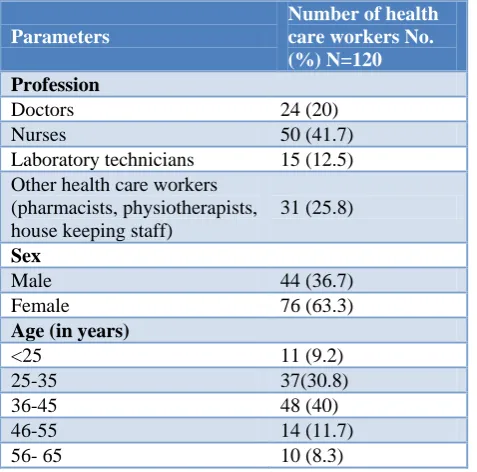
A total of 120 health care workers were recruited during the study of which 50 (41.7%) were staff nurses, 24 (20%) were doctors, 15 (12.5%) were laboratory technicians and 31 (25.8%) were other health care workers (pharmacists, physiotherapists and housekeeping staff). Of them, 76 (63.3%) were females and the rest were males. Maximum (40%) of them were in the age group of 36–45 years (Table 1).
Table 1: Characteristics of study participants.
Parameters
Number of health care workers No. (%) N=120
Profession
Doctors 24 (20)
Nurses 50 (41.7)
Laboratory technicians 15 (12.5) Other health care workers
(pharmacists, physiotherapists, house keeping staff)
31 (25.8)
Sex
Male 44 (36.7)
Female 76 (63.3)
Age (in years)
<25 11 (9.2)
25-35 37(30.8)
36-45 48 (40)
46-55 14 (11.7)
56- 65 10 (8.3)
Table 2: MRSA carriage status.
No. of health care workers sampled
No. positive for
S. aureus
No. positive for MRSA
120 49 9
Figure 1: Profession/cadre related distribution of S. aureus and MRSA carriage.
The nasal carriage rate of MRSA among HCWs was found to be 7.5% (9/120) and the prevalence of S. aureus
carriage in nares was 40.8% (49/120) (Table 2). The prevalence of MRSA among nurses was 10% (5/50), followed by laboratory technicians 6.6% (1/15), other health care workers 6.4% (2/31) and doctors 4.1% (1/24) (Figure 1).
Figure 2: Distribution of MRSA carriers.
Our study shows that among the 49 health care workers who were positive for nasal carriage of S. aureus, majority were nurses (21/49, 42.9%). Nine health care workers were positive for nasal carriage of MRSA, out of which 5 were nurses (55.6%) (Table 3). Among the total MRSA carriers, the carrier rate was highest among nurses (55.6%) (Figure 2).
The carriage rate of MRSA among males was 9.1% whereas it was 6.5% among females.
Table 3: Profession/cadre related distribution of S. aureus and MRSA carriage status.
Designation No. sampled (%)
N=120
No. positive for S. aureus carriage (%) N=49
No. positive for MRSA carriage (%) N=9
Doctors 24 (20) 7 (14.3) 1 (11.1)
Nurses 50 (41.7) 21 (42.9) 5 (55.6)
Laboratory
technicians 15 (12.5) 5 (10.2) 1 (11.1) Other health care workers (pharmacists,
physiotherapists, housekeeping staff) 31 (25.8) 16 (32.6) 2 (22.2)
Table 4: Characteristics of MRSA carriers.
Parameters No. of health care workers sampled
(N=120)
Number positive for MRSA (%)
Sex
Male 44 4 (9.1)
Female 76 5 (6.5)
Age
<25 13 1 (7.6)
25-35 37 2 (5.4)
36-45 42 4 (9.5)
46-55 14 1 (7.1)
56-65 14 1 (7.1)
No of years of working in the hospital
<1 year 29 2 (6.8)
1-5 years 56 2 (3.5)
>5 years 35 5 (14.2)
Figure 3: Antibiotic susceptibility profile of S. aureus isolates.
All the isolates of S. aureus were resistant to Penicillin. Resistance to Amoxyclav and Erythromycin was 80% and 58% respectively. All the S. aureus strains were 100% sensitive to Linezolid and Vancomycin (Figure 3) The MRSA isolates were 100% sensitive to linezolid and vancomycin. (MIC of vancomycin was in the range 1-2 ug/ml.) All the MRSA isolates were 100% resistant to Penicillin. Resistance to amoxyclav was 90%, to cotrimoxazole and erythromycin it was 60% and was 50% to clindamycin (Figure 4).
Figure 4: Antibiotic susceptibility profile of MRSA isolates.
DISCUSSION
S. aureus can colonise multiple sites in the body like the anterior nares, axilla, perineum, pharynx and gastrointestinal tract. But the most common site of colonization of S. aureus are the anterior nares.15
According to our study, the prevalence of S. aureus
carriage of S. aureus is 29.7% among the health care workers.16
Nasal colonization with S. aureus have been reported to range from 6.3 to 17.8% in the general population and in health care workers it varies from 18.2 to 28.2%.17,18
The maximum prevalence of S. aureus carriage is among nurses (42.9%) and the least was among laboratory technicians (10.2%) (Table 3/Figure 1). This is in contrast to the study conducted by Radhakrishna et al where the S. aureus carriage was highest among doctors (32.5%) and the least was among nurses (13.6%).4
In our study, the prevalence of MRSA among health care workers is 7.5% (Table 2) which is comparable to the findings of Cesur et al.19
It has been found that the prevalence of MRSA carrier state worldwide among the health care workers is around 10-40%.20
Literature search done by Albrich and Harbarth from January 1980 to March, 2006, which involved 127 investigations and screening of 33,318 health-care participants, revealed that 4.6% of the health care personnel were either infected or colonized with MRSA.10
Various studies in Indian health care settings have different rates of MRSA carriage among health care workers. An MRSA carriage rate of 1.8% from Pondicherry, 6.6% in Delhi and 2% in Madurai was revealed. Outside India, nasal carriage was 2% in Nepal and 38.9% in Nigeria.21-25
These differences in prevalence of MRSA are due to the variability in geographical distribution, hospital settings, hospital specialities and areas within hospital where the study was conducted.
The highest prevalence of MRSA carriage is among nurses (10%) in this study (Figure 1). This is in accordance with the findings of Kalyani et al where the carrier rate of MRSA among nurses is 7.5%.26 Study done by Al Humaidan et al showed a very high carrier rate of 23% among nurses.27
In contrast, the carriage rate among nurses is very low (2.7%) in the study conducted at Kasturba medical college.4
Among the nasal carriers of MRSA (total 9), 5 (56%) were nurses (Figure 2). This finding is similar to the study findings of Sridharan et al where 10 out of the total 17 MRSA carriers (58.8%) were nurses.28
The highest rate of MRSA carriage (14.2%) is among the health care workers who have worked for >5 years in this study (Table 4). In a study conducted by Al Humaidan et
al in Saudi Arabia the highest rate of MRSA carriage was among the health care workers who have worked for 4-6 years (26%) whereas lowest was observed among those who have worked for >7 years.27 In our study we did not find any workers who have worked for >7 years in the hospital. This may be probably due to the fact that our study period is for a short duration and the hospital is not a very old one, so we may have missed the few health care workers who have worked for >7 years.
Although the prevalence of MRSA among health care workers in our hospital is not alarming, it is important to emphasize the need for stringent hospital infection control policies. It is also important to stress the importance of hand hygiene among health care workers to prevent transmission of MRSA within the hospital and also to their family members.
All the S. aureus isolates were 100% sensitive to vancomycin and linezolid (Figure 3).
According to a study done by Arali et al, 4.9% resistance was observed for vancomycin, whereas the isolates were 100% sensitive to vancomycin in a study done by Morelli et al.29,30 Our study is also in accordance to the study of Radhakrishna et al where the sensitivity of S. aureus
isolates to vancomycin and linezolid was 100%.4 In this study, the resistance of S. aureus isolates to penicillin was 100% (Figure 3) which is similar to the findings of Radhakrishnan et al.4
Among the MRSA isolates, 100% sensitivity to vancomycin and linezolid was observed (Figure 4) in accordance with the findings of Radhakrishnan et al. However, sensitivity to vancomycin was 84.3% in a study done by El Aila et al.31 As disc diffusion test is not reliable for vancomycin we determined MIC of the MRSA isolates by automated Vitek 2 system. All the isolates showed MIC ≤2 µg/ml and hence were taken to be susceptible to Vancomycin which was similar to the findings of Radhakrishna et al.4
The sensitivity of MRSA isolates to erythromycin, teicoplanin, ciprofloxacin and gentamicin is 40%, 80%, 20% and 80% respectively (Figure 4) This can be compared to the antibiotic susceptibility pattern of MRSA strains isolated in Kasturba medical collegewhere the sensitivity to erythromycin is 40%, to teicoplanin and gentamicin is 80% and to ciprofloxacin is 20%.4 According to a study done in Al Shifa hospitalsensitivity of the MRSA isolates to gentamicin, ciprofloxacin, clindamycin, and vancomycin was 92.2,% 88.2%, 86.3% and 84.3%.31 In the present study sensitivity of MRSA isolates to clindamycin is 50%.
We informed the hospital infection control committee of our hospital regarding the findings of our study so that they could initiate decolonization measures.
CONCLUSION
In this study, nasal carriage of MRSA among the health care workers is 7.5% with the rate being highest among nurses (10%). Considering the fact that nurses are more involved in the patient care activities, it is necessary that they should be sensitized regarding this issue and the importance of hand washing should be emphasized upon them.
This study highlights the fact that we need to adhere to infection control practices to reduce the spread of MRSA to susceptible individuals. Hand Hygiene is the single most important measure that should be practiced in an appropriate manner to prevent the occurrence of nosocomial infections including MRSA.
ACKNOWLEDGEMENTS
We are thankful to the management of Kalinga Institute of Medical Sciences (KIMS), Bhubaneswar who have supported us in undertaking this project. We are thankful to Indian Council of Medical Research for approving this project (This research work was done under the STS program of ICMR). We are also thankful to the laboratory staff of MIcrobiology department who have helped us in this project. We are indebted to all the faculty members of the Department of Microbiology, KIMS, who have helped us in completing the project.
Funding: No funding sources Conflict of interest: None declared
Ethical approval: The study was approved by the Institutional Ethics Committee
REFERENCES
1. Pillai M, Latha R, Sarkar G. Detection of Methicillin Resistance in Staphylococcus aureus by Polymerase Chain Reaction and Conventional Methods: A Comparative Study. J Laboratory Physicians. 2012;4(2):83-8.
2. Melzer M, Eykyn SJ, Gransden WR, Chinn S. Is Methicillin-Resistant Staphylococcus aureus More Virulent than Methicillin-Susceptible S. aureus? A Comparative Cohort Study of British Patients with Nosocomial Infection and Bacteremia. Clin Infect Dis. 2003;37(11):1453–60.
3. Boucher H, Miller LG, Razonable RR. Serious Infections Caused by Methicillin‐Resistant
Staphylococcus aureus. Clin Infect Dis. 2010;51(2). 4. M Radhakrishna, Souza MD, Kotigadde S.
Prevalence of Methicillin Resistant Staphylococcus aureus Carriage amongst Health Care Workers of Critical Care Units in Kasturba Medical College
Hospital, Mangalore, India. J Clin Diagnos Res. 2013;2:697–700.
5. Ruiz A, Mora M, Zurita C, Larco D, Toapanta Y, Zurita J. Prevalence of methicillin‐resistant
Staphylococcus aureus among health care workers of intensive care units in Ecuador. J Infection Developing Countries. 2014;8(1):116-9.
6. Sassmannshausen R, Deurenberg RH, Köck R, Hendrix R, Jurke A, Rossen JWA, et al. MRSA Prevalence and Associated Risk Factors among Health-Care Workers in Non-outbreak Situations in the Dutch-German EUREGIO. Frontiers in Microbiol. 2016;7.
7. Eiff CV, Becker K, Machka K, Stammer H, Peters G. Nasal Carriage as a Source of Staphylococcus aureus Bacteremia. N Eng J Med. 2001;344(1):11– 6.
8. Simpson AHRW, Dave J, Cookson B. The value of routine screening of staff for MRSA. J Bone Joint Surg Br. 2007;89(5):565–6.
9. Vonberg RP, Stamm-Balderjahn S, Hansen S, Zuschneid I, Rüden H, Behnke M, et al. How Often Do Asymptomatic Healthcare Workers Cause Methicillin-Resistant Staphylococcus aureus
Outbreaks? A Systematic Evaluation. Infection Control Hospital Epidemiol. 2006;27(10):1123–7. 10. Albrich WC, Harbarth S. Health-care workers:
source, vector, or victim of MRSA? Lancet Infect Dis. 2008;8(5):289–301.
11. Cheesbrough M. District Laboratory Practise in Tropical Countries. Part 2. Cambridge University Press, Cambridge, 2009: 62-68.
12. Bauer AW, Kirby QMM, Sherns J C, Turik M. Antibiotic susceptibility testing by standardized single disk method. Am J Clin Path. 1966;45:493-6. 13. CLSI. Surveillance for Methicillin-Resistant
Staphylococcus aureus: Principles, Practices, and Challenges; A Report. CLSI document X07-R. Wayne, PA: Clinical and Laboratory Standards Institute; 2010.
14. Clinical and Laboratory Standard Institute. Performance standards for antimicrobial susceptibility; 22nd informational supplement; CLSI document M100-S22. 2012;32(3).
15. Wertheim HF, Melles DC, Vos MC, van Leeuwen W, van Belkum A, Verbrugh HA, et al. The role of nasal carriage in Staphylococcus aureus infections. Lancet Infect Dis. 2005;5:751-62.
16. Treesirichod A, Hantagool S, Prommalikit O. Nasal carriage and antimicrobial susceptibility of Staphylococcus aureus among medical students at the HRH Princess Maha Chakri Sirindhorn Medical Center, Thailand: A cross sectional study. Journal of Infection and Public Health. 2013;6(3):196–201. 17. Pathak A, Marothi Y, Iyer RV, Singh B, Sharma M,
18. Kim OS, Yim J. Rates of Staphylococcus Aureus and Methicillin-resistant Staphylococcus Aureus Nasal Carriage Infections among Nursing Students. Int J Bio-Sci Bio-Tech. 2015;7(5):21-32.
19. Cesur S, Cokça F. Nasal carriage of methicillin-resistant Staphylococcus aureus among hospital staff and outpatients. Infect Control Hosp Epidemiol. 2004;25:169-71.
20. Azeez-Akanda O. Global trend of methicillin-resistant Staphylococcus aureus and emerging challenges for control. Afr J Clin Exp Microbiol. 2010;11:150-8.
21. Mathanraj S, Sujatha S, Sivasangeetha K, Parija SC. Screening for methicillin-resistant Staphylococcus aureus carriers among patients and health care workers of a tertiary care hospital in Southern India. Indian J Med Microbiol. 2009;27:62-4.
22. Goyal R, Das S, Mathur M. Colonisation of methicillin resisitant Staphylococcal aureus among health care workers in a tertiary care hospital of Delhi. Indian J of Med. Sciences 2002;56(7):321-4. 23. Vinodhkumaradithyaa A, Uma A, Srinivasan M,
Ananthalakshmi I, Nallasivam P, Thirumalaikolundusubramanian P. Nasal Carriage of Methicillin – Resistant Staphylococcus aureus among Surgical Unit Staff. Jpn J Infect Dis. 2009;62:228-9.
24. Shakya B, Shrestha S, Mitra T. Nasal carriage rate of methicillin resistant Staphylococcus aureus among at National Medical College Teaching Hospital, Birgunj, Nepal. Nepal Med Coll J. 2010;12(1):26-9.
25. Fadeyi A, Adeboye MAN, Fowotade A, Nwabuisi C, Bolaji BO, Oyedepo O, et al. Methicillin Resistant Staphylococcus aureus Carriage amongst Healthcare Workers of the Critical Care Units in a Nigerian Hospital. Am J Infect Dis. 2010;6(1):18-23.
26. Kalyani K, Jayakumari K, Kumar JS. Prevalence of MRSA among HCWs of Shri Satya Sai Medical
College and Hospital – A tertiary care centre. J Dent Med Sci. 2012;3:23–7.
27. Al-Humaidan O, El-Kersh T, Al-Akeel R. Risk factors of nasal carriage of Staphylococcus aureus and methicillin-resistant Staphylococcus aureus among health care staff in a teaching hospital in central Saudi Arabia. Saudi Med J. 2015;36(9):1084–90.
28. Sridharan K, Mallik A, Madan M. Prevalence of methicillin-resistant Staphylococcus aureus among hospital healthcare workers in a tertiary care hospital: A cross-sectional study. Int J Health Allied Sci. 2016;5:169-71.
29. Arali S, Kulkarni V, Manjula GN, Gaddad S, Jayaraj Y, Shivannavar C. Prevalence and antibiotic susceptibility profile of MRSA isolated from the Anterior Nares of school going children in Gulbarga. Int J Med Sci Public Health. 2016;5(4):620.
30. Morelli J, Hogan PG, Sullivan M, Wallace M, Muenks C, Wang J, et al. Antimicrobial Susceptibility Profiles of Staphylococcus aureus (SA) Isolates Recovered From Humans, Environmental Surfaces, and Companion Animals in Households of Children With Community- Associated Methicillin-Resistant S. aureus (CA-MRSA) Infections. Open Forum Infect Dis. 2015;2(1).
31. Aila NAE, Laham NAA, Ayesh BM. Nasal carriage of methicillin resistant Staphylococcus aureus among health care workers at Al Shifa hospital in Gaza Strip. BMC Infect Dis. 2017;17(1):28.