The State of Using SMS-Based e-Government
Services: Case Study in Jordan
Mohammad Al-ma'aitah 1, Mohammad altarwneh
Haroon altarawneh
Email: [email protected]
---ABSTRACT--- Recently the Hashemite Kingdom of Jordan has wide spread of information technology and communications. In addition, it has improved the infrastructure of mobile phone networks. This encourage government to take advantage of this development and trying to provide SMS-Based e-Government Services through their e-government program. This paper tries to evaluate the state of using SMS-Based e-Government Service in the Hashemite Kingdom of Jordan and study the factors that affect on citizen adoption of this service. This study investigated a sample formed of (600) individuals distributed on three categorize were university students and Employees, public sector employees, private sector employees. The study presented statistical information explained the state of using SMS-based e-government service by Jordanian citizens. In addition the study showed that individual’s beliefs have positive effect on use SMS-based e-government services. Furthermore it orders these factors ascending depending on importance, from Jordanian citizens' perspective. The top three factors were Perceived ease of use, perceived efficiency in time and distance, perceived value for money.
Keywords – Believes, E-government, Jordan, SMS, SMS-Based Services.
---Date of Submission: October 06, 2012 ---Date of Acceptance: November 27, 2012---1. Introduction
T
he huge growing of the Internet; supports new opportunities for managing the government business online. Today all governments try to use technology in facilitating the delivery of services electronically. In addition to the Internet, the number of mobile users growing day by day in Jordan, Mobile phones offer a suitable channel through which communicating citizen, organizations and staff. Through the use of text messaging, Governments will be able to send information that is quick and easy access to all areas. As well as making government accessible to people regardless of where they where they may at any time.E-Government program works in Jordan to provide services to citizens through various communication channels, Also SMS is one of the services provided to all segments of Jordanian society. This service is one of the common services provided by the e-Government program in government agencies. There is two Types of SMS available:
1. Push Messages: Messages sent by government to the citizens without a request, such as reminders, awareness campaigns, information on the status of a transaction.
2. Pull Messages these are the messages sent by citizens to request certain information through the number 94444 number, a message is then received with the information requested by the citizen, which was obtained from the department concerned.
Every citizen has the free will to query one-time only, or to subscribe in the service to obtain short SMS on an ordinary source from the concerned sector.
broadcast by the various institutions and government departments for citizens Which reached 7.9 million gate
message Phones through last period [1].
2. Theoretical background
The concept of e-Government is a comprehensive concept. Many definitions have developed for this concept with taking into account the fact that this concept is still under development. The following are some of these definitions. According [2] they defined it as the use information technology to support access to government information and deliver services to citizens and business partners. Also [3] argued that “E-Government” refers to the use by government agencies of information technologies (such as Wide Area Networks, the Internet, and mobile computing) that have the ability to transform relations with citizens, businesses, and other arms of government. These technologies can serve a variety of different ends: better delivery of government services to citizens, improved interactions with business and industry, citizen empowerment through access to information, or more efficient government management. The resulting benefits can be less corruption, increased transparency, greater convenience, revenue growth, and/or cost reductions".
Government could be able to provide government services and information through the media and new interactive tools, taking advantage of the benefits provided by these media, especially information and communications technology. As the government and e-democracy is one of the most important success factors for the development of e-citizenship. E Democracy means that citizens will not only use technology to notify themselves about present events, but will also use it for active participation to their administration governments [4]. According [5] they argued that Governments must support its citizens with several options for electronic access to their services, because each method has positives and negatives.And it depends on the circumstances and considerations of each government. Despite persistent attempts to apply this concept, but many countries can not progress up to now at this level. Several studies have done to figure out the obstacles faced by governments to transport electronically such as ([6]; [7]; [8]; [9]; [10]). The study [7] argued that the following determinants (perceived usefulness, relative advantage, and trust) have attention to use E-government. The study [11] showed that is privacy one of the determinants of customer loyalty. Also they considered that the privacy of information for people is one of the key factors for customers and make them do not use services provided through the Mobile if it doesn't available. Recently many governments used SMS in the provision of electronic services; the following are some examples explain some of these uses. Singapore banks have been using SMS extensively for information security issues and authentication. In Europe SMS is used for many purposes such as: tram/bus ticket booking, parking slot
booking, fleet management, alert accident or car theft [12]. Telemedicine system based on Internet and short message service reduced 62% the number of unscheduled face-to-face visits, and 82.7% in the subgroup of insulin-treated patients, improving patient satisfaction, and achieving similar pregnancy and new born outcomes [13]. The study [14] argued that, at present, short message brings people profit in various aspects, including every day communication, celebration greeting, and weather estimate, manage stock information, short news, etc. As the role of short message increasingly enlarges, it becomes a very main issue to automatically categorize short messages in order to reach an efficient management. Australian study showed that Deaf persons have adapted with modern technology that give them a better ability to communicate and meet their requirements. This study also showed that participants were from all age groups [15]. [16] Believed that _"The spread of Internet technology in providing services and expanding outreach fits the explanatory analysis of no controversial policies that are diffused by a process of emulation, executive power, leadership, and professional networks reinforce this pattern of emulation ". In India, according to a study applied to more than 100 villages that the farmers rely heavily on SMS service to get information about weather, prices and demand and supply their crops [17]. The study [18] shows that on his study convenience and low cost, entertainment, coordination, and fashion were strong instrumental motives for SMS use. Diffusion of e-services has huge effect on gross domestic product (GDP) [19].
compatibility; and perceived self-efficacy in using SMS are considered important factors have influences citizens to use
or to refuse the services toward using SMS-based e-government services.
The prior researches presented three dimensions that may influence individuals to use an SMS based e-government service as shown in the following Table:
Table 1: Dimensions toward using SMS based e-government service [22].
Beliefs Definitions
Perceived behavioral controls
Self-efficacy to use SMS The degree to which individuals is confident that he/she is able to use SMS
Resource facilitating conditions The degree to which an individuals perceive that a mobile phone ( as a device) and money or phone credit are available for using the service
Social norms
External influences Influences from mass media
Interpersonal influences Influences from interpersonal networks , such as friend s, family, or supervisors
Attitude toward using the service
Perceived responsiveness The degree to which an individuals believes that his/her SMS will be respond by government quickly, appropriately and satisfactorily
Perceived good Government The degree to which an individuals believes that the government has implemented good governance principle such as transparency, accountability, and anti-corruption.
Perceived reliability of the system performance
The degree to which an individuals is confident that SMS-based system is reliable all the time.
Perceived reliability of the mobile network The degree to which an individuals is confident that his/her mobile network is reliable for accessing the SMS-based system
Trust of the SMS technology The degree to which an individuals believes that using an SMS channel is safe and will not initiate any problem for him/her.
Perceived Compatibility The degree to which a citizen perceives that the service is consistent with the existing public service channels and the popular communication media, and the information is suitable to be derived by SMS than other channels
Perceived ease of use The degree to which an individuals perceives that the service is free difficulty to use
Perceived communication control The degree to which an individuals perceives that the service enable him or her to control to take control over the over the communication
Perceived efficiency in time and distance The degree to which an individuals perceives that the service could lower traveling and queuing time, and cut traveling expenses to get the service manually
Perceived convenience The degree to which an individuals perceives that the service can be accessed by any time any where
their emotion and social or personal identity.
Perceived enjoyment The degree to which an individuals believes that using the service is enjoyable
Perceived surveillance The degree to which an individuals believes that the service enable him or her to let others know about some critical or beneficial information
Perceived personal relationship The degree to which an individuals believes that the service enable him or her to communicate personally and develop personal relationship
Perceived usefulness The degree to which an individuals believes that the service is relevant and satisfy his/her need
Perceived value The degree to which an individuals believes that what is received from the service is worthy to what is given to the service
Perceived cost The degree to which an individuals perceives that the service's cost is worthy to cost paid
Anxiety Physiological barriers that may deter individuals from using the service, such as anxiety, shyness, or afraid of making mistake
Perceived risk to user privacy The degree to which a citizen believes that the system can maintain confidentially and using the service will not cause privacy problems
Perceived financial risk The degree to which an individuals believes that using service the service might cause financial problem
According [23] they classified SMS-based e-government services into six levels as follow:
1. Listen level: in this type of message citizens can send their messages in one direction only, without responding to them, such as services of complaints and suggestions.
2. Notification level: In this type of message the Government inform its citizens some of personal information or inform them some instructions or services and this type is also a one-way.
3. Pull-based Information level: This type of message is two-way between the citizen and the government, such as the citizen to inquire about violations of his
car and answer come to him directly. The information options provided by services in this level are restricted and the request-text must be in a convinced format.
4. Communication level: This type of message is two-way between the citizen and the government with no worrying about the text format.
5. Transaction level: In this kind of messages people can accomplish operations such as paying utility bills. 6. Integration level: In this model integrates all the
services-based messages in a single portal so citizens can access the services by sending SMS to one number only.
3. Methodology
3.1 Samples of the study
University students, public sector employees, private sector employees are selected as the respondents for this research. We choose this 600 questionnaires distributed to the three previous groups in the central states of Jordan; equally. The first section of the questionnaire was about demographic of respondents' information. Second and third section were adopted from previous researches [20], second section items asks about using, perception but not use, not perception of SMS based e- government service. Third section items ask about effect of citizens' beliefs on use SMS-based e-government services. The five point
4. Respondents' profile
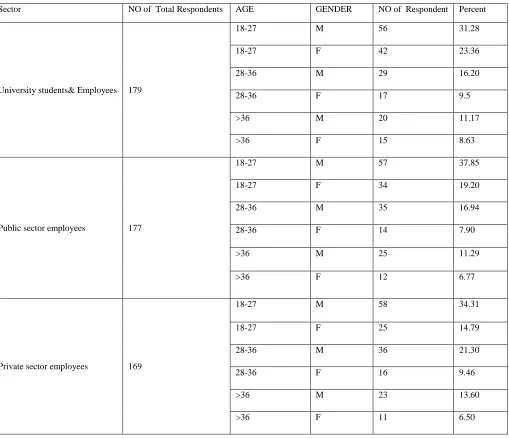
The following Table despite respondents' information which represent respondent sector, age, gender, number of
respondent, and percentage of respondent by age for each sector.
Table 2: Respondents information.
Sector NO of Total Respondents AGE GENDER NO of Respondent Percent
University students& Employees 179
18-27 M 56 31.28
18-27 F 42 23.36
28-36 M 29 16.20
28-36 F 17 9.5
>36 M 20 11.17
>36 F 15 8.63
Public sector employees 177
18-27 M 57 37.85
18-27 F 34 19.20
28-36 M 35 16.94
28-36 F 14 7.90
>36 M 25 11.29
>36 F 12 6.77
Private sector employees 169
18-27 M 58 34.31
18-27 F 25 14.79
28-36 M 36 21.30
28-36 F 16 9.46
>36 M 23 13.60
>36 F 11 6.50
5. Findings and discussion
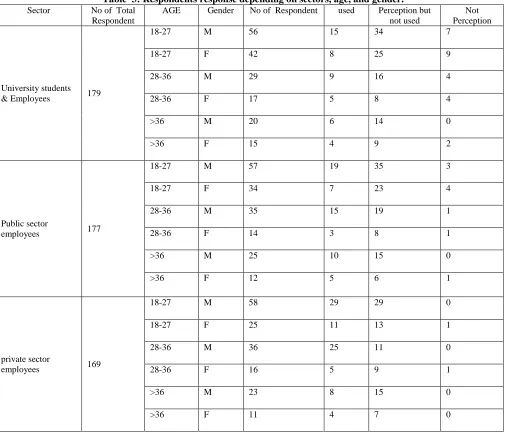
This study investigated the level of perception and adoption of SMS-based e-government services among respondents. It categorized the percentages of the citizens into: (i) those who used SMS-based e-government
Table 3: Respondents response depending on sectors, age, and gender. Sector No of Total
Respondent
AGE Gender No of Respondent used Perception but not used
Not Perception
University students & Employees 179
18-27 M 56 15 34 7
18-27 F 42 8 25 9
28-36 M 29 9 16 4
28-36 F 17 5 8 4
>36 M 20 6 14 0
>36 F 15 4 9 2
Public sector
employees 177
18-27 M 57 19 35 3
18-27 F 34 7 23 4
28-36 M 35 15 19 1
28-36 F 14 3 8 1
>36 M 25 10 15 0
>36 F 12 5 6 1
private sector
employees 169
18-27 M 58 29 29 0
18-27 F 25 11 13 1
28-36 M 36 25 11 0
28-36 F 16 5 9 1
>36 M 23 8 15 0
>36 F 11 4 7 0
The following figure represents citizens who used, perception but did not use, and not perception of SMS-
based e-government services for all respondents
The above figure show that the percentage of respondents who used SMS-based e-government services (36%), who
were perception of, but did not use them(56.7%), who were not even perception of the services (7.3%)
5.1 Citizens age and perception and adoption of SMS-based e-government services Unlike previous studies, such as studying[21], Where the
previous mentioned study found that as the citizens’ age increased, there was more perception of and adoption of SMS-based e-government services. In this study we found that as the citizens’ age decreased, there was more perception of and adoption of SMS-based e-government services in Jordan environment as shown in Table(4). We comfort this to the young men, whether college students
or recent graduates tend to use a mobile phone in a variety of uses not only for contact, they use it for Internet, work conferences, facebook, In addition to orientation to acquire modern mobile phones provides them with a variety of services and this is what makes them more likely to use SMS in e-government applications more than other age groups.
Table 4: Age Comparisons.
Age Used Perception but not used Not Perception
18-27
46.59% 53.73% 63.15%
28-36
34.03% 23.98% 28.96%
>36 19.37% 22.29% 7.89%
5.2 Citizens' gender and perceptions and adoption of SMS-based e-government services
In this context, our study coincided with previous studies which indicate that more males than females were used SMS e-government services as shown in Table (5). Of the 339 male respondents, 136(40.11%) were used and 188 (55.45%) perception of the services compared to the 186 female respondents, 55 (29.56%) were used and 108 (58.6%) perception of the service.
We comfort that the percentage of users to Short Message Service for the use of e-services in the Jordanian environment is that men are always helping women in the provision of services, whether electronic or traditional.
We hope to provide services electronically in a variety of e-Government; either through SMS or the Internet which will give Jordanian women chances for self-reliance and perform services on their own
Table 5: Gender Comparisons.
Gender Used Perception but not used Not Perception
M
40.11 55.45
4.42
F
29.56 58.6
12.36
5.3 Sectors and perception and adoption of SMS-based e-government services
For purpose of this study we were choose three sections of the Jordan Environment and that was on the grounds that these sectors are the most educational and commonly used for technology. These sections were University
students and employees, public sector employees and private sector employees.
We comfort this to the culture of the use of technology in the private sector which is much larger than the rest of the sectors and this is reflected in the employee's daily work
including the use of SMS technology to manage their lives and take advantage of the time as best they can.
Table 6: Sectors Comparisons
.
Sectors Used Perception but not used Not Perception
University students& employees 26.25% 59.12% 14.5%
Public sector employees 39.45% 54.19% 5.74%
Private sector employees 48.8% 50% 1.91%
5.4 Individual’s beliefs which influence citizens to use or not use SMS-based e-government services
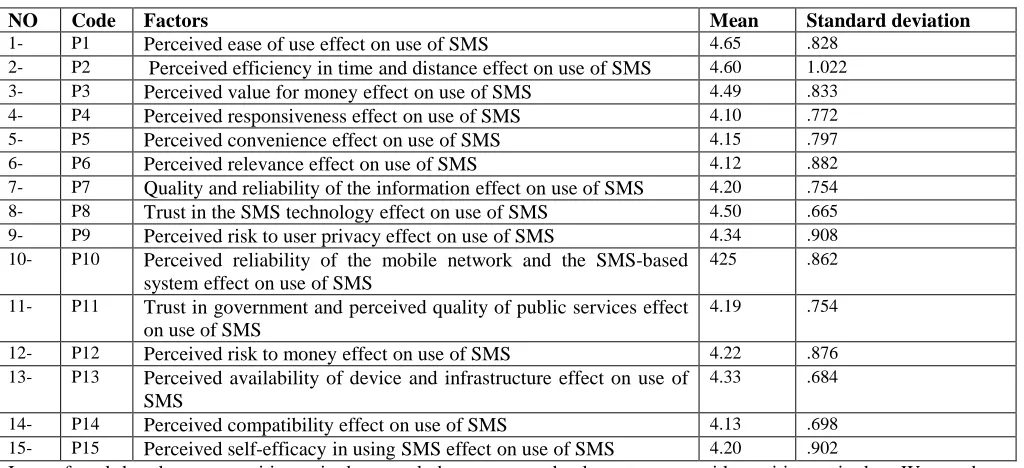
According to the theoretical background which we presented above, there are many beliefs effect on use or not use SMS-based e-government services, these studies listed 15 beliefs which may influence citizens to use or to refuse an SMS service. We will examine these beliefs effect on use SMS based e-government service in the Hashemite Kingdom of Jordan environment. Accordingly we proposed the following hypothesis:
H0: Individual’s beliefs have not positive effect on use SMS-based e-government services
H1: Individual’s beliefs have positive effect on use SMS-based e-government services
To test the previous hypothesis we analyst just
questionnaires respondent who were their answers use or perception but didn’t use which they represent 92.3 of all respondents.
Table 7: Describes Analysis
NO Code Factors Mean Standard deviation
1- P1 Perceived ease of use effect on use of SMS 4.65 .828
2- P2 Perceived efficiency in time and distance effect on use of SMS 4.60 1.022
3- P3 Perceived value for money effect on use of SMS 4.49 .833
4- P4 Perceived responsiveness effect on use of SMS 4.10 .772
5- P5 Perceived convenience effect on use of SMS 4.15 .797
6- P6 Perceived relevance effect on use of SMS 4.12 .882
7- P7 Quality and reliability of the information effect on use of SMS 4.20 .754 8- P8 Trust in the SMS technology effect on use of SMS 4.50 .665 9- P9 Perceived risk to user privacy effect on use of SMS 4.34 .908 10- P10 Perceived reliability of the mobile network and the SMS-based
system effect on use of SMS
425 .862
11- P11 Trust in government and perceived quality of public services effect on use of SMS
4.19 .754
12- P12 Perceived risk to money effect on use of SMS 4.22 .876
13- P13 Perceived availability of device and infrastructure effect on use of SMS
4.33 .684
14- P14 Perceived compatibility effect on use of SMS 4.13 .698
15- P15 Perceived self-efficacy in using SMS effect on use of SMS 4.20 .902 It was found that there are positive attitude toward above
questions because their means are greater than mean of the scale (3). Also q1 has the greatest positive attitudes with the highest mean. We argued that the ease of use of any technological application that is the secret of the success of this modern application. And q14 has
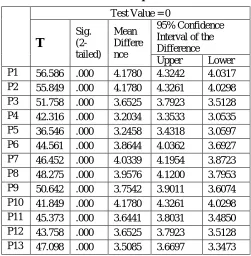
Table 8: One sample T-test
Test Value = 0
T
Sig. (2-tailed) Mean Differe nce 95% Confidence Interval of the DifferenceUpper Lower P1 56.586 .000 4.1780 4.3242 4.0317 P2 55.849 .000 4.1780 4.3261 4.0298
P3 51.758 .000 3.6525 3.7923 3.5128
P4 42.316 .000 3.2034 3.3533 3.0535 P5 36.546 .000 3.2458 3.4318 3.0597
P6 44.561 .000 3.8644 4.0362 3.6927
P7 46.452 .000 4.0339 4.1954 3.8723
P8 48.275 .000 3.9576 4.1200 3.7953 P9 50.642 .000 3.7542 3.9011 3.6074
P10 41.849 .000 4.1780 4.3261 4.0298
P11 45.373 .000 3.6441 3.8031 3.4850 P12 43.758 .000 3.6525 3.7923 3.5128
P13 47.098 .000 3.5085 3.6697 3.3473
P14 45.715 .000 3.4661 3.6163 3.3159
P15 44.275 .000 3.9576 4.1200 3.7953
Depending on the statistical analysis we reject H0 and accept H1 depend on the significant values which all less than .05, as shown in the Table above, Indicates that Individual’s beliefs have positive effect on use SMS-based e-government services. In addition for that and depending on t vales showed in the above Table, we can arrange these factors as there importantly on use SMS based e-government service from Jordanian citizens' perspective. The factors order were as follow: Perceived ease of use, perceived efficiency in time and distance, perceived value for money, perceived risk to user privacy, trust in the SMS technology, perceived availability of device and infrastructure, quality and reliability of the information, perceived compatibility, trust in government and perceived quality of public services, perceived relevance, perceived self-efficacy in using SMS, perceived risk to money, perceived responsiveness, perceived reliability of the mobile network and the SMS-based system, perceived convenience.
6. Conclusions
This research presented The State of Using SMS-Based e-Government Services in the Kingdom of Jordan. Where this study has provided a detailed presentation of the categories use, perception but did not used and unused for these service. And these cases were discussed based on targeted sectors and in terms of gender and age. It was observed that the vast majority realize the advantage of using SMS in the e-government applications but do not use this service. Our study
attributed that
for several reasons including a lack of motivation for citizens to use this service by pro bono and e-government specialized, as well as the absence of the role of institutions providing these services. And other reasons lack of perception's and advertising methods for these services and there are not support from other organizations like educational enterprises,Ministry of Industry and Commerce, Ministry of Municipalities, which could give there supports by making seminars,Production of brochures and guides
,conferences to citizens to help in advertising and perception's of the utility of this service and how to use and support phone numbers necessary for the query or applied of these services. Also traffic department may put illustrative Hoa_khas on public roads to announce about these services. It also has this study examining the role of citizen beliefs on the use of this service, the statistical results showed that there is significant impact to the convictions of personal citizens to adopt and use these services and applications So, officials applied these services in e-government has to focus on the development of these beliefs in a positive way because of their significant role of the success of this attends. Also has to be done intensive study on this subject especially that Jordan is still in its early stages in this subject and this study one of the very few studies on this subject in Jordan.
References
[1]. www.alghad.com/index.php/article/523766.html,
[2]. Turban, E, and King, D, Electronic Commerce: A Managerial Perspective (Prentice Hall, 2004). [3]. World Bank (2008), Definition of e-government,
available at: http://go.worldbank.org/ M1JHE0Z280 (accessed 1 April 2012).
[4]. Biasiotti, M and Nannucci, P, E-democracy Prospects: E-xitizenship within the European and
Italian Polices, IADIS International Conference e-Society, Italy, 2004.
[6]. Sacheva, S., Change Management for e-Governance, Journal of E-Government Policy and Regulation, Vol. 32, 2009, pp. 109–117.
[7]. Sang, S. and Lee, J., E-government adoption in ASEAN: the case of Cambodia, Internet Research Journal, Vol. 19 No. 5, 2009, pp. 517-534.
[8]. Warkentin, M., Gefen, D., Pavlou, P. and Rose, G., Encouraging citizen adoption of e-government by building trust, Electronic Markets, Vol. 12 No. 3, 2002, pp. 157-62.
[9]. Carter, L. and Be´langer, F., The utilization of e-government services: citizen trust, innovation and acceptance factors, Information Systems Journal, Vol. 15 No. 1, 2005, pp. 5-25.
[10].Kolsaker,A and Kelley,L., Citizens’ attitudes towards e-government and e-governance: a UK study, International Journal of Public Sector Management Vol. 21, No. 7, 2008, pp. 723-738. [11].Wahab, S., Zahari, A., and Khaled, M., The
influence of perceived privacy on customer loyalty in mobile phone services: An Empirical Research in Jordan", IJCSI International Journal of Computer Science Issues, Vol. 8, 2011.
[12].Mukhebi, A., Kenya agricultural commodity exchange limited (KACE), reaching the poor in rural Kenya with market information: a case study of a market information system, Proceeding, Role of Information Tools in Food Security, CTA Seminar, Mozambique, 2004.
[13].Ferre, N., Galindo, M., and Velasco, V., A Telemedicine system based on Internet and short message service as a new approach in the follow-up of patients with gestational diabetes, Diabetes Research and Clinical Practice Journal, available at: www.elsevier.com/located/diabres., 2009
[14].Jun, G., The classification on short message, The
Journal of china universities of posts and telecommunication, Vol. 14, 2007.
[15].Power, M., Power, D., and Horstmanshof, L., Deaf People Communicating via SMS, TTY, Relay Service, Fax, and Computers in Australia, Published by Oxford University Press, 2006
[16].Jung, H. and Opheim, C., Building on Success: The Diffusion of e-Government in the American State Electronic Journal of e-Government, Volume 8, 2010, pp.71-82.
[17].Fafchamps, M and Minte, B., Impact of SMS-Based Agricultural Information on Indian Farmers, Published by Oxford University, 2012.
[18].Leung, L., Unwillingness-to-communicate and college students’ motives in SMS mobile messaging", Journal of Telematics and Informatics, Vol.24 , 2007, pp. 115–129.
[19].Turk, T., Jerman, B and Trkman, P., Factors and sustainable strategies fostering the adoption of broadband communications in an enlarged European Union, Journal of Technological Forecasting & Social Change, Vol. 75, 2008, pp. 933–951.
[20].Hujran, O., Toward the utilization of M-Government service in developing countries: A qualitative invistigation International Journal of Business and Social Science Vol. 3 No. 5. 2012, pp.150-160.
[21].Susanto, T and Goodwin, R., Factors Influencing Citizen Adoption of SMS-Based e-Government Services, Electronic Journal of e-Government Vol. 8, 2010 , pp.55-71.
[22].Susanto, T and Goodwin, R., Adoption Success Factors of SMS-based e-Government: A Case Study of SMS-OBM and SMS-MIIAS", The 3rd International Conference on Chief Information Officer (ICCIO), Bandung, Indonesia ,2010.
![Table 1: Dimensions toward using SMS based e-government service [22]. Beliefs](https://thumb-us.123doks.com/thumbv2/123dok_us/1298836.1636894/3.612.45.570.143.716/table-dimensions-using-sms-based-government-service-beliefs.webp)