RESEARCH ARTICLE
A Novel Efficient Rebroadcast Protocol for
Minimizing Routing Overhead in Mobile Ad-Hoc
Networks
Priyaganga Guruswamy
Department of Information Technology, PIIT, Mumbai University, India.
Madhumita Chatterjee
Department of Computer Engineering, PIIT, Mumbai University, India.
Abstract – Mobile Ad-Hoc Network (MANET) is a wireless ad-hoc network comprising of mobile devices which undergo peer to peer routing, to provide network connectivity instead of pre-existing network infrastructure. Despite its simplicity of network infrastructure, however it poses challenges of variable link capacity, dynamic topology, exhaustible battery power of nodes and limited physical security. In MANET, broadcasting is a conventional mechanism carried out to deliver messages from source node to all other nodes in MANET. Flooding is commonly used method for broadcasting of Route Request (RREQ) packet which is prone to broadcast storm problem. As a result, there is a need of an efficient routing strategy to build a reliable route which can neglect high variation of signal strength, collision and draining of battery power. In this paper, a new approach is introduced to rebroadcast based on an efficiency factor called delay and to provide a route repairing procedure against link failures. Our approach also focuses on disseminating neighbor coverage knowledge within nodes in order to avoid duplication problem of RREQ packets. Simulation results of our approach reveal better performance in terms of metrics such as packet delivery ratio, energy consumption and control overhead.
Index Terms – Broadcast, Collision, Energy, Failures, & Rebroadcast
1. INTRODUCTION
Mobile Ad-hoc Network (MANET) consists of group of mobile nodes which can move arbitrarily in any direction. This network has no aid of any centralized administration or backbone for communication between nodes. Earlier, connectivity is achieved by means of flooding the RREQ packet in network, however it causes high collision and energy consumption of nodes respectively. The wireless link in network makes it unstable to determine a flexible route due to its channel characteristics. Mobile nodes in network play a significant role in connectivity. The coordination of nodes has strong impact on performance of the network [1]. When the source has to transmit data to the destination node that is not within its transmission range, then it uses the intermediate nodes to reach the destination. This way MANET behaves like
a multi-hop network [2]. Nodes assist each other by passing data and control packets from one node to another. Ad hoc network topology changes as mobile hosts shift to another geographical location or dead due to less battery power [1, 3]. A node may encounter certain challenges on battery and traffic at node, due to which it may lack its ability of forwarding RREQ packet. The energy of mobile nodes in a route are depleting significantly compared to those node which are in sleep state. As a result, node may have variable chances of participating in a stable path. Energy management is the duty of MAC (Medium Access Control) layer while the network layer can take decisions based on current traffic characteristics or topology [3].The behavior of mobile nodes are unpredictable when it is congested with traffic flow of data packets. Thus, our routing scheme must ensure that nodes participating in a reliable route should have favorable links, sufficient energy to route packets and few load. In order to reduce the number of retransmissions and improve the network connectivity, we introduce a new metric for efficiency known as rebroadcast delay factor in our proposed scheme. In this paper, we proposed an efficient algorithm which mainly focuses on three different network statuses such as link quality between the nodes, energy and routing load at each node, which are combined to define rebroadcast delay. Thereby, a route repairing procedure is introduced against link failures. The rest of the paper is organized as follows: In section 2, we discuss the related work on routing approaches and probabilistic scheme for routing. The description of our proposed work is introduced in section 3, then section 4 prescribes the performance of our approach with simulation results. Finally, we present our conclusion in section 5.
2. RELATED WORK
RESEARCH ARTICLE
centralized system to handle the routing process, it incurs high collision rate of packets due to redundant rebroadcasts. D. Johnson et.al [6] proposed a novel approach of dynamic source routing protocol which includes flooding of RREQ packets from source node until a valid route to destination is found. When the destination receives the first RREQ packet it immediately sends back RREP packet all along the active path to the source node. The drawback of this approach is it fails to optimize the most suitable route without ensuring path recovery against link failure. Unlike AODV, flooding of RREP packets are not considered in this approach.
LI Ting et.al [7] presented an approach based on signal to noise ratio, where each node broadcasts RREQ packet based on signal to noise ratio and evaluating delay factor. Route with smallest delay factor is being considered by destination node. Thus, flexibility of a route is maximized, by selecting a lowest delay path which improves the efficiency of network. Redundancy of RREQ packet is possible, since there is no nearby neighbor coverage information within the nodes and the approach does not resolve a broken link in a path.
Zeki Bilgin [8] introduced the ideology of optimizing the route using dynamic shrink mechanism. The mechanism involves decreasing number of hops in a path, which leads to reduction of 2 hop connection to 1 hop connection by forwarding shrink-0 and shrink-1 message to each active node in a route. Thereby eliminating unnecessary hops in an active route. However, it causes flooding of shrink messages received from intermediate nodes.
ShivaShankar et.al [9], proposed energy based routing protocol which identifies energy of each node in a path on transmitting RREQ (Route Request). The selection of a route with largest minimum energy node is optimized by the destination node. Although, this approach does not ensure to reduce number of hops and repair a broken link. One of the disadvantage of this approach is that, it considers route with maximum number of hops.
Xing Ming Zhang et.al [10], proposed a routing protocol considering AODV [5] as a base. A node may rebroadcast the RREQ packet to its uncommon neighbors based on a probability P. The probability factor is computed depending upon the fact that less the number of common neighbors, more the probability of forwarding the packet but then it shows lot of complexity in determining this probability. The node only shows that it must forward RREQ packet when the local density of nodes are low in network. As a result, the approach works even better in sparse network area rather than dense area.
3. EFFICIENT REBROADCAST PROTOCOL Our proposed method shows the impact of neighbor coverage knowledge by sorting the uncovered neighbors list of an intermediate node. The objectives of our proposed approach are as follows:
To determine energy efficient reliable route
To achieve path stability in network
To minimize routing overhead.
In, the route discovery process of neighbor coverage based probabilistic rebroadcast routing algorithm [10], the node may flood RREQ packet only based on probability and uncovered nodes. According to our protocol, if an inefficient node is involved in rebroadcasting process in terms of energy, load or link quality it will affect in data dissemination performance. Hence a technique is contributed that allows the node to rebroadcast when it is efficient in terms of energy, load and link quality. In route maintenance phase, When a link failure occurs in route, then intermediate node recovers the link by finding out an alternate route.
The main contributions are as follows:
An efficiency parameter called rebroadcast delay is computed based on three network factors which include - Signal to Noise ratio, Energy and Routing load.
Route repairing procedure is introduced to recover a route against link failure.
3.1 Route Discovery Mechanism
A node has no interference when it wishes to communicate directly with other node which lies within its transmission range. In case of a destination node which lies outside the transmission range, there is demand to optimize route to destination node.
3.1.1Computation of Uncovered Nodes
In this phaseof computation, initially the source node sends Route Request (RREQ) message to intermediate nodes. Suppose s is the source node which sends RREQ packet to node i. Node i an intermediate node can use the in the RREQ packet to compute how many of its neighbors have been uncovered by the RREQ packet from s. Node i computes the uncovered neighbors set U(i) as per Ref. [10] formulation: U(i) = N(i)-[N(i)∩N(s)]-{s}……….(1) Where N(i) and N(s) are neighbors set of node i and s respectively. Thus here the initial uncovered neighbor set is obtained [10].
RESEARCH ARTICLE
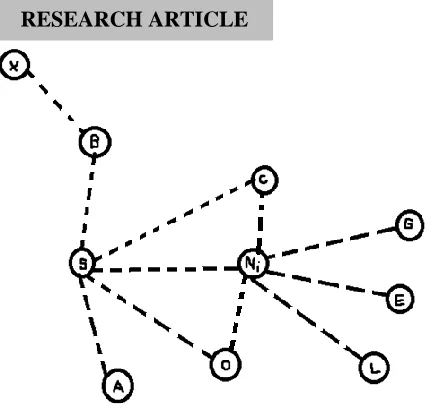
Fig 1: Scenario for uncovered neighbors
Source node S broadcasts RREQ packet to its entire neighbor node B, C, Ni, O and A. Suppose if node Ni, an intermediate node to source node S receiving an RREQ packet computes the uncovered neighbors by comparing the neighbor list in RREQ. Thus nodes O, C are common neigbors to node Ni and source S. On neglecting these common nodes and source node S from the neighbor list for node Ni , we obtain node G, E and L as the uncovered neighbor nodes for node Ni.
3.1.2 Estimation of Link quality
The intermediate node i compute link quality by obtaining signal to noise ratio of the link. The expression for computing SNR is formulated as follows:
S(i) = µ. 𝑀(i)………...……. (2)
Where S(i) is smoothed signal to noise ratio value and M(i) is the measured signal to noise ratio value at node i respectively.µ is a coefficient which can have value between 0 and 1. There can be gradual changes in the link quality because of dynamic nature of network environment, the smooth value of a node has to be sensitive to measured value of signal to noise ratio. As a result, the measured signal to noise ratio value will be extended with a coefficient µ.
3.1.3Computation of Remaining Energy
The node with residual energy has to be selected for participation in a route to destination. So node i will compute residual energy 𝑅𝑒(i) which is formulated as follows:
𝑅𝑒(i) = 𝐼𝑒 (i) - 𝑃𝑚𝑇𝑚 . ………... (3)
Where
𝐼
𝑒(i) is the initial energy of node i, 𝑃𝑚and 𝑇𝑚 are thepower and the transmission time of mth packet at node i.
3.1.4 Computation of Load
Meanwhile the traffic load at node i is evaluated to avoid congestion of packets. The traffic load at node can be evaluated as the ratio of number of packets currently in the buffer to the size of buffer [8]. The buffer ratio B(i) is formulated as follows:
B(i) =p(i)/s………... (4) Where p(i) is the number of packets currently queued in the buffer and s is total size of the buffer at node i [8].
3.1.5 Efficiency Evaluation
The node i computes efficiency factor called delay based on the above network factors, delay 𝐷𝑅(𝑖) at node i can be
expressed as per Ref. [7] is formulated as follows:
𝐷𝑅(𝑖) = [ α(𝑅𝐼𝑒(i)
𝑒 (i) ) +β.B(i) +λ( 𝑆𝑡ℎ
𝑆(i)) ]
…………...…(5)
The idea is to provide equal weightage to all the efficiency factors such as energy(𝑅𝐼𝑒(i)
𝑒 (i)), load B(i) and signal to noise
ratio( 𝑆(i)𝑆𝑡ℎ) by considering coefficients such as α, β and λ which can have value between 0 and 1. 𝑆𝑡ℎis threshold value of
signal to noise ratio.
3.1.6 Elimination of Common Neighbours
The node i evaluates total efficiency based on wireless link, buffer and energy of the node further it sets a timer in order to avoid duplication of RREQ packet and the uncovered neighbour set is modified. For example, if a node i receives a duplicate RREQ packet from node j, it knows that how many of its neighbours are been covered by the RREQ packet from node j. Node i could further modify its uncovered neighbour set according to neighbour list packet from node j. Then U(i) can be adjusted as per ref.[10] which is formulated as: U(i) = U(i) - [U(i)∩N(j)]………(6) After obtaining the final uncovered neighbor set, the RREQ packet received from node j is been discarded by node i. When timer expires the nodes in final uncovered neighbor set are the nodes that need to receive and process the RREQ packet [10].
3.1.7Acceptance Condition
Each intermediate node i rebroadcasts the RREQ packet to nodes in final set of uncovered nodes based on delay
𝐷
𝑅(𝑖)
.The condition for node i to rebroadcast the RREQ packet is given as follows:RESEARCH ARTICLE
When the value 𝐷𝑅(𝑖) is less than 1 then node i can forward RREQ packet to its uncovered neighbor set else if value of 𝐷𝑅 (i) is greater than 1 mean node i discards the RREQ packet. 3.2 Route Repairing Procedure
Link failure may occur in a route due to any of the facts such as energy is depleted in nodes, load is exceeded in buffer or link quality is low. The intermediate node sets up a timer of about 0.125ms to determine an alternate route to destination. If an alternate route is not found within that expiry time, then node has to reply back with (RERR) messages to source. Finally, the source reinitiates the process to determine an alternate route, where the node has to rebroadcast the RREQ packet to the other node which is at its orientation to destination.
4. ALGORITHM
1. If Node i receives a new RREQ from source
2. Computation of initial uncovered set U(i) U(i) = N(i)-[N(i)∩N(s)]-{s}……... (1)
3. Evaluation of link quality,
S(i) = µ. 𝑀(i)………... (2)
4. The Energy is formulated as,
𝑅𝑒(i) = 𝐼𝑒(i) - 𝑃𝑚𝑇𝑚 …………... (3) 5. Occupancy of buffer is formulated as,
B(i) = p(i)/b ……… (4)
6. Rebroadcast Delay is computed as follows:
𝐷𝑅(𝑖) = [α(𝑅𝐼𝑒(i)
𝑒 (i))+β.B(i) +λ( 𝑆𝑡ℎ
𝑆(i))] 𝑇0 …….. (5) 7. Set a Timer at the node
8. end if
9. While node i receives a duplicate RREQ from Node j before timer expires then do adjust uncovered set. U(i) = U(i)-[U(i)∩N(j)]……….……… (6)
10. Discards RREQj.
11. Timer expires.
12. end while
13. Acceptance Condition:
Broadcast (RREQ) 0 <𝐷𝑅(𝑖) < 1
Discard (RREQ) otherwise
14. end if
Scenario: when a link is failed
1. Intermediate node sets up timer
2. It sends RREQ packet to the node which is at orientation to destination.
3. If Tr > = 0.125ms (Tr is repair time)
4. Node sends RERR (Route Error) message along all active nodes to source
5. Reinitiate route discovery process. 6. end if
5. SIMULATION ENVIRONMENT
We evaluate our proposed algorithm using NS-2 version 2.35 on Linux Ubuntu 12.04, and the evaluation criteria of our proposed algorithm are done by the following performance metrics.
Packet Delivery ratio
It is the ratio of number of data packets delivered to the destination to the number of data packets sent from the source. This illustrates the level of delivered data to the destination.
Energy Consumption
Energy consumption is defined as the amount of energy consumed for the network operation and data transmission. This parameter illustrates efficiency of our protocol on computing amount of energy consumed by nodes in the network which is computed as the difference between initial energy and remaining energy.
Control Overhead
The ratio of the total packet size of control packets (include RREQ, RREP, RERR and Hello) to the total packet size of data packets delivered to the destinations [11].The size of RREQ packets are used, which includes neighbor list in it. This RREQ packet is bigger in size than that of conventional AODV. It measures the effectiveness of a routing protocol. 5.1 Simulation Model
RESEARCH ARTICLE
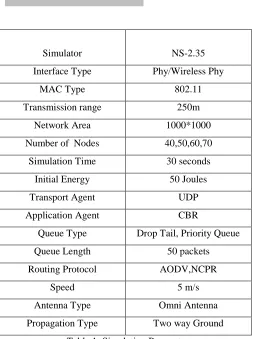
Table 1: Simulation Parameters 5.2 Experimental Results
The performance of our algorithm is compared to other routing protocols such as AODV and Neighbor Coverage based Probabilistic Rebroadcast algorithm (NCPR). The graphs for network metrics such as energy consumption, packet delivery ratio and control overhead are shown below:
Fig 2: Node V/s Packet Delivery Ratio
The graph for packet delivery ratio is plotted against increasing density of nodes. Fig.2 shows that the packet delivery ratio values are increasing for our proposed method
on comparison with existing NCPR approach and AODV because it significantly reduces collision of packets. The values are more deprived for AODV while it is relatively constant for both NCPR and efficient algorithm.
Fig 3: Node V/s Energy Consumption Graph
Fig. 3 measures energy (Joules) consumption with varied number of nodes. There is a massive consumption of energy for conventional AODV compared to NCPR and proposed algorithm. Initially, the energy consumption is less for both NCPR and proposed scheme and as the density of node increases the energy values are relatively smooth.
Fig 4: Node V/s Control Overhead Graph
Fig.4, measures overhead among varied number of nodes. At a very light traffic load, there is gradual increase in overhead for NCPR, AODV and proposed approach. Since RREQ packet contains neighbor list and hello packets add extra overhead, it shows effect on reducing retransmissions. Thus, on increasing traffic load, the routing overhead of conventional AODV is more, while it is low for NCPR and to our proposed efficient approach.
6. CONCLUSION & FUTURE WORK
Broadcasting is an active research area in MANETs. An important problem is how to minimize the number of rebroadcast packets while good retransmission latency and
0 20 40 60 80 100 120
Nodes 40
Nodes 50
Nodes 60
Nodes 70
Proposed
NCPR
AODV
0.1 0.3 0.5 0.7 0.9 1.1 1.3 1.5
Nodes 40
Nodes 50
Nodes 60
Nodes 70
Proposed
NCPR
AODV
2 4 6
Nodes 40
Nodes 50
Nodes 60
Nodes 70
Proposed
NCPR
AODV
Simulator NS-2.35 Interface Type Phy/Wireless Phy
MAC Type 802.11 Transmission range 250m
Network Area 1000*1000 Number of Nodes 40,50,60,70 Simulation Time 30 seconds Initial Energy 50 Joules Transport Agent UDP Application Agent CBR
Queue Type Drop Tail, Priority Queue Queue Length 50 packets Routing Protocol AODV,NCPR
RESEARCH ARTICLE
packets reachability are maintained. This work describes a new route discovery process which improves performance of routing in MANETS. It involves a route maintenance procedure which can determine route on link breakages. Thus compared to existing Neighbor Coverage Probabilistic Rebroadcast (NCPR) algorithm, our approach eliminates the complexity of computing rebroadcast probability. The future work is to evaluate shortest route by reducing number of hops and to improve multipath routing in the network.
REFERENCES
[1] Poonam Mittal, Sanjay Batra, Dr. C.K. Nagpal “Implementation of Novel Protocol for Cordination of Nodes in Manet”, International Journal of Computer Networks and Applications, Vol 2, Issue 2, March-April 2015.
[2] Ravneet kaur, Dr.Neeraj Sharma, “Dynamic node recovery in MANET for high recovery probability”, International Journal of Computer Networks and Applications, Vol 2, Issue 4, July - August 2015. [3] Ragul Ravi.R, Jayanthi.V, “Energy Efficient Neighbor Coverage
Protocol for Reducing Rebroadcast in MANET”, Science Direct 2015. [4] Piet demeester, Jeroenhoebeke,” An overview of Mobile Ad hoc
Networks: Applications and Challenges “.
[5] Perkins, Belding-Royer and Das, “Ad hoc On-Demand Distance Vector (AODV) Routing”, RFC 3561, 2003.
[6] D. Johnson, Y. Hu, and D. Maltz, “The Dynamic Source Routing Protocol for Mobile Ad Hoc Networks (DSR) for IPv4”, IETF RFC 4728, Vol. 15, pp. 153-181, 2007.
[7] LI Ting, Tang Rui – bo, JI Hong, “Status Adaptive Routing with Delayed Rebroadcast scheme in AoDV – based MANETS”, science direct 2008.
[8] Zeki Bilgin, “A Dynamic Route Optimization Mechanism for AODV in Manets”, IEEE, 2010.
[9] Shiva Shankar, Varaprasad, Narayana Gowda Suresh, jayanthi, “Designing Energy routing protocol with power consumption optimization in MANET”, IEEE Transaction 2013.
[10] Xing Ming Zhang, En Bo Wang , “ Neighbor coverage based probabilistic rebroadcast for reducing routing overhead in Mobile Ad hoc Networks”, IEEE transactions on mobile computing, vol12, No3, March 2013.
[11] Ambarish Bhuyar et.al, “Reducing Routing overhead in mobile ad-hoc network using Probabilistic rebroadcast mechanism” International Journal of Computer Technology & Applications, Vol 5, Sept-Oct 2014. [12] http://www.isi.edu/nsnam/ns/tutorial/
[13] Fenglien lee, University of Guam “Routing in Mobile Ad-Hoc Networks” 2011.
[14] Priyanka Goyal, Vinti Parmer, Rahul Rishi, MANET: Vulnerabilities, Challenges, Attacks, Application, ‘International Journal of Computational Engineering & Management’, Vol. 11, pp. 32-37, 2011. [15] Ankur O.Bang, Prabhakar, L.Ramteke “MANET: History, Challenges