Original Research Article
Assessment of knowledge of school going children regarding HIV/AIDS
in rural field practice area (RHTC) Srinagar, JLN medical college
and Hospital, Ajmer
Mahesh Keswani, Teena Gupta*, Bharat Meharda
INTRODUCTION
AIDS, the acquired immune-deficiency syndrome (slim disease) is a fatal illness caused by a retro virus known as the human immunodeficiency virus (HIV) which break down the body’s immune system, living the victim vulnerable to a host of life threatening opportunistic
infections, neurological disorders or unususal
malignancies.1
Transmission of HIV is mainly by unprotected sexual contacts, mother to child (antenatal, perinatal and postnatal), and transfer of infected blood. There are several methods to prevent HIV transmission, these include comprehensive education and campaign, safe sex by use of condoms, abstinence, faithfulness, safe blood transfusion and the use of antiretroviral drugs to prevent mother to child transmission (MTCT) of HIV.2
ABSTRACT
Background: AIDS, the acquired immune-deficiency syndrome (slim disease) is a fatal illness caused by a retro virus known as the human immunodeficiency virus (HIV) which breaks down the body’s immune system. Transmission of HIV is mainly by unprotected sexual contacts, mother to child (antenatal, perinatal and postnatal), and transfer of infected blood.
Methods: The present cross-sectional study was conducted from January 2018 to June 2018 in randomly selected government and private schools from rural field practice area. A total of 300 students randomly selected from 10th to 12th class were included in the study, of whom 150 were boys and 150 were girls. The data collected were presented in percentage and figure.
Results: Majority of students (61.35%) belonged to age group of 15-18 years and most of them were females. Most of the students (85.2%) had heard about HIV/AIDS but only 53.5% knew that HIV/AIDS caused by a virus. The knowledge regarding mode of transmission of HIV/AIDS was unprotected sex, as expressed by 86.1% students. 70.66% students believe that condoms is the best method of protection against HIV followed by safe blood 43.6%, Disposable syringes 40.29%.
Conclusions: Majority of students (61.35%) belonged to age group of 15-18 years and most of them were females. Most of the students (85.2%) had heard about HIV/AIDS but only 53.5% knew that HIV/AIDS caused by a virus. The knowledge regarding mode of transmission of HIV/AIDS was unprotected sex, as expressed by 86.1% students. 70.66% students believe that condoms is the best method of protection against HIV followed by safe blood 43.6%, Disposable syringes 40.29%.
Keywords: Knowledge, HIV/AIDS, Transmission, Prevention
Department of Community Medicine, JLN Medical College, Ajmer, Rajasthan, India
Received: 02 April 2019
Revised: 14 May 2019
Accepted: 16 May 2019
*Correspondence:
Dr. Teena Gupta,
E-mail: [email protected]
Copyright: © the author(s), publisher and licensee Medip Academy. This is an open-access article distributed under the terms of the Creative Commons Attribution Non-Commercial License, which permits unrestricted non-commercial use, distribution, and reproduction in any medium, provided the original work is properly cited.
The United Nations adopted to halt and reverse the spread of HIV/AIDS as one of its millennium development goals. Since the beginning of the epidemic, almost 70 million people have been infected with the HIV virus and about 35 million people have died of AIDS. Globally, 36.9 million (31.1–43.9 million) people were living with HIV, 1.8 million people newly infected with HIV and AIDS related deaths in 2017 were 940000 (670000- 1.3 million) (UNAIDS data 2018). The total number of people living with HIV in India was estimated at 21.17 lakh (17.11- 26.49 lakh) in 2015. The estimated number of new HIV infections in 2015 was around 86 thousand (56-129) thousand. In 2015 an estimated 67.6 (46.4-106.0) thousand people died of AIDS related causes nationally.3
As per the India HIV Estimation 2015 report, adult (15-49years) HIV prevalence in India was estimated at 0.26% (0.22%- 0.32%) in 2015. in 2015, adult HIV prevalence was estimated at 0.30% among males and at 0.22% among females.3
AIDS has a great negative effect amongst students both at primary and secondary level if no proper measures are put in place to avert them. School students especially those at secondary level are much more vulnerable to
HIV/AIDS because their social, emotional and
psychological development is incomplete, they tend to experiment with risky behavior, often with little knowledge/ awareness of the danger. Nevertheless, most young people have limited knowledge about HIV/AIDS, largely because the society makes it difficult for them to obtain information. As children are a valuable resource for the future of a country, it is imperative that they be equipped with ample amount of information so as to protect themselves.4
Thus present study was conducted with the following objectives:
To know the socio-demographic profile of study participants.
To assess the knowledge/awareness of school
children regarding HIV/AIDS.
To provide suggestions for HIV/AIDS education in schools.
METHODS
The present cross-sectional study was conducted from January 2018 to June 2018 in randomly selected government and private schools from rural field practice area of Department of Community Medicine, JLN Medical College, Ajmer. A total of 300 students randomly selected from 10th to 12th class were included in the study, of whom 150 were boys and 150 were girls.
A pre-structured questionnaire was used to assess the general knowledge on HIV/ AIDS, its mode of transmission and prevention. The consent was obtained from the school principals after explaining the purpose of study to them. The data collected were presented in percentage and figure.
RESULTS
In the present study majority of students (61.35%) belonged to age group of 15-18 years and most of them were females. 62 (20.65%) students were less than 15 years and 54 (18%) students were above 18 years of age (Table 1).
Table 1: Age and gender wise distribution of study subject (n=300).
Age (in years)
Male no. Female no. Total no.
N (%) N (%) N (%) <15 30 (20.31) 32 (21.09) 62 (20.65)
15-18 87 (57.81) 97 (64.84) 184 (61.35)
>18 33 (21.88) 21 (14.06) 54 (18.00)
Total 150 (50) 150 (50) 300 (100)
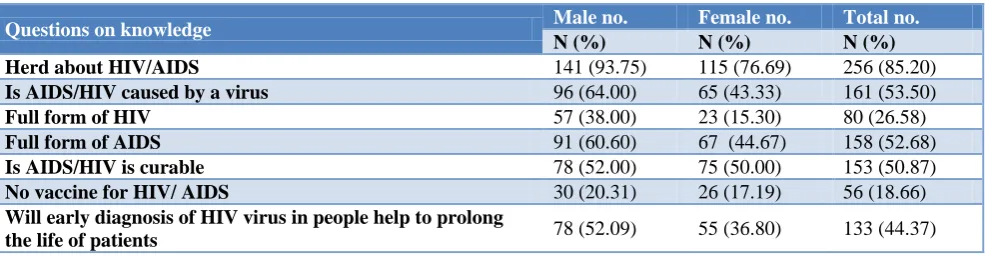
In the present study most of the students (85.2%) had heard about HIV/AIDS but only 53.5% knew that HIV/AIDS caused by a virus. 52.68% participants were able to write the full form of AIDS and only 26.58% were able to write the full form of HIV, only 18.66% knew that there is no vaccine available to protect from HIV/AIDS, 50.87% participants believe that HIV/ AIDS is curable and 44.37% participants believe that early diagnosis of HIV virus in people help to prolong the life of patients (Table 2).
Table 2:Knowledge regarding HIV/AIDS among study population (n=300).
Questions on knowledge Male no. Female no. Total no.
N (%) N (%) N (%) Herd about HIV/AIDS 141 (93.75) 115 (76.69) 256 (85.20)
Is AIDS/HIV caused by a virus 96 (64.00) 65 (43.33) 161 (53.50)
Full form of HIV 57 (38.00) 23 (15.30) 80 (26.58)
Full form of AIDS 91 (60.60) 67 (44.67) 158 (52.68)
Is AIDS/HIV is curable 78 (52.00) 75 (50.00) 153 (50.87)
No vaccine for HIV/ AIDS 30 (20.31) 26 (17.19) 56 (18.66)
Will early diagnosis of HIV virus in people help to prolong
Table 3: Evaluation of the knowledge on various modes of transmission (n=300).
Modes of transmission Male no. Female no. Total no.
N (%) N (%) N (%) HIV infected mother to baby 30 (20.31) 41 (27.34) 71 (23.64)
Unprotected sexual intercourse 127 (84.37) 131 (87.50) 258 (86.10)
Infected blood transfusion 70 (46.87) 69 (46.09) 139 (46.31)
Sharing of infected syringes and needles 79 (52.34) 73 (48.44) 152 (50.64)
Table 4: Source of information about HIV/AIDS (n=300).
Source Male no. Female no. Total no.
N (%) N (%) N (%) Internet 97 (64.54) 77 (51.40) 174 (58.00)
T.V. 115 (76.84) 97 (64.42) 212 (70.56)
Radio 69 (45.98) 47 (31.59) 116 (38.62)
Newspaper, Magazines & Books 30 (20.32) 28 (18.98) 58 (19.30)
Friends 35 (23.50) 15 (10.20) 50 (16.61)
Parents 23 (15.20) 18 (12.24) 41 (13.58)
Others 16 (10.40) 12 (8.00) 28 (9.33)
Table 5: Evaluation of knowledge regarding methods of prevention of HIV/AIDS (n=300).
Methods of prevention Male no. Female no. Total no.
N (%) N (%) N (%) Use of condom 138 (92.19) 74 (49.22) 212 (70.66)
Safe blood 75 (50.00) 56 (37.50) 131 (43.60)
Disposable syringes 79 (52.34) 42 (28.13) 121 (40.29)
Not sharing injections/ blades 66 (43.75) 39 (25.78) 105 (35.10)
Availability of treatment for HIV/AIDS 29 (19.53) 23 (15.63) 52 (17.33)
The present study reveals that the knowledge regarding mode of transmission of HIV/AIDS was unprotected sex, as expressed by 86.1% students followed by sharing syringes/ needles (50.64%), infected blood transfusion (46.31%), and HIV infected mother to baby (23.64%) (Table 3).
Source of information about HIV/AIDS: In the present study shows that TV. 70.56% (76.84% and 64.42% of boys and girls respectively), internet 58% (64.54%and 51.40% of boys and girls respectively) and radio 38.62% (45.98% and 31.59% of boys and girls respectively) are considered as major sources of providing information about disease. On the other hand newspaper, magazines & books, friends, parents and others (19.3%, 16.61%, 13.58% & 9.33% respectively) are also the good sources for their knowledge about the disease (Table 4).
Knowledge regarding methods of prevention of HIV/ AIDS, in the present study shows that 70.66% students (92.19% and 49.22% of boys and girls respectively) believe that condoms is the best method of protection against HIV followed by safe blood 43.6% (50.0% and 37.50%of boys and girls respectively), disposable syringes 40.29% (52.34% and 28.13% of boys and girls respectively), not sharing injections and blade 35.1% (43.75% and 25.78% of boys and girls respectively) and
availability of treatment for HIV/AIDS 17.33% (19.53% and 15.63% of boys and girls respectively) (Table 5).
DISCUSSION
The present study reveals that the knowledge regarding mode of transmission of HIV/AIDS was unprotected sex, as expressed by 86.1% students followed by sharing syringes/ needles (50.64%), infected blood transfusion (46.31%), and HIV infected mother to baby (23.64%). The similar finding were observed by Saluja et al in their study carried out in rural area of Haryana revealed that the knowledge regarding modes of transmission of HIV/AIDS 82.4% students (58.2% boys and 24.1% girls) said that it was through unprotected sex followed by sharing injections (78.5%), blood transfusion (67.6%), and from infected mother to baby (62.4%).8 In another study conducted by Shinde et al revealed that the awareness regarding mode of transmission of HIV/AIDS was unprotected sex, as expressed by 85.94% students followed by sharing injections/ blades (50.39%), infected blood transfusion (46.48%), HIV infected mother to baby (23.83%).5 Kotech et al in their study carried out in urban slums of Vadodara city revealed that the knowledge regarding modes of transmission were the sexual act followed by needles and blood transfusion.9
Source of information about HIV/AIDS: In the present study shows that TV 70.56% (76.84% and 64.42% of boys and girls respectively), internet 58% (64.54%and 51.40% of boys and girls respectively) and radio 38.62% (45.98% and 31.59% of boys and girls respectively) are considered as major sources of providing information about disease. On the other hand newspaper, magazines & books, friends, parents and others (19.3%, 16.61%, 13.58% & 9.33% respectively) are also the good sources for their knowledge about the disease. In another study conducted by Saluja et al revealed that three hundred and ten (91.2%) students had heard about HIV/AIDS from television while 186 (54.7%) mentioned radio as main source of information to them.8 Gupta et al in their study at Pune reported that TV was the commonest source of information in both male and female.10
Knowledge regarding methods of prevention of HIV/ AIDS, in the present study shows that 70.66% students (92.19% and 49.22% of boys and girls respectively) believe that condoms is the best means of protection against HIV followed by safe blood 43.6% (50.0% and 37.50%of boys and girls respectively), disposable syringes 40.29% (52.34% and 28.13% of boys and girls respectively), not sharing injections and blade 35.1% (43.75% and 25.78% of boys and girls respectively) and availability of treatment for HIV/AIDS 17.33% (19.53% and 15.63% of boys and girls respectively. Similar results were observed by Shinde et al in their study that condoms is the best means of protection against HIV followed by safe blood (43.75%), disposable syringes (40.23%), not sharing injections and blade (34.77%) and availability of treatment for HIV/AIDS.5 In another by Yadav et al revealed that the higher number of respondents (82.75%) were aware of the blood safety.11 In a study by Selcuk Koksal et al reported that 78.51% participants knew that the sharing injections, needles and razors with a HIV/ AIDS infected person would transmit HIV virus.12 In
another study done by Gaash et al reported 23.11% participant, Bhalla et al reported 50.35% and Lal et al reported 44.4% of participant knew that sharing injections with a needle from an HIV/AIDS infected person will transmit HIV virus.7,13,14
CONCLUSION
The basic knowledge of HIV/AIDS over various issues like prevention and mode of transmission is deficient among many students. Adolescents are more vulnerable and are less aware of the knowledge to protect themselves from HIV/AIDS. The awareness campaign should be designed at school levels for preventing and protecting adolescents from the HIV/AIDS and to spread awareness to induced behavioral change among the adolescent. The effort as regards HIV/AIDS education to be initiated, as a part of school curriculum with all the literature available at school level to enhance the knowledge related to HIV/AIDS among the students.
ACKNOWLEDGEMENTS
The authors are grateful to school authority for support and permission to conduct the study and special thanks to all study participants because without them study could not be completed.
Funding: No funding sources Conflict of interest: None declared
Ethical approval: The study was approved by the Institutional Ethics Committee
REFERENCES
1. Park K. Park’s Text book of preventive and social medicine. 24th ed., 2017.
2. Kamala B.A. Abaud S. Knowledge, attitude and practices on HIV prevention among secondary school students in Bukoba rural Kagera region
Tanzania. Dares Salaam Med Students J.
2006;14(1):14-18.
3. National Aids Control Organisation - annual report (2016-2017). Available at http://naco.gov.in/sites/ default/files/NACO%20ANNUAL%20REPORT%2 02016-17.pdf. Accessed on 29 September 2018.
4. Shira CD, Deka A, Das H, Deori P. Knowledge and
awareness regarding HIV/AIDS in school children
of Guwahati city of India. IOSR-JDMS
2016;15(5):55-9.
5. Shinde M, Trivedi A, Shinde A. A study of awareness regarding HIV/AIDS among secondary school students. Int J Community Med Public Health. 2016;3(6):1461-5.
6. Jain J, Mittal H. Comparative study of awareness and knowledge of boys and girls about HIV/AIDS among students of senior secondary school. Int J Med Sci Educ. 2016;3(1):11-5.
of Delhi. Indian J Community Med. 2008;33(3):190-2.
8. Saluja N, Kumar A. Awareness of HIV/AIDS
among adolescents of rural area of Haryana. J Evol Med Dent Sci. 2014;3(72):15275-82.
9. Kotech PV, Patel S. Measuring Knowledge about HIV among youth: Baseline survey for urban slums of Vadodara. Indian J Sex Transm Dis AIDS. 2008;29(2):68-72.
10. Gupta PK, Pore P, Patil U. HIV/ AIDS related KAP
among high school students of Municipal
corporation school in Pune. National J Community Med. 2012;3(1):74-9.
11. Yadav SB, Makwana NR, Vadera BN, Dhaduk KM,
Gandha KM. Awareness of HIV/AIDS among rural youth in India: a community based cross-sectional study. J Infect Dev Ctries. 2011;5(10):711-6.
12. Koksal S, Namal N, Vehid S, Yurtseve E.
Knowledge and attitude towards HIV/AIDS among Turkish Students. IDJP. 2005: 118-121.
13. Gaash B, Ahmad M, Kasur R, Bashir S. Knowledge, attitude and belief on HIV/AIDS among the female senior secondary students in Srinagar District of Kashmir. Health Population. 2003;26(3):101-9. 14. Bhalla S, Chandwani H, Singh D, Somasundaram C,
Rasania SK, Singh S. Knowledge about HIV/AIDS among senior secondary School students in
Jamnagar, Gujarat. Health Population.
2005;28(4):178-88.
Cite this article as: Keswani M, Gupta T, Meharda B.Assessment of knowledge of school going children regarding HIV/AIDS in rural field practice area (RHTC) Srinagar, JLN medical college and Hospital, Ajmer. Int J Community Med Public Health