Retraction
The article "Prevalence and the factors influencing soil transmitted helminths among school age children of 5 to 14 years in a rural area of Coimbatore district" is retracted by the Editor-in-Chief, due to violation of the policies and practices of International Journal of Community Medicine and Public Health.1 The article is retracted on request of corresponding author and co-authors due to some errors in data which happened by the authors unintentionally.
REFERENCES
1. Rajan XC, Manivasagan S, Boppe A. Prevalence and the factors influencing soil transmitted helminths among school children of age 5 to 14 years in a rural area of Coimbatore district. Int J Community Med Public Health 2019;6:4924-8. DOI: http://dx.doi.org/10.18203/2394-6040.ijcmph20195081.
Original Research Article
Prevalence and the factors influencing soil transmitted helminths among
school age children of 5 to 14 years in a rural area of
Coimbatore district
Xavier C. Rajan
1*, Sivamani Manivasagan
2, Appalaraju Boppe
3INTRODUCTION
The soil-transmitted helminthes (STH) causing major illness among human beings are Ascaris lumbricoides, Trichuris trichiura, Necator americanus and Ancylostoma duodenale.1 STH are considered Neglected Tropical Diseases (NTDs). 2 STH affects more than one fourth of
the world’s population, and it is reported more in tropical and subtropical areas.3 The greatest numbers of cases are occurring in sub-Saharan Africa, the Americas, China and East Asia.4 In India the reported prevalence of STH infection varied from 7.8% to 92.6%.5-9 The reported prevalence varies according to the place and time of the study conducted.
ABSTRACT
Background: Highest intensity of soil transmitted helminthiasis (STH) is seen among school age children. The objective of this study is to find out the prevalence and factors associated with STH infection among school age children of 5-14 years in a rural area of Coimbatore district.
Methods: After getting ethical clearance, five of the fourteen villages of Vedapatti were selected by cluster sampling method. Totally 819 participated in the survey conducted between November 2015-July 2016 in the field practice area. Consent from parents and assent from child were obtained. Structured questionnaire was used to collect information. Totally 610 gave one adequate stool sample. Early morning samples were collected and transported to the laboratory within four hours. Formal ether concentration method was performed and examination was done. Data analysis was done with SPSS-19 software. Prevalence is expressed in percentage with 95% confidence interval (CI). Univariate and Multivariate analysis were performed. Strength of association was expressed in terms of odds ratio and adjusted odds ratio with 95% confidence interval. P value <0.05 was considered as statistically significant.
Results: The prevalence of STH was 7.70% (95% CI: 5.58- 9.82). Ascaris lumbricoides was highly prevalent 6.9% (4.89% to 8.91%) followed by hook worm 0.2(0.15% to 0.55%) and Trichuris trichura 0.7%(0.04% to 1.36%). Uni variate and Multivariate logistic regression analysis showed that pucca houses offered protection against STH. Conclusions: STH is still a public health problem in Coimbatore. When regular deworming is accompanied by appropriate sanitation and hygiene activities designed to prevent re infection of STH, a long-term impact can be achieved.
Keywords: Soil transmitted helminthiasis, Prevalence, School age children, Coimbatore 1Department of Community Medicine, Kilpauk Medical College, Chennai, Tamil Nadu, India
2Department of Community Medicine, PSG Institute of Medical Sciences and Research, Coimbatore, Tamil Nadu,
India
3Department of Microbiology, PSG Institute of Medical Sciences and Research, Coimbatore, Tamilnadu, India
Received: 12 September 2019 Accepted: 15 October 2019
*Correspondence: Dr. Xavier C. Rajan,
E-mail: [email protected]
Copyright: © the author(s), publisher and licensee Medip Academy. This is an open-access article distributed under the terms of the Creative Commons Attribution Non-Commercial License, which permits unrestricted non-commercial use, distribution, and reproduction in any medium, provided the original work is properly cited.
Rajan XC et al. Int J Community Med Public Health. 2019 Nov;6(11):4924-4928
The highest intensity of soil transmitted helminthes occur in school age children.10 Children in their schooling age do not fully understand the connections between illness and behaviour.11 It has been demonstrated that children often than adults tend to go barefoot, resulting in more contact with soil, and they often fail to use sanitary facilities even when they are present.12 STH infections are considered as an important cause of sickness absenteeism. They are accounting for loss of 12.3% and 11.4% of disability adjusted life years (DALY) in girls and boys respectively.13 Over 270 million preschool-age children and over 600 million school-age children live in areas where sanitation is poor and these parasites are intensively transmitted.14 In India more than 241 million children are at risk of parasitic worm infections. Ministry of Health and Family Welfare (MoHFW), Government of India launched the National Deworming Day (NDD)on Feb 10, 2015. NDD aims to de-worm all children between the ages of 1 to 19 years.15 The tablets were supplied to children through Government, Government-aided and private schools, and Anganwadi centers.
When regular deworming is accompanied by appropriate sanitation and hygiene activities designed to prevent re-infection, a long-term impact can be achieved Epidemiological studies are needed to identify risk factors which may represent critical control points. There is no recently published article on prevalence of soil transmitted helminthes in Coimbatore, where open air defecation is a common practice. As per 2011 census, 46% of the households in Coimbatore district lack toilets. Hence this cross sectional study was conducted with the objective of finding the prevalence and risk factors associated with soil transmitted helminth infections in school age children of 5-14 years in a rural area of Coimbatore district.
METHODS
The study was conducted in the field practice area of the Rural Health Training Centre (RHTC) Vedapatti, Coimbatore. RHTC caters to a total population of 23,841 distributed in 14 villages of Thondamuthur and Madukarai block of Coimbatore district. The total number of school aged children of 5–14 years is 3266.
Ethical clearance was obtained from IHEC, in 2014. The sample size was calculated to be 819 assuming 34.5% as prevalence, relative precision of 15%, design effect of 2, and non-response rate of 20%.16 Five out of fourteen villages were selected by cluster sampling method. House to house survey was conducted in the five villages during November 2015 to July 2016. All school-age children (aged 5–14 years) who were permanent residents of Vedapatti field practice area of RHTC were included in the study. Children who were not available on three visits within a week time were excluded from the study.
At the home setting, after getting consent from the parent and assent from the child any of the parents of the child
was interviewed in the evening hours of the day. A structured questionnaire was used to collect information on demographic, socioeconomic and environmental information like availability of type of drinking water and availability of functioning sanitary toilet etc. Few questions were asked regarding the knowledge and attitude of the parents on STH. Respondent was asked to give comment on the personal hygiene practices of childlike washing hands with soap before taking food and after defecation, eating fallen foods on the floor, wearing foot wear outside the house and intake of de-worming tablets in the last three months. Observations were also made regarding the personal hygiene of the children related to STH like clipped nails etc. Knowledge and attitude score was generated from the correct responses for the knowledge and attitude questions. The correct responses were given a score of one, and maximum score one could get was nine. Score five and above was considered as adequate knowledge and attitude score.
At the end of survey a screw-capped plastic container with identification of the child was given to collect the stool sample of the child on the next morning. Instructions regarding stool collection were given. The stool samples were transported to microbiology lab within four hours of sample collection. Stool samples were examined by saline wet mount and Iodine wet mount .17 Iodine preparations was done for better visualization of morphological details of ova. All Samples were re-examined after concentrating with WHO recommended.18 Formalin-Ether sedimentation method (FES). To reduce human error, duplicate slides (both direct and after concentration method) were prepared from each sample and the slides were read by two different Microbiologists and the opinion of Chief Microbiologist was considered as final. 19
Statistical analysis
Data entry was made in the Microsoft Excel software in codes and analysis was done using SPSS-19 computer package. The Presence of ova of Ascaris lumbricoides, Trichuris trichiura, Necator americanus and Ancylostoma duodenale was considered as dependent variable. Prevalence is expressed in percentage with 95% confidence interval (CI). Uni-variate analysis and logistic regression were performed to find the associations between independent variables and dependent variables. Strength of association was expressed in terms of odds ratio and adjusted odds ratio with 95% CI and p value <0.05 was considered as statistically significant.
RESULTS
The distribution of study population and their risk factors is shown in (Table 1 and 2). The mean age of the study population was 8.92±2.68. Among them Children below ten year, female participants (52.1%), children belonged to nuclear family (62.1%) and children belonged to low socio economic status (52.3%) class IV and V according to modified Prasad classification were found in majority. Illiteracy was found among 20.2% of mothers 16.1% of fathers. Open air defecation was found among 33.4% of
the children. Regarding the toilet usage only 50.7% of the children were using the toilets in the home. Around 66% did not wash their hands with soap before taking food. And 44.6% did not wash their hands with soap after defecation around 63 % children regularly used foot wear and around 70% of the children had trimmed nail during the visit. Nearly half of the parents of children were having adequate knowledge on STH. Only 59% reported intake of de-worming tablets in the last three months.
Table 1: Association of STH with socio economic and demographic factors by univariate and multivariate analysis.
Factors Category
STH Unadjusted
odds ratio (95% CI)
Adjusted odds ratio (95% CI)
P value
Yes No
Age (years)
≥10 24 229 1.52 (0.80-2.90) 1.45 (0.78-2.7)
0.24
<10 23 334 1 1
Sex Male 24 268 1.15 (0.60-2.18) 1.07 (0.58-2.00) 0.82
Female 23 295 1 1
Total number of family members
Less than 4 22 253 1.08 (0.56- 2.05) 1.21 (0.64- 2.27) 0.55
Four and above 25 310 1
Type of house
Pucca house 4 115 0.36 (0.09-1.03) 0.34 (0.10- 0.91) 0.05 Others (semipucca,
kutcha house) 43 448 1 1
Mother’s educational status
Illiterate 10 113 1.08 (0.46-2.29) 1.03 (0.43- 2.30) 0.94
Literate 37 450 1 1
Socio economic status (modified prasad scale)
Lower SES (Class IV,V) 26 293 1.14 (0.60-2.19) 1.10 (0.56-2.20) 0.78
High SES (Class I,II,III) 21 270 1 1
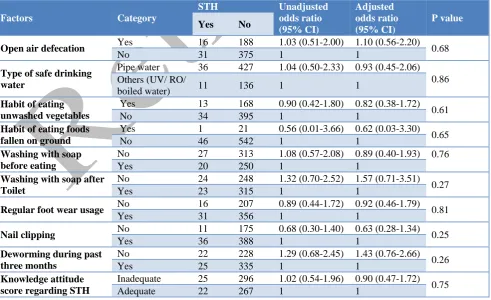
Table 2: Association of STH with Risk factors by univariate and multivariate analysis.
Factors Category
STH Unadjusted
odds ratio (95% CI)
Adjusted odds ratio (95% CI)
P value
Yes No
Open air defecation Yes 16 188 1.03 (0.51-2.00) 1.10 (0.56-2.20) 0.68
No 31 375 1 1
Type of safe drinking water
Pipe water 36 427 1.04 (0.50-2.33) 0.93 (0.45-2.06) 0.86 Others (UV/ RO/
boiled water) 11 136 1 1
Habit of eating unwashed vegetables
Yes 13 168 0.90 (0.42-1.80) 0.82 (0.38-1.72) 0.61
No 34 395 1 1
Habit of eating foods fallen on ground
Yes 1 21 0.56 (0.01-3.66) 0.62 (0.03-3.30) 0.65
No 46 542 1 1
Washing with soap before eating
No 27 313 1.08 (0.57-2.08) 0.89 (0.40-1.93) 0.76
Yes 20 250 1 1
Washing with soap after Toilet
No 24 248 1.32 (0.70-2.52) 1.57 (0.71-3.51) 0.27
Yes 23 315 1 1
Regular foot wear usage No 16 207 0.89 (0.44-1.72) 0.92 (0.46-1.79) 0.81
Yes 31 356 1 1
Nail clipping No 11 175 0.68 (0.30-1.40) 0.63 (0.28-1.34) 0.25
Yes 36 388 1 1
Deworming during past three months
No 22 228 1.29 (0.68-2.45) 1.43 (0.76-2.66) 0.26
Yes 25 335 1 1
Knowledge attitude score regarding STH
Inadequate 25 296 1.02 (0.54-1.96) 0.90 (0.47-1.72) 0.75
Rajan XC et al. Int J Community Med Public Health. 2019 Nov;6(11):4924-4928
The prevalence of STH among 610 children who had given one adequate stool sample and whose parents participated in survey was 7.70% (95% CI: 5.58-9.82). Among all STH, Ascaris lumbricoides was highly prevalent 6.9% (95% CI: 4.89-8.91) followed by hook worm 0.2% (95% CI: 0.15-0.55) and Trichuris trichura
0.7% (95% CI: 0.04-1.36).
There was no significant association found between STH and factors influencing STH by univariate analysis. Since none of the factors came as significant in univariate analysis, all independent variables were subjected to multivariate logistic regression analysis. Only pucca houses offered protection OR 0.36 [95% CI: 0.09-1.03] against STH, by multivariate analysis.
DISCUSSION
Relatively high non response rate (24.42%) was noted in this study. It is also evident from a similar study by Shubha et al that surveys involving bio samples shows high non response rate (30.9%) when compared to simple questionnaire based surveys.20
The prevalence of STH in the study population is 7.7% (95% CI 5.58- 9.82). Results of current study were lesser than other studies conducted in the nearby areas.
The explanations for low prevalence are more number of risk group (29.13%) were found among the non-responders compared to younger children (22.72%, p=0.02). The study results were based on single stool sample, Modified Formol-ether concentration (FEC) method with low sensitivity (63.1%) which could have estimated the low prevalence. 21The other probable explanations are Mass Drug Administration under National Deworming Day(NDD) might have changed the scenario.5-9 However there is no sufficient data from to compare prevalence before de-worming in this area to support this statement. Coimbatore first round of National De-worming Day was just completed and second round was on- going at the time of the survey (Febraury 2016). Kattula et alalso explains the reason for low prevalence of STH (7.8%) in Vellore area is due to Albendazole supplied in Mass Drug Admininistation (MDA) along with Diethylcarbamazine since 2004.8 Deworming using Albendazole rapidly declines the overall prevalence of STH, and this is evident from Mani et al study on efficacy of Albendazole in Tamilnadu.22 However there are other studies reported with higher prevalence in nearby areas. Kaliappan et al explains the reason for the increased prevalence (39%) in Thiruvanamalai District in the year 2013 could be due to five stool samples collected among tribal population where open air defecation and bare foot walking were common practice.23 Ragunathan et al explains the reason for higher prevalence (34.56%) reported in Pudhuchery, a coastal area using FEC method in year 2006 is due to poor hygienic practices of the participants.16
This study showed the most common soil transmitted helminth as Ascaris lumbricoides with the prevalence of 6.9% (95% CI 4.89-8.91) followed by Hook worm 0.7% (95% CI 0.04%-1.36%) and Trichuris Trichura 0.2% (95% CI 0.15-0.55). In general studies showed that
Ascaris and Trichuris were more common among urban children and hookworm infestation among rural children.24
Regarding the factors influencing STH pucca houses offered protection OR 0.36 [95% CI 0.09-1.03] against STH, by multivariate analysis. A cross sectional study by Kattulaet al showed that children living in Hut/ Kutcha houses, are at higher risk for STH.8
Kattulaet al also showed that children of more than 10 years of age, living in households without toilet, open air defecation, unhygienic practices like keeping untrimmed nails are important risk factors for STH.8 Kattulashowed that consumption of deworming tablets offered protection. However there was no significant association between STH and factors influencing STH noted in this study.8
The major limitations of the study are, the results were based on single stool sample which could have estimated the low prevalence. The newer techniques with higher sensitivity would have given higher prevalence. Sample size was not adequate to comment on factors influencing STH. This is a cross-sectional study; hence the cause-effect relationship cannot be determined
In Asia, several countries, notably Japan, South Korea and Taiwan, showed that they have achieved sustained and successful control of STH infections over the last forty years (WHO, 1996). More recently, Sri Lanka has reduced prevalence to less than five percent.25
CONCLUSION
It is evident from our results that soil-transmitted helminth (STH) infections can be controlled by improving the coverage of NDD, and NDD should be evaluated for further control. Open air defecation is a biggest concern (33.4%), hence more private, public toilets should be built in this area. The children should be trained to use toilet facilities either private or public. It is also very important to raise the awareness about these infections, hence parents of children with inadequate knowledge should be given Health education. Regular deworming if accompanied by appropriate sanitation and hygiene activities designed to prevent reinfection, a long-term impact can be achieved.
Funding: No funding sources Conflict of interest: None declared
REFERENCES
1. World Health Organization, Focusing on STH: towards an integrated approach for STH control. Available at http://www.who.int/intestinal_worms/ en/http://whqlibdoc.who.int/publications/2012/9789 241503129_eng.pdf?ua=1. Accessed 10 September 2019.
2. Statement regarding Soil Transmitted Helminths, by CDC. Available at http://www.cdc.gov/globalhealth/ ntd/. Accessed 10 September 2019.
3. Pullan RL, Smith JL, Jasrasaria R, Brooker SJ. Global numbers of infection and disease burden of soil transmitted helminth infections in 2010. Parasites Vectors. 2014;7:37.
4. WHO: 2012. Eliminating soil-transmitted helminthiasis as a public health problem in children soil-transmitted helminthiasis progress report; 2001-2010.
5. Ramesh GN, Malla N, Raju GS, Sehgal R, Ganguly NK, Mahajan RC, et al. Epidemiological study of parasitic infections in lower socio-economic group in Chandigarh (north India). Indian J Med Res. 1991;93:47-50.
6. Singh P, Gupta ML, Thakur TS, Vaidya NK. Intestinal parasitism in Himachal Pradesh. Indian J Med Sci. 1991;45:201-4.
7. Singh S, Raju GV, Samantaray JC. Parasitic gut flora in a north Indian population with gastrointestinal symptoms. Trop Gastroenterol. 1993;14:104-8.
8. Kattula D, Sarkar R, Ajjampur SS, Minz S, Levecke B, Kang G. Prevalence and risk factors for soil transmitted helminth infection among school children in south India. Indian J Med Res. 2014;139:76-82.
9. Naish S, McCarthy J, Williams GM. Prevalence, intensity and risk factors for soil-transmitted helminth infection in a South Indian fishing village. Acta Trop. 2004;91:177-87.
10. World Bank. The global burden of disease. Appendix B. In: World development report. Investing in health-world development indicators. New York: World Bank and Oxford University Press; 1993;213-25.
11. Richmond JB, Kotelchuck M. Personal health maintenance for children. West J Med. 1984;141:816–23.
12. Abera B, Alem G, Yimer M, Herrador Z. Epidemiology of soil transmitted helminths, Schistosomamansoni and haematocrit values among schoolchildren in Ethiopia. J Infect Dev Ctries. 2013;7(3):253-60.
13. Curtale F, Pezzotti P, Sharbini AL, al Maadat H, Ingrosso, Saad YS. Knowledge, perceptions and behaviour of mothers toward intestinal helminths in Upper Egypt: implications for control. Health Policy Plan. 1998;13:423-32.
14. World health organisation: 1998. Control of Tropical Disease Geneva. Available at http://www.who.int/neglected_diseases/en/.
Accessed 10 September 2019.
15. Information regarding National Deworming Day in India from NHM website. Available at http://nrhm.gov.in/nrhm-components/rmnch-a/child- health-immunization/national-deworming-day-august-2016.html. Accessed 10 September 2019. 16. Ragunathan L, Kalivaradhan SK, Ramadass S,
Nagaraj M,Ramesh K. Helminthic infections in school childrensPudhuchery, South India. Microbiol Immunol Infect. 2010;43(3):228–32.
17. Manual of basic techniques for a health laboratory, Second Edition: World Health Organization, Geneva 2003.
18. World Health Organization; Geneva: 1994. Bench Aids for the Diagnosis of Intestinal Parasites. Available at http://apps.who.int/iris/handle/10665/ 37323. Accessed 10 September 2019.
19. Chatterjee KD. Text book of Parasitology 13th edition. CBS publishers and distributors. 2015. 20. Shubha D, Fatima F. A coprological survey for
assessing intensity of parasitic infection in school children: cross-sectional study. Trop Parasitol. 2011;1(2):88-93.
21. Yimer M, Hailu T, Mulu W, Abera B. Evaluation performance of diagnostic methods of intestinal parasitosis in school age children in Ethiopia. BMC Research Notes. 2015;8:820.
22. Mani TR, Rajendran R, Munirathinam A, Sunish IP, Md Abdullah S, Augustin DJ, et al. Efficacy of co-administration of albendazole and diethyl-carbamazine against geohelminthiases: a study from South India. Trop Med Int Health. 2002;7:541-8. 23. Kaliappan SP, George S, Francis MR, Kattula D,
Sarkar R, Minz S, et al. Prevalence and clustering of soil-transmitted helminth infections in a tribal area in southern India. Trop Med Int Health. 2013;18(12):1452–62.
24. Fernandez MC, Verghese S, Bhuvaneswari R, Elizabeth SJ, Mathew T, Anitha A, et al. A comparative study of the intestinal parasites prevalent among children living in rural and urban settings in and around Chennai. J Commun Dis. 2002;34:35–9.
25. WHO (World Health Organization) Report of the WHO Informal Consultation on the use of chemotherapy for the control of morbidity due to soil-transmitted nematodes in humans. Geneva: WHO; 1996. (WHO/ CTD/ SIP/ 96.2). Available at http://apps.who.int/iris/handle/10665/63331.
Accessed 10 September 2019.