Original Research Article
A comparative study on health seeking behaviour of parents
towards their child’s illness in rural and urban field practice
area of a medical college
Kalyan Chakravarthy Burra
1, Chandrashekharvaraprasadrao Dimmala
2*
INTRODUCTION
The attitude of parents towards their children’s health and illness is an important factor with regards to child’s overall development. In most developing countries, the health of the children is strongly dependent on parental healthcare behaviour. In a country like India, the mortality of under-five children is mainly due to acute respiratory infections (23%) and diarrheal diseases (18%) as per WHO report 2002. However these may be very low estimates as many children may not be brought to a suitable health care facility and they go unnoticed. Therefore health seeking behaviour for such sick children and the factors which determine the treatment need to be
assessed.1 Understanding the determinants of these morbidities, as well as the health seeking behavior, may help in planning interventions for controlling childhood morbidity and mortality. Though the magnitude of childhood morbidities in India is well known, very few studies have focused on their determinants and the health seeking behavior of the mothers of the ill children.2 It is influenced by a large number of factors apart from knowledge and awareness, operating at individual, family and community level, including the bio-social profile of individual, his past experiences, influences at the community level, availability of alternative health-care providers and his perceptions regarding efficiency and quality of the services available. Belief system prevalent
ABSTRACT
Background: The attitude of parents towards their children’s health and illness is an important factor with regards to child’s overall development. In most developing countries, the health of the children is strongly dependent on parental healthcare behavior. This current study mainly looks into these aspects.
Methods: A community based cross sectional study involving urban and rural area field practice areas of a medical college in the study period of November 2016-January 2017 with a sample size of 100 families each having children in urban and rural areas have been fixed purposively. House to house survey done by simple random method using pretested semi structured interview schedules.
Results: Around 55% of rural parents took treatment from RMP (quacks) with 55% of urban counterparts opting for wait and watch method. Only 8% of respondents from both areas too their children to a pediatrician. About 12% of urban area went to government hospital and none from rural utilized government hospital facilities.
Conclusions: Large proportions of respondents did not seek appropriate medical care for childhood illnesses.
Keywords: Parent, Health seeking behaviour, Children, Urban and rural, Self-medication, Quacks
Department of Community Medicine, 1Dr VRK Womens Medical College Aziz Nagar, Hyderabad, Telangana,
2Maharajah’s Institute of Medical sciences, Nellimarla, Vizianagaram, Andhra Pradesh, India
Received: 07 May 2019
Revised: 21 June 2019
Accepted: 25 June 2019
*Correspondence:
Dr. Chandrashekharvaraprasadrao Dimmala, E-mail: [email protected]
Copyright: © the author(s), publisher and licensee Medip Academy. This is an open-access article distributed under the terms of the Creative Commons Attribution Non-Commercial License, which permits unrestricted non-commercial use, distribution, and reproduction in any medium, provided the original work is properly cited.
in the communities, i.e., how people conceptualize the etiology of health problem and how symptoms are perceived is another important factor in deciding the first step of treatment seeking.3 This current study mainly looks into the attitude and health seeking behavior of parents residing in rural and urban field practice areas of a medical college.
Objectives
To compare the attitude and health seeking behaviour of parents towards their Children’s health between urban and rural area.
To assess the awareness of the parents regarding the common diseases occurring in children
To assess the attitude and health seeking behavior of parents towards their child health.
METHODS
Study design: A community based cross sectional study Study setting: Urban and rural area field practice areas of a medical college.
Study period: 3 months (November 2016-January 2017). Sample size: 100 families each having children in urban and rural areas have been fixed purposively.
Data collection
House to house survey done by simple random method using pretested semi structured interview schedules. Verbal consent sought before their involvement in the study. Use of numbers on the questionnaires instead of names ensured confidentiality.
Statistical analysis
Data were entered in MS-Excel and analyzed in SPSS V20. Descriptive statistics were represented with frequencies and percentages. Chi-square test and Fisher exact test were applied to find significance. P<0.05 was considered as statistically significant.
RESULTS
Majority of the respondents are females in both areas with 49% of rural participants who were employed with majority of them falling under unskilled category (84%) Illiteracy levels were found to be at 2% and 5% among urban and rural participants respectively which had some impact on their attitude and awareness levels (Table 1). Majority of the participants reported common illnesses respiratory diseases were common in both areas with 79% in urban areas followed by 56% in rural areas followed by fevers which were high in rural children at 32% and urban children at 15% and other illness seen in
children were GIT disorders which accounted at 16% in both areas combined but only 2% of rural children had skin infections which were not to be seen in urban areas (Table 2).
Table 1: Socio-demographic characteristics of respondents (n=200).
Socio-demographic Urban Rural
Respondents (N)
Female 99 100
Male 1 0
Employment of respondent (%) 33 49
Illiteracy in study participants
(%) 2 5
Occupation (unskilled) in (%) 48 84
Table 2: Awareness of parents about common illnesses in children (n=200).
Common
illnesses Urban (%)
Rural
(%) P value
Respiratory 79 56 <0.001
Fever 15 32 0.005
GIT 6 10 0.29
Skin disorders 0 2 0.16 Regarding source of information among parents 47% of rural participants got information from family members and 31% in urban. Similarly 52% of urban respondents had self-experienced about illness which occurred in their children when compared to 35% in rural areas. Interestingly 17% from rural area got information from doctors when compared to 15% in urban area. Media and other factors played very less role in creating awareness and informing them about health (Table 3).
Table 3: Sources of information about common illnesses (n=200).
Sources of information Urban Rural
Family members (%) 31 47
Self- experience (%) 52 35
Doctors (%) 15 17
Neighbors/friends/ media (%) 2 1 Regarding superstitious beliefs rural parents 18% believed in evil power and nearly 37% in rural and 31% in urban areas sought divine intervention (taking child to a religious place) before treatment taking children to an accountable health facility. About 87% of urban parents practiced self -medication when compared to only 8% of rural parents (Table 4).
Majority of rural parents favored RMP (quacks) for treating their children because of reasons listed in (Table 6).
Table 4: Attitude and health seeking behavior of the parents when the child was sick (n=200). Attitude and health
seeking behavior Urban Rural P value
Belief in evil power 1 18 <0.001
Seeking divine intervention before treatment
31 37 0.37
Self -medication 87 8 <0.001 About 12% of urban area went to government hospital and none from rural utilized government hospital facilities and 100% preferred private health care providers (Table 7).
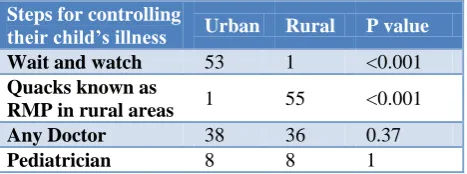
Table 5: Steps for controlling their child’s illness (n=200).
Steps for controlling
their child’s illness Urban Rural P value
Wait and watch 53 1 <0.001
Quacks known as
RMP in rural areas 1 55 <0.001
Any Doctor 38 36 0.37
Pediatrician 8 8 1
Table 6: Reason for consulting the quacks (n=200).
Reason for consulting
the quacks Urban Rural P value
Qualified to treat 3 43 <0.001
Economic 16 9 0.14
Easily approachable/
Friendly 4 9 0.15
Table 7: Health care utilization for this population (n=200).
Health care utilization of
the study participants Urban Rural
Government hospital 12 0
Private health care
providers 88 100
DISCUSSION
The boundaries of health services are broad and include all activities whose primary purpose is to improve or maintain health. It includes multi-sectorial interventions which include health care services as one of the domains. Hence in the current analysis health seeking behavior included all the modifiable determinants of health which promote, maintain or restore health. Health care seeking behavior on other end is for an individual to respond to
an illness episode by seeking first and foremost help from a trained allopathic doctor, in a formally recognized health care setting.4
Since this study was done to assess the health seeking behaviour of parents age and gender of the children was not taken into consideration as it could lead to bias in the study outcome. While there were few studies which have focused on this issue but none of them had compared urban and rural areas. Majority of respondents were females and illiteracy levels in urban and rural study areas was found to be 2% and 5% respectively also determined the behaviour. In this present study high prevalence of respiratory infections 79% in urban and 56% in rural areas (P<0.001) were found out during our investigation when compared to other studies such as National Family Health Survey-IV (NFHS-IV)in Andhra Pradesh which had 73.9% and 78.6% respectively these findings urban results were similar but in case of rural areas there was significant difference and Dongre ARalso done similar study in rural area and found out 50% of respiratory infections which is similar to our findings. Another study from rural Meerut district of Uttar Pradesh, 42.3% under-five children were suffered from acute respiratory infection.5-7 Ray et al reported that 58.2 % under five children suffered from ARI in rural West Bengal.8 Mandalik et al found out that 52% of children from urban areas were suffering from Respiratory tract infections which were similar to our study In our study fevers accounted for 15% and 32% in urban and rural areas which was quite similar to Deshmukh PR who reported 34% in rural areas.1,2,9 Gastro intestinal infections in our study were 6% and 10% in urban and rural areas which are quite similar to NFHS-4 which reported 6% and 7% in urban and rural areas and similar study conducted by Sudharsanam et al showed prevalence of 4.7% in rural areas.1,5 Regarding awareness about illnesses 47% from rural areas relied on family members compared to 31% from urban and 52% from urban area had self-experience during the episodes of the child’s illness when compared to 35% of rural respondents here the print and electronic media played very less role as source of information in both areas. During this study we found out that majority of rural parents 18% believed in evil power which was thought to be the reason for their child’s sickness when compared to urban which had very less only 1% (p<0.001) proving that superstitious beliefs are still present till today was one of the important findings of the study. Another significant finding in our study was about 31% and 37% from urban and rural population sought divine intervention i.e. visits to different religious places before treatment and a similar study conducted by Sreeramareddy et al found out that 26% of study population visited religious places and traditional healers.10
compared to rural parents which was 8% (p<0.001) and in a similar study done by Minhas et alreported 33% in rural and 30% in urban areas.4 In our study 53% and 1% in urban and rural areas preferred to wait and watch before taking steps to control illness contradict study done by Minhas et alwho reported16.91% and 15.32% in urban and rural areas and another study done by Haresh Chandwani reported 27.9%.4,11 Interestingly only 1% of urban parents took their children to quacks also known as RMP (rural medical practioner) in Andhra Pradesh when compared to 55% from rural area (p<0.001). In another study done by Mandalik et alfound 0.6% from urban area approached quacks and Minhas et alreported 12.9% in rural and 5% in urban areas.4,9
When asked about reasons for visiting quacks 43% of parents from rural areas thought he was qualified to treat (p<0.001) and 16% from urban area answered quacks were less expensive and economic when compared with doctors and 9% from rural and 4% from urban answered that they were easily accessible, approachable and friendly. Finally 12% from urban area utilized the government hospitals while majority of them 88% preferred various private health care providers when compared to rural counterparts who 100% were dependent on various private health care providers and none of them preferred government hospitals and in a study done by Sreeramareddy reported that Two-thirds of the children received treatment for their illnesses from private HCPs which is around 70%.12 Owing to the doubtful efficacy of treatment they receive from the government health care providers, the rural parents preferred to access private doctors, although, the quality of care and qualification from some of these private providers can be questioned.
CONCLUSION
This study was done to assess the knowledge attitude and practices of parents. Awareness regarding the disease occurrence in parents was inadequate. Large proportions of respondents did not seek appropriate medical care for childhood illnesses. Majority of respondents from urban area (87%) opted for self-medication and majority of respondents from rural area opted for RMP’s instead of qualified medical practitioners. Though governments were spending huge amounts on health coverage many factors like literacy, economic status and geographical location were playing important role in treatment seeking behaviour. Due to small sample size there were limitations in outcome of the study so further studies should be done to assess the magnitude of these issues. Recommendations
Community based behavioral change communication strategy to be adapted to improving the health care facilities and infrastructure and staffing and adequate supply of drugs. Awareness regarding the spread of common childhood morbidities should be taken much
more into community by media strict laws should be implemented to abolish quackery and policies should be framed to restore faith in Government hospitals.
ACKNOWLEDGEMENTS
We would like to thank all the parents who have participated in this study and provided the valuable information and helped us to complete the study.
Funding: No funding sources Conflict of interest: None declared
Ethical approval: The study was approved by the Institutional Ethics Committee
REFERENCES
1. MB Sudharsanam, SB Rotti. Factors determining health seeking behaviour for sick children in a Fishermen Community in Pondicherry. Indian J Community Med. 2007;32(1):71-2.
2. Deshmukh P, Dongre AR, Sinha N, Garg BS. Acute childhood morbidities in rural Wardha: Some epidemiological correlates and health care seeking. Indian J Med Sci. 2009;63(8):345-54.
3. Jeet G, Sharma A, Mohanta TG, Trakroo A. Health seeking behavior of the mother for the special care new-born units discharged child: a comparative study. Indian J Public Health 2013;57(2):113-6. 4. Minhas A, Chander V, Sharma S, Bansal P. Health
care seeking behavior of parents of under five in District Kanga, Himachal Pradesh. Int J Community Med Public Health 2018;5(2):561-8.
5. National Family Health Survey-4. Fact sheet: Andhra Pradesh, 2015-16. Available at http://rchiips.org/nfhs/NFHS-4Reports/Andhra
Pradesh.pdf. Accessed 30 April 2019.
6. Dongre AR, Deshmukh PR, Garg BS. Childhood morbidity, household practices and health care seeking for sick children in a tribal district of Maharashtra, India. Indian J Med Sci. 2010;64(1):7-16.
7. Kaushik PV, Singh JV, Bhatnagar M, Garg SK, Chopra H. Nutritional correlates of acute respiratory infections. Indian J Matern Child Health. 1995;6(3):71-2.
8. Ray SK, Haldar A, Biswas B, Misra R, Kumar S. Epidemiology of undernutrition. Indian J Pediatr. 2001;68(11):1025-30.
9. Mandlik MD, Haralkar SJ, Mulaje SM, Mangulikar SK. Study of health-care seeking behavior of parents for child health problems in an urban slum area of Solapur. Int J Med Sci Public Health. 2017;6(10):1503-8.
11. Chandwani H, Pandor J. Healthcare-Seeking behaviors of mothers regarding their children in a Tribal Community of Gujarat. Electronic Physician. 2015;7(1):990-7.
12. Sreeramareddy CT, Sathyanarayana TN, Kumar HNH. Utilization of health care services for childhood morbidity and associated factors in India: A National Cross-Sectional Household Survey. PLoS ONE. 2012;7(12):e51904.
Cite this article as: Burra KC, Dimmala C.A comparative study on health seeking behaviour of parents towards their child’s illness in rural and urban field practice area of a Medical College. Int J