Original Research Article
A study on hospital bed utilisation based on disease wise ICD-10 coding
in surgery ward of a rural tertiary care hospital of
Darjeeling district of West Bengal
Sumanta Chakraborty
1*, Sunamika Banerjee
2INTRODUCTION
Hospital costs are the largest component of health expenditure and they have therefore been a key focus in the drive for increased efficiency in the health sector.1 With the simultaneous menace of ever increasing price rise and population explosion there is dearth of the existing meagre resources and thereby it becomes necessary to allocate and utilise the available resources to the fullest with provisions for minimum wastage. In the Indian scenario, the complex interplay and disparity
between ever increasing population in one hand and limited health care infrastructure on the other hand determines the availability of the most important commodity of health care infrastructure i.e., a hospital bed. Thus the availability of beds is deemed to be the most important factor when it comes to the determination of hospital resources.
India, in its phase of demographic transition marching towards the goal of population stabilisation, paucity of hospital beds becomes imminent. According, to World
ABSTRACT
Background: Hospital costs are the largest component of health expenditure and they have therefore been a key focus in the drive for increased efficiency in the health sector.1With the simultaneous menace of ever increasing price rise and population explosion there is dearth of the existing meagre resources and thereby it becomes necessary to allocate and utilise the available resources to the fullest with provisions for minimum wastage. The objective of this study is to find out the pattern of diseases with their ICD-10 codes and the hospital performance indicators in patients admitted at the surgery ward of North Bengal Medical College during the study period.
Methods: A descriptive epidemiological study with cross-sectional design was done by complete enumeration of all
patients admitted in surgery ward of North Bengal Medical College and Hospital in Darjeeling district of West Bengal from July 2016 to September 2016.
Results: A total of 2227 patients were admitted during the study period with intra-cerebral haemorrhage (I61) being
the most common cause of admission followed by abdominal injury (S36) and burn (T29). The bed occupancy rate was 144.21%, bed turn-over rate 14.26 and average length 9.1. Scatter plot indicates hospital utilisation at Region IV as per Pabon Lasso Model of Hospital Utilisation.
Conclusions: A high bed occupancy rate and low bed turn-over rate indicates scarcity of hospital beds,
preponderance of severe and chronic cases and unnecessary stay in hospital.
Keywords: Hospital bed utilisation, ICD-10 code, Pabon Lasso model, Darjeeling
1
Department of Community Medicine, Bankura Sammilani Medical College, Bankura, West Bengal, India
2Department of Economics, Calcutta University, Kolkata, West Bengal, India
Received: 22 July 2019
Accepted: 31 August 2019
*Correspondence:
Dr. Sumanta Chakraborty,
E-mail: [email protected]
Copyright: © the author(s), publisher and licensee Medip Academy. This is an open-access article distributed under
the terms of the Creative Commons Attribution Non-Commercial License, which permits unrestricted non-commercial use, distribution, and reproduction in any medium, provided the original work is properly cited.
Bank data of 2011, the number of hospital bed per 1000 population including Government and private run hospitals in India was 0.7 while in developed countries like USA, UK it was 2.9 each.2 The average population served per bed in a Government run hospital in 2013 is 879 in India while it is below the National average at 1213 in West Bengal as per the data of Chief Data Officer, Government of India.3 Moreover the cost of construction of a new bed is also to an extent of Rs.50,000 to Rs.1,00,000 added to its huge maintenance cost.4
There exists a complex interplay of a multitude of factors,
including disease wise bed occupancy rate,
geographically uneven allocation and social customs,
beliefs and traditions that compound in the
underutilisation of the scarcely available hospital resources.
To achieve a dual benefit of making up for the paucity of hospital beds and thereby reaping up significant financial gains, an efficient hospital bed management system is the call of the day.
The purpose of hospital service statistics are for identification of the deficiencies at various level i.e., input, process and outcome of the services and evaluation of the effectiveness and efficiency of the administration.
Hospital bed utilization indices reveals trends and pattern of hospital utilization. Davis and Macula have described various indices to assess the same, which are: average length of stay (ALS), bed occupancy rate (BOR), turn over rate (TOR).5
There are many studies regarding hospital bed utilisation but there is dearth of it in the hilly and difficult terrains of Darjeeling district which is home to diversified tribal communities with their unique cultural values and traditional beliefs.6-10 Also, there is scarcity of literature regarding, study of hospital bed utilisation as regard to different diseases coded by ICD-10 code being admitted to the surgery ward of the hospital.11,12
The aim of this study is to determine the hospital performance indicators in the surgery ward of North Bengal Medical College and Hospital, Darjeeling.
METHODS
Study type
Descriptive study with cross-sectional design.
Study area
North Bengal Medical College, Darjeeling is the only tertiary care hospital catering populations from difficult and hilly terrains and draining North-eastern part of the
Study setting
Surgery ward of North Bengal Medical College and Hospital.
Study period
3 months from July 2016 to September 2016.
Study population
All patients admitted at surgery ward of North Bengal Medical College and Hospital in various wards was included.
Sample size and sampling technique
Complete enumeration of all patients admitted in surgery ward of North Bengal Medical College and Hospital in Darjeeling district of West Bengal during the study period fulfilling the study criteria.
Exclusion criteria
Non-availability of relevant records.
Tools and technique
Tools used for the study were pre-designed, pre-tested semi-structured validated schedule, relevant medical records or prescriptions or referral cards and ICD-10 training module. Techniques such observation, record reviewing and checklist monitoring were done.
Method of data collection
Data collection was started after approval from Institutional Ethics Committee and respective higher authorities. Faculties and nursing staffs of the surgical wards was priory sensitised about the purpose and benefits of the study and their cooperation was sought.
Data was collected from the relevant records available in the ward using the pre-designed pre-tested schedule. The ICD-10 coding of the collected data was done by using appropriate and available software for ICD-10 coding and the data was entered in the Microsoft excel sheet.
Plan for analysis of data
Completeness and consistency of data was checked and the data was analysed using principles of descriptive and inferential statistics as and when applicable. Data was analysed using IBM Statistical Package of Social Sciences version 22.
Ethical issues
College, Darjeeling West Bengal. Permission regarding handling of data was taken from the Medical Superintendent cum Vice-principal of the college. The purpose and procedure of the study was explained to the on-duty nursing staff and thereby the data was collected from the available records in the ward.
RESULTS
A total of 2227 patients were admitted in the surgery ward of North Bengal Medical College, Darjeeling during the study period. Table 1 show that the bed occupancy rate in the present study was 144.21%, bed turn-over rate was 14.26 and the average length of stay was 9.1. The OPD: IPD ratio was 6.9 and 1164 surgeries, 1912 investigations and 779 blood transfusions were done during the study period.
Table1: Hospital performance indicators in surgery ward.
Hospital performance indicators Value
Bed occupancy rate 144.21%
Turn-over rate 14.26
Average length of stay 9.1
Outpatient/inpatient ratio 6.9
Number of surgeries 1164
Number of investigations 1912
Number of blood transfusions 779
Figure 1: Pattern of diseases with ICD-10 codes.
The pattern of diseases with ICD-10 codes was shown in Figure 1. It was found that Chapter XI (Diseases of Gastro-intestinal system) was maximum at 29% followed by Chapter XIX (External injuries) 24%, Chapter IX (Diseases of circulatory system) 19% and Chapter II (Neoplasms) 18%.
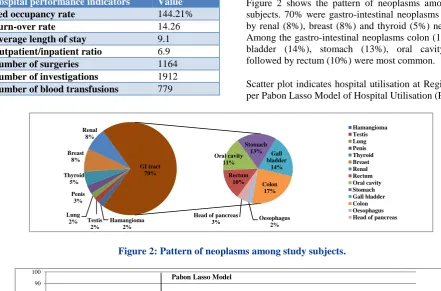
Figure 2 shows the pattern of neoplasms among study subjects. 70% were gastro-intestinal neoplasms followed by renal (8%), breast (8%) and thyroid (5%) neoplasms. Among the gastro-intestinal neoplasms colon (17%), gall bladder (14%), stomach (13%), oral cavity (11%) followed by rectum (10%) were most common.
Scatter plot indicates hospital utilisation at Region IV as per Pabon Lasso Model of Hospital Utilisation (Figure 3).
Figure 2: Pattern of neoplasms among study subjects.
Figure 3: Bed occupancy rate and bed turn-over rate. Chapter I 2% Chapter II 18% Chapter IX 19% Chapter XI 29% Chapter XII 3% Chapter XIV 3% Chapter XVII 2% Chapter XIX 24% Chapter I Chapter II Chapter IX Chapter XI Chapter XII Chapter XIV Chapter XVII Chapter XIX Hamangioma 2% Testis 2% Lung 2% Penis 3% Thyroid 5% Breast 8% Renal 8% Rectum 10% Oral cavity 11% Stomach
13% Gall bladder 14% Colon 17% Oesophagus 2% Head of pancreas
3% GI tract 70% Hamangioma Testis Lung Penis Thyroid Breast Renal Rectum Oral cavity Stomach Gall bladder Colon Oesophagus Head of pancreas
0 10 20 30 40 50 60 70 80 90 100
0 20 40 60 80 100 120 140 160
B ed t u rn ove r rat e
Bed occupancy rate Pabon Lasso Model
I
III
DISCUSSION
The bed occupancy rate in the present study was 144.21% indicating high patient turnout as compared to the number of available beds, hence floor admission were present. It also indicates a good reputation of the hospital and the availability of multiple services in one place. Also, a
dearth of required services in the peripheral public health care institutions and the lack of availability of reputed private health care institutions may added to increased admission rate and thereby high bed occupancy rate. A study in Ranchi15 and Iran16 also has increased bed occupancy rate. The comparative bed utilisation indices in the present study in comparison with other similar studies in India and abroad was shown in Table 2.
Table2: Relative hospital utilisation indices as reported by different studies.
Name of the author Bed occupancy rate (%) Bed turn-over rate Average length of stay (days)
Present study (2016)a 144.21 14.26 9.1
Borkar et al.5,a 75.71 - 5.39
Quereshi et al.13,a 87.41 56.68 6.9
Marcelo et al.14,b 52.2 39.1 7.2
Haider et al.15,a 118.51 43 9.5
Bastani et al.16,b 114.8 2.4 1.82
Dutta et al.17,b 61.3 13.8 14.7
*a: Studies in India; b: Studies abroad.
The bed turn-over rate was 14.26 indicating the slow speed of rotation of patients on any bed. The more complicate the case dealt with by the hospitals, the smaller is the turn-over rate. A high average length of stay indicates severity and chronicity of the cases being admitted in the hospital.
Scatter plot indicates hospital utilisation at Region IV as per Pabon Lasso Model of Hospital Utilisation. The implication of the findings is that there were large proportions of severe cases, predominance of chronic cases and long duration of hospital stay. All those findings accentuate the scarcity of bed and dearth of proper facilities in the peripheral health care facilities. This model was also used in a study in Iran by Mohammad et al to evaluate the efficiency of hospitals in a province.18
Limitations
Time was the greatest limitations of the present study, to study the trend of the disease a minimum of 5 years data collection is required. Also, to comment further on hospital utilisation indices a minimum of 1 year study is essential.
CONCLUSION
It was found in this study of utilization of hospital beds that though the Bed occupancy rates were on an overall very high, suggestive of less number of beds. The difficult terrains it serves with in-flow of patients from neighbouring states like Bihar and Assam and neighbouring countries like Bangladesh and Nepal along with the districts of Northern part of West Bengal is partly responsible for the high bed occupancy rates suggesting dearth of required services in the more peripheral public health care institutions and inadequacy
To deal with the situation, there is urgent need for increase in the number of beds and also the number and availability of trained human resources and other material resources not only in the tertiary care hospitals but also in the peripheral health care institutions. More sophisticated and super-specialised units like Burn unit, Trauma care unit are the need of the hour. A month by month statistical analysis would enable the administrators to plan ahead for meeting this contingency and do the necessary corrective measures for a particular ward or for a particular season.
This study provides an insight that to get the best out of a hospital bed in any hospital, the hospital authorities should formulate its policies taking into account the local
community requirements, socio-economic status,
marketing strategies and use all hospital resources to the fullest potential.
Funding: No funding sources Conflict of interest: None declared
Ethical approval: The study was approved by the Institutional Ethics Committee
REFERENCES
1. Lewellyn L, Davies R, Macaulay HMC. Hospital Planning and Administration, WHO Monograph series No 54. Geneva, New Delhi: Jaypee Brothers; 1995: 35.
2. Available at: http://data.worldbank.org/indicator/ SH.MED.BEDS.ZS. Accessed on 19 May 2016. 3. Available at:
https://data.gov.in/resources/stateut- wise-number-government-hospitals-and-beds-rural-and-urban-areas-including/download. Accessed on 19 May 2016.
5. Borkar AM. Hospital utilization pattern at a tertiary care hospital in tribal area of Central India. Int J Community Med Public Health. 2016;3(2):551-4. 6. Background and reading material for training course
of Diploma in Health Administration-Paper-III. Academy of Hospital Administration. New Delhi; 2000: 10-20.
7. Alonso M, Anto JM. The Appropriateness
Evaluation Protocol Group of the Hospital Universitari del Mar using length of stay and inactive days in the hospital to assess appropriateness of utilization in Barcelona, Spain. J Epidemiol Community Health. 1996;50:196-201. 8. Anand TR. Hospital Services and Management
Methods. Background and reading material for training course on Hospital Management. 1982:6. 9. Tripathi GD. Maximum utilization of Hospital beds.
NIHAE Bull. 1997;3:315-21.
10. Saha JB, Mitra J, Mondal A. Length of stay of in-patients of a Gynecological ward in a sub-divisional hospital in West Bengal. Indian J Public Health. 1991;35: 71-4.
11. Cohan CF. Hospital expenses rise faster than overall CPI. Hospital. 1980;54:59-62.
12. Kiran ER, Vijaya K. Utilization of beds in a tertiary care hospital. 2003;15:7-12.
13. Quereshi W. A five year retrospective study of bed utilization trends in a tertiary care teaching institution. JK Science. 2014;16(3):119-21.
14. de Azevedo Ramos MC, da Cruz LP, Kishima VC, Pollara WM, de Lira ACO, Couttolenc BF. Performance evaluation of hospitals that provide care in the public health system, Brazil. Rev Saude Publica. 2015;49:43.
15. Haider S, Singh SB, Kashyap V, Lal PK. Hospital utilisation statistics as a measure of functioning of the facility at RIMS, Ranchi. Indian J Prev Soc Med. 2008;39(3):4.
16. Bastani P, Vatankhah S, Salehi M. Performance Ratio Analysis: A National Study on Iranian Hospitals Affiliated to Ministry of Health and Medical Education. Iran J Public Health. 2013;42(8):876-82.
17. Dutta S, Biswas R, Lahiri A. A Study on Bed Utilization in the Gynaecological Ward of a District Hospital in West Bengal. Indian J Public Health. 2005;49(4):263-4.
18. Mehrtak M, Yusefzadeh H, Jaafaripooyan E. Pabon
Lasso and Data Envelopment Analysis: a
complementary approach to hospital performance measurement. Glob J Health Sci. 2014;6(4):107-16.
Cite this article as: Chakraborty S, Banerjee S. A