361
Agent-Based Ergonomic User Interface
Development Environment - Design Phase
Dr. Md. Abdul Muqsit KhanAbstract: The well-being of the users has been a great concern for the user interface designer for many years, little attention has been paid by the UI designers in this direction, an ergonomic user interface design using roles in a Multi-agent system can full fill this gap. This work contributes to the potential solution by developing an Agent-Based Ergonomic User Interface, this paper presents the design phase of the proposed Agent-Based Ergonomic User Interface Development Environment. As agents have been accepted as technology, there is a thriving need for practical methods for developing agent applications. An architecture for Agent-Based Ergonomic User Interface using the Prometheus methodology is presented in this paper. Prometheus contrasts from predominant methodologies in that it is a comprehensive methodology, evolved out of the pedagogical and industrial experience. The proposed role-based MAS architecture includes seven types of agents: AgentContextOfUse, AgentAdaptationProcess AgentContextUser, AgentContextPlatform, AgentStimuliGenerator, AgentContextEnvironment, and DispatcherAgent. In designing Ergonomic User Interface, Roles are vital, the work also identified the various actors and their roles in the multi-agent system.
Index Terms: Architecture, Adaptation, Agent, Design, Ergonomics User Interface (EUI), Environment, Multi-agent system (MAS), Roles, User Interface (UI), User.
—————————— ——————————
1.
INTRODUCTION
It has been a prodigious challenge globally for the past few years in the software industry to design a UI that meets the user requirement. The expectations of the users are high, whereas designers are starving to cope up with a dynamic user requirement. To fulfill the requirement of users' various design methods have been proposed. The design of interactive systems by taking the user in the design process was initiated in the 70s by participatory design method and further its extension, the user centered design (UCD) was proposed, it is the systematic design methods applied by expert designers. The UCD is further refined by an ergonomic user interface (EUI) in the proposed system. EUI is a systematic, interdisciplinary approach necessary for design and analysis. Interdisciplinary knowledge from Psychology and Engineering are required in EUI design: to formulate systems goals; to understand the functional requirements; to design a new system; analyse a system, and to implement the system. The design and implementation of the proposed architecture are formulated by using MAS. The goal of the proposed architecture was to make decisions about which alternative is most appropriate for adaptation. In this regard, an architecture based on the concept of agent will be a great benefit to the system, since it allows more natural process modeling human decision making [1,16].
The sharing of responsibilities between different actors are also encouraged by MAS, it also facilitates the current trend of decentralization of the software. The proposed architecture will leverage the knowledge of the UI gathered during the design of the interface, allowing integration of design-based UI models in the adaptation process. There are anonymous benefits of applying an efficient way to develop any application software, as the first step to solve a problem is to clarify it, only then you can propose a solution. An Agent-Based Ergonomic User Interface Development Environment (AB-EUIDE) has been developed, which formulate a framework for EUI architecture using agent technology. This designed complements the classical model-based approaches [2, 3], with the features needed for carrying out the adaptation process for user comfort. Human factor Engineering or Ergonomics is increasingly becoming an investigative topic amongst cognitive science researchers, including linguists [5,15], computer ergonomics [6,7,8], and cloud computing [9,10]. This paper presents a part of the larger work done on AB-EUIDE. The work on AB-EUIDE which has been penned down by the author are as follows: in [11] has presented a framework for AB-EUIDE, in [12] has penned the Metrics for Agent-Based Ergonomic User Interface and in [13] has penned down Agent-Based Ergonomic User Interface Development Environment: Analysis Phase. In this paper, the author has transcribed the Architecture of Multi-Agent System used to design EUI, an overview of the design of the proposed multi-agent architecture. The notation of Prometheus methodology has been chosen for this multi-agent systems development [14].
The organization of the paper is as follows: The section two presents objectives of the multi-agent system. In section three actors and their roles in multi-agent system are discussed. Section four presents an overview of the proposed architecture. The author finally presents the conclusions and feature work in section five.
2
OBJECTIVES
OF
THE
MULTI-AGENT
SYSTEM
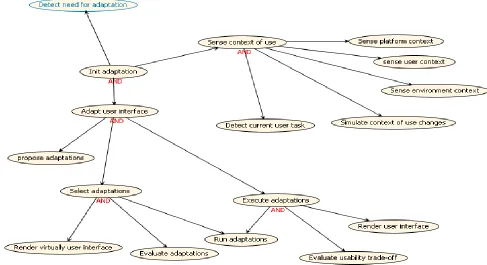
The major goals of the proposed architecture include mainly the implementation of the proposed adaptation process. Therefore, the design of the proposed MAS started from the specification of the different stages of the adaptation process. Figure 1, shows the objectives specified for a MAS. The ————————————————
Dr. Md. Abdul Muqsit Khan is Principal of MANUU Polytechnic Darbhanga, Maulana Azad National Urdu University, Hyderabad, T.S., India, PH-919430013617. E-mail [email protected]. Dr. Md. Abdul Muqsit khan pursued Bachelor of Science from Gulbarga University of Gulbarga, India in 1996 and Master of Science from JNTU, Hyderabad in year 2002. and Ph.D from JNTUA, Anantapure, India. and currently working as Principal MANUU polytechnic, Maulana Azad National Urdu University of Hyderabad, India since 2009.
He is a Fellow of IE, IETE, IRED, and ISRD. He is a life member of the ISC, IAENG, IS. He has published more than 26 research papers in reputed international journals including Thomson Reuters (SCI & Web of Science) and conferences including IEEE, ACM and it’s also available online. His main research work focuses on Ergonomics, Ergonomic User Interface, Multi-Agent Systems, Affective computing, NLP and social computing. He has 20 years of teaching experience and 10 years as principal polytechnic. He also have four years of industrial experience.
362 ultimate goal is to adapt the UI to the user desire. This
objective has been broken down into four sub-objectives that represent the four stages of the adaptation process. The initiative is modelled step by step into initiative goal adaptation. This step subdivided in detecting the possible necessity of applying an adaptation (Detect need for adaptation), and detecting changes in the context (Sense context of use). The detection of changes in the context includes detecting changes in both the platform where the interaction is performed (Sense platform context), the current user (Sense user context) and the physical environment where the user is located (Sense environment context). Moreover, this objective also includes the inference of what may be the current task the user is performing right now (Detect current user task) and processing changes in the simulated context
(Simulate context of use changes) to allow assessment and treatment adaptation capabilities (especially when there are no physical sensors necessary to capture changes in context). Goals also include adaptations feasible proposition given the current context of use (Propose adaptations), the selection of adaptations (Select adaptations), and finally the execution of selected adaptations (adaptations Execute). The selection of adaptations includes assessing each of the proposed adaptations and virtually running them. The implementation of the adjustments is performed by applying selected rules (Run adaptations), the commitment of usability evaluation to ensure the preservation of system usability (Evaluate usability trade-off), and finally, the display adapted UI (Render UI).
.
Figure 1 Objectives of the proposed multi-agent system.
3
.
ROLES
IN
THE
MULTI-AGENT
SYSTEM
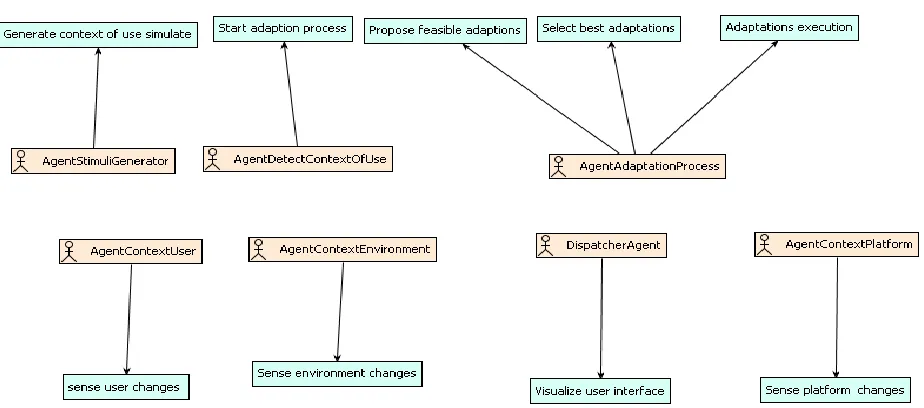
The distribution of the different roles of the players that play leads to the definition of agents. This will have on account factors such as the degree of cohesion of roles including each agent. Figure 2 describes the distribution of roles has performed and the resulting agents of such distribution.
3.1 THE ACTORS AND THEIR ROLES IN MULTI-AGENT SYSTEM The roles allow grouping the objectives of the system according to the different personalities that should take an agent in the system to carry out a series of goals. Figure 3 shows the roles identified for the proposed multi-agent architecture. Identification of roles for each of the stages of the adaptation process (Start adaptation process, propose feasible adaptations, select best adaptations, Adaptations
363
Figure 3 Roles identified in the multi-agent system.
Figure 2 Distribution of roles between the various agents
4.
AN
OVERVIEW
OF
THE
ARCHITECTURE
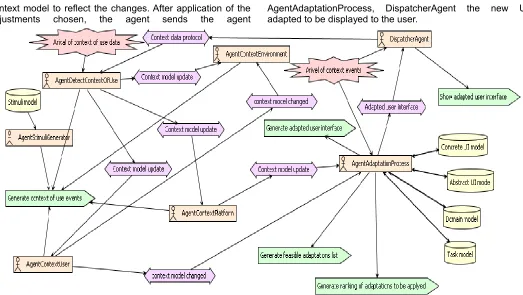
After defining the agents involved in the architecture for the adaptation of UI proposal and the roles that each of these agents plays, then an overview of the MAS architecture is described, In Figure 4 this overview is presented. The agent AgentAdaptationProcess will be between their beliefs, the information gathered during the design of the UI models for a specific UI, abstract UI, domain, and tasks as discussed in [20,23,24,25,26]. The agent receives events representing changes in the context from AgentContextUser, AgentContextPlatform and AgentContextEnvironment agents
depending on whether the context change has occurred on the platform, the user or the environment, respectively. Changes in the context will initially capture by the agent DispatchetAgent, which AgentDetectContextOfUse sent to the agent. This agent decides on the relevance or otherwise of the information received from, according to the specification of the sensors, and will inform the agent (AgentContextUser AgentContextPlatform, or AgentContextEnvironment) corresponding changes in the context. Such agents will finally
produce events that address the context
364 context model to reflect the changes. After application of the
adjustments chosen, the agent sends the agent AgentAdaptationProcess, DispatcherAgent the new UI adapted to be displayed to the user.
Figure 4 Overview of the proposed multi-agent architecture
Figure 5 Stages in the adaptation process used in the architecture
.5.
CONCLUSIONS
AND
FUTURE
WORK
The work has described an architecture that allows the user to provide a set of adaptation capabilities that are designed using the method proposed in [4,20,21,22]. The proposed architecture is based on the concept of an agent, which facilitates designing the most appropriate adaptations. This work also describes in detail how to carry out each stage of the adaptation process in the MAS. The work has posed an exertion to improve the quality of software, especially an improvement in the quality UI by applying human factor engineering. To do this, in recent years, it has delved into the study of proposals to improve the ergonomics of the system on several fronts. In effect, there has been interesting work on improving the ergonomics of the UIs by incorporating the experience, the study of designing UI post-WIMP user methodology for the design of UI solutions, and ultimately improving the ergonomics of the system through the
adaptation of the system to the characteristics of the context of use (user, platform, current task and environment) and their changes. This work gives a solution to the design of UIs able to adapt to the context of use while maintaining their usability. Future directions of our research will focus on
Work will also present the remaining phases of AB-EUIDE. Exploring the development of AB-EUIDE for social
computing [19], affective computing [17, 18], and remote user authentication systems [28] can be done.
The methods of Intellectual property (IP) registration was presented in [27], exploring of same for EUI can be done. An unresolved and controversial interpreted task, related
to design an AB-EUIDE for IoT can be part of future work.
ACKNOWLEDGMENT
365 providing all facilities for my research work. I am also thankful
to Professor Chandra Sekharaiah k, for his continuous encouragement and guidance.
REFERENCES
[1]
Chandra Sekharaiah k, D. J. Ram, & Abdul
Muqsit Khan, “The Peculiarities of Software
Composition Models” J. of Digital Information
Management, Vol. 3(3), Sep05, pp.181-187.
[2]
F. Bodart, A. M. Hennebert, J. M. Leheureux,
Isabelle
Sacre,
and
J.
Vanderdonckt,
“Architecture Elements for Highly-Interactive
Business-Oriented Applications,” in LNCS,
Vol. 153, Springer, 1993, pp. 83-104.
[3]
A.R. Puerta. “A Model-Based Interface
Development Environment”. IEEE Software,
14(4) 1997, pp. 40-47.
[4]
Md. Abdul Muqsit Khan, and Chandra
Sekharaiah K.. “Perspective of MAS Modeling
Through Roles and Ontology,” International
Journal of Recent Trends in Engineering,
IJRTE, 1(2), 2009, pp. 294-298.
[5]
Chandra Sekharaiah, Md. Abdul Muqsit Khan,
and Gopal U. “Obstacles to Machine
Translation,” in Proc. of National Conf. on
Recent Advances and Future Trends in IT,
Punjabi Univ., India, 2005, pp. 86-90.
[6]
Chandra Sekharaiah K., Md. Abdul Muqsit
Khan, and Gopal,
“Computer Ergonomics:
Relooking at Machines vs. Environment,” The
IUP Journal of IT, 2(3), 2006, pp. 19-27.
[7]
Chandra S. K., Md. Abdul Muqsit Khan, and U.
Gopal, "Computer Ergonomics: Relooking at
Machines
Vs.
Environment",
2nd
Int.
Ergonomics Conf. Humanizing Work and Work
Environment, IIT Guwahati, 2005, pp. 10-12.
[8]
Chandra Sekharaiah K., and Md. Abdul Muqsit
Khan. “Computer Ergonomics: Relooking at
Machines vs. Environment,” in chapter 21,
Environmental Protection, Daya Publishing
House, 2007, pp.104-112
[9]
Ravi, Md. Abdul Muqsit Khan, Chandra S.,
and Sundara, “A Study on Agent Based
Ergonomic and Intelligent User Interface
Design in Cloud Computing,” ICTCS16 Proc.
of the 2nd Int. Conf. on ICT for Competitive
Strategies,
ACM,
NY,
USA.
2016,
doi>10.1145/2905055.2905058.
[10]
Ravi, Md. Abdul Muqsit Khan, Chandra
S., and Sundara, “AB-EUIDE: An approach to
the design of ergonomic user interfaces for
Cloud Computing,” ICTCS16 Proc. of the 2nd
Int. Conf. on ICT for Competitive Strategies,
ACM,
NY,
USA.
2016,
doi>10.1145/2905055.2905056 .
[11]
Md. Abdul Muqsit Khan, “Framework
For Multi-Agent Based Intelligent Ergonomic
User interface System: Requirements Phase”
in Int. Journal of Advanced Research in
Computer Science. Vol. 8(7), Jul-Aug. 2017,
pp. 599-603.
[12]
Md. Abdul Muqsit Khan,
“Metrics for
Agent-Based Ergonomic User Interface” in
Journal of The Institution of Engineers (India):
Series B, submitted.
[13]
Md. Abdul Muqsit Khan,
“Agent-Based
Ergonomic
User
Interface
Development
Environment: Analysis Phase” in International
Journal
of
Innovative
Technology
and
Exploring Engineering (TM), submitted.
[14]
Padgham L.; and Winikoff M.; 3rd Int
Workshop on Agent Oriented Software Eng.,
AOSE02. LNCS 2585, 2002, pp. 174-85.
[15]
Chandra K. Sekharaiah , Md Abdul
Muqsit Khan,
and U. Gopal, “Obstacles to
Machine
Translation,”
Int.
Journal
of
Translation, 18(1-2), Aug 06, pp. 89-102.
[16]
Chandra S. K., Ram J., and Md. Abdul
Muqsit Khan. “The Peculiarities of Software
Composition Models,” in proc. of 2nd Int. Conf.
on Information Technology ICIT05, HCI,
Jordan, 2005, pp. 330-339.
[17]
Chandra S. K., Md Abdul Muqsit K.,
and Gopal “Affective Computing: Next
Generation AI Software Systems,” The IUP
Journal of IT, Vol. 3(4), Dec.07, pp. 61-74.
[18]
Chandra Sekharaiah K., Md.Abdul
Muqsit Khan, and U.Gopal, “Affective
Computing: Next Generation AI Software
Systems,” in Proc. of National Conf. on S.E.,
Cochin University, India, Apr 07, pp.199-206
[19]
Chandra Sekharaiah K., and Md Abdul
Muqsit Khan, “Towards Metrics for Social
Computing,” Proc. of World Academy of
Science, Engineering, and Tec. 37, no.
2070-3740, Jan 2009, pp 1086-1090.
[20]
Abdul Muqsit Khan, and Chandra
Sekharaiah K. “Roles and Ontology for Agent
Systems”,
Proceedings
of
National
Conference on Next Generation Computing
Technologies, ITS, India, 2008, pp. 244-256.
[21]
Md. Abdul Muqsit Khan, and Chandra
Sekharaiah
K.,.
Ergonomics
for
web
applications development, in Proceedings of
4th International conf., IETET, India, 2013,
pp.62-72.
[22]
Md. Abdul Muqsit Khan, and Tunga A.,
366