2829
SOR (Stimulus-Organism-Response) Model
Application In Observing The Influence Of
Impulsive Buying On Consumer‟s Post-Purchase
Regret
Jondry Adrin Hetharie, Surachman, Ananda Sabil Hussein, Astrid Puspaningrum
Abstract: This study used the concept of stimulus-organism-response (SOR) to test the environmental stimuli, such as store environment, social factor, and fashion involvement, to the impulsive buying behavior mediated by customer‟s emotional gratification and its ef fect on post-purchase. SOR‟s basic assumption explains that change of behavior of an organism is influenced by the quality of stimulus, which is similar to the learning process. The population of the study is the customer of the Matahari Departement Store in Ambon city. The sample number was determined by purposive sampling with 223 respondents. Structural equation modeling (SEM) was used for data analysis. 9 hypotheses were tested; 8 accounted for the direct causative; 1 accounted for the moderation factor, and another accounted for the mediation factor. The result showed that 2 insignificant factors; the store environment and emotional gratification to the impulsive buying of the customer.
Keywords: Stimulus-Organism-Response, impulse buying, consumer‟s post-purchase regret ————————————————————
1.
INTRODUCTION
Knowledge about customers is vital in marketing strategy planning for any company, including retail. Customers might become the most valuable asset for companies, so they have to create and preserve equity. Companies need effective information about customers from the store and develop it into a stimulus for purchase. Besides that, it is also required to determine an efficient resource consumption strategy to increase sales and competitiveness. Purchase made by consumers can be classified into planned and unplanned purchasing (Stern in Virvilaite, Saladiene, and Žvinklyte, 2011). Planned purchasing involves information gathering in the purchase, while unplanned purchasing does not . In certain situation, purchases can occur out of the nowhere without planning, and right on site to deal with urgent desire to be happy and content (Rook, 1987 in Billieux, Rochat, Rebetez, and Ven der Linden, 2008). The research estimated that average British person can spend up to 49,900-pound sterling, (nearly IDR 689 million), in their life for purchases that they did not plan (Kompas, 2010). A study in Denmark also indicated that 9 of 10 buyers did not plan one-third of their purchases (Solomon et al. 2006). After a purchase is made, consumers then assess the pros and cons of the transactions that they have made to convince themselves that their purchase decisions are appropriate and to ensure that the products can solve their problems and satisfy their needs (Kassarjian and Cohen, 1965 in Hasan and Nasreen, 2012; Bakshi, 2012). Some of the times they compare the products they bought with other similar products. Comparisons between these products can lead to psychological conditions known as cognitive dissonance or post-purchase regret (Saleh, 2012). Regret can occur if the product that they have bought is not as good as their expectation or unpurchased other similar products (Bell, 1982; Tsiros and Mittal, 2000 in Lee and Cotte, 2009). A poll involving 3,000 women shows that 84% of the respondents claimed that they intended to go window shopping when they plan to go to a shopping center, but they bought something in the end. 40% of them admitted
that they did not like the clothes they bought when they arrived at home, and 85% of them regretted about the items or clothes they bought (Lubis and Nugraheni, 2010).
Research by Frontier Consulting Group
2830 IJSTR©2019
buying, mediated by consumer‟s emotional gratification; and also to elucidate the effect of characteristics situational variables in moderating the emotional gratification factor to impulse buying and post-purchase regret after shopping in Matahari Department Store, Ambon. The model used is Mehrabian-Russel‟s SOR model. The result of this study is hoped to give a reference for businessmen in formulating a strategy to influence customer‟s purchasing behavior.
2.
LITERATURE REVIEW
2.1 Mehrabian-Russel’s Stimulus-Organism-Response Model
Mehrabian-Russell‟s stimulus model illustrates the occurrence of a person's response to stimuli from the environment. Adopted from the theory of environmental psychology, Stimulus-Organism-Response (SOR) reveals that environment is a stimulus (S), which consists of a set of signs that cause an internal evaluation of someone (O) and then produces a response (R) (Mehrabian and Russell, 1974). The SOR model suggests that consumer‟s emotions become an important part in responding to the exposing environmental stimulus (Mowen, 2002). This model also suggests that conscious and unconscious perceptions and environmental interpretations influence what someone feels (Donovan, 1982). Mehrabian and Russel (1974) mentioned that emotional responses to the environment can be explained by three dimensions:
a. Pleasure, which is measured by verbal judgments about reactions to the environment in the form of happiness, joy, or satisfaction level in a certain situation.
b. Arousal, which is measured by a broader verbal judgment in the form of a person's level of happiness or activeness in a certain situation.; c. Dominance, which is measured by indications of a
respondent‟s feelings in the form of willingness to be dominant and influential in an environmental situation.
These dimensions assume that each environment produces certain emotional conditions for an individual. According to Mehrabian and Russell (1974), arousal is a psychological concept about the level of feeling which is mostly expressed in spoken reports. The idea of arousal concept is often compared with environmental psychology as a charge or content. A high charge (arousal) in a comfortable environment causes approach behavior, as a high charge in an uncomfortable environment causes avoidance behavior. A low charge environment is not strong enough to motivate neither approach nor avoidance behavior.
2.2Post-Purchase Regret
Even though the purchasing process has been completed, consumers often evaluate their decisions (Bakshi, 2012). They do not always feel confident and anxious about the decisions that they have made. Regret is a cognitive emotion that consumers want to avoid, bury, deny, and regulate when the feeling arises (Zeelenberg and Pieter, 2006 in Lee and Cotte, 2009). It can occur when a consumer realizes that the results of his purchase are not meeting their expectation (Bell, 1982; Tsiros and Mittal, 2000 in Lee and Cotte, 2009). Hoyer and MacInnis (2010) in Lee and Cotte (2009) stated that post-purchase regret
occurs when a consumer realized that the performance of the product he has bought is not better than the performance of other products that he had not bought. Customers can also feel post-purchase regret even though they do not have any information about other products.
2.3Impulsive buying
According to Beatty and Ferrell (1998), impulsive buying is immediate and sudden purchases without any intention prior to shopping toward a specific product category to meet certain needs. This behavior occurs after consumers experience a sudden occurrence of a very strong impulse to buy and compelled to make spontaneous purchases without sufficient consideration (Hausman, 2000). The drive to make impulsive buying is a complex hedonic factor that often stimulates emotional conflict, which could be coming from internal (psychological and emotional aspects) or external (persuasion of marketers) (Rook and Fisher, 1995).
2.4 Emotional Gratification
Emotion is a relatively uncontrollable feeling that strongly influences behavior and all emotional experiences tend to have the same elements. Emotions are usually triggered by environmental events. However, we can also start emotional reactions with internal processes such as imagery. Another characteristic feature of emotional experience is cognitive thought. The type of thought and our ability to think rationally vary according to the emotional types and level. Extreme emotional response is often used to explain incorrect thought and actions. Emotions are generally evaluated (whether preferable or not) in a consistent pattern across individuals and within individuals over time, but cultural, individual, and situational variations persist. Emotions are important because the emotional expression is proven to be able to eliminate stress at work. The more precisely we communicate our feelings, the more comfortable our feelings become. Skills in emotional management allow us to be friendlier, communicate sincerely, and be open to others. Emotions felt by someone are important factors in making purchase decisions. Emotions are usually divided into emotional gratification and negative emotions (Watson and Tellengan, 1985). Emotional gratification of a buyer may arise when he is in a store that has an effective layout, in a good mood before making a purchase, and confronted by a strong store environment to do impulsive buying (Rook and Gardner, 1993; Youn and Faber, 2000; Hausman, 2000; Beatty and Ferrel, 1998). Consumers who make impulsive buying and have emotional gratification after purchase tend to use a simpler process in making purchase decisions (Isen, 1984). Compared to negative emotions, consumers who make impulsive buying and have emotional gratification after purchase will make repeat purchases because they feel a higher and beneficial energy boost and do not evaluate their purchases (Rook and Gardner, 1993).
2.5 Fashion Involvement
2831
Good & Gentry. 1989; Flynn & Goldsmith, 1993 in Park et al, 2006). It is the level of consumers' view about clothing consumption as part of their lives and as a meaningful and interesting activity (O‟Cass, 2004). Park et al. (2005) stated that fashion involvement is the interest level of someone in fashion product category such as clothes. Japarianto and Sugiono (2011) defined fashion involvement as the consumer‟s involvement in a clothing product due to the customer‟s need and interests, as well as the value of the product. Park et al. (2006) found that fashion involvement influences emotional gratification when shopping and influences fashion-oriented impulsive buying. In the context of fashion pop-up outlets, Ryu (2011) found that fashion involvement has a positive influence on fashion-oriented impulsive buying behavior. O‟Cass (2000) found that fashion involvement influences knowledge about fashion, which then influences one's belief in making a decision to purchase. The description of the relationship between variables in this study explains substantially the relationship
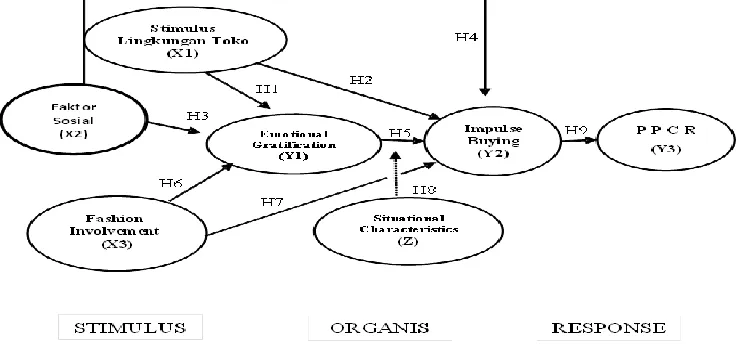
flow between store environment stimulus, social factors, and emotional gratification on impulsive buying and post-purchase consumer regret at Matahari Department Store in Ambon city. In this study, the researcher adopted a stimulus-organism-response model developed by Mehrabian and Russel (1974). This model describes a person's response to environmental stimuli. This model is adopted from the theory of environmental psychology, Stimulus-Organism-Response (SOR), which reveals that the environment is a stimulus (S), which consists of a set of signs that cause an internal evaluation of someone (O), which then produces responses (R) from that person. The Mehrabian-Russell‟s response stimulus model, as in Mowen (2002), suggests that consumer emotions are an important part in responding the exposing environmental stimuli. This model also suggests that conscious and sub-conscious perceptions and environmental interpretations influence what is felt by someone (Donovan, 1982).
Figure 1. Conceptual Model and Relationship between Variables
2.6 Store Environment Stimulus
The results of Donovan and Rossiter (1982), as in Rohman (2009), found that a pleasant physical environment influences the consumer to make purchase decisions beyond the planned level. The results of Park and Lennon also showed that the physical environment can influence impulsive reactions from consumers. The results of Peck and Terry (2006), as in Rohman (2009), confirm the findings of Park, Jihye and Lennon (2006),namely that the more strongly physical environment gives information to consumers to be used as a reference, the stronger consumers‟ desire to buy becomes. This result is confirmed by Chang et al. (2008), who use stimulus-organism-response framework, that consumer emotions can be a mediating factor in the buying process.
Based on the description above, the two hypotheses below were made.
Hypothesis 1: The stimulus of store environment directly influences consumer‟s emotional gratification
Hypothesis 2: The stimulus of store environment directly influences on impulsive buying
2.7 Social Factor
The social environment is related to the influence of others on consumers in consumption situations (Belk, 1975 in
Rohman, 2009). Consumers can relate directly to other people or experience an event because they see other people doing activities. In this case, the social factor is the extent of the affection that a customer feels towards the crowdedness in a store and employee participation in helping him. The results of the study indicate that assistance from store attendants in helping customers influences the willingness of customers to buy (Baker, Levy and Grewal, 1992 as in Matilla, 2006).
Based on the description above, the two hypotheses below were made.
Hypothesis 3: Social factor directly influences consumer‟s Emotional Gratification
Hypothesis 4: Social factor directly influences Impulsive buying
2.8 Emotional Gratification
2832 IJSTR©2019
emotional gratification and fashion involvement and impulsive buying. According to Park et al. (2006), emotion is the effect of mood, which is an important factor in the purchasing decisions of consumers. The feeling or emotion factor is a temporary construct because it is related to a particular situation or object. Feelings such as love, perfection, excitement, the desire to possess, passion, fascination, and enthusiasm, according to various studies, allegedly have a significant positive correlation with the tendency of impulsive buying (Premananto, 2007). However, emotions related to purchasing decisions, such as emotions created by brands and existing stimuli, need to be distinguished from emotions in broader nature. This was stated by Shiv and Fedorikhin in Premananto (2007), who classify emotions into task-induced affect which is expressed as effective reaction that emerges directly from the decision task itself‟; and ambient affect which is expressed as 'affective states that arise from background condition such as fatigue and mood'. One approach in personality is the theory of big-five personality, which is a personality hierarchy model that divides personality into five factors. Each of them explains the personality clearly and extensively (Gosling, Rentfrow, & Swann Jr., 2003). The five personality types are neuroticism, extraversion, openness to new experience, agreeableness, and conscientiousness. The first dimension, neuroticism, includes negative feelings, such as anxiety, sadness, irritability, and tension. This dimension has a positive relationship with impulsive buying. The properties contained in this dimension include the tendency of individuals to have psychological distress, unrealistic ideas, excessive needs or desires, and inappropriate coping responses (Costa & McRae as in Pervin, 2005). Lazarus and Folkman (1986) stated that coping responses are related to cognitive and emotional side of individuals. Neurotics have inappropriate coping responses. This is related to impulsive buying tendencies, which are characterized by conflicts between cognitive and emotional considerations (Verplanken & Herabadi, 2001). This conflict is won by the emotional side that causes an individual to make irrational purchases. For this reason, people who tend to be included in this type have the tendency to make impulsive buying. Based on the description above, the hypothesis below was made.
Hypothesis 5: Emotional gratification directly influences impulsive buying
2.9 The Relationship between Fashion Involvement, Emotional Gratification, and Impulsive buying
According to O'Cass, involvement is a motivational interest or part that is generated by a stimulus or a particular situation and is shown through appearance characteristics (O‟Cass, 2004 in Park, 2006). Whereas, according to Zaichkowsky, involvement is a person's relationship with an object based on needs, values, and interests (Zaichkowsky, 1985, pp. 341-352). Involvement can be seen as a motivation for processing information. Consumers will pay attention to advertisements related to the product, give more effort to understand the ads and focus their attention on information about the products in them. On the other hand, one might not bother to pay attention to the information provided (Celsi and Olson, 1988, pp. 210-224). Similarly, many people are involved in fashion, spending time and money on the latest styles; while others (mostly
men) find that shopping for clothes is a task. In fashion marketing, fashion involvement refers to the interest in fashion product categories. Fashion involvement is mainly used to predict behavioral variables related to clothing products such as product involvement, buying behavior, and consumer characteristics (Browne and Kaldenberg, 1997; Fairhurst, 1989; Flynnand Goldsmith, 1993 in Park, 2006). For example, O‟Cass (2004) in Park (2006) found that fashion involvement in clothing is closely related to personal characteristics (i.e. women and young people) and fashion knowledge, which in turn affects consumer‟s confidence in making purchase decisions. Kim (2005) suggested that to identify the relationship of fashion involvement with impulsive buying behavior, the indicators below are used.
• Having one or more clothes of the latest style
• Fashion is one important thing that supports activities • Preferring to situations when what he wears is different from what others wear
• Clothing shows characteristics
• Can know much about others from the clothes they wear • When wearing favorite clothes, he makes other people interested to see them
• Trying fashion products first before buying them • Know more about the latest fashion compared to others Based on the description above, hypotheses 6 and 7 below were made.
Hypothesis 6: Fashion Involvement directly influences emotional gratification
Hypothesis 7: Fashion Involvement directly influences impulsive buying
2.10. The Relationship between Situational Characteristics, Emotional Gratification, and Impulsive buying
According to studies, emotional gratification is often related to money, work, or social status (Martin and Mihaly, 2000). People believe that those who have enough money are more likely to be happy. In particular, the availability of money plays a facilitator role because it increases the consumer‟s purchasing power. When consumers have more money in hand to spend, they tend to feel more positive and happier. Similarly, Wood (1998) found that consumers who have more money are more likely to get positive emotions. Thus, the availability of money regulates the relationship between the consumer‟s emotional response and impulsive buying. Based on the description above, the hypothesis below was made. Hypothesis 8: Situational characteristics moderates the influence of emotional gratification on impulsive buying
2833
compares the poor decision process he had with a better decision processes he might have (Lee & Cotte, 2009). Based on the description above, the hypothesis below was made.
Hypothesis 9: Impulsive buying directly influences post-purchase regret.
3
METHOD
This research is explanatory research to explain the relationship of each variable with the proposed hypotheses with quantitative approach. The focus of this study is to check the causative relationship of various factors (store environment, social factor, and fashion involvement) to emotional gratification and its effect on the unplanned purchase and post-purchase consumer regret.
3.1 Sample
The sample of this study was determined through purposive sampling. The researcher directly distributed the list of questions to customers of the department store. Initial questions were used to ensure that customers do impulsive buying at Matahari department store. The number of samples suitable for a study, according to Davis and Cosenza (1993) in Kuncoro (2003) and Rohman (2009), is influenced by its tools of analysis. In accordance with the analyzing tool, the number of samples in this study is 223. This fulfills the criteria for sample determination as described by Roscoe in Ferdinand (2003) that the number
of samples which is greater more than 30 and fewer than 500 is sufficient for all studies. In addition, SEM analysis requires a good number of samples, which is 100-200.
3.2 Research Instrument
Likert scale was used as the instrument in this study, which is used to measure attitudes, opinions, and perceptions of a person or a group of people about social events or phenomena (Sarwono, 2007). By using Likert scale, the measured variables are narrowed down into dimensions, then into sub-variables, and finally narrowed down into measurable indicators in forms of questions or statements that must be responded by the respondents in form of scores, from one to five, strongly disagree to strongly agree respectively.
4. RESULTS
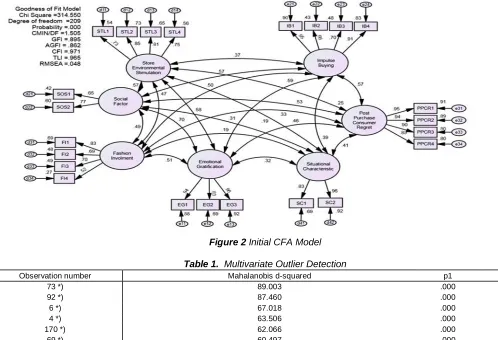
Confirmatory Factor Analysis (CFA) can be used to examine the unidimensionality of variables as it is required for analyzing the reliability and validity of a construct (Anderson and Gerbing, 1991 in Ferdinand, 2002). This model is proven to have an estimated variance-covariance matrix that is not different from the variance-covariance matrix of the sample if the probability value is greater than 0.05. Another criterion used to measure the suitability of the model is the goodness of fit index (GFI). The minimum expected value for GFI is 0.90.
Figure 2 Initial CFA Model
Table 1. Multivariate Outlier Detection
Observation number Mahalanobis d-squared p1 p2
73 *) 89.003 .000 .000
92 *) 87.460 .000 .000
6 *) 67.018 .000 .000
4 *) 63.506 .000 .000
170 *) 62.066 .000 .000
69 *) 60.497 .000 .000
180 *) 57.189 .000 .000
214 *) 55.307 .000 .000
2834 IJSTR©2019
Observation number Mahalanobis d-squared p1 p2
87 *) 50.972 .001 .000
215 *) 46.536 .003 .000
190 *) 45.826 .003 .000
116 *) 44.468 .005 .000
15 40.909 .012 .000
143 40.658 .013 .000
*) = multivariate outliers
The Mahalanobis Distance is used to detect multivariate outliers. There were 13 observations with multivariate outliers because of p1<0.01; namely 73, 92, 6, 4, 170, 69, 180, 214, 5, 87, 15, 190, and 116. These observations were not included in the further analysis, so the number of the observations is 210.
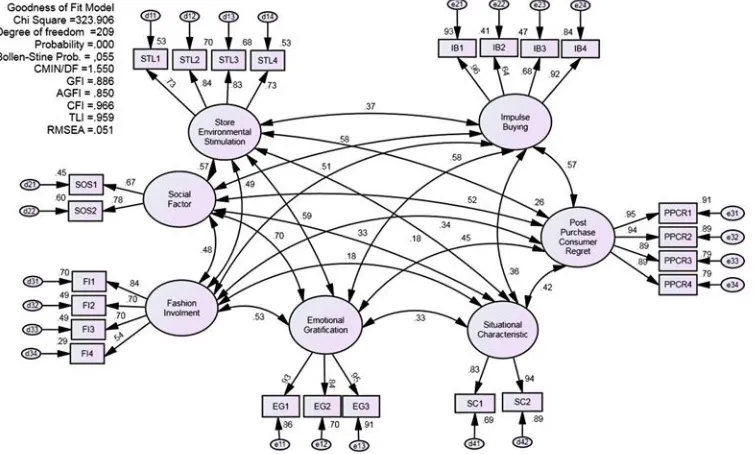
4.1 First Evaluation of CFA Model
The first evaluation of the CFA Model presents the results by not including the 13 outliers. Bollen-Stine bootstrap was used to estimate parameter. 210 observations were the number of the sample. The results of the fit model in the CFA model are chi-square = 323,906 (Bollen-Stine p>
0.05), GFI = 0.886, AGFI = 0.850, CFI = 0.966, TLI = 0.959 and RMSEA = 0.051. The good fit model were found in CFI and TLI (greater than 0.95) and RMSEA (smaller than 0.08), then the marginal fit models were found in GFI and AGFI (0.80-0.90), while no poor fit model was found.
Figure 3, CFA Model – First Evaluation
4.2 Hypothesis Model Test
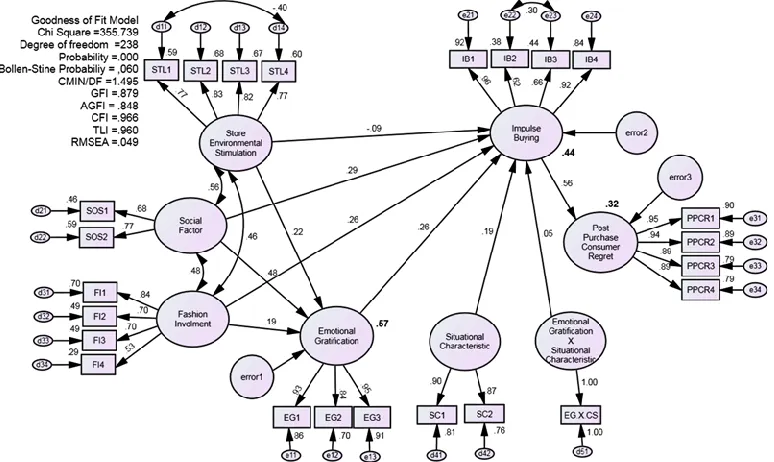
The results of the fit model on the hypothesis model are chi-square = 355,739 (p> 0.05), GFI = 0.879, AGFI = 0.848, CFI = 0.966, TLI = 0.960 and RMSEA = 0.049. The good fits were found in RMSEA (smaller than 0.08), CFI, and TLI
2835
Figure 4. Model hypothesis test result
4.3 Path Coefficient Test
The results of the path coefficient test will be explained sequentially according to the location of the endogenous variables in the hypothesis model (emotional gratification, impulse buying, PPCR). The path coefficient of emotional gratification from store environment stimulus is significant at 0.219 (p = 0.007), from social factor is significant at 0.485 (p <0.001), and from fashion involvement is significant at 0.191 (p = 0.013). The contribution of store environment stimulus, social factor, and fashion involvement in explaining the data variation of emotional gratification is 57%, while the remaining is explained by other variables. The path coefficient of impulsive buying from store
environment stimulus is insignificant at -0.087 (p = 0.298), from social factor is significant at 0.288 (p = 0.021), from fashion involvement is significant at 0.263 (p = 0.001), from emotional gratification is significant at 0.261 (p = 0.012), from situational characteristics is significant at 0.190 (p = 0.002), and from interactions of emotional gratification and situational characteristics is insignificant at 0.048 (p = 394). The contribution of store environment stimulus, social factor, fashion involvement, emotional gratification, and situational characteristics in explaining the data variation of impulse buying is 44%. For the last endogenous variable, the path coefficient of impulsive buying towards post-purchase regret is significant at 0.564 (p <0.001). The contribution of impulse buying in explaining data variations of post-purchase regret is 32%.
Table 2 Path Coefficient Test result
Regression Weight (Estimate)
standard
error. C.R. P value
Standardized Regression Weight Emotional <--- Environment 0.212 0.079 2.684 0.007 0.219 Impulse <--- Environment -0.073 0.070 -1.040 0.298 -0.087 Emotional <--- Social 0.401 0.089 4.520 <0.001 0.485
Impulse <--- Social 0.206 0.089 2.302 0.021 0.288
Impulse <--- Emotional 0.225 0.090 2.508 0.012 0.261 Emotional <--- Fashion 0.314 0.126 2.497 0.013 0.191 Impulse <--- Fashion 0.374 0.117 3.211 0.001 0.263 Impulse <--- Situational 0.122 0.040 3.037 0.002 0.190
Impulse <--- EGXCS 0.037 0.043 0.852 0.394 0.048
PPCR <--- Impulse 1.057 0.122 8.656 <0.001 0.564
4.4 Test Result for Indirect Influence
The coefficient of regression weight of store environment stimulus on emotional gratification was 0.212. The path coefficient of emotional gratification on impulsive buying was 0.225. The magnitude of the indirect influence is 0.212 x 0.225 = 0.048 with SE = 0.025, resulting in a CR value of 1.901. The result of this indirect influence test was not significant (p> 0.05), so emotional gratification does not mediate the influence of store environment stimulus on impulsive buying. The coefficient of regression weight of
2836 IJSTR©2019
magnitude of the indirect effect was 0.315 x 0.225 = 0.071 with SE = 0.038, resulting in the CR value of 1.840. The
result of this indirect influence test was insignificant (p>
0.05), so emotional gratification does not mediate the influence of fashion involvement on impulsive buying.
Table 3. The Result of Mediation Test using Sobel Test
Relationship Regression Weight
(Estimate) Standard error P value The mediation of emotional gratification in the influence of store environment stimulus on impulsive buying
Environment --> Emotionala 0.212 0.079 0.007
Emotional --> Impulseb 0.225 0.090 0.012
Environment --> Emotional --> Impulseab 0.048 0.025 0.057
The mediation of emotional gratification in the influence of social factor on impulsive buying
Social --> Emotionala 0.401 0.089 <0.001
Emotional --> Impulseb 0.225 0.090 0.012
Social --> Emotional --> Impulseab 0.090 0.040 0.026
The mediation of emotional gratification in the influence of involvement on impulsive buying
Fashion--> Emotionala 0.314 0.126 0.013
Emotional --> Impulseb 0.225 0.090 0.012
Fashion --> Emotional --> Impulseab 0.071 0.038 0.066
4.5. Measurement Model Test
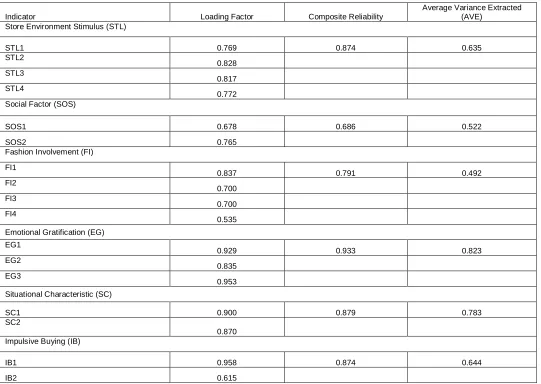
The measurement model will explain the validity and reliability of the constructs of the seven variables in the hypothesis model. The measurement model in the hypothesis model has good validity and reliability. The loading factor between 0.535 and 0.958 are good because it is greater than 0.50. Composite reliability values are in the
range of 0.686 to 0.955, most of which have exceeded the recommended limit, which is 0.70 and signify the good reliability in each construct. The construct reliability measured from the AVE value is good, in the range of 0.492 to 0.843, most of which have exceeded the recommended limit, which is 0.50.
Table 4. Validity and Reliability of Construct
Indicator Loading Factor Composite Reliability
Average Variance Extracted (AVE)
Store Environment Stimulus (STL)
STL1 0.769 0.874 0.635
STL2
0.828 STL3
0.817 STL4
0.772 Social Factor (SOS)
SOS1 0.678 0.686 0.522
SOS2 0.765
Fashion Involvement (FI) FI1
0.837 0.791 0.492
FI2
0.700 FI3
0.700 FI4
0.535 Emotional Gratification (EG)
EG1
0.929 0.933 0.823
EG2
0.835 EG3
0.953 Situational Characteristic (SC)
SC1 0.900 0.879 0.783
SC2
0.870 Impulsive Buying (IB)
IB1 0.958 0.874 0.644
2837
Indicator Loading Factor Composite Reliability
Average Variance Extracted (AVE)
IB3 0.664
IB4 0.915
PPCR PPCR1
0.951 0.955 0.843
PPCR2
0.941 PPCR3
0.888 PPCR4
0.890
Discriminant validity is used to analyze the differentiating power of the measurement results for each construct. AVE root value was calculated in each construct and the correlation coefficient of the construct was compared. All constructs have higher AVE roots than all correlation
coefficients among constructs. For example, the construct of store environment stimulus has an AVE of 0.635 and AVE root of 0.797, while the correlation coefficient with other constructs ranges from 0.000 to 0.563. Thus, this construct is proven to have good discriminant validity.
Table 5. Discriminant Validity
STL SOS FI EG SC IB PPCR
STL (0.797)
SOS 0,563 (0.723)
FI 0.461 0.481 (0.701)
EG 0.580 0.700 0.525 (0.907)
SC 0.000 0.000 0.000 0.000 (0.885)
IB 0.348 0.549 0.499 0.550 0.190 (0.802)
PPCR 0.196 0.309 0.281 0.310 0.107 0.564 (0.918)
Notes: The values in the diagonal parts are the roots of AVE; values under the diagonal line are the correlation coefficient among constructs
4.6 Hypothesis Testing result
This study contains ten hypotheses; eight hypotheses test the direct effect, one tests the moderating effect, and another tests the indirect influence (mediation). Based on the previous result, there are two rejected hypotheses, which are H2 (direct influence)and H8 (moderating effect), while the others are accepted.
Hypothesis 1 states that the store environment stimulus influences emotional gratification. This hypothesis is accepted because the path coefficient of the influence of the store environment stimulus on emotional gratification is significant at 0.219 (p <0.05) (Table 2). Shopping places with the right store environment stimulus increase customer‟s emotional gratification.
Hypothesis 2 states that store environment stimulus influences impulsive buying. This hypothesis is rejected because the path coefficient of the influence of store environment stimulus on impulsive buying is insignificant at -0.087 (p> 0.05) (Table 2). The stimulus of the store environment in shopping places does not directly increase impulsive buying.
Hypothesis 3 states that social factor influences the emotional gratification of customers. This hypothesis is accepted because the path coefficient of the influence of social factor on emotional gratification is significant at 0.485 (p <0.05) (Table 2). Social factor, in this case, the positive perception of customers about the crowdedness of the
store and the role of employees, increases customer‟s emotional gratification.
Hypothesis 4 states that social factor influences customers' impulsive buying. This hypothesis is accepted because the path coefficient of the influence of social factor on impulsive buying is significant at 0.288 (p <0.05) (Table 2). Social factor, in this case, the positive perceptions of customers about the crowdedness of the store and the role of employees, increases impulsive buying.
Hypothesis 5 states that emotional gratification influences customers' impulsive buying. This hypothesis is accepted because the path coefficient of the influence of emotional gratification on impulsive buying is significant at 0.261 (p <0.05) (Table 2). Emotional gratification increases impulsive buying. Customers of Matahari department store who feel happy and satisfied will buy more products while shopping.
2838 IJSTR©2019
and passion for the product, so they seek information about the products.
Hypothesis 7 states that fashion involvement influences impulsive buying. This hypothesis is accepted because the path coefficient of the influence of fashion involvement on impulsive buying is significant at 0.263 (p <0.05) (Table 2). Fashion involvement from customers will increase their impulsive buying.
Hypothesis 8 states that situational characteristics moderate the influence of emotional gratification on impulsive buying. This hypothesis is rejected because the path coefficients of the influence of situational characteristics and emotional gratification on impulsive buying are insignificant at 0.048 (p> 0.05) (Table 2). Situational characteristics of customers are not proven to moderate the increase of customer‟s impulsive buying due to emotional gratification.
Hypothesis 9 states that impulsive buying influences post-purchase regret. This hypothesis is accepted because the path coefficient of the influence of impulsive buying on post-purchase regret is significant at 0.237 (p <0.05) (Table 5.19). High impulsive buying will increase post-purchase regret.
5.
DISCUSSION
The
results
of this study show that the physical environment (Matahari department store stimulus) directly affects customer‟s emotions, which in this case is the emotional gratification felt by customers when visiting the department store. The excitement of customers leads to increased response. Stimulus in forms of music, color, aroma, and product availability increases the interest in consumption and impulsive buying. The results are in line with Mattila and Wirtz (2008), which states that if the store‟s aroma and music are mutually congruent, customer‟s assessment about the environment becomes more positive. The level of closeness, unplanned buying behavior, and satisfaction is higher than when the environmental signals (music, color, and aroma) are not harmonious. Studies show that regret can be caused by both internal and external factors. The external factors are the responsibility for the choices that have made; the gap between expectations and reality; the choice between brand name and price; type of purchase; time of decision making; store service; involvement; and alternate choices. Internal factors are self-esteem, social comparison, doubt, age, gender, and impulsivity (M'Barek and Gharbi, 2011). One characteristic that can affect post-purchase regret is impulsivity. Impulsive consumers tend to feel regret about choices that they have made compared to non-impulsive consumers because the former did not try much in finding information during the decision-making process. They tend to be emotional so they will feel sorry if they have bad experiences when using the products that they choose (M‟Barek and Gharbi, 2011). Consumer‟s decisions related to products and brands are strongly influenced by economic resources, like money and time, which greatly determine consumer behavior (Engel, Blackwell, and Miniard, 1984). The availability of money and time is a situational variable since they are important facilitators in the impulsive buying process (Beatty and Ferrel, 1998). Situational factors can increase or decrease the tendency of consumers to enjoy from impulsive consumption (Dholakia, 2000). Money is animportant element in everyday life, including impulsive behavior. It motivates and influences someone in making purchasing decisions. Its availability is a facilitator in the impulsive buying process (Beatty and Ferrel, 1998) because it can increase individual‟s purchasing power, so individuals who do not have a lot of money will avoid the shopping environment (Foroughi et al., 2012). Money owned by consumers has a direct positive influence on impulsive purchases and tends to affect the mood of someone at the same time. Money can be defined as the amount of budget that can be spent at that time or day (Beatty and Ferrel, 1998). Time availability refers to the amount of time that one thinks is available when he/she makes considerations for a purchase decision. The availability of time for consumers has a positive relationship with the activity of searching for products in the store (Beatty and Smith, 1987). Furthermore, the availability of time is the consumer's perception of the time needed for shopping compared to the actual time available to perform his task (Park, Iyer, and Smith, 1989). It influences decision making while in the store.
6.
CONCULSION
Regret can be influenced by both dispositional and situational factors. Situational factors that affect regret are sense of responsibility for choices that have been made, gap between expectations and reality, choice between brand and price, type of purchase, time in decision making, store service, involvement, and alternative choices of products. Dispositional factors that influence regret are self-esteem, social comparison, doubt, age, gender, and impulsivity (M'Barek and Gharbi, 2011). Impulsivity is one of the characteristics that can lead to post-purchase regret because it is often accompanied by insufficient effort during the decision-making process, leading to a greater sense of responsibility due to one‟s failure in making better decisions (M'Barek and Gharbi, 2011). Impulsive buying is a purchase that occurs when consumers experience a sudden and uncontrolled drive to make unplanned purchases loaded with high emotional involvement (Herabadi, 2003; Solomon et al., 2006; Hoyer and MacInnis, 2010). MacInnis and Patrick (in Suh, Na, Kim, 2010) stated that feelings such as pleasure, guilt, shame, pride, and regret can arise after impulsive buying. Impulsive buying is often associated with post-purchase regrets, product returns, frustration, dissatisfaction, and guilt. Although consumers feel pleasure and satisfaction during the purchase process, they get negative feelings and frustration afterwards. Therefore, consumers who make impulsive buying are more likely to return the purchased products and experience post-purchase regret (Virvilaite, et al. 2011; Suh, et al. 2010; Herabadi, 2003)
6.1 Practical Implication
2839
implementing their retail strategies and policies to face the modern retail business competition.
6.2 Limitation and Suggestion for Next Studies
.This study uses a non-random sampling technique based on consideration with purposive Sampling method, so the generalization is relatively not optimal. Subsequent studies can include elements of product characteristics such as product quality, design, and brand as the determinants of impulsive buying.
REFERENCES
[1] Bell, David E. (1982), “Regret in Decision-making under Uncertainty,” Operations Research, 30 (September-October), 961-81.
[2] Beatty, S. E., and Smith, S. M. 1987. External Search Effort: An Investigation Acroos Several Product Categories. Journal of Consumer Research, 83-95
[3] Beatty, S.E. and M.E. Ferrel (1998), ”Impulse Buying: Modelling its Precursors,” Journal of Retailling, Vol. 74, Issue 2, pp. 169-191.
[4] Bakshi, S. (2012). Impact of Gender on Consumer Purchase Behaviour. National Monthly Referred Jounal of Research in Commerce & Management, Vol. 1(9).
[5] Bayley, Geoff and Clive Nancarrow. 1998. Impulse Purchasing: A Qualitaive Exploration of the Phenomenon. An International Journal, Vol 2, pp.99-114.
[6] Belk, Russel W. 1975. Situational Variable and Consumer Behavior. Journal of Consumer Research, Vol 2, December, pp157-164.
[7] Billieux, J., Rochat, L., Rebetez, M.M.L., & Ven der Linden, M. (2008). Are All Facets of Impulsivity Related to Self-Reported Compulsive Buying Behavior. Personality and Individual Differences, Vol. 44:1432-1442.
[8] Baron, R. A, & Byrne, D. E. 2002. Social Psychology. USA : Pearson
[9] Chang, Chen, dan S. W. Chen. 2008. The Impact of Online Store Environment Cues On Purchase Intentions: Trust and Perceived Risk as a Mediator. Online Information Review 32, no. 6: 818-841.
[10]Chase, H.W., Camile, N.,Michael,A. Bullmore, E.T. Robbins, T.W.,& Sahakian, B.J.(2010). Regret and the negative evaluation of decision outcomes in major depression. Cognitive, Affective, & Behavioral Neuroscience, 10(3), 406-413
[11]Celsi, R and Olson, J. (1998). The Role of Involvementin Attention and Comprehension Processes. Journal of Consumer Research 15: 210-224
[12]Dholakia, U. M. 2000. Temptation and Resistance: an Integrated Model of Consumption Impulse Formation and Enactment. Psychology and Marketing. Vol 17 No. 11, pp955-982.
[13]Donovan, R.J. and Rossiter, J.R. (1982). Store atmosphere: an environmental psychology approach, Journal of Retailing, Vol. 58 No. 1, pp. 34-57.
[14]Engel, James F., Roger D. Blackwel., and Paul W. Miniard. 1994. Perilaku Konsumen. Edisi Keenam, Binarupa Akasara, Jakarta.
[15]Foroughi, A., Buang, N. A., Sherilou, M. 2012 Exploring the Influnce of Situational Factors (Money Time Avialable) on Impulse Buying Behaviour among Different Etthics. Elixir Marketing Mgmt. 46 (2012) 8577-8580 ISSN: 2229-712X
[16]Ferdinand, A. 2003. Stuktural Equation Modeling Dalam Penelitian Manajemen. Badan Penerbit Universitas Diponegoro
[17]Ferdinand, 2002. Metode Penelitian Manajemen : Pedoman Penelitian Untuk Skripsi, Tesis, dan Disertasi Ilmu Manajemen, Semarang : Badan Penerbit Universitas Diponegoro
[18]Gosling, S. D., Rentfrow. P. J., and Swann, W. B., Jr. (2003). A Very Brief Measure of Big Five Personality Domains, Journal of Research in Personality, 37, 504-528.
[19]Hasan, U., & Nasreen, Dr.R. (2012). Cognitive Dissonance and Its Impact on Consumer Buying Behaviour. Journal of Business and Management, Vol. 1(4):07-12.
[20]Hatane, S. 2006. Bentuk Format Media Iklan
Sebagai Stimulus Respon Emosi dan
Kecenderungan Perilaku Pembelian Impulsif. Disertasi Progam Pascasarjana Fakultas Ekonomi Universitas Brawijaya Malang.
[21]Herabadi, A.G. (2003). Buying Impulses: A Study on Impulsive Consumption. Unpublished dissertation. University of Nijmegen, The Netherlands.
[22]Hausman, A. 2000. A Multi-method Investigation of Consumer Motivations in Impulse Buying Behavior. Journal of Consumer Marketing, Vol. 17 No. 5, pp. 403-417.
[23]Isen, A. (1984). The influence of positive affect on decision-making and cognitive organization. Advances in Consumer Research, Vol. 11, pp. 534-537.
[24]Jaya, Negara. 2002. The Relationship between Shopping Environment an Shopping Behavior : An Approach to Structural Equation Modelling”. Sinrem I, 29 Juni: 305.
[25]Kim, H. (2005), “Consumer profiles of apparel product involvement and values”, Journal of Fashion Marketing and Management, Vol. 9 No. 2, pp. 207-20.
[26]Hoyer, Wayne D.; Macinnis, Deborah J. (2010). Consumer Behavior 5th edition. South-Western. [27]Kuncoro, Mudrajad. 2003. Metode riset Untuk
Bisnis dan Ekonomi. Jakarta: Erlangga
[28]Kompas. (2010). Mengapa Kita Membeli Barang
Enggak Penting. [online].
http://female.kompas.com/read/2010/12/20/19504 590/Mengapa.Kita.Membeli.Barang.Enggak.Penti ng-12. Diakses pada April 2015.
2840 IJSTR©2019
[30]Lee, S.H., & Cotte, J. (2009). Post-Purchase Consumer Regret: Conceptualization and Development of the PPCR Scale. Advance In Consumer Research, Vol. 36: 456-462.
[31]Lazarus, S. And Folkman, R.S. (1986). Stress Appraisal, and Coping. Springer: New
[32]Mehrabian, A., dan Russel, J.A. (1974). An Approach to Environmental Psychology. Cambrige, Mass: MIT press.
[33]Mattila, S. Anna and Fochen Wirtz. 2006. The Role Store Environmental Stimulation and Factors on Impulse Purchasing. Journal of Service Marketing: 562-567.
[34]M‟Barek, M.B., & Gharbi, A. (2011) The Modertors of Post Purchase Regret. Journal of Marketing Research & case Studies, Article ID 511121
[35]Mowen, J. C. and Michael Minor. 2002. Perilaku Konsumen. Penerbit: Erlangga, Jakarta.
[36]Nasiry, J., & popescu, I., 2011, Dynamic pricing with Loss-Averse Consumers and Peak-End Anchoring, Operations Research 59 (6), pp. 1361-1368.
[37]Negara, D. J. & Dharmmesta, B, S. (2003). Normative Moderators of Impulse Buying behavior, Gadjah Mada International journal of Business, 5 (1), 1-14
[38]O‟Cass, A (2000). An Assessement Of Consumer Product Purchase Decision, Advertising and Consumption Involvement in Fashion Clothing, Journal Of Economic Psychology, Vol. 21, pp, 545-576
[39]O‟Cass, A. (2004), “Fashion clothing consumption: antecedents and consequences of fashion
[40]Clothing Involvement”, European Journal of Marketing, Vol. 38 No. 7, pp. 869-82.
[41]Premananto, Gancar Candra. 2007. Proses Pengambilan Keputusan Pembelian Impuls Dengan Pendekatan Psikologi Lingkungan Dan Rantai Kausalitas.Jurnal Antisipasi, Vol. 10, No. 1, Hal. 172-184
[42]Piron, F. (1993). „A Comparison of Emotional Reactions Experienced by Planned, Unplaned and Impulse Purchasers, “Advances in Consumer Research, Vol. 20, pp. 341-344
[43]Pervin, L. A., and John, O.P. (2005). Personality : Theory and Research. NJ: Wiley
[44]Park, C. W., Iyer, E.S., and Smith, D.C. (1989), The Effects of Situatioal Factors On In-store Grocery Shopping Behvior: The Role of Store Environment and Time Available For Shopping. Journal of Consumer Research, 15. 422-433 [45]Park, E.J.,Kim,Eun Yong.,and Forney,J.C. 2006.
A Structural Model of Fashion Oriented Impulse Buying Behavior. Journal of Fashion Marketing and Manajement Vol.10 No.4 pp.433-446.
[46]Park, Jihye, and Sharron J. Lennon. 2006. Psychological Environmenttal Antencendent Of Impulse Buying Tendency In The Multichanel Shopping Context. Journal Of Consumer marketing
[47]Prima, A (2016).Hubungan Kontrol Diri Dengan Penyesalan Pasca Pembelian (Post Purchase Regreet) Pada Konsumen Di Bangka Belitung Yang Membeli Pakianmelalui Onlinedengan Impulsive Buying Sebagai Variabel Mediator. Skripsi fakultas ilmu Sosial dan Humaniora Universitas Islam Negeri Sunan Kalijaga Yogyakarta.
[48]Rock, D.W. and Gardner, M.P. (1993). In the mood: impulse buying‟s affective antecedents. Research in Consumer Behavior, Vol. 6, pp. 1-26. [49]Rook, D.W. and R.J. Fisher (1995), Normative Influence on Impulse Buying Behaviour, Journal of Consumer Research. Vol. 22, pp. 305-313. [50]Rook, D.W. (1987) The Buying Impulse, Journal
Of Consumer Research, Vol 14,pp. 189-199. [51]Ryu, J.S. (2011) . Consumer Attitudes and
Shopping Intentions toward Pop-up
Fashion store.
[52]Journal of Global Fashion Marketing 2-3, pp. 139-147
[53]Rohman, Fatchur. 2009. Peran Nilai Hedonik Konsumsi dan Reaksi Impulsif Sebagai Mediasi Pengaruh Faktor Situasional Terhadap Keputusan Pembelian Impulsif di Butik Kota Malang. Disertasi Progam Pascasarjana Fakultas Ekonomi Universitas Brawijaya Malang.
[54]Suh, H.S., Na, Y.K., and Kim, M.H(2010). The Influence of Fashion Consumers' Perceived Risk and Regret-Solution Effort upon the Post-Purchase Intention-Focus on the Different Impulse Buying Types, Journal of the Korean Society of Clothing and Textiles, 34(6), pp.889-901.
[55]Sugden, R. (1985), Regret, Recrimination, and Rationality. Theory and Decision, 19, 77-99 [56]Seligman, Martin E.P. :Csikszentmihalyi, Mihaly.
(2000). Positive Psychology: An Introduction. American Psychologist. Vol. 55: 5-14.
[57]Saleh,Hamid,AM.2012. An Investigation of Relationship Between Unplanned Buying and Post-Purchase Regret. International Journal of Marketing Studies; Vol.4,No.4; 2012
[58]Sarwono, Jonathan. 2007. Analisis Jalur Untuk Riset Bisnis Dengan SPSS. Penerbit Andi, Yokyakarta.
[59]Simonson, Itamar (1992), The Influence of Anticipating Regret and Responsibility on Purchase Decisions. The Journal of Consumer Research, Vol. 19, No. 1 (Jun., 1992), pp. 105-118 Published by: The University of Chicago Press
[60]Solomon, M., Bamossy, G., Askegaard, S., & Hogg, M.K. (2006). Consumer Behaviour: An European Perspective. 3rd edition. Harlow, England: Prentice Hall.
2841
[62]Verplanken, B. and A. G. Herabadi (2001), Individual Differences inImpulse buying Tendency: Feeling and No Thinking, European Journal of Personality, Vol.15, pp. 71-83.
[63]Watson, D. And Tellegan, A (1985). Towards a consensus structure of mood. Psychological Bulletin. Vol. 98 No. 2, pp. 219-235
[64]Wood, M. (1998). Socioeconomic Status, Delay of Gratification, and Impulse Buying. Journal of Economic Psychology, 19 (3), 295-320
[65]Youn, S. And Faber, R.J. (2000). Impulse buying: its relation to personality traits and cues. Advances in Consumer Research. Vol. 27,pp 179-185
[66]Zaichkowsky, J. L. (1985). Measuring the Involvement Construct in Marketing. Journal of Consumer Research, 12 (12).
[67]Zeelenberg, M & Pieters, R.(2007). A Theory of regret regulation 1.0. Journal of consumer psychology, 17(1),318
[68]Zeelenberg, M.,W. W. Van Dijk, Manstead, A. S. R., Van der Pligt, J. (2000). On Bad Decisions and Disconfirmed Expectancies: The Psychology Of Regret and Disappointment. Cognition and Emotion. 14(4) 521-541
[69]Zaichkowsky, J. L. (1985). Measuring The Involvement Construct in Marketing. Journal of
Consumer Research.