772
Method Based On Challenging Flow By
Competences For Tasks With High Cognitive
Demand
Jhon Holguin-Alvarez, Luzmila Garro-Aburto, Yrene Uribe-Hernández, Pedro Novoa-Castillo
Abstract: Cognitive demand in mathematics is crucial for addressing problem solving, learning geometry, statistics, and other disciplines that are exercised when students face complex tasks, which start from school to university. However, no activity developed in the classroom, based on activities anchored in emotional stages and affectivity that develops student commitment to mathematics, has been studied by educational science in this field. For this reason, the research proposed to increase the skills to develop tasks of high cognitive demand in mathematics in a sample of 335 primary school students from public and private schools in Peru. A standardized test using the correlation method and regular reliability was used. The results show high levels of approach to tasks of low connective level of information, in high-level tasks, but there are difficulties in increasing the skills to solve tasks with high cognitive demand. We conclude that tasks with high cognitive demand require more than eight months of practical experimentation, with greater diligence in developing personalized tasks as opposed to group ones. The experimental group showed that after 80 learning sessions, students manage to tackle high-demand tasks, although they need more support to formulate other problems of a similar nature as substantial evidences.
Index Terms: Cognitive demand; Connective task; Flow; Mathematical Operations; Mathematical task; Problem resolution; Student commitment. —————————— ——————————
1.
INTRDUCTION
Interest in mathematics in educational contexts has been increasing in recent years, which is reflected in the evaluations applied in European, Latin American, Asian and African latitudes. The explanation of this interest is due to the fact that the demands in the professional field imply the use of mathematics according to various life situations. Therefore, the student needs to learn, master, understand and solve problematic situations with different levels of complexity. In this case, the cognitive demand in mathematics is the predominant objective in this research, focusing centrally on the verification of the approach to complex tasks by students motivated by the challenges faced in cognitive emotional competences. The method is based on the theory of cognitive and emotional flow. The background reports that students retrieve mathematical information without making automatic cognitive connections, both in solving operations and in finding solutions to problems [1], [2], [3], [4], [5]. In general, they develop more skills when they face certain levels of complexity in an ascending way, since they feel that their cognitive capacity increases [6], [3], but, mainly, the problem of learning mathematics is in the understanding of propositions of a problem or the usefulness of metacognitive operations when developing an operation [1], [3]. In effect, many of these cognitive operations affect the solutions that students obtain because they find weaknesses in their analytical process during the process of solving cognitive tasks in mathematics. Some authors cite that cognitive demand increases when the subject tries to collect implicit information from the text [7], [8], or, by relating the explicit with other data that they provide as a relational
process of understanding [7], [8], [9], [10]. The cognitive and neurocognitive authors [11], [12], [13], [14], indicate that mathematical complexity causes distortion in the retrieval of information, for which the students only guess to be solved automatically, but without fluency in resolution. The real problem with this question is that although it is true that some subjects solve quickly, they only do it because they have available strategies for a family problem or operational exercise, but when the complexity or cognitive demand of the tasks implies the use of different information sources, levels of understanding and constant self-monitoring. Then, the resolution capacity decreases considerably, causing in the students other variables such as procrastination, rejection, forgetfulness and stress towards mathematics. Other authors [15], [16], [17], think that the pedagogical custom of teachers has transmitted to students a certain lethargy for solving problems in arithmetic, geometry, statistics, but vertically, using conventional information and without abstractions. In this regard, tasks with high cognitive demand can be defined as exercises, practices, evaluations that are constituted by types of theoretical and practical information that each student must solve, using operational memory and the informational processor to understand and relate their own data. of the problem or external to it [8], [12], [16], [17]. Among them are the tasks of memorization or evocation, procedural offline, connective tasks [8], [18], [19], [20], and in some studies the of greater complexity or abstraction, these are called: doing mathematics [8], [21], [22], [23]. The theory of the state of flow has been based on humanistic, positivist, constructionist foundations or approaches, which build the theoretical model of the middle ground in the utility of cognitive or emotional operations. From the beginning, the authors argued that human needs imply a human emotional regulation, in order to establish self-reflective and self-dominant strategies in any vital process []. If this theory is applied to the cognitive aspects of the educational task, it can be found that the flow state causes the student's commitment to any task [24], [28], with any type of complexity, with any type of obstacle, so the theoretical aspects that support these foundations, cause that the adoption of this commitment in students is generated based on the pleasure that they themselves seek in certain ————————————————
Jhon Holguin Alvarez, Universidad César Vallejo, Peru, https://orcid.org/0000-0001-5786-0763. E-mail: [email protected]
Luzmila Garro-Aburto, Universidad César Vallejo, Peru, https://orcid.org/0000-0002-9453-9810.
Yrene Uribe-Hernández, Universidad Nacional de Cañete, Peru, https://orcid.org/0000-0003-2754-1520.
773 activities [24], [28], [29], [30]. This occurs specifically, in the
area of mathematics, cognitive provocation turns out to be the objective of students who seek to face increasingly profound and demanding cognitive tasks, therefore, it is essential to make them passionate about solving cognitive tasks with greater complexity as a means some personal victory. The pedagogical proposal managed to allow this research to forge the foundations of a method of challenges, based on the flow or search for pleasure in mathematical competences. Some studies support Flow in this respect causing changes in behavior [31], [32], as well as in classroom performance [33], [34]. Other evidences have corroborated the prevalence of performance improvements, and in these the optimism variable appears as the increase in commitment or interest in complex tasks [29], [35], [36], [37]. The research among its objectives, tries to predict the increase in abilities to overcome cognitive tasks in students who participate in challenge-based stimuli based on cognitive and emotional fluency, specified in a school skills program.
2
METHOD
The study was quantitative, of experimental design, explanatory level [38], [39], since it sought to describe the causes and effects of the application of a program of cognitive challenges using dynamic Flow-based competencies (independent variable) to intervene in mathematical cognitive demand (dependent variable). The type of study was pre-experimental with a single group and methodology: pre-test / post-test.
2.2 Research sample
The sample size was made up of 335 students from the fifth to the sixth grade of primary education in public and private educational institutions in Peru (M = 11.4 years old; SD = 0.321). Student participation was of both genders (male = 49%; female = 51%). The subjects of the study were selected under the inclusion sampling criteria: a) Performance in the area of mathematics of process and initiation level (Criteria of the Peruvian school system), b) presenting stable cognitive and affective conditions, d) students with ages from ten to eleven years of age up to one month before the application of the study instrument. The criteria that allowed the exclusion of some individuals from the experiment were: a) disruptive behavior problems; b) moderate level dyslexia or dyscalculia problems. All included students participated under the permission of their parents (informed consent).
2.3 Materials and instruments
The resolution of tasks with different cognitive demands, required establishing some test that would allow capturing performance in concrete and logical mathematics. That is, it was necessary to avoid the use of dichotomous tests, with which it was only known if they developed the exercise or not, so we resorted to development tests with a scale score scale. The Multiple Cognitive Demand Arithmetic Problems Test (PRODECM) was developed. It is a test composed of 16 items, prepared in order to evaluate tasks (dimensions) classified according to cognitive demand: a) memorization, b) procedures without connections, c) procedures with connections and d) doing mathematics (high demand). The instrument was made up of different exercises (tasks): operations, problem solving, and composition of slogans. The standard level proposed for the preparation of the test was
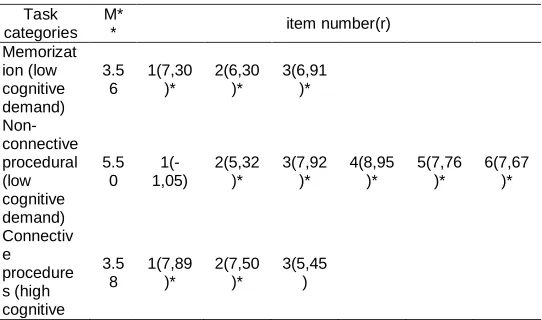
established according to the performances established by the Ministry of Education of Peru [40], aimed at developing skills established in the profile of graduation from second grade of primary school, in correspondence with the of the National Basic Education Curriculum. The instrument was rated with three scores in operations with possibilities of up to three response options: 0 = does not solve, 1 = solves an exercise or proposes solutions; and 2 = propose solutions to operations, solve the problem or create new instructions. Other items were rated binomially (error = 0 points; hit = 1 point). The final version, explained below, was made up of 11 items. This test was passed to five evaluators of content validity (evaluated criteria: relevance, clarity, and adequacy). Three of them were specialized teachers in didactics of mathematics for attention in public and private educational institutions; two of the evaluators were methodologists and specialists from two universities in Lima (Peru). The average acceptance by item was greater than 95%, and in the total of the instrument greater than a rate of 95.6%, for which the instrument was considered valid. The reliability of the instrument was explored through a pilot plan applied to 170 fifth and sixth grade students from other institutions neighboring the study for item discrimination. This in order to avoid external invalidation regarding the inclusion of subjects participating in the experiment. Reliability was considered by analyzing the data from the pilot plan, by which the Cronbach's Alpha index was calculated. The result was considered as acceptable (α = 9,010). After performing this check, we ensure the content construction process through a correlation analysis. According to Table 1, the intensity of correlations and their significance showed dimensions linked to the total of the construct and stability in the basic discrimination of the grouped items. Mathematical tasks were conceived as activities that vary a given motivational-attentional level in students, and require a specific solution, the use of prior knowledge as a necessary condition for learning. This knowledge is due to the type of connective tasks, that is, they require the ability to construct information (constructs), and those that do not imply such construction (rote memory). Faced with this need, we resorted to the theory of optimal experience adapted to the approach of complex cognitive tasks, with the purpose of elaborating a program of provocation of challenges with scaffolding –support– between the teacher and his students.
TABLE 1
CATEGORY AND CORRELATION AVERAGES OF THE TEST COMPONENTS
Task categories
M*
* item number(r)
Memorizat ion (low cognitive demand)
3.5 6
1(7,30 )*
2(6,30 )*
3(6,91 )*
Non-connective procedural (low cognitive demand)
5.5 0
1(-1,05)
2(5,32 )*
3(7,92 )*
4(8,95 )*
5(7,76 )*
6(7,67 )*
Connectiv e procedure s (high cognitive
3.5 8
1(7,89 )*
2(7,50 )*
774 demand)
Doing math (high cognitive demand)
4.8 1
1(4,56 )
2(7,81 )*
3(6,20 )*
4(5,71 )
Source: Own elaboration based on study data. Note: *p <.001; **n = 170 students.
To test the initial hypothesis, a program was developed: Mathematical challenges under competition, made up of 80 learning sessions of 60 minutes each, trying to respond to the basic school curriculum plan. This was done in order to develop camouflage activities in daily and curricular activities, and avoid the influence of other internal variables. This program was developed during eight months of schooling in various educational institutions in Peru. All the activities were developed through the management of the Central Coordination of Professional Practices in Education, directed by a private university in Lima. The total of learning sessions in training curricular programs were implemented with their final year students. These were carried out before his university graduation as part of his pre-professional teaching regime.
2.4 Analysis of information
The information was analyzed taking as criteria two dimensions of the study: a) type of design of the experiment, b) type of distribution of data. In the first case, since the pre-experimental methodology had been carried out, we opted for data analysis by non-parametric comparison tests. However, as a means of verification, the normality analysis of the data obtained at the pretest and posttest times of the study (dimension b) was used. The Kolmogorov-Smirnov test (n> 50 cases) was applied, the results of which obtained a misadjusted distribution to the normality curve, both for the variable (p> .005) and for the dimensions (p <. 005). Although this indicated opting for a non-parametric test (Wilcoxon's signs), we chose to apply a standard parametric test as a corroboration measure in each case (Student t-test for related samples).
3 RESULTS
AND
DISCUSSION
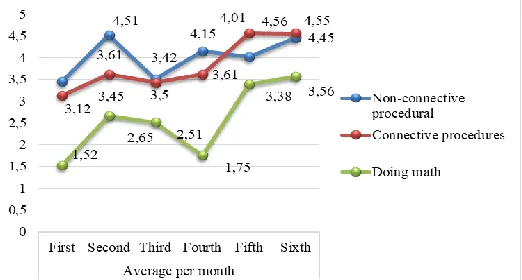
Regarding memorization tasks, the students learned to develop them effectively from the second month, which reflected more pronounced differences than in other months (first month = 2.36; second month = 2.69). The participants finished the program with a very high average level (M = 3.45). In turn, the change was noticeable in the comparison of the pre-test and post-test measurements, since they were significant (Mdn (pre-test) = 4.50 / Mdn (post-test) = 5.00) with significant statistical ranges (p <.001). This difference was also obtained in the t-Student test (t (2.61) = 3.29; gl (331) =, 000). In other words, the use of the information from the mathematical checkpoint produced the development of the memorization tasks; therefore the evidence on significance was obtained with 95% probability of confidence. This reveals the conditions that develop in tasks with low cognitive demand when the vertical processes of the non-significant task are stimulated, as suggested by various authors [7], [8], [9]. The facilities and speed of progress that the program produced through experimentation are supported by this type of memory tasks, because in its mathematical structure digits are calculated by trained calculation methods, mental and even by the mechanical sense of performing mathematical operations. In this case, the Peruvian students achieved greater fluidity in the
775 Fig. 1. Description of averages in tasks of cognitive demand.
Non-Connective, Connective and Doing Mathematics in the eight months of experimentation.
3.1 Tasks with high cognitive demand
Regarding the descriptive comparison between the Connective Procedural tasks (PC) and Doing Mathematics (HM), the increase has been more potential in PCs than in HM. The difference is notable from the third month of application of the program, and seems to standardize between the fifth and sixth month, although the differences in the sixth month are minimal (PC = 1.55; HM = 1.56), this highlights that the tasks Doing Mathematics, they held procedures that implied higher levels of information relationship, but in turn, more demanding in terms of verification and reflection. For this reason, the students proceeded to use concepts to establish relationships with each other, as well as with other concepts when using more specific skills: representing information, proposing solutions, scrutinizing implicit information and relating it. In sum, it has been observed that in the execution of these capacities, students implement micro strategies as a second option when tackling and solving complex problems, despite the complexity of the exercise or the semantic constitution of the problems, which would affect the achievement of effective performance as discovered in other investigations that have worked on regulation as a cognitive companion or self-supervision strategy [12], [30], [34]. It is true that the students achieved these skills, from which the appearance of anxiety / tedium regulatory processes can be deduced when faced with high-demand tasks, although progress was slow, however, it was experienced between the fifth and sixth month of experimentation. The medians relative to the scores of the Connective Procedural Tasks dimension (PC), reported differences in the pretest (Mdn = 5.14) and posttest (Mdn = 3.76) comparisons, which were also verified in the statistical test (p <.001). These differences were also corroborated in parametric tests (t (3.81) = 2.45; gl (331) =, 001; p <.005). Here the result was peculiar: the most notable differences were obtained by obtaining significance of less than 5% in the parametric test. Regarding the analysis of results, in the indicator capacity to find correct solutions to proposed operations in connective tasks, deficiencies or omissions were found in the development of complex operations before starting the experimentation program (pre-test measurement). Many of the activities of the type program: Playful dynamics, collective challenges, setting goals by levels of difficulty; they allowed the development of regulatory and meta-cognitive aspects that were thought to be typical of tasks to do mathematics. These results are similar to others in that the assurance and meta-understanding of slogans are important in
tackling tasks with high cognitive demand [2], [3], [8]. In this situation, the ability to develop multiple solutions and test them is more difficult in students who only seek correct answers to the questions they address. Due to the Doing Mathematics (HM) tasks, the differences in non-parametric measures established significant descriptive differences (Mdn (pre-test) = 1.72 / Mdn (post-test) = 5.66), as well as inferential statistical level (sig. =, 004; p <.005). In the parametric measures, these differences were significant (t (1.45) = 2.12; gl (328) =, 001; p <.005), which showed that the program was influential in achieving the participants' abilities to obtain more effective results with what the problems requested. In particular, the rigor of the HM tasks presented greater difficulty for four months, which means that the student body had little opportunity to perform a potential relational understanding since it turned out to be more complex, from which it can be inferred that the benefits of the program They also raised optimism and satisfaction for performing these types of tasks [35], [36], [37]. Success in the face of challenges led students to rehearse this type of task many times until achieving better results, as suggested by theoretical references on this type of task in which connective or relational processes of information are also carried out in order to understand the task [25], [28], to ensure operational procedures, verify a priori results, and issue new forms of solution. Given these evidences, it is assumed that the challenge caused by the optimal experience theory (Flow) did allow the students to tackle tasks of high cognitive demand in a gradual way, or rather, in a procedural way. Obviously, the development of this type of task through challenges stabilizes mathematical practice, making them more confident and with an interest in constantly checking their results.
REFERENCES
[1] Ayllón, M. F., Gómez, I. A. & Ballesta-Claver, J. (2016). Pensamiento matemático y creatividad a través de la invención y resolución de problemas matemáticos [Mathematical thinking and creativity through inventing and solving mathematical problems]. Propósitos y representaciones, 4(1), 169-218. https://doi.org/10.20511/pyr2016.v4n1.89
[2] Benedicto, C., Jaime, A., & Gutiérrez, Á. (2015). Análisis de la demanda cognitiva de problemas de patrones geométricos [Analysis of the cognitive demand of geometric pattern problems]. En C. Fernández, M. Molina y N. Planas (Eds.), Investigación en educación matemática XIX (pp. 153-162). Alicante: Universidad de Alicante. http://rua.ua.es/dspace/handle/10045/51591
[3] Burgos, M., Giacomone, B., Beltrán-Pelliecer, P. y Godino, J. D. (2017). Reconocimiento de niveles de algebrización en una tarea de proporcionalidad por futuros profesores de matemáticas de secundaria [Recognition of levels of algebrization in a proportionality task by future high school mathematics teachers]. En J. M. Muñoz, A. Arnal, P. Beltrán, M. L. Callejo y J. Carrillo (Eds.), Investigación en Educación Matemática XXI (pp. 177-186). Zaragoza: SEIEM.
https://dialnet.unirioja.es/servlet/libro?codigo=705555 [4] Dávila, K. & Trujillo, E. (2016). Rendimiento de los
776 Pontificia Universidad Católica del Perú, Lima, Perú.
[5] Mateus, E. (2015). Configuraciones epistémicas previas para dar significado global al objeto matemático ―método de integración por partes‖ [Previous epistemic configurations to give global meaning to the mathematical object "integration method by parts"]. Acta Latinoamericana de Matemática Educativa, 28,145-153). https://clame.org.mx/inicio/actas/ [6] Cirino, C. (2011). Análise crítica de tarefas matemáticas:
um estudo com professores que ensinam matemática nos anos iniciais do ensino fundamental [Análisis crítico de tareas matemáticas: un estudio con profesores que enseñaban matemáticas nos dio años de enseñanza fundamental] (Tesis de maestría). Universidad Estatal de Londrina, Londrina, Brasil.
http://www.educadores.diaadia.pr.gov.br/modules/mydown loads_01/visit.php?cid=4&lid=7101
[7] Baroody, A. J. (2000). El pensamiento matemático de los niños. Un marco evolutivo para maestros de preescolar, ciclo inicial y educación especial [Mathematical thinking of children. An evolutionary framework for preschool, early childhood, and special education teachers]. Visor.
[8] Stein, M. K., Smith, M. S., Henningsen, M. & Silver, E. (2009). Implementing standards-based mathematics instruction. Columbia University.
[9] Godino, J.; Batanero, C.; & Font, V. (2004). Fundamentals of teaching and learning mathematics. In: Juan D. Godino (2004). Mathematics teaching for teachers, 5-123. Universidad de Granada.
[10]González, A. (2013). ¿A resolver problemas se enseña? El problema como contenido a ser enseñado de 1º a 7º [How to solve problems is taught? The problem as content to be taught from 1st to 7th]. Homo Sapiens.
[11]Aguirre-Leguizamo, E. (2016). Flexibilidad cognitiva y atención en aprendices SENA según su desempeño académico [Cognitive flexibility and attention in SENA learners according to their academic performance] (Tesis de máster). Universidad Internacional de la Rioja, Colombia. https://reunir.unir.net/handle/123456789/4876 [12]Canet-Juric, L., Introzzi, I., Andrés, M. L. & Stelzer, F.
(2016). La contribución de las funciones ejecutivas a la autorregulación [Contribution of executive functions to self-regulation]. Cuadernos de Neuropsicología, Panamerican Journal of Neuropsychology, 10(2), 106-128. http://www.cnps.cl/index.php/cnps/article/view/238/253 [13]Defaz, G. J. (2017). El desarrollo de habilidades cognitivas
mediante la resolución de problemas matemáticos [The development of cognitive skills by solving mathematical problems]. Journal of Science and Research, 2(5), 14-17, https://doi.org/10.26910/issn.2528-8083vol2iss5.2017pp14-17 [14]Scattarética, F. (2017). Caracterización de tareas multiplicativas a partir de la invención de problemas matemáticos [Characterization of multiplicative tasks from the invention of mathematical problems] (Tesis de licenciatura). Universidad Catolica del Norte, Antofagasta, Chile. http://funes.uniandes.edu.co/9296/
[15]Budiarto, M.T.; Khabibah, S. & Setianingsih, R. (2017). Construction of High School Students' Abstraction Levels in Understanding the Concept of Quadrilaterals. International Education Studies, 10(2), 148-155. doi: https://doi.org/10.5539/ies.v10n2p148
[16]Caviedes-Barreda, S.; de Gamboa-Rojas, G. & Badillo-Jiménez, E. (2019). Conexiones matemáticas que establecen maestros en formación al resolver tareas de
medida y comparación de áreas [Mathematical connections established by teachers in training by solving measurement tasks and comparing areas]. Praxis 15(1), 69-87. http://dx.doi.org/10.21676/23897856.2984
[17]Suh, J. & Seshaiyer, P. (2015). Examining Teachers' Understanding of the Mathematical Learning Progression through Vertical Articulation during Lesson Study. Journal of Mathematics Teacher Education, 18(3), 207-229. http://dx.doi.org/10.1007/s10857-014-9282-7
[18]Georgius, K. (2013). Planning and Enacting Mathematical Tasks of High Cognitive Demand in the Primary Classroom. ProQuest LLC, Ph.D. Dissertation, New York University.
https://search.proquest.com/docview/1530478491 [19]Ni, Y.; Zhou, D.-H. R.; Cai, J.; Li, X.; Li, Q.; & Sun, I. X.
(2017). Improving cognitive and affective learning outcomes of students through mathematics instructional tasks of high cognitive demand. Journal of Educational
Research, 111(6), 704-719.
https://doi.org/10.1080/00220671.2017.1402748
[20]Ni, Y.; Zhou, D.; Li, X. & Li, Q. (2013). Relations of Instructional Tasks to Teacher-Student Discourse in Mathematics Classrooms of Chinese Primary Schools. Cognition and Instruction, 32(1), 2-43. https://doi.org/10.1080/07370008.2013.857319
[21]Barriteau, C. (2013). Managing Mathematics: How Does Classroom Management Affect the Maintenance of High Cognitive Demand Tasks during Lessons with Standards-Based Instructional Materials? ProQuest LLC, Ph.D. Dissertation, New York University. https://search.proquest.com/docview/1417776134 [22]McCormick, M. (2016). Exploring the Cognitive Demand
and Features of Problem Solving Tasks in Primary Mathematics Classrooms. Mathematics Education Research Group of Australasia, Paper presented at the Annual Meeting of the Mathematics Education Research Group of Australasia (MERGA) (39th, Adelaide, South
Australia, 2016).
https://eric.ed.gov/?q=+tasks+of+high+cognitive+demand &pg=2&id=ED572329
[23]Mwadzaangati, Li. (2019). Comparison of Geometric Proof Development Tasks as Set up in the Textbook and as Implemented by Teachers in the Classroom. Pythagoras-Journal of the Association for Mathematics Education of
South Africa, 40(1), 1-14.
https://pythagoras.org.za/index.php/pythagoras/article/vie w/458
[24]Csikszentmihalyi, M. (2014). Learning, ―flow,‖ and happiness. In Applications of Flow in Human Development and Education, 153–172. https://doi.org/10.1007/978-94-017-9094-9_7
[25]Csikszentmihalyi, M. & Csikszentmihalyi, I. S. (Eds.). (1998). Optimal experience. Psychological studies of flow in consciousness. Desclée de Brouwer.
[26]Csikszentmihalyi, M. (1998a). Creativity. The Flow and Psychology of Discovery and Invention. Paidós.
[27]Csikszentmihalyi, M. (1998b). Fluir (Flow). Una psicología de la felicidad. Editorial Kairós.
777 [29]Wu, J. H. & Lin, C. Y. (2017). A multilevel analysis of teacher
and school academic optimism in Taiwan elementarys. Asia Pacific Education Review, 19(1), 53-62. https://doi.org/10.1007/s12564-017-9514-5
[30]Yeh, Y.-C & Lin, C. S. (2018). Achievement goals influence mastery experience via two paths in digital creativity games among elementary school students. Journal of Computer Assisted Learning, 34(3), 223-232. https://doi.org/10.1111/jcal.12234
[31]Challco, G. C., Andrade, F. R. H., Borges, S. S., Bittencourt, I. I. & Isotani, S. (2016). Toward a unified modeling of learner’s growth process and flow theory. Journal of Educational Technology & Society, 19(2), 215-227. https://www.j-ets.net/ETS/issues475d.html?id=71 [32]Mesurado, B. (2008). Validez factorial y fiabilidad del
cuestionario de experiencia óptima (Flow) para niños y adolescentes [Factor validity and reliability of the optimal experience questionnaire (Flow) for children and adolescents]. Revista Iberoamericana de Diagnóstico y Evaluación - e Avaliação Psicológica, 1(25), 159-178.
Recuperado de
http://www.redalyc.org/articulo.oa?id=459645445009 [33]Garces-Bascal, R.M., Cohen, L. & Tan, L. S. (2011). Soul
behind the skill, heart behind the technique: Experiences of flow among artistically talented students in Singapore. Gifted Child Quarterly, 55(3), 194-207. https://doi.org/10.1177/0016986211413574
[34]Ersöz, G. & Eklund, R. C. (2017). Behavioral regulation and dispositional flow in exercise among American College Students relative to stages of change and gender. Journal of American College Health, 65(2), 94-102. https://doi.org/10.1080/07448481.2016.1239203
[35]Hong, F.-Y. (2017). Antecedent and consequence of school academic optimism and teachers’ academic optimism model. Educational Studies, 43(2), 165-185. https://doi.org/10.1080/03055698.2016.1248902
[36]Makvandi, A., Naderi, F., Makvandi, B., Pasha, R. & Ehteshamzadeh, P. (2018). Academic optimism and organizational citizenship behaviour amongst secondary school teachers. International Journal of Emotional Education, 10(1), 164-166. https://www.um.edu.mt/ijee [37]Sedigh, A., Jenaabadi, H. & Pourghaz, A. (2016). The
relationship of mental pressure with optimism and academic achievement motivation among second grade male high school students. International Education
Studies, 9(8), 127-133.
https://doi.org/10.5539/ies.v9n8p127
[38]Bologna, E. & Urrutia, A. (2011). Comparación entre dos grupos [Comparison between two groups]. En: Eduardo Bologna (2001). Estadística para la psicología y educación [Statistics for psychology and education], pp. 371 – 400. Brujas.
[39]Campbell, D.T. & Stanley, J.C. (2011). Diseños expe rimentales y cuasiexperimentales en la investigación social [Experimental and quasi-experimental designs in social research]. Amorrortu.
[40]Ministerio de Educación, Perú (Minedu, 2016). Programa curricular de Educación Primaria [Primary Education
Curriculum Program].