2528
Improving Of Physical Layer Insecurity Of The
Non Orthogonal Multiple Access System
Pankaj M Patel, Prof. Dr. Chetan B. Bhatt
Abstract: The key aspect of the NOMA (power domain non orthogonal) is the user possibility for decoding the messages belonging to another pair users on similar resources. The method interprets a security threat especially in the case where the base station serves the users with various security clearance or untrusted users. The main aspect of NOMA is to serve the multiple users upon the similar radio resources at the minimal inter user interference expense. The system not only permits the serving of particular users with high efficient bandwidth but also permits the scheduling more type of users than the timely available users. In this study we investigated the secrecy outage probability (SOP) and OP in the both two user and multi user NOMA system where the BS is supposed to pair a trusted or legitimate user with other untrusted users because of the un even distribution of the untrusted and trusted users in the cell. SIC, the successive interference cancellation was then implemented at the receiver side for decoding the message signals. With the application of NOMA concept the study investigated the pair outage behavior under the SOP constraints on the trusted users. In specific, the SOP and OP of the concerned U1 were obtained in the closed type of expressions. The study also provided the understanding the possibility of obtaining an optimal outage efficiency for pairing under the SOP constraints. With certain numerical simulations the study verified the effectiveness of the analytical derivations with respect to various scenarios.
Index Terms: NOMA, Secrecy outage Probability, Successive Interference Cancellation, bandwidth, channel state information etc. —————————— ——————————
1
INTRODUCTION
The physical layer security and non-orthogonal multiple access was regarded as the encouraging techniques for the processing of wireless communication network systems. Today the combination of the two significant communication methods was studied to guarantee a spectral efficient and secure wireless transmission. Most of the prevailing works predominantly concentrated on the optimization and efficiency of the PLS in the existence of untrusted relay nodes and external eavesdroppers(Arafa et al., 2019a)But there occurs a gap in the theoretical studies to describe the ease of obtaining the enhanced efficiency in the existence of untrusted users. Recently the network traffic amount have greatly enhanced particularly with the updated growth in IoT applications in future. To rectify the huge traffic demand, upcoming wireless networks must deliver a best spectral effectiveness and large connectivity (Sun et al., 2018). NOMA is regarded as the best technology in which various NOMA technique exhibit similar concept of providing several users at the similar frequency and time. The famous NOMA types are code domain and power domain that provided enhanced efficiency when compared with the existing techniques. The paper adopted the power domain on the basis of super position coding (transmitter side) at the SIC (receiver side). Hence the users could possess the key for the messages of other users and thereby utilize SIC for removing the interference (Cao et al., 2019) (Zhao et al., 2018). Hence various NOMA methods was proposed for allowing the adjacent users to perform as a relay for improving the efficiency of the weak users through the resending of decoded data in a next time slot. The weak user could utilize the MRC technique to integrate the information achieved in different time slots. In addition obtaining a secured communication is a crucial problem over the vulnerable wireless networks to security threats mainly because of the broadcasted transmission nature.
The study investigated the secrecy performance and outage with the untrusted user(Furqan et al., 2019). The main aspect of the study is to analyze the feasibility of achieving the O.P of the pair under a trusted user. Because of the decoding facility and spectrum sharing of SIC, the untrusted user could perform as a eavesdropper.
Figure 1: Representation of Base station
Figure 1 depicts the representation of base station. The main aim of the proposed system defined as,
• To investigate the outage probability of the proposed system
• To investigate the SOP of the proposed system.
• To derive the accurate expression of the outage probability for all kind of scenarios and closed form of expressions for few special cases and verifying them numerically for yielding a better outage efficiency.
2
RELATED
WORKS
This section describes the different existing techniques and methods related as our proposed system. (Cao et al., 2019)suggested two kinds of relay selection process denoted as AF (amplify and forward) and DF (decode and forward) on the basis of AORS and DORS for achieving secure and reliable NOMA systems under the untrusted users. The study derived the accurate and asymptotic closed form of the SOP expressions and the PSCP obtained by the two methods and investigated the optimized feature of the two methods. The ____________________________________
2529 complete analysis and the simulation results represented that
both the AORS and DORS characteristically outperformed the benchmark system apart from obtaining the similar SOP and the required PSCP at very high Signal to noise ratio. (Zhang et al., 2018)Investigated the power allocation and joint subcarrier issue for NOMA –AF two-way relay networks with restrictions. The study focused to optimize the obtainable secrecy efficiency by designing jointly the SC task, power allocation and user pair scheduling. The paper suggested a SCAS-1 technique by assuming the appropriate information about the channel state information in the relay station followed by the formulation of SCAS-2.The secured power allocation issue is structured as a convex programming issue and then resolved by in-depth point techniques. The results of simulation explained that the efficiency of the suggested SSPA algorithms with and without CJ respectively. (Arafa et al., 2019b)Considered a downlink system where the base station is connecting with two appropriate users in two various scenarios in the unsecured environments which are the presence of the eavesdropper and untrusted relay communication. In the first process, several trusted cooperative relays is engaged for assisting with the base station transmission and protect the corresponding signals from the eavesdropper. Several relay methods are framed and investigated for the following process which are forward and decode, cooperative jamming and AF.For all the technique, secured beam forming signals were formulated at the relays for maximizing the obtainable secret rate areas. For the next process, with untrusted relay, the obtained secrecy rate areas obtained for two various relay schemes which are AF and CF under two various operation modes. In the first process, the prescribed users will receive the signals from the untrusted relay and the base station for decoding the messages. The study depicted that the efficient relay scheme is highly dependent on the parameters of the system, especially the nodal distance and the secrecy rate area. (Sun et al., 2018)Studied the algorithm for resource allocation for MISO systems where the full duplex BS serve several half duplex downlink and uplink users on the similar subcarrier. The allocation of the resource have been optimized for maximizing the weight system output whereas the leakage of information was restricted and an artificial noise was induced for granting secured communication with respect to potential eavesdroppers. The study formulated a novel non-convex optimization issue by considering the imperfect CSI of the channels and requirements of QoS of legitimate users. The simulation results stated the efficiency of the optimal algorithm was related to the suboptimal algorithm. Apart from that the suggested MISO NOMA technique not only guarantee uplink and downlink communication purpose for security but delivers a characteristic rate of system secrecy when compared with the conventional MISO and other two baseline methods. (Dang et al., 2017)Analysed the outage efficiency of various multicarrier relay selection techniques for 2 hop OFDM system in Poisson relay fields. The study concentrated on DF relay systems with more selection schemes. The accurate expressions for the OP are provided in integrals generally. Apart from that, asymptomatic derivatives for O.P in the SNR region in the fixed circle area are predicted for both relay selection techniques in closed forms. Consequently several significant factors that are linked to the cooperative network were examined comprising O.P ratio of two selection
2530 graphical impact on the mobile video services and thereby
suggested a CTMDP on the basis of resource allocation technique by considering social graphs as the constraints. With the use of relative value, an optimized policy could be achieved that aimed at increasing the reward regarding the average system. The simulation depicted that the suggested CTMDP obtained an increased efficiency against the state of art methods.
3
PROPOSED
WORK
Fig 2. Proposed flow depicting the overall mechanism.
The proposed(Interference mitigation using POMDP) overall flow is depicted in the figure 2. After setting up of the base station the distance between the base station and the user was determined and if the distance is less than 200 meters it is decided as trusted users and if it is greater than 200 m it is defined as untrusted users. In case of untrusted users the channel state information is subjected to POMDP (Partially observable Markov Decision Process) followed by resource allocation. The performance analysis have been done after the system. The work considered a NOMA oriented cellular setup provided with a base station at the centre and two users as shown in the figure 2. The adjacent (near) user possess high level of security clearance that is required for securing with physical layer from the low security/untrusted clearance user (U2) that is located at a faraway distance from the base station. P is defined as the maximum transmit power level (base station).In this paper it is assumed that all the network nodes are installed with single antenna and further all the channels are considered to be identical independently quasi static with Rayleigh distribution with respect to distribution
𝐶𝑁(0, 𝛿 ⁄ 𝜔 ⁄ ) In which 𝛿 is the distance in-between the BS
and nodes 𝑈 .Here path-loss exponent and path-loss constant is represented as 𝛼, and 𝜔 . In addition it is assumed that base station predicted the user location so that a better CSI is obtainable at base station that is involved in pairing the users.
The base station transmits the superimposed mixture,
𝑥 = √𝑡 𝑠 + √1 − 𝑡 𝑠
In which 𝑠,𝑠 are the unit power signals received by users 𝑈 and
𝑈, respectively, 𝑡 is the power
allocation coefficient for the adjacent user.
𝑟 = ℎ 𝑥√𝑃 + 𝑛
𝑟 = ℎ 𝑥√𝑃 + 𝑛
where ℎ ℎ - the channel gain linked with the small-scale fading from the base station to users 𝑈 and 𝑈 respectively. 𝑛 and 𝑛 are the extra white Gaussian noise with variance and zero mean 𝑁0 and it is assumed that 𝜌 = 𝑃/𝑁0 is the BS convey signal-to-noise ratio (SNR). In NOMA technique,
farther user that possess more power
could decode its own signal by considering the adjacent signal as a noise without decoding the adjacent user message. In the preceding equation it is assumed that U1 first decode the weak signal followed by decoding its own signal with SIC.U2 which is the untrusted user attempted to decode the near user message after the decoding of the adjacent user messages after the process of decoding its own message with SIC.Hence the following equation have been achieved
𝑆𝐼𝑁𝑅 =( )| |
| | ⁄ and 𝑆𝐼𝑁𝑅 = 𝑡 𝜌 |ℎ |
𝑆𝐼𝑁𝑅 =( )| |
| | ⁄ and 𝑆𝐼𝑁𝑅 = 𝑡 𝜌 |ℎ|
𝑇𝑜𝑡𝑎𝑙 = *𝑆𝐼𝑁𝑅 ; 𝑆𝐼𝑁𝑅 ; 𝑆𝐼𝑁𝑅 ; 𝑆𝐼𝑁𝑅 +
where 𝑆𝐼𝑁𝑅 represented the signal-to-interference-plus-noise-ratio of user 𝑚 that was decoded by 𝑈 for 𝑚, 𝑛𝜖*𝑖, 2+ and the
channels gain of 𝑈 denoted by |ℎ |
followed an exponential distribution
with the parameter 𝜁 = 𝜔𝛿
Problem Formulation:
Hence the base station should achieve and serve a better communication for the users who are susceptible to security threat from untrusted user, the proposed system defined two kinds of QoS efficiency measures that could be regarded to be important for framing the issue. In specific the study defined a pair of OP to check the reliability of the QoS satisfaction. In general the pair OP is stated as the probability in which the obtainable data rates dor the users equal to or greater than the least target threshold. The next metric also called as the SOP is the probability that the non negative secrecy capacity obtained by the trusted user is more than the threshold value . The following issue aimed at reducing the pair OP subjected to a SOP factor for the user U1 that is provided by
min𝑃
0 < 𝑡 < 0.5
𝑆𝑂𝑃 ≤ 𝛽
in which 𝑃, 𝑆𝑂𝑃 and 𝛽 are the pair OP, SOP(𝑈) and the permissible SOP threshold.
4 PERFORMANCE
ANALYSIS
Derivation of the Pair OP:
With the use of Shannon’s capacity formula, and considering 𝐶 and 𝐶 as the threshold capacities of users 𝑈 and
user 𝑈 , respectively, the OP of the pair could be provided by,
𝑃 = 1 − 𝑄𝑥𝑄
in which
𝜏 = 2 𝑚 𝜖 *𝑖, 2+
𝜙 =
( )
𝜙 =
2531
𝑄 = {exp (
) ,0 < 𝑡 <
0 , 𝑜𝑡ℎ𝑒𝑟𝑤𝑖𝑠𝑒
Case 1: 𝜙 > 𝜙
For having 𝜙 > 𝜙 the constraint on
the power allocation factor (t) needs to be satisfied: (𝑡 >
) and for this case 𝑄 could be obtained as
follows:
𝑄 = { exp (
) ,
< 𝑡 <
0 , 𝑜𝑡ℎ𝑒𝑟𝑤𝑖𝑠𝑒
Case 2: 𝜙 < 𝜙
Like case 1, it was stated that opposite constraint on
a as (𝑡 <
) and
𝑄 can be derived as follows
𝑄 = { exp (
) ,0 < 𝑡 <
0 , 𝑜𝑡ℎ𝑒𝑟𝑤𝑖𝑠𝑒
The OP of the NOMA pair,
𝑃 = {
1 − 𝑓(𝑡)𝑘 (𝑡),
< 𝑡 <
1 − 𝑓(𝑡)𝑘 (𝑡), 0 < 𝑡 <
in which
𝑓(𝑡) = 𝑒𝑥𝑝 {
( ( ))}
𝑘 (𝑡) = 𝑒𝑥𝑝 {
( ( ))}
𝑘 (𝑡) = 𝑒𝑥𝑝 {
}
Derivation of SOP of 𝑈 :
With Shannon’s capacity formula, the secrecy rate of user 𝑈 was provided by
𝑆𝐶 = 𝐽 − 𝐽
𝐽 = log (1 + 𝑇𝑜𝑡𝑎𝑙 (r(1)))
𝐽 = log (1 + 𝑇𝑜𝑡𝑎𝑙 (r(2)))
𝑆𝐶 is the non-negative secrecy capacity of 𝑈. Provided the secrecy capacity in, the SOP of 𝑈 is
𝑆𝑂𝑃 = 1 − 𝜈𝑒
𝐴 =
𝜈 =
𝑇 - the user 𝑈,\secrecy target rate
Theorem 1
Outage-optimal power allocation factor
𝑡 = √
( )
In which 𝑤 =
𝑤 = 𝑧 = 1 + 𝜏
The minimum power allocation factor (𝑎 )
𝑡 =
(
)
The optimal OP of the NOMA pair under the SOP constraint
=
( ) ( ( ))𝑒
( )
That is < 0whih meant that the U1 (SOP) is a reducing function Of t that results in the optimal power allocation factor that is greater than 𝑡 for the satisfaction of secrecy constraining
factor.Partially observable Markov decision process: S is represented as statesLet D is the channel features which is consider here as actions, the conditional transition probability between states is regarded as T Reward function R is
calculated as the prediction of maximum capacity channel with respect to data rate r = R(S x D), the agent receives an observation o ϵ 𝔶 o ∈ Ω {\display style o\in \Omega} that depended on the new environment state , S, and on the just took action, d, with the probability O(o|s, d)
Reward received at time t is conveyed as r = R(S x D) H is the belief states over POMDP states,
𝐻 is the belief state transition function
𝑟 = 𝑅(𝐻 x 𝐷) is the reward function on the belief states
𝐵 (ℎ, 𝑑, ℎ) = ∑ 𝔶Pr (ℎ|ℎ, 𝑑, 𝑜) Pr(𝑜|𝑑, ℎ)
Pr(h|h, d, o) =
{1 if the belief update with arguments h, d, o returns h
0 otherwise The reward function is updated on the basis of the belief MDP,
r(h, d) = ∑ ∈ h(s) R(s, d)
the agent focus on the largest expected immediate reward,in other words the maximum capacity channel. The section analyse the accuracy of the analytical derivations under various settings.
Figure 3. The feasible pairing
The SOP of U1 with the increasing untrusted user U2 and distance (d2), for several BS transmits Signal to Noise Ratio
at 𝜌 = −20, −10,20 𝑑𝐵is depicted in with a=0.05 and 0.1 and
2532 Figure 4. The Secrecy outage probability
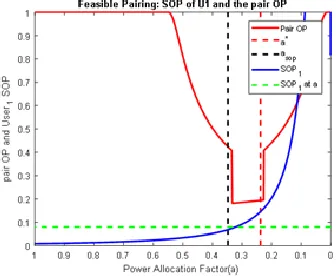
Feasible Pairing in th SOP of pair OP and U1 with the enhanced power allocation factor (a) in which d2 = 700 m, d1 = 200 m, 𝜌 = 15 dB and ϵ = 0:1. The results depicted that the the pair OP and SOP of user U1 with increased a for two (d2) various distances of the (U2) untrusted user. The results approve the convex nature of the pair OP and the SOP curve is gradually decreasing on the basis of a. Generally during the increase in a, the power assigned to the weak user message decreases that minimize the ability of U2 for discriminating the superior positioned signals thereby improving the SOP of U1.
Figure 5 The Pair outage probability
Pair OP in case of rising U2 untrusted user in distance (d2), for different base station transfer the signal to noise ratio.(𝜌 = 5; 15; 25 dB), where a = 0:15 and d1 = 200 m.
Figure 6.The infeasible pairing of secrecy outage probability of the pair OP and U1.
The infeasible pairing of SOP (U1) and the pair outage probability with the enhanced allocation of the power a,d1(200 m),d2(300 m),𝜌 = 15dB and ϵ = 0.
The figure 6 depicted that the
The figure 6 shows the similar plotting of the data by altering the untrusted user location by transferring it to a BS closer distance (d2 = 300 m). It also depicted that the U1. SOP constraint of is disrupted at a because the SOP is more than ϵ. The accuracy is well-matched and verified with all range of numerical simulation. The results noticed that the efficiency is based on the comparative locations of the two user with the base station.
Figure 7. The figure 7 depicts that SNR versus strictly positive secrecy rate.
The observed graph proves that the secrecy capacity outperforms the existing techniques. The proposed precoding application increases the performance of the system. The transmission power of the system is the power required to transmit a particular data. When there is an increase in the number of users there is the possibility of inference in the data transmission and hence the efficiency of the data rate may be affected. Depending on these instances the efficiency of the antenna capacity to withheld and accommodate the data determined.
Figure 8. The power radiated by BS antenna
In the figure 8,with respect to the simulation setup, the precoding methods are performed based on the radiated power per BS antenna is depicted. The results observed the better efficiency of the proposed system. The proposed proves to be better when compared with existing linear precoding methods in the prescribed three metrics thereby stating that MRT may be utilized for the the examination of the secrecy capacity. Our proposed technique spends less radiatated power thereby increasing the overall capacity of the system.
5
CONCLUSION
2533 base station pairs the trusted user in closed type of
expressions. The proposed (Interference mitigation using POMDP) also enable the understanding of possibility of achieving outage optimal efficiency to pair under SOP constraints. The numerical verifications verified the efficiency of the analytical derivations.
6
REFERENCES
[1]. ALI, M. S., TABASSUM, H. & HOSSAIN, E. 2016. Dynamic user clustering and power allocation for uplink and downlink non-orthogonal multiple access (NOMA) systems. IEEE access, 4, 6325-6343. [2]. ARAFA, A., SHIN, W., VAEZI, M. & POOR, H. V.
2019a. Secure relaying in non-orthogonal multiple access: Trusted and untrusted scenarios. IEEE Transactions on Information Forensics and Security, 15, 210-222.
[3]. ARAFA, A., SHIN, W., VAEZI, M. & POOR, H. V. 2019b. Secure relaying in non-orthogonal multiple access: Trusted and untrusted scenarios. IEEE Transactions on Information Forensics and Security. [4]. CAO, K., WANG, B., DING, H., LI, T. & GONG, F.
2019. Optimal Relay Selection for Secure NOMA Systems under Untrusted Users. IEEE Transactions on Vehicular Technology.
[5]. DANG, S., CHEN, G. & COON, J. P. 2018. Multicarrier relay selection for full-duplex relay-assisted OFDM D2D systems. IEEE Transactions on Vehicular Technology, 67, 7204-7218.
[6]. DANG, S., COON, J. P. & CHEN, G. 2017. Outage performance of two-hop OFDM systems with spatially random decode-and-forward relays. IEEE Access, 5, 27514-27524.
[7]. FIANU, S. & DAVIS, L. B. 2018. A Markov decision process model for equitable distribution of supplies under uncertainty. European Journal of Operational Research, 264, 1101-1115.
[8]. FURQAN, H. M., HAMAMREH, J. & ARSLAN, H. 2019. Physical Layer Security for NOMA:
Requirements, Merits, Challenges, and
Recommendations. arXiv preprint arXiv:1905.05064. [9]. HOU, L., ZHENG, K., CHATZIMISIOS, P. & FENG, Y.
2018. A Continuous-Time Markov decision process-based resource allocation scheme in vehicular cloud
for mobile video services. Computer
Communications, 118, 140-147.
[10]. KOKSHOORN, M., CHEN, H., WANG, P., LI, Y. & VUCETIC, B. 2016. Millimeter wave MIMO channel estimation using overlapped beam patterns and rate adaptation. IEEE Transactions on Signal Processing, 65, 601-616.
[11]. LIU, Y., ELKASHLAN, M., DING, Z. & KARAGIANNIDIS, G. K. 2016. Fairness of user clustering in MIMO non-orthogonal multiple access systems. IEEE Communications Letters, 20, 1465-1468.
[12]. LV, L., CHEN, J., NI, Q. & DING, Z. 2017. Design of cooperative non-orthogonal multicast cognitive multiple access for 5G systems: User scheduling and performance analysis. IEEE Transactions on Communications, 65, 2641-2656.
[13]. SUN, Y., NG, D. W. K., ZHU, J. & SCHOBER, R. 2018. Robust and secure resource allocation for full-duplex MISO multicarrier NOMA systems. IEEE Transactions on Communications, 66, 4119-4137. [14]. ZHANG, H., YANG, N., LONG, K., PAN, M.,
KARAGIANNIDIS, G. K. & LEUNG, V. C. 2018.
Secure communications in NOMA system:
Subcarrier assignment and power allocation. IEEE Journal on Selected Areas in Communications, 36, 1441-1452.