2581
An Effective Owl Search Based Optimized
Resource Allocation Framework For Network
Slicing In An LTE Network
M. Leeban Moses, B. Kaarthick
Abstract: Network slicing enables service providers to set up multiple independent virtual networks to support a wide range of services and applications on a single physical network. Network operators can also provide an expense-effective solution to satisfy different technical requirements of distributed software and services with network slicing. Many of the wireless networks slicing strategies were computationally expensive due to the time it takes to calculate the required resources for each individual slice. Hence, there seems to be no guarantee that a slice will equally share the resource allocation between users. Every slice of the network needs two resource types, bandwidth as well as energy to process. As a result, resource distribution between these two elements must be balanced, and conceptions of equality and efficiency become much more complicated. Therefore, in this paper, we intend to propose an efficient network slicing resource allocation system on LTE network. Software Defined Networking (SDN) and Virtual Network (VN) can act as network slicing building blocks by enabling network programmability. First, we best describe the LTE network model of the distribution system and then the solution proposed. In addition, we use the MATLAB to analyze different scenarios to test the proposed models in this paper, and the simulation results show that the proposed algorithm can substantially satisfy end-user resource allocation approach.
Index Terms: Network slicing, Software Defined Networking (SDN), Network Function Virtualization (NFV), LTE network, Resource management —————————— ——————————
1.
INTRODUCTION
CELLULAR document networks have innovated
telecommunications over the past two decades and thus are responsible for linking more individuals and phones than it has ever been [1]. The exponential developments in mobile network technology eventually tackled many networking challenges; enhanced customer numbers and large amounts of data traffic have been handled [2]. With the number of users drastically increasing the multimedia content consumption specifically video and data traffic has been increased by something like of about 65% [3]. Because of the proliferation of cellular technology in the developing world, demand for bandwidth-intensive services such as video streaming, and the rise in machine-to-machine traffic, this trend is expected to continue [4]. Reports also estimate that the total number of Internet-connected devices will hit 50 billion by 2020 out of just 12.5 billion in 2010 [5]. The unprecedented increase in the percentage of mobile devices leads to massive greenhouse emissions due to heavy use of electrical energy from which network infrastructure absorbs up to 90 percent [6]. The mobile networks currently exist in the real world require substantial changes in architecture to efficiently accommodate the anticipated rise in user base and resulting in high demands for bandwidth while at the same time reducing levels of energy usage [7]. Existing networks are also strongly hardware-dependent, making the upgrade process for new wireless access technologies both expensive and sluggish [8]. Experts and operators have been looking at network virtualization to tackle these issues in cellular networks [9].
Considering the remarkable success of introducing
virtualization technologies to tackle specific processing and computing problems in the IT sector, the research community is investigating the cloudification of Internet-based services with the aim of creating network services that are autonomous, scalable and secure [10]. Recent progress in networking technology is reinforcing the case for cellular network virtualization by Software Defined Networks (SDN), Network Function Virtualization (NFV), and Cloud-based Radio Access Networks (CRAN). In addition to providing scalable network architecture, we agree that these technologies of virtualization can significantly reduce capital and operating costs [11]. Consequently the Advanced virtualized networks have to get a new management mechanism to ensure resource allocation reliability and assured isolation of resources [12]. To achieve these goals, a new resource management system is needed that takes into account both low and high-level resource allocation management models [13]. In this paper we suggest a comprehensive approach to improve the way networks are sliced and resource distribution is optimized by using the power of software defined networking (SDN) and network virtualization (NV) technologies. The key factors contributing to the rapid adoption of network virtualization are: cost-effective network capacity sharing and high network usage. To achieve unique and powerful incentives from network virtualization, and together with the development of efficient network architectures, we focus on an effective resource management method using the metaheuristic approach in a virtual network in this paper. The main role of the low-level model would be to assign PRB-based resources in the number of units, thus ensuring high accuracy. The high-level design, on the other hand, should be responsible for ensuring independence among the resources allocated. Software Defined Network (SDN) and Network Function Virtualization (NFV) open up new opportunities to promote such versatile resource allocation, adaptive network configuration and cost-effective network operations [14]. The rest of the paper is structured as follows. Section II offers some additional information on network slicing used to update some of the existing research on digital ______________________
Bannari Amman Institute of Technology, Sathyamangalam, India
Email: [email protected]
2582
resource allocation. Section III explains the design of the framework and the strategy proposed. Complete simulation results are given in Section IV and We conclude this paper in Section V.
2 RELATED WORK: A BRIEF REVIEW
Detailed The network slicing principle makes the
implementation of LTE network services versatile and dynamic. Some of the works have been listed here in this section among the numerous past research works on resource management in network slicing. In a heterogeneous cloud infrastructure, Halabian et.al [15] introduced a resource allocation framework for virtualized 5 G networks. For each of its virtual network features, each network slice has a resource demand vector in its design. First, they considered a cooperative slice model and formulated the resource allocation as a problem of convex optimization, optimizing the overall utility function of the system. They also proposed a decentralized solution to the problem of resource allocation by establishing a resource auction between the slices and the data centers. By using an example, we demonstrate how the egotism of non-collaborative slices affects the system's fairness quality. They also developed a new resource allocation question based on the notion of dominant resource equality for a process of non-collaborative slices and suggested a fully distributed scheme to solve the problem. Architecture for the distribution of centralized radio assets has been suggested by Y. Sun et.al [16] in the paper, , in which the GRRM appeared to be accountable for allocating sub-channels in slices to local radio resource managers (LRRMs), who can then distribute the resources allocated to their UE. A hierarchical resource allocation problem was developed under the architecture, and the problem was further modeled as a Stakelberg game with the GRRM as the leader and the LRRM as followers, taking into account the relationship between the GRRM and the LRRM. Due to the NP-hardness of the problems of the followers, a method was first proposed to achieve the Stackelberg equilibrium (SE) based on exhaustive search. Nonetheless, once the network size became relatively large, it was impossible for game players to achieve SE within minimal decision-making time. GRRM and LRRMs were seen as restricted rational players facing this challenge, and low-complexity algorithms were developed to help them achieve optimal local solutions leading to a poor SE version. K. Teague et.al [17] explored the challenge of selecting base stations (BSs) to install a virtual network that fulfills a service provider's specific requirements and adaptive resource sharing between the demand points of the service provider. For modeling the problem of joint BS selection and adaptive slicing, a two-stage stochastic optimization system was implemented. To evaluate an approximation for the two-stage stochastic optimization model, two methods were presented. The first method uses a sampling technique applied to the stochastic model's determinist equivalent system. The second method uses a BS choice and adaptive slicing genetic algorithm through a single-stage linear optimization problem. A number of scenarios have been developed for testing using a lognormal model designed to emulate demand from cellular networks in the real world. Y. Tun et.al [18] discussed the issue of two-level allocation in network slicing, thus allowing for efficient use of resources;
inter-slice isolation and intra-slice isolation. Also developed was a generalized Kelly mechanism (GKM) based on which the resource allocation problem was discussed at the top level. Another advantages of using such a resource bidding and allocation system was that the seller (InP) did not need to know the true bidders (MVNOs) valuation. The optimal resource allocation was extracted from each MVNO to its mobile users using KKT conditions to solve the lower resource allocation problem (i.e. between MVNOs and their mobile users). Then there is the bandwidth resource to allocate the MVNOs to the users. A. Fendt et.al [19] introduced a mathematical model formalized as a structured Mixed Integer Linear System to solve the offline Network Slice Embedding Problem. A latency-sensitive purpose feature ensures maximum use of the network and low latency in network slice interactionL. Tang et.al [20] suggested a slice-based scheduling of digital assets with NOMA software to increase the system's quality of service (QoS). They formulate the allocation of power granularity and subcarrier allocation strategies into a question of the Constrained Markov Decision Process (CMDP), aimed at optimizing the overall user frequency. They developed an adaptive resource allocation algorithm based on Approximate Dynamic Programming (ADP) to solve the problem in order to further escape the dimensionality curse and the expectation estimation in the optimal value function. G. Wang et.al [21] examined network slice dimensioning with resource pricing policy. They initially design a network slice dimensioning optimization model in which the problem of the Slice Customer (SCP) maximizes the benefit of the SC and the problem of the Slice Provider (SPP) maximizes net social welfare (resource efficiency). They actually find that maximizing net social welfare and benefit from SP are two clear priorities when resources are limited; and so a tradeoff occurred. Based on this result, they proposed a distributed algorithm of low complexity in order to accomplish near-optimal net social welfare with a benefit guarantee for SP / SCs. J. Chen et.al [22] introduced a dynamic resource management strategy called the Enterprise Visor engine which handles network resource allocation between slices. The EnterpriseVisor engine first slices the network of an enterprise into virtual subnet and then controls the use of each subnet's asset. The Linear Programming approach is used in the engine by dynamic resource scheduling of the subnet for each operation. The engine then provides the schedule to data plane users as the FlowVisor layer's resource allocation rule. A four-subnet OpenFlow testbed was designed to demonstrate the feasibility of the proposed EnterpriseVisor engine.
3 PROPOSED
METHODOLOGY
3.1 LTE Network
2583
connects via radio interface to an eNodeB. Perhaps the eNodeB executes tasks for controlling radio resources such as allocating radio resources and handling inter-cell interference. The eNodeB links via a mobile backhaul network to a serving gateway (SGW). The SGW supports a significant number of eNodeBs and for the inter-eNodeB handover functions as the regional mobility anchor point. The SGW is linked to a Packet Data Network (PDN) gateway (PGW), which allocates UE (user) IP addresses, enforces regulation, and filters packets and charges. It is indeed a destination point to the internal network for the packet data interface.
UE
BTS
Node eB eNodeB
BSC RNC
LTE 2G
3G
SGSN MME
PCRF
HSS
Operator IP Service(IMS) Internet
SGW
PGW Mobile Backhaul
Fig.1. Basic Structure of an LTE network
The main control body is the Mobility Management Entity
(MME), which is responsible for upholding mobility
management conditions for UEs and setting up client traffic bearers. A central database where user profiles are stored is the home subscriber server (HSS). It is responsible for authenticating and approving the UE. The role of policy and charging rules (PCRF) provides the PGW with QoS and charging rules. User data packets are transmitted between eNodeB and PGW through GTP (GPRS tunneling protocol) tunnels. Figure 1 demonstrates the overall LTE mobile network structure. Whereas the LTE rolled off to accommodate with mobile device development, it has some many challenges and opportunities [24]. The LTE is difficult to manage in radio access and the mobile backhaul network, the installation of many base stations and the control plane delivery, resulting in inconsistent utilization of radio assets. With no clear separation between control and data planes, the network is difficult to manage and monitor in the cellular core network. The use of proprietary hardware by network organizations leads to high implementation and operating costs and inefficient distribution and use of resources; this slows down the introduction of new innovations on the market and has an impact on operators ' profits [25].
3.2 Proposed Network Slicing Resource allocation mechanism
The underlying mechanism for regulating acceptance takes full advantage of tier interests. Our concept is based on the idea
that slices of the network transmit the desired level of QoS to an admission control body. Depending on the slice's preference, the admission control mechanism chooses to serve the slice. Finally, the virtual network allocates the resources to the UEs / user of the accepted slices according to inter and intra slice priorities. As per the admission control decision, the resource allocation function is carried out with the goal of optimizing the users ' quality of experience (QoE) within each slice, taking into account the inter-slice priority.
Physical layer Virtual Network slicing
Slicer
SDN Admission control mechanism
Resource required
Sl
ic
e
al
lo
ca
te
Re so ur ce in fo rm ati on
Sl
ic
e
al
lo
ca
te
to
U
E
Fig.2. Proposed Resource Allocation Scheme
The QoE is calculated in this paper by considering the users' effective throughput, standardized according to their total required data rate. To this end, the resources allocated to a low-priority slice could be reduced, if required, to the minimum amount capable of meeting the basic QoS criteria to allow higher priority for new slice(s). Our concept adjusts the sum of network resources assigned to network slices dynamically. The suggested access control mechanism progressively sets the allocated assets to allow slices based on the current traffic load. Consideration was provided to the inter-slice and intra-slice priority order to model the resource allocation task's QoE maximization problem. In view of priority orders for QoE work, the satisfactory rate of UEs can be improved network usage. The design consists of four main elements: the system slice layer, the virtual layer of the network, the physical resources and the admission control manager. The service slices provide various services that demanded resources to be served. We show in the virtual network with the collection of slices
S
S 1,2,3,..., . That slice has a set of UEs, a set like this is
denoted by Us 1,2,3,..., Us. In terms of QoS constraints, that slice executes an application for admission control. We
model a objective in this paper with m in
s
R andRsm ax , which
denotes the minimum and maximum data rates related with
the slice. Every slice is prioritizeds, where such priorities are
specified with the restriction that
S
s s
1
. Likewise, each
clientu belonging to the sliceS , i.e., where
# , 1 s
s U
s u
the virtual network layer provides an abstraction of the
physical network resources, Us is defined by a priority
s u
.
2584
control / control manager's decisions. The digital network receives requests from various slices in terms of the UEs to be served for each slice and carries out the resulting allocation of physical resources according to the inter-and intra-slice priorities while taking into account the UEs ' QoE, with this aim, we can define
) ( m ax s u u R r q s s (1)
As UE's QoE in the slice s; is UE'su slicing s data rate
s u
r . The total slice client QoE can be estimated as:
s s s u s U u u s qq ( )
(2)
We can clearly describe that,
S s s s qQ ( )
(3)
As, the total QoE that all UEs of all slices encountered, on a scheduling basis, the virtual network provides services. In a
standard scheduling frame t, we define with, t
us
q ,qts and Qt
the QoE. The time-average QoE values can therefore also be defined as follows:
t us
us q
T q
E[ ] 1
(4) t s s q T q
E[ ] 1
(5)
t Q T Q
E[ ] 1
(6)
Where T was the total number of scheduling frames
considered, the physical resources correspond to the virtual network's radio infrastructure. For convenience's purpose, we refer to one vector-cell's backhaul network. B MHz represents the total available bandwidth. The set M= { 1, 2,..., M} specifies the sub-channels available in which the standard sub-channel m bandwidth is bm= B / M. The maximum transmission power PTOT is distributed uniformly to each sub-channel, i.e. pm= P / M. The essential problem in concern during the resource allocation stage is to optimize UEs ' QoE by simultaneously taking into account the inter- and intra-slice priorities. As in Equation 10, this problem can be formulated.
Maximize s us s s s S
s u U s
u R r
m ax (7)Subjectto
M
m s Su U
m s m s s B b u , 7(a) m ax m in s us
s r R
R
7(b)
In which limit (7a) specifies that the sum of sub-channels allocated can not exceed the maximum available bandwidth;
this constraint often explicitly applies to the orthogonality of delegated services. Framework (7b) indicates that the data rate obtained by UE us is constrained by the corresponding slice s requirements. It should be noted that in Equation (6), the QoE is a number lower than or equal to 1; as a result, the higher a slice's priority, the lower the value of πs. This also applies to the users, i.e. the higher a user's priority, the lower the μus value. The resource allocation process is achieved by optimizing the data rate using Owl search optimization algorithm as well as the UEs channel conditions.
3.3 Owl Search Algorithm
The owl search algorithm launches the optimization process by an initial set of random data rate solutions that reflects the forest owl's initial position (dimensional search space). Therefore to assign the initial position of each owl in the forest, a uniform distribution is used.
) ( * ) 1 , 0
( u L
L
i O U O O
O
(8)
Where ith owl Oiin the jth dimension and U(0,1) are lower and
upper limits of OLand Ou, respectively, is a uniformly
distributed random number in the range[0,1 ]. The fitness of the position of each owl in a forest is evaluated and stored using an objective function in equation 8. It is presumed in the present work that the fitness value of the location of each owl directly relates the frequency information received through the ears. Therefore, the strongest owl achieves maximum intensity (for problems with maximization) as it is closer to the vole. The
ith owls structured strength data is used to modify the location
and can be measured as:
w b
w f Ii i
(9) where k n k f b
max
,.... 1 k n k f wmin
,.... 1 Every single owl and prey's distance information is measured with the following equation:
2 || , || O V
Ri i (10)
where V is the prey position obtained by the fittest owl, it has also been stated that in the forest there is only one vole (global optimum). Owls undertake flights in silence as they pass towards the prey. Therefore, they obtain modified frequency, obeying the sound intensity inverse square law. You
can obtain the shift in frequency for ith owl as follows:
noise Random R I I i i
ci 2
(11)
Voles are present in the real world and therefore their movement causes the owls to quietly change their approach location. The prey movement is planned using chance and thus new owl positions can be obtained through the following position updating function:
2585
(12)
In the above equation pvm seems to be the possibility of optimal global progression i.e. data rate, α is a uniformly distributed random number in the range [0, 0.5] and β is a linearly decreasing constant from 1.9 to 0. makes major changes and encourages searching space exploration [26].
4
RESULT
AND
DISCUSSIONS
This section offers an analysis of the quality of our proposed mechanism for allocating resources. To this end, we introduced a resource allocation algorithm that allocates network resources to optimize users ' overall QoE by taking into account their QoS criteria (minimum and maximum data rate) as well as each user's priority. We use the MATLAB to analyze various scenarios to test the proposed models in this paper. Thus we implement the resource allocation scheme, by taking into account the admission control process, which is done as a first step before the allocation of the resources. The explanation behind this selection is to highlight the effect of admission control on network resource management. We assume in our simulations that the UEs arrival data rate is distributed uniformly over the entire simulation period. The total number of UEs is distributed evenly among the slices considered. The values of UEs within the same slice are generated randomly with the restriction of a sum equal to 1. In case, the priorities of UEs are much the same as our proposed solution is considered, with the exception that the restriction of having a number of priorities equal to 1 is applied to all users in the system. The core network parameters being used are about 5 MHz LTE bandwidth, about 200 overall UEs, about 10s overall interval and about 174dBm / Hz overall Noise Spectral Density.
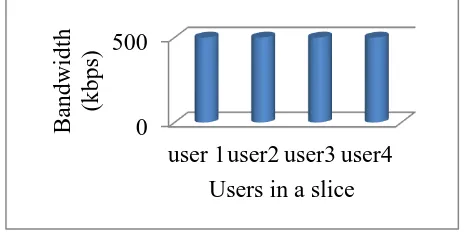
Fig. 3. Average bandwidth for UEs
Figure 3 shows the average bandwidth of the same slices for UEs. It can be remembered that, although these services belong to two different slices with different priorities, the proposed mechanism experiences the same throughput bandwidth. This illustrates strongly that the proposed solution is not only capable of ensuring slice-based resource allocation, but also based on utility.
Fig. 4. Bandwidth comparison for system with and without optimization
Fig.5. Resource allocation based on demand without optimization
Fig. 6. Resource allocation based on demand with optimization
In fig 4, our proposed solutions significantly increase the data rate for all service slices in contrast to the management of resource allocation without optimization. We may note that the proposed approach ensures higher bandwidth efficiency compared to the management approach without optimization, thereby emphasizing the importance of the proposed admission control in achieving better resource utilization. From this estimate, as the number of UEs rises, we can note that the total QoE decreases. This is because it algorithm helps to increase the overall data rate of the network by allocating resources to the services when the number of UEs increases. Figure 5 and 6 shows that before optimizing the search based on owl, the sharing of resources differs as shown in Fig.5 and Fig.6. The resources are fairly dependent on the requirements after owl search-based optimization. It is therefore noted that there is ample use of the limited resource across network slices.
0
500
user 1user2 user3 user4
B
andwidth
(kbps)
Users in a slice
0
500
user 1 user2 user3 user4
b
an
d
w
id
th
(kb
p
s
Slice
Comparison Chart
200
400
600
user 1 user2 user3 user4
Re
sou
rc
e
d
em
an
d
Resource allocation before
optimization
-300
200
700
user 1
user2
user3
user4
Re
sou
rc
e
d
em
an
d
2586
4
CONCLUSION
Network slicing is a process which allows the development of several logical networks on behalf of a common physical infrastructure shared. In this paper, we address the issue of sharing resources equally between slices based on demands and so we implement a novel resource allocation system for network slicing in an LTE network that allows us to provide real-time slices and self-scale slices optimally. We formulated the optimal allocation of resources as a convex problem with the goal of optimizing the overall data rate function of the system. We implemented an owl-based search approach to solve the problem of process optimization and theoretically demonstrated that the approach is special and also converges to the optimal solution of the global system. The proposed solution is implemented in MATLAB and simulation results have been given to test the bandwidth and resource allocation efficiency of the distributed scheme for different users based on demand. We also contrasted their success with our proposed metaheuristic approach and without it.
REFERENCES
[1] S. Iyer, "Virtualisation of network functions and the SDN", Australian Journal of Telecommunications and the Digital Economy, vol. 2, no. 2, 2014.
[2] Center for Energy-efficient Telecommunications, "The
Power of Wireless Cloud", tech. rep., Bell Labs and University of Melbourne, April 2012.
[3] D. G. Ainscough, "The evolution and future of modern
mobile communications", blueadmiral.co.uk, 2001.
[4] L. E. Li, Z. M. Mao, and J. Rexford, "Toward
software-defined cellular networks", in Proceedings of the 2012 European Workshop on Software Defined Networking, EWSDN ’12, Washington, DC, USA, pp. 7–12, IEEE Computer Society, 2012.
[5] J. Schulz-Zander, L. Suresh, N. Sarrar, A. Feldmann,
T. H¨uhn, and R. Merz, "Programmatic orchestration of wifi networks", in Proceedings of the 2014 USENIX
Conference on USENIX Annual Technical
Conference, USENIX ATC’14, Berkeley, CA, USA, pp. 347–358, USENIX Association, 2014.
[6] A. Gudipati, D. Perry, L. E. Li, and S. Katti, "SoftRAN:
Software defined radio access network", in
Proceedings of the Second ACM SIGCOMM Workshop on Hot Topics in Software Defined Networking, HotSDN ’13, New York, NY, USA, pp. 25– 30, ACM, 2013.
[7] K.-K. Yap, R. Sherwood, M. Kobayashi, T. Y. Huang,
M. Chan, N. Handigol, N. McKeown, and G. Parulkar, "Blueprint for introducing innovation into wireless mobile networks", in Proceedings of the Second ACM SIGCOMM Workshop on Virtualized Infrastructure Systems and Architectures, VISA ’10, New York, NY, USA, pp. 25–32, ACM, 2010.
[8] X. Jin, L. E. Li, L. Vanbever, and J. Rexford, "SoftCell:
Scalable and flexible cellular core network
architecture", in Proceedings of the Ninth ACM Conference in Emerging Networking Experiments and Technologies, CoNEXT ’13, New York, NY, USA, pp. 163–174, ACM, 2013.
[9] Y. Zaki, L. Zhao, C. Goerg, and A. Timm-Giel, "LTE
wireless virtualization and spectrum management", in WMNC2010, Budapest, Hungary, pp. 1–6, Oct 2010.
[10]X. Project, "The xen project, the powerful open source
industry standard for virtualization", 2013
[11]Y. Zaki, "Future mobile communications: LTE
optimization and mobile network,” Springer Science & Business Media, 2012.
[12]L. Zhao, M. Li, Y. Zaki, A. Timm-Giel, and C. G¨org,
"LTE virtualization: From theoretical gain to practical
solution", in Teletraffic Congress (ITC), 2011 23rd
International, San Francisco, California, pp. 71–78, Sep 2011.
[13]M. Li, L. Zhao, X. Li, X. Li, Y. Zaki, A. Timm-Giel, and
C. Gorg, "Investigation of network virtualization and load balancing techniques in lte networks", in 2012 IEEE 75th Vehicular Technology Conference (VTC Spring), Yokohama, Japan, pp. 1–5, May 2012.
[14]B. Liu, and H. Tian, "A bankruptcy game-based
resource allocation approach among virtual mobile operators", IEEE Communications Letters, vol. 17, pp. 1420–1423, July 2013.
[15]H. Halabian, "Distributed Resource Allocation
Optimization in 5G Virtualized Networks", IEEE Journal on Selected Areas in Communications, vol. 37, no. 3, pp. 627-642, 2019.
[16]Y. Sun, M. Peng, S. Mao, and S. Yan, "Hierarchical Radio Resource Allocation for Network Slicing in Fog Radio Access Networks," IEEE Transactions on Vehicular Technology, vol. 68, no. 4, pp. 3866-3881, 2019.
[17]K. Teague, M. Abdel-Rahman, and A. MacKenzie,
"Joint Base Station Selection and Adaptive Slicing in
Virtualized Wireless Networks: A Stochastic
Optimization Framework", 2019 International
Conference on Computing, Networking and
Communications (ICNC), Honolulu, HI, USA, USA, pp. 859-863, Feb 2019.
[18]Y. Tun, N. Tran, D. Ngo, S. Pandey, Z. Han, and C.
Hong, "Wireless Network Slicing: Generalized Kelly
Mechanism-Based Resource Allocation," IEEE
Journal on Selected Areas in Communications, vol. 37, no. 8, pp. 1794-1807, 2019.
[19]A. Fendt, C. Mannweiler, L. Schmelz, and B. Bauer,
"A Formal Optimization Model for 5G Mobile Network Slice Resource Allocation," 2018 IEEE 9th Annual Information Technology, Electronics and Mobile Communication Conference (IEMCON), Vancouver, BC, Canada, pp. 101-106, Nov 2018.
[20]L. Tang, Q. Tan, Y. Shi, C. Wang, and Q. Chen,
"Adaptive Virtual Resource Allocation in 5G Network Slicing Using Constrained Markov Decision Process," IEEE Access, vol. 6, pp. 61184-61195, 2018.
[21]G. Wang, G. Feng, W. Tan, S. Qin, R. Wen, and S.
Sun, "Resource Allocation for Network Slices in 5G with Network Resource Pricing," GLOBECOM 2017 - 2017 IEEE Global Communications Conference, 2017.
[22]J. Chen, Y. Ma, H. Kuo, C. Yang, and W. Hung,
"Software-Defined Network Virtualization Platform for Enterprise Network Resource Management," IEEE Transactions on Emerging Topics in Computing, vol. 4, no. 2, pp. 179-186, 2016.
[23]P. H. A. Rezende, and R. M. M. Edmundo, "An
2587
[24]M. Hu, et al, "Dynamic slicing and scheduling for
wireless network virtualization in downlink LTE system," 2016 19th International Symposium on
Wireless Personal Multimedia Communications
(WPMC), Shenzhen, China, pp. 153-158, Nov 2016. [25]Y. Hao, et al, "Network slicing technology in a 5g
wearable network," IEEE Communications Standards Magazine, vol. 2.1, pp. 66-71, 2018.
[26]M. Jain, S. Maurya, A. Rani, and V. Singh, "Owl