R E S E A R C H
Open Access
Identification of positive selection in
genes is greatly improved by using
experimentally informed site-specific models
Jesse D. Bloom
Abstract
Background: Sites of positive selection are identified by comparing observed evolutionary patterns to those expected under a null model for evolution in the absence of such selection. For protein-coding genes, the most common null model is that nonsynonymous and synonymous mutations fix at equal rates; this unrealistic model has limited power to detect many interesting forms of selection.
Results: I describe a new approach that uses a null model based on experimental measurements of a gene’s site-specific amino-acid preferences generated by deep mutational scanning in the lab. This null model makes it possible to identify both diversifying selection for repeated amino-acid change and differential selection for mutations to amino acids that are unexpected given the measurements made in the lab. I show that this approach identifies sites of adaptive substitutions in four genes (lactamase, Gal4, influenza nucleoprotein, and influenza hemagglutinin) far better than a comparable method that simply compares the rates of nonsynonymous and synonymous substitutions. Conclusions: As rapid increases in biological data enable increasingly nuanced descriptions of the constraints on individual protein sites, approaches like the one here can improve our ability to identify many interesting forms of selection in natural sequences.
Reviewers: This article was reviewed by Sebastian Maurer-Stroh, Olivier Tenaillon, and Tal Pupko. All three reviewers are members of theBiology Directeditorial board.
Keywords: Deep mutational scanning, Phylogenetics, Substitution model, Diversifying selection, dN/dS
Background
An important goal of biology is to identify genetic modifi-cations that have led to evolutionarily significant changes in phenotype. In the case of protein-coding genes, this means identifying mutations that were fixed by selection to alter properties such as the activity of enzymes or the antigenicity of viral proteins.
This goal is challenging because not all mutations that fix do so because they confer beneficial phenotypic effects that are selected by evolution. Sometimes mutations fix because they adaptively alter phenotype, but mutations also fix due to forces such as genetic drift or hitchhiking. Therefore, it is difficult to examine gene sequences and
Correspondence: [email protected]
1Division of Basic Sciences and Computational Biology Program, Fred Hutchinson Cancer Research Center, 1100 Fairview Ave N, Seattle, WA, 98109, USA
pinpoint specific mutations that have changed evolution-arily relevant phenotypes. As Zuckerkandl and Pauling [1] noted a half-century ago:
[Many] substitutions may lead to relatively little functional change, whereas at other times the
replacement of one single amino acid residue by another may lead to a radical functional change... It is the type rather than number of amino acid substitutions that is decisive.
Unfortunately, Zuckerkandl and Pauling [1] did not pro-vide a prescription for determining the “type” of sub-stitution that leads to phenotypic change, and such a prescription remains elusive decades later.
Because it is difficult to determine a priori which substitutions have altered relevant phenotypes, methods have been devised that compare homologous sequences
to identify sites where mutations have been positively selected by evolution. The basic strategy is to formu-late a null model for evolution, and then identify sites that have evolved in ways incompatible with this model. If the null model adequately describes evolution in the absence of selection for phenotypic change, then sites that deviate from the model are ones where mutations have been selected because they alter evolutionarily relevant phenotypes.
For protein-coding genes, the most widely used meth-ods for identifying specific sites of positive selection are built around the null model that nonsynonymous and synonymous mutations should fix at equal rates. These methods estimate the rates of fixation of nonsynonymous (dN) and synonymous (dS) mutations at each codon siter [2–6]. The ratiodN/dSatris taken as a measure of selec-tion. If the ratio is clearly>1 then pressure for phenotypic change is favoring fixation of protein-altering nonsyn-onymous mutations, and the site is under diversifying selection. If the ratio is clearly < 1 then nonsynoymous mutations are being purged to prevent phenotypic change, and the site is under purifying selection.
AlthoughdN/dSmethods are tremendously useful (the leading software implementationsHyPhyandPAMLhave each been cited thousands of times [7, 8]), their underlying null model is clearly oversimplified. A random nonsyn-onymous mutation completely inactivates the typical pro-tein≈40% of the time [9]. So unsurprisingly, most genes have many sites withdN/dS< 1. This finding is often of little biological value, since researchers frequently already know that the gene they are studying is under some type of protein-level constraint.
Perhaps more importantly,dN/dSmethods also can fail to identify sites that have fixed adaptive mutations. For instance, T-cells drive fixation of immune-escape muta-tions in influenza – but because the relevant sites are under strong constraint, dN/dS remains < 1 and the relative increase in nonsynonymous substitution rate is only apparent in comparison to homologs not subject to immune selection [10]. Therefore, even positive selection for adaptive mutations can fail to elevatedN/dS > 1 at functionally constrained sites.
The limitations of simply comparing the rates of fixa-tion of nonsynonymous and synonymous mutafixa-tions have become especially glaring in light of deep mutational scanning experiments. These experiments, which subject libraries of mutant genes to selection in the lab and query the fate of each mutation by deep sequencing [11, 12], can measure the preference of each site in a protein for each amino acid [13]. A clear result is that sites vary wildly in their amino-acid preferences. Some sites are relatively unconstrained and prefer all amino acids roughly equally; for these sites, simply testing fordN/dS > 1 is a reason-able approach for identifying positive selection. But most
sites strongly prefer one or a few amino acids, so posi-tive selection would not necessarily be expected to elevate dN/dS>1 for these sites.
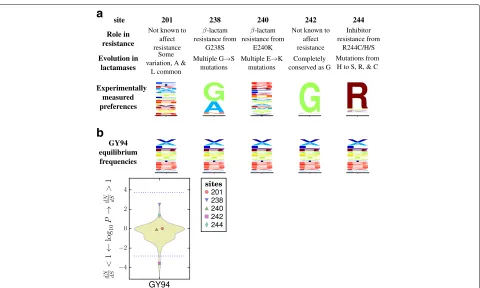
As an example, Fig. 1 shows the amino-acid preferences of five sites in TEM-1 β-lactamase as measured by the deep mutational scanning of Stiffler et al [14]. Mutations at three of these sites confer antibiotic or inhibitor resis-tance inβ-lactamases [15]. Inspection of Fig. 1 shows that the two sites not implicated in resistance have evolved in ways that seem roughly compatible with their amino-acid preferences measured in the lab: site 201 tolerates many amino acids in the lab and is moderately variable in nature, while site 242 strongly prefers glycine in the lab and is conserved at that identity in nature. But the three sites involved in resistance have evolved in ways that seem to deviate from their amino-acid preferences measured in the lab: site 238 substitutes from the lab-preferred glycine to the less preferred serine, site 240 repeatedly substitutes to lysine despite not strongly preferring this amino acid in the lab, and site 244 substitutes from the lab-preferred arginine to several less preferred amino acids. So given the experimentally measured preferences, it is fairly appar-ent that the sites where mutations contribute to antibiotic resistance are evolving in ways that deviate from the pref-erences measured in the lab. But as Fig. 1 shows, adN/dS method fails to find any site withdN/dS > 1 at a false-discovery rate (FDR) of 0.05. As this example shows, a null model that fails to account for site-specific amino-acid preferences can overlook sites that fix adaptive mutations.
Fig. 1Different sites are expected to evolve differently, butdN/dSmethods ignore this fact and so have limited power to detect positive selection. aThe amino-acid preferences of five sites in TEM-1β-lactamase as measured by deep mutational scanning (using the data measured with the highest concentration of ampicillin in [14]; letter heights are proportional to amino-acid preferences). Three sites experience mutations that confer extended-spectrum antibiotic or inhibitor resistance [15]. The two sites not involved in resistance are evolving in a way that seems roughly compatible with the experimentally measured amino-acid preferences, while the three sites implicated in resistance are evolving in ways that clearly deviate from the preferences (for instance, site 238 mutates from highly preferred glycine to the very low preference amino-acid serine).bA standarddN/dSmodel (the M0 variant [4] of the Goldman-Yang model [23], abbreviated GY94) assumes all sites evolve under uniform constraints. When this model is used to fit a site-specificdN/dS, no sites are deemed under diversifying selection (dN/dS>1) at a FDR of 0.05 for testing all sites, although the non-resistance site 242 is deemed under purifying selection (dN/dS<1). The violin plot shows the distribution ofP-values for sites havingdN/dS>or<1. All sites below the bottom dotted blue line are deemed to havedN/dS<1 at an FDR of 0.05. No sites havedN/dS>1 at this FDR, so the top dotted blue line indicate theP-value that would be needed for a site to havedN/dS>1 at a significance level of 0.05 using a Bonferroni correction. A full analysis of all sites and further details are later in the paper. See Additional file 16 for subtleties about amino-acid preferences versus equilibrium frequencies
Results
An evolutionary null model informed by experimentally measured amino-acid preferences
To remedy the limitations ofdN/dS methods illustrated in Fig. 1, we formulate a description of how sites should evolve if selection in nature matches the constraints measured by deep mutational scanning in the lab. This description consists of a set of site-specific experimentally informed codon models (ExpCM). The ExpCM used here are similar but not identical to those in [16, 17]. Specif-ically, they differ from the model in [17] by inclusion of anωparameter representing the relative rate of nonsyn-onymous to synnonsyn-onymous substitutions, and by handling the nucleotide mutation terms via an HKY85-style [18] formalism rather than the formalism in [17].
Deep mutational scanning experiments provide direct measurements of the preferenceπr,aof each siterfor each
amino acid a (for details of how these preferences can be obtained from the experimental data, see [13]). These preferences are normalized soaπr,a = 1. We use the preferences to define an ExpCM for each site. As is typi-cal for phylogenetic substitution models, each ExpCM is a reversible stochastic matrix giving the rates of substitu-tion between codons. The ratePr,xy from codonxtoyat siteris written in mutation-selection form as
Pr,xy=Qxy×Fr,xy (1)
where Qxy represents the rate of mutation from x to y andFr,xy represents the selection on this mutation. The mutation terms are identical across sites, but the selection terms are site-specific.
to one. Theseφ parameters give the expected nucleotide composition in the absence of selection on amino acids; the actual nucleotide frequencies are also influenced by the selection (for this reason, theφ terms cannot simply be equated with the empirical alignment frequencies). The mutation term is:
Qxy=
⎧ ⎪ ⎪ ⎨ ⎪ ⎪ ⎩
0 xandydiffer by>1 nucleotide,
φw xcan be converted toyby transversion tow,
κ×φw xcan be converted toyby transition tow.
(2)
The site-specific amino-acid preferencesπr,aenter the model via the selection termsFr,xy. Let A(x) denote the amino acid encoded by codonx, letβ be the stringency parameter described in [17], and letωbe a gene-wide rel-ative rate of fixation of nonsynonymous to synonymous mutations after accounting for the amino-acid prefer-ences. Then:
Fr,xy=
⎧ ⎪ ⎪ ⎪ ⎪ ⎪ ⎪ ⎨ ⎪ ⎪ ⎪ ⎪ ⎪ ⎪ ⎩
1 ifA(x)=A(y)
ω ifA(x)=A(y)andπr,A(x)=πr,A(y)
ω×
ln
(πr,A(y))β
(πr,A(x))β
1−(πr,A(x))β
(πr,A(y))β
otherwise.
(3)
The functional form relatingFr,xytoπr,afor nonsynony-mous mutations is that derived by Halpern and Bruno [19] under certain (probably unrealistic) assumptions about the evolutionary process and the relationship between the preferences and amino-acid fitnesses (see also [20–22]). Relative to the equation of Halpern and Bruno [19], Eq. 3 removes terms related to mutation (these are captured byQxy) and corrects a typographical error in the denominator. The stringency parameterβis>1 if natural selection favors high-preference amino acids with greater stringency than the experiments used to measureπr,a, and is< 1 if it favors them with less stringency. Under the assumptions of Halpern and Bruno [19], β is related to effective population size. Note that ifβ=0, then the sub-stitution model defined by Eq. 1 reduces to a F1X4 version of the M0 variant [4] of the Goldman-Yang [23] model. Theωparameter indicates if there is a retardation (ω <1) or acceleration (ω > 1) in the rate of fixation of non-synonymous mutations relative to non-synonymous mutations after accounting for the preferences. In [17], it is shown that a model of the form defined byPr,xyis reversible and has stationary state
pr,x =
πr,A(x) β
×φx1 ×φx2×φx3
y πr,A(y) β
×φy1×φy2×φy3 (4) wherex1,x2, andx3are the nucleotides at positions 1, 2, and 3 of codonx.
The ExpCM can be used to calculate the likelihood of a phylogenetic tree and an alignment of genes using the algorithm of Felsenstein [24], which implicitly assumes that sites evolve independently. The set of ExpCM for a given gene have six free parameters:ω,β,κ, and three of theφ’s. Theπr,avalues are not free parameters, since they are specified a priori from experimental data. The values of the six free parameters are fit by maximum likelihood.
Overall, the ExpCM describe how sites evolve if selec-tion in nature is concordant with the amino-acid prefer-ences measured in the lab.
Identifying sites of diversifying selection
Having established a null model for how a gene should evolve if selection adheres to the constraints measured in the lab, we next want to identify sites that deviate from this model. Such sites are likely targets of additional selec-tion. One such form of selection is diversifying selection for amino-acid change, as occurs at viral epitopes under continual pressure to escape newly generated immunity.
To detect diversifying selection, we use an approach analogous the fixed effects likelihood (FEL) method [5, 25, 26]. After fixing the tree and model parameters to their maximum likelihood values for the entire sequence, for each siterwe fit a synonymous rateμrand a parame-terωrcorresponding to the nonsynonymous rate relative to the synonymous rate by replacing Eq. 3 with
Fr,xy= ⎧ ⎪ ⎪ ⎪ ⎪ ⎪ ⎪ ⎪ ⎪ ⎨ ⎪ ⎪ ⎪ ⎪ ⎪ ⎪ ⎪ ⎪ ⎩
μr ifA(x)=A(y)
μr×ωr ifA(x)=A(y)andπr,A(x)=πr,A(y)
μr×ωr× ln
⎡ ⎣
πr,A(y)β
πr,A(x) β
⎤ ⎦
1−
πr,A(x)β
πr,A(y) β
otherwise.
(5)
pinpoint sites like 238 and 244 in Fig. 1, which fix multi-ple nonsynonymous mutations despite being under strong functional constraint.
Identifying sites of differential selection
Some interesting forms of selection do not cause sites to change repeatedly, but rather lead them to substitute to amino acids that are unexpected given the amino-acid preferences measured in the lab. Such sites are under dif-ferential selection to fix mutations different from those expected if selection in nature parallels that in the lab.
To detect differential selection, we compare the prefer-ences measured in the lab to those that optimally describe evolution in nature. We again begin by fixing the tree and model parameters to their maximum likelihood val-ues determined over the whole gene. We then examine the effect of allowing the preferences at each site to dif-fer from the values measured in the lab. Specifically, denote the preferences that optimally describe evolution in nature as πˆr,a, with aπˆr,a = 1. Denote the differ-ential preferenceπr,a for amino-acidaat siteras the difference betweenπˆr,aand the experimentally measured preferences rescaled by the stringency parameter:πr,a=
ˆ
πr,a− (πr,a)
β
a(πr,a)
β. If we redefine Eq. 3 by replacing πr,a
β
withπˆr,aas in
Fr,xy=
⎧ ⎪ ⎪ ⎪ ⎪ ⎨ ⎪ ⎪ ⎪ ⎪ ⎩
1 ifA(x)=A(y)
ω ifA(x)=A(y)andπˆr,A(x)= ˆπr,A(y) ω×
ln
ˆ πr,A(y)
ˆ
πr,A(x)
1−ππˆˆr,A(x)
r,A(y)
otherwise,
(6)
then we can determine the preferences that optimally describe natural evolution by optimizing with respect to
ˆ
πr,a after fixing the tree and model parameters to their maximum likelihood values for the entire sequence. How-ever, unconstrained optimization of Eq. 6 will overfit the data [29, 30]. We therefore instead optimize the product of Eq. 6 and an Eq. that regularizes the πr,a values by biasing them towards zero:
Pr πˆr,a
|πr,a
,β=
a
1
1+C1× πr,a
2 C2
(7)
where C1 andC2 determine how strongly πˆr,a is biased towards the experimentally measured preferences. Here I use C1 = 150 and C2 = 0.5; Eq. 7 is illustrated in Additional file 1. Effectively, this equation biases the estimated values towards the prior expectation from the deep mutational scanning, although the equation is not a true prior as we are using a maximum-likelihood rather than a Bayesian approach. Note that while the underlying
rationale for regularizing theπr,avalues is clear, the reg-ularization implemented by Eq. 7 was chosen heuristically with the rationale that the marginal cost of shiftingπr,a away from zero should initially be steep but then flatten somewhat, corresponding to the intuition that most sites have little differential selection, but some have a lot. How-ever, a more statistically principled method for assessing the support for non-zeroπr,avalues is an important area for future work.
A differential preference ofπr,a >0 implies that nat-ural evolution favors amino-acid a at site r more than expected, whereasπr,a < 0 implies that evolution dis-favors this amino acid. The total differential selection at ris quantified as half the absolute sum of the differential preferences, 12aπr,a; this quantity ranges from zero to one. As demonstrated below, this approach has excel-lent power to pinpoint sites like 238 and 240 in Fig. 1, which fix mutations to unexpected amino acids. How-ever, I emphasize that this test for differential selection is heuristic, and does not incorporate formal statistical significance testing.
Choice of four genes to test approaches to identify sites of selection
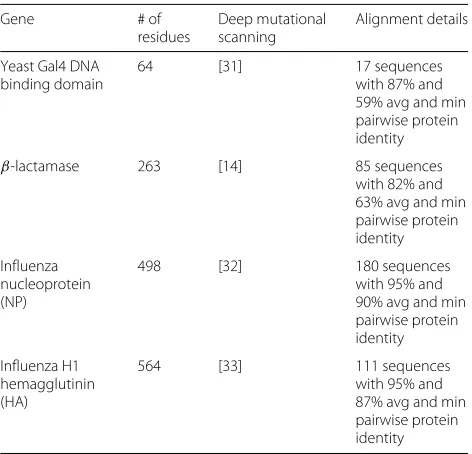
To test the approaches for detecting selection described above, I selected four genes: the DNA-binding domain of yeast Gal4, β-lactamase, the nucleoprotein (NP) of human influenza, and the hemagglutinin (HA) of human seasonal H1N1 influenza. Previous deep mutational scan-ning studies have measured the effects of all mutations to these genes [14, 31–33], enabling calculation of their site-specific amino-acid preferences. For β-lactamase there are actually two deep mutational scanning datasets: one from Firnberg et al [34] and a more recent one from Stiffler et al [14]. As will be shown below, a likelihood-based model comparison shows that the latter of these two datasets provides a better description ofβ-lactamase evolution in nature, and so for that reason this is theβ -lactamase deep mutational scanning dataset used in the current study. For each gene, I assembled an alignment of homologs for evolutionary analysis (Table 1).
Table 1The four genes analyzed in this study
Gene # of
residues
Deep mutational scanning
Alignment details
Yeast Gal4 DNA binding domain
64 [31] 17 sequences
with 87% and 59% avg and min pairwise protein identity
β-lactamase 263 [14] 85 sequences
with 82% and 63% avg and min pairwise protein identity
Influenza nucleoprotein (NP)
498 [32] 180 sequences
with 95% and 90% avg and min pairwise protein identity
Influenza H1 hemagglutinin (HA)
564 [33] 111 sequences
with 95% and 87% avg and min pairwise protein identity
drug-resistance and immune-escape mutations in the other three genes.
Experimentally informed site-specific models are vastly better descriptors of evolution
Our basic assumption is that site-specific ExpCM are a better null model for evolution than the non-site-specific models used by dN/dSmethods. Prior work has shown that experimentally informed site-specific models similar to the ExpCM defined here greatly outperform non-site-specific models [16, 17, 32, 33]. To confirm this result for the ExpCM and genes here, I compared the ExpCM to the several variants [4] of the Goldman-Yang style models [23] (denoted as GY94) commonly used bydN/dS meth-ods. I used F3X4 equilibrium frequencies for GY94, with the nine F3X4 parameters estimated by maximum likeli-hood. These equilibrium frequencies arenotsite-specific; this is the major difference between GY94 and ExpCM (Fig. 1).
To compare the models and perform the other analyses in this paper, I developed the software packagephydms (phylogenetics informed by deep mutational scanning; https://github.com/jbloomlab/phydms). This software interfaces with and extendsBio++[41, 42] to enable anal-yses with both ExpCM and GY94 models. The analanal-yses described in this paper usephydmsversion 1.2.3.
I used phydms to infer a maximum-likelihood phy-logenetic tree for each gene using GY94 with a single gene-widedN/dSratio (the M0 model in [4]). After fix-ing the tree topology to that estimated usfix-ing GY94 M0, I re-optimized the branch lengths and model parameters by maximum likelihood for four additional models. The first
is GY94 M3 [4], in which the likelihood for each site is a linear combination of those under three differentdN/dS values, with these values and their weights shared across the whole alignment and optimized by maximum likeli-hood. The second is ExpCM. The third is ExpCM with the amino-acid preferences averaged across sites – this aver-aging makes the model non-site-specific, but captures any gene-wide trends in the deep mutational scanning data. The final is ExpCM with the amino-acid preferences ran-domized among sites – this model is still site-specific, but the site-specific parameters are no longer associated with the actual site for which they were measured.
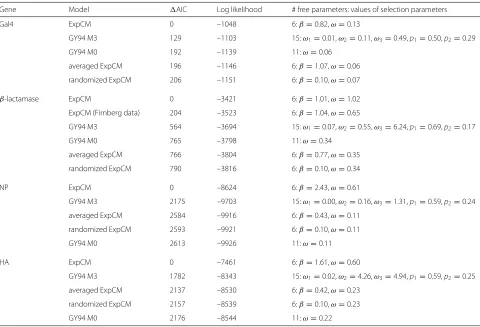
I compared these models using Akaike Information Criteria (AIC) [43], which measures model fit penalized by the number of free parameters. Table 2 shows that ExpCM describe the evolution of all four genes far bet-ter than any other model. This table also shows that for β-lactamase, the new Stiffler et al [14] deep muta-tional scanning dataset informs ExpCM that are superior to those informed by the older Firnberg et al [34] deep mutational scanning dataset, although ExpCM informed by either dataset are vastly superior to any GY94 models. The huge superiority of ExpCM over the GY94 models is because ExpCM capture site-specific evolutionary con-straints, as demonstrated by the fact that ExpCM in which preferences are averaged across sites are comparable to GY94. The poor performance of the randomized ExpCM is because a site-specific model only helps if the experi-mentally measured preferences are assigned to the correct sites. Indeed, Table 2 shows that randomly assigned site-specific preferences are so detrimental that they are nearly completely flattened by fitting a stringency parameter β that is close to zero, effectively making the randomized ExpCM non-site-specific. Overall, Table 2 confirms previ-ous work [16, 17, 32, 33, 44] showing that experimentally informed site-specific models provide vastly improved descriptions of evolution.
Another informative comparison is between thedN/dS
of GY94 and the ω of ExpCM. ExpCM can represent
Table 2Site-specific ExpCM are vastly better than GY94 or ExpCM with preferences averaged or randomized across sites
Gene Model AIC Log likelihood # free parameters: values of selection parameters
Gal4 ExpCM 0 –1048 6:β=0.82,ω=0.13
GY94 M3 129 –1103 15:ω1=0.01,ω2=0.11,ω3=0.49,p1=0.50,p2=0.29
GY94 M0 192 –1139 11:ω=0.06
averaged ExpCM 196 –1146 6:β=1.07,ω=0.06
randomized ExpCM 206 –1151 6:β=0.10,ω=0.07
β-lactamase ExpCM 0 –3421 6:β=1.01,ω=1.02
ExpCM (Firnberg data) 204 –3523 6:β=1.04,ω=0.65
GY94 M3 564 –3694 15:ω1=0.07,ω2=0.55,ω3=6.24,p1=0.69,p2=0.17
GY94 M0 765 –3798 11:ω=0.34
averaged ExpCM 766 –3804 6:β=0.77,ω=0.35
randomized ExpCM 790 –3816 6:β=0.10,ω=0.34
NP ExpCM 0 –8624 6:β=2.43,ω=0.61
GY94 M3 2175 –9703 15:ω1=0.00,ω2=0.16,ω3=1.31,p1=0.59,p2=0.24
averaged ExpCM 2584 –9916 6:β=0.43,ω=0.11
randomized ExpCM 2593 –9921 6:β=0.10,ω=0.11
GY94 M0 2613 –9926 11:ω=0.11
HA ExpCM 0 –7461 6:β=1.61,ω=0.60
GY94 M3 1782 –8343 15:ω1=0.02,ω2=4.26,ω3=4.94,p1=0.59,p2=0.25
averaged ExpCM 2137 –8530 6:β=0.42,ω=0.23
randomized ExpCM 2157 –8539 6:β=0.10,ω=0.23
GY94 M0 2176 –8544 11:ω=0.22
The ExpCM stringency parameterβalso provides use-ful information. Recall that β > 1 means that natural evolution selects for preferred amino acids with greater stringency than the deep mutational scanning. Table 2 shows that for both influenza genes (NP and HA), the stringency of natural selection exceeds that of the deep mutational scanning, indicating that the selection in experiments in [32] and [33] was not as rigorous as selec-tion in nature. Forβ-lactamase, the stringency of natural evolution is approximately equal to that of the deep muta-tional scanning, providing a second indication (along with the fitting ofω ≈ 1) that the experiments in [14] did an excellent job of capturing the constraints onβ-lactamases in nature. Only for Gal4 isβ < 1: either the selections in [31] were more stringent than natural selection, or the measured preferences are not completely representative of those in nature and soβ is fit to<1 to somewhat flatten these preferences.
The stringency-rescaled amino-acid preferences are in Fig. 2 and Additional files 2, 3 and 4. These figures reveal remarkable variation in constraint among sites, explain-ing why ExpCM better describe evolution than non-site-specific models. Overall, the results in this section verify
that ExpCM offer a better evolutionary null model, and so motivate their use in identifying diversifying and differen-tial selection.
Experimentally informed site-specific models better detect diversifying selection
I used the ExpCM to identify sites of diversifying selection for amino-acid change. This was done by usingphydms to fitωrand a synonymous rate for each sitervia Eq. 5, fixing all other parameters at their optimized values. To compare to a standarddN/dSmethod, I also fit adN/dS ratio and synonymous rate for each site using GY94 with all other parameters fixed to the values optimized under GY94 M3 (equivalent to the fixed effects likelihood or FEL method as implemented in [5]).
Fig. 2Site-specific amino-acid preferences forβ-lactamase. The height of each letter is proportional to the preference for that amino acid at that site, and letters are colored by amino-acid hydrophobicity. These are the preferences experimentally measured in [14] for TEM-1β-lactamase under selection with 2.5 mg/ml ampicillin, re-scaled by the stringency parameterβ=1.01 from Table 2. The re-scaling is done so that if the experimentally measured preference for amino-acidaat siterisπr,a, then the rescaled preference is proportional to πr,aβ. Theβ-lactamase sequence is
numbered using the Ambler scheme [82], meaning that residue numbers 239 and 253 are skipped. Comparable data for Gal4, NP, and HA are shown in Additional files 2, 3 and 4, respectively
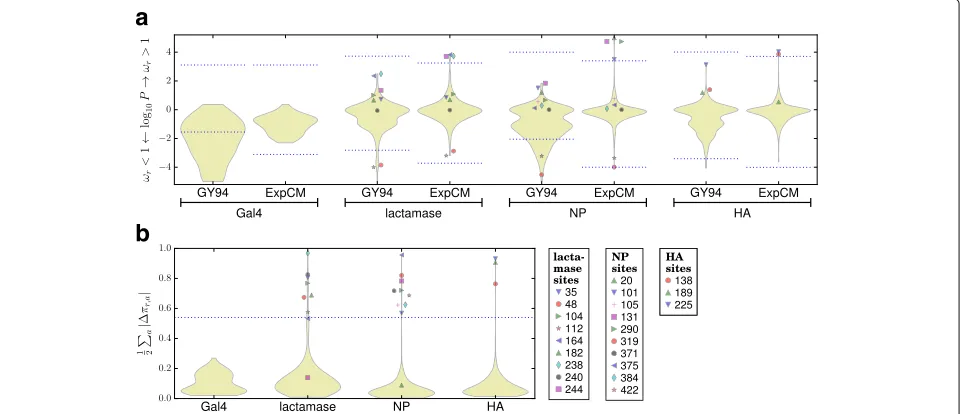
protein sequence to be under evolutionary constraint. The more plausible ExpCM null model finds that all sites in Gal4 are evolving as expected from the measurements in the lab (for no sites does it reject the null hypothesis ωr =1). For the other three genes, GY94 again finds that there are many sites withdN/dS<1 while failing to iden-tify any sites withdN/dS>1 at an FDR of 0.05 – despite the fact that there is clear evidence that all three genes fix drug-resistance or immune-escape mutations. In contrast, the more realistic ExpCM find sites of diversifying selec-tion for all three genes: there are three sites withωr>1 in
β-lactamase, four in NP, and two in HA.
To statistically validate the ExpCM approach for iden-tifying diversifying selection, I used pyvolve [46] to simulate alignments of NP under ExpCM informed by the experimentally measured preferences and using the tree inferred for the actual NP sequences. In each simulation, I randomly selected five sites and placed them under diver-sifying withωr values ranging from 5 to 30. I then ana-lyzed the simulated alignments for diversifying using the ExpCM and the FEL-like GY94dN/dSmethod. As shown in Additional file 5, ExpCM consistently outperformed GY94 at identifying the simulated sites of diversifying
selection. Additional file 5 also shows that the Benjamini-Hochberg procedure [28] effectively controlled the false discovery rate. These simulations demonstrate the statis-tical soundness of the ExpCM approach for identifying diversifying selection.
Both the FEL-like GY94dN/dSmethod and the ExpCM used for the analysis in Fig. 3a test for diversifying selec-tion across the phylogeny. But in many cases, diversifying selection is episodic. Therefore, dN/dS methods have been extended to identify sites under diversifying selec-tion in only some lineages [6, 47–49]. I used one of these methods,MEME[6], to test for episodic diversifying selec-tion. Additional file 6 shows thatMEMEidentifies one site of diversifying selection each inβ-lactamase and NP, and no sites in HA or Gal4. This makesMEMEmore power-ful than the FEL-like GY94 method but still less powerpower-ful
than ExpCM. However, MEME and ExpCM outperform
Fig. 3The experimentally informed models (ExpCM) identify many sites of diversifying or differential selection that are missed by a standarddN/dS analysis (GY94).aThe violin plots show the distribution ofP-values that a site is under diversifying selection for (positive numbers) or against (negative numbers) amino-acid change (ωrindicates both the ExpCM parameter in Eq. 5 and the GY94dN/dSratio). The portion of the distribution
above / below the dotted blue lines contains all sites for which there is support for rejecting the null hypothesisωr=1 at a FDR of 0.05. When there
are no sites with support at this FDR, the dotted blue lines indicate theP-value that would be needed for a site to haveωr>1 or<1 at a
significance level of 0.05 using a Bonferroni correction. ThedN/dSmethod identifies many sites of purifying selection, but fails to find any sites of selection for amino-acid change. The ExpCM model already accounts for basic functional constraints and so doesn’t identify any sites withωr<1,
but does identify sites of diversifying selection in all genes except Gal4 (which is not thought to evolve under pressure for phenotypic change). bThe violin plots shown the distribution of differential selection at each site inferred with the ExpCM. Since Gal4 is not under selection for phenotypic change, I defined a heuristic threshold at 2-times the Gal4 maximum value of 0.27. At this threshold, sites of differential selection are identified for all three other genes. The legend labels all sites under diversifying or differential selection. This analysis was performed usingphydms; Additional file 17 shows that similar results are obtained if thedN/dSanalysis is instead performed usingHyPhy[7]
A variety of otherdN/dSmethods have also been devel-oped. The most prominent other class includes so-called “random effects” methods that use an empirical Bayesian approach to share information about the distribution of dN/dSacross sites [2, 50–52]. The relative pros and cons of “random effects” methods versus the “fixed effects” methods used in this paper remain an area of active dis-cussion [5, 53]. It is beyond the scope of the current study to compare these two classes of methods. Here I simply note that as with the test for episodic selection described in the previous paragraph, ExpCM substitution models could in principle also be incorporated into the “ran-dom effects” framework, since the essential differences between “random effects” and “fixed effects” methods are due to how parameters are handled rather than the substitution model itself.
Overall, the results in this section show that ExpCM are better at identifying diversifying selection than several standarddN/dSmethods. The reason for this superiority is that the ExpCM account for variation in the inherent constraints on different sites, and so have greater power to recognize when a functionally constrained site is changing more rapidly than expected.
Experimentally informed site-specific models enable detection of differential selection
ExpCM also enable identification of differential selection for unexpected amino acids. I usedphydmsto estimate the differential preferenceπr,a of each siter for each amino-acidaby optimizing the product of Eq. 6 and Eq. 7 after fixing all other parameters. The differential selection at each siterwas quantified as 12aπr,a, which can range from zero to one.
on these genes. Note that similarly reasonable results are not obtained using the non-phylogenetic Kullback-Leibler divergence to measure differences between amino-acid frequencies in nature and the experimentally mea-sured amino-acid preferences (Additional file 7). This fact emphasizes the importance of examining evidence for diversifying selection in a phylogenetic framework rather than analyzing them using statistical approaches that treat them as independent samples from some underlying ensemble.
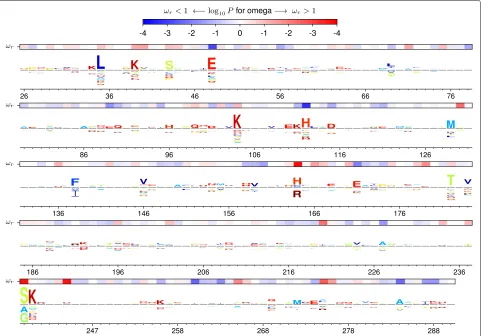
A more detailed portrayal of the diversifying selection at each site is in Fig. 4 and Additional files 8, 9, and 10. For each site, these images display the evidence for diversify-ing selection, the strength of differential selection, and the differential preference for each amino acid at sites under non-negligible differential selection.
There are sites in β-lactamase, NP, and HA that are under both diversifying and differential selection, but
there are also sites that are only under one of these forms of selection (Fig. 3). These findings make sense: often, pressure for amino-acid change will drive multiple sub-stitutions to non-preferred amino-acid identities, leaving traces of both types of selection. But sometimes, a rela-tively unconstrained site substitutes to a variety of differ-ent amino acids, leading to diversifying but not differdiffer-ential selection. In other cases, a site fixes just one or a few sub-stitutions to a non-preferred amino acid that confers some enduring phenotypic benefit, leading to differential but not diversifying selection.
The identified sites of selection are consistent with existing biological knowledge
The ExpCM identified sites of differential and diversifying selection in all three genes that are undergoing adaptive evolution (β-lactamase, NP, and HA), while GY94 iden-tified no sites withdN/dS < 1 in any of the genes. But
Fig. 4Site-specific selection onβ-lactamase inferred with experimentally informed models. The height of each letter above/below the black center line is proportional to the differential selection for/against that amino acid at that site relative to what is expected from the amino-acid preferences in Fig. 2. The overlay bar shows the evidence for diversifying selection at each site, which is manifested by strong evidence for a ratioωrof
nonsynonymous to synonymous substitution rates that is higher (red) or lower (blue) than expected from the amino-acid preferences. The
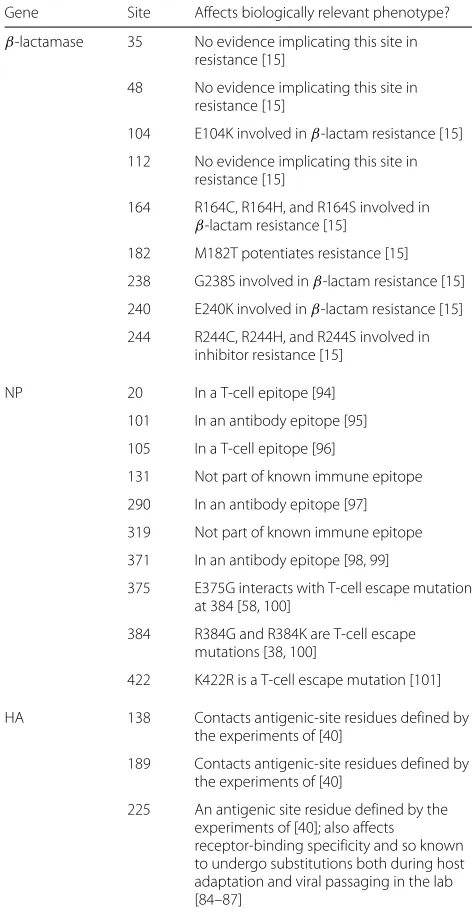
before concluding that this result indicates the superiority of the ExpCM, we must answer the following question: are the identified sites actually the locations of substitutions that have altered evolutionarily relevant phenotypes? To answer this question, I examined the literature on drug resistance inβ-lactamases and immune escape by NP and HA (Table 3).
Forβ-lactamases, [15] reports 18 sites at which muta-tions known to affect resistance are observed in clinical isolates. The ExpCM identify 9 sites of selection; 6 of these 9 sites are among the 18 known sites of resis-tance mutations (Table 3). There are 263 residues in the
Table 3At most sites of selection identified using ExpCM, mutations affect drug resistance or immune escape
Gene Site Affects biologically relevant phenotype?
β-lactamase 35 No evidence implicating this site in resistance [15]
48 No evidence implicating this site in resistance [15]
104 E104K involved inβ-lactam resistance [15]
112 No evidence implicating this site in resistance [15]
164 R164C, R164H, and R164S involved in
β-lactam resistance [15]
182 M182T potentiates resistance [15]
238 G238S involved inβ-lactam resistance [15]
240 E240K involved inβ-lactam resistance [15]
244 R244C, R244H, and R244S involved in inhibitor resistance [15]
NP 20 In a T-cell epitope [94]
101 In an antibody epitope [95]
105 In a T-cell epitope [96]
131 Not part of known immune epitope
290 In an antibody epitope [97]
319 Not part of known immune epitope
371 In an antibody epitope [98, 99]
375 E375G interacts with T-cell escape mutation at 384 [58, 100]
384 R384G and R384K are T-cell escape mutations [38, 100]
422 K422R is a T-cell escape mutation [101]
HA 138 Contacts antigenic-site residues defined by the experiments of [40]
189 Contacts antigenic-site residues defined by the experiments of [40]
225 An antigenic site residue defined by the experiments of [40]; also affects
receptor-binding specificity and so known to undergo substitutions both during host adaptation and viral passaging in the lab [84–87]
mature β-lactamase protein, so we can reject the pos-sibility that the identified sites are not associated with resistance mutations (P=10−6, Fisher’s exact test). So for β-lactamase, the ExpCM mostly identify sites that have been independently shown to affect drug resistance.
NP is under immune selection to escape T cells [10, 38] and probably also antibodies [54, 55]. The ExpCM identify 10 sites of selection. I searched the literature and found reports that 8 of these 10 sites are relevant to immune escape (Table 3). So for NP, the ExpCM mostly iden-tify sites that have been independently shown to affect immunogenicity.
HA is under immune selection to escape antibodies. Caton et al [40] used antibodies to map escape muta-tions in H1 HA. A reasonable definition of the antigenic portion of HA is the set of sites identified in [40] plus any sites in three-dimensional contact with these sites (a contact is defined as aCα −Cα distance ≤ 6Å in PDB 1RVX). Using this definition, 86 of the 509 sites in the HA ectodomain are in the antigenic portion of the molecule. The ExpCM identify 3 sites of selection, all of which are in the antigenic portion of HA. We can reject the possibility that these identified sites are not associated with the anti-genic portion of the molecule (P = 0.005, Fisher’s exact test). So for HA, the ExpCM identify sites that have been independently shown to affect immunogenicity.
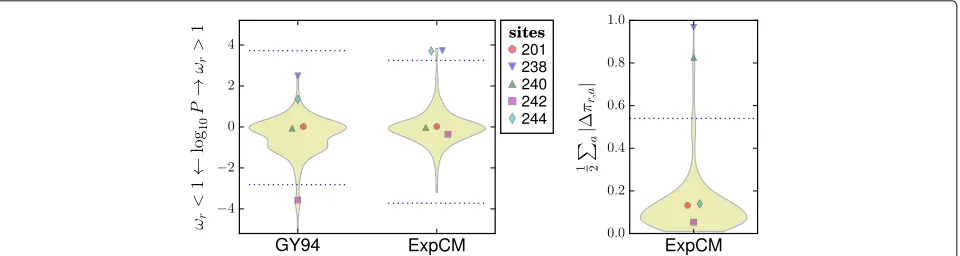
Overall, these results show that sites of selection iden-tified by ExpCM are indeed the locations of substitutions that alter evolutionarily relevant phenotypes. For a con-crete illustration of sites of adaptive substitutions that are identified by ExpCM but not by a dN/dS method, Fig. 5 shows the results of the ExpCM analysis of the five example sites inβ-lactamase discussed in the Intro-duction and Fig. 1. Three of these five sites experience substitutions that affect resistance, but adN/dSmethod fails to flag any of them as under diversifying selection (dN/dS > 1) since it doesn’t account for site-specific constraints (Fig. 1). Figure 5 shows that ExpCM correctly identify all three resistance sites as under diversifying or differential selection, while finding that the non-resistance sites are evolving as expected. Visual inspection of the two figures provides an intuitive explanation of why account-ing for site-specific amino-acid preferences makes ExpCM so much more powerful at identifying sites of selection to alter evolutionarily relevant phenotypes.
Discussion
Fig. 5The experimentally informed models (ExpCM) correctly identify the threeβ-lactamase sites in Fig. 1 that contribute to drug resistance. Figure 1 showed five sites inβ-lactamase, three of which (238, 240, and 244) experience substitutions that contribute to drug resistance. However, a dN/dSanalysis (GY94) fails to identify any of these sites as under diversifying selection (dN/dS>1) at a FDR of 0.05 for testing all sites (dotted blue lines). In contrast, ExpCM correctly determine that the three resistance sites are under diversifying (238 and 244) or differential (238 and 240) selection, and that the two non-resistance sites (201 and 242) are evolving as expected. ExpCM outperform thedN/dSmethod because they implement a null model that accounts for the site-specific amino-acid preferences shown in Fig. 1; for instance, this null model is not surprised that site 242 remains fixed at the highly preferred amino-acid R, but does find it noteworthy that site 240 substitutes to K multiple times even though that is not a particularly preferred amino acid
sometimes more informative than the latter. It is by now abundantly clear that most protein residues are under some type of constraint, so finding that a site evolves non-neutrally is often unsurprising. Instead, we want to iden-tify sites of substitutions that have altered evolutionarily relevant phenotypes. As demonstrated here, experimen-tally informed models have much greater power to iden-tify such sites. The improvement is remarkable: while a dN/dSmethod fails to find any sites of adaptive evolution in the genes examined, experimentally informed models identify 22 sites of diversifying or differential selection, most of which fix mutations that have been independently shown to affect drug resistance or immunogenicity.
What accounts for the improved power of the exper-imentally informed site-specific models? As vividly illustrated by the deep mutational scanning studies that provide the data used here (Fig. 2 and Additional files 2, 3, and 4), there is vast variation in the constraints on sites within a protein. Therefore, the significance that we should ascribe to a substitution depends on where it occurs: several changes at an unconstrained site may be unremarkable, but a single substitution away from a pre-ferred amino acid at a constrained site probably reflects some powerful selective force. WhereasdN/dSmethods treat all substitutions equally, the models used here eval-uate the significance of each substitution in the context of the experimentally measured amino-acid preferences of the site at which it occurs.
Does this reliance on experimental measurements make the approach less objective? At first glance, the fact that dN/dS methods are uncontaminated by messy experiments feels reassuring. In contrast, experimen-tally informed models are dependent on all the subjec-tive decisions associated with experimental design and
interpretation. In addition, experiments in the lab may fail to fully capture all the selection pressures operating in nature. But in truth, experimentally informed models simply make explicit something that is already true: we define positive selection with respect to a null model for evolution in the absence of this selection. At least for the genes examined here, sites of known adaptive mutations are better identified by leveraging imperfect experiments that capture many of the constraints on natural evolution than by objectively testing the implausible null hypothesis that every site is evolving neutrally.
An assumption of experimentally informed site-specific models is that amino-acid preferences are conserved among the homologs under analysis. At first glance this assumption seems tenuous – epistasis can shift the effects of mutations as a gene evolves [56–58]. But it is rare for epistatic shifts to be large enough to undermine the advantage of site-specific models: this fact is demon-strated by direct experiments [32, 59, 60], the observation that parallel viral lineages tend to substitute to the same preferred amino acids at each site [61], and the empirical superiority of site-specific models in fitting phylogenies of diverged homologs (Table 2, [17, 32]). Therefore, epistasis does not subvert the basic advantage of a model informed by site-specific amino-acid preferences.
study I had to subsample the 105 publicly available influenza sequences down to a manageable number. The core techniques of deep mutational scanning – sequenc-ing and gene/genome engineersequenc-ing – are improvsequenc-ing at a similar pace, so coming years will see measurement of the amino-acid preferences of many more genes.
Another possibility is to use non-experimental strate-gies to inform site-specific models like the one here. One strategy is to predict site-specific constraints from higher-level properties such as solvent accessibility [64–66] or via molecular simulation [67–70]. It remains unclear whether such non-experimental strategies can predict site-specific amino-acid preferences with sufficient accuracy to inform substitution models that can match the ExpCM used here. Another strategy is to infer preferences from nat-urally occurring sequences [30, 71–75]. If care is taken to avoid the over-fitting that could accompany inferring preferences from the same naturally occurring sequences that are being analyzed for selection, then this might be a viable approach. Indeed, while the current paper was under review, Rodrigue and Lartillot published an elegant study that implements an approach along these lines [76]. But I suggest that direct measurement of amino-acid pref-erences via deep mutational scanning may well prove the best solution in many cases: after all, biology is full of properties that are challenging to predict or infer, but are now routinely measured in high-throughput.
Overall, I have described a new approach that lever-ages high-throughput experimental data to identify sites of selection in protein-coding genes. This approach clearly outperforms a standard implementation of the widely used dN/dS strategy, however there is much room for improvement. The utility of thedN/dSstrategy has been enhanced by innovations that have made it possible to do things like test for selection only along certain branches [6, 49], utilize Bayesian approaches to share information across sites [2, 50–52], better incorporate synonymous rate variation [77], and more rapidly perform the com-putational analyses [52, 78]. Most of these innovations could also be used in combination with the experimen-tally informed models described here. Methodological improvements of this sort, coupled with growing amounts of deep mutational scanning data, could make experimen-tally informed models an increasingly powerful tool to identify genotypic changes that have altered phenotypes of interest.
Methods
Software implementing the analyses
The algorithms described in this paper are implemented in the phydms software package, which is available at https://github.com/jbloomlab/phydms. This package
is written in Python, and uses cython to
inter-face with and extendBio++(http://biopp.univ-montp2.
fr/, [41, 42]) for the likelihood calculations. Special thanks to Laurent Guéguen and Julien Dutheil for gen-erously making the cutting-edge version ofBio++ avail-able and providing assistance in its use. The software uses dms_tools (https://github.com/jbloomlab/dms_ tools, [13]) and weblogo(http://weblogo.threeplusone. com/, [79]) for visualizing the results. The analyses in this paper usedphydmsversion 1.2.3.
Amino-acid preferences for the four proteins
The amino-acid preferences were taken from previously published deep mutational scanning experiments. For NP, the preferences were taken from [32], using the average of the measurements for the two NP variants. For HA, the preferences were taken from [33]. Forβ-lactamase, [14] provides “relative fitness” scores, which are log10 enrich-ment ratios. I used the scores for the selections on 2.5 mg/ml of ampicillin (the highest concentration), averaging the scores for the two replicates. Following the definition in [13] of the preferences as the normalized enrichment ratios, the preferences πr,aare calculated from the rela-tive fitness scores Sr,a so that πr,a ∝ max 10Sr,a, 10−4
and 1 = aπr,a. For Gal4, [31] provides “effect scores”, which are the log2of the enrichment ratios. The prefer-ences are calculated from the effect scores Er,a so that
πr,a∝max 2Er,a, 2×10⁻⁴and 1=aπr,a. A few effect scores are missing from [31], so these scores are set to the average for all mutations for which scores are provided. The formulas to convert theβ-lactamase and Gal4 scores to preferences include the max operators to avoid esti-mating preferences of zero; the minimal allowable values specified by the second argument to these operators are my guess of the lowest frequency that would have been reliably observed in each experiment.
For the comparison of the two different deep mutational scanning datasets forβ-lactamase shown in Table 2, the measurements from the Firnberg et al [34] deep muta-tional scanning were converted into site-specific amino-acid preferences as described in [17].
Alignments of naturally occurring sequences for each protein
and 1977–2008), and retaining just four sequences per year to yield a manageable alignment. For β-lactamase,
the alignment consists of the TEM and SHV β
-lactamases used in [17]. For Gal4, a set of homologs was obtained by performing a tblastnsearch of the Gal4 DNA-binding domain used by [31] against wgs
(lim-iting by saccharomyceta (taxid:716545)) and
chromosomesfor hits withE≤0.01, and retaining only sequences that aligned to the Gal4 DNA-binding domain with≥70% protein identity and≤5% gaps. For all genes, alignments were made pairwise to the sequence used for the deep mutational scanning withEMBOSS needle [81], and sites were purged if they were gapped in that sequence.
Sequence numbering
In the figures and tables, the residues in NP are num-bered sequentially beginning with one at the N-terminal methionine. The residues in HA are numbered using the H3 numbering scheme (the one used in PDB 4HMG), and the site-specific selection analysis is performed only for the residues in HA ectodomain (residues present in PDB 4HMG). The residues inβ-lactamase are numbered using the Ambler scheme [82]. The residues in Gal4 are numbered using the scheme in [31].
Data availability
The software package that implements the algorithms described in this paper is available at https://github.com/ jbloomlab/phydms. The analyses were performed using version 1.2.3 of thephydmssoftware. Data and scripts to perform the specific analyses are provided as Additional files 11, 12, 13, 14 and 15.
Reviewers’ comments
Reviewer Report 1: Sebastian Maurer-Stroh, Bioinformatics Institute (BII), A*STAR, Singapore
Reviewer summary –
Interesting well conceived approach.
Author response:Thank you for the kind words. Reviewer recommendations to author –
This is an interesting approach to overcome simplifica-tions of dN/dS site selection models by using site-specific experimental data from deep mutational scanning. As beautifully detailed and desirable this sounds, one should not forget that the experimental setup is detrimental for the types or aspects of protein function that can actu-ally be investigated which directly influences the range of obtainable interpretations. For example, influenza hemag-glutinin has multiple roles to fulfill on top of anti-genic drift such as pH-dependent conformational changes and receptor binding. Similarly, functional roles of the
nucleoprotein are not only thermal stability and immune response evasion but also RNA packing and sub-cellular shuttling. Also beta-lactamases will mutate differently under different pressures from different antibiotics or in competition with other bacteria. The difficulty of the experimental setup to represent the full complexity of nat-ural selection pressures is not always just a limiting factor but looking only at some aspects of function at any one time allows elegantly gauging details of specifically tar-geted evolutionary forces at play. The notion of the critical influence of the experimental setup is mentioned in the discussion but would be good to be included also in the introduction.
Author response: This is an important point. I have elaborated the paragraph in the Discussion that describes how experiments in the lab will sometimes fail to fully capture selection in nature (This is the paragraph begin-ning, “Does this reliance on experimental measurements make the approach less objective?” I have also added men-tion of this point in the Introducmen-tion by emphasizing that “lab measurements are undoubtedly imperfect proxies for actual selective constraints in nature.”
The reviewer also makes excellent points regarding influenza hemagglutinin in particular. Although I do not go into these points in the current manuscript (which focuses more on the general approach than the details of HA), the reviewer’s intuition is validated by recent work for my group specifically focusing on HA [44] which found that the experimentally informed models identify both sites of actual positive selection from immunity and sites subject to lab-specific selection pressures related to pro-teolytic activation of HA. However, despite these caveats, I think that the current manuscript clearly demonstrates that site-specific models informed by imperfect experi-ments are superior to the much more unrealistic standard non-site-specific models.
The formalism of the approach is well developed and intuitively makes sense but the practical result for hemag-glutinin left me a bit wanting. Certainly the identified sites for HA in Table 3 are important but they seem only a small subset of such sites that can be identified with other methods (e.g. SLAC fromHyPhypackage over naturally occurring sequences finds dozens that can be rational-ized to make sense through overlap with known epitopes etc). Could it simply be that the, in some cases, used heuristic Gal4-based thresholding is too conservative and considering less stringent criteria would find more of the presumably true sites?
sites of positive selection for the H1 alignment. I would expect that all approaches would identify more sites in H3 HA, since human H3N2 influenza undergoes more rapid antigenic drift than human seasonal H1N1 influenza[83]. Such an analysis will be possible once deep mutational scanning data are available for an H3 HA.
By the way, the criterion of Caton epitope residues plus everything within 6A does includes a lot of structurally buried residues. Maybe an additional surface accessibility criterion to enrich for direct epitope candidates may be justifiable here? If I am not wrong, HA 225 (in H3 num-bering in Table 3) is a classical host/passage specificity position in H1 context and it is good to be highlighted by the new approach but its potentially broader functional importance on receptor binding should also be mentioned and referenced accordingly.
Author response:These are both good points. The three sites of selection listed in the table are at least partially surface-exposed. As the reviewer points out, some of the 89 sites within 6Å are buried, and so are probably not true antigenic sites. Accounting for this fact would deflate the denominator in the Fisher’s exact test that we use to test the significance that we are identifying true antigenic sites, and so further improve the P-value for supporting the validity of our ExpCM method. However, I prefer to be conservative and keep all 89 sites in the denominator, since in some cases mutations at buried sites may still introduce slight con-formational changes or N-linked glycosylation motifs that escape antibodies.
The point about HA site 225 in receptor-binding is a good one. I have added a line in the table that emphasizes that mutations at site 225 are implicated in both host adapta-tion and lab passaging adaptaadapta-tion via changing receptor binding, and have cited the following relevant references: [84–87].
The following additional points are meant to stimulate further thoughts for future work: Empirical average (nei-ther site- nor protein-specific) amino acid substitution tables have been derived en masse since the early works of Dayhoff (PAM, JTT, BLOSUM, . . .). Picking one of the most popular, BLOSUM62, how similar or different is it for the studied proteins’ ExpCM results?
Author response:Good question. Empirical amino-acid substitution matrices themselves cannot be directly sub-stituted for codon substitution models. But there are a variety of empirical codon substitution models, which com-bine empirical amino-acid substitution models with codon substitution models. One such set of models are Kosiol et al 2007 models [88]. In prior work[16, 17, 33]I have com-pared these Kosiol 2007 models to the various forms of the Goldman-Yang style models used here, as well as earlier versions of the ExpCM. As described in that prior work, the Kosiol 2007 models in general were not substantially bet-ter (and were often actually worse) than the Goldman-Yang
models in terms of phylogenetic fit. Therefore, it appears that an empirical model that tries to account for amino-acid substitutions in a way that is NOT site-specific does not lead to substantial improvements. This is probably because protein-level constraints are highly site-specific, and cannot effectively be modeled in an “average” across sites.
Classical substitution matrices are traditionally derived from globular regions of proteins forming 3D struc-tures but un- or dynamically structured N- or C-terminal stretches are also under selection pressure for targeting motifs and other constraints. An unbiased but complete scanning method may be equally applicable also in non-globular regions and pinpoint critical sites often neglected by earlier approaches?
Author response:This is another good question. As the reviewer suggests, I would expect that perhaps the site-specific amino-acid preferences for unstructured protein domains to be quite a bit different than for globular pro-teins. To my knowledge, no one has yet performed deep mutational scanning on an unstructured protein domain. But once such experiments are done, as the reviewer sug-gests, it would be very interesting to test whether such experiments could inform substitution models.
On the complexity of adaptive mutations in the sub-strate binding pocket of beta-lactamases, I found it curious that antibiotics resistance genes in microbiomes of an un-contacted Amazonian tribe had the capacity to also neutralize synthetic man-made antibiotics they have never been exposed to (http://www.sciencemag. org/news/2015/04/resistance-antibiotics-found-isolated-amazonian-tribe). This highlights plasticity of the natural repertoire of substrate binding pocket residues to accom-modate a broad range of unknown substrates directly or with few mutations.
Author response:This is an interesting observation. As more deep mutational scanning data sets become avail-able, it will be interesting to compare the inherent plasticity of different active sites.
Adaptive mutations are of great importance not just in the context of pathogens but it would be interesting to also apply deep scanning and ExpCM on key genes in human diseases (P53, KRas, EGFR, . . . )
Author response:This is a great suggestion. Some recent studies by other groups have already started to move in this direction; see for instance[89, 90]. These studies may have the potential to aid in the prospective identification of disease-causing human mutations.
Last but not least, the manuscript and suppl. material with code links are commendably complete descriptions of the work.
Additional responses from reviewer after reading the revised version. The quoted text indicates the author’s comments in the revision:
“I think the relative paucity of sites identified in HA is due to the fact that the analysis focuses on seasonal H1 HA rather than H3 HA.” Indeed, could be true.
“. . . keep all 89 sites in the denominator, since in some cases mutations at buried sites may still introduce slight conformational changes or N-linked glycosylation motifs that escape antibodies.” Ok to keep all 89 sites for this paper but remove in the response the comment on buried N-glycosylation sites. The latter most commonly are not buried due to the simple necessity of access for the modifying enzyme machinery [91].
Author response: The reviewer is correct that the N-linked glycans themselves are not buried. I had meant that in some cases the Ser/Thr in the Asn-Xaa-Ser/Thr gly-cosylation motif might be buried, but admittedly this is probably a rare event.
“As described in that prior work, the Kosiol 2007 mod-els in general were not substantially better (and were often actually worse). . . ” Sure, I did not mean that they would be better in performance but more that it might be inter-esting to study trends in observed differences to possibly improve them with some extra rules e.g. something that would filter out less reliable sites where differences are always high. In other words, some amino acid substitu-tion pairs may be more site-specific than others? In any case, partially addressed before and possible extension for future work.
Author response:I agree that this is an interesting area for future work.
“To my knowledge, no one has yet performed deep mutational scanning on an unstructured protein domain. But once such experiments are done, as the reviewer sug-gests, it would be very interesting to test whether such experiments could inform substitution models.” Most pro-teins are not fully structured but typically feature flexible N- and C-termini as well as often only partially structured longer loop regions. One way to define these unstructured regions is by looking for unresolved residues in crystal structures despite being part of the used sequence. These are easy to see when looking at the sequence tab of PDB files online. In fact for the H1N1 HA deep scan, it seem the author has deep scanning data for∼18 unstructured residues in the N-terminus and 60 in the C-terminus [44]. Surprisingly there seems to be quite some constrained sites in the C-term here which also may point to functional importance as motifs or partial or conditional structure.
Author response: This is a good idea – it would be interesting to specifically look at unstructured regions in proteins that have already been studied by deep muta-tional scanning. Such an analysis is beyond the scope of the current study, but is an interesting topic for future work. As
the reviewer notes, the conservation at some sites in the C-terminus of HA is compatible with the fact that parts of the transmembrane domain and cytoplasmic tail are impor-tant for virion formation, such as via interactions between HA’s cytoplasmic tail and the matrix protein.
Reviewer Report 2: Olivier Tenaillon, INSERM, France
Reviewer summary –
In his manuscript entitled “Identification of positive selection in genes is greatly improved by using experimen-tally informed site specific models”, Jesse Bloom propose to use quantitative information based in deep mutational scanning experiments to detect selection in phylogenies. In previous articles, he proposed to use such information to improve the phylogenetic reconstruction, in the present one he extends the approach to detection of selection, the rational being that a better underlying model allows a finer detection of selection, and a site specific model gives more power to detect local effects. He applies his method to 4 genes, one in which no selection is expected and 3 in which there are target sites for selection. The results suggest a better detection of sites under selection. I really appreciated the approach used and have just minor comments.
Author response:Thank you for the nice summary and kind words about the manuscript.
Reviewer recommendations to author –