R E S E A R C H
Open Access
Towards a practical
O
(
n
log
n
)
phylogeny algorithm
Jakub Truszkowski
*, Yanqi Hao and Daniel G Brown
Abstract
Recently, we have identified a randomized quartet phylogeny algorithm that hasO(nlogn)runtime with high probability, which is asymptotically optimal. Our algorithm has high probability of returning the correct phylogeny when quartet errors are independent and occur with known probability, and when the algorithm uses a guide tree on O(log logn)taxa that is correct with high probability. In practice, none of these assumptions is correct: quartet errors are positively correlated and occur with unknown probability, and the guide tree is often error prone. Here, we bring our work out of the purely theoretical setting. We present a variety of extensions which, while only slowing the algorithm down by a constant factor, make its performance nearly comparable to that of Neighbour Joining , which requires(n3)runtime in existing implementations. Our results suggest a new direction for quartet-based
phylogenetic reconstruction that may yield striking speed improvements at minimal accuracy cost. An early prototype implementation of our software is available at http://www.cs.uwaterloo.ca/∼jmtruszk/qtree.tar.gz.
Keywords: Phylogeny, Random walk, Quartet
Background
Any useful phylogenetic reconstruction algorithm must use(nlogn)time to reconstruct a phylogeny ofntaxa, because it takes that much time to write down a tree (see,e.g., [1]). In practice, all commonly used algorithms take much longer runtimes. To optimize parsimony, like-lihood or the least-squares objective is NP-hard, and the best distance-based methods require (n3) runtime in the worst case for Neighbour Joining , or(n2)time for UPGMA [2]. Typical quartet methods require(n4)time, since they enumerate all quartets. Common heuristics for the problem run in quadratic time, and the recent pro-gram FastTree has a runtime of(n1.5logn)in practice.
Programs with such a subquadratic runtime are necessary: many projects currently desire trees on hundreds of thou-sands of taxa, and new projects such as metagenomics or sequencing individual cells inside a human may require creating trees from millions of sequences.
We have recently developed a quite different phyloge-netic approach, based on quartet queries, which achieves the O(nlogn)runtime lower bound, in expectation and
*Correspondence: [email protected]
David R. Cheriton School of Computer Science, University of Waterloo, Waterloo ON N2L 3G1 Canada
with high probability, while giving probabilistic guaran-tees on the quality of its performance in a simple error model [3]. It also promises to return the correct topology with 1−o(1)probability. Our algorithm is randomized, so its runtime is a random variable, but its expectation is
O(nlogn)regardless of the true topology of the tree. However, the probabilistic assumptions on which the program’s error analysis depends are not realistic: we require that quartet queries err both independently and with known probability. This presumption is false: for example, two quartet queries that include the same taxon are definitely not independent. Moreover, some quartets may have evidence of being of high quality, while others are not very good. Our initial description of our algorithm did not incorporate this evidence. Our algorithm also only places some taxa into the final tree; with high probability in the theoretical model, all taxa are placed, but in prelimi-nary experiments, 40% of taxa were not present in the tree returned.
Here, we describe our work to bring our algorithm away from a purely theoretical approach to a substantially more practical, still extremely fast, phylogenetic recon-struction method. We describe a number of extensions to our method which increase both the fraction of taxa in
the returned tree, which we callcoverage, and the accu-racy of the topology of the tree that is returned. As a result of these extensions, the coverage of our algorithm is now over 90%, and the accuracy of the tree that results approaches that of Neighbour Joining : see the experi-ments section. When combined with local search, our algorithm can produce trees on the full taxa set whose accuracy is almost identical to that of FastTree, while being substantially faster. This paper is an expanded ver-sion of our earlier conference publication [4].
Our methods show that quartet-based algorithms, prop-erly used, can form the basis of an effective phylogenetic reconstruction method, in time that is both theoretically and practically faster than any commonly used approach for the problem.
Background and Related work
Our algorithm is anincrementalphylogeny algorithm: it starts with a guide tree on a small number of taxa, and then inserts each new taxonsiinto the phylogeny created
by the firsti−1 taxa, until allntaxa are inserted. We use a randomized balanced search tree structure to ensure that, with high probability, it requires O(logi) time to insert taxonsi.
Definitions
A phylogeny T is an unrooted binary tree withn leaves in 1-to-1 correspondence with a setS of terminal taxa. Removing an internal node v from a phylogeny yields three subtrees, ti(T,v) fori = 1, 2, 3. The tree ti(T,v)
joined with its edge tovis thechild subtree ci(T,v).
Aquartet is a phylogeny of four taxa. Aquartet query q(a,b,c,d), returns one of three possible quartet topolo-gies: ab|cd, ac|bdandad|bc: inab|cd, if we remove the internal edge, we disconnect {a,b} from {c,d}. In our work, we assume a quartet query can be done in O(1) time; we discuss how to perform such queries in Section “Quartets”.
Anode query N(T,v,x)for internal nodevof phylogeny
Tand new taxonxis a quartet queryq(x,a1,a2,a3), where ai is a leaf of T in ti(T,v). Such a query identifies the ci(T,v)where taxonxbelongs, if the returned quartet is
correct.
Summary of our previous work
Our algorithm incrementally adds each taxon to the grow-ing tree, usgrow-ing quartet queries to direct the taxon to smaller and smaller parts of the tree. By using a struc-ture that is balanced (with high probability), we ensure that each search requires logarithmic time, giving the asymptotically optimal runtime bound.
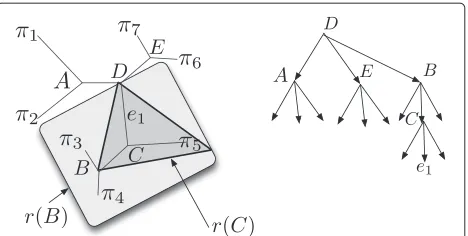
We direct the queries using a rooted ternary search tree structure (Figure 1). Each internal node vin our search tree corresponds to a pair: a contiguous regionr(v)of the
Figure 1A search tree.A phylogeny and a corresponding search tree. Internal nodes of the search tree correspond to subphylogenies: two, forr(B)andr(C), are indicated. Leaves of the search tree correspond to edges of the phylogeny.
phylogeny, and a nodes(v)within that region. Each leaf
v of the search tree corresponds to an edger(v) in the phylogeny. For an internal nodevof the search tree, its three children correspond to each of the threeti(r(v),s(v))
subtrees. If node queries are always correct, then ask-ing the node query(T,s(v),x)will identify which of the
ti(r(v),s(v))subtrees the taxonxbelongs in, and a
traver-sal through the search tree to a leaf will identify which edge ofTis the one where the new taxonxbelongs.
Quartet errors are common, which would lead to errors in this simple algorithm. To allow for their existence, we incorporate a random walk method: rather than requiring that we only move down the search tree, we allow for the possibility that we backtrack. Specifically, at nodevin the search tree, we ask up to two node queries, corresponding to the boundaries of the current region of the phylogeny; if either of them gives evidence that the new taxon does not belong inr(v), we move to the parent of the current node in the search tree. If they are consistent withr(v), we ask a node query at(T,s(v),x), and that identifies which child ofvwe go to in the search tree.
Assuming that there is a bias toward going in the correct direction, and that query errors are independent, there is a steady push toward winding up at the correct node in the search tree: the random walk has positive drift, so it moves at an expected constant speed toward the true goal. If we are at a leaf, then we continue the algorithm, but each query that pushes us to stay at the chosen leaf increments a counter and each query that pushes us away from the leaf decrements the counter. We only move up from the leaf in the search tree when the counter has value zero.
new taxon is placed in the correct location with 1−o(1/n) probability.
Further, the algorithm runs inO(nlogn)runtime both in expectation and with high probability, since if we use a uniformly-chosen permutation, the search tree remains balanced with high probability. For full details, we refer the reader to our original paper [3].
One key technical detail is that we must ensure that the algorithm never runs out of queries to ask: each new quar-tet query must be distinct from all the previous ones. This is achieved by first constructing a “guide tree” phylogeny for a large enough subset of taxa. We then build a search tree for the guide tree and insert the remaining taxa into the search tree in random order. Additionally, we guaran-tee that the guide tree is accurate; in our original paper [3], we show this holds with probability 1−o(1)when the tree is the maximum quartet consistency tree of a set of log logntaxa.
In practice, larger guide trees are more likely to be accu-rate, thus improving the accuracy of the whole algorithm. For guide trees reconstructed using Neighbour Joining, we recommend using guide trees oncn1/3 taxa, for a small
enough value of c. This ensures that the time spent on reconstructing the guide tree is negligible compared to the running time of the main algorithm, as reconstructing the guide tree takes linear time.
Quartets
There are several ways of inferring the subtopology of a phylogeny corresponding to just four taxa,{W,X,Y,Z}. Perhaps the most natural is to compute an estimatedi,j
for the pairwise distance between all pairs from the four taxa, and then use ordinary least-squares estimation to compute the additive distance matrix closest to the inferred distance matrix, and return the quartet corre-sponding to the structure of that distance matrix. This is equivalent to comparingdW,X +dY,Z,dW,Y + dX,Z and dW,Z + dX,Y; if the smallest of the three values is the
first, we infer topology WX|YZ, if the second is small-est, we inferWY|XZ, and if the third is smallest, we infer
WZ|XY.
In practice, quartet topology estimation is notably chal-lenging. If the middle edge of the true quartet is short and the other four edges are long, uncertainty in estimating the four pairwise distances that cross the middle edge may dominate the actual length of the edge, making quartets whose true topologies are hard to infer. In a balanced phy-logeny where each edge is of constant length, a constant fraction of all quartets will have this problem.
As the traversal of the search tree progresses, the region of the tree that is under search shrinks, so quartets will correspond to smaller total lengths, meaning that the frac-tion of the total edge length of the quartet that is falling on the middle edge will increase; this suggests that quartet
errors may be rarer at lower levels of the search tree, as we discuss in the next section.
Other methods to infer quartets include the ordinal quartet method [6], weighted least-squares, and using maximum-likelihood methods. Our algorithm assumes all of these methods operate inO(1)time on a quartet, as our runtime does not depend on the phylogenetic source data, whether it is biological sequences, an alignment of such sequences, or microsatellite or other data with phyloge-netic signal. Indeed, our algorithm works in any scenario in which quartets can be successful with sufficiently high probability.
Other fast phylogenetic algorithms
The tree that optimizes the Neighbour Joining objec-tive is not known to be producible in o(n3) time in worst case. However, heuristics for this problem have been a subject of much research; Wheeler [7] gives an exact Neighbour Joining implementation, using clever data structures, which seems to require sub-cubic run-time in typical instances, while other authors [8,9] have given heuristic algorithms that operate in O(n2) time and that typically run inO(n√nlogn) time, but do not guarantee to optimize the Neighbour Joining objective. The UPGMA objective can be optimized inO(n2) run-time [2]. Desper and Gascuel [10] give a heuristic for the minimum-evolution objective that runs inO(n2logn)for most trees.
Erd¨os and co-authors have shown that the short quar-tet method can solve the phylogenetic inference problem inO(n2polylogn)time on most trees, on sufficiently long sequences, and assuming standard Markov models of evo-lution [1]; Cs˝ur¨os gives a practical algorithm that has sim-ilar guarantees [11]. There is also a developing literature on sequence length requirements for various phylogeny algorithms, and on identifying parts of the tree that can be reconstructed from a given alignment [12].
Sub-quadratic phylogeny methods are quite rare: King
et al.[13] give anO(n2 log logn
logn )-time algorithm that is not
widely used. When data are error free, our algorithm is not the firstO(nlogn) algorithm, as Kannanet al.[14] have given a rooted-triple algorithm with this runtime.
A more distressing lower bound, also in the same paper of King et al., shows that any distance-based method requires(logn2n)time to reconstruct correct trees where a simple Markov model of evolution is assumed, and dis-tances are inferred using standard techniques, assuming sequences are quite short.
Quality measures
same taxa, the Robinson-Foulds quality is the fraction of the non-trivial splits (internal edges) of one topology found in the other. The quartet quality (see,e.g., [15,16]) is the fraction of then4quartets that have the same result in both tree topologies. The Robinson-Foulds measure is fragile: a single misplaced taxon can ruin all of the splits of the tree. By contrast, the quartet distance is robust to indi-vidual errors: even a randomly-placed taxon will probably have the correct topology in one-third of its quartets, as there are only three choices for the topology.
Extensions to improve performance
Our basic algorithm suffers from a number of issues that greatly limit its practical performance. The accuracy of quartet inference is often very low, particularly for quar-tets asked at the top nodes of the search tree; when running the basic algorithm on the COG840 data set [9], we found that only 66% of quartets were inferred cor-rectly, with only 50% of correct inferences at the root of the search tree. In practice, quartet inference errors are also not independent, which may cause the random walk to “drift away” from the optimal placement of the taxon either to an incorrect place or to drift in the higher nodes of the search tree, leading to reduced coverage. In this section, we discuss a number of improvements to the algorithm to address these problems.
Quartet weights
The basic algorithm considers all quartets to be equally reliable. In practice, some quartets are more likely to be correct than others. Assigning equal weight to all quar-tets can lead to serious errors due to many erroneous quartets. Various quartet phylogeny algorithms estimate the reliability of inferred quartet topologies based on their likelihood scores [17-19] or distances between taxa (e.g.[20]).
We assign quartet weights based on the inferred mid-dle edge length normalized by the the sum of all the edge lengths of the quartet. For a quartet with external edge lengthsa,b,c,dand an internal edge lengthe, this becomes
w=e/(a+b+c+d+e). The intuition behind this idea is that if the inferred middle edge is long compared to the distances between taxa, then the inferred quartet topology is less likely to have arisen from errors in the distance esti-mates. The edge lengths are inferred using ordinary least squares, which was dictated by the speed of this approach. We note that this weighing scheme is somewhat dif-ferent than other commonly used schemes. Most quartet algorithms use likelihood weights as opposed to distances. Sniret al.[20] use the topological diameter of the quartet in a preliminary tree constructed by Neighbor Joining.
To incorporate the reliability information into the algo-rithm, we ask kquartet queries at each node query and vote according to the weights. We have tested two voting
schemes. In the weighted-majority scheme, the weights of each quartet pointing in the same direction are added and the direction with the highest vote total is chosen. In the winner-takes-all scheme, the direction is chosen accord-ing to the quartet query with the highest weight from thek
used. We found that the weighted-majority voting scheme results in better accuracy according to the quartet mea-sure, while the winner-takes-all approach yields higher accuracy according to the Robinson-Foulds measure (see the experiments section).
Biased choice of quartets
Many authors have suggested that large distances between taxa lower the accuracy of quartet inference [1,20]. While our algorithm is forced to ask long quartets at the top of the search tree, biasing the choice towards shorter quar-tets at the lower nodes of the search tree might reduce the number of unreliable quartets. When asking a node query at nodeyof the search tree, we require that the represen-tatives for each quartet query are contained in a subtree
r(y∗) associated with a node y∗ that is at mostd levels aboveyin the search tree. The valuedis chosen for each
yso that the number of possible representatives in each direction is at least 20. Note that this does not change the behaviour of the algorithm in the upper parts of the search tree, since the subtrees associated with the upper nodes are typically much larger. This heuristic is used in all experiments.
Multiple insertion rounds
Due to the ambiguity in inferred quartets, the random walk will often terminate at an internal node in the search tree, resulting in the taxon not being inserted into the phy-logeny. After the algorithm has attempted to insert every taxon in the search tree, we try reinserting the taxa that did not make it to a leaf in the first round. We have two such rounds of reinsertions.
Confidence threshold
Incorrectly inserting a taxon can prevent subsequent taxa from being inserted in the correct place. To mitigate this, we only add a new taxon to the phylogeny if it has spent more than the=30 last steps of the random walk at the current leaf.
Repeating the random walk
To improve our confidence in the placement of new taxa, we ran the random walk two times for each inserted taxon. The taxon was then inserted only if both walks terminated at the same leaf node.
As-yet unsuccessful ideas
extensions here to document the challenging process of improving a theoretical prototype into a useful method for phylogenetic inference.
Increasing the number of quartet queries without weighting them improved the fraction of taxa inserted, but decreased the accuracy. This emphasizes the need for weighing quartets.
We have tried various other methods of estimating the reliability of quartets. Earlier work on short quartet meth-ods [1,20] suggested using the diameter of the quartet for estimating its reliability. Contrary to our expectations, this approach did not provide satisfactory results. This may be because the diameter of the inferred quartets varies widely between different levels of the search tree. Quar-tets inferred near the root of the search tree tend to have large distances between taxa, whereas quartets inferred in the deeper parts of the search tree are shorter since they only span a small fraction of the overall tree. Using least squares fit of the distances to the quartet topology to weigh the quartets also did not seem to improve the accu-racy of node queries. Using weighted least squares did not improve the accuracy of quartet inferences.
We have tried to find a good starting point for the ran-dom walk by using profile search. For each of the top logn nodes of the search tree, we constructed a profile of sequences in the subtree associated with that search tree node. Before starting the random walk for the new taxon, we aligned its sequence to each profile and started the random walk from the subtree whose profile gave the highest alignment score. This did not have a significant effect on the results, perhaps because of the large diversity of sequences within the top subtrees.
Experiments
We have evaluated our algorithm on several simulated data sets. The simulated data sets are taken from Price
et al.[9] who used them to evaluate their heuristic pro-gram FastTree, which hasO(n1.5logn)runtime on typical instances. These data sets were generated by taking real protein alignments and their maximum likelihood trees, and then simulating evolution of sites along that phylo-genetic tree, treating it as ground truth. The evolutionary rates varied across sites.
In most experiments, the initial guide tree was created using Neighbor Joining on a randomly chosen subset of 200 taxa. For protein sequences, our algorithm uses Score-Dist [21] to estimate distances. FastTree uses a similar, but distinct, distance measure [9]. For nucleotide sequences, both algorithms use the standard log-corrected Jukes-Cantor distance. For a fair comparison of accuracies and running times, we only compare against the initial Neigh-bor Joining phase of FastTree. FastTree then performs nearest neighbour interchanges to improve the quality of the resultant tree, which takes up much of its runtime;
we have not incorporated these into our algorithm, either, so we compare against the initial phase of FastTree for consistency of comparison.
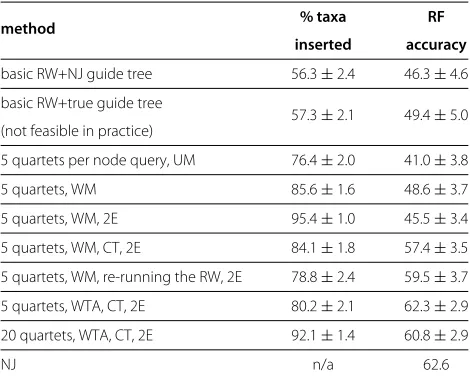
In the first experiment, we assessed how various improvements discussed in the previous section changed the performance of the algorithm. We ran each version of the algorithm 100 times on the COG840 data set. The results are given in Table 1.
Overall, the improvements to the algorithm boosted the RF accuracy from 46% to around 60%, and increased the proportion of inserted taxa from 56% to 82-95%, depend-ing on the settdepend-ings. The biggest gains were achieved by introducing quartet weights and a confidence thresh-old. Multiple rounds of insertions increased the coverage of the taxa set. Increasing the number of quartets and running the random walk twice increased the accuracy, but at the cost of increased running time. It should be noted, however, that the increase in running time was not directly proportional to the number of quartets per query: one run of the algorithm for 5 quartets per query takes around 11 seconds, compared to just under 20 seconds for 20 quartets per query. This is because the running time is dominated by computing the distances, which we save and reuse in the subsequent quartet queries.
In general, WTA voting tended to produce trees with higher RF accuracy than weighted-majority voting. In
Table 1 The effect of heuristics on the performance of the algorithm
method % taxa RF
inserted accuracy
basic RW+NJ guide tree 56.3±2.4 46.3±4.6
basic RW+true guide tree
57.3±2.1 49.4±5.0 (not feasible in practice)
5 quartets per node query, UM 76.4±2.0 41.0±3.8
5 quartets, WM 85.6±1.6 48.6±3.7
5 quartets, WM, 2E 95.4±1.0 45.5±3.4
5 quartets, WM, CT, 2E 84.1±1.8 57.4±3.5
5 quartets, WM, re-running the RW, 2E 78.8±2.4 59.5±3.7
5 quartets, WTA, CT, 2E 80.2±2.1 62.3±2.9
20 quartets, WTA, CT, 2E 92.1±1.4 60.8±2.9
NJ n/a 62.6
contrast, weighted-majority voting resulted in higher quartet accuracy, as we shall see in the next experiment.
We see that there is a trade-off between the proportion of the inserted taxa and the RF accuracy. This is not sur-prising since incorrectly inserting a hard-to-place taxon into the phylogeny can cause many splits to be incorrect.
The accuracy of guide trees was considerably lower than that of the NJ tree for the full data set. To investigate the impact of errors in the guide tree on the accuracy of the algorithm, we ran the algorithm starting from a guide tree consistent with the true phylogeny. Contrary to our expec-tations, errors in the guide tree have little impact on the accuracy; substituting the NJ guide tree with the true one improved the accuracy by 2 to 3 percent, depending on the version of the algorithm.
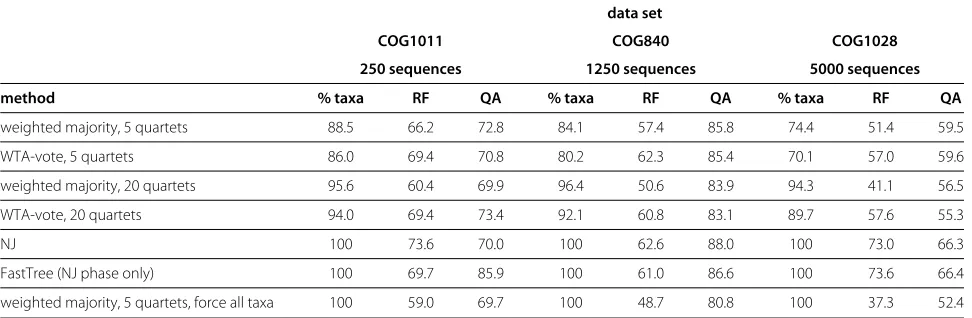
In the second experiment, we evaluated the algorithm on three unrelated data sets having 250, 1250, and 5000 taxa, respectively. For each data set, we ran the algorithm in four different configurations, using two voting schemes and varying the number of quartet queries per node query. The size of the guide tree was 200 except for the 250 taxon data set, where it was set to 100. The results are shown in Table 2.
We see that the weighted-majority voting scheme tends to produce trees with higher quartet accuracy, whereas the winner-takes-all voting scheme yields higher RF accu-racy. In general, we see that the two measures are very different: an algorithm can have relatively good perfor-mance according to one while being considerably worse in the other, though the difference between voting schemes tends to be more pronounced for RF accuracy. In most cases, the accuracy of the random walk algorithm is lower than the accuracy of Neighbor Joining.
In the next experiment, we measured the running time of our algorithm on large data sets. For this experiment,
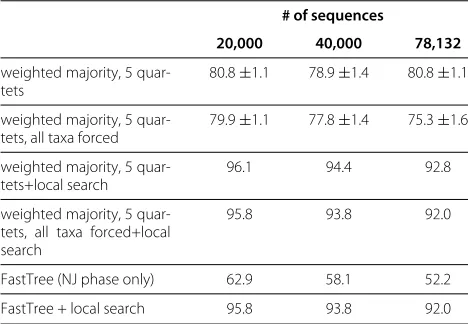
we took a large simulated nucleotide alignment based on a real 16S alignment and compared the runtimes of the initial phase of FastTree and our algorithm. We ran the algorithms on the full alignment and on two smaller align-ments created by randomly sampling 20000 and 40000 sequences from the large alignment. All running times were measured on a standard desktop computer with an AMD 7750 Dual Core 2712MHz processor and 4 GB RAM. In all cases, our algorithm runs faster, with the relative speedup increasing with the size of the data set; Table 3 shows the running times. Table 4 shows the accu-racies obtained in these runs. In contrast to the previous experiment, our algorithm achieves higher accuracy than FastTree.
On the data set with 20000 sequences, the QuickTree implementation of Neighbour Joining [22] took over 360 minutes to complete and produced a tree almost identical to the one produced by FastTree, with over 99% of splits agreeing between the two trees. We were not able to run Neighbour Joining on larger data sets due to QuickTree’s memory consumption.
To investigate the differing relative performance of our algorithm and FastTree on different data sets, we gen-erated more data sets under varying conditions. When designing this series of experiments, we wanted to test two hypotheses: first, that our algorithm is more accurate than FastTree when sequences of sufficient length are avail-able; second, that our algorithm is more accurate when the branch lengths are short. Both of these are consistent with the differences between the COG data sets used in the first experiment and the 16S data sets used in the second experiment.
We simulated 10 trees on 20000 taxa from the pure-birth process. We then multiplied the length of each branch by a factor chosen uniformly at random from
Table 2 Comparison of different algorithms
data set
COG1011 COG840 COG1028
250 sequences 1250 sequences 5000 sequences
method % taxa RF QA % taxa RF QA % taxa RF QA
weighted majority, 5 quartets 88.5 66.2 72.8 84.1 57.4 85.8 74.4 51.4 59.5
WTA-vote, 5 quartets 86.0 69.4 70.8 80.2 62.3 85.4 70.1 57.0 59.6
weighted majority, 20 quartets 95.6 60.4 69.9 96.4 50.6 83.9 94.3 41.1 56.5
WTA-vote, 20 quartets 94.0 69.4 73.4 92.1 60.8 83.1 89.7 57.6 55.3
NJ 100 73.6 70.0 100 62.6 88.0 100 73.0 66.3
FastTree (NJ phase only) 100 69.7 85.9 100 61.0 86.6 100 73.6 66.4
weighted majority, 5 quartets, force all taxa 100 59.0 69.7 100 48.7 80.8 100 37.3 52.4
Table 3 Running times on large data sets
# of sequences
20,000 40,000 78,132
weighted majority, 5 quartets 6m 41s 15m 52s 34m
FastTree (NJ phase only) 13m 52s 41m 15s 116m
Running times of the random walk algorithm compared to FastTree. We used the huge.1 alignment from the original FastTree paper [9]. Smaller data sets were created by choosing a random subset of sequences from the large alignment. Our algorithm runs 2.1 to 3.4 times faster than FastTree on these very large data sets.
interval [0.5,2] to deviate the trees from ultrametricity. This methodology follows the previous work of Liuet al.
[23]. We then scaled the branch lengths by several con-stant factors. For each choice of tree and scaling factor, we generated nucleotide alignments whose length var-ied between 250 and 4000 positions. The sequences were simulated from the Jukes-Cantor model, with variable evolutionary rates across sites drawn from the exponential distribution. No indels were introduced in the simulation. We usedrose[24] to generate the sequences andr8s[25] to generate the trees.
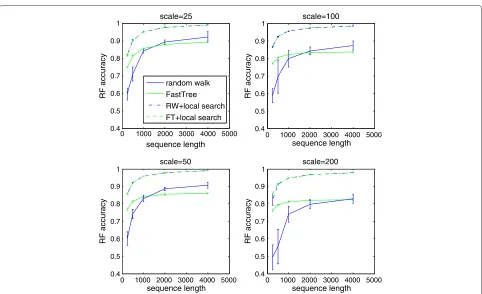
We see that the accuracy of both algorithms improves as more sequence data is available. However, the accu-racy of the random walk algorithm improves faster than that of FastTree as sequences get longer. For trees with shorter branches, the advantage of the random walk algo-rithm is visible for shorter sequence lengths. Even for long sequences, the advantage of the random walk algo-rithm over FastTree was not as large as on the simulated 16S data set. Figure 2 shows the performance of the
Table 4 Accuracies on large data sets
# of sequences
20,000 40,000 78,132
weighted majority, 5 quar-tets
80.8±1.1 78.9±1.4 80.8±1.1
weighted majority, 5 quar-tets, all taxa forced
79.9±1.1 77.8±1.4 75.3±1.6
weighted majority, 5 quar-tets+local search
96.1 94.4 92.8
weighted majority, 5 quar-tets, all taxa forced+local search
95.8 93.8 92.0
FastTree (NJ phase only) 62.9 58.1 52.2
FastTree + local search 95.8 93.8 92.0
Robinson-Foulds accuracies of FastTree and the random walk algorithm for the huge.1 data set [9]. The figures for the random walk algorithm represent the average accuracy over 10 runs of the algorithm, together with empirical standard deviations. We used a confidence threshold, with two additional rounds of insertions. The average taxon coverage for weighted majority was 98.6, 98.6, and 98.0 per cent for the 20,000, 40,000, and 78,132 taxa alignments, respectively. After applying local search, the variance between the runs of the random walk algorithm is negligible.
two algorithms in various conditions. The average taxon coverage for random walk trees was 97.3%, with only three experimental settings yielding coverage below 95%. Unsurprisingly, coverage was lower for short sequences and long branches.
The impact of local search
FastTree uses local search to improve the accuracy of the Neighbour Joining tree. The improvement can be quite dramatic: for the huge.1.20000 alignment, local search improved the accuracy from 62% to 96%.
We ran FastTree’s local search procedure starting from trees obtained from our algorithm and the Neighbour Joining phase of FastTree for the tree sets used in the previous experiment. We inserted the remaining taxa into the random walk trees by running the random walk fol-lowed by a simple descent down the search tree. We then ran local search on the resultant trees. The results are shown in Figure 2. Despite huge differences in the accuracy of starting trees for some data sets, the trees improved by local search have very similar accuracies. This suggests that our algorithm can be combined with the local search phase of FastTree to produce trees that are very similar to FastTree, in less runtime. We also obtained similar results for the huge.1 data set (see Table 4).
The quality of the starting tree did not have much impact on the running time of the local search procedure. For all datasets we investigated, the differences between the two runs of local search were less than 15% of the over-all running time. Table 5 shows the running times for the huge.1 data set.
Trees produced by running local search on incomplete random walk trees (without forcing) had very similar accuracies compared to those obtained from the full taxa set; for all data sets, the difference was at most 3%. In most cases, the differences in accuracy were less than 1%. Before local search, the loss of accuracy was more substantial, with the RF accuracy dropping by up to 10% when the remaining taxa were inserted into the random walk tree. In most cases, this negative effect is much more minor, averaging less than 2%.
Aggregating information from many trees
Our random walk algorithm is not limited to quartets inferred from aligned sequences. It can also be used with other types of quartet queries,e.g.evaluating how many times a given quartet topology appears in a collection of phylogenetic trees. We investigated how our algorithm can be used to aggregate conflicting information from many phylogenetic analyses to create a single, more accu-rate tree. Such algorithms are known assupertree methods
orconsensus methods.
0 1000 2000 3000 4000 5000 0.4
0.5 0.6 0.7 0.8 0.9 1
sequence length
RF accuracy
scale=25
0 1000 2000 3000 4000 5000 0.4
0.5 0.6 0.7 0.8 0.9
1 scale=100
sequence length
RF accuracy
0 1000 2000 3000 4000 5000 0.4
0.5 0.6 0.7 0.8 0.9 1
scale=50
sequence length
RF accuracy
0 1000 2000 3000 4000 5000 0.4
0.5 0.6 0.7 0.8 0.9 1
scale=200
sequence length
RF accuracy
random walk FastTree RW+local search FT+local search
Figure 2Comparison of the random walk algorithm and FastTree.The performance of the random walk algorithm and FastTree as a function of the length of the sequences. The four graphs represent the performance on 10 tree topologies with branch lengths scaled by constant factors 25,50,100, and 200. In all cases, the random walk algorithm compares increasingly favourably with FastTree as the sequence length increases. After applying local search, the differences between the average accuracies of the two methods are less than 1% for all the settings except the shortest sequences in the data set scaled by 200, where trees obtained from FastTree are 3.8% more accurate. The average taxon coverage for random walk trees was 97.3%, with only three experimental settings yielding coverage below 95%. Missing taxa were inserted into random walk trees before applying local search.
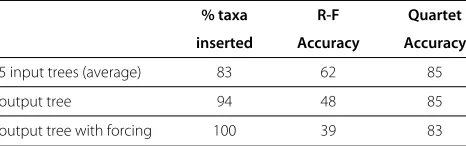
distinct trees. We then ran the algorithm for the sixth time, this time answering quartet queries based on the most common quartet topology found in the five trees constructed in the previous phase. The quartets were weighted by the square root of the proportion of the input trees that contained the majority quartet.
The results are shown in Table 6. Somewhat surpris-ingly, aggregating several inferred trees did not improve the accuracy, but the coverage was increased from 83% to 94%. The quartet accuracy remained roughly the same, while the Robinson-Foulds accuracy dropped. The quar-tet accuracy remained the same when the remaining taxa
were forced into the tree by running the random walk and inserting the taxon at the first leaf that was reached. However, the Robinson-Foulds accuracy dropped further as a result of inserting those remaining taxa.
One problem with using our algorithm for amalgamat-ing trees on different taxa sets is that many quartets needed by our algorithm are not contained in all the input trees. For example, if all the input trees have coverage of 83%, the probability that an input tree contains a random quartet is roughly 0.834 ≈ 0.5, meaning that most quar-tets will be decided based on just 2 or 3 votes, and some of them might not appear in any of the input trees, which
Table 5 Running times on large data sets
# of sequences
20,000 40,000 78,132
weighted majority, 5 quartets+local search 20m 40s (27m 21s) 41m 33s (57m 25s) 79m (113m)
FastTree + local search 21m 27s (35m 19s) 42m 29s (83m 44s) 80m (196m)
Table 6 Aggregating multiple trees
% taxa R-F Quartet
inserted Accuracy Accuracy
5 input trees (average) 83 62 85
output tree 94 48 85
output tree with forcing 100 39 83
The performance of the random walk algorithm as a supertree method. We generated 5 input trees by running the random walk five times independently on the COG840 alignment. We then ran the random walk algorithm with quartet queries evaluated by taking the induced quartet in each tree, and choosing the most common one. The guide tree was chosen as the subtree induced by 200 randomly chosen taxa on one of the 5 input trees.
means that another quartet query has to be asked. This problem will be more challenging for datasets where input trees have even lower coverage.
In the second experiment, we generated 100 bootstrap samples from the COG840 alignment and ran Neighbour Joining 100 times. We then ran the random walk algo-rithm with the majority vote quartet oracle, as in the previous experiment. The resulting tree contained over 98% of the taxa and had quartet accuracy of 94%, com-pared to the average accuracy of 88% for the input trees. The Robinson Foulds acccuracy dropped from 62% to 50%.
These experiments show that our random walk algo-rithm may be potentially useful in aggregating informa-tion from multiple trees. However, the trees obtained from the algorithm tend to sacrifice Robinson-Foulds accuracy to increase quartet accuracy or coverage, which may be considered a drawback of the method. If the input trees have low coverage, many quartets asked by the algorithm do not appear in any of the trees, which may harm speed and accuracy. We leave the solution to these two problems for future work.
Conclusions
We have presented our work in progress to move our extremely fast quartet phylogeny algorithm from being a theoretical result to a practical algorithm for inferring trees. A variety of sensible heuristics, including weighting quartets by our confidence in them, using multiple quar-tet queries per insertion, and using multiple rounds of insertions, can increase both coverage and accuracy sub-stantially over our original implementation. If we force all taxa into the tree and use local search, accuracy is com-parable to existing programs. At present, our algorithm is close to being competitive with Neighbour Joining, while being much faster. For very large data sets, it may be suggested as one of few heuristics for the task.
There is still much future work: in particular, we are currently limited in part due to bad quartet inferences. If there were a way to bias our quartet choice toward
high-quality quartets, this could substantially improve our quality. Also, it would be helpful if, after each round of insertions of taxa, we could remove taxa that are likely in a poor placement, and re-insert them. Finally, we are inves-tigating a profiling technique, as described in the improve-ments section, to pre-identify a good starting search node for each new taxon, instead of the search tree root, where we predict errors are more common.
It remains to be seen whether a very fast quartet-based phylogeny method of our sort can in fact be competitive with the best algorithms. However, over the years, a num-ber of other methods have grown up trading off speed with accuracy. We see evidence that that speed can be pushed to the theoretical limit, and that good trees can result from such procedures.
Competing interests
The authors declare that they have no competing interests.
Authors’ contributions
JT and DGB jointly conceived the approach. JT designed and implemented most of the algorithms and performed most of the experiments. YH implemented some of the algorithms and performed some of the experiments. DGB directed the project. All authors wrote parts of the manuscript. All authors read and approved the manuscript.
Acknowledgements
Funding for this research came from the Natural Sciences and Engineering Research Council of Canada, through a Discovery Grant to DGB and through an Undergraduate Student Research Assistant award to YH; from the Province of Ontario through an Early Researcher Award to DGB; and from a Cheriton Scholarship to JT.
Received: 1 February 2012 Accepted: 4 November 2012 Published: 26 November 2012
References
1. Erd ¨os PL, Steel MA, Sz´ekely LA, Warnow T:A Few Logs Suffice to Build (almost) All Trees: Part II.Theor. Comput. Sci1999,221(1-2):77–118. 2. Gronau I, Moran S:Optimal implementations of UPGMA and other
common clustering algorithms.Inf. Process. Lett2007,104(6):205–210. 3. Brown DG, Truszkowski J:Fast error-tolerant quartet phylogeny
algorithms.InProceedings of CPM 2011: Palermo, Italy;LNCS 6661:147–161.
4. Brown DG, Truszkowski J:Towards a practicalO(nlogn)phylogeny algorithm .InProceedings of WABI 2011. Saarbr ¨ucken, Germany;LNCS 6833:14–25.
5. Karp RM, Kleinberg R:Noisy binary search and its applications.In Proceedings of SODA 2007. USA: New Orleans, Louisiana:881–890. 6. Kearney PE:The ordinal quartet method.InProceedings of RECOMB
1998. New York, New York, USA :125–134.
7. Wheeler TJ:Large-Scale Neighbor-Joining with NINJA.InProceedings of WABI 2009. Philadelphia, Pennsylvania, USA;LNCS5724:375–389. 8. Elias I, Lagergren J:Fast Neighbor Joining.InProceedings of ICALP 2005.
Lisbon, Portugal;LNCS3580:1263–1274.
9. Price MN, Dehal PS, Arkin AP:FastTree: Computing Large Minimum Evolution Trees with Profiles instead of a Distance Matrix.Mol Biol Evol2009,26(7):1641–1650.
10. Desper R, Gascuel O:Fast and Accurate Phylogeny Reconstruction Algorithms Based on the Minimum-Evolution Principle.J Comp Biol 2002,9(5):687–706.
11. Cs ˝ur ¨os M:Fast Recovery of Evolutionary Trees with Thousands of Nodes.J Comp Biol2002,9(2):277–297.
13. King V, Zhang L, Zhou Y:On the complexity of distance-based evolutionary tree reconstruction.InProceedings of SODA 2003. Baltimore, Maryland, USA:444–453.
14. Kannan SK, Lawler EL, Warnow TJ:Determining the Evolutionary Tree Using Experiments.J Algorithms1996,21:26–50.
15. Bryant D, Tsang J, Kearney PE, Li M:Computing the quartet distance between evolutionary trees.InProceedings of SODA 2000. San Francisco, California, USA:285–286.
16. Brodal GS, Fagerberg R, Pedersen CNS:Computing the Quartet Distance between Evolutionary Trees in Time O(n log n).Algorithmica 2003,38(2):377–395.
17. Strimmer K, von Haeseler, A:Quartet puzzling: a quartet
maximum-likelihood method for reconstructing tree topologies. Mol Biol Evol1996,13(7):964–969.
18. Strimmer K, Goldman N, von Haeseler A:Bayesian Probabilities and Quartet Puzzling.Mol Biol Evol1996,14(2):210–211.
19. Ranwez V, Gascuel O:Quartet-Based Phylogenetic Inference: Improvements and Limits.Mol Biol Evol2001,18(6):1103–1116. 20. Snir S, Warnow T, Rao S:Short Quartet Puzzling: A New Quartet-Based
Phylogeny Reconstruction Algorithm.J Comp Biol2008,15:91–103. 21. Sonnhammer ELL, Hollich V:Scoredist: A simple and robust protein
sequence distance estimator.BMC Bioinf2005,6:108.
22. Howe KL, Bateman A, Durbin R:QuickTree: building huge Neighbour Joining trees of protein sequences.Bioinformatics2002,
18(11):1546–1547.
23. Liu K, Raghavan S, Nelesen S, Linder C, Warnow T:Rapid and accurate large-scale coestimation of sequence alignments and phylogenetic trees.Science2009,324(5934):1561–1564.
24. Stoye J, Evers D, Meyer F:Rose: generating sequence families. Bioinformatics1998,14(2):157–163.
25. Sanderson MJ:r8s: inferring absolute rates of molecular evolution, divergence times in the absence of a molecular clock.Bioinformatics 2003,19(2):301-302.
doi:10.1186/1748-7188-7-32
Cite this article as: Truszkowski et al.: Towards a practicalO(nlogn) phylogeny algorithm.Algorithms for Molecular Biology20127:32.
Submit your next manuscript to BioMed Central and take full advantage of:
• Convenient online submission
• Thorough peer review
• No space constraints or color figure charges
• Immediate publication on acceptance
• Inclusion in PubMed, CAS, Scopus and Google Scholar
• Research which is freely available for redistribution