27 |
P a g e
HYBRID METHOD FOR MOVING OBJECT TRACKING
WITHIN A VIDEO SEQUENCE & OCCLUSION
HANDLING
1
Gaurav.R.Desai ,
2Prof.K.R.Desai
1,2
Electronics &Telecommunication Engineering, Shivaji University(India)
ABSTRACT
This paper presents a implementation of an object tracking system in a video sequence. The tracking system uses a
combination of camshift and kalman filter algorithm. The main steps in video analysis are two: detection interesting
moving objects and tracking of such objects from frame to frame. Most of the tracking algorithms use pre-specified
methods for processing .The main problem in tracking a moving object is occlusion. Proposed method gives better
performance in case of occlusion, by using a combination of camshift and kalman filter algorithm. When the moving
object is a large area blocked, the velocity of moving object is applied linear prediction to kalman filter tracking.
Also in the case where the camera is moving, we can quickly find the target by using this tracking system.
Keywords: Camshift, Kalman Filter, Tracking System, Occlusion
I. INTRODUCTION
Object tracking is an important task within the field of computer vision. The proliferation of high-powered
computers, the availability of high quality and inexpensive video cameras, and the increasing need for automated
video analysis has generated a great deal of interest in object tracking algorithms [1].The object tracking (person,
face, hand, glass, and car) is widely used in the tasks of automobile driver assistance, vehicle navigation, robotics,
human-computer interaction, video surveillance, biometric, video games and industrial automation and security.
Most of these applications require reliable object tracking techniques. In a tracking scenario, an object can be
defined as anything that is of interest for further analysis. For instance, boats on the sea, fish inside an aquarium,
vehicles on a road, planes in the air, people walking on a road, or bubbles in the water are a set of objects that may
be important to track in a specific domain [5]. In its simplest form, tracking can be defined as “the problem of
estimating the trajectory of an object in the image plane as it moves around a scene”. In other words, a tracker
assigns consistent labels to the tracked objects in different frames of a video. Additionally, depending on the
tracking domain, a tracker can also provide object-centric information, such as orientation, area, or shape of an
object.
One can simplify tracking by imposing constraints on the motion or appearance of objects. For example, almost all
tracking algorithms assume that the object motion is smooth with no abrupt changes [9]. One can further constrain
28 |
P a g e
about the number and the size of objects, or the object appearance and shape, can also be used to simplify the
problem.
There are a lot of object tracking methods available which has advantages along with their disadvantages.
Depending upon our application requirements we can use them for object tracking. “Meanshift algorithm” with
quickly matching mode is widely used in object tracking on the basis of the estimation theory of nonparametric
kernel probability density. Fukunaga et al proposed the mean shift algorithm [11] and applied to pattern recognition.
“Meanshift” is an efficient pattern matching algorithm with no parameter estimation, and can be combined with other algorithms. It uses the kernel function histogram model of the target object. Comaniciu applied the mean shift
algorithm [12] to object tracking. But the mean shift algorithm is not able to update the object model in the process
of tracking, which will result in inaccurate scale locating and even object losing while object's scale varies
obviously. Camshift (continuous adaptive of mean shift) algorithm is proposed by Bradski [13] in order to solve
such problems. Richard, John and Jesse [16] Track a Robust Real Time non-rigid objects based on color
thresholding, user selected region of the initial frames using K-means Algorithm. But they were not combining other
features of the video such as edges and texture together with color information. Wang Jiangtao, Yang Jingyu
proposed “Object Tracking Based on Kalman-MeanShift in Occlusions” [14] to solve the problem of occlusion“Mean-Shift” itself is a robust nonparametric technique for finding the mode (peak) in a probability
distribution. In Camshift, Mean-Shift algorithm is modified so that it can deal with dynamically changing color
probability distribution which is taken from the video frames. This algorithm can automatically adjust the window
size to fit the size of object changes in the image. It is effective to resolve the problem of inaccurate object tracking
due to the deformation of moving object.In view of the above it will be apparent that, there exists a need of “object
tracking system” that will overcomes the drawbacks of all above methods and provides a better performance with
occlusion handling. Proposed method is a hybrid method which uses combination of Camshift and Kalman filtering
for tracking a moving object within a video sequence.
II. CAMSHIFT ALGORITHM
2.1 Meansift Algorithm
The meanshift algorithm is a non-parametric method. It provides accurate localization and efficient matching
without expensive exhaustive search.The size of the window of search is fixed. It is an iterative process, that is it
firstly computes the meanshift value for the current point position, then move the point to its meanshift value as the
new position, then compute the meanshift until it fulfill certain condition. As the HSV colour space are better in
expressing the colour information, the RGB colour space of target area is converted to HSV space firstly. Secondly
we extract the component H and divided into m shares with each corresponding to a sub-characteristic value. Lastly
the whole target region can be characterized by these values. For each sub-feature, kernal-based density distribution
29 |
P a g e
To characterize the target, first a feature space is chosen [2]. The reference target model is represented by its pdf “q”
in the feature space. For example, the reference model can be chosen to be the color pdf of the target. Without loss
of generality, the target model can be considered as centered at the spatial location 0. In the subsequent frame, a
target candidate is defined at location y, and is characterized by the pdf p(y). Both pdfs are to be estimated from the
data.
Here similarity function is calculated which characterizes the similarity between the initial target model and target
candidates, Similarity measure methods commonly used include “Bhattacharyya coefficient”, “Fisher measure of information”, and “histogram intersection technique”[1]. Here proposed method uses “Bhattacharyya coefficient method” [2]. The sample estimate is given by;
Using (3) the distance between two distributions can be defined as;
The statistical measure d(y) is well suited for the task of target localization. If d(y) was smaller, the similarity
between the two color distribution histogram would be higher. In the search process we employ mean-shift iterations
to achieve the maximization of .
2.2 Camshift Algorithm
If we extended meanshift to a continuous image sequence, thus CamShift algorithm is formed. The basic idea of
camshift is to make all the video frames MeanShift operations. And the result of the previous frame is taken as the
initial value of the Search Window of the next frame’s MeanShift algorithm. If this iteration continues, target tracking can be achieved. The iteration steps list below [1]:
1: Set the image as the search area.
2: Initialize the size and location of the search window.
3: calculating the probability distribution of color in the search window.
30 |
P a g e
5: In the next frame of video images, initialize location and size of search window by (4) and Jump to (3) continue to run.
III.KALMAN FIRTER
The Kalman filter estimates the position of the object in each frame of the sequence. The input parameters of the
Kalman filter, respectively, the position of the object in the image at time k, the size of the object and the width and
length of the search window of the object which varies due to the mobility of the object during the sequence. These
parameters represent the state vector and measurement vector of the Kalman filter. The variable parameters of the
Kalman filter are the state vector and measurement vector [5]. The state vector is composed of the initial position,
width and length of the search window and the center of mass of the object at time tk the measurement vector of the
Kalman filter is composed of the initial position, length and width of the search window of the object at time tk.
Kalman filtering algorithm is that predict the most probable object location in the current frame according to the
results of targets tracking in the previous frame, then search target location in the neighbor area of the location. If
there is a target existing in the search area, continue to process the next frame [1]. The key of kalman filter is
prediction and update.
IV.SYSTEM OVERVIEW
31 |
P a g e
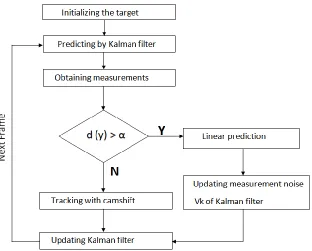
The tracking system uses a combination of Camshift and Kalman Filter. In experiment, the proposed method
assumes a threshold (α). Firstly Here similarity function is calculated which characterizes the similarity between the pdf of initial target model and target candidate using “Bhattacharyya coefficient method” [2]. Then from similarity
function the distance between these two distributions is calculated. If Bhattacharyya distance [d(y) >α], it is inferred
that the object has been occluded [1]. If the target appears occlusion, system track object by using the method of
linear prediction .Otherwise, system track object by using camshift. Linear Prediction is be utilized to search the
target location. Moving target can be divided into horizontal and vertical velocity components. Horizontal and
Vertical velocity components, these components are predicted using linear prediction technique [1].
V.NUMERICAL RESULTS & DISCUSSION
Figure 2: Object Tracking by Using Hybrid Method
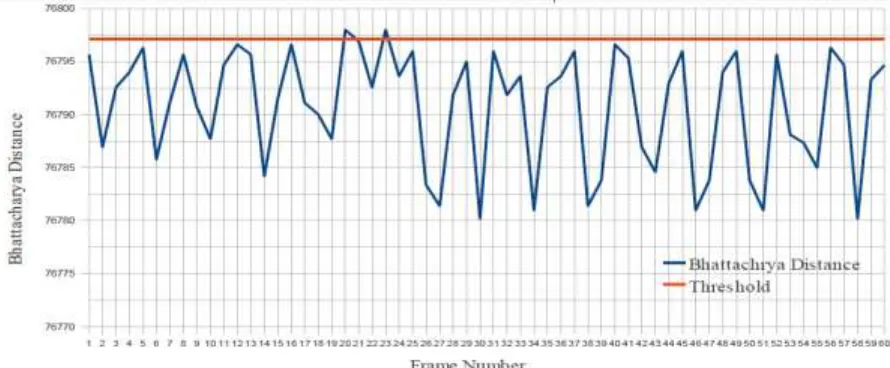
In our hybrid method of tracking an object we assign a threshold value α = 76797.114, when d(y) value exceeds
than α object is said to be occuled & it can not be tracked perfectly by Camshift method so in this case linear
prediction method is employed to track the object .In linear prediction method it calculates the horizontal & vertical
velocity component & based on that track the object .The different values of similarity function d(y) i.e nothing but
the bhattacharya distance is calculated for every frame as shown in the figure below,
32 |
P a g e
VI. CONCLUSION
Here we have made a hybrid method for tracking a moving object within a video sequence which is giving the better
performance than kalman filter or Camshift method alone .Also it handle the occlusion condition very well.
REFERENCES
[1] Shengluan Huang, Jingxin Hong “Moving Object Tracking System Based On Camshift And Kalman Filter”
IEEE 2011.
[2] Dorin Comaniciu, Visvanathan Ramesh, Peter Meer, “Kernel-based object tracking”. IEEE Transactions on
Pattern Analysis and Machine Intelligence, Vol, 25(5), 2003, pp: 564-577
[3]Zhiwei Wang, Fuping Yang “Object Tracking Algorithm Based on Camshift and Grey Prediction Model in
Occlusions” The 2nd International Conference on Computer Application and System Modeling (2012).
[4]HYEON KYU LEE, JIN H KIM. “An HMM-based threshold model approach for gesture recognition,” IEEE,
Pattern Analysis and Machine Intelligence, Vol 21(10), 1999 pp: 961-973
[5] AFEF SALHI, AMENI YENGUI JAMMOUSSI “Object tracking system using Camshift, Meanshift and
Kalman filter” World Academy of Science, Engineering and Technology 64 2012.
[6] P. Hidayatullah, H. Konik “CAMSHIFT Improvement on Multi-Hue and Multi-Object Tracking” 2011
International Conference on Electrical Engineering and Informatics 17-19 July 2011, Bandung, Indonesia.
[7] Huiyu Zhou, Yuan Yuan, Chunmei Shi “Object tracking using SIFT features and mean shift” Computer Vision
and Image Understanding 113 (2009) 345–352.
[8] John G. Allen, Richard Y. D. Xu, Jesse S. Jin “ Object Tracking Using CamShift Algorithm and Multiple
Quantized Feature Spaces” School of Information Technologies University of Sydney Madsen Building F09,
University of Sydney, NSW 2006.
[9] Alper Yilmaz, Omar Javed “Object Tracking: A Survey” ACM Comput. Surv. 38, 4, Article 13 (Dec. 2006), 45
pages.
[10] R.J. Francois “CAMSHIFT Tracker Design Experiments with Intel OpenCV and SAI” IMSC-04-423 °c 2004
ARJF Alexandre Institute for Robotics and Intelligent Systems University of Southern California July 2004.
[11] FUKUNAGA K; HOSTETLER L D. The estimation of the gradient of a density function, with applications in
pattern recognition, IEEE Transaction on Information Theory [J], 1975, PP: 32–40
[12] Comaniciu D; Meer P. Mean shift analysis and applications. IEEE Int. Conf. on Computer Vision[C], 1999,
PP: 1197-1203.
[13]BRADSKI R. Computer vision face tracking as a component of a perceptual user interface. Proceedings of
IEEE Workshop Applications of Computer Vision [J]. 1998, PP: 214-219.
[14] Wang Jiangtao, Yang Jingyu. “Object Tracking Based on Kalman-Mean Shift in Occlusions, “Journal of
System Simulation, Vol 19(18), 2007, pp: 4216-4220
[15] Wu Huimin, Zheng Xiaoshi, “Improved and efficient object tracking algorithm based on Camshift,” Computer