H.S. TALWAR\ R.C. NAGESWARA RAO' AND S.N. NIGAM
Received on 12 Dec., 2001
SUMMARY
215 on crop productivity in barley (Monteith 1965, Aungus and Wilson 1972), and soybean (Shaw and Weber 1967). The mechanical manipulation of horizontal leaves canopy to erect leaves and tailoring of canopy architecture resulted in higher crop photosynthetic rate in rice (Tanaka 1972). The dry matter production of many crops has been linked with light interception and radiation use efficiency (RUE) considered constant for a given crop species (Monteith
1977, Muchow and Sinclair 1994). RUE is critical in determining the productivity of pigeon pea under both well watered and moisture-deficit regimes (Nam et al. 1998).
However, in groundnut, very little work has been done to exploit variability in canopy geometry in the crop improvement. This could perhaps be due to the lack of
*Present address: 'Regional Research Station, Central Arid Zone Research Institute, Bangala Nagar, Bikaner 334004, Rajasthan 2Queensland Department of Primary Industries, 1.B. Petersen Research Station, Kingaroy, Q 4610, Australia.
INTRODUCTION
Plant and crop ecologists have long recognized the importance of canopy structure in crop productivity. Matching canopy size and duration to the seasonal moisture and irradiance pattern eitherthrough agronomic or genetic means is one of the main task of crop improvement. This enables the production in a target environment to be optimized (Monteith and Elston 1982). Orientation of leaves forming plant canopies plays a decisive role in the radiation penetration into the canopies, which influence the canopy photosynthesis and hence the crop productivity (Monsi et al. 1973, Mathews et al. 1988b). Various workers have reported the influence of canopy structure
Genetic Resources and Enhancement Program, International Crops Research Institute for the Semi-Arid Tropics (ICRISAT), Patancheru, 502 324, Andhra Pradesh.
Key words: Canopy structure, crop growth rate, extinction coefficient, groundnut, partitioning,
radiation use efficiency.
The influence of canopy structure and geometry on groundnut productivity was examined in two genotypes, TMV 2 and TMV 2-NLM. The latter is a mutant ofTMV 2 with narrow leaves. The two genotypes were grown on an alfisol field under irrigated and water deficit conditions during 1994-95 post-rainy and 1995 rainy seasons at ICRISAT centre. The crop growth rate (CGR) ofTMV 2-NLM was greater than TMV 2 nnder adequately irrigated conditions by 11% during 1994-95 post-rainy and by 13% during 1995 rainy season. Under water deficit conditions, CGR of TMV 2-NLM was 32% higher than in TMV 2. TMV 2-NLM also had greater radiation use efficiency, 0.81 g mll compared to 0.68 g mj-l in TMV 2. The light extinction co-efficient of TMV 2-NLM was 0.51 as compared to 0.58 of TMV 2 under irrigated conditions, suggesting greater penetration of incident radiation into the canopy of TMV 2-NLM compared to that TMV 2. Although TMV 2-NLM produced greater total dry matter, the partitioning of dry matter to the pods (Pr) was less compared to TMV 2. Under water deficit conditions the Prwas reduced by 18% in TMV 2-NLM compared to 13% reduction in TMV 2. These results suggest scope for enhancing the crop productivity by tailoring canopy architecture. However, further research efforts are required to improve partitioning ability of groundnut genotype to match enhanced crop growth rates.
INFLUENCE OF CANOPY ATTRIBUTES ON THE PRODUCTIVITY OFGROUNDNUT
H.S. TALWAR etat.
availability of isolines with varied canopy structure to pinpoint the contribution of canopy attributes to the productivity. The present study examines the influence of canopy structure on various physiological attributes contributing to productivity.
MATERIALS AND METHODS
The genotypes TMV 2 and TMV 2-NLM, selected for this study have similar genetic background, with the latter being a mutant of TMV 2 with a narrow leaf character. Thus, test material was appropriate to study the canopy effects on productivity. The experiments were conducted during 1994-95 post-rainy (December to April) and 1995 rainy (June-September) seasons on alfisol at ICRISAT centre Patancheru, Andhra Pradesh. At the time of land preparation a basal dose of 40 Kg ha-1P20S was applied and broad beds of 1.2 m width with furrows of 0.3 m between the beds were prepared. Seeds ofTMV 2 and TMV 2-NLM were treated with captan and thiram at the rate of 3 g kg-l seed and planted with a spacing of 30 cm beween the rows and 10 cm in between the plants within rows. During the 1994-95 post-rainy season, experiment was laid in a randomized block design with four replications under adequately irrigated conditions. During the 1995 rainy season, the experiment was conductedina split-plot design with two moisture regimes as main plots and two genotypes as sub-plots, with four replications. Sowing was done on December 2, during the 1994-95 post-rainy season and on June 6, during the 1995 rainy season. During the 1995 rainy season, two moisture regimes, adequately irrigated (equivalent to 80% of cumulative evaporation) at weekly interval (Tl) and 25% of water given inTI at weakly interval (T2), were imposed from 52 days after sowing (DAS) to the final harvest. Final harvest was done at 142 and 110 DAS during 1994-95 post-rainy and 191994-95 rainy seasons, respectively.
Plants were sampled from a ground area of 0.6 m2 at l5-day interval starting from 30 DAS, as described by Nageswara Rao et al. (1988). Fractional radiation interception was measured at the time of sampling for growth analysis using a light quantum sensor. Total dry matter (vegetative weight of above ground parts +pod weight), pod weight, crop growth rate and partitioning co-efficient were estimated as described by Nageswara Rao
et al. (1988). Pod weights were adjusted for their higher
energy content by multiplying with a factor ofl.65 (Duncan
et al. 1978).
Radiation use efficiency (RUE) was determined as the slope of the regression of cumulative light intercepted by the canopy and the total biomass produced at the sequential growth harvests. Light extinction coefficient was calculated as the slope of regression between the fractional radiation intercepted and leaf area index (LAI).
RESULTS AND DISCUSSION
In the 1994-95 post-rainy season, mean minimum and maximum temperatures during the early growth stages of crop were about 14°C (range was 9-20 0C) and 28°C (range was 24-33 0C), respectively (Table 1). The mean minimum and maximum temperatures increased steadily as the season progressed and they reached to a mean minimum of2l °C (ranged between 16-27 0C) and maximum of 37°C (ranged between 34-41 0C) during the seed development stages. During the 1995 rainy season, the temperatures did not fluctuate much and mean minimum and maximum temperatures were about 22°C (range was 21-24 0C) and 30°C (range was 27-32 0C) respectively.
Table 1. Air temperature (maximum and minimum)
during the 1994-95 post-rainy and 1995 rainy seasons at ICRISAT centre.
Season Standard Days after Temperature range ("C)
Weeks Sowing Max. Min.
1994 - 95 50-52,1-8 0-80 24-33 9-20 (Dec.-Apr. )
9-11 80-100 31-36 11-23
12-17 100-142 31-41 16-27
1995 25-40 0-112 27-32 21-24
(June-Sept. )
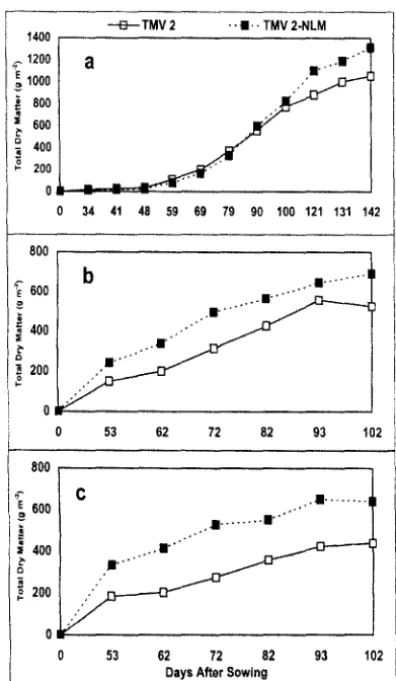
217 differences in TDM production were greater during the rainy season as compared to the post-rainy season. The TDM accumulation in these two genotypes during the post-rainy season coincided with the increase in air temperature during the growing season (Table I and Figure. la). At early stages (upto 80 DAS), both the genotypes grew at a slower rate as the average minimum temperature was 14 °C, which is much below the optimum level. But with the rise in the mean minimum and maximum temperatures to optimum levels of 17 °C and 32 °C, respectively during the later stages (80-100 DAS), the growth rate increased in both the genotypes (William et al. 1978, Cox 1979). During this phase genotypic difference were noticed as TMV 2-NLM accumulated TDM at higher rate than TMV 2. With further rise in the mean maximum and minimum temperatures to 37 °C and 21 °C respectively during the seed development stage (100 DAS to final harvest, an inhibitory response to growth was noticed and this was more prominent in TMV 2 than TMV 2-NLM. During the rainy season, this type of trend in the rate of TDM accumulation in these two genotypes was not noticed. TMV 2-NLM kept on accumulating more biomass than TMV 2 at all growth stages after emergence under both irrigated and water deficit conditions (Fig. 1band c). The genotypic differences in groundnut in response to 35 °C and above temperature were reported earlier also (Ketring 1984, Talwar et al.
1999). These observations, like earlier reports (Leong and Ong 1983, Talwar et al. 1999, Varaprasad et al.
1999), suggested that plant growth and development rates were predominantly determined by temperature.
102 102
93 93
.•...
...
....
...•....
82
..•.. TMV 2-NLM
72
...
.•...
.•...•...
Post rainy 1994-95 Rainy 1995
TDM Pod TDM Pod
T1 T1 Tl T2 T1 T2
11.7 7.3 6.1 5.2 2.3 1.4
13.0 7.4 7.5 7.2 1.9 1.3
12.4 7.4 6.5 1.8
1.22 1.01 0.43 0.07
17.7 25.3 7.8 13.3
62 72 82
Days After Sowing -e-TMV2
53
o a 1400
1200
a
1000 800 600 400 200
o
o 34 41 48 59 69 79 90 100 121 131 142
800
.'; 600 b
~ ;
~ 400
~
0
j! 200
0 ~
a
0 53 62
800
~ 600 \
c
~ 2 400
~
....
0
~ 200
~
Fig. 1. Accumulation of total dry matter at different growth stages inTMV 2andTMV 2-NLM grown during post-rainy
1994-95 season under irrigated conditions (a), rainy 1995
season under irrigated conditions (b) and rainy 1995 season under water deficit coditions (c).
Indian J. Plant Physiol., Vol. 7, No.3, (N.S.) pp. 215-220 (July-Sept., 2002)
Mean
cv%
SE± TMV2
Genotypes
TMV2 NLM
H.S. TALWAR etat.
The greater TDM production in TMV 2-NLM was due to its higher crop growth rate than TMV 2 under both irrigated and water deficit conditions during both the seasons (Table 3). As compared with TMV 2, TMV 2-NLM had 11% and 13% higher crop growth rate under adequately irrigated conditions during both the seasons and 31% higher crop growth rate under water deficit conditions during 1995 rainy season. The two genotypes accumulated different amount of TDM with the same amount of light radiation intercepted. TMV 2-NLM produced more TDM than TMV 2 with each unit of radiation intercepted during both the seasons (Table 4). The two genotypes differ in their leaf area, TMV 2-NLM having the narrower leaves. This indicated that TDM production and radiation use efficiency are highly
influenced by leaf size as has been reported by others (Methews et aI. 1988 b).
The lower extinction coefficient of narrow leafmutant under both the treatments (Table 4) indicated that the mutation caused a change in canopy geometry and made it more open and therefore, allowed more light to reach the bottom leaves. The percentage light interception by both the genotypes increased with the increase in leaf area index (LAI) till the saturation point was achieved (Figure 2 a-c). The narrow leafmutant ofTMV 2 intercepted more light radiation with similar LA!. This indicated that more TDM production is due to the openness of canopy structure in the mutant which allows itto harvest more light radiations during the growing season. These results suggested that
Table 3. Crop growth rate (CGR, g dry·l) and dry matter partitioning to pods (Pf)ofTMV 2 and TMV 2 NLM grown under irrigated (Tl) and water deficit conditions (T2) during two seasons at ICRISAT centre.
Genotypes
TMV 2 TMV 2 NLM Mean
SE±
CV%
Post-rainy 1994-95 Rainy 1995
CGR Pf CGR PC
T1 T1 T1 T2 T1 T2
1\.9 0.57 6.3 5.2 0.52 0.45
13.2 0.54 7.1 6.8 0.50 0.41
12.5 0.56 5.8 0.47
0.81 0.021 0.42 0.005
11.5 7.3 9.5 14.9
Table 4. Radiation use efficiency (RUE, g mj'l) and extinction coefficient (Ee) ofTMV 2 and TMV 2 NLM grown under irrigated (Tl) and water deficit conditions (T2) during two seasons at ICRISAT centre.
Genotypes
TMV 2 TMV 2 NLM Mean
SE±
CV%
Post-rainy 1994-95 Rainy 1995
RUE EC RUE EC
T1 Tl T1 T2 Tl T2
0.97 0.54 0.39 0.26 0.62 0.51
1.13 0.46 0.48 0.35 0.56 0.50
\.20 0.53 0.37 0.55
0.064 0.032 0.022 0.003
219
Mathews, R.B., Harris, D., Nageswara Rao, R.C., William, J.H. and Wadi a, K.D.R. (1988a). The physiological basis of yield differences between four groundnut (Arachis hypogaea L.) genotypes in response to drought. r.Dry matter production and water use. Exp. Agr. 24: 191-202.
Mauchow, R.C., and Sinclair, T.R. (1994). Nitrogen response ofleaf photosynthesis and canopy radiation use efficiency in field grown maize and sorghum. Crop Sci.34: 721-727.
Monteith, J. L. (1965). Light distribution and photosynthesis in field crops. Ann. Bot. 29: 17-37.
NageswaraRao,R.C., WiIliam,J.H., Shivkumar, M.V.K. and Wadi a, K.D.R. (1988). The effect of water deficit at different growth phases of peanut. II Response to drought during preflowering phase. AgronJ. 80: 431-438.
Shaw, R.H. and Weber, C.R. (1967). Effect of canopy arrangement on light interception and yield of Soybean. Agron J.59: 155-159. Monsi, M., Uchijima, Z. and Oikawa. T. (1973). Structure offoliage
canopies and photosynthesis. Annu. Rev. Eco. &Syst. 4: 301-327.
Mathews. R.B., Harris, D., William, J.H. and Negeswara Rao, R.C. (1988b). The physiological basis of yield differences between four groundnut (A rachis hypogaea L.) genotypes in response to drought. n.Solarradiation interception and leafmovement. Exp. Agr. 24: 203-213.
Nam, N.H., Subbarao, G.V., Chauhan, Y.S., and Johansen, C. (1998). Importance of canopy attributes in determining dry matter accumulation of pig eon pea under contrasting moisture regimes.
Crop Sci.38: 955-961.
Monteith, J.L. (1977). Climate and efficiency of crop production in Britian. Phillos. Trans. R. Soc. London. B.281: 227-294. Monteith, J.L., and Elston, J. (1982). Performance and productivity of
foliage in the field. In: J.E. Dale and F.L. Milthorpe (eds.), The Growth and Functioning of Leaves, pp. 449-451. Cambridge University Press, Cambridge, U.K.
Ketring, D.L. (1984). Temperature effects on vegetative and reproductive development of peanut. Crop. Sci. 24: 877-882.
Leong, S.K. and Ong, c.K. (1983). The influence of temperature and soil water deficit on the development and morphology of groundnut
(Arachis hypogaea L.).J. Exp. Bioi. 34: 1556-1561.
Heathe, M.e. and Hebblethwaitte, P.D. (1985). Solar radiation intercepted by leafless, semi-leafless and leafed peas(Pissum
sativum L.) under contrasting field conditions. Ann. Appl. Bioi.
107: 303-318 .
Ducan, W,]., McMloud, D.E., McGraw, R.L. and Boote, KJ. (1978). Physiological aspects of peanut improvement. Crop Sci. 18:
1015-1020.
1 2 3
Leaf Area Index
o o 100 .c 0> :.::i20 80 !! o .260 ~ ~ 40
L
1 2 3
Leaf Area Index
o o 100 80 ~ c .2 60 1i. ~ E40 .c 0> ::i20 40
o 1 2 3 4 5
leaf Area Index 100
D TMV 2 • TMV 2-NLM
'j
r
.;(~ a-.C80 ./.,' c
o / a / ~ " ~ 60 0> :J 6
Bennett, J. M., Sinclair, T.R., Ma, Li. and Boote, K.J. (1993). Single leaf carbon exchange and canopy radiation use efficiency of four peanut cultivars. Peanut Science 20: 1-5.
Angus, R. and Wilson lH. (1972). A comparison of barley cultivars with different leaf inclination Aust. J. Agric. Res.23: 945-957.
Indian J.Plant Physiol., Vol. 7, No.3, (N.S.) pp. 215-220 (July-Sept., 2002) Crox, F.R. (1979). Effect oftemperature treatment on peanut vegetative
and fruit growth. Peanut Science 6: 14-17.
REFERENCES
total dry matter accumulation was linearly related to amount of radiation intercepted, which depended upon the canopy geometry (Heathe and Hebblethwaitte, 1985, Bennett et al. 1993).
Pod yield in TMV 2 was higher than its mutant, TMV 2 NLM, under both irrigated and water deficit conditions during the 1995 rainy season (Table 2). Although the mutant had higher crop growth rate but dry matter partitioning to the pods was lower than TMV 2 under both irrigated and water deficit conditions (Table 3). The reduction in partitioning under water deficit condition as compared to irrigated condition was more in TMV 2-NLM (18%) than TMV2 (13%). The genotypic variation in partitoning was reported earlier also in groundnut (Mathews et al., 1998 a).
The present study suggests that the crop growth rate can be manipulated by modifying canopy architecture. However, separate approaches are required to improve partitioning ability along with over all crop growth rates. Fig. 2. Relatioship between leaf area index and light interception in TMV 2 (solid line) and TMV 2-NLM (broken line) grown during post-rainy 1994-95 season under irrigated conditions (a), rainy 1995 season under irrigated conditions (b) and rainy 1995
H.S. TALWAR etat.
Talwar,H.S., Takeda, H., Yashima,S. andSenboku, T. (1999). Growth and photosynthetic responses of groundnut genotypes to high temperature. Crop Sci.39(2): 460-466.
Tanaka, T. (1972). Studies on the light curves carbon assimilation of rice plants-The interrelation among the light curves, the plant type and maximizing yield of rice.Bull. Nationallnstitute ofAgri. Sci.
19: 100-108.
Varaprasad, P.V., Craufurd, P.Q. and Summerfield, RJ. (1999). Fruit number in relation to pollen production and viability in groundnut exposed to short episodes of heat stress.Ann. Bot.84: 381-386. William, lH., Hilderbrand, G. J. and Tattersfield, J. K. (1978). The