RESEARCH
The reproductive pattern and potential
of free ranging female wild boars
(
Sus scrofa
) in Sweden
Anna Malmsten
1*, Gunnar Jansson
2, Nils Lundeheim
3and Anne‑Marie Dalin
1Abstract
Background: The number and spatial distribution of wild boars (Sus scrofa) has increased remarkably in Sweden as well as in other European countries. To understand the population dynamics of the wild boar, knowledge of its repro‑ ductive period, oestrus cycle and reproductive success is essential. The aim of this study was therefore to describe the seasonal reproductive pattern and reproductive potential of a wild boar population in Sweden. The study was based on findings from macroscopic examinations of the reproductive organs from 575 hunter‑harvested female wild boars (>30 kg body weight). Samples were collected between December 2011 and December 2015 in the southern and middle parts of Sweden. The age of the sampled animals was determined and dressed weight was noted. The stage of the reproductive cycle was defined according to ovarian structures and in relation to the appearance of/and find‑ ings in the uterus. The crown‑rump length (CRL) of the embryos/foetuses was used to calculate the oestrus/mating month and month for the expected farrowing.
Results: The macroscopic examination revealed a seasonal variation of reproductive stages, although cyclic and pregnant females were found in all seasons. Moreover, the estimated oestrus/mating and farrowing months based on the CRL showed that mating and farrowing may occur ‘off‑season’. The average litter size (no. of embryos or foetuses) per pregnant female was 5.4. Sow weight and age had significant effect on both the reproductive potential (ovulation rate and litter size) and pregnancy rate, respectively.
Conclusions: The reproductive potential in the studied wild boar population was high compared to studies from other countries and farrowing may occur ‘off‑season’. This suggests that the environmental conditions in Sweden, including supplemental feeding, are favourable for wild boar reproduction.
Keywords: Litter size, Ovulation rate, Pregnancy rate, Seasonality, Supplemental feeding
© The Author(s) 2017. This article is distributed under the terms of the Creative Commons Attribution 4.0 International License (http://creativecommons.org/licenses/by/4.0/), which permits unrestricted use, distribution, and reproduction in any medium, provided you give appropriate credit to the original author(s) and the source, provide a link to the Creative Commons license, and indicate if changes were made. The Creative Commons Public Domain Dedication waiver (http://creativecommons.org/ publicdomain/zero/1.0/) applies to the data made available in this article, unless otherwise stated.
Background
The number and spatial distribution of wild boars has increased remarkably in Sweden as well as in other
Euro-pean countries during the last decades [1–5]. Besides the
generalist behaviour of wild boars such as wide feed and habitat selection, the main reasons for this rapid increase are thought to be the high reproductive potential of the
wild boar [6] in combination with extensive supplemental
feeding and relatively low harvest rates.
To understand the population dynamics of a game species such as the wild boar, knowledge of its repro-ductive period, oestrus cycle and reprorepro-ductive success
is essential [7, 8]. Wild boar biology has been studied in
several countries with a long history of wild boar popu-lations. Based on European studies, pure breeds of wild boars without a history of hybridization with domestic pigs (that are poly-oestral throughout the year) have a
reproduction that is clearly seasonal [9]. The wild boars
are so-called short-day breeders. During the summer months, the majority of the female wild boars are
anoes-tral [9–11]. In continental Europe, the summer anoestrus
coincides with high ambient temperatures, long days and
Open Access
*Correspondence: [email protected]
restricted access to feed [12]. In the autumn, as a result
of shortened day length, the oestrus period begins [9].
However, the first oestrus of the breeding season may take place at different time in different years depending on natural feed availability and other environmental and
climatic factors [9, 11, 13]. For example, it appears that
earliness or delay in the onset of the breeding season is related to the level of available feed in that a high access
to feed can cause a shortened anoestrus period [10]. In
a natural environment, without any human impact, there is normally only one oestrus peak in the autumn/winter
[12]. However, a bimodal pattern of oestrus and
conse-quently farrowing can also occur [2, 14]. In addition,
some studies show that farrowing may occur throughout
the year when feed is available all year round [15, 16].
The current wild boar population in Sweden originates from an unknown number of individuals that escaped enclosures in the 1970s and 1980s. Since, the popula-tion has steadily and rapidly increased. During the last 20 years, the annual number of harvested wild boars in
Sweden has increased from 5000 to 100,000 animals [5].
The knowledge about Swedish wild boar and its manage-ment is limited, and only a few studies have been pub-lished. These studies have mainly described wild boar movement patterns, behaviour, and habitat selection
[17–20], but few include data on reproduction [7, 21], i.e.
reproductive performance and reproductive potential of the species in Sweden.
The aim of this study was to describe the reproductive pattern and potential of free ranging female wild boars in Sweden.
Methods Study area
Samples were collected between December 2011 and December 2015 at seven hunting estates in four different regions (Skåne, Blekinge, Södermanland, and Uppland)
in southern and central Sweden (Additional file 1).
The size of the estates varied from 10 to 87 km2 and the
population density of wild boars estimated by the wild-life manager at each estate ranged from 5 to 40 animals
per km2 among the estates. Similar management
strate-gies for the wild boars were applied at all estates, includ-ing supplemental feedinclud-ing throughout the year. The types of feed used were corn, grain, mixes of cereal and sugar beets, and silage (anaerobic fermentation with wheat and oats grains, peas, and clover). Meteorological data (monthly mean precipitation and temperature) were
obtained from local meteorological services [22].
Dur-ing the study period, the weather conditions in the sam-pling regions were similar with mean temperatures in
January and July of −1 and 18 °C respectively, and mean
precipitation in January and July was 49 and 58 mm,
respectively (Additional file 2).
Hunting methods and Swedish wild boar hunting legislation
Sampling occurred during ordinary hunting. The hunting methods used were beat/drive hunts and stalking. Beat/ drive hunts were the most common method in the study areas during the main hunting season (October until Feb-ruary) and resulted in considerable hunting bags (30–100 animals per day). Stalking was used during spring and summer and animals were most often shot while feed-ing at open field/grazfeed-ing-ground, i.e. huntfeed-ing was used mainly as a crop preventive action.
For practical reasons, the sampling effort was biased towards the main hunting season (October–February). In Sweden, the hunting season of adult wild boars range between 16th of April and 15th of February. The wild boar hunting is allowed 24 h, i.e. day and night, and hunting with dogs is allowed between 1st of August and 31st of Janu-ary. Hunting of yearlings is allowed throughout the year,
whereas females with dependent piglets are protected [23].
Data collection
Body weight (BW) and field dressed weight (FDW, weight of the eviscerated animal with skin) were recorded.
Sam-pling included all females with BW ≥30 kg. For animals
where only BW was noted, FDW were estimated using
the equation FDW = −1.855 + 0.810*BW, based on the
known relationship between BW and FDW of 296 ani-mals [Lundeheim, unpublished data]. Altogether, FDW was noted for 540 animals. Age was determined for 442 of the animals based on tooth eruption and replacement
pattern [24] and the animals were subdivided into
juve-niles (<1 year), yearlings (1–2 years) and adults (>2 years).
Macroscopic examinations of reproductive organs
The collected reproductive organs were frozen at −20 °C
until the macroscopic laboratory examination [7]. The
size and weight of the uterus and ovaries were recorded
as were the ovarian structures (follicles and corpora lutea,
CL). Ovulation rate (OR) was defined as the total number of active CL from both ovaries. The uteri were cut open and the contents examined. The reproductive stage was determined based on the data from the macroscopic
examination [7]. Animals in prooestrus, oestrus,
(CRL), weight, gender and development of the embryos/ foetus were noted. The estimated oestrus/mating months and expected farrowing months were calculated based on
the CRL of the embryos/foetuses [25].
Statistical analyses
The statistical analyses were carried out in SAS (SAS Institute Inc. Cary, N. C). In the analyses, year was divided into four seasons as: spring (March–May), sum-mer (June–August), autumn (September–November) and winter (December–February). Analysis of variance [both PROC GLM (general linear model) and PROC GLIMMIX (generalized linear mixed model)] were used for the statistical analyses.
Primary statistics showed that there was a high vari-ation and poor overlapping in number of observvari-ations
among seasons and age classes (Table 1). To overcome
the statistical problems this raises in the analyses, mono-factorial analyses were performed.
Sub‑analysis 1
Analyses of the effect of season and age class on the con-tinuous variables weight (dressed), OR and litter size. The statistical model included either the fixed effect of season (4 classes) or age class (3 classes). These analyses was per-formed using PROC GLM, and were based on 421, 139 and 71 observations, respectively.
Sub‑analysis 2
For the analyses of the three binary variables, indicating the reproductive stage (anoestrus, cyclic or pregnant), fixed effects of season and age class were included in the model, one at a time. In these analyses prepubertal ani-mals and aniani-mals with disrupted cycles were excluded. These analyses were performed using PROC GLIMMIX, and were based on 357 (for season) and 261 (for age class) observations. Using this approach, the effect of age class on the pregnancy rate of female wild boars was also ana-lysed (442 observations). The pregnancy rate was defined as the proportion of pregnant females per age class of the sampled population. P-values less than 0.05 were consid-ered as significant.
Results
In total, 617 female wild boars were collected and 575 individuals met the requirements to be included in this study, i.e. a complete set of reproductive organs avail-able for examination. The number of animals sampled in each season and in relation to age and sampling region is
presented in Table 1. The number of animals in the
dif-ferent reproductive stages were: 207 prepubertal (36.0%), 131 anoestral (22.8%), cyclic 104 (18.1%), 123 pregnant (21.2%), and 11 had a disrupted ovarian cyclic pattern (1.9%). The levels of significance for the effects included
in the statistical analyses are presented in Table 2. The
proportion of animals in different reproductive stages (prepubertal animals and animals with disrupted oes-trus cycle excluded) was significantly affected by season
(P < 0.0001, Fig. 1).
Pregnancy was detected in 122 animals. After exclud-ing 11 pregnant females with embryo mortality and 10 animals in an early pregnancy state (<2.5 weeks),
the mean number of CL was 6.4 (range 2–11; n = 101)
and the mean number of embryos/foetuses was 5.4 (range 1–9). The estimated oestrus/mating- and far-rowing months based on the CRL of embryos/foetuses
Table 1 The number of sampled female wild boars in total, per season, per age class, and per sampling region
Season Total Age class Region
Juvenile Yearling Adult Unknown Skåne Blekinge Södermanland Uppland
Spring 76 11 16 8 41 0 5 59 12
Summer 48 7 17 8 16 0 2 44 2
Autumn 345 109 100 101 35 38 149 78 80
Winter 106 23 15 27 41 45 2 31 28
Total 575 150 148 144 133 83 158 212 122
Table 2 The levels of significance for the effects of season and age class on weight, reproductive potential, reproduc-tive stage and pregnancy rate of the sampled female wild boars
Levels of significance: ns not significant P < 0.05; ** P ≤ 0.01; *** P ≤ 0.001
Variable Season Age class
Weight *** ***
Reproductive potential
OR Ns ***
Litter size Ns ***
Reproductive stage
Anoestrus *** **
Cyclic *** Ns
Pregnant *** Ns
from 105 pregnant female wild boars sampled between November 2012 and December 2014, are illustrated in
Fig. 2.
Age class and weight was highly associated (Table 2).
The reproductive potential (OR and litter size) in relation to weight class for 99 of the pregnant animals, for which the FDW was noted and the pregnancy had proceeded
over 18 days, is illustrated in Fig. 3. The reproductive
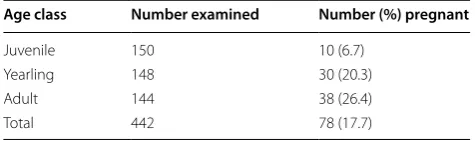
potential increased significantly with age class. Age was determined in 442 animals of which 78 were pregnant, and the pregnancy rate in relation to age class is
pre-sented in Table 3. The pregnancy rate increased
signifi-cantly per age class (P < 0.001).
Discussion
To identify the population dynamics of a game species in order to conduct a proper management, understand-ing of its reproductive period, oestrus cycle and the mean reproductive outcome is essential. In the present study, the reproductive pattern and potential among free rang-ing female wild boars in Sweden is described.
The reproductive potential indicated by ovulation rates and litter size of the studied wild boars was high (6.4 and 5.4, respectively), compared to litter sizes reported from
other countries, e.g. Portugal 4.2 [15], Iberian Peninsula
3.6 [26], Switzerland 4.8 [27], and Italy 5.0 [1], but not as
high as in a recent German study; 6.6 [8]. The
reproduc-tive potential of wild boars can be affected by many
fac-tors such as feed availability, climate [6, 26, 28, 29], the
genetic background including influence of domestic pigs
[14, 30, 31], and the weight and age of gilts and sows [9,
29]. High natural feed availability may increase the litter
size [32] as well as the availability of supplementary feed
[26, 29]. In Sweden, although controversial, supplemental
feeding is to a varying extent applied throughout the wild boar range. This makes studies of the direct effects of supplemental feeding on free ranging wild boars, includ-ing controls (in areas without supplementary feedinclud-ing), more or less impossible to conduct in Sweden. Moreover, the availability of natural feed in Sweden is high for wild boars, both in forests and agricultural habitats, and espe-cially in the southern and central parts of Sweden. Dur-ing winter, the scarcity of natural feed is compensated by supplemental feeding. Compared to southern and central 0%
10% 20% 30% 40% 50% 60% 70% 80%
Spring
n=51 Summern=25 Autumnn=210 Wintern=71
Proportion Anoestral
Cyclic Pregnant
Fig. 1 The proportion of female wild boar in different reproductive stages in relation to culling season (prepubertal animals and animals with disrupted ovarian cyclic pattern excluded)
0 2 4 6 8 10 12 14
2012 Sept
Oc
t
No
v
De
c
2013 Ja
n
fe
b
Ma
r
Ap
r
Ma
y
June July Au
g
Sept Oc
t
No
v
De
c
2014 Ja
n
Fe
b
Ma
r
Ap
r
Ma
y
June July Au
g
Sept Oc
t
No
v
De
c
2015 Ja
n
fe
b
Ma
r
Apri
l
Number
Months
Estimated oestrus Estimated farrowing
Europe [12], Swedish summers are (due to mild climate) not likely to constitute a regulating season for wild boar populations. Instead, the summer conditions in the south and central Sweden normally result in a long vegetation period without long periods of high ambient
tempera-tures or drought [22]. Such conditions are favorable for
wild boars [8, 28] and possibly contribute to the large
lit-ter sizes.
The genetic background and possible influence of domestic pigs in the wild boar population is known to
affect the litter size and growth rate [30]. Bergman et al.
[33] found genetic signs in Swedish wild boars that
possi-bly could indicate interbreeding between wild boars and domestic pigs. Still, further studies to identify the occur-rence of genetic introgression from domestic pig into the Swedish wild boar populations are required for wider conclusions.
The age/weight of the sows in the wild boar popula-tion can also affect the observed litter size. Younger and lighter individuals have smaller litters than older/heavier
individuals [12, 26]. In agreement with previous studies
[1, 8, 15, 26, 34], we also found that pregnancy rate and
reproductive potential increased with age and weight. The proportion of old/heavy sows, included in the stud-ied material, is highly linked to management in Sweden.
The Swedish hunting regulations [35] prohibit culling
of females with piglets, and large females (also without piglets) are often voluntarily banned from culling by hunters. Therefore, it is possible that the age and weight composition of the sampled animals was not representa-tive for the actual age and weight composition of the wild boar population in the sampled areas. Instead, it is likely that the proportion of large, adult females was higher in the population than in the studied material, and the average reproductive potential presented here might be underestimated.
Although the majority of the studied female wild boars showed a seasonal pattern in accordance to previous
studies [2, 9], cyclic and pregnant females were found in
all seasons. This pattern was further confirmed by the estimated oestrus/mating and farrowing months based
on the CRL of embryos/fetuses (Fig. 2). These
obser-vations show that farrowing may occur ‘off-season’ in Sweden, as also suggested by studies describing the cor-responding pattern when feed is accessible throughout
the year [15, 36]. Despite the lack of material from a few
months, a tendency of at least two peak periods for oes-trus/mating (one in November and one in March) is seen in the material from 2013 and evident, but not as
pro-nounced in 2014 (Fig. 2). This would give (if the animals
had stayed alive), peaks of farrowing in March and July. Breeding in March is not considered to be normal for “short-day breeders”, such as wild boars. However, this bimodal distribution of birth has been described in other
studies [2, 14]. Other authors explain this second peak as
a result of (1) some factors that make an early spring litter die and the sow then goes into oestrus again and become pregnant, (2) involvement of young females in repro-duction during spring, (juveniles that did not reach the necessary weight at the time of the mating season), and (3) genetic influences of domestic pigs in the wild boar population that also can affect the seasonality of
repro-duction [14], a factor that still is to be investigated in the
Swedish wild boar population. In the first explanation, harsh weather conditions, scarcity of feed, or diseases are factors that may affect the litter survival. In our case, the female boars involved in the second birth peak (June–
July) had a mean live weight of 54.3 kg (n = 13, range
34–70.6 kg), which may contribute to the second theory. Moreover, scarcity of feed would not be an explanation to the second peak because the studied population was sup-plementary fed throughout the study period. However, during January and February 2013, game managers at the
2 5 8
40
60
80
100
120
Number of Cl
Dressed weight (kg)
1 4 7
40
60
80
100
120
Litter size
Dressed weight (kg)
Fig. 3 The number of corpora lutea (ovulation rate) and litter size in relation to maternal field dressed weight in kg. Box and whisker plots show median (point within box), 25% (interquartile range 1) and 75% (interquartile range 3) percentiles (box) and the range (whiskers). Circles indicate statistical outliers
Table 3 Pregnancy rate of the examined female wild boars in relation to age class
Age class Number examined Number (%) pregnant
Juvenile 150 10 (6.7)
Yearling 148 30 (20.3)
Adult 144 38 (26.4)
different estates, observed a lot of piglets that later on disappeared. The results of the macroscopical examina-tion of the reproductive tract of female wild boars from this period confirm these observations. We found that a
large proportion (17%, n = 84 in 2013) and (26%, n = 27
in 2014) of the females that were shot between January and May (both included), recently had been pregnant. In practice this means that these individuals either (1) had lost their piglets shortly after birth due to piglet death (because of disease, predation, starvation, or frostbite) or the sows had left their piglets of unknown cause; (2) had aborted, i.e. lost their litter before birth due to poor body condition or disease; or (3) were shot although their piglets were alive (unlikely when hunters neither seen piglets or quoted drawn teats of sows). Harsh weather conditions and infectious diseases may contribute to the annual loss of wild boar litters. Still, the appearance and possible effect of infectious diseases on wild boar repro-duction, i.e. porcine parvovirus and porcine circovirus type 2 is still to be investigated.
Litters produced all year round complicate wild boar hunting and may thus infer difficulties to meet manage-ment goals. Adult sows which, if targeted by hunting, would be the animal category most effective to harvest if a population decrease is aimed for, are protected from culling if accompanied by piglets. Further, piglets present during hunting season, may be injured and/or killed by hunting dogs, which is an important issue of ethical and animal welfare to acknowledge.
Conclusions
This descriptive study of wild boar reproduction showed that the reproductive potential in the studied population was high and that farrowing may occur ‘off-season’. We suggest that the general high feed availability and envi-ronmental conditions in Sweden is favorable for wild boars. The possible effect of introgression of domestic pigs should not be neglected as a possible contributing factor to the high reproductive potential presented in this study.
Authors’ contributions
AM, AMD, and GJ were involved in the design and coordination of the study, AM and AMD collected the data and performed the organ examination. NL performed the statistical analyses. All authors contributed in drafting the manuscript. All authors read and approved the final manuscript. Additional files
Additional file 1. Map of Sweden highlighting the regions where female wild boars were sampled. a) Skåne, b) Blekinge c) Södermanland, d) Uppland.
Additional file 2. Mean temperature and percipitation in four Swedish counties, measured in January and July in the years of 2013–2015.
Author details
1 Division of Reproduction, Department of Clinical Sciences, Swedish Uni‑ versity of Agricultural Sciences, Box 7054, 750 07 Uppsala, Sweden. 2 Grimsö Wildlife Research Station, Department of Ecology, Swedish University of Agri‑ cultural Sciences, 730 91 Riddarhyttan, Sweden. 3 Department of Animal Breeding and Genetics, Swedish University of Agricultural Sciences, Box 7054, 750 07 Uppsala, Sweden.
Acknowledgements
We thank all of the estate owners for permitting collection and the wildlife managers and hunters for their engagement and contribution in this project. The authors wish to thank Andreas Karlsson and Bertil Malmsten who assisted in the sample collection.
Competing interests
The authors declare that they have no competing interests.
Ethics approval
This study did not require official or institutional ethical approval because material was collected at already hunted animals.
Funding
This work was supported by the Swedish Environmental Protection Agency, and the Swedish Association for Hunting and Wildlife Management.
Publisher’s Note
Springer Nature remains neutral with regard to jurisdictional claims in pub‑ lished maps and institutional affiliations.
Received: 8 March 2017 Accepted: 25 July 2017
References
1. Boitani L, Trapanese P, Mattei L. Demographic patterns of a wild boar (Sus scrofa L.) population in Tuscany, Italy. IBEX J Mount Ecol. 1995;3:197–201. 2. Ježek M, Štípek K, Kušta T, Červený J, Vícha J. Reproductive and morpho‑ metric characteristics of wild boar (Sus scrofa) in the Czech Republic. J For Sci. 2011;57:285–92.
3. Keuling O, Baubet E, Duscher A, Ebert C, Fisher C, Monaco A, et al. Mortality rates of wild boar Sus scrofa L. in central Europe. Eur J Wildl Res. 2013;59:805–14.
4. Massei G, Kindberg J, Licoppe A, Cačić D, Šprem N, Kamler J, Baubet E, et al. Wild boar populations up, numbers of hunters down? A review of trends and implications for Europe. Pest Manag Sci. 2015;71:492–500. 5. Svenska Jägareförbundet [The Swedish Hunting Association]. 2014.
http://svenskjakt.se/Start/Nyheter/2014/08/hur‑mycket‑vilt‑har‑vi‑egent‑ ligen/. Accessed 19 July 2016.
6. Servanty S, Gaillard JM, Allaine D, Brandt D, Baubet E. Litter size and fetal sex ratio adjustment in a highly polytocous species: the wild boar. Behav Ecol. 2007;18:427–32.
7. Malmsten A, Jansson G, Dalin AM. Postmortem examination of the repro‑ ductive organs of female wild boars (Sus scrofa) in Sweden. Reprod Dom Anim. 2017. doi:10.1111/rda.12947.
8. Frauendorf M, Gethöffer F, Siebert U, Keuling O. The influence of envi‑ ronmental and physiological factors on the litter size of wild boar (Sus scrofa) in an agriculture dominated area in Germany. Sci Total Environ. 2016;541:877–82.
9. Mauget R. Seasonality of reproduction in the wild boar. In: Cole DJA, Foxcroft GR, editors. Control of pig reproduction. London: Butterworth Scientific; 1982. p. 509–26.
10. Pépin D, Spitz F, Janeau G, Valet G. Dynamics of reproduction and devel‑ opment of weight in the wild boar (Sus scrofa) in South‑West France. Z Säugetierk. 1987;52:21–30.
• We accept pre-submission inquiries
• Our selector tool helps you to find the most relevant journal • We provide round the clock customer support
• Convenient online submission • Thorough peer review
• Inclusion in PubMed and all major indexing services • Maximum visibility for your research
Submit your manuscript at www.biomedcentral.com/submit
Submit your next manuscript to BioMed Central
and we will help you at every step:
12. Mauget R. Seasonal reproductive activity of the European wild boar. Comparison with the domestic sow. In: Assenmacher I, Farner DS, editors. Environmental endocrinology. Berlin: Springer; 1978. p. 79–80.
13. Macchi E, Starvaggi Cucuzza A, Badino P, Odore R, Re F, Bevilacqua L, Mal‑ fatti A. Seasonality of reproduction in wild boar (Sus scrofa) were assessed by fecal and plasmatic steroids. Theriogenology. 2010;73:1230–7. 14. Mauget R. Observations sur la reproduction du sanglier (Sus scrofa L.) a
l’état sauvage. Ann Biol Anim Biochem Biophys. 1972;12:195–202. 15. Fonseca C, Santos P, Monzón A, Bento P, Alves da Silva A, Alves J, et al.
Reproduction in the wild boar (Sus scrofa Linnaeus, 1758) populations of Portugal. Galemys. 2004;16:53–65.
16. Orlowska L, Rembacz W, Florek C. Carcass weight, condition and repro‑ duction of wild boar harvested in north‑western Poland. Pest Manage Sci. 2012. doi:10.1002/ps.3355.
17. Lemel J, Truvé J, Söderberg B. Variation in ranging and activity behavior of European wild boar Sus scrofa in Sweden. Wildl Biol. 2003;9:29–36. 18. Truvé J, Lemel J. Timing and distance of natal dispersal for wild boar Sus
scrofa in Sweden. Wildl Biol. 2003;9:51–7.
19. Thurfjell H, Ball JP, Åhlén PA, Kornacher P, Dettki H, Sjöberg K. Habitat use and spatial patterns of wild boar Sus scrofa: agricultural fields and edges. Eur J Wildl Res. 2009;55:517–23.
20. Welander J. Spatial and temporal dynamics of wild boar (Sus scrofa) root‑ ing in a mosaic landscape. J Zool. 2000;252:263–71.
21. Malmsten A, Dalin AM. Puberty in female wild boar (Sus scrofa) in Swe‑ den. Acta Vet Scand. 2016;58:55. doi:10.1186/s13028‑016‑0236‑1. 22. SMHI.se. 2016. Vegetationperiod. http://www.smhi.se/kunskapsbanken/
klimat/vegetationsperiod‑1.6270. Accessed 30 June 2016.
23. Naturvårdsverket. 2016. http://www.naturvardsverket.se/Var‑natur/Jakt/ Jakt‑pa‑klovvilt/Jakt‑pa‑vildsvin/. Accessed 13 Sept 2016.
24. Matschke GH. Ageing European wild hogs by dentition. J Wildl Manag. 1967;31:109–13.
25. Henry VG. Fetal development in European wild hogs. J Wildl Manag. 1968;32:966–70.
26. Fernández‑Llario P, Mateos‑Quesada P. Body size and reproductive parameters in the wild boar Sus scrofa. Acta Theriol. 1998;43:439–44. 27. Moretti M. Birth distribution, structure and dynamics of a hunted moun‑
tain population of wild boars (Sus scrofa L.), Ticino, Switzerland. IBEX J Mount Ecol. 1995;3:192–6.
28. Geisser H, Reyer HU. The influence of food and temperature on popula‑ tion density of wild boar Sus scrofa in the Thurgau (Switzerland). J Zool. 2005;267:89–96.
29. Fernández‑Llario P, Carranza J. Reproductive performance of the wild boar in a Mediterranean ecosystem under drought conditions. Ethol Ecol Evol. 2000;12:335–43.
30. Booth WD. Wild boar farming in the United Kingdom. IBEX J Mount Ecol. 1995;3:245–8.
31. Gongora J, Peltoniemi OAT, Tammen I, Raadsma H, Moran C. Analyses of possible domestic pig contribution in two populations of finnish farmed wild boar. Acta Agric Scand. 2003;53:161–5.
32. Massei G, Genov PV, Staines BW. Diet, food availability and repro‑ duction of wild boar in a Mediterranean coastal area. Acta Theriol. 1996;41:307–20.
33. Bergman IM, Sandholm K, Nilsson Ekdahl K, Okumura N, Uenishi H, Guldbrandtsen B, et al. MBL1 genotypes in wild boar populations from Sweden, Austria, the Czech Republic, and Japan. Int J Immunogenet. 2012. doi:10.1111/j.1744‑313X.2012.0113240:131.
34. Santos P, Fernández‑Llario P, Fonseca C, Monzón A, Bento P, Soares AMVM, et al. Habitat and reproductive phenology of wild boar (Sus scrofa) in the western Iberian Peninsula. Eur J Wildl Res. 2006;52:207–12.
35. Jaktförordning. 1987:905. https://www.notisum.se/rnp/sls/lag/19870905. htm#B1. Accessed 2 Feb 2017.