Abstract
Introduction:Planarians belong to an evolutionarily early group of organisms that possess a central nervous system including a well-organized brain with a simple architecture but many types of neurons. Planarians display a number of behaviors, such as phototaxis and thermotaxis, in response to external stimuli, and it has been shown that various molecules and neural pathways in the brain are involved in controlling these behaviors. However, due to the lack of combinatorial assay methods, it remains obscure whether planarians possess higher brain functions, including integration in the brain, in which multiple signals coming from outside are coordinated and used in determining behavioral strategies.
Results:In the present study, we designed chemotaxis and thigmotaxis/kinesis tracking assays to measure several planarian behaviors in addition to those measured by phototaxis and thermotaxis assays previously established by our group, and used these tests to analyze planarian chemotactic and thigmotactic/kinetic behaviors. We found that headless planarian body fragments and planarians that had specifically lost neural activity following regeneration-dependent conditional gene knockdown (Readyknock) of synaptotagmin in the brain lost both chemotactic and thigmotactic behaviors, suggesting that neural activity in the brain is required for the planarian's chemotactic and thigmotactic behaviors. Furthermore, we compared the strength of phototaxis, chemotaxis, thigmotaxis/kinesis, and thermotaxis by presenting simultaneous binary stimuli to planarians. We found that planarians showed a clear order of predominance of these behaviors. For example, when planarians were simultaneously exposed to 400 lux of light and a chemoattractant, they showed chemoattractive behavior irrespective of the direction of the light source, although exposure to light of this intensity alone induces evasive behavior away from the light source. In contrast, when the light intensity was increased to 800 or 1600 lux and the same dose of chemoattractant was presented, planarian behaviors were gradually shifted to negative phototaxis rather than chemoattraction. These results suggest that planarians may be capable of selecting behavioral strategies via the integration of discrete brain functions when exposed to multiple stimuli.
Conclusions:The planarian brain processes external signals received through the respective sensory neurons, thereby resulting in the production of appropriate behaviors. In addition, planarians can adjust behavioral features in response to stimulus conditions by integrating multiple external signals in the brain.
Keywords:Planarian, Chemotaxis, Thigmotaxis, Thigmokinesis, Higher brain function, Decision-making, Integration, RNAi, Readyknock
* Correspondence:[email protected] †Equal contributors
Department of Biophysics, Graduate School of Science, Kyoto University, Kitashirakawa-Oiwake, Sakyo-ku, Kyoto 606-8502, Japan
Introduction
As an animal survives under exposure to many kinds of stimuli, its nervous system detects sensory cues and con-verts this information into adaptive movement. For behav-iors in response to a simple stimulus, sensory neurons sometimes communicate directly with motor neurons; however, when animals are exposed to more complex stimuli, integration of sensory information should be ne-cessary to decide the appropriate behavior. Furthermore, integration of sensory information in this neural machin-ery is essential for choosing an animal's behavioral strategy based on the context and on the animal's memory, and such integration enables animals to refine their behaviors. Although some of the specific neuronal processing activ-ities that encode neuronal activation into a behavioral re-sponse have been extensively studied, much remains to be understood about how to these processing activities decide an adaptive behavioral strategy under multiple environ-mental signals.
Planarians are free-living platyhelminths, and belong to an evolutionarily early group possessing a CNS that includes a brain with simple architecture, i.e., a bi-lobed brain composed of around 2.0 ~ 3.0 x 10⁴neurons in a planarian of length about 8 mm [1-3]; and their brain consists of several functional and structural domains de-fined by the discrete expression of homeobox genes, with a surprisingly complex set of expressed genes, so-phisticated neural networks, and neural modulators that are quite similar to those used by mammals [4]. In addition, planarians can sense a variety of environmental signals, and rapidly display distinct responsive behaviors depending on the type of signal, such as light or temperature [5-7], conveyed through sensory neurons projecting to their brain [1,2]. Despite the increasing knowledge that has been gained recently about the mor-phogenesis of the planarian brain and its robust regen-erative ability [4,8], examination of the function of the planarian brain at the molecular level has just begun [6,7,9-11]. Research during the past two decades using molecular and cellular techniques has shown that the planarian brain is divided into several functional and structural domains that are composed of several neural subtypes, and that it uses many neurotransmitters and neuronal modulators, such as glutamate, dopamine, serotonin, GABA, acetylcholine, and neuropeptides, that are quite similar to those used by mammals [12-16]. These findings indicate that analysis of the planarian brain with its structurally simple, but nevertheless well-organized, brain may provide a unique opportunity as an emerging good new model system to elucidate molecular mechanisms underlying the basis of brain function. However, it has been difficult until now to clarify the mechanisms of planarian higher brain function, includ-ing learninclud-ing and memory, because of the lack of
knowledge about the neural processing pathway(s) in the brain regulating the behavior in response to a particular stimulus or to multiple stimuli.
Planarians display stereotypical behaviors in response to external stimuli, for example, they display phototaxis, chemotaxis, thermotaxis, and thigmotaxis [5]. Phototaxis and chemotaxis of planarians have been relatively well studied because of their association with morphologically well-characterized organs, namely the eyes and auricles, respectively [6,11,17]. The sensory organs of planarians are located in the head portion of the animal and send projections to the brain. The brain processes these signals and directs appropriate behavioral responses [6,11]. These findings clearly showed that planarian behavioral assays are useful for analyzing the CNS function. In this study, we focused on chemotaxis and thigmotaxis in addition to phototaxis and thermotaxis, and thereby assessed planar-ian behaviors that might reveal molecular and neural path-ways in the brain involved in producing appropriate behavior in response to multiple signals.
Materials and methods
Animals
A clonal strain of planarian (Dugesia japonica), SSP, cul-tured at 23°C in tap water was used. Planarians were starved for at least one week prior to amputation, anesthe-tized by chilling on ice, and then cut. Planarians 7 mm in length were used for all experiments. All planarians were maintained and manipulated according to a protocol ap-proved by the Animal Care and Use Committee of Kyoto University.
Assay for planarian behaviors
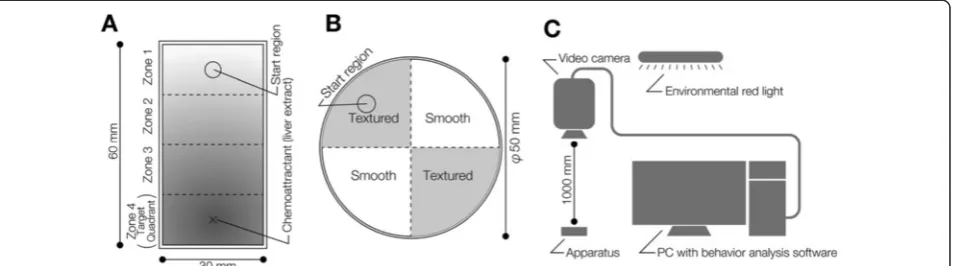
A schematic representation of the chemotaxis assay sys-tem is shown in Figure 1A. Two ml of water containing 0.1% low melting point agarose at 23°C was placed in a 60 × 30 × 10 mm assay chamber. To obtain reproducible assay results, chicken liver extract prepared as follows was used as the chemoattractant: small chicken liver pieces were autoclaved (121°C, 20 min); the supernatant was obtained (chicken liver extract). The liver extract was divided into aliquots and frozen until use. Tenμl of the 100-fold diluted extract were placed in the center of the target quadrant (Zone 4) at one end of the assay chamber. A planarian was placed in the quadrant at the opposite end (Zone 1) of the chamber (Figure 1A).
For assays to examine the priorities among the four planarian behaviors studied here (chemotaxis, phototaxis, thigmotaxis, and thermotaxis), two behaviors were tested simultaneously as follows. A planarian was placed in the center of the 60 × 30 × 10 mm assay chamber described above. A preference index was calculated as follows: pref-erence index = (number of planarians in one particular re-gion–number of planarians in the opposite region)/(total number of planarians in the assay chamber).
To assay for external stimuli integration, a planarian was placed in the middle of a 60 × 10 × 3 mm chamber constructed from glass [6]. One ml of water containing 0.1% low melting point agarose was put in the container. Each planarian behavior was captured using a video re-corder (Sony) placed above the container (Figure 1C) for the time indicated in the Results section. The trajectory of movement was analyzed with SMART software (Panlab) (Figure 1C) [6]. All behavioral experiments were per-formed in a dark room with only a red light of a wave-length that cannot be sensed by planarians (Figure 1C) [18]. Calculations based on the data obtained were per-formed using static ggplot2 package of R software [19].
Statistical evaluation
Data were analyzed by determining the statistical signifi-cance of differences between test results as determined by Student's t test;pvalues greater than 0.05 were taken as not significant (ns).
RNA interference
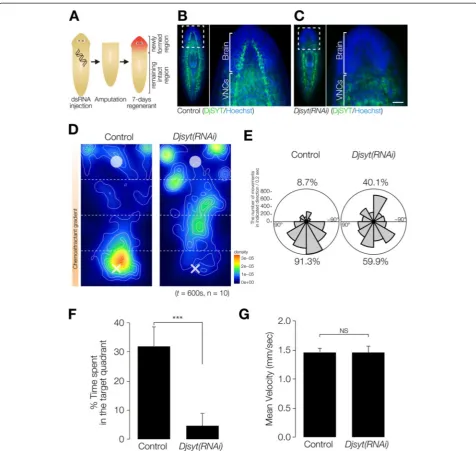
Double-stranded RNA (dsRNA) was prepared as de-scribed previously [20,21]. For Readyknock [11], dsRNA was injected into the posterior intestinal duct of planar-ians using a Drummond Scientific Nanoject injector (Broomall, PA, USA). At four hours after injection, pla-narians were amputated posterior to the auricles and the
resulting regenerants were used for analysis at seven days of regeneration. Control animals were injected with dsRNA for green fluorescent protein (GFP), a gene that is not found in planarians.
Whole-mount immunohistochemistry
Whole-mount immunostaining was performed as de-scribed previously [10]. Planarians were stained using the following dilutions of antibodies: 1/2000 planarian synaptotagmin (DjSYT) [22], 1:1000 anti-planarian arrestin [23], 1:2000 anti-G-protein β subunit (anti-DjGβ) [10], or 1:2000 anti-planarian tyramine beta-hydroxylase (anti-DjTBH) [24], in 10% goat serum in 0.1% Triton X-100-containing phosphate buffered saline (TPBS). After washing, the samples were incubated with fluorescently labeled goat secondary antibodies (Alexa488-labeled anti-mouse IgG(H + L) antibody and 10 μg/ml Hoechst 33342 (Life Technologies) in TPBS containing 10% goat serum overnight at 4°C. Fluorescence was de-tected with an FV10 confocal scanning microscope (Olympus) (10x/0.4 NA, or 60x/1.34 NA oil immersion objective lens). Images were processed with FV10-ASW (Olympus) and ImageJ software (NIH). All images were obtained using the same photography conditions to allow direct comparison between experimental animals and controls.
Results
Chemotactic behavior analysis in planarian
To observe and quantify planarian chemical-sensing be-havior, a tractable assay method for tracking chemotaxis behavior was developed. For this assay, we used liver-extract solution, the food used for culturing planarians in our laboratory, as chemoattractant (Figure 1A). We rea-soned that if planarian recognized the chemoattractant and showed chemotaxis toward it, the chemoattractant
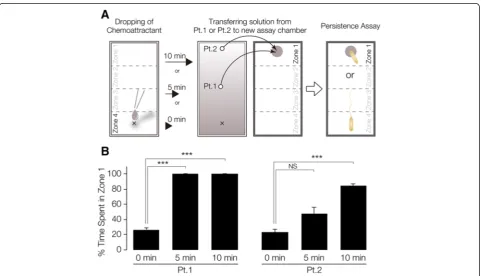
should be present with a concentration gradient in the assay field. However, because we could not visualize or measure the concentration gradient of the chemoattract-ant(s) sufficient to induce the planarian chemotaxis, we in-stead used a bioassay we named the “persistence assay” (Figure 2A). The rationale for the “persistence assay” is that whereas planarians normally move in various direc-tions and away from the original region (Zone 1) after be-ing placed there, they would remain in the original region (Zone 1) if a concentration of chemoattractant sufficient for them to sense were present there. We preliminarily measured the chemoattractant's diffusion rate in the assay field to determine when we should start the analysis after adding the chemoattractant as follows. Tenμl of chicken liver extract as chemoattractant were placed in the center of a quadrant (Zone 4) of the assay chamber. After 0, 5, or 10 min, 3μl of agar solution was transferred from point 1 or point 2 into the center of a quadrant (Zone 1) of a fresh assay chamber. Soon thereafter, a planarian was placed in Zone 1, and its behavior was observed. Figure 2B shows the time spent in Zone 1 during the 1-min assay period. Al-though at 0 min after adding the solution transferred from point 1, planarians moved away from Zone 1 and showed a
low score of time spent there (percent of time ± SEM, 26.7 ± 2.9%), after 5 min planarians continuously stayed in Zone 1, and thus showed a higher score of time spent there (100 ± 0.0%) (Figure 2B). In contrast, planarians did not stay in Zone 1 even after 5 min (47.8 ± 8.31%), when the solution had been transferred there from point 2. However, after 10 min, they did stay in Zone 1 (84.3 ± 3.1%). In addition, we did not find any differences in loco-motion among these planarians (data not shown). These results suggest that the chemoattractant reproducibly dif-fused throughout the entire assay chamber within 10 min after it was added, and that this bioassay using planarians is useful for directly and efficiently detecting the diffusion of a chemoattractant that induced planarian chemotaxis. There-fore, we decided to use the chemoattractant gradient field in the assay chamber 10 min after adding the chemo-attractant to it in subsequent experiments.
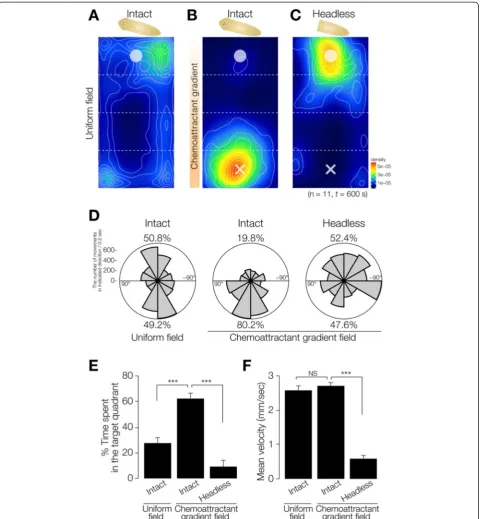
Next, we tested the behavior of intact planarians in a nor-mal field (uniform-field assay chamber without chemo-attractant). Figure 3A shows the averaged movements of 11 planarians together with a heat map for these movements (in which warm colors indicate locations where much time was spent, and cool colors those where little time was
spent), and indicates that planarians tended to move near the edge of the field. In contrast, planarians placed at the start region indicated by an open circle in a chamber with chemoattractant showed a preference to move toward the region where the chemoattractant had been dropped (cross in Figure 3B). However, headless planarians did not move toward the chemoattractant, and instead showed random movements around the start region indicated by a white circle in Zone 1, indicating that the head is required for chemotaxis (Figure 3C). In order to investigate whether pla-narians orient their movement up a gradient of chemo-attractant, we analyzed the overall orientation (angle) of their movement in Zones 2 and 3 (except for the start and target quadrants). Intact animals in a chemoattractant gra-dient field showed orientation biased toward the chemo-attractant (80.2% of their movement was directed toward the chemoattractant), whereas planarians in a uniform field (49.2%) and headless planarians (47.6%) did not show linear movement directed toward the chemoattractant, and in-stead showed random movements (Figure 3D).
Next, the average time (during a 600-sec test interval) spent by the animals in the target quadrant region where the chemoattractant had been placed was measured to assess the ability of animals to recognize attractant che-micals and move to the region where those cheche-micals were concentrated. Intact animals spent a large fraction of their time in the target zone after reaching it (62.7 ± 4.1%) (Figure 3E). In contrast, headless animals showed a much lower thermotaxis score (8.9 ± 5.1%) (Figure 3E). There was no difference in the speed of movement of planarians in the chemoattractant-gradient field (2.69 ± 0.12 mm/sec) and uniform field (2.58 ± 0.11 mm/sec), in-dicating that the difference of chemotaxis score between animals on a chemoattractant-gradient, and thus the dif-ference of planarian movement between a uniform-field chamber and a plate containing chemoattractant, was not the result of acceleration of the locomotor activity by the chemoattractant (Figure 3F). These results indicate that this assay method is useful for quantitatively evaluating planarian chemotactic behavior, and that planarian chemotaxis is dependent on the head. Although decapita-tion inhibited planarians’movement, and they frequently stopped, resulting slower value of velocity (0.60 ± 0.07 mm/sec) (Figure 3F), the 600-sec assay time was thought to be sufficiently long for planarians to move to the target quadrant, suggesting that the headless planarians may have lost chemotaxis rather than that they spent less time in the target quadrant due to slowing of their movement.
Analysis of the brain neurons involved in chemotaxis with Readyknock ofsynaptotagmin
The above data showed that headless planarian showed slower movement, and therefore we next analyzed vari-ous brain neurons to test whether the brain was
Thigmotactic/kinetic behavior analysis in planarians
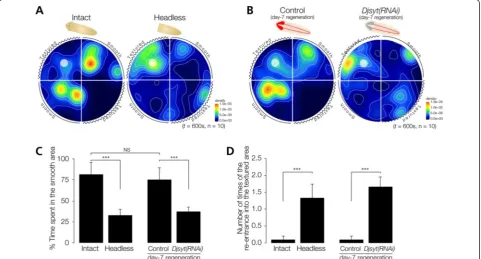
Planarians show reactions through mechanical-tactile sensing to such stimuli as water flow, touch, and contact with objects [5,25]. To study such sensing, we next established a thigmotaxis/kinesis assay (Figure 1B). Figure 5A shows the averaged movements of 10 planar-ians together with a heat map of these movements, and indicates that planarians placed at a start region with a textured surface region showed a preference to move away from the textured surface region and move to a re-gion with a smooth surface, and then stopped on the smooth region (Figure 5A). Note that intact animals that started from a textured surface region little spent time in the textured surface region of the assay plate opposite to that of the start region. In contrast, headless planar-ians showed random movements, and stopped without regard to the start-site condition, indicating that the head is required for thigmotaxis/kinesis (Figure 5A). Next, to investigate brain functions involved in thigmotaxis/kinesis, we performed a thigmotaxis/kinesis behavioral assay after Readyknock with Djsyt(RNAi). The results revealed that Djsyt(RNAi)planarians did not preferentially move to the smooth-surface region, although control animals showed
normal thigmotactic/kinetic behavior (Figure 5B). In order to better analyze the data, we quantified behaviors by calculating the average time spent by the animals in the smooth-surface region during a 600-sec test period to assess the ability of animals to recognize the physical properties of the surface and to move to a smooth-surface region, and plotted the results graphically (Figure 5C). These analyses clearly indicate that intact animals spend a large fraction of their time in the target zone after reach-ing it (81.4 ± 14.2%) (Figure 5C), whereas headless animals show a much lower thigmotaxis/kinesis score (32.8 ± 7.3%) (Figure 5C). Similarly, quantification of the time spent in the smooth-surface region byDjsyt(RNAi) planar-ians clearly showed that although control RNAi animals showed normal thigmotactic/kinetic behavior (75.3 ± 14.3%) (Figure 5C),Djsyt(RNAi)animals moved randomly and stopped in a random manner, like headless planarians (37.5 ± 5.0%) (Figure 5C). This finding is consistent with the findings in our chemotaxis, phototaxis, and thermo-taxis assays (Figure 4) [7,11].
Next, comparison of intact and control RNAi animals at seven days of regeneration revealed that the average time they spent in the smooth-surface region was nearly
Figure 5Planarian thigmotaxis/kinesis. (A)Heat map view with contour lines of thigmotaxis/kinesis of intact and headless planarians in thigmotaxis/kinesis assay field. Intact planarians tended to move to the smooth-surface region after starting from the textured surface region indicated by the white circle. In contrast, headless planarians continued to move around in the assay field independent of whether the bottom surface was smooth or textured.(B)Heat map view with contour lines of thigmotaxis/kinesis of control and Readyknock-treated planarians of
Djsytin the thigmotaxis/kinesis assay field.Djsyt(RNAi)planarian showed random movement, like headless planarians, whereas control planarians moved to and stayed in the smooth-surface region.(C)Time spent in the smooth region during assay of intact, headless, control, andDjsyt(RNAi)
gion (1.3 ± 0.4, 7/9; 1.7 ± 0.3, 8/9), indicating that planar-ians avoid textured surfaces, and that this behavior may require brain neural activity (Figure 5D). These results suggest that the thigmotaxis/kinesis assay system is useful for analyzing the function of the planarian brain and nervous-system-related genes, and that neural activity in the brain is required for several planarian behaviors, in-cluding chemotaxis, thigmotaxis/kinesis, phototaxis, and thermotaxis [7,11].
Prioritization among behaviors
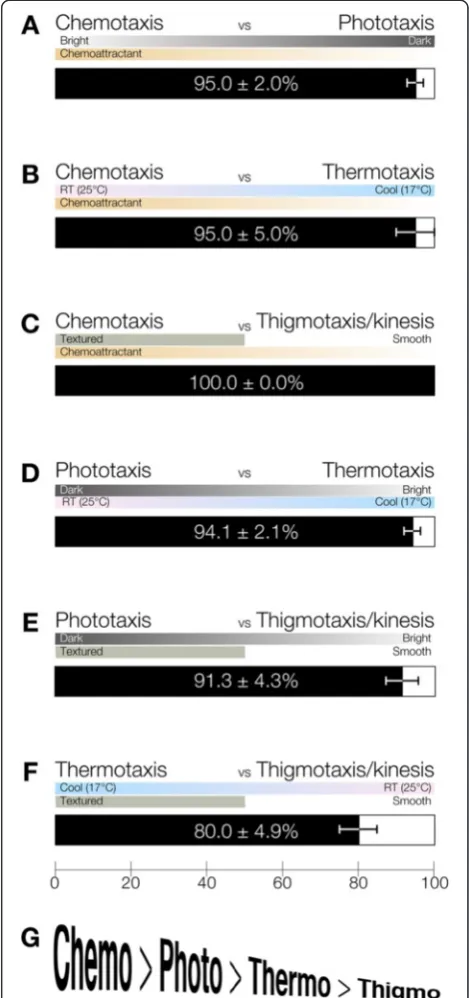
Next, by combining assays of different behaviors, namely chemotaxis, phototaxis, thermotaxis, and thigmotaxis/ kinesis, we examined the ability of planarians to inte-grate various stimuli. To determine the order of pre-dominance of these planarian behaviors under specific conditions in this study using constant strengths of stim-uli, at first we performed combinatorial assays in which two distinct stimuli were presented simultaneously to planarians. For these assays, a planarian was placed in the center position of a 60 × 30 × 10 mm assay chamber, and was given different stimuli from the two different ends, and then the number of planarians at a given pos-ition was measured after 600 sec.
When we compared behaviors in this combinatorial assay using planarians presented with both chemo-attractant and 400 lux of light, planarians preferred to move toward the chemoattractant rather than es-caping from the light, even though they received strong enough light (400 lux) to induce phototaxis in a single-stimulus assay (Figure 6A) [6]. The preference index for chemotaxis (95.0 ± 2.0%) clearly indicated that planarians predominantly showed chemotaxis ra-ther phototaxis behavior (Figure 6A). Moreover, planar-ian chemotaxis was dominant over thermotaxis and thigmotaxis/kinesis (Figure 6B,C). Next, when phototaxis was compared to thermotaxis and thigmotaxis/kinesis, phototaxis was predominant over thermotaxis and thigmotaxis/kinesis (Figure 6D, E). Finally, when thermo-taxis and thigmothermo-taxis/kinesis were compared, the prefer-ence index of thermotaxis (80.0 ± 4.9%) was higher than that of thigmotaxis/kinesis (Figure 6F). The results of our
analyses using these combinatory assay systems (chemo-taxis, photo(chemo-taxis, thermo(chemo-taxis, and thigmotaxis/kinesis) re-vealed that one behavior tends to predominate when planarians receive two different stimuli (Figure 6A-F). In
these combinatory experiments, planarians gave top pri-ority to a chemical stimulus and second-highest pripri-ority to a light stimulus, and gave the lowest priority to a mechanical stimulus (Figure 6G). These data suggest that planarians may have the ability to integrate various different external kinds of information in the brain.
Establishment of a behavioral integration assay method to analyze brain function using two distinct
external stimuli
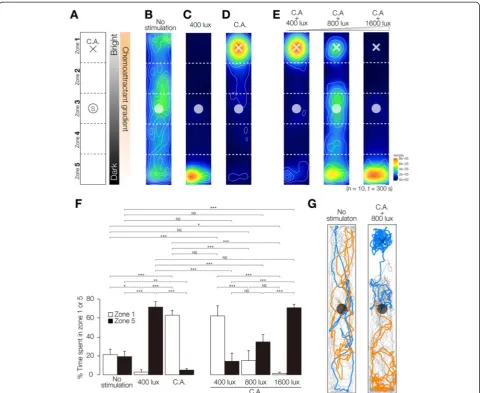
It is thought that animals integrate multiple signals, and show appropriate behaviors after integrating their re-sponses. Next, to investigate in more detail whether pla-narians prioritize different stimuli, and whether the order of predominance of behaviors in planarian is absolute, we employed an integrative assay that we developed to per-form combinatory assays using two distinct stimuli. Our combinatory assay system using two distinct stimuli, light and chemoattractant, is illustrated in Figure 7A. The 60 × 10 × 3 mm assay chamber was divided into five zones to enable quantitative measurement of the planarian behav-iors. When a planarian was placed into the center of the chamber (Zone 3), it moved randomly (Figure 7B). The heat map of planarian movement showing the time spent in each zone did not indicate any particular tendency of movement in this control condition, which was consistent with the above data shown in Figure 3A. When we assayed planarian phototaxis and chemotaxis using this chamber, planarians moved away from the 400-lux light source (Figure 7C), as previously described [6], and planarians moved toward Zone 1, where the chemoattractant (C.A.) had been added (Figure 7D), as seen in Figures 3 and 4. In addition, when planarians were exposed to 400 lux of light and chemoattractant simultaneously, they moved toward the region of the chemoattractant source (Zone 1) (Figure 7E). This result was also consistent with the above results (Figure 6A). However, by exposing planarians to different intensities (800 or 1600 lux) of light and exposing them to a constant dose of chemoattractant at the same time, it was found that planarians changed their preference and moved toward the dark side of the chamber, depending on the level of the stimuli (Figure 7E). These results suggest that planarians can change their be-havioral features in response to a stimulus to which they are repeatedly exposed, and that planarian behavior can be manipulated. Figure 7F shows the time spent in the dark-est zone (Zone 5) and in the chemoattractant-source zone (Zone 1), and this graph clearly indicates that we success-fully manipulated the outcome of the integration process by changing the signal strength. When planarians were ex-posed to 800 lux of light and chemoattractant simultan-eously, they seemed to move in a random way, as seen in control planarians without stimulation (Figure 7B). Con-sistently, there was no significant difference in spent time
in Zone 1 or 5 between planarians with no stimulation and combined exposure to 800 lux of light and chemo-attractant (Figure 7F). However, careful analysis of their trajectories revealed that each control planarian moved extensively in the assay chamber, whereas each planarian exposed to 800 lux of light and chemoattractant moved toward the chemoattractant or moved toward the dark region (Figure 7G). This suggests that planarians might decide upon a behavior strategy from among several pos-sible candidate strategies, and they may select different strategies depending on the individual. These results sug-gest that planarians may decide their behavioral strategies via their brain function when exposed to multiple stimuli.
Discussion
Planarian chemotaxis and thigmotaxis/kinesis
Chemosensing in addition to visual sensing and appropri-ate responses to various stimuli in order to find food, to escape from predators, and to communicate with other in-dividuals, are among the most important primary func-tions of organisms. Planarian food-finding behavior is thought to be completely dependent on chemosensing [26], and the auricles and head margin are thought to be an important organ of chemosensing [27], although no chemosensory receptors or chemosensory neurons have been identified. Here, we established a new, tractable be-havioral analysis system for chemotaxis to a food attract-ant, and used it to quantify the movements of planarians exposed to food as a chemoattractant. This behavioral assay system combined with RNAi may be a powerful tool for finding genes involved in chemotaxis, genes important in processing neurons in the brain, genes encoding mosensory receptors, and other genes important in che-mosensory neurons.
In contrast, unfortunately we have not been able to prepare a texture-gradient field, and therefore we were unable to investigate how planarians recognize the differ-ence between textured and smooth surfaces to reach a re-gion with a preferred surface. In addition, we are unable to distinguish whether the thigmotaxis/kinesis we observed here was positive or negative (preference for a smooth sur-face or evasion of a textured sursur-face), although the planar-ians showed a clear tendency to move to and stay for a
long time in the smooth surface region (Figure 5). We speculate that planarians can attach more strongly to smooth surfaces with wider adhesion areas than to textured surfaces, and that this behavior may benefit planarians by enabling them to find safer and more stable surfaces. Con-sistently, in nature, planarians can usually be found under small stones or leaves, where they may avoid light, strong water flow, and predators. Moreover, we found that this fea-ture of planarians could be utilized to arbitrarily restrict the
regions where planarians moved in a field to regions with-out vertical walls (Additional file 1: Figure S1).
Planarian behaviors require neural activity of the brain
The robust regenerative ability of planarians makes them very useful for analyzing the phenotypes of amputated body fragments, such as headless animals, in order to in-vestigate the organs regulating behaviors, since these fragments do not die. Head-amputated planarians com-pletely lost both chemotaxis and thigmotaxis (Figures 3C, and 5A), suggesting that the head is required for both of these planarian behaviors. Furthermore, the planarian's strong regenerative ability enabled us to perform region-conditional gene knockdown by the procedure called Readyknock [11], and the resultant specific loss of neural activity in the brain by Readyknock of the synaptotagmin gene caused complete loss of both chemotaxis and thigmo-taxis. These results suggest that neural activity in the brain is required for the sensing of chemical and mechanical stimuli, and/or for processing in the brain of the signals re-ceived through chemo- and thigmosensory neurons.
Note that decapitation caused a decrease of mean vel-ocity of locomotion (Figure 3F), although the duration of the assay (600 sec) was sufficient for planarians to reach target regions from the start point in the assay chamber, and for us to judge their chemotactic behavior. Because of this decrease of mean velocity we cannot completely exclude the possibility that the decapitation-induced decrease of velocity led to the reduction of the chemotactic and thigmotactic scores. However, loss of synaptotagmin gene function in the brain did not affect their velocity of locomotion (Figure 4G), but did cause loss of these behaviors, suggesting that planarian chemotaxis and thigmotaxis are dependent on the brain in their head, and that our chemotaxis and thigmotaxis assay systems are useful for analyzing various functions of the planarian brain and of nervous-system-related genes. Previously, we reported that neural activity in the brain is required for both phototaxis and thermotaxis [7,11,28]. Our results in this study together with those previous results strongly suggest that planarian behaviors responsive to external stimuli are controlled by the brain.
Panel of behavioral assays may provide means to unravel neural networks of higher brain function in planarian
Planarian higher brain function was first described in the 1950s, when Thompson and McConnell used clas-sical conditioning experiments using light and electrical shock to show planarian's ability to learn and remember [29]. However, as this phenomenon has not been verified by other groups, McConnell's studies of planarian learn-ing remain controversial [30,31].
The unique features of planarians’ higher brain func-tions have provided many insights into brain function in
metazoans, and studies on planarian classical conditioning have attracted many researchers [32,33]. However, the neural pathways of planarian higher brain functions, in-cluding integration and learning, have not yet been unrav-eled, and even many of the original observations made decades ago have not been verified yet at the neuronal level. Moreover, it is difficult to analyze the neural mecha-nisms underlying higher brain function in planarians using the originally reported classical conditioning assay system utilizing light and electrical shock, because electrical stimulation might affect muscles directly. Previously, assay systems for planarian phototaxis and thermotaxis have been reported, and a number of genes and neuronal sub-types involved in sensing external stimuli and related char-acteristic behaviors have been identified [6,7,28]. Here we took another step forward by developing quantita-tive methods for chemotaxis and thigmotaxis/kinesis that enabled us to investigate the mechanisms under-lying information processing and integration in the planarian brain. In order to acquire information about planarian behaviors in response to multiple simultan-eous stimuli, we performed a binary competitive assay in which a planarian was given two distinct stimuli sim-ultaneously under specific conditions in combinatory experiments. The results showed that planarians dis-played an order of priority among their responses to these different stimuli (Figure 6), suggesting that the planarian brain has the ability to integrate signals com-ing from outside to decide appropriate planarian behav-iors. Furthermore, we showed that planarian movements vary according to the stimulus level (Figure 7E), although we did not find any light-intensity dependence of plan-arian phototaxis (data not shown). These results sug-gest that planarians do not show a simple, direct response to a stimulus, but rather integrate external stimuli and then behave suitably in response to the overall conditions.
Neural networks predicted to be involved in controlling decision-making
and motor function of body wall muscles is regulated by cholinergic neurons [37] (Figure 8A).
It seems unlikely that individual neurotransmitters are in-volved in only single neural circuits or behaviors [24,28,37];
rather, neurons expressing a particular neurotransmitter may have different roles according to the particular cell or position in the brain, and may accordingly construct more complex neural networks. By accumulating further data
from the kinds of experiments reported here and further refining the assay systems, we should be able to unravel the neural networks or systems involved in the higher brain function in planarian. Here we found that planarian behav-iors in response to stimuli could be changed flexibly ac-cording to the level of stimulation. Axons of the sensory neurons in planarian, such as the axons of the optic neu-rons and chemosensory neuneu-rons, project to different re-gions in the brain (Figure 8B,C). For example, visual neurons project to the dorso-medial region (visual center) in the brain, whereas axons of chemosensory neurons in the lateral branch neurons project to the ventro-lateral re-gion of the brain, as visualized by immunostaining with specific antibodies (Figure 8B,C), consistent with previous results obtained using fluorescent dye tracing [2]. It has been suggested that external stimuli sensed by such organs are integrated in some region(s) of the brain, finally result-ing in planarians’ behaviors. Ultimately, the information acquired by sensory neurons might be accumulated inside the brain, and then processed and integrated to transduce the signals into the activity of motor neurons (Figure 8).
Conclusions
The chemotaxis and thigmotaxis/kinesis assay methods established here are useful for quantitatively analyzing planarian chemotactic and thigmotactic/kinetic behav-iors. Headless planarian body fragments and planarians treated by Readyknock of synaptotagmin in the brain lost both chemotactic and thigmotactic behaviors, suggest-ing that brain neural activity is required for the chemotac-tic and the thigmotacchemotac-tic behavior in planarian. When we tested the priority among four planarian behaviors (photo-taxis, chemo(photo-taxis, thigmotaxis/kinesis, and thermotaxis) by presenting the respective stimuli to planarians simul-taneously as binary stimuli, the results revealed that pla-narians showed a clear order of predominance of these behaviors, with chemotaxis being the strongest stimulus under our conditions. We also found that planarians showed predominance of their behavioral response to either of two simultaneously presented stimuli depending on the strengths of the two stimuli in a competitive binary stimuli assay using light and chemoattractant. Taken to-gether, our results support the notion that external stimuli sensed by respective sensory organs are integrated in the brain and determine planarian behaviors.
Additional file
Additional file 1: Figure S1.Planarian behaviors in arbitrary smooth surface region.(A)Schematic drawing of textured dish for thigmotaxis/ kinesis assay. Textured regions are indicated by gray color. The other region (colored white) indicates a smooth region.(B)Heat map view of planarians’movement. Planarians only moved on the smooth surface region, although planarians usually tend to move near the edge of a dish as a default behavior.
Abbreviations
CNS:Central nervous system; VNCs: Ventral nerve cords; RNAi: RNA interference; Readyknock: Regeneration-dependent conditional gene knockdown; CA: chemoattractant; DjGβ: G-proteinβsubunit; DjTBH:Dugesia japonica
tyramine beta-hydroxylase; Djsyt:Dugesia japonicasynaptotagmin;
DjTRPMa:Dugesia japonicatransient receptor potential ion channel melastatin family a; DjTPH:Dugesia japonicatryptophan hydroxylase; DjGAD: Glutamic acid decarboxylase; gamma-aminobutyric acid; DjTH:Dugesia japonicatyrosine hydroxylase; DjChAT:Dugesia japonicacholine acetyltransferase; oc: optic chiasm; cn: Chemosensory neuron; SEM: Standard error of mean.
Competing interests
The authors declare that they have no competing interests.
Authors’contributions
TI conceived the project, designed and performed molecular and histological experiments, conducted data analysis and wrote the manuscript. HH conducted chemotactic, and integrative behavior analysis. TY conducted thigmotactic and competitive behavior analysis. SS conducted chemotactic behavior analysis. KA wrote the manuscript. All authors read and approved the final manuscript.
Acknowledgments
We thank Dr. Elizabeth Nakajima for critical reading of the manuscript. This work was supported by a Grant-in-Aid for Young Scientists (B) to TI, The Kyoto University Research Funds for Young Scientists to TI, The Brain Science Foundation funds to TI, a Grant-in-Aid for Scientific Research on Innovative Areas to KA, a Grant-in-Aid for Creative Scientific Research to KA, and the Grants to Excellent Graduate Schools (MEXT) program of Kyoto University.
Received: 26 September 2014 Accepted: 27 November 2014
References
1. Agata K, Soejima Y, Kato K, Kobayashi C, Umesono Y, Watanabe K. Structure of the planarian central nervous system (CNS) revealed by neuronal cell markers. Zool Sci. 1998;15:433–40.
2. Okamoto K, Takeuchi K, Agata K. Neural projections in planarian brain revealed by fluorescent dye tracing. Zool Sci. 2005;22:535–46. 3. Takeda H, Nishimura K, Agata K. Planarians maintain a constant ratio of
different cell types during changes in body size by using the stem cell system. Zool Sci. 2009;26:805–13.
4. Umesono Y, Tasaki J, Nishimura K, Inoue T, Agata K. Regeneration in an evolutionarily primitive brain–the planarian Dugesia japonica model. Eur J Neurosci. 2011;34:863–9.
5. Pearl R. The movements and reactions of fresh-water planarians: A study in animal behaviour. Q J Microsc Sci. 1903;46:509–714.
6. Inoue T, Kumamoto H, Okamoto K, Umesono Y, Sakai M, Sanchez Alvarado A, et al. Morphological and functional recovery of the planarian photosensing system during head regeneration. Zool Sci. 2004;21:275–83. 7. Inoue T, Yamashita T, Agata K. Thermosensory signaling by TRPM is
processed by brain serotonergic neurons to produce planarian thermotaxis. J Neurosci. 2014;34:15701–14.
8. Cebria F. Regenerating the central nervous system: how easy for planarians! Dev Genes Evol. 2007;217:733–48.
9. Fusaoka E, Inoue T, Mineta K, Agata K, Takeuchi K. Structure and function of primitive immunoglobulin superfamily neural cell adhesion molecules: a lesson from studies on planarian. Genes Cells. 2006;11:541–55.
10. Inoue T, Hayashi T, Takechi K, Agata K. Clathrin-mediated endocytic signals are required for the regeneration of, as well as homeostasis in, the planarian CNS. Development. 2007;134:1679–89.
11. Takano T, Pulvers JN, Inoue T, Tarui H, Sakamoto H, Agata K, et al. Regeneration-dependent conditional gene knockdown (Readyknock) in planarian: demonstration of requirement for Djsnap-25 expression in the brain for negative phototactic behavior. Dev Growth Differ. 2007;49:383–94. 12. Umesono Y, Watanabe K, Agata K. A planarian orthopedia homolog is
specifically expressed in the branch region of both the mature and regenerating brain. Dev Growth Differ. 1997;39:723–7.
Photochem Photobiol. 1999;69:99–104.
19. Wickham H. ggplot2: Elegant Graphics for Data Analysis. New York, USA: Springer; 2009.
20. Shibata N, Hayashi T, Fukumura R, Fujii J, Kudome-Takamatsu T, Nishimura O, et al. Comprehensive gene expression analyses in pluripotent stem cells of a planarian,Dugesia japonica. Int J Dev Biol. 2012;56:93–102.
21. Rouhana L, Weiss JA, Forsthoefel DJ, Lee H, King RS, Inoue T, et al. RNA interference by feeding in vitro-synthesized double-stranded RNA to planarians: methodology and dynamics. Dev Dyn. 2013;242:718–30. 22. Tazaki A, Gaudieri S, Ikeo K, Gojobori T, Watanabe K, Agata K. Neural
network in planarian revealed by an antibody against planarian synaptotagmin homologue. Biochem Biophys Res Commun. 1999;260:426–32.
23. Sakai F, Agata K, Orii H, Watanabe K. Organization and regeneration ability of spontaneous supernumerary eyes in planarians -eye regeneration field and pathway selection by optic nerves. Zool Sci. 2000;17:375–81. 24. Nishimura K, Kitamura Y, Inoue T, Umesono Y, Yoshimoto K, Taniguchi T,
et al. Characterization of tyramine beta-hydroxylase in planarianDugesia japonica: cloning and expression. Neurochem Int. 2008;53:184–92. 25. Weimer BR. Thigmotactic Reactions of the Fresh Water Turbellarian,
Phagocata gracilis, Leidy. Trans Am Microsc Soc. 1918;37:111–24.
26. Miyamoto S, Shimozawa A. Chemotaxis in the Freshwater Planarian,Dugesia japonica japonica. Zool Sci. 1985;2:389–95.
27. Pigon A, Morita M, Best JB. Cephalic mechanism for social control of fissioning in planarians. II. Localization and identification of the receptors by electron micrographic and ablation studies. J Neurobiol. 1974;5:443–62. 28. Nishimura K, Kitamura Y, Umesono Y, Takeuchi K, Takata K, Taniguchi T,
et al. Identification of glutamic acid decarboxylase gene and distribution of GABAergic nervous system in the planarianDugesia japonica. Neuroscience. 2008;153:1103–14.
29. Thompson R, McConnell JV. Classical conditioning in the planarian,Dugesia dorotocephala. J Comp Physiol Psychol. 1955;48:65–8.
30. Hartry AL, Keith-Lee P, Morton WD. Planaria: Memory Transfer through Cannibalism Reexamined. Science. 1964;146:274–5.
31. Rilling M. The mystery of the vanished citations: James McConnell's forgotten 1960s quest for planarian learning, a biochemical engram, and celebrity. American Psychologist. 1969;51:589–98.
32. Shomrat T, Levin M. An automated training paradigm reveals long-term memory in planarians and its persistence through head regeneration. J Exp Biol. 2013;216:3799–810.
33. Prados J, Alvarez B, Howarth J, Stewart K, Gibson CL, Hutchinson CV, et al. Cue competition effects in the planarian. Anim Cogn. 2013;16:177–86. 34. Asano Y, Nakamura S, Ishida S, Azuma K, Shinozawa T. Rhodopsin-like proteins in planarian eye and auricle: Detection and functional analysis. J Exp Biol. 1998;201:1263–71.
35. Zamanian M, Kimber MJ, McVeigh P, Carlson SA, Maule AG, Day TA. The repertoire of G protein-coupled receptors in the human parasite
Schistosoma mansoniand the model organismSchmidtea mediterranea. BMC Genomics. 2011;12:596.
36. Nishimura K, Kitamura Y, Inoue T, Umesono Y, Sano S, Yoshimoto K, et al. Reconstruction of dopaminergic neural network and locomotion function in planarian regenerates. Dev Neurobiol. 2007;67:1059–78.
37. Nishimura K, Kitamura Y, Taniguchi T, Agata K. Analysis of motor function modulated by cholinergic neurons in planarianDugesia japonica. Neuroscience. 2010;168:18–30.
Submit your next manuscript to BioMed Central and take full advantage of:
• Convenient online submission
• Thorough peer review
• No space constraints or color figure charges
• Immediate publication on acceptance
• Inclusion in PubMed, CAS, Scopus and Google Scholar
• Research which is freely available for redistribution