RESEARCH ARTICLE
Development and differentiability
of three brief interventions for risky alcohol
use that include varying doses of motivational
interviewing
Jennifer E. Hettema
1*, Stephanie A. Cockrell
1, Abigail Reeves
2, Karen S. Ingersoll
2, Paula J. Lum
3, Richard Saitz
4,
Cristina M. Murray‑Krezan
5and Valerie A. Carrejo
1Abstract
Background: While brief intervention (BI) for risky alcohol use generally yields positive effects among those identi‑ fied by screening, effect sizes are small and there is unexplained heterogeneity in outcome. The heterogeneity may be related to differences in intervention style and content, including elements of motivational interviewing (MI). To date, it has been difficult to interpret the role of MI in BI and these gaps in knowledge interfere with efforts to train, dissemi‑ nate and implement BI that retains and maximizes efficacy. This study sought to develop BI protocols with varying doses of MI and test their differentiability. Differentiable BI protocols could allow for future studies that prospectively evaluate the role MI plays in affecting BI outcome.
Methods: We developed three intervention protocols: brief advice, standard BI (NIAAA Clinician’s Guide), and MI‑ enhanced BI and administered them to 45 primary care patients who reported exceeding recommended drinking limits. We then rated the BI sessions for fidelity to the assigned protocol as well as MI consistency based on Moti‑ vational Interviewing Treatment Integrity (MITI) scale scores. The differentiability of BI protocols was determined by calculating fidelity to assigned protocols and comparing MITI scores using pairwise, Tukey‑adjusted comparisons of least squares mean scores.
Results: High rates of fidelity to each protocol were achieved. The three BI protocols were also highly differentiable based on MITI scores.
Conclusions: The three interventions can be used in future trials to prospectively examine the role MI has in deter‑ mining BI outcome.
Trial registration clinicaltrials.gov NCT02978027, retrospectively registered 11/28/16
Keywords: Motivational interviewing, Brief alcohol intervention in primary care, Treatment fidelity, Differentiable interventions, Risky alcohol use
© The Author(s) 2018. This article is distributed under the terms of the Creative Commons Attribution 4.0 International License (http://creativecommons.org/licenses/by/4.0/), which permits unrestricted use, distribution, and reproduction in any medium, provided you give appropriate credit to the original author(s) and the source, provide a link to the Creative Commons license, and indicate if changes were made. The Creative Commons Public Domain Dedication waiver (http://creativecommons.org/ publicdomain/zero/1.0/) applies to the data made available in this article, unless otherwise stated.
Background
Screening and brief intervention (SBI) for risky alco-hol use in primary care settings has demonstrated effi-cacy. In a meta-analysis of 23 controlled studies, patients
identified by screening in primary care settings who received BI consumed less alcohol on average (3.6 fewer drinks per week) and were less likely to exceed limits (12% fewer) than control patients at one-year follow-up [1]. However, despite overall positive findings, there are high levels of variability in BI effects, with significant unexplained heterogeneity in outcomes [1–3]. In fact, the number of studies that do and do not find significant
Open Access
*Correspondence: [email protected]
1 Department of Family and Community Medicine, University of New Mexico, Albuquerque, NM, USA
BI effects are nearly evenly split [4]. This variability may be attributable in part to differences in the interven-tion components and communicainterven-tion style that under-lie tested BI protocols, including fidelity to motivational interviewing (MI).
MI is a patient-centered communication style that seeks to draw out and enhance patients’ own motiva-tion to change health behaviors [5]. Studies of SBI fre-quently report that the tested BI protocol was conducted in a manner that was consistent with an MI approach, but additional methodological details are often lacking. For example, Richmond et al. [6] briefly mention that “Patient counseling included techniques of motivational interviewing,” Senft et al. [7]. mention that research staff “were trained in principles of motivational interview-ing,” Fleming et al. [8] included a workbook “based on the principles of motivational interviewing,” and Reinhardt et al. [9] provided counseling sessions “based on motiva-tional Interviewing,” in which “the main content of each intervention was the enhancement of motivation.” None of these examples provide a specific description of how MI was incorporated into the intervention.
There are several potential ways in which MI princi-ples or skills could be integrated into BI. For example, interventionists could be trained to take a collabora-tive or empathic stance, to avoid potential roadblocks to communication such as labeling and unsolicited advice, to use specific frequencies of communication skills such as complex reflections, to conduct specific exercises, to adhere to different decision rules regarding patient readi-ness levels, or some combination of the above. Lack of methodological details regarding the content and struc-ture of brief interventions makes it difficult to assess the moderating impact of MI dose on outcome across trials, and primary care-based meta-analyses to date have been unable to report on the impact of this construct [1–4].
Although MI has been found to be effective for address-ing alcohol issues in medical care settaddress-ings [10] and aligns with several principles of medical ethics [11], there are many barriers to implementing MI in brief medical inter-actions. Healthcare providers are faced with many com-peting priorities and limited time with patients, creating pressure to conduct preventive and behavioral health interventions as efficiently as possible [12]. Conducting MI, even its briefest applications, is more time consum-ing than simple advice givconsum-ing. In addition, MI is a com-plex set of skills that requires flexible application and contingent responding to moment-to-moment changes in what patients say [5]. Proficiency in the approach requires extensive training time, ongoing supervision and resources that are often limited among medical trainees and clinicians. A recent review of MI training for health-care professionals found that average training duration
exceeded 1 day and in many cases such training failed to yield clinical improvements in MI proficiency [13]. Lastly, medical clinicians themselves often perceive barriers to implementing MI, including concerns about lack of time, low levels of perceived responsibility, low confidence, and lack of support [14].
To date, there is a dearth of empirical work examining mechanisms of behavior change in SBI for risky alcohol use [15]. Of the available research that has focused on the impact of MI within SBI, results have yielded mixed find-ings [16]. For example, Bertholet et al. [17] re-analyzed combined data from three controlled BI trials for profi-ciency in important MI behaviors and found no consist-ent predictors of outcome. In a similar secondary analysis designed to test the mediating link between MI-consist-ent behaviors such as open-questions, affirmations, and reflections, client change talk, and outcome proposed by the prevailing MI model [18], this hypothesized causal chain was only supported in specific conditions, such as with therapists who had more than 3 years experience [19].
There have been some attempts to compare different SBI approaches prospectively. For example, the Effec-tiveness of Screening and Brief Alcohol Intervention in Primary Care Trial (SIPS trial) compared three brief intervention conditions for hazardous drinkers in pri-mary care settings: an informational leaflet, a brief advice session, and an MI-informed brief lifestyle counseling session [20]. Results of the SIPS showed no significant differences in drinking reduction between the three con-ditions at follow-up, although patients in the lifestyle counseling group had significantly increased readiness to change and satisfaction with the intervention. While this trial did compare different intensities of intervention, it was confounded by content and not specifically designed to allow for inferences regarding the role of MI strategies on outcome, as treatment modalities were additive, with all participants first receiving brief advice. Additionally, the content and structure of brief advice was not tightly controlled and study authors report that study interven-tionists, who were clinic-based providers, often extended into more therapeutic tasks.
telephone booster among trauma center patients who recently consumed alcohol and found that the BMI plus booster condition outperformed other treatments [22]. Apodaca conducted a recent secondary analysis of a brief intervention for college students with problems drink-ing and found that therapist use of Mi microskills such as reflections and open-questions produced both change and sustain talk [23]. This trend was also observed on a recent multivariate meta-analysis of MI process and out-come, which found that both therapist microskills and global ratings predicted change and sustain talk and that sustain talk was predictive of poor outcome, providing equivocal support for the proposed MI theory of change [24].
While we have evidence to suggest that primary care-based brief advice may be just as effective as MI with smoking cessation [25], the evidence is not clear for BI for risky alcohol use. One strategy for determining the impact of MI on BI efficacy is by prospectively com-paring SBI protocols with varying doses of MI content. While mechanisms of action research have revealed vari-ability in MI within clinical trials, to date, it has not been demonstrated that is possible to create interventions that are reliably differentiable while still maintaining consist-ency within a general BI structure. In the current study we sought to develop SBI protocols that were differenti-able in terms of dose of MI, with the goal of prospectively comparing them in a future controlled trial.
Methods Study procedures
Participants were recruited during regularly scheduled primary care visits at two university-operated commu-nity primary care clinics. While the university system electronic medical record prompts medical assistants to conduct alcohol screening annually during triage at pri-mary care appointments, there is no standardized SBI protocol in place, compliance with screening is vari-able, and providers do not typically follow up regard-ing screenregard-ing results. Patients attendregard-ing the clinics were approached in the waiting room or the exam room prior to their scheduled visit to determine their interest in being screened for eligibility in the research study. Inter-ested participants were asked to fill out a paper copy of the NIAAA screening questions (“Do you sometimes drink beer, wine, or other alcoholic beverages?, “How many times in the past year have you had 5 or more (4 for women) alcoholic drinks in one day?” [26], and the Alcohol Use Disorders Identification Test - Consump-tion (AUDIT-C) quesConsump-tionnaire [27], which includes three multiple choice questions measuring drinking frequency in the past year, number of drinks consumed on a typical drinking day, and frequency of risky drinking episodes
in the past year. Inclusion criteria were endorsement of past year risky drinking, defined as any score other than zero in response to the NIAAA question about drinks in 1 day. Participants with an AUDIT-C score greater than 7, which indicates a likely alcohol use disorder were excluded, given that BI may not be sufficient for them. Eligible participants met with a researcher in a private exam room to provide informed consent. During their regularly scheduled primary care appointment, consent-ing patients were administered a baseline assessment and BI in their exam room prior to their provider visit or in a private adjacent office following their visit depend-ing on the clinic flow and the availability of the clinician. Participants were randomly assigned to one of three dis-tinct intervention conditions: BI based on the approach described in the NIAAA Clinician’s Guide (NIAAA), Brief advice (BA), or an MI-enhanced NIAAA Clinician’s Guide approach (MI). After the intervention, participants received a $25 gift card.
Baseline assessment
Following consent, participants completed a brief base-line assessment. The assessment was designed to be min-imal to avoid potential assessment reactivity effects [28,
29]. Baseline assessment included a brief demographic form and a locator form to assist with later follow-up. Within the context of the SBI protocol, interventionists verbally re-administered the NIAAA heavy drinking epi-sode screening question, determined drinking quantity and frequency, and assessed for AUDs using two ques-tions related to drinking in harmful situaques-tions and drink-ing more than intended [26]. Participants who endorsed either of these criteria were further assessed for AUD by responding to questions that correspond to each DSM 5-criterion.
Intervention protocols
Interventions were adapted from the NIAAA protocol “Helping Patients Who Drink Too Much: A Clinician’s Guide” [26]. All interventions were video recorded for later coding. Intervention protocols can be accessed in Additional files 1, 2 and 3.
NIAAA Clinician’s Guide (NIAAA)
rule out patients with a likely alcohol use disorder, this screening tool does not have perfect sensitivity and it was still possible for patients to have an AUD upon fur-ther assessment. In this trial, assessment of alcohol use disorders was conducted using Vinson’s [30] two ques-tions described above, instead of the entire diagnostic checklist. Those exceeding recommended limits were told: “You’re drinking more than is medically safe.” They were shown a chart describing U.S. adult drinking pat-terns that included recommended drinking limits and the prevalence and consequences of exceeding them. The clinician then stated: “I strongly recommend that you cut down and I’m willing to help.” The protocol called for assessment of readiness to change (“Are you will-ing to make changes in your drinkwill-ing?”). For patients unwilling to make a change, the clinician was instructed to restate their concern, encourage self-reflection by asking the patient about reasons to cut down on drink-ing and barriers to change, and reaffirm willdrink-ingness to help. For patients willing to make a change, the clinician was instructed to help the patient develop a plan to cut down within maximum limits, agree on specific steps and strategies, and provide a tip sheet on strategies for cutting down. The clinicians in the trial were specifically instructed to be warm and friendly. However, they were also instructed to avoid the use of MI micro-skills such as reflection, statements that infer the meaning underlying what patients have said, and not to differentially respond to change talk, by focusing on patients’ motivations (ver-sus barriers) to change.
Brief advice (BA)
The brief advice protocol was designed by removing MI-consistent elements from the NIAAA Clinician’s Guide, while leaving other elements that were either not MI-consistent or neutral. The protocol involved screen-ing and assessment usscreen-ing the same strategies described above. Patients exceeding recommended limits received the same feedback, information, and advice described above. All patients were then provided with a tip sheet on strategies for cutting down (e.g. pacing and spacing, keeping track, know your ‘no’) and encouraged to follow-up with a behavioral health provider with any questions or concerns. As above, the clinician in the trial was spe-cifically instructed to be warm and friendly, but avoid the use of reflection and evocation of change talk.
MI‑enhanced NIAAA Clinician’s Guide (MI)
The MI intervention condition was also adapted from the NIAAA Clinician’s Guide, with additional modifica-tion to include elements of MI. At the start of the pro-tocol, clinicians were instructed to normalize SBI and ask the patient’s permission before discussing alcohol
use. The NIAAA screening questions were adminis-tered as designed, which is closed-ended. Otherwise, when possible, closed questions were reframed as open questions. Assessment of quantity, frequency, and AUD symptoms was done using open questions, followed by closed questions if additional clarification was needed. The ask-tell-ask technique was used to share feedback regarding the patient’s risky drinking status and exchange information regarding U.S adult drinking patterns. Ask-tell-ask, involves asking patients what they know about a particular topic, providing information in a tailored way, and then asking the patient what they think of the information or how they might apply it. For patients low in readiness to make a change, clinicians built readiness using one of two structured MI tools: a scaling ruler or a road map. Scaling rulers involve asking patients to self-assess their perceived importance, confidence, or readi-ness to change and then strategically evoking change talk by inviting them to speak about why their assessment wasn’t lower. The road map exercise involves evoking change talk by asking patients to imagine their life down two paths and to speak about the good things that might happen if they change and the bad things that might hap-pen if they don’t change. For patients high in readiness to change, the ask-tell-ask technique was used to explore the tip sheet on strategies for cutting down and develop an action plan. The MI intervention called for interven-tionists to use reflective listening statements and summa-ries throughout the protocol and differentially focus on the patient’s reasons for change.
Fidelity and MI dose assessment
as assessment of global characteristics of the interven-tion, such as empathy and evocation. The MITI also has suggested benchmarks for beginning proficiency and competency.
Interventionists
The study interventionist was primarily the second author, a master’s level social worker with extensive train-ing in MI, however, the first author, a clinical psycholo-gist, also conducted some sessions. Both are members of the Motivational Interviewing Network of Trainers (MINT) who completed a MINT “training for train-ers (TNT).” Training for the study intervention involved extensive practice with mock patients until 95% fidelity measures were consistently met on all SBI protocols. The first author conducted bi-weekly feedback and supervi-sion during the trial.
Statistical analysis
To determine the reliability of fidelity coding, intraclass correlation coefficients (ICCs) were calculated using a one-way random model for absolute agreement [33]. Cicchetti has recommended that ICCs be interpreted as follows: below 0.40 = poor; 0.40–0.59 = fair; 0.60– 0.74 = good; and 0.75–1.0 = excellent [34]. To deter-mine the differentiability of the three interventions, mean percent fidelity to each protocol was compared across the three conditions using one-way ANOVA. MITI scores were compared across the three conditions using pair-wise, Tukey-adjusted comparisons of least squares mean scores. To reduce the possibility of spurious findings, a Bonferroni adjustment was made for 9 comparisons. Outcome measures met normality assumptions required for these analyses.
Results
Interrater agreement
Of the 45 sessions, 9 (20%) were co-rated to assess inter-rater agreement. Rates of interinter-rater agreement were excellent for the fidelity checklist (ICC = 0.93, 95% CI = 0.72, 0.98). All MITI global scores (evocation, col-laboration, autonomy support, direction, empathy) were also in the excellent range, with the exception of direc-tion, which could not be calculated because there was no variability in rating. All behavior count threshold (% open questions, % complex reflections, reflection to question ratio, and % MI-adherent) interrater agreement esti-mates were also in the excellent range.
Participant flow
Of the 502 patients approached by researchers, 413 agreed to be screened for eligibility and 92 (22.3%) screened positive for risky drinking. Among ineligible
screens, 291 did not report any past year risky drinking, and 5 exceeded the AUDIT-C upper cutoff. Other com-mon reasons for ineligibility were lack of English fluency (n = 15) and pregnancy (n = 3). Of those who screened positive, 45 (48.9%) enrolled in the study: 15 were assigned to NIAAA, 14 were assigned to the BA, and 16 were assigned to MI. The primary reason for non-enroll-ment was lack of time.
Participant characteristics
Participants were predominantly female (60%) and 42% were Hispanic. On average, participants reported between 1 and 156 heavy drinking days in the past year (mean 26 (SD = 42)). AUDIT-C scores ranged from 3 to 7 (mean 4.6 (SD = 1.3)).
Timing
Mean time to complete SBI varied across conditions, with BA taking, on average, 7 min (SD = 6, Range 4–14), NIAAA 9 min (SD = 3, Range 6–18), and MI 17 min (SD = 6, Range 5–32).
SBI fidelity
Fidelity to intervention components, as measured by the fidelity checklists was high across all conditions. Overall, the clinician completed between 92 and 96% of proto-col elements, with little variability within or across con-ditions. The mean percent fidelity did not differ across BA, NIAAA, and MI, which had respective scores of 96% (SD = 7%), 94% (SD = 6%), and 92% (SD = 6%) (p = 0.32).
MI differentiability
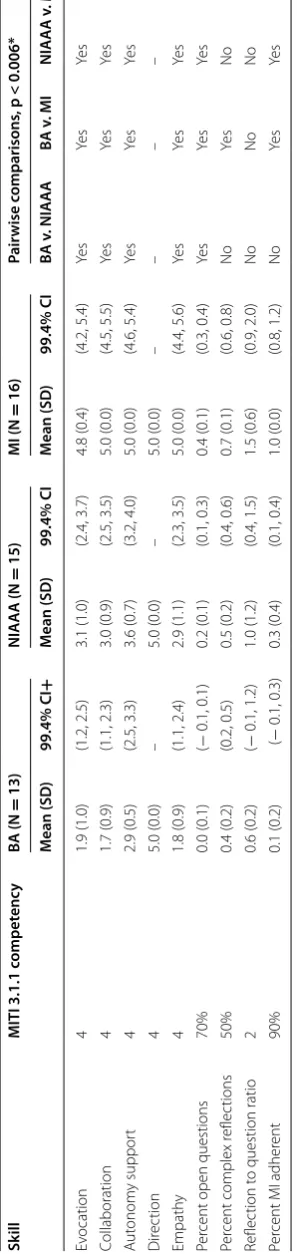
Significant differences between conditions were found for nearly all MITI constructs (Table 1). All differences were in the expected direction with MI showing the highest doses of MI, then NIAAA, and then BA. The MI condition met or exceeded MI competency standards on all measured domains with the exception of reflection to question ratio. BA and NIAAA did not contain levels of MI that are normally defined as meeting MI compe-tency standards on any of the assessed domains, with the exception of percent complex reflections for the NIAAA condition.
Discussion
doses of MI. The protocols can be used in their current form to conduct such work and the MI protocol can provide a standardized MI-based SBI protocol for other work. The availability of these protocols may help to shine light on the unclear picture regarding the role of MI in SBI for risky alcohol use in primary care. Similarly, in the area of treatment and in other settings where the impact of MI structure and content on outcome is some-what equivocal, the development of highly differentiable interventions may allow for improve prospective and ret-rospective analysis of effects.
The study has several strengths and limitations. The study sample was all English speaking and result may not be generalizeable to other clinic populations. The meth-ods were tightly controlled resulting in strong internal validity and could be easily translated to a future pro-spective comparison of the interventions using an effi-cacy trial design. However, the current study does not necessarily reflect rates of fidelity or MI differentiabil-ity that might be observed in an effectiveness trial that involves real-world clinicians. Additionally, training and oversight of the study interventionist was much more intensive than might be feasible with non-research staff.
The protocols in the current study were also primarily conducted by one study interventionist. While this fac-tor eliminates the risk of therapist effects confounding observed differences across SBI protocols, it may limit the generalizability of findings. Set the stage for other research that attempts to dismantle without clearly dem-onstrating idffereintiability.
Overall, this study represents an important contribu-tion to the research base focused on mechanism of accontribu-tion of SBI for risky alcohol use in primary care. Conducting SBI with high doses of MI takes more time and requires more training and oversight, resulting in many feasibil-ity barriers in the current medical training and practice environment. The current study provides researchers with a tool to address this important question. Future research should seek to compare the efficacy of the three SBI protocols, as well as determine the feasibility of train-ing non-research clinicians to conduct the interventions with fidelity to both structure and MI dose, determine the intensity of training and support needed to yield such results and compare the protocols using a effectiveness trial design.
Conclusions
This study demonstrated that it is possible to create pro-tocols for SBI for risky alcohol use that vary in MI dose, while maintaining fidelity to a structured SBI protocol. Fidelity ratings were consistently high and did not vary across the three SBI conditions, while nearly all meas-ures of MI consistency varied across conditions in the
Table 1 MITI sc or es among c onditions + 99.4% c onfidenc e in ter
vals with t
ype I er
ror r at e B onf er roni-cor rec ted f
or 9 c
ompar isons (α = 0.006) *P -v alues fr om pair wise , T ukey -adjust ed c ompar
isons of least squar
es mean sc
or
es
, with additional B
onf
er
roni adjustmen
t f
or 9 c
ompar
isons
Sk
ill
MITI 3.1.1 c
ompet enc y BA (N = 13) NIAAA (N = 15) MI (N = 16) Pair wise c omparisons , p < 0.006* M ean (SD ) 99.4% CI + M ean (SD ) 99.4% CI M ean (SD ) 99.4% CI BA v . NIAAA BA v . MI NIAAA v . MI Ev ocation 4 1.9 (1.0) (1.2, 2.5) 3.1 (1.0) (2.4, 3.7) 4.8 (0.4) (4.2, 5.4) Ye s Ye s Ye s Collaboration 4 1.7 (0.9) (1.1, 2.3) 3.0 (0.9) (2.5, 3.5) 5.0 (0.0) (4.5, 5.5) Ye s Ye s Ye s A ut onom y suppor t 4 2.9 (0.5) (2.5, 3.3) 3.6 (0.7) (3.2, 4.0) 5.0 (0.0) (4.6, 5.4) Ye s Ye s Ye s Dir ec tion 4 5.0 (0.0) – 5.0 (0.0) – 5.0 (0.0) – – – – Empath y 4 1.8 (0.9) (1.1, 2.4) 2.9 (1.1) (2.3, 3.5) 5.0 (0.0) (4.4, 5.6) Ye s Ye s Ye s Per
cent open questions
70% 0.0 (0.1) ( − 0.1, 0.1) 0.2 (0.1) (0.1, 0.3) 0.4 (0.1) (0.3, 0.4) Ye s Ye s Ye s Per
cent complex r
eflec tions 50% 0.4 (0.2) (0.2, 0.5) 0.5 (0.2) (0.4, 0.6) 0.7 (0.1) (0.6, 0.8) No Ye s No Reflec tion t
o question ratio
2 0.6 (0.2) ( − 0.1, 1.2) 1.0 (1.2) (0.4, 1.5) 1.5 (0.6) (0.9, 2.0) No No No Per
cent MI adher
expected direction. The only exception was reflection to question ratio, which may have been suppressed because of the screening and assessment questions at the begin-ning of the protocol. This study suggests that it is possi-ble to unbundle SBI and MI to inform whether varying outcomes relate to the intensity of MI components in SBI protocols. Future studies should investigate potential dif-ferential outcomes of SBI protocols that contain no, little, or extensive MI skills and strategies.
Abbreviations
AUD: alcohol use disorders; AUDIT‑C: Alcohol Use Disorders Identification Test ‑ Consumption; BA: brief advice (intervention condition); BI: brief interven‑ tion; MI: motivational interviewing; MITI: motivational interviewing treatment integrity code; NIAAA: National Institute on Alcohol Abuse and Alcoholism; SBI: screening and brief intervention.
Authors’ contributions
JEH, SAC, KSI, AR, PJL, RS, CMMK, VAC, JEH, SAC, KSI, and PJL conceptualized the work; JEH, SAC, AR collected the data; JEH and CMK analyzed the data; JEH, SAC and AR drafted the manuscript; JEH, SAC, KSI, AR, PJL, RS, CMMK, VAC pro‑ vided critical revisions to the manuscript; JEH, SAC, KSI, AR, PJL, RS, CMMK, VAC approved the final manuscript and agree to be accountable for its content. All authors read and approved the final manuscript.
Author details
1 Department of Family and Community Medicine, University of New Mexico, Albuquerque, NM, USA. 2 Department of Psychiatry and Neurobehavioral Sci‑ ences, University of Virginia, Charlottesville, VA, USA. 3 Department of Medi‑ cine, University of California San Francisco, San Francisco, CA, USA. 4 Depart‑ ment of Community Health Sciences, Boston University School of Public Health, Boston, MA, USA. 5 Department of Internal Medicine, University of New Mexico Health Sciences Center, Albuquerque, NM, USA.
Acknowledgements
Thank you to Krystal Bradford who assisted in data collection.
Competing interests
Jennifer Hettema is a consultant on a Substance Abuse and Mental Health Services Administration (SAMHSA) funded grant to the University of Nevada that focuses on developing and implementing training for health professional students in SBIRT (Screening, Brief Intervention, and Referral to Treatment). She serves as a nonpaid steering committee member for the Fetal Alcohol Syndrome Disorders Regional Training Center at the University of Nevada Reno. She is a a consultant for Train for Change, Inc. in which she provides motivational interviewing training and coaching and assists in developing curricula. She also owns two limited liability corporations, Transfer Innovations and Land of Enchantment Productions, which sell MI training videos and cur‑ ricula that she developed.
Availability of data and materials
The datasets used and/or analyzed during the current study are available from the corresponding author on reasonable request.
Additional files
Additional file 1. NIAAA Clinician’s Guide Protocol. Additional file 2. Brief Advice Protocol.
Additional file 3. MI‑enhanced Clinician’s Guide Protocol. Additional file 4. NIAAA Clinician’s Guide Fidelity Checklist. Additional file 5. Brief Advice Fidelity Checklist.
Additional file 6. MI‑enhanced Clinician’s Fidelity Checklist.
Consent for publication
Not applicable.
Ethics approval and consent to participate
This study (#14‑067) was approved by the University of New Mexico Health Sciences Center Institutional Review Board (IRB) and participants provided informed consent.
Funding
This study was supported by a Grant (K23 AA020865) from the National Institutes on Alcoholism and Alcohol Abuse. The funding organization did not have any role in the design or conduct of the study; data collection manage‑ ment, analysis, or interpretation of the data; preparation, review or approval of the manuscripts; or the decision to submit the manuscript for publication.
Publisher’s Note
Springer Nature remains neutral with regard to jurisdictional claims in pub‑ lished maps and institutional affiliations.
Received: 10 May 2017 Accepted: 5 December 2017
References
1. Jonas DE, Garbutt JC, Amick HR, Brown JM, Brownley KA, Council CL, et al. Behavioral counseling after screening for alcohol misuse in primary care: a systematic review and meta‑analysis for the U.S. Preventive Services Task Force. Ann Intern Med. 2012;157:645–54.
2. Kaner EF, Dickinson HO, Beyer F, Pienaar E, Schlesinger C, Campbell F, et al. The effectiveness of brief alcohol interventions in primary care settings: a systematic review. Drug Alcohol Rev. 2009;28(3):301–23.
3. Moyer A, Finney JW, Swearingen CE, Vergun P. Brief interventions for alcohol problems: a meta‑analytic review of controlled investigations in treatment‑seeking and non‑treatment‑seeking populations. Addiction. 2002;97(3):279–92.
4. Whitlock EP, Polen MR, Green CA, Orleans T, Klein J, U.S. Preventive Services Task Force. Behavioral counseling interventions in primary care to reduce risky/harmful alcohol use by adults: a summary of the evidence for the U.S. Preventive Services Task Force. Ann Intern Med. 2004;140(7):557–68.
5. Miller WR, Rollnick S. Motivational interviewing: helping people change. 3rd ed. New York: Guilford Press; 2013.
6. Richmond R, Heather N, Wodak A, Kehoe L, Webster I. Controlled evalua‑ tion of a general practice‑based brief intervention for excessive drinking. Addiction. 1995;90:119–32.
7. Senft RA, Polen MR, Freeborn DK, Hollis JF. Brief intervention in a primary care setting for hazardous drinkers. Am J Prev Med. 1997;13(6):464–70. 8. Fleming MF, Lund MR, Wilton G, Landry M, Scheets D. The healthy moms
study: the efficacy of brief alcohol intervention in postpartum women. Alcohol Clin Exp Res. 2008;32(9):1600–6.
9. Reinhardt S, Bischof G, Grothues J, John U, Meyer C, Rumpf H. Gender differences in the efficacy of brief interventions with a stepped care approach in general practice patients with alcohol‑related disorders. Alcohol Alcohol. 2008;43(3):334–40.
10. Lundahl B, Moleni T, Burke BL, Butters R, Tollefson D, Butler C, et al. Motivational interviewing in medical care settings: a systematic review and meta‑analysis of randomized controlled trials. Patient Educ Couns. 2013;93(2):157–68.
11. American Medical Association: Principles of medical ethics. http://www.
ama‑assn.org (2001). Accessed 22 Jul 2016.
12. Yarnall KSH, Pollak KI, Østbye T, Krause KM, Michener JL. Primary care: is there enough time for prevention? Am J Public Health. 2003;93(4):635–41.
13. Söderlund LL, Madson MB, Rubak S, Nilsen P. A systematic review of motivational interviewing training for general health care practitioners. Patient Educ Couns. 2011;84:16–26.
• We accept pre-submission inquiries
• Our selector tool helps you to find the most relevant journal
• We provide round the clock customer support
• Convenient online submission
• Thorough peer review
• Inclusion in PubMed and all major indexing services
• Maximum visibility for your research
Submit your manuscript at www.biomedcentral.com/submit
Submit your next manuscript to BioMed Central
and we will help you at every step:
15. Heather N. Toward an understanding of the effective mechanisms of alcohol brief interventions. Alcohol Clin Exp Res. 2014;38:626–8. 16. Gaume J, McCambridge J, Bertholet N, Daeppen J‑B. Mechanisms of
action of brief alcohol interventions remain largely unknown—a narra‑ tive review. Front Psychiatry. 2014;5:108.
17. Bertholet N, Palfai T, Gaume J, Daeppen JB, Saitz R. Do brief alcohol moti‑ vational interventions work like we think they do? Alcohol Clin Exp Res. 2014;38:853–9.
18. Miller WR, Rose GS. Toward a Theory of Motivational Interviewing. Am Psychol. 2009;64(6):527–37.
19. Gaume J, Longabaugh R, Magill M, Bertholet N, Gmel G, Daeppen JB. Under what conditions? Therapist and client characteristics moderate the role of change talk in brief motivational intervention. J Consult Clin Psychol. 2016;84(3):211–20.
20. Kaner E, Bland M, Cassidy P, Coulton S, Dale V, Deluca P, et al. Effectiveness of screening and brief alcohol intervention in primary care (SIPS trial): pragmatic cluster randomized controlled trial. Br Med J. 2013;346:e8501. 21. Morgenstern JJ, Kuerbis A, Houser J, Amrhein P, Shao S, McKay JR.
Dismantling motivational interviewing: Effects on initiation of behavior change among problem drinkers seeking treatment. Psychol Addict Behav. 2017;31:751.
22. Field C, Walters S, Marti CN, Jun J, Foreman M, Brown C. A multisite randomized controlled trial of brief intervention to reduce drinking in the trauma care setting: how brief is brief? Ann Surg. 2014;259:873–80. 23. Apodaca TR, Jackson KM, Borsari B, Magill M, Longabaugh R, Mastroleo
NR, Barnett NP. Which individual therapist behaviors elicit client change talk and sustain talk in motivational interviewing? J Subst Abuse Treat. 2016;61:60–5.
24. Pace BT, Dembe A, Soma CS, Baldwin SA, Atkins DC, Imel ZE. A multivari‑ ate meta‑analysis of motivational interviewing process and outcome. Psychol Addict Behav. 2017;31:524–33.
25. Hettema JE, Hendricks PA. Meta‑analysis of motivational interviewing for smoking cessation. J Consult Clin Psychol. 2010;78:868–84.
26. National Institute on Alcohol Abuse and Alcoholism. Helping patients who drink too much: a clinician’s guide. U.S. Department of Health and Human Services. 2005. http://pubs.niaaa.nih.gov/publications/Practi‑
tioner/CliniciansGuide2005/guide.pdf. Accessed 22 Jul 2016.
27. Bush K, Kivlahan DR, McDonell MB, Fihn SD, Bradley KA. The AUDIT alco‑ hol consumption questions (AUDIT‑C): an effective brief screening test for problem drinking. Arch Intern Med. 1998;158:1789–95.
28. Donovan DM, Bogenschutz MP, Perl H, Forcehimes A, Adinoff B, Mandler R, et al. Study design to examine the potential role of assessment reactiv‑ ity in the Screening, Motivational Assessment, Referral, and Treatment in Emergency Departments (SMART‑ED) protocol. Addict Sci Clin Pract. 2012;7:16.
29. McCambridge J, Kypri K. Can simply answering research questions change behavior? Systematic review and meta analyses of brief alcohol intervention trials. PLoS ONE. 2011;6(10):e23748.
30. Vinson DC, Kruse RL, Seal JP. Simplifying alcohol assessment: two questions to identify alcohol use disorders. Alcohol Clin Exp Res. 2007;31(8):1392–8.
31. Moyers TB, Martin T, Manuel JK, Hendrickson SM, Miller WR. Assessing competence in the use of motivational interviewing. J Subst Abuse Treat. 2005;28(1):19–26.
32. Moyers TB, Martin T, Manuel JK, Miller WR, Ernst D. Revised Global Scales: Motivational Interviewing Treatment Integrity 3.1.1 (MITI 3.1.1). University of New Mexico Center on Alcoholism, Substance Abuse and Addictions (CASAA). http://casaa.unm.edu/download/MITI3_1.pdf. Accessed 22 Jul 2016.
33. Shrout PE, Fleiss JL. Intraclass correlations: uses in assessing rater reliabil‑ ity. Psychol Bull. 1979;86:420–8.