HELGOL,~NDER MEERESUNTERSUCHUNGEN Helgol~nder Meeresunters. 49, 617-632 (1995)
Marine systems analysis and modeling
K. F e d r a
Advanced Computer Applications (ACA), International Institute for Appfied Systems
Analysis (IIASA); Schlossplatz 1, A-2361 Laxenburg, Austria
ABSTRACT: O c e a n o g r a p h y and marine ecology have a considerable history in the use of computers for modeling both physical and ecological processes. With increasing stress on the marine environ- ment due to h u m a n activities such as fisheries and numerous forms of pollution, the analysis of marine problems must increasingly and jointly consider physical, ecological and socio-economic aspects in a broader systems framework that transcends more traditional disciplinary boundaries. This often introduces difficult-to-quantify, "soft" elements, such as values and perceptions, into formal analysis. Thus, the problem domain combines a solid foundation in the physical sciences, with strong e l e m e n t s of ecological, socio-economic and political considerations. At the same time, the domain is also characterized by both a very large volume of some data, and an extremely data- poor situation for other variables, as well as a very high d e g r e e of uncertainty, partly due to the temporal and spatial heterogeneity of the marine environment. Consequently, marine systems analysis and m a n a g e m e n t require tools that can integrate these diverse aspects into efficient information systems that can support research as well as planning and also policy- and decision- making processes. Supporting scientific research, as well as decision-making processes and the diverse groups and actors involved, requires better access and direct u n d e r s t a n d i n g of the informa- tion basis as well as easy-to-use, but powerful tools for analysis. A d v a n c e d information technology provides the tools to design and implement s m a r t software where, in a broad sense, the emphasis is on the m a n - m a c h i n e interface. Symbolic and analogous, graphical interaction, visual representa- tion of problems, integrated data sources, and built-in domain k n o w l e d g e can effectively support users of complex and complicated software systems. Integration, interaction, visualization and intelligence are key concepts that are discussed in detail, using an operational software e x a m p l e of a coastal water quahty model. The model comprises components of a geographical information and m a p p i n g system, data bases, dynamic simulation models, and an integrated expert system. An interactive graphical user interface, dynamic visualization of model results, and a h y p e r - t e x t - b a s e d help-and-explain system illustrate some of the features of n e w and powerful software tools for marine systems analysis and modeling.
I N T R O D U C T I O N
G r o w i n g c o n c e r n a b o u t t h e e n v i r o n m e n t , i n c l u d i n g o c e a n s , c o a s t a l w a t e r s a n d t h e i m p a c t s of h u m a n a c t i v i t i e s , i m m e d i a t e a s w e l l a s l o n g - t e r m , m a k e s t h e m o n i t o r i n g of t h e s t a t e of o u r e n v i r o n m e n t , t h e p r e d i c t i o n a n d a n a l y s i s of e n v i r o n m e n t a l i m p a c t s a n d risks, a n d t h e d e s i g n of p o l i c i e s a n d s t r a t e g i e s for t h e m a n a g e m e n t a n d p r o t e c t i o n of t h e e n v i r o n m e n t a t a s k of c o n s i d e r a b l e u r g e n c y a n d g l o b a l i m p o r t a n c e . E n v i r o n m e n t a l i n f o r m a t i o n s y s t e m s t h a t i n c l u d e s i m u l a t i o n m o d e l s a r e a c l a s s of p o w e r f u l , c o m p u t e r - b a s e d t o o l s t h a t c a n s u p p o r t t h i s t a s k , b o t h for s c i e n t i f i c r e s e a r c h a n d for p l a n n i n g a n d p o l i c y m a k i n g .
618 K. F e d r a
s o m e classics in the field see, for e x a m p l e , Riley et al. (1949); N i h o u l (1975); G o l d b e r g et al. (1977); K r e m e r & Nixon (1978); F a l c o n e r et al. (1989); F r a n s z et al. (1991).
H o w e v e r , most of t h e s e a p p r o a c h e s a r e d e s i g n e d to i m p r o v e scientific u n d e r s t a n d i n g of p h y s i c a l a n d biological processes, w i t h the n o t a b l e e x c e p t i o n of s o m e of the fisheries m o d e l s that h a v e obvious m a n a g e m e n t i m p l i c a t i o n s (e.g. A n d e r s e n & Ursin, 1977). O t h e r m a n a g e m e n t - o r i e n t e d a n d m o d e l - b a s e d studies of m a r i n e s y s t e m s i n c l u d e the RAND C o r p o r a t i o n classic on the O o s t e r s c h e l d e (Bigelow et al., 1977) or the r e c e n t s t u d y of the North S e a M A N S , M a n a g e m e n t A n a l y s i s N o r t h S e a ( A n o n y m o u s 1988; 1989; Klomp, 1990). Here, as w e l l as in a n u m b e r of similar projects i n c l u d i n g models, t h e e m p h a s i s is on e n v i r o n m e n t a l a n d r e s o u r c e m a n a g e m e n t issues, on decision s u p p o r t r a t h e r t h a n p r i m a r i l y scientific progress.
A d d r e s s i n g m a n a g e m e n t issues, a n d p l a c i n g the p h y s i c a l a n d e c o l o g i c a l p h e n o m e n a into the b r o a d e r f r a m e w o r k of t e c h n o l o g i c a l a n d s o c i o - e c o n o m i c s y s t e m s also involves different a u d i e n c e s that i n c l u d e specialists from m a n y areas, p u b l i c officials, a n d the g e n e r a l public. This i m p l i c a t e s different l a n g u a g e s a n d traditions t h a t often m a k e c o m m u n i c a t i o n difficult. A n i m p o r t a n t f e a t u r e of information systems is to p r o v i d e a c o m m o n information basis, b u t also a c o m m o n l a n g u a g e for a d i v e r s e g r o u p of users, w h i c h could include, for e x a m p l e , m a r i n e biologists, r e g i o n a l p l a n n e r s , s a n i t a r y e n g i n e e r s , fisheries m a n a g e r s , p u b l i c officials, a n d e n v i r o n m e n t a l activists.
E N V I R O N M E N T A L I N F O R M A T I O N SYSTEMS
A l a r g e a m o u n t of formal, m a t h e m a t i c a l a n d c o m p u t a t i o n a l m e t h o d s h a v e b e e n d e v e l o p e d for e n v i r o n m e n t a l a p p l i c a t i o n s , i n c l u d i n g the a r e a of p h y s i c a l a n d b i o l o g i c a l o c e a n o g r a p h y . T h e y r a n g e from r e s e a r c h - o r i e n t e d tools that a d v a n c e our u n d e r s t a n d i n g of c o m p l e x s y s t e m s a n d p h e n o m e n a , to v e r y p r a c t i c a l tools for specific m a n a g e m e n t tasks.
M a n y c o m p u t e r - b a s e d m o d e l s a n d m e t h o d s are p o t e n t i a l l y useful, a n d not only for their d e v e l o p e r s . H o w e v e r , to turn a p o t e n t i a l l y useful m e t h o d into one a c t u a l l y u s e d b y a b r o a d e r g r o u p of users, r e q u i r e s a n u m b e r of s p e c i a l f e a t u r e s as w e l l as a n a p p r o a c h t h a t t a k e s p s y c h o l o g i c a l a n d institutional a s p e c t s as w e l l as scientific a n d t e c h n i c a l o n e s into account. This, in particular, is i m p o r t a n t in the a r e a of e n v i r o n m e n t a l i m p a c t a s s e s s m e n t , p l a n n i n g a n d m a n a g e m e n t , w h e r e p h y s i c a l a n d e n g i n e e r i n g c o n s i d e r a t i o n s n e e d to b e c o m b i n e d w i t h ecological a n d u l t i m a t e l y s o c i o - e c o n o m i c a s p e c t s for a n i n t e g r a t e d a s s e s s m e n t , ultimately, the s u p p o r t of d e c i s i o n - m a k i n g p r o c e s s e s .
The a v a i l a b i l i t y of a f f o r d a b l e c o m p u t e r s , as w e l l as n e w t e c h n o l o g i e s s u c h as e x p e r t systems, g e o g r a p h i c a l i n f o r m a t i o n systems, or d y n a m i c c o m p u t e r graphics, n o w m a k e it p o s s i b l e for powerful, accessible, a n d e a s y - t o - u s e i n f o r m a t i o n a n d d e c i s i o n s u p p o r t sys- t e m s for e n v i r o n m e n t a l r e s e a r c h , p l a n n i n g , m a n a g e m e n t , a n d i m p a c t a s s e s s m e n t to b e b u i l t ( F e d r a & Loucks, 1985; Loucks & F e d r a , 1987). T h e s e s y s t e m s a r e d e s i g n e d to p r o v i d e scientists, p l a n n e r s a n d p o l i c y m a k e r s w i t h direct a n d i n t e r a c t i v e a c c e s s to a l a r g e v o l u m e of information in c o m b i n a t i o n w i t h m e t h o d s of scientific a n a l y s i s .
Basic c o m p o n e n t s of t h e s e e n v i r o n m e n t a l software s y s t e m s i n c l u d e :
M a r i n e systems analysis a n d m o d e l i n g 619
infrastructure, resources, site-specific information (e.g. cities, w a s t e - w a t e r t r e a t m e n t plants) as well as p r o v i d i n g tools for spatial analysis;
9 Data Bases, c o n t a i n i n g n o n - s p a t i a l data such as eco-physiological data on i n d i v i d u a l species, or p a r a m e t e r s of h a z a r d o u s chemicals;
9 K n o w l e d g e Bases, r e p r e s e n t i n g qualitative (symbolic) k n o w l e d g e a b o u t the p r o b l e m domain, that allow logical d e d u c t i o n s to be m a d e ;
9
Simulation and Optimization Models,
r e p r e s e n t i n g process-oriented n u m e r i c a l a n d algorithmic a s s e s s m e n t tools;9
Graphical User Interface,
i n t e g r a t i n g the a b o v e into one c o h e r e n t system a n d provid- ing the user with interactive access a n d a high d e g r e e of d y n a m i c visualization.C o m p u t e r b a s e d tools that are easy to use, e q u i p p e d with a friendly user interface, use p r o b l e m - a d e q u a t e r e p r e s e n t a t i o n formats a n d a high d e g r e e of visualization, custo- m i z e d for a n i n s t i t u t i o n a n d its specific view of problems, a n d that are d e v e l o p e d in close collaboration with the e n d user, stand a b e t t e r c h a n c e of b e i n g u s e d t h a n tools that are b a s e d on "only" good science. Good science is a necessary, b u t certainly not a sufficient condition for a useful a n d u s a b l e e n v i r o n m e n t a l information a n d decision support system. A d v a n c e d i n f o r m a t i o n t e c h n o l o g y provides the tools to d e s i g n a n d i m p l e m e n t s m a r t software where, in a b r o a d sense, the e m p h a s i s is on the m a n - m a c h i n e interface (Fedra, 1991). Integration, i n t e r a c t i o n a n d visualization are three k e y concepts in e n v i r o n m e n t a l i n f o r m a t i o n systems (Fedra, 1990).
I n t e g r a t i o n implies that in a n y given software system for real-world applications, more t h a n o n e p r o b l e m r e p r e s e n t a t i o n form or model, several sources of i n f o r m a t i o n or data bases, a n d a multi-faceted, p r o b l e m - o r i e n t e d user interface o u g h t to be c o m b i n e d within a c o m m o n framework to provide a useful a n d realistic information base. Integra- tion also m e a n s that tools such as expert systems c o m p o n e n t s c a n be e m b e d d e d in, for example, s i m u l a t i o n models a n d user interfaces in general, p r o v i d i n g the m e a n s for smart systems behaviour. The i n c r e a s i n g complexity of such composite tools, in turn, requires a w e l l - s t r u c t u r e d a n d m o d u l a r approach supported by technological d e v e l o p m e n t s such as powerful w o r k s t a t i o n s s u p p o r t i n g b i t - m a p p e d colour graphics a n d cost-effective high- v o l u m e mass storage, d i s t r i b u t e d c o m p u t i n g a n d n e t w o r k i n g support, or o b j e c t - o r i e n t e d software.
Interaction is a c e n t r a l feature of a n y effective m a n - m a c h i n e system: a real-time dialogue allows the u s e r to define a n d explore a p r o b l e m i n c r e m e n t a l l y in r e s p o n s e to i m m e d i a t e a n s w e r s from the system; fast a n d powerful systems with m o d e r n processor technology can offer the possibility to simulate d y n a m i c processes with a n i m a t e d output, a n d they c a n provide a h i g h d e g r e e of r e s p o n s i v e n e s s that is essential for m a i n t a i n i n g a successful dialogue a n d direct control over the software. Obviously, r a w c o m p u t e r power, b u t also the availability of appropriate i n p u t a n d o u t p u t devices, such as h i g h - r e s o l u t i o n colour screens or m o u s e pointers, are key r e q u i r e m e n t s here.
620 K. Fedra
A n a p p l i c a t i o n e x a m p l e
To illustrate the ideas i n t r o d u c e d above, a n application to coastal w a t e r quality m o d e l i n g is p r e s e n t e d . The system was d e v e l o p e d by IIASA's A d v a n c e d C o m p u t e r A p p l i c a t i o n s Project, i n collaboration with Delft Hydraulics, who c o n t r i b u t e d the basic n u m e r i c a l models. T h e system was i m p l e m e n t e d for a n u m b e r of locations in the Irish Sea, with a case study of S w a n s e a Bay. T h e S w a n s e a Bay area is heavily i n d u s t r i a l i z e d , l e a d i n g to w a t e r q u a h t y problems not only from domestic w a s t e w a t e r a n d s l u d g e with o r g a n i c material, BOD, a n d coliform bacteria, b u t also from several i n d u s t r i a l sources c o n t a i n i n g h e a v y metals (Collins et al., 1980). As such, it is r e p r e s e n t a t i v e of n u m e r o u s similar coastal areas suffering from various levels of pollution all over the world.
Recent applications of simulation m o d e l s in this field include, for e x a m p l e , Lewis & Riddle (1989) a n d Krohn et al. (1991). Mates & S c h e i n b e r g (1991) discuss a m o d e l with e m p h a s i s on r e c r e a t i o n a l activities, a n d Barnes (1988) looks at n o n - p o i n t sources a n d a cartographic approach. A food chain m o d e l for PCB a c c u m u l a t i o n is p r e s e n t e d by C o n n o l l y (1991), a n d Reed et al. (1989) discuss a complex model system, n a m e l y the N a t u r a l Resource D a m a g e A s s e s s m e n t M o d e l System for Coastal a n d M a r i n e E n v i r o n - m e n t s that is primarily o r i e n t e d towards accidental spills. Economic aspects in the case of effluent charges a n d chlorine residuals from the forest i n d u s t r y p o l l u t i n g the Baltic Sea are c o n s i d e r e d by H u l t k r a n t z (1991).
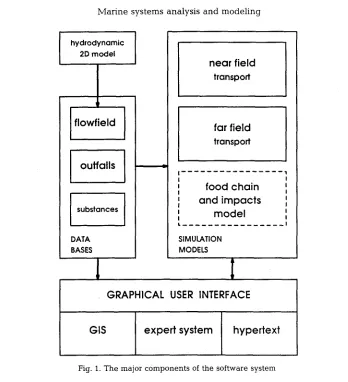
T h e m o d e l system for S w a n s e a Bay simulates the fate a n d d i s t r i b u t i o n of various types of pollutants, such as conservative tracers, BOD, or coliform b a c t e r i a from o n e or several outfalls or off-shore d u m p i n g locations. The system includes:
9 a data b a s e of these major sources of pollution, e.g. w a s t e w a t e r t r e a t m e n t p l a n t s a n d outfall pipelines, l i n k e d to
9 a g e o g r a p h i c a l i n f o r m a t i o n system (GIS) c o m p o n e n t that can m a n a g e spatial data, such as l a n d - u s e information or b a t h y m e t r y , as well as observational data. such as flows tidal records, or w a t e r quality m e a s u r e m e n t s ;
9 a n i n t e r a c t i v e a n d graphical interface to m o d e l scenario editors as well as for r u n n i n g the m o d e l s visualizing the d y n a m i c m o d e l output;
9 coupled to the scenario editors, a n e m b e d d e d expert system for scenario e d i t i n g a n d p a r a m e t e r estimation; a n d as a post-processor of m o d e l results, a n e x p e r t system for i m p a c t a s s e s s m e n t ;
9 coupled with the expert system's rule b a s e as well as the editor f u n c t i o n s a n d the overall help a n d e x p l a i n functions, a h y p e r t e x t system for additional t e x t u a l informa- tion.
T h e basic modules of the system are s h o w n in F i g u r e 1
T h e s i m u l a t i o n m o d e l s
M a r i n e systems analysis a n d m o d e l i n g
hydrodynamic J
2D model
flowfield
ouffalls
substances
DATA
BASES
near field
transport
far field
transport
food chain
a n d impacts
m o d e l
L _
SIMULATION MODELS
I
G R A P H I C A L USER INTERFACE
_ 1621
GIS
expert system
hypertext
Fig. 1. The major components of the software system
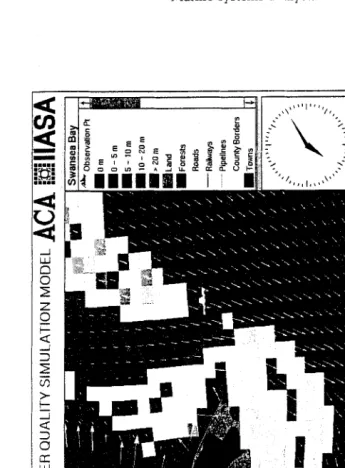
For the purpose of m o d e h n g both near-field a n d far-field dispersion r e s u l t i n g from the c o n t i n u o u s release of more or less persistent s u b s t a n c e s a particle-tracking m o d e l (DELPAR) a n d a g e n e r a l finite difference w a t e r quality model (DELWAQ) were coupled. The finite difference m o d e l uses the same grid as the h y d r o d y n a m i c model, a n d uses the flowfield g e n e r a t e d by the h y d r o d y n a m i c m o d e l (Fig. 2). For the initial, s u b g r i d stage of dispersion m the vicinity of pollution sources (outfalls), a particle-tracking m o d e l was i m p l e m e n t e d . This p a r t i c l e - t r a c k i n g m o d e l e n a b l e s high sub-grid resolution a n d in- corporates i m p o r t a n t p h e n o m e n a for n e a r - f i e l d dispersion exphcitly, like vertical velocity gradients a n d w i n d effects.
The particle-tracking m o d e l a s s u m e s that c o n c e n t r a t i o n s can be s e e n as a n u m b e r of mass particles per v o l u m e . T h e mass particles are c o n s i d e r e d to be s u b j e c t to B r o w n i a n m o v e m e n t a n d small-scale t u r b u l e n c e s , b u t also to horizontal transport b y the current. T h e model computes the e x p e c t e d location of each of several t h o u s a n d s of particles a n d derives c o n c e n t r a t i o n v a l u e s (contours) from their locations.
t,L,
a~
Westerly
Wind,
Average
Tide,
Tidal
Cycle
for
25.09,89
High
tide
at
10:20
Default
tracer
nl3/10'~
10m3
100000
particles
Model
Paused
'
Select
Option
with
Mouse
.,,
~-]
IIL
j.
~.
lllg
lllUklt:~l
UUllldlll
~311UWlIILJ
tllg
LUlVllllledl
LJIIU
blldleU
Uy
Ulg
IlyUlUtI~/IIdlIIIL
CIlIU
tllt:~
Wfltgl
quality
M a r i n e systems analysis a n d m o d e l i n g 623
dispersion coefficient approach u s e d for other models. For this reason, the user is r e q u i r e d to provide the model with the p a r a m e t e r s of a diffusion formula of the type D =
at b.
From basic calculus a n d stochastic limit t h e o r e m s it can b e s h o w n that the r a n d o m step size is proportional to the s q u a r e root of D 9 A t, w h e r e D is the diffusion coefficient a n d ~ t is the time step of the simulation.
Both water quality models a n d their calibration for a case study of S w a n s e a Bay are described in Delft Hydraulics (1990).
I n t e g r a t i o n a n d u s e r i n t e r f a c e s
A complex suite of models, like the h y d r o d y n a m i c model a n d the two w a t e r quality models, are powerful a n d sophisticated tools that require s u b s t a n t i a l user expertise for the p r e p a r a t i o n of i n p u t data files, r u n n i n g of the actual code, a n d the post-processing a n d i n t e r p r e t a t i o n of the very large a m o u n t of n u m e r i c a l results g e n e r a t e d e v e n b y a single model run.
Building t h e m into a p r o b l e m - o r i e n t e d framework, with a user-friendly interface, allows a more e x p e r i m e n t a l use of the model. A user c a n c o n c e n t r a t e on the analysis, on the comparative e v a l u a t i o n of alternatives, both in terms of the d e s i g n a n d decision variables such as outfall locations a n d characteristics, or model parameters. Patterns a n d trends over time, in space, b u t also in the r e l a t i o n s h i p of d r i v i n g variables a n d systems responses can b e identified in this interactive a n d graphical approach.
The d y n a m i c a n d visual r e p r e s e n t a t i o n of m o d e l results allows the user to develop a n intuitive u n d e r s t a n d i n g of complex, spatially distributed a n d d y n a m i c systems behaviour. T h e visualization is not only helpful in c o m m u n i c a t i n g with a n o n - t e c h n i c a l a u d i e n c e : the high b a n d w i d t h of the d y n a m i c graphics e n a b l e s a user to scan a very large a m o u n t of i n f o r m a t i o n that w o u l d be clearly i n c o m p r e h e n s i b l e in a n u m e r i c a l , i.e. tabular, format. Also, m a n y b e h a v i o u r a l features of a model, a n d e v e n errors, m a y only b e c o m e obvious t h r o u g h the use of a m u l t i t u d e of r e p r e s e n t a t i o n forms a n d display styles. In the Wales model, the p r i m a r y display style is c o n s t r a i n e d b y the two d i m e n s i o n a l n a t u r e of the model: c o n c e n t r a t i o n fields are plotted over a m a p of the area (Fig. 3). As a d d e d features, b o t h the m o d e l grid a n d the flow field ( r e p r e s e n t e d by small vectors i n d i c a t i n g m a g n i t u d e a n d direction of flow) c a n b e displayed. Different colour choices, a n d the ability to interactively t u n e the graphical i n t e r p r e t a t i o n of the n u m b e r s g e n e r - ated, i.e. stretch the contrast along a u s e r - d e f i n e d r a n g e of the c o n c e n t r a t i o n f r e q u e n c y distribution, allow a b r o a d r a n g e of display options. Z o o m i n g into the m a p provides h i g h e r resolution for s u b - a r e a s (Fig. 4).
In addition to the a n i m a t e d c o n c e n t r a t i o n field, the user c a n define o b s e r v a t i o n points a n d g e n e r a t e g r a p h s of c o n c e n t r a t i o n over time for these locations.
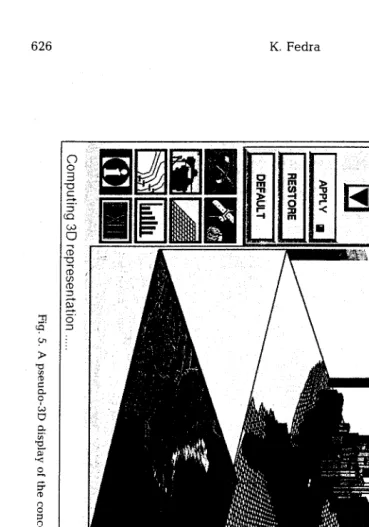
Finally, the c o n c e n t r a t i o n field c a n also b e d i s p l a y e d in a p s e u d o 3D graph, w h e r e the functional v a l u e over each grid cell is d i s p l a y e d i n the vertical (Fig. 5).
The d y n a m i c m o d e l allows the user to simulate specific scenarios, i.e. sets of d e s i g n variables a n d a s s u m p t i o n s for m o d e l p a r a m e t e r s a n d inputs. A p r i m a r y d e s i g n v a r i a b l e is the location a n d n a t u r e of the outfalls simulated. A n o t h e r choice is that of the s u b s t a n c e simulated, e.g. a conservative tracer, BOD, or coliform bacteria.
wELs.
w,,~:
co,,s~,,~
w,,~
ooAL.~Y
s..o~,,~.O.
~00~.
ACA
i~ilIASA
New
Scenario
9
B
Westerly
Wind,
Average
Tide,
Tidal
Cycle
for
25.09.89
High
tide
at
10:20
Default
tracer
m3/10"
10m3
1
Model
Paused
:
Select
Option
with
Mouse
..,
Wind
speed
(tOm)
7.25
mJs
00000
particles
Fig.
4.
A
close-up
of
the
concentration
and
flow
field
after
zooming
into
the
model
domain
r~
WELSH
WATER'COASTAL
WATER
QUALITY
SIMULATION
MODEL
ACA
i~illASA
I
APPLY
I
RESTORE
DEFAULT
Computing
3D
representation
...
Fig.
5.
A
pseudo-3D
display
of
the
concentration
I
WELSH
WATERCOASTAL
WATER
QUALITY
SIMULATION
MODEL
ACA
i iIIASA
l
~ Swansea BaLI ~ I Current Scenario! New Scenario " - ..io~
Model
parameters
I~-sm Is-ram
:: .v:..'/;'&e~cs ~.,t'~.-~,!~Eyyt~i=.: ~,~--'~: .~ ~ ~-~ ~',.,'. kf -~- ~ .... > ~..',- . .4~_~ " "1 9 9 . : -~-, ,,, :::,~ :~.~-~c.~! ::~-~ . '."~::::",~ Dispersion parameters: dispersion D = a t o [O is coeffici I 1 hour after r, Question Iill Range of Answers Values What is the wind influence parameter ?
LIIII~/
Large Average
coefficient a: Small coefficient Very small ~ule-Based I
Check
i
Run Deduction Hypothesis Model -- Rai~ays -- -Pipe~es County
Borders
9
Towns "'1
I \" 25 Sep 1989 7.0 100000 particlesu~ Wl~y H Rule Trace H Modet ~J I~ J 3D-10H-30M- 0S ... ~l I I I
Select
Option
with
Mouse
..,
.< O
Fig. 6. An example of the user interface and expert systems integration in the model scenario editor
628 K. F e d r a
full tidal cycle. T h e h y d r o d y n a m i c scenarios are p r e c o m p u t e d with a two d i m e n s i o n a l , vertically a v e r a g e d h y d r o d y n a m i c simulation m o d e l TRISULA 2D (Delft Hydraulics, 1990). T h e u s e r can also set a p r e v a i l i n g w i n d direction and w i n d s p e e d that will i n f l u e n c e the p r e c o m p u t e d flow fields. Finally, the user can choose t h e n u m b e r of particles to be u s e d in the particle model, w h i c h allows an optimal c h o i c e b e t w e e n
" p r e c i s i o n " or s m o o t h n e s s of the results a n d the s p e e d of the model.
At a s e c o n d level, the " e x p e r t " l e v e l of the u s e r interface, additional m o d e l p a r a m e - ters can b e modified. At the n o r m a l u s e r interface level, default v a l u e s a r e used. To calibrate the m o d e l h o w e v e r , a m o d i f i c a t i o n of m o d e l p a r a m e t e r s such as the w i n d i n f l u e n c e p a r a m e t e r , bottom r o u g h n e s s length, or the coefficients u s e d to r e p r e s e n t diffusion as a function of time in the particle tracking a p p r o a c h (Fig. 6).
At this level, a r u l e - b a s e d e x p e r t system h e l p s to set t h e s e p a r a m e t e r s , for e x a m p l e , w h e n c a l i b r a t i n g the m o d e l a g a i n s t o b s e r v a t i o n data. T h e e x p e r t system u s e d , its syntax and functionality, as well as an a p p l i c a t i o n e x a m p l e in w a t e r r e s o u r c e s p l a n n i n g and e n v i r o n m e n t a l i m p a c t a s s e s s m e n t are d e s c r i b e d in F e d r a et al. (1991). T h e rules of the system r e p r e s e n t the e x p e r i e n c e of o n e or s e v e r a l m o d e l e r s i n t i m a t e l y f a m i l i a r with the c o d e and its b e h a v i o u r , but also the n a t u r e of the location or specific e l e m e n t s in the systems behaviour. For e x a m p l e , o b s e r v e d d e v i a t i o n s of p e a k v a l u e or the s p r e a d of the pollutant, d e v i a t i o n s r e l a t e d to t h e w i n d direction etc., can b e used to g u i d e the u s e r in a d j u s t i n g the r e s p e c t i v e p a r a m e t e r s .
F r o m s i m u l a t i o n to d e c i s i o n s u p p o r t
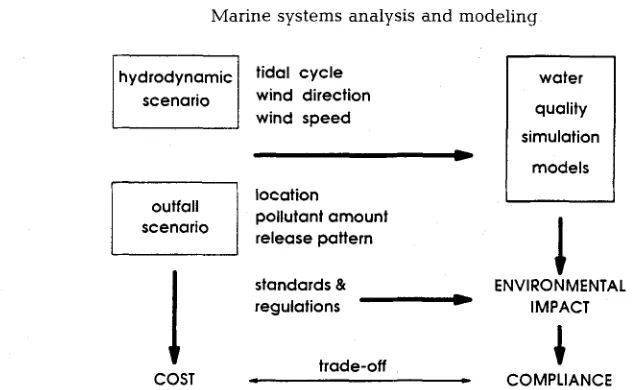
T h e basic m o d e of o p e r a t i o n of the system is scenario analysis. H o w e v e r , to turn the system into a useful tool for the e v a l u a t i o n of a l t e r n a t i v e outfall scenarios in t e r m s of their e n v i r o n m e n t a l c o n s e q u e n c e s , the u s e r m u s t b e p r o v i d e d with additional i n f o r m a t i o n and in particular, w i t h e c o n o m i c and p o l i c y - r e l a t e d criteria (Fedra, 1985). T h e s e m u s t include. for the outfall scenario, the cost of a g i v e n s c h e m e in terms of i n v e s t m e n t , operations, m a i n t e n a n c e , and r e p l a c e m e n t costs. At l e a s t a first a p p r o x i m a t i o n of the costs for a t r e a t m e n t plant can be e s t i m a t e d from, for e x a m p l e , the p o p u l a t i o n served, t h e a m o u n t of t r a d e waste, the l e v e l of treatment, a n d the location (distance from the plant) of the outfall.
T h e e n v i r o n m e n t a l impact, on t h e o t h e r h a n d can b e described, for e x a m p l e , in t e r m s of the a r e a a b o v e a g i v e n w a t e r quality standard, the d e g r e e a n d d u r a t i o n of the violation, or the a v e r a g e c o n c e n t r a t i o n o v e r time in a g i v e n sensitive a r e a such as the i m m e d i a t e shoreline,
T h e s e a d d i t i o n a l descriptors or criteria for a g i v e n h y d r o d y n a m i c r e f e r e n c e s c e n a n o or a r a n g e of typical h y d r o d y n a m i c scenarios p r o v i d e the basis for a multi-criteria e v a l u a t i o n of cost criteria versus e n v i r o n m e n t a l i m p a c t s a n d c o m p h a n c e w i t h s t a n d a r d s and r e g u l a t i o n s (Fig. 7).
T h e s a m e e m b e d d e d e x p e r t s y s t e m u s e d for p a r a m e t e r e s t i m a t i o n a n d t h e c o n s i s t e n t definition of scenarios can also b e u s e d in t h e i n t e r p r e t a t i o n of t h e m o d e l results, for e x a m p l e to assess c o m p h a n c e with w a t e r quality standards. C o m p h a n c e w i t h s t a n d a r d s c a n c o n v e n i e n t l y b e e x p r e s s e d as a rule of t h e following e q u a t i o n :
IF pollutant c o n c e n t r a t i o n is a b o v e s t a n d a r d
M a r i n e systems analysis a n d m o d e l i n g
hydrodynamic
scenario
outfall
scenario
tidal cycle
wind direction
wind speed
location
pollutant amount
release pattern
water
quality
simulation
models
I
standards &
~
ENVIROIMENTAL
regulations
I M P A C Ttrade-off
C O S T ~, . C O M P L I A N C E
Fig. 7. A framework for scenario analysis: from simulation to decision support
629
T h e r u l e - b a s e d e x p e r t system can also use p e r c e p t i o n s of w a t e r quality (in t e r m s of colour, foam, a l g a e on the beach, smell, etc.) to g e n e r a t e additional, q u a l i t a t i v e criteria for the a s s e s s m e n t of a scenario. Finally, the e x p e r t system can be u s e d to perform a m o r e c o m p l e x and c o m p r e h e n s i v e i m p a c t a s s e s s m e n t at the c h o s e n s c r e e n i n g level, b a s e d on the c o m p u t e d pollutant c o n c e n t r a t i o n s (Fedra et al., 1991).
D I S C U S S I O N
Built a r o u n d one or more c o u p l e d models, n u m e r i c a l simulation m o d e l s or rule- driven i n f e r e n c e models, the a b o v e e x a m p l e features:
9 an interactive, m e n u - d r i v e n user i n t e r f a c e that g u i d e s the user with p r o m p t and e x p l a n a t o r y m e s s a g e s t h r o u g h the application. T h e c o m p u t e r assists the u s e r in its p r o p e r use; no c o m p u t e r e x p e r i e n c e is r e q u i r e d to u s e this tool;
9 d y n a m i c colour graphics for the m o d e l output a n d a symbolic r e p r e s e n t a t i o n of m a j o r p r o b l e m c o m p o n e n t s that allow e a s y a n d i m m e d i a t e u n d e r s t a n d i n g of basic p a t t e r n s a n d relationships. Rather than e m p h a s i z i n g the n u m e r i c a l results, symbolic r e p r e s e n t a - tions a n d the visualization of c o m p l e x patterns, in t i m e a n d space, support an intuitive u n d e r s t a n d i n g of the b e h a v i o u r of c o m p l e x systems:
9 the c o u p l i n g with o n e or s e v e r a l d a t a b a s e s that p r o v i d e the m o d e l s with n e c e s s a r y i n p u t information. T h e user's choice or definition of a specific scenario can be e x p r e s s e d in an a g g r e g a t e d a n d symbolic, p r o b l e m - o r i e n t e d m a n n e r , without c o n c e r n for t h e t e c h n i c a l details of the c o m p u t e r i m p l e m e n t a t i o n ;
9 e m b e d d e d AI components, such as specific k n o w l e d g e bases, allow u s e r specltlcatlons in a l l o w a b l e r a n g e s to b e c h e c k e d a n d constrained, thus e n s u r i n g the c o n s i s t e n c y of an i n t e r a c t i v e l y d e f i n e d scenario.
630 K, Fedra
error-prone tasks of data file preparation, the r o u t i n e of model runs, a n d f i n a l l y from the i n t e r p r e t a t i o n a n d t r a n s l a t i o n of n u m e r i c a l results into m e a n i n g f u l terms t h a t are ade- q u a t e to the problem. This not only allows the user to employ the models m o r e freely in a n e x p e r i m e n t a l a n d i n t e r e s t i n g way, it also allows the analyst to c o n c e n t r a t e on the more i m p o r t a n t tasks they c a n do best, i.e. the r e c o g n i t i o n of e m e r g i n g patterns, t h e compara- tive e v a l u a t i o n of complex alternatives, a n d the entire institutional a s p e c t s of a n y e n v i r o n m e n t a l i m p a c t a s s e s s m e n t rather t h a n its technicalities.
It is, however, i m p o r t a n t to recognize that there is a price to be paid for the ease of use of such systems: not only are t h e y more e x p e n s i v e to b u i l d - after all, t h e i n f o r m a t i o n that m a k e s t h e m smart has to b e compiled a n d i n c l u d e d at some stage - t h e y are also m u c h less flexible t h a n their more conventional, g e n e r a l - p u r p o s e siblings. O n l y by restricting the r a n g e of applications c a n more application*specific k n o w l e d g e b e built into the systems a n d thus m a k e t h e m a p p e a r smart. There is no such t h i n g as the g e n e r a l - p u r p o s e p r o b l e m solver, or a g e n e r i c m o d e l or decision support system that is easy to use. Mastery of a p r o b l e m area comes only at the price of n a r r o w specialization.
Nevertheless, or m a y b e just b e c a u s e of these restrictions, the a b o v e e x a m p l e s illustrate that c o m p u t e r - b a s e d m e t h o d s c a n b e powerful tools to support m a r i n e systems analysis a n d m o d e l i n g . However, it is i m p o r t a n t to realize w h a t their a c t u a l role a n d limitations are.
Certainly the expert systems approach, or a n y c o m p u t e r i z e d decision s u p p o r t system for that matter, is n o t a r e p l a c e m e n t for the h u m a n expert in such a c o m p l e x p r o b l e m d o m a i n ; it still requires a k n o w l e d g e a b l e a n d responsible person to u s e it, to i n t e r p r e t a n d apply the results, w h e t h e r for research purposes or in the e n v i r o n m e n t a l p l a n n i n g a n d d e c i s i o n - m a k i n g process. However, the system will take care of the m o r e m u n d a n e tasks of data h a n d l i n g , freeing the a n a l y s t to c o n c e n t r a t e on the real p r o b l e m s that r e q u i r e h u m a n creativity, which is s o m e w h a t difficult to b u i l d into c o m p u t e r s .
Information a n d d e c i s i o n - s u p p o r t systems, w h e t h e r they are expert s y s t e m s or b a s e d on simulation or optimization models, organize the p l a n n i n g or d e c i s i o n - m a k i n g process; they provide structure, e n s u r e c o m p l e t e n e s s , a n d m a y e v e n ascertain plausibility. It is the easy-to-use "smart" interface, the fast a n d efficient operation, a n d the a p p a r e n t intel- l i g e n c e of the p r o g r a m s that m a k e s t h e m attractive. Based on the o r g a n i z e d collection of e x p e r i e n c e of n u m e r o u s experts, i n t e r n a t i o n a l literature b u t also on v a r i o u s g u i d e l i n e s . regulations, a n d e n v i r o n m e n t a l law, a systems k n o w l e d g e base, with or w i t h o u t one or more n u m e r i c a l m o d e l s i n its core, m a y i n d e e d offer i n t e l l i g e n t advice to a n y i n d i v i d u a l user.
The same holds true for the s i m u l a t i o n models: by i n t e g r a t i n g d a t a bases, GIS c o m p o n e n t s , a n d e m b e d d e d AI technology, they are easy a n d efficient to use. T h e y allow the analyst to test n u m e r o u s assumptions, r u n multiple scenarios u n d e r v a r y i n g a s s u m p - tions, a n d to explore the problem. Similar ideas of i d e n t i f y i n g a n d c o m p a r i n g several alternative m o d e l s for m a r i n e pelagic foodwebs were p r e s e n t e d more t h a n t e n years ago (Fedra, 1981); w h a t w a s t h e n a nice idea is t e c h n i c a l reality now.
M a r i n e s y s t e m s a n a l y s i s a n d m o d e l i n g 631 h a s o b v i o u s l i m i t a t i o n s . H o w e v e r , f o r e c a s t i n g r e s u l t s m u s t i n c l u d e t h e u n c e r t a i n t y of t h e e s t i m a t e a s p a r t of t h e i n f o r m a t i o n p r o v i d e d , a s a n i m p o r t a n t a s p e c t for t h e i r f u r t h e r u s e , i.e. d e c i s i o n m a k i n g .
T h e i n t e r a c t i v e a p p r o a c h , t h e i n t e g r a t i o n of t h e m o d e l s w i t h t h e n e c e s s a r y d a t a b a s e s , a n d t h e v i s u a l i z a t i o n of r e s u l t s i n f o r m a t s t h a t a r e i n t u i t i v e l y u n d e r s t a n d a b l e m a k e t h e m a t t r a c t i v e tools. By r e l y i n g o n s y m b o l i c r e p r e s e n t a t i o n a n d a m e n u - d r i v e n u s e r d i a l o g u e t h a t u s e s t h e m a c h i n e n o t o n l y to p e r f o r m t h e n e c e s s a r y i n f o r m a t i o n p r o c e s s i n g t a s k s b u t at t h e s a m e t i m e to g u i d e a n d a s s i s t t h e u s e r i n h i s a n a l y s i s a n d a s s e s s m e n t , t h e a p p r o a c h b e c o m e s s u f f i c i e n t l y g e n e r a l to b e u s e f u l in a w i d e r a n g e of i n s t i t u t i o n a l c i r c u m s t a n c e s a n d a p p l i c a t i o n a r e a s .
L I T E R A T U R E C I T E D
Andersen, K. P. & Ursin, E., 1977. A multispecies extension to the Beverton and Holt theory of fishing, with accounts of phosphorus circulation and primary production. - M e d d r Danm. Fisk.- og Havunders. 7, 319-435.
Anonymous, 1988. MANS - M a n a g e m e n t analysis North Sea. Summary report 1987. Rijkswater- staat, North Sea Directorate, The Hague, 39 pp.
Anonymous, 1989. Modelling of the North Sea water quality. Rijkswaterstaat, Tidal Waters Division, The Hague, 24 pp.
Barnes, K. B., 1988. Cartographic modeling of nonpoint pollutant surfaces for a coastal drainage area. In: Proceedings of the Symposium on Coastal Water Resources. Ed. by K. B. Barnes, W. L. Lyke & T. J. Hoban. American Water Resources Association, Bethesda, 133-I46.
Bigelow, J. H., Haven, J. C. de, Dzitzer, C., Eilers, P. & Peeters, J. C. H., 1977. Protecting an estuary from floods - a policy analysis of the Oosterschelde. III.: Assessment of long-run ecological balances. Rand Corporation, Santa Monica. 215 pp. (R-2121/4-NETH).
Collins, M. B., Banner, F. T. & Tyler, P. A. (Eds), 1980. Industrial e m b a y m e n t s and their environ- mental problems. A case study of S w a n s e a Bay. Pergamon Press, Oxford, 608 pp.
Connolly, J. P., 1991. Application of a food chain model to polychlorinated biphenyl contamination of the lobster and winter flounder food chains in N e w Bedford Harbor. - Environ. Sci. Technol. 25, 760-770.
Delft Hydraulics (Ed.), 1990. Draft - S w a n s e a Bay Model - dispersion modelling and particles tracking model (T647). Delft Hydraulics, Delft, 78 pp.
Falconer, R. A., Goodwin, P. & Matthew, R. G. S. (Eds), 1989. Hydraulic and environmental modeling of coastal, estuarine and river waters. Proceedings of the International Conference held at the University of Bradford, I9-21 S e p t e m b e r 1989. Gower Technical, Aldershot, 694 pp.
Fedra, K., 1981. Pelagic foodweb analysis: hypothesis testing by simulation. - Kieler Meeresforsch. (Sonderh.) 5, 249-258.
Fedra, K., 1985. A modular interactive simulation system for eutrophication and regional develop- ment. - Water Resour. Res. 21 (2), 143-152.
Fedra, K., 1990. Interactive environmental software: integration, simulation and visualization. In: Informatik ffir d e n Umweltschutz. Proceedings of the 5th Symposium on Computer Science for Environmental Protection, 19-21 S e p t e m b e r 1990, Vienna, Austria. Hrsg. von W. Pillmann & A. Jaeschke. Springer, Berlin, 733-744:
Fedra, K., 1991. Smart software for water resources planning and m a n a g e m e n t . Decision Support Systems. Ed. by D. P. Loucks & J. R. da Costa. Springer, Berlin, 145-172. (NATO ASI Ser. [G] 26).
Fedra, K. & Loucks, D. P., 1985. Interactive computer technology for planning and policy modeling. - Water Resour. Res. 21 (2), 114-122.
Fedra, K., Winkelbauer, L. & Pantulu., V. R., 1991. Expert systems for environmental screening. An application in the Iower M e k o n g Basin. RR-91-19. International Institute for Applied Systems Analysis, Laxenburg, 169 pp.
6 3 2 K. F e d r a
G o l d b e r g , E. D., M c C a v e , I. N., O ' B r i e n , J. J. & Steele, J. H. (Eds), 1977. T h e s e a . Vol. 6: M a r i n e m o d e l i n g . Wiley, N e w York, 1048 pp.
H u l t k r a n t z , L., 1991. T h e cost of e d i b l e fish - effects o n t h e S w e d i s h a n d F i n n i s h f o r e s t i n d u s t r i e s f r o m t h e i m p o s i t i o n of e f f l u e n t c h a r g e s o n c h l o r i n e r e s i d u a l s in S w e d e n . - J. e n v i r o n . M g m t 32,
145-164.
K l o m p , R., 1990. M o d e l l i n g t h e t r a n s p o r t a n d f a t e of toxics in t h e s o u t h e r n N o r t h Sea. - Sci. total E n v i r o n m e n t . 97/98, 103-114.
K r e m e r , J. N. & N i x o n , S. W,, 1978. A c o a s t a l m a r i n e e c o s y s t e m - s i m u l a t i o n a n d a n a l y s i s . S p r i n g e r , Berlin, 217 pp.
K r o h n , J., Mfiller, A. & Puls, W., 1991. P o l l u t a n t t r a n s p o r t m o n i t o r i n g a n d p r e d i c t i o n b y m a t h e m a t i c a l m o d e l l i n g : N o r t h S e a a n d a d j a c e n t e s t u a r i e s . - Mar. Pollut. Bull. 23, 6 9 9 - 7 0 2 .
Lewis, R. E. & Riddle, A. M., 1989. S e a disposal: m o d e l l i n g s t u d i e s of w a s t e field dilution. - Mar. Pollut. Bull. 20(3), 124-129.
L o u c k s , D. P. & F e d r a , K., 1987. I m p a c t of c h a n g i n g c o m p u t e r t e c h n o l o g y o n h y d r o l o g i c a n d w a t e r r e s o u r c e m o d e l i n g . - Rev. G e o p h y s . 25(2), 107-112.
M a t e s , A. & S c h e i n b e r g , Y., 1991. A m o d e l for a p p r o v i n g a n d c o n t r o l l i n g s e a w a t e r p o l l u t i o n for r e c r e a t i o n a l activity. - Toxicol. e n v i r o n . C h e m . 31/32, 4 7 9 - 4 8 7 .
N i h o u l , J. C. J. (Ed.), 1975. M o d e l l i n g of m a r i n e s y s t e m s . Elsevier, A m s t e r d a m , 272 pp.
Reed, M., F r e n c h , D., G r i g a t u n a s , T. & O p a l u c h , J., 1989. O v e r v i e w of a n a t u r a l r e s o u r c e d a m a g e a s s e s s m e n t m o d e l s y s t e m for c o a s t a l a n d m a r i n e e n v i r o n m e n t s . - Oil c h e m . Pollut. 5, 8 5 - 9 7 . Riley, G. A., S t o m m e l , H. & B u m p u s , D. F., 1949. Q u a n t i t a t i v e e c o l o g y of t h e p l a n k t o n of t h e w e s t e r n