HAND TO EYE CO-ORDINATION
ERROR ASSESSMENT USING SIMPLE
MAZE TEST
Priyadarshini Natarajan
3rd year, BE Biomedical Engineering, PSG College of Technology, Coimbatore-641004.
Dr. T. Judeth Malliga
Professor
Jansons Institute of Technology, Coimbatore-641659.
Abstract :
In this paper an economical faster way to determine a person’s hand to eye co-ordination error is proposed without performing any complicated tests that would involve any kind of risk to the patient. Hand-eye coordination is the ability of the vision system to coordinate the information received through the eyes to control, guide, and direct the hands in the accomplishment of a given task, such as handwriting or catching a ball. Hand-eye coordination uses the eyes to direct attention and the hands to execute a task. The current technique to calculate Hand to Eye Co-ordination through the maze test is done manually, where the physicians compare the mazes completed for various trials and they estimate the value of deviation. This process could be simplified and can increase its accuracy by computerizing the maze setup. This is a simple technique to determine the extent of impairment in hand-eye co-ordination for different people. It could be used as primary diagnosis of various diseases/disorders associated with impaired co-ordination.
.Keywords: vision system; primary diagnosis; computerizing the maze setup.
1. Introduction
Hand-eye coordination is a complex neurological process - the ability of the nervous system to coordinate the information received through the eyes to control, guide, and direct the hands to accomplish a desired task. An indication of the impaired hand-eye coordination becomes evident quickly when we observe an affected child or adult performing a simple task.
Much previous work has been done on the diagnosis of Coordination problems and results show that upon performing mechanical activities, the discrepancies between the motor behavior of the motor-impaired and normal persons can be seen as either manifesting delay or deviancy.
The goal of this paper is to place our recent work in the area of computerizing the whole test and to estimate the degree of impairment to the patient’s co-ordination. Hand-eye coordination problems are usually first noted as a lack of skill in drawing or writing. Their drawing shows poor orientation on the page and the patient is unable to stay within the lines when using a coloring book or tracing a maze.
1.1 Causes and symptoms
Some of the associated medical symptoms for Coordination problems may include:
Balance symptoms
Clumsiness
Movement symptoms
Mental problems
Weakness
A disorder in hand to eye co- ordination may be due to various disorders some of which may be due to
Aging
Vision impairment
Movement disorder
Sleep deprivation
Balint’s syndrome
Alzheimer's Disease
Hyperactivity Disorder
Down syndrome
Parkinson’s disease
Dementia
Stroke
2. Earlier work on estimating co-ordination error
Previous efforts in the areas of motion tracking and real-time control are too numerous to exhaustively list. The current day Hand to Eye Co-ordination through the maze test is done manually and the physicians compare the images and calculate the value of deviation.
Various other tests that are used in the diagnosis of Coordination problems are:
Eye examination looking for nystagmus (rhythmical oscillation of the eyeballs), papilledema or paralysis of eye movements. They may be due to neural disorders, tumours or diseases affecting normal brain function.
Neurological examination including gait, tone, power, reflexes and co-ordination in upper and lower limbs looking for signs of stroke, cerebellar disease, transient ischemic attack, multiple sclerosis, brain tumour, Parkinson's disease and other diseases of the nervous system
Observation of chorea (non- repetitive abrupt involuntary jerky movements) that can cause coordination problems. Causes of chorea include Huntington's chorea, Sydenham's chorea, Wilson's disease and senility.
3. Implementation of the maze test
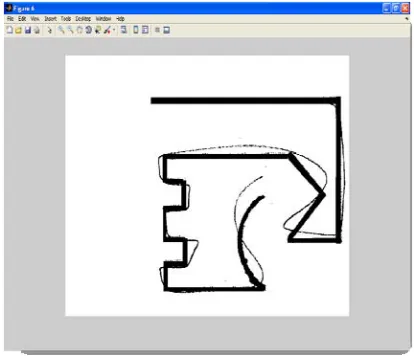
As mentioned earlier, the patients with impaired hand-eye co-ordination have difficulty in writing and drawing. While performing such activities, the discrepancies between the motor behavior of the motor-impaired and normal persons are varied in accuracy. On the basis of this fact, the maze test for different people was conducted and the performance of normal and co-ordination impaired persons were determined. In this test, a maze was given to the people and they were asked to trace it and were requested to finish it as soon as possible. Normal persons could trace the given track without much deviation and in a short time span; whereas the affected patients’ drawings show much deviations or they take more time to finish it.
4. Creation of database
Data sets from patients taking treatments in neurology department at PSG Hospitals were collected for the project. The patients with various abnormalities (ranging from head ache to severe neurological disorders like Left ataxic Hemiparesis) took the maze test. The time taken for the patient to finish the test and the age, sex of the person was also noted. The dataset included health problems like headache, dementia, left ataxic Hemiparesis, pleuritic Chest Pain, left Ganglio Capsular Hemorrhage and neuroglia.
5. Process Steps
5.1 Loading template and source mazes
The Template maze and the Source maze are loaded from the database. The maze of the Template image is filled with black and is converted into bitmap image, for faster comparison. Both the target and source images need to be fused together and logical operations are performed on the fused image to extract the parts that the patient has sketched outside the maze.
5.2 Fusion procedure
For the fusion to be performed, both the source and target image should have the same dimensions and must be aligned properly, so their sizes are checked before further process. If they are not aligned they are registered before fusing. For this we make use of the transforms which let us select the control points in the source and target images.
5.3 Selection of control points
be either variables that contain images or strings that identify files containing greyscale images. The Control Point Selection Tool returns the control points in a CPSTRUCT structure.
5.4 Alignment of the images
The distance between the control points of both the images is calculated and the source matrix is shifted by this value by the function circshift(A,shiftsize) this command circularly shifts the values in the array A, by the shiftsize elements. shiftsize is a vector of integer scalars where the nth element specifies the shift amount for the nth dimension of array A. The shift size is defined by the values obtained from cpselect.
5.5 Setting up transparency levels
For fusion, an alpha factor is initialized within the range of 0 to 1. This factor is multiplied with the images to determine their transparency level. The target image is taken as the background and the patients’ sketch as the foreground. For α=0.5 the level of transparency for both the images are same. If α is set as 0.3, the background image has a transparency level of 0.3 and the foreground with 1-0.3 = 0.7
5.6 Logical extraction
After setting the level for both the images they are added together to get the fused image. The XOR operation is performed on the bitmap image of the fused and the template. The area of the XORed image is calculated by area=bwarea(image) this returns the area of the deviated image.
5.7 Normalized error calculation
The co-ordination error is then calculated by dividing the area of the deviated region by the area of the error free image (nominal value). It’s multiplied by 100 to give a % error value. The nominal value is derived from the tests taken by 15 students who possessed good Hand to Eye Co-ordination.
6. Experimental results
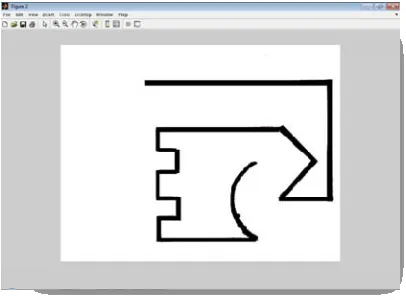
The below figures show the Template (Fig 1) and the Source mazes (Fig 2) in the Binary mode. The image processing is much faster in the bitmap mode rather than processing in the RGB mode as the memory occupied to store the binary values is less than that of RGB.
Figure 2. Source image from the Patient
In Fig 3 the control points are selected to align the template and the source image. The value of the displacement from img1-img2 was found to be [171 96]. This value is assigned as the shift parameter in the circshift command.
Figure 3. Selection of control points to determine the value of shift.
The output is the aligned image; α value is fixed as 0.5 so that equal level of transparency is assigned to both the images. The images are then added together to fuse
The area of the deviated region in the image is calculated using the bwarea(image) command. The value of the area calculated for the image is 97.5725. Then area of the full sketch without deviation is calculated. The deviation % is calculated as
The value for the above image was 0.48252 the % is 48.252% this is the co-ordination error.
7. Analysis
Initially, Patients were asked to trace the maze of greater thickness and then of reduced thickness. Patients with hand Eye co ordination were found to deviate more in the second time. They also took relatively more time to complete the task than that of normal persons. There are nearly 2126 causes of co-ordination reported in the website http://www.wrongdiagnosis.com/symptoms/coordination_problems/causes.htm.
So classifying the diseases based on the degree of impairment in hand Eye co-ordination becomes difficult or nearly impossible. Using this test we can predict the presence of some neurological disorders provided the patient’s age and visual acuity is known and probably save the patient from future impairments.
8. Future scope and limitations
Apart from clinical applications, this method can also be used in other simple, yet important occasions. This method is fairly simple and hence can be used by an employer to test the Hand Eye Co-ordination of their employees, especially drivers, pilots and astronauts. Common people and sports persons can use it develop their Hand Eye Co-ordination by trying to trace the maze as quickly as possible with minimum or no deviations.
The ideas expressed above can be used in the primary diagnosis of diseases associated with Hand Eye co-ordination though it cannot confirm the presence of a particular disease. However, several issues like Noise Reduction and Storage Space remain to be solved before practical and reliable systems of this form can be implemented.
9. Conclusion
Hand to eye co-ordination is very important to survive in the world. Without it, we will not be able to perform our most basic daily work. Problems in the hand to eye co-ordination due to aging are inevitable but its effects due nervous disorders can be cured if it could be detected early and given proper treatment. A real application of this could be implemented in the hospitals where the first level of diagnosis could be the maze test instead of sending the patient through a series of neural scans. Using the Maze test mild disorders could be easily found as they will have only less error values. Decisions on the patient’s next level of treatment could then be carried out depending on their co-ordination error as it could be used in the predictions of several of the diseases. Hence if this is implemented in the hospitals it could pave way to a cheaper diagnostic and the neural scans could be suggested only for the patients to whom it’s absolutely necessary.
Acknowledgments
I thank the Medical Director and The Head of Neurology Department, PSG Hospitals for giving permission to collect the data from the patients.
References
[1] 'A primer on wavelets and their scientific applications' by James S Walker (2nd edition, pp 141-144). [2] http://www.asc-csa.gc.ca/eng/educators/resources/pmdis/coordination.asp
[3] http://www.wrongdiagnosis.com/symptoms/coordination_problems/causes.htm. [4] http://www.ehow.com/facts_5972420_hand-eye-coordination_.html#ixzz0usVivGMC
[5] http://www.healthofchildren.com/G-H/Hand-EyeCoordination.html#ixzz0usVyzWTE
[6] Eye hand PMDIS Resource
[7] “On Specifying and Performing Visual Tasks with Qualitative Object Models” by Gregory D. Hager, The Johns Hopkins University
(International Conference on Robotics 8 Automation, San Francisco. CA April 2009).
[8] “Inter- and intra sensory modality matching in children with hand-eye coordination problems- exploring the developmental lag
hypothesis” - Sigmundsson H, Ingvaldsen RP, and Whiting HT. Department of Sport Sciences, Norwegian University of Science and
Technology, Trondheim.
[9] Natural Image Segmentation with Adaptive,Texture and Boundary Encoding,Shankar R. Raoy, Hossein Mobahiz, Allen Y. Yang, S.