Prehospital: Emergency Care
Eleventh Edition
Chapter 38
Pediatrics
Copyright © 2018, 2014, 2010 Pearson Education, Inc. All Rights Reserved
Learning Readiness
• EMS Education Standards, text p. 1116.
• Chapter Objectives, text p. 1116.
• Key Terms, text p. 1116.
Copyright © 2018, 2014, 2010 Pearson Education, Inc. All Rights Reserved
Setting the Stage
(1 of 2)• Overview of Lesson Topics
– Dealing with Caregivers
– Dealing with the Child
– Assessment-Based Approach to Pediatric Emergencies
– Airway and Respiratory Problems
Setting the Stage
(2 of 2)• Overview of Lesson Topics
– Specific Pediatric Respiratory and Cardiopulmonary Conditions
– Other Pediatric Medical Conditions and Emergencies
– Pediatric Trauma
– Child Abuse and Neglect
Copyright © 2018, 2014, 2010 Pearson Education, Inc. All Rights Reserved
Case Study Introduction
Case Study
(1 of 4)• What criteria should Julian and Tammy use to develop a general impression of the patient's condition?
• What questions should they ask the parents?
Copyright © 2018, 2014, 2010 Pearson Education, Inc. All Rights Reserved
Introduction
• Many EMS providers agree with the stressful nature of pediatric emergencies.
• Trauma is the leading cause of fatal injuries in children under the age of 14.
• Of medical problems, respiratory problems are the most serious.
Dealing with Caregivers
• Caregivers may be upset, cry, blame themselves, or be angry.
• Listen carefully and remain nonjudgmental.
• Let caregivers verbalize their emotions.
Copyright © 2018, 2014, 2010 Pearson Education, Inc. All Rights Reserved
Dealing with the Child
(1 of 6)• Developmental Characteristics
– Each age group has specific emotional and physical characteristics that affect assessment and treatment.
– Pain is difficult to assess in most age groups.
Dealing with the Child
(2 of 6)• Developmental Characteristics
– Neonates (birth to one month)
– Infants (one month to one year)
– Toddlers (1 to 2 years of age)
Copyright © 2018, 2014, 2010 Pearson Education, Inc. All Rights Reserved
Dealing with the Child
(3 of 6)• Developmental Characteristics
– School-Age and Preadolescent Children (6 to 12 years of age)
Dealing with the Child
(4 of 6)Copyright © 2018, 2014, 2010 Pearson Education, Inc. All Rights Reserved
Table 38-1 Estimated Pediatric Heart Rate,
Respiratory Rate, Systolic Blood Pressure, and
Diastolic Blood Pressure Based on Age
Age Heart Rate (beats/minute) Respiratory Rate (breaths/minute) Systolic Blood Pressure (mmHg) Diastolic Blood Pressure (mmHg) Systolic Hypotension (mmHg)
Neonate 100–205 40–60 67–84 35–53 <60
Infant 100–180 30–53 72–104 37–56 <70
Toddler 98–140 22–37 86–106 42–63
Preschool 80–120 20–28 89–112 46–72
School-age
75–118 18–25 97–120 57–80
Adolescent 60–100 12–20 110–131 64–83 <90
Dealing with the Child
(5 of 6)• Anatomic and Physiologic Differences
– Airway
– Head
– Chest and Lungs
Copyright © 2018, 2014, 2010 Pearson Education, Inc. All Rights Reserved
Dealing with the Child
(6 of 6)• Anatomic and Physiologic Differences
– Cardiovascular System
– Abdomen
– Extremities
– Metabolic Rate
Assessment-Based Approach to Pediatric
Emergencies
(1 of 25)• Scene Size-up
– Look for clues to the nature of the problem.
– Assess the need for additional resources.
Copyright © 2018, 2014, 2010 Pearson Education, Inc. All Rights Reserved
Assessment-Based Approach to Pediatric
Emergencies
(2 of 25)• Primary Assessment
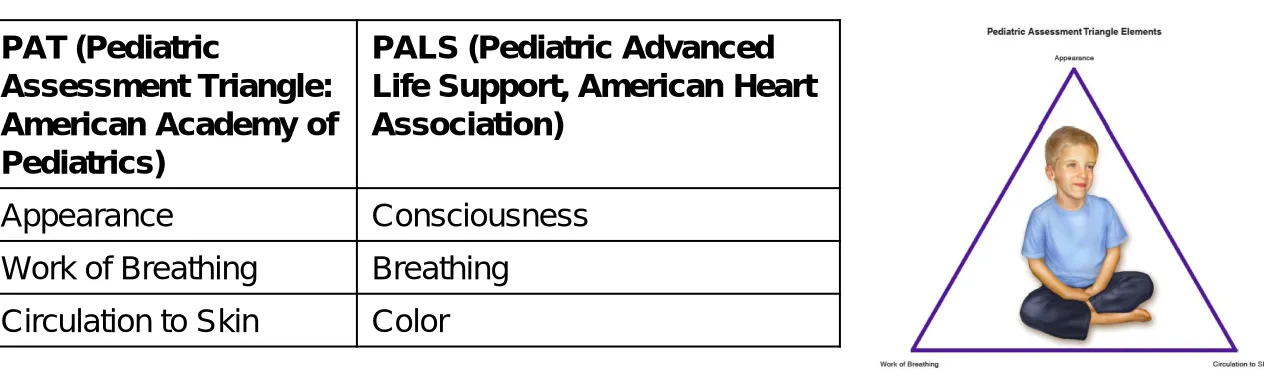
– Form a general impression using the Pediatric Assessment Triangle (PAT).
▪ Assess the level of consciousness.
▪ Assess the airway.
▪ Assess breathing.
▪ Assess circulation.
Table 38-2 Primary Assessment “From the
Doorway”
PAT (Pediatric
Assessment Triangle: American Academy of Pediatrics)
PALS (Pediatric Advanced Life Support, American Heart Association)
Appearance Consciousness
Work of Breathing Breathing
Copyright © 2018, 2014, 2010 Pearson Education, Inc. All Rights Reserved
Assessment-Based Approach to Pediatric
Emergencies
(3 of 25)• Primary Assessment
– Form a general impression using the Pediatric Assessment Triangle (PAT)
▪ Appearance
– Tone
– Interactivity and irritability
– Consolability
– Look or gaze
Assessment-Based Approach to Pediatric
Emergencies
(4 of 25)• Primary Assessment
– Form a general impression using the Pediatric Assessment Triangle (PAT)
▪ Work of Breathing
– Abnormal sounds
– Abnormal posture or position
– Retractions
Copyright © 2018, 2014, 2010 Pearson Education, Inc. All Rights Reserved
Assessment-Based Approach to Pediatric
Emergencies
(5 of 25)• Primary Assessment
– Form a general impression using the Pediatric Assessment Triangle (PAT)
▪ Circulation to Skin
– Pallor — skin and mucous membranes
– Mottling
– Cyanosis
Assessment-Based Approach to Pediatric
Emergencies
(6 of 25)• Primary Assessment
– Form a general impression using the Pediatric Assessment Triangle (PAT)
Copyright © 2018, 2014, 2010 Pearson Education, Inc. All Rights Reserved
Assessment-Based Approach to Pediatric
Emergencies
(7 of 25)• Primary Assessment
– Form a general impression using the Pediatric Assessment Triangle (PAT)
Assessment-Based Approach to Pediatric
Emergencies
(8 of 25)• Primary Assessment
– Form a general impression using the Pediatric Advanced Life Support (PALS) initial impression
▪ Consciousness
▪ Breathing
Copyright © 2018, 2014, 2010 Pearson Education, Inc. All Rights Reserved
Assessment-Based Approach to Pediatric
Emergencies
(9 of 25)• Primary Assessment
– Acting on Life Threats Identified During the General Impression
▪ If breathing is adequate, proceed to the primary assessment.
Assessment-Based Approach to Pediatric
Emergencies
(10 of 25)• Primary Assessment
– Acting on Life Threats Identified During the General Impression
▪ If there is no pulse, begin chest compressions.
▪ If there is a pulse but signs of poor perfusion are present and the heart rate is less than 60, begin chest compressions
Copyright © 2018, 2014, 2010 Pearson Education, Inc. All Rights Reserved
Click on the Item that is NOT a Component that
is Assessed Using the Pediatric Assessment
Triangle (P
A
T)
a. Muscle tone
b. Blood pressure
c. Breathing
Assessment-Based Approach to Pediatric
Emergencies
(11 of 25)• Primary Assessment
– Assessing the Level of Consciousness
▪ Use the AVPU approach.
Table 38-3 AVPU Scale in the Pediatric Patient
A (Alert) Infant or child is curious, alert, and awake.
V (Verbal response) Infant or child turns head to sounds.
Copyright © 2018, 2014, 2010 Pearson Education, Inc. All Rights Reserved
Assessment-Based Approach to Pediatric
Emergencies
(12 of 25)• Primary Assessment
– Airway Assessment
Assessment-Based Approach to Pediatric
Emergencies
(13 of 25)• Primary Assessment
– Breathing Assessment
▪ Rapid breathing
– Normal breathing rates are 25–30/minute in an infant and 15–30/minute in a child.
– Check for signs of hypoxia and respiratory distress.
Copyright © 2018, 2014, 2010 Pearson Education, Inc. All Rights Reserved
Assessment-Based Approach to Pediatric
Emergencies
(14 of 25)• Primary Assessment
– Breathing Assessment
▪ Noisy breathing
▪ Coughing, gagging, gasping
▪ Crackles, wheezing, stridor
Assessment-Based Approach to Pediatric
Emergencies
(15 of 25)• Primary Assessment
– Circulatory assessment
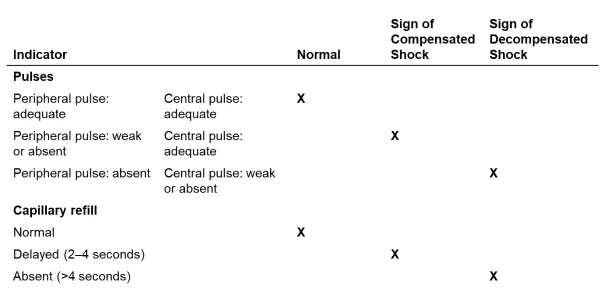
▪ Assess the pulse.
▪ Capillary refill is reliable in children.
Copyright © 2018, 2014, 2010 Pearson Education, Inc. All Rights Reserved
Assessment-Based Approach to Pediatric
Emergencies
(16 of 25)• Primary Assessment
– Circulatory Assessment
▪ Pulse rate and strength
▪ Strength of peripheral versus central
▪ Warmth and color of hands and feet
▪ Urinary output
Copyright © 2018, 2014, 2010 Pearson Education, Inc. All Rights Reserved
Assess the Strength of the Central Pulse. In
an Infant, Check the Femoral Pulse
Locate this pulse by identifying the midpoint of an imaginary line extending from the anterior superior iliac spine to the symphysis pubis, then moving your fingertip about one to two finger
Copyright © 2018, 2014, 2010 Pearson Education, Inc. All Rights Reserved
To Assess the Strength of the Central Pulse
in an Older Child, Check the Carotid Pulse
Copyright © 2018, 2014, 2010 Pearson Education, Inc. All Rights Reserved
Assessment-Based Approach to Pediatric
Emergencies
(17 of 25)• Primary Assessment
– Priority Determination
▪ Consider scene size-up, PAT/PALS, and primary assessment information.
▪ Priority patients
– Respiratory distress
– Respiratory failure
– Respiratory arrest
Assessment-Based Approach to Pediatric
Emergencies
(18 of 25)• Secondary assessment
– For trauma, perform the assessment first, then the history and baseline vital signs.
– For a responsive patient with a medical problem, a focused assessment may be performed.
Copyright © 2018, 2014, 2010 Pearson Education, Inc. All Rights Reserved
Table 38-4 Ten Tips for Examining Infants
and Children
(1 of 3)When examining an infant or child:
1. If possible, have only one E M T deal with the infant or child. This reduces
the fear the patient may experience by being assessed by two unknown individuals.
2. Get down to the child’s eye level. Towering above an infant or child will
only increase his fear and anxiety. Sit down next to the child whenever possible.
3. With children under school age, start the assessment with your hands and
save stethoscopes, blood pressure cuffs, and scissors until you have developed some trust with the child. Keep the most painful parts of the examination for the end.
4. Speak in a calm, quiet voice and maintain eye contact as much as
Table 38-4 Ten Tips for Examining Infants
and Children
(2 of 3)5. Never become impatient or lose your temper. This will just ignite the
patient’s temper. Switch off with a partner or take a brief time-out for yourself, if you need to.
6. Avoid questions that require “yes” or “no” answers. Given the choice, a
child will almost always say “no” when asked if you can do something to him. Instead, ask questions in this format: “Would you like your mother to take off your shirt, or may I do it?” Giving the child a choice also empowers him in what may be a very scary situation.
7. Involve the caregivers (or a familiar person) as much as possible during
Copyright © 2018, 2014, 2010 Pearson Education, Inc. All Rights Reserved
Table 38-4 Ten Tips for Examining Infants
and Children
(3 of 3)8. Be honest. For instance, you might say, “It will hurt when I touch you here,
but it will only last a moment. If you feel like crying, it’s okay.” Children can tolerate some pain if they are prepared for it and are given adequate
support.
9. Ask children for their help and assure them that they are doing a good job.
Have toys, stickers, or other “rewards” to console and encourage a child.
10. Be gentle. Use all appropriate measures to reduce the amount of pain that
a child must endure. If you must restrain a child, be sure that it is
Assessment-Based Approach to Pediatric
Emergencies
(19 of 25)• Secondary Assessment
– Special Considerations for the Physical Exam
▪ Pediatric Glasgow coma scale
▪ Assessing lung sounds
Copyright © 2018, 2014, 2010 Pearson Education, Inc. All Rights Reserved
Assessment-Based Approach to Pediatric
Emergencies
(20 of 25)Table 38-6 Evaluating Blood Pressure in the Pediatric Patient
Neonate Systolic BloodPressure less than 60 mmHg is
considered hypotensive
Infant Systolic BloodPressure less than 70 mmHg is
considered hypotensive
Child 1 to 10 years of age
Upper limit of normal for systolic BloodPressure = 90 + (2 × age in years)
Child 1 to 10 years of age
Median systolic
BloodPressure = 80 + (2 × age in years)
Child 1 to 10 years of age
Lower limit of normal systolic BloodPressure = 70 + (2 × years in age)
Child 1 to 10 years of age
Diastolic BloodPressure is the systolic BloodPressure
Child older than 10 years
Systolic BloodPressure less than 90 mmHg is
considered hypotensive 2
Assessment-Based Approach to Pediatric
Emergencies
(21 of 25)• Secondary Assessment
– Special Considerations for Assessing the Vital Signs
▪ Respirations
▪ Pulse
▪ Skin
▪ Pupils
Copyright © 2018, 2014, 2010 Pearson Education, Inc. All Rights Reserved
Assessment-Based Approach to Pediatric
Emergencies
(22 of 25)• Secondary Assessment
– Special Considerations for Taking a History
▪ Watch the child’s interaction with the caregiver.
▪ If there are no life threats, take time to establish trust.
Assessment-Based Approach to Pediatric
Emergencies
(23 of 25)• Secondary Assessment
– Special Considerations for Taking a History
▪ Avoid rapid-fire “yes” and “no” questions.
▪ Avoid words that increase anxiety.
▪ Keep the child with the parent.
▪ Examine small children toe to head.
Copyright © 2018, 2014, 2010 Pearson Education, Inc. All Rights Reserved
Assessment-Based Approach to Pediatric
Emergencies
(24 of 25)• Secondary Assessment
– Special Considerations for Taking a History
▪ Do not explain things too far in advance.
Assessment-Based Approach to Pediatric
Emergencies
(25 of 25)• Reassessment
– Monitor the mental status, airway, breathing, and circulation.
– Remember that compensatory mechanisms fail rapidly and without warning.
Copyright © 2018, 2014, 2010 Pearson Education, Inc. All Rights Reserved
Case Study
(2 of 4)Julian and Tammy arrive to find a 2-year-old boy held by their father. The child seems listless and tired. He is slightly pale, and his respirations are rapid with nasal flaring and retractions.
Case Study
(3 of 4)The child’s skin is warm and dry. Julian auscultates the
Copyright © 2018, 2014, 2010 Pearson Education, Inc. All Rights Reserved
Case Study
(4 of 4)• What additional assessment information do the EMTs need?
Airway and Respiratory Problems in
Pediatric Patients
(1 of 22)• The leading cause of cardiac arrest in pediatric patients is respiratory failure.
• Failure to establish and maintain the airway and
ventilations will defeat any other treatment and lead to failure.
• Compensatory mechanisms function until total
Copyright © 2018, 2014, 2010 Pearson Education, Inc. All Rights Reserved
Airway and Respiratory Problems in
Pediatric Patients
(2 of 22)• Early Respiratory Distress
– Adequate depth and rate of respiration
– Work of breathing is increased.
– The patient can progress to respiratory failure and respiratory arrest.
Copyright © 2018, 2014, 2010 Pearson Education, Inc. All Rights Reserved
If Signs of Early Respiratory Distress are Present,
Provide Oxygen and Prompt Transport to the
Copyright © 2018, 2014, 2010 Pearson Education, Inc. All Rights Reserved
Airway and Respiratory Problems in
Pediatric Patients
(3 of 22)• Decompensated Respiratory Failure
– Patient cannot compensate and is unable to maintain adequate breathing.
– Either the respiratory rate or the tidal volume is inadequate.
Copyright © 2018, 2014, 2010 Pearson Education, Inc. All Rights Reserved
Airway and Respiratory Problems in
Pediatric Patients
(4 of 22)• In addition to signs of respiratory distress, patients in respiratory failure may have:
– Respiratory rate greater than 60
– Cyanosis
– Decreased muscle tone
Airway and Respiratory Problems in
Pediatric Patients
(5 of 22)• Decompensated Respiratory Failure
– In addition to signs of respiratory distress, patients in respiratory failure may have:
▪ Respirations greater than 60/min, cyanosis
▪ Poor peripheral perfusion
▪ Altered mental status
▪ Grunting
Copyright © 2018, 2014, 2010 Pearson Education, Inc. All Rights Reserved
Airway and Respiratory Problems in
Pediatric Patients
(6 of 22)• Respiratory Arrest
– Respiratory rate less than10
– Irregular or gasping respirations
– Limp muscle tone
– Unresponsiveness
– Slower than normal or absent heart rate
– Weak or absent peripheral pulses
Copyright © 2018, 2014, 2010 Pearson Education, Inc. All Rights Reserved
Airway and Respiratory Problems in
Pediatric Patients
(7 of 22)• Airway Obstruction
– Partial Airway Obstruction
▪ If the airflow is adequate, allow the patient to assume a comfortable upright position.
▪ Administer oxygen.
▪ Encourage the patient to cough.
▪ Do not agitate the patient.
Airway and Respiratory Problems in
Pediatric Patients
(8 of 22)• Airway Obstruction
– Complete Airway Obstruction
▪ No crying or talking
▪ Ineffective or absent cough
▪ Altered mental status
▪ Cyanosis probable
Copyright © 2018, 2014, 2010 Pearson Education, Inc. All Rights Reserved
Airway and Respiratory Problems in
Pediatric Patients
(9 of 22)• Emergency Medical Care — Respiratory Emergencies
– Establish and maintain a patent airway.
▪ If no cervical spine injury is suspected, use a head-tilt, chin-lift maneuver.
Copyright © 2018, 2014, 2010 Pearson Education, Inc. All Rights Reserved
Copyright © 2018, 2014, 2010 Pearson Education, Inc. All Rights Reserved
Airway and Respiratory Problems in
Pediatric Patients
(10 of 22)• Emergency Medical Care — Respiratory Emergencies
– Emergency care for obstructed airway
▪ Suction secretions, vomitus, or blood.
▪ Limit suctioning to 3 to 5 seconds.
Copyright © 2018, 2014, 2010 Pearson Education, Inc. All Rights Reserved
Airway and Respiratory Problems in
Pediatric Patients
(11 of 22)• Emergency Medical Care — Respiratory Emergencies
– Assist ventilations as needed
▪ If positive pressure ventilation is needed, insert an oropharyngeal airway if the patient does not have a gag reflex.
Copyright © 2018, 2014, 2010 Pearson Education, Inc. All Rights Reserved
Copyright © 2018, 2014, 2010 Pearson Education, Inc. All Rights Reserved
Airway and Respiratory Problems in
Pediatric Patients
(12 of 22)• Emergency Medical Care — Respiratory Emergencies
– Assist ventilations as needed
▪ Initiate positive pressure ventilation for respiratory failure or respiratory arrest.
– Ventilate 20 to 25 times per minute.
▪ Attach supplemental oxygen.
Copyright © 2018, 2014, 2010 Pearson Education, Inc. All Rights Reserved
Copyright © 2018, 2014, 2010 Pearson Education, Inc. All Rights Reserved
Ensure a Good Mask Seal by Using Proper
Hand Placement
(1 of 2)For a one-handed technique, place the middle, ring, and little finger of your non-dominant hand along the jaw in an “E” or “3” shape. Place the thumb and index finger on the mask in a “C” shape, thumb over the
Ensure a Good Mask Seal by Using Proper
Hand Placement
(2 of 2)Copyright © 2018, 2014, 2010 Pearson Education, Inc. All Rights Reserved
Airway and Respiratory Problems in
Pediatric Patients
(13 of 22)• Emergency Medical Care — Respiratory Emergencies
– Oxygen Therapy
▪ If the patient is breathing adequately, administer oxygen to maintain an SpO2 greater than or equal to 94%.
Copyright © 2018, 2014, 2010 Pearson Education, Inc. All Rights Reserved
To Administer Oxygen, the Blow-By Method, Using
Oxygen Tubing and a Paper Cup, is Appropriate for
an Infant or for a Child Who Will Not Tolerate a
Airway and Respiratory Problems in
Pediatric Patients
(14 of 22)• Emergency Medical Care — Respiratory Emergencies
– Position the patient
▪ Respiratory distress
▪ Unresponsive patients
▪ Patients in need of ventilation
Copyright © 2018, 2014, 2010 Pearson Education, Inc. All Rights Reserved
Airway and Respiratory Problems in
Pediatric Patients
(15 of 22)• Emergency Medical Care – Respiratory Emergencies
– Transport the patient
▪ If they have respiratory distress complaints
▪ If they have respiratory distress findings
Airway and Respiratory Problems in
Pediatric Patients
(16 of 22)• Emergency Medical Care — Foreign Body Airway Obstruction
– Suspect foreign body airway obstruction if there is high resistance to airflow with positive pressure ventilation.
– Attempt to reposition the airway, first.
Copyright © 2018, 2014, 2010 Pearson Education, Inc. All Rights Reserved
Airway and Respiratory Problems in
Pediatric Patients
(17 of 22)• Emergency Medical Care — Foreign Body Airway Obstruction
– Infant or child with a mild foreign body airway obstruction
Airway and Respiratory Problems in
Pediatric Patients
(18 of 22)• Emergency Medical Care – Foreign Body Airway Obstruction
– Infant or child with a mild foreign body airway obstruction
– Do not intervene.
▪ Allow the patient to continue to cough.
▪ Provide supplemental oxygen.
Copyright © 2018, 2014, 2010 Pearson Education, Inc. All Rights Reserved
Airway and Respiratory Problems in
Pediatric Patients
(19 of 22)• Emergency Medical Care — Foreign Body Airway Obstruction
– Infant with a severe foreign body airway obstruction
Copyright © 2018, 2014, 2010 Pearson Education, Inc. All Rights Reserved
Airway and Respiratory Problems in
Pediatric Patients
(20 of 22)• Emergency Medical Care — Foreign Body Airway Obstruction
– Unresponsive infant with a foreign body airway obstruction
Copyright © 2018, 2014, 2010 Pearson Education, Inc. All Rights Reserved
Airway and Respiratory Problems in
Pediatric Patients
(21 of 22)• Emergency Medical Care – Foreign Body Airway Obstruction
– Child with severe foreign body airway obstruction
Copyright © 2018, 2014, 2010 Pearson Education, Inc. All Rights Reserved
Airway and Respiratory Problems in
Pediatric Patients
(22 of 22)• Emergency Medical Care — Foreign Body Airway Obstruction
– Unresponsive child with foreign body airway obstruction
Chest Compressions on a Child Who is Unresponsive.
for an Older Child, Place One Hand on Top of the
Copyright © 2018, 2014, 2010 Pearson Education, Inc. All Rights Reserved
Case Study Conclusion
(1 of 4)Tammy hands the patient’s father the oxygen tubing, with oxygen flowing, and instructs him to hold it near the
patient’s face. Julian allows the father to continue to hold the patient as they complete vital signs.
Case Study Conclusion
(2 of 4)The EMTs place the child in his car seat and secure the car seat in the ambulance, so they can transport the patient
and his father to the emergency department.
Copyright © 2018, 2014, 2010 Pearson Education, Inc. All Rights Reserved
Case Study #2 Introduction
EMTs Deb Maestes and Ben Allen arrive on the scene of an 8-year-old who was struck by a car while riding her bicycle. The patient is lying in the street, shivering and crying. Deb can see immediately that her skin is pale and mottled, and there is swelling and deformity of her left
Case Study #2
• What is your general impression of this patient?
• What injuries should be suspected with this mechanism of injury?
Copyright © 2018, 2014, 2010 Pearson Education, Inc. All Rights Reserved
Specific Pediatric Respiratory and
Cardiopulmonary Conditions
(1 of 23)• Croup
– Infection of the upper airway
– Common between 6 months to 4 years
– Causes swelling beneath the glottis
– Presents with a “seal bark” cough
Copyright © 2018, 2014, 2010 Pearson Education, Inc. All Rights Reserved
Specific Pediatric Respiratory and
Cardiopulmonary Conditions
(2 of 23)• Croup
– Emergency Medical Care
▪ Administer oxygen, humidified if possible, to
maintain an SpO2 greater than or equal to 94%.
▪ Keep the patient in a comfortable position.
Specific Pediatric Respiratory and
Cardiopulmonary Conditions
(3 of 23)• Epiglottitis
– Bacterial infection that causes swelling of the epiglottis
– Usually between ages of 2 to 7 years
– Untreated, it has a 50percent mortality rate.
Copyright © 2018, 2014, 2010 Pearson Education, Inc. All Rights Reserved
Specific Pediatric Respiratory and
Cardiopulmonary Conditions
(4 of 23)• Epiglottitis
– Specific Signs and Symptoms
▪ Pain on swallowing
▪ High fever; “toxic” ill-appearance
▪ Drooling and mouth breathing
▪ Changes in voice quality, pain with speaking
▪ Chin and neck thrust outward
Specific Pediatric Respiratory and
Cardiopulmonary Conditions
(5 of 23)• Epiglottitis
– Emergency Medical Care
▪ Do not place anything in the child’s mouth.
▪ Place patient in comfortable position
▪ Oxygen by nonrebreather mask or blow-by method
▪ Consider ALS backup
Copyright © 2018, 2014, 2010 Pearson Education, Inc. All Rights Reserved
Specific Pediatric Respiratory and
Cardiopulmonary Conditions
(6 of 23)• Asthma
– Inflammatory process characterized by
▪ Increased mucous production
▪ Swelling of airway walls
Pathophysiology of Asthma
Inflammation inside the bronchiole, an increase in the production of thick, sticky mucus, and bronchiole smooth muscle contraction
Copyright © 2018, 2014, 2010 Pearson Education, Inc. All Rights Reserved
Specific Pediatric Respiratory and
Cardiopulmonary Conditions
(7 of 23)• Asthma
– Signs and Symptoms
▪ Shortness of breath
▪ Chest tightness
▪ Wheezing
Copyright © 2018, 2014, 2010 Pearson Education, Inc. All Rights Reserved
Specific Pediatric Respiratory and
Cardiopulmonary Conditions
(8 of 23)• Asthma
– Questions to ask regarding medical history
▪ How long has the child been wheezing?
▪ Have they had a recent cold or other infection?
▪ Have they had any medication for this attack? What is it? When? How much?
Specific Pediatric Respiratory and
Cardiopulmonary Conditions
(9 of 23)• Asthma
– In the assessment, pay attention to:
▪ Position
▪ Mental status
▪ Vital signs
▪ Skin color and condition
Copyright © 2018, 2014, 2010 Pearson Education, Inc. All Rights Reserved
Specific Pediatric Respiratory and
Cardiopulmonary Conditions
(10 of 23)• Asthma
– Emergency Medical Care
▪ Maintain oxygen to keep pulse ox greater than or equal to 94%.
– Initiate PPV if patient’s condition deteriorates.
▪ Assist with prescribed inhaler if present.
▪ Consider ALS backup or intercept
Specific Pediatric Respiratory and
Cardiopulmonary Conditions
(11 of 23)• Bronchiolitis
– The mucosal layer of the bronchioles is inflamed by a viral infection, often RSV.
– This produces wheezing and other signs and symptoms of asthma.
– There usually is a low-grade fever.
Copyright © 2018, 2014, 2010 Pearson Education, Inc. All Rights Reserved
Pathophysiology of Bronchiolitis
Inflammation inside the bronchiole and an increase in the production of thick, sticky mucus from an infection lead to a reduced bronchiole
Specific Pediatric Respiratory and
Cardiopulmonary Conditions
(12 of 23)• Bronchiolitis
– Emergency Medical Care
▪ Maintain oxygen to keep pulse ox greater than or equal to 94%.
– Initiate PPV if patient’s condition deteriorates.
▪ Place patient in position of comfort
▪ Monitor vitals and mental status en route.
Copyright © 2018, 2014, 2010 Pearson Education, Inc. All Rights Reserved
Pathophysiology of Pneumonia. Mucus Inside the
Specific Pediatric Respiratory and
Cardiopulmonary Conditions
(13 of 23)• Pneumonia
– Infection in the lungs can obstruct the airways and lead to respiratory compromise.
Copyright © 2018, 2014, 2010 Pearson Education, Inc. All Rights Reserved
Specific Pediatric Respiratory and
Cardiopulmonary Conditions
(14 of 23)• Pneumonia
– Assessment
▪ Position
▪ Mental status
▪ Vital signs
▪ Skin Color and Condition
Specific Pediatric Respiratory and
Cardiopulmonary Conditions
(15 of 23)• Pneumonia
– Emergency Medical Care
▪ Maintain oxygen to keep pulse ox greater than or equal to 94%.
– Initiate PPV if patient’s condition deteriorates
▪ Place patient in comfortable position.
▪ Transport the patient.
Copyright © 2018, 2014, 2010 Pearson Education, Inc. All Rights Reserved
Specific Pediatric Respiratory and
Cardiopulmonary Conditions
(16 of 23)• Congenital Heart Disease (CHD)
– Can be due to abnormal valves, vessels, or chambers
– Results in more deaths during first year of life than any other birth defect
Specific Pediatric Respiratory and
Cardiopulmonary Conditions
(17 of 23)• Congenital Heart Disease
– May present with:
▪ Inadequate pulmonary blood flow with cyanosis and hypoxia
▪ Excessive pulmonary blood with congestive heart failure, hypoperfusion, and shock
Copyright © 2018, 2014, 2010 Pearson Education, Inc. All Rights Reserved
Specific Pediatric Respiratory and
Cardiopulmonary Conditions
(18 of 23)• Congenital Heart Disease
– Emergency Medical Care
▪ Maintain oxygen to keep pulse ox greater than or equal to 94%.
– Initiate PPV if patient’s condition deteriorates.
▪ Support the cardiovascular system as necessary.
Specific Pediatric Respiratory and
Cardiopulmonary Conditions
(19 of 23)• Shock
– Causes include hypovolemic, obstructive, distributive, and cardiogenic.
▪ Less common causes of shock are allergic reactions, poisoning, or cardiac events.
– Common findings include diarrhea, dehydration,
Copyright © 2018, 2014, 2010 Pearson Education, Inc. All Rights Reserved
Compensated and Decompensated Shock
Copyright © 2018, 2014, 2010 Pearson Education, Inc. All Rights Reserved
Specific Pediatric Respiratory and
Cardiopulmonary Conditions
(20 of 23)• Shock
– Emergency Medical Care
▪ Maintain an open airway and use oxygen to
maintain an SpO2 greater than or equal to 94%.
– Positive pressure ventilation, if breathing is inadequate
▪ Control bleeding if present.
▪ Keep the patient supine and warm.
Emergency Care Protocol: Pediatric
Shock
(1 of 2)1. Establish and maintain an open airway, extending the head only enough to allow an open airway and avoid hyperextension.
2. Suction secretions.
3. Provide positive pressure ventilation with supplemental oxygen connected to the ventilation device at a rate of 12–20
ventilations/minute if breathing is inadequate.
4. If breathing is adequate, administer oxygen via nonrebreather mask at 15 lpm; consider blow-by oxygen in infants and very young
Copyright © 2018, 2014, 2010 Pearson Education, Inc. All Rights Reserved
Emergency Care Protocol: Pediatric
Shock
(2 of 2)6. Keep the patient warm. If hypothermia is suspected, wrap the
patient in warm blankets and place the ambulance heater on high. Cover the infant or child’s head. (Note: All patients in shock should be kept warm.)
7. Consider calling advanced life support.
8. Expedite transport.
Specific Pediatric Respiratory and
Cardiopulmonary Conditions
(21 of 23)• Cardiac arrest
– Almost all cardiac arrests in children result from
airway obstruction or respiratory distress leading to respiratory arrest.
– Shock is also a cause of cardiac arrest.
Copyright © 2018, 2014, 2010 Pearson Education, Inc. All Rights Reserved
Specific Pediatric Respiratory and
Cardiopulmonary Conditions
(22 of 23)• Cardiac arrest
– Signs of cardiac arrest include:
▪ Unresponsiveness
▪ Gasping or no respiratory sounds
▪ No audible heart sounds
▪ Chest is not moving
▪ Pallor or cyanosis
Specific Pediatric Respiratory and
Cardiopulmonary Conditions
(23 of 23)• Cardiac Arrest
– Emergency Medical Care
▪ PPV with supplemental oxygen
▪ CPR and AED application
▪ Early ALS backup or intercept
Copyright © 2018, 2014, 2010 Pearson Education, Inc. All Rights Reserved
Click on the Condition that is Most Consistent with a
Child Who is Found Sitting up, Remaining Very Still,
with a High Fever, Drooling, and Inspiratory Stridor
a. Epiglottitis
b. Croup
c. Pneumonia
Copyright © 2018, 2014, 2010 Pearson Education, Inc. All Rights Reserved
Other Pediatric Medical Conditions and
Emergencies
(1 of 27)• Seizures
– Abnormal electrical discharge that occurs in the brain
Other Pediatric Medical Conditions and
Emergencies
(2 of 27)• Seizures
– Causes include:
▪ Fever, epilepsy, drug overdose
▪ Brain tumors or brain injury
▪ Electrolyte abnormalities
▪ Hypoglycemia
▪ Meningitis
Copyright © 2018, 2014, 2010 Pearson Education, Inc. All Rights Reserved
Other Pediatric Medical Conditions and
Emergencies
(3 of 27)• Seizures
– Assessment
▪ Muscular rigidity or twitching
▪ Dilated pupils
▪ Irregular breathing
▪ Incontinence
▪ Cyanosis
Other Pediatric Medical Conditions and
Emergencies
(4 of 27)• Seizures
– History Findings
▪ History of prior seizures?
▪ If so, is this the normal pattern?
▪ Has the child taken any prescribed medications?
▪ Duration of unconsciousness?
Copyright © 2018, 2014, 2010 Pearson Education, Inc. All Rights Reserved
Other Pediatric Medical Conditions and
Emergencies
(5 of 27)• Seizures
– Emergency Medical Care
▪ Maintain an open airway and use oxygen to
maintain an SpO2 greater than or equal to 94%.
– Provide PPV if breathing is inadequate.
▪ Position the patient on their side.
▪ Be prepared to suction.
Emergency Care Protocol: Pediatric
Seizures
(1 of 2)1. Establish and maintain an open airway, extending the head only enough to allow an open airway and avoid hyperextension.
2. Protect the infant or child from injuring himself; place him on his left side.
3. Suction secretions.
4. Provide positive pressure ventilation with supplemental oxygen via reservoir at a rate of 12–20 ventilations/minute if breathing is
Copyright © 2018, 2014, 2010 Pearson Education, Inc. All Rights Reserved
Emergency Care Protocol: Pediatric
Seizures
(2 of 2)6. Check the blood glucose level, if your protocol permits.
7. Expedite transport in any of the following situations:
a. Epileptic seizures lasting >5 minutes
b. Two or more epileptic seizures without a period of consciousness between them
c. Febrile seizures lasting >15 minutes
d. Seizure from any other cause (e.g., hypoxia, head injury)
8. Consider calling advanced life support.
9. Expedite transport.
Other Pediatric Medical Conditions and
Emergencies
(6 of 27)• Altered Mental Status
– The change to mental status could be mild to significant.
– There are many underlying causes of altered mental status in a pediatric patient.
Copyright © 2018, 2014, 2010 Pearson Education, Inc. All Rights Reserved
Other Pediatric Medical Conditions and
Emergencies
(7 of 27)• Altered Mental Status
– Assessment Considerations
Other Pediatric Medical Conditions and
Emergencies
(8 of 27)• Altered Mental Status
– Emergency Medical Care
▪ Maintain an open airway, use oxygen to keep SpO2 greater than or equal to 94%
– Apply positive pressure ventilation if breathing is inadequate.
▪ Position the patient on their side.
Copyright © 2018, 2014, 2010 Pearson Education, Inc. All Rights Reserved
Emergency Care Protocol: Pediatric
Drowning
(1 of 4)Pediatric Altered Mental Status
1. Establish and maintain an open airway, extending the head only enough to allow an open airway and avoid hyperextension.
2. Suction secretions.
3. Provide positive pressure ventilation with supplemental oxygen at a rate of 12–20 ventilations/minute if breathing is inadequate.
4. If breathing is adequate, administer oxygen to maintain an SpO2 of 94% or greater; consider blow-by oxygen in infants and very young children.
Emergency Care Protocol: Pediatric
Drowning
(2 of 4)6. If signs and symptoms of hypoglycemia are present and the child is a known diabetic on medication for the condition, consider oral
glucose if the child is able to swallow and medical direction approves.
7. Consider calling advanced life support.
8. Expedite transport.
Copyright © 2018, 2014, 2010 Pearson Education, Inc. All Rights Reserved
Other Pediatric Medical Conditions and
Emergencies
(9 of 27)• Drowning
– Can occur in any amount of water
Other Pediatric Medical Conditions and
Emergencies
(10 of 27)• Drowning
– Assessment Considerations
▪ Be aware of associated trauma and hypothermia.
Copyright © 2018, 2014, 2010 Pearson Education, Inc. All Rights Reserved
Other Pediatric Medical Conditions and
Emergencies
(11 of 27)• Drowning
– Emergency medical care
▪ Consider spinal injury.
▪ Maintain an open airway and use oxygen to keep SpO2 greater than or equal to 94%.
– PPV if breathing is inadequate.
▪ Place the patient on their side, if possible.
▪ Provide CPR and use the AED, if needed.
Emergency Care Protocol: Pediatric
Drowning
(3 of 4)1. Remove the infant or child from the water. If diving was involved in children or adolescents, consider spine motion restriction.
2. Establish and maintain an open airway, extending the head only enough to allow an open airway and avoid hyperextension.
3. Suction secretions.
4. Provide positive pressure ventilation with supplemental oxygen connected to the ventilation device at a rate of 12–20
Copyright © 2018, 2014, 2010 Pearson Education, Inc. All Rights Reserved
Emergency Care Protocol: Pediatric
Drowning
(4 of 4)6. If breathing is adequate, administer oxygen to maintain an SpO2 of 94% or greater; consider blow-by oxygen in infants and very young children.
7. If hypothermia is suspected, remove wet clothing, wrap the patient in warm blankets, and place the ambulance heater on high. Cover the infant or child’s head.
8. Consider calling advanced life support.
9. Expedite transport.
Other Pediatric Medical Conditions and
Emergencies
(12 of 27)• Fever
– Fevers of 104° to Fahrenheit–105° Fahrenheit are concerning.
▪ Causes include infection and heat exposure.
Copyright © 2018, 2014, 2010 Pearson Education, Inc. All Rights Reserved
Other Pediatric Medical Conditions and
Emergencies
(13 of 27)• Fever
– Assessment Considerations
▪ Rise of temperature more important than actual temperature
▪ Changes may occur to pulse amplitude
▪ Fontanelle may be sunken in the infant.
Other Pediatric Medical Conditions and
Emergencies
(14 of 27)• Fever
– Emergency Medical Care
▪ Maintain an SpO2 greater than or equal to 94%.
▪ Remove excess layers of clothing.
▪ Cool patient as needed in a controlled fashion.
Copyright © 2018, 2014, 2010 Pearson Education, Inc. All Rights Reserved
Emergency Care Protocol: Pediatric
Fever
(1 of 2)1. Establish and maintain an open airway, extending the head only enough to allow an open airway and avoid hyperextension.
2. Suction secretions.
3. Provide positive pressure ventilation with supplemental oxygen via reservoir at 12–20 ventilations/minute if
breathing is inadequate.
Emergency Care Protocol: Pediatric
Fever
(2 of 2)5. Febrile seizures >15 minutes are a dire emergency and require expeditious transport and consideration for
advanced life support.
6. Consider calling advanced life support.
7. Transport.
Copyright © 2018, 2014, 2010 Pearson Education, Inc. All Rights Reserved
Other Pediatric Medical Conditions and
Emergencies
(15 of 27)• Meningitis
– Infection of the lining of the brain and spinal cord
– Fever in infants younger than 3 months is suspected as meningitis.
Pathophysiology of Bacterial Meningitis
Copyright © 2018, 2014, 2010 Pearson Education, Inc. All Rights Reserved
Other Pediatric Medical Conditions and
Emergencies
(16 of 27)• Meningitis
– Assessment Considerations
▪ Recent ear or URI
▪ High fever, lethargy
▪ Nausea and vomiting
▪ Fontanelle may bulge in infant
▪ Pain with movement
Other Pediatric Medical Conditions and
Emergencies
(17 of 27)• Meningitis
– Emergency Medical Care
▪ Wear a mask, gloves, and possibly a gown.
▪ Keep pulse ox at greater than or equal to 94%
▪ Ventilate the patient if needed
Copyright © 2018, 2014, 2010 Pearson Education, Inc. All Rights Reserved
Other Pediatric Medical Conditions and
Emergencies
(18 of 27)• Gastrointestinal Disorders
– Assessment Considerations
▪ Conditions include gastroenteritis, which can lead to dehydration, and appendicitis.
– Emergency Medical Care
▪ Maintain an SpO2 greater than or equal to 94%,
Other Pediatric Medical Conditions and
Emergencies
(19 of 27)• Poisoning
– Assessment Considerations
▪ Most common to children younger than 4 years old.
▪ A thorough secondary assessment is critically important to find the cause.
Copyright © 2018, 2014, 2010 Pearson Education, Inc. All Rights Reserved
Other Pediatric Medical Conditions and
Emergencies
(20 of 27)• Poisoning
– Emergency Medical Care
▪ Contact medical direction or PCC.
▪ If activated charcoal is ordered, the dose is 1 gram/kg.
▪ Maintain an open airway and adequate ventilation and oxygenation.
Protocol for Pediatric Poisoning
(1 of 3)1. Extend the head only enough to allow an open airway; avoid hyperextension.
2. Suction secretions.
3. Provide positive pressure ventilation with supplemental oxygen at a rate of
12–20 ventilations/minute if breathing is inadequate.
4. If breathing is adequate, administer oxygen to maintain an SpO2 of 94% or
greater; consider blow-by oxygen in infants and very young children.
5. Treat the specific poisoning:
Copyright © 2018, 2014, 2010 Pearson Education, Inc. All Rights Reserved
Protocol for Pediatric Poisoning
(2 of 3)– Altered mental status
– Ingestion of acids or alkalis
– Patient who is unable to swallow
Inhalation
Remove from toxic environment. Maximize oxygenation by nonrebreather mask
at 15 litreperminute if breathing adequately or by positive pressure ventilation if breathing
inadequately.
Absorption
Protocol for Pediatric Poisoning
(3 of 3)Injection
Carefully monitor airway and breathing. If allergic reaction, and with order from medical direction, consider administration of epinephrine at 0.15 mg if the
child weighs less than 66 lb. If the child’s weight is greater than 66 lb, an adult
(0.3 milligram) dose should be used. Apply a constricting band proximal to site of
bite or injection.
6. Consider calling advanced life support.
7. Expedite transport.
Copyright © 2018, 2014, 2010 Pearson Education, Inc. All Rights Reserved
Other Pediatric Medical Conditions and
Emergencies
(21 of 27)• Brief Resolved Unexplained Events (BRUE)
– Assessment Considerations
▪ An episode that is frightening to the observer in infants younger than 1 year of age
▪ Characterized by some combination of apnea, color change, marked change in muscle tone, choking, or gagging.
Other Pediatric Medical Conditions and
Emergencies
(22 of 27)• Brief Resolved Unexplained Events (BRUE)
– Emergency Medical Care
▪ Maintain an open airway and adequate breathing and oxygenation.
▪ Apply positive pressure ventilation for inadequate breathing.
Copyright © 2018, 2014, 2010 Pearson Education, Inc. All Rights Reserved
Other Pediatric Medical Conditions and
Emergencies
(23 of 27)• Sudden Infant Death Syndrome (SIDS)
– Sudden and unexpected death of an infant in which an autopsy fails to identify the cause of death
– Peak incidence at 2 to 4 months
– Exact cause is unknown.
Other Pediatric Medical Conditions and
Emergencies
(24 of 27)• Sudden Infant Death Syndrome (SIDS)
– Assessment Considerations
▪ Physical appearance of the infant
▪ Position of the infant in the crib
▪ Physical appearance of the crib
▪ Presence of objects in the crib
Copyright © 2018, 2014, 2010 Pearson Education, Inc. All Rights Reserved
Other Pediatric Medical Conditions and
Emergencies
(25 of 27)• Sudden Infant Death Syndrome (SIDS)
– Emergency Medical Care
▪ Attempt resuscitation unless rigor mortis or dependent lividity is present.
▪ Encourage caregivers to talk.
▪ Do not provide false reassurances.
▪ Transport with ALS backup or intercept.
Other Pediatric Medical Conditions and
Emergencies
(26 of 27)• Sudden Infant Death Syndrome (SIDS)
– Aiding Family Members in SIDS Emergencies
▪ Reactions vary, but shock and disbelief are common.
▪ Making decisions may be difficult for the parents.
Copyright © 2018, 2014, 2010 Pearson Education, Inc. All Rights Reserved
Other Pediatric Medical Conditions and
Emergencies
(27 of 27)• Sudden Infant Death Syndrome (SIDS)
– Presence of Parents During Pediatric Resuscitation
▪ Allow parents to be present during resuscitation attempts.
Pediatric Trauma
(1 of 14)• Thousands of children die from unintentional injury and more are permanently disabled.
• Leading cause of death from ages 1-14 years of age
• 50percent of deaths from trauma occur within the first hour after an injury.
Copyright © 2018, 2014, 2010 Pearson Education, Inc. All Rights Reserved
Pediatric Trauma
(2 of 14)• Mechanisms of Injury
– Common Modes of Injury
▪ Unrestrained MVC
▪ Pedestrian versus vehicle
▪ Cyclist versus vehicle
▪ Water accident
▪ Burn trauma
▪ Sport injuries
Pediatric Trauma
(3 of 14)• Trauma and Pediatric Anatomy
– Assessment Considerations
▪ Head
▪ Chest
▪ Abdomen
▪ Extremities
Copyright © 2018, 2014, 2010 Pearson Education, Inc. All Rights Reserved
Copyright © 2018, 2014, 2010 Pearson Education, Inc. All Rights Reserved
Pediatric Trauma
(4 of 14)• Emergency Medical Care—Pediatric Trauma
– Maintain an airway and provide a high concentration of oxygen.
▪ Provide PPV if breathing is inadequate.
– Provide spine motion restriction as needed.
Pediatric Trauma
(5 of 14)• Infant and Child Car Seats in Trauma
– Can protect a properly secured child from injury, particularly with frontal and rear-end collisions
Copyright © 2018, 2014, 2010 Pearson Education, Inc. All Rights Reserved
Pediatric Trauma
(6 of 14)• Infant and Child Car Seats in Trauma
– Removing the Infant or Child from a Car Seat
▪ If the seat was involved in a moderate-to-severe crash, do not use it to transport the patient.
Pediatric Trauma
(7 of 14)• Infant and Child Car Seats in Trauma
– Removing the Infant/Child from a Car Seat
▪ The vehicle was able to be driven away from the crash site.
▪ The vehicle door nearest the safety seat was undamaged.
▪ There were no injuries to the occupants.
Copyright © 2018, 2014, 2010 Pearson Education, Inc. All Rights Reserved
Pediatric Trauma
(8 of 14)• Infant and Child Car Seats in Trauma
– Removing the Infant/Child from a Car Seat
▪ If a child must be removed from a car seat, it must be done in a coordinated manner,
Pediatric Trauma
(9 of 14)• Infant and Child Car Seats in Trauma
– Safe Transport of Children in Ground Ambulances
Copyright © 2018, 2014, 2010 Pearson Education, Inc. All Rights Reserved
Pediatric Trauma
(10 of 14)• Infant and Child Car Seats in Trauma
– Safe Transport of Children in Ground Ambulances
▪ The National Highway traffic Safety
Administration’s 2012 recommendations for safe transport are divided into five different situations.
Pediatric Trauma
(11 of 14)• Infant and Child Car Seats in Trauma
– Safe Transport of Children in Ground Ambulances
1. Uninjured or not ill child at the scene of an injured or ill patient
2. Injured or ill child who does not require intensive monitoring
Copyright © 2018, 2014, 2010 Pearson Education, Inc. All Rights Reserved
Pediatric Trauma
(12 of 14)• Infant and Child Car Seats in Trauma
– Safe Transport of Children in Ground Ambulances
4. Child who’s condition requires spinal immobilization or lying flat.
Pediatric Trauma
(13 of 14)• Infant and Child Car Seats in Trauma
– Four-Point Spine Motion Restriction of an Infant or Child
▪ At times, the EMT may have to improvise the
Copyright © 2018, 2014, 2010 Pearson Education, Inc. All Rights Reserved
Secure the Arms and Legs Using the
Extremity Straps
Copyright © 2018, 2014, 2010 Pearson Education, Inc. All Rights Reserved
Pediatric Trauma
(14 of 14)• Injury Prevention
– Preventable childhood injuries account for
44percent of deaths between the ages of 1 and 19 years.