125
AN EFFICIENT RESOURCE ALLOCATION STRATEGY BASED ON IMPROVED
PARTICLE SWARM OPTIMIZATION (IPSO)
Naresh, T
1Department Sandip Institute of Technology and Research Center, Nasik. Affiliated to Savitribai Phule Pune University and Research Scholar, Computer Science and Engineering Department, at K L University
A Jaya Lakshmi
2and Vuyyuru Krishna Reddy
3,
Department of Computer Science & Engineering, Devineni Venkata Ramana & Dr Hima Sekhar MIC College of Technology, 3Department of Computer Science and Engineering, DST-FIST Sponsored Department, K
L University, Green Fileds, Vaddeswaram - 522502. [email protected], [email protected]
ABSTRACT
Resource allocation is a method that is deploy to allocate the accessible resource in a best way. It is the arrangement of activities and the resource needed by those activities while returns into consideration both the resource availability and the time. The proposed method discusses optimal resource discovery and dynamic resource allocation. The proposed method consists of two phases namely resource discovery and resource allocation. For resource discovery, the proposed method uses the Hierarchical Agglomerative Clustering Algorithm (HAC). Based on the HAC algorithm the proposed tree construction is generated. After that the resources are allocated by hybrid optimization algorithm. The proposed method use the Improved Particle Swarm Optimization and Cuckoo Search algorithm (IPSOCS).
Index Terms—Resource allocation, Hierarchal Agglomerative Clustering Algorithm, Particle Swarm Optimization.
I. INTRODUCTION
Resource allocation is a scheme for utilize avai-lable resources, for example human resources, mostly in the near term, to attain goals for the future. Cloud computing is internet-based computing in which large groups of remote servers are networked to allow the centralized data storage, and online access to computer services or resources. Cloud structure is assumed to be under a payment model, straight to avoid users’ over -demand of their resources against their true needs [1]. Thus, a cloud replica is expected to have a scale up and down straight to manage the load variation [2]. Google furnishes a well-organized and scalable solution for working large-scale data [3]. Distributed computing suppliers convey request along the Internet, which are received from web program. The business program-ming and information are place away on servers at a remote area [4].
Applications can be deployed in Cloud compu-ting in the absence of any installation of software. The users can utilize the Internet and forward messages anywhere in the world [5]. Centralized storage, mem-ory, processing and bandwidth are greater distance sys-tematic computing that are allowed in Cloud compu-ting. The success of clouds has been conveyed in part by the utilization of virtualization as their unrevealed technology [6].
Cloud assists consumers to outsource computa-tion, storage and other tasks to third party cloud providers and the resources utilized will be paid. And learn about how a cloud service provider is best multi-plexing its virtual resources. The grid environment consists of several components such as schedulers, load balancer, grid broker, and portals. The schedulers are the kinds of applications that are answerable for the management of jobs, such as assigning resources requi- red for any particular job, dividing of jobs to schedule
corresponding implementation of tasks, data manage-ment [8].
Chen, et al., [7] focus the difficulty of decreasing data transmission in a MapReduce cluster and the proposed method evolve a scheduling technique to better map tasks’ data locality rate. When a job is assigned to the clouds, it is generally separated into several tasks. Following two questions are required to review when registering parallel processing in perfor-ming these tasks:
1) The allocation of resources to tasks;
2) Tasks are performed in what order in cloud; and 3) The planning of overheads when Virtual Machines construct, finish or handle tasks.
The scheduling of task and allocation of resource can answer these three problems.
The task scheduling application is not suitable for use in a cloud computing environment due to the small particles. The MapReduce cluster, data are distributed to separate nodes and keep in their disks. To perform a map task on a node, it requires to first have its input data available on that node [7].
II. LITERATURE SURVEY
Resource allocation is the emerging topic in cloud computing and so many researchers already concentra-ted on this topic. Some of the most distinguished researches are presented here.
Prasenjit Kumar Patra et al., [11] have proposed that the outcome of expansion of on demand service in computing paradigms of large scale distributed compu-ting. It was adoptable technology as it provided inte-gration of software and resources which are dynami-cally scalable. Those systems were more or less prone to failure. Fault tolerance evaluates the ability of a system to answer gracefully to an unexpected hardware or software failure. In order to achieve robustness and dependability in cloud computing, failure should be assessed and handled effectively.
Chandrashekhar S. Pawar and Rajnikant B. Wagh [12] have proposed an algorithm that is accepted Preemp- table task implementation and multiple SLA variables such as network bandwidth, memory and needed CPU time. Experimental results of this algorithm showed that in a situation where resource contention is fierce, our algorithm provides superior utilization of resources. Dorian Minarolli and Bernd Freisleben [13] have pro-posed the distributed version of the resource manager existing of several ANNs in which the ANN has respon-sible for performance of application and consumption of power of a single VM while interchanging informa- tion with other ANNs to coordinate resource allocation. Wang Xue-yi et al., [14] have proposed the cloud environment for resource allocation. First, the network structure of resource allocation mechanism was crea-ted, and then tender descriptions were given for four kinds of common resources. Second, a support vector regression (SVM) based method was acquired to change a compound resource desire into numerous isolated resource demands. Third, inner framework was established to bidding policy and tender assessment technique was designed to decide an optimal tender of cloud resource provider.
Goudarzi et al., [15] have proposed a resource allocation issue which was considered to reduce the whole energy cost of cloud computing system which meet the recognized client-level SLAs in a probabilistic sense. This cloud computing system paid penalty for the percentage of a client’s requests that do not meet a identified upper bound on their service time. An effici-ent heuristic algorithm based on convex dynamic prog-ramming and convex optimization was conferred to answer the foregoing resource allocation problem. Doaa and Shawky [16] have proposed that the cloud resources were provisioned and released on demand. That elastic nature of resource provisioning allows for the “pay as you go” concept. Thus, it makes the major benefit of adopting cloud-based solutions. There was a need to assess the performance of the resource provisioning algorithm adopted by cloud computing platforms.
Kumar et al., [17] have proposed systematic structure name called EARA (Efficient Agent based Resource Allocation) for resource allocation based on agent
omputing on SaaS level in Cloud Computing. EARA Contain five different agents, each agent provided with functionality to gather details concerning all resources accessible in definite cloud deployment based on signed SLA agreement and then replied to the user with appropriate allocation or response code.
From the literature survey, it is observed that the users wish to minimize their payment when guaranteeing their service level such that their task can be finished before deadlines. Such a limit guaranteed resource allocation with reduced payment. More ever inevitable error in estimating job work load will certainly shape the problem harder.
III. OBJECTIVES
In this section discuss the objective of my research work To formulate a deadline driven resource
alloca-tion issue based on the cloud environment. To minimize user’s payment in terms of their
anticipated deadline.
Analyzed the upper bound of job execution length based on the possibly inaccurate prediction
To validate its effectiveness over a real VM facilitated cluster environment under different level of competition.IV. METHODOLOGY
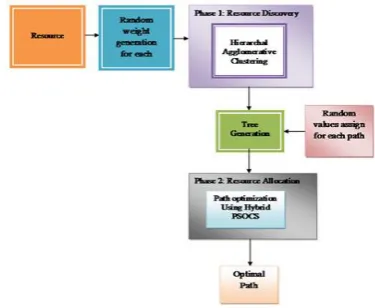
To find out the resources and assign them in a cost-effective way is the major intension of the suggested method. The suggested methodology contains 2 phases such as 1) Resource discovery and 2) Resource alloca-tion. In the initial phase, the typical resource usage distribution for a group of nodes with related resource consumption patterns is worked out as resource bundle which can be employed to simply find a set of nodes pleasing a common obligation. Now it offers the clustering-based resource aggregation such as Modified Hierarchal Agglomerative Clustering Algorithm (MH-AC) to attain compact representation of a group of similarly behaving nodes for scalability. In the next phase for dynamic resource allocation process, the proposed method will employ bi-objective hybrid opti-mization algorithm based on Particle Swarm Optimiza-tion and cuckoo search algorithm. The general process of the proposed method is made cleared and shown in Fig.1. It’s explained as follows:
127 The proposed method has two phase,
1)Resource discovery 2) Resource allocation
4.1 Resource Discovery Phase
Initially, weights are produced arbitrarily for each node in the resource. The suggested method produces the tree construction based on the weights. Now reorganize hierarchical agglomerative clustering algorithm is empl- oyed for the tree construction.
4.1.1 Hierarchical Agglomerative clustering algorithm Hierarchical clustering sequentially divides a dataset with a specified distance measure. In this sequential partition process, an algorithm erects nested partitions layer by layer through grouping objects into a tree of clusters exclusively based on the distance measure without the required to know the number of clusters in advance. There are two approaches to a tree of clusters; i.e. i) Agglomerative Hierarchical clustering algorithm or AGNES (bottom up) and ii) Divisive Hierarchical clustering algorithm or DIANA (top down). Both this algorithm is precisely overturned of each other. The top down approach presumes that all objects in a dataset are originally in a single cluster and next the cluster is recurrently separated into smaller and smaller clusters till a stopping condition is met. In difference, the bottom up approach, well recognized as agglomerative algorithm, presumes that all objects in a dataset are atomic clusters of an individual element. Next all atomic clusters combine to turn into larger. Our sugge-sted method employs the Agglomerative Hierarchical clustering algorithm. To refine the performance of tra-ditional agglomerative algorithm, the proposed method employ adapted Agglomerative Hierarchical clustering algorithm. Now grouping of each node is based on the minimum distance with the random weight. The speci-fied process of adapted hierarchical agglomerative clustering algorithm with example is set below, Step 1: Allocate each node to a detach cluster with their weights
Step 2: Begin with the disjoint clustering having level L (0) = 0 and sequence number n = 0.
Step 3: Assess all pair-wise distances between clusters Step 4: Erect a distance matrix by means of the distance values
Step 5: Look for the pair of clusters with the shortest distance
Step 6: Increase the sequence number: n = n +1. Merge clusters (p) and (q) into one cluster to form the next cluster n. Assign the level of this cluster to L (n) = d [(p), (q)].
Step 7: Update the distance matrix, D, by removing the rows and columns corresponding to clusters (p) and (q) and adding a row and column corresponding to the recently formed cluster. The distance between the new cluster, denoted by (p, q) and old cluster(r) is described in this way: d[(r), (p, q)] = min (d [(r), (p)], d [(r), (q)]). Step 8: Replicate till the distance matrix is decreased to a single element.
4.2 Resource Allocation Phase
Based on the hybrid optimization algorithm the rce will be assigned in this phase. To assign the
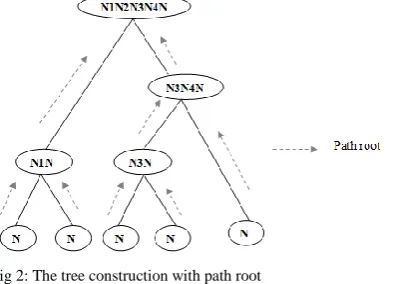
resou-rce for the task, the proposed method produce the random value for each path in the tree construction for the intention of finding the best path. Each path in the tree construction is produced a random value in the range of [0, 1]. By means of the hybrid optimization algorithm these paths are optimized. Let as reflect on a tree construction with number of path, it is revealed in Fig.2. The tree contains n number of leaf nodes and their related weights based on these each node are clustered together. To reach parent node each leaf node travel on their path. The path connected to each leaf node and their tree construction is specified beneath,
Fig 2: The tree construction with path root
Path1: (N1)-(N1N2)-(N1N2N3N4N5) Path2: (N2)-(N1N2)-(N1N2N3N4N5)
Path3: (N3)-(N3N4)-(N3N4N5)-(N1N2N3N4N5) Path4: (N4)-(N3N4)-(N3N4N5)-(N1N2N3N4N5) Path5: (N5)-(N3N4N5)-(N1N2N3N4N5)
In the suggested method, it will allocate the random values for each path after finding the path for the complete leaf node. Our tree construction contains five paths, each path allocating the random values in the range of zero to one. Next the paths are minimized using the hybrid particle Swarm optimization with cuckoo search algorithm.
4.2.1 Minimization Using Hybrid Particle Swarm Optimization with Cuckoo Search
The proposed method employ hybrid particle swarm optimization with cuckoo search for the minimization problem. Particle swarm optimization (PSO) is applied
to minimize the path and Cuckoo search is applied to update the initial solution from the particle swarm
optimization. Every individual particle has an arbitrarily initialized position
where being its position in the dth dimension,
velocity in the dth dimension,
where being the best position in the dth dimension
and g where being the
global best position in the dth dimension in the D-dimensional search space. Some particle can travel in the direction of its personal best position to its best global position in the course of each generation. This process is explained in flowchart Fig.3. The moving process of a swarm particle in the search space is explained as:
)+
(1)
(2) Where,
, - constants with the value of 2.0
, -independent random numbers produced in the range[0-1]
-Velocity of ith particle.
-current position of the particle i.
-Best fitness value of the particle at the current position.
-Best fitness value in the swarm.
The flow chart for the hybrid particle swarm optimization with cuckoo search is given below,
Fig.3 Flowchart for the hybrid particle swarm optimization with cuckoo search
Initiate the particle: For a population size p,
build the particles arbitrarily.
Discover the fitness function: The fitness
func-tion that should be engaged for the constraints according to the present population. Now eqn. (1) is employed for fitness function calculation.
fitness=min
(3)
Initialize g and : At first the fitness value
computed for each of the best one is chosen as the g and value
Velocity Computation: The novel velocity is
worked out by means of the below equation. Replace with the c1 and c2 values in the velocity equation (1).
Swarm Updation: Work out the fitness function
again and revise the g and values. If the novel value is better than the earlier one, substitute the old by the current one. And as well choose the best g and . In our suggested method, cuckoo search algorithm is employed for the swarm Updation.
Update the initial solution by levy flights. The excellence of the new solution is evaluated and a nest is selected among arbitrarily. If the excellence of new solution in the selected nest is better than the old solutions, it will be replaced by the new solution (Cuckoo). Otherwise, the previous solution is set aside as the best solution. The levy flights employed for cuckoo search algorithm is,
Levy(n) (4)
Criterion to stop: Carry on till the solution isgood enough or maximum iteration is attained finally the proposed method got the optimal
path from the hybrid algorithm. The optimal
path contains the number of optimal nodes.
If one new task is appearing for allocating
the resource, the proposed method deploys
the minimum path in which the best nodes
are selected for the new task. Based on this
the proposed method assigns the resource
for the available resource with time.
V.CONCLUSION
In this paper, the proposed method discusses resource discovery and resource allocation with hierarchical agglomerative clustering using hybrid artificial bee colony with cuckoo search is implemented in the working platform of JAVA with CloudSim.
VI.REFERENCES
[1] Sheng Di and Cho-Li Wang, Error-Tolerant Resource Allocation and Payment Minimization for Cloud System. IEEE Transactions on Parallel and Distributed Systems 24(6): 1097-1106 (2013).
[2] L. Dhivya and K. Padmaveni, Dynamic Resource Allocation Using Virtual Machines for Cloud Compu-ting Environment. International Journal of Research in Engineering & Advanced Technology 2(1): 1-4 (2014). [3] V.Sivaranjani, and R.Jayamala, Optimization of workload prediction based on map Reduce frame work in a cloud system. International Journal of Research in Enginee-ring and Technology 3(3): 264-266 (2014).
[4] Chandrasekhar S. Pawar, Rajnikant B. Wagh, Priority Based Dynamic resource allocation in Cloud Compu-ting, Proceedings of International Symposium on Cloud and Services Computing Pp 1-6 (2012). [5] Saranya S. and N. Saranya, An Efficient Resource
129 Organizing Clouds. International Journal of Innovative Research in Computer and Communication Enginee-ring 2(1): 648-1651 (2014).
[6], Pratik P. Pandya, Hitesh A. Bheda, Dynamic Resource Allocation Techniques in Cloud Computing. Interna-tional Journal of Advance Research in Computer Science and Management Studies 2(1): 559-563 (2014) [7] Chen He, Ying Lu and David Swanson, Matchmaking: A New MapReduce Scheduling Technique, proceeding of Third IEEE International Conference on Cloud Com-puting Technology and Science Pp. 40-47 (2011). [8] Nanthiya D. and P.Keerthika, Load Balancing GridSim
Architecture with Fault Tolerance, International confe-rence of information communication and embedded system (ICICAS) Pp. 425-428 (2013).
[9] Haozheng Ren, Yihua Lan and Chao Yin, The Load Bala-ncing Algorithm in Cloud Computing Environment, 2nd International Conference on Computer Science and Network Technology Pp.925-928 (2012).
[10] Hadi Goudarzi and Massoud Pedram, Multi-dimensional SLA-based Resource Allocation for Multitier Cloud Computing Systems, Proceeding of IEEE 4th Inter-national Conference on Cloud Computing Pp. 324-331, (2011).
[11] Prasenjit Kumar Patra, Harshpreet Singh and Gurpreet Singh, Fault Tolerance Techniques and Comparative Implementation in Cloud Computing. International Journal of Computer Applications 64(14):37-41(2013). [12] Chandrashekhar S. Pawar and Rajnikant B. Wagh,
Priority Based Dynamic Resource Allocation in Cloud Computing with Modified Waiting Queue, Interna-tional Conference on Intelligent Systems and Signal Processing (ISSP) Pp. 311-316 (2013)
[13] Dorian Minarolli and Bernd Freisleben, Distributed Resource Allocation to Virtual Machines via Artificial Neural Networks, Proceeding of 22nd Euromicro
International Conference on Parallel Distributed and Network-Based Processing Pp. 490-499 (2014) [14] Wang Xue-yi, Wang Xing-wei and Huang Min, A
Multiple Attribute Decision and Bidding based Cloud Resource Dynamic Allocation Method, Proceeding of 8th Annual China Grid Conference Pp. 22-27 (2013). [15] Goudarzi H., Ghasemazar M. and M.M. Pedram,
SLA-based Optimization of Power and Migration Cost in Cloud Computing, Proceeding of 12th ACM Inter-national Symposium on Cluster Cloud and Grid Computing (CCGrid) Pp. 172-179 (2012).
[16] Doaa M. and Shawky Performance Evaluation of Dynamic Resource Allocation in Cloud Computing Platforms Using Stochastic Process Algebra, procee-ding of 8th International Conference on Computer Engineering & Systems (ICCES) Pp. 39-41 (2013). [17] Kumar A., E.S.Pilli and R.C.Joshi, An efficient frame
work for resource allocation in cloud computing, Proceeding of Fourth International Conference on Computing Communications and Networking Techno-logies (ICCCNT) Pp. 1-6 (2013).
[18] Zhi Zhou, Fangming Liu, Yong Xu, Ruolan Zou, Hong Xu, John C.S. Lui and Hai Jin, Carbon-aware Load Balancing for Geo-Distributed Cloud Services, Procee-ding of IEEE 21st International Symposium on Modelling, Analysis & Simulation of Computer and Telecommunication Systems (2013)
[19] Hui Dou, Yong Qi and Peijian Wang, Hybrid Power Control and Electricity Cost Management for Distri-buted Internet Data Centers in Cloud Computing, Proceeding of 10th Web Information System and Application Conference Pp. 394-399 (2013).