Research Article
Genetic studies in upland cotton
(Gossypium hirsutum L.) for earliness and
yield contributing traits
Sabir Hussain Kaleri
1, Arshad Ali Kaleri
1*, Abdul Wahid Baloch
1, Shah
Nawaz Mari
1, Sajid Hussain Kaleri
2, Naila Gandahi
1, Wajid Ali Jatoi
1,
Tanweer Fatah Abro
1and Mohsin Khan
31. Department of Plant breeding & Genetics, S.A.U Tandojam-Pakistan 2. Department of Soil Science, S.A.U Tandojam-Pakistan
3. Department of Biotechnology, S.A.U Tandojam-Pakistan
*Corresponding author’s email: [email protected]
Citation
Sabir Hussain Kaleri, Arshad Ali Kaleri, Abdul Wahid Baloch, Shah Nawaz Mari, Sajid Hussain Kaleri, Naila Gandahi, Wajid Ali Jatoi, Tanweer Fatah Abro and Mohsin Khan. Genetic studies in upland cotton (Gossypium hirsutum L.) for earliness and yield contributing traits. Pure and Applied Biology. Vol. 6, Issue 1, pp153-158.
http://dx.doi.org/10.19045/bspab.2017.60008
Received: 10/11/2016 Revised: 09/01/2017 Accepted: 14/01/2017 Online First: 18/01/2017
Abstract
The current experiment was conducted to evaluate the genetics for earliness and yield traits in
upland cotton (Gossypium hirsutum L.) during Kharif season 2013 at Cotton Section, Agriculture
Research Institute, Tandojam. The experiment was laid out in a randomized complete block design with three replications. The experiment consisted of fifteen genotypes in which ten F1
were developed from five parents crossed in a 5 x 5 diallel matting design for days to 1st flower,
bolls formed at 90 days after planting, bolls opened at 90 days after planting, plant height (cm), sympodial branches plant-1, bolls plant-1, boll weight (g) and seed cotton yield plant-1 (g). The genotypes were significantly different (P≤0.05) for days to 1st flower, bolls formed at 90 days after planting, bolls opened at 90 days after planting, plant height, sympodial branches plant-1,
bolls plant-1 and seed cotton yield plant-1. Among the genotypes, Sindh-1, CRIS-134 and
Shahbaz were best general combiners for days to 1st flower, bolls formed at 90 days after planting, bolls opened at 90 days after planting, plant height, sympodial branches plant-1, bolls plant-1, boll weight and seed cotton yield plant-1. The F1 hybrids Sadori x Sindh-1, Shabaz x
Haridost, Sadori x CIM-496 were best specific combiners for all the characters studied. The F1
hybrids Shahbaz x Sindh-1, Sadori x Sindh-1, Sadori x Haridost and Sadori x CIM-496 gave higher heterotic effects for all the studied traits.
Keywords: Earliness; Diallel; Seed cotton yield; Upland cotton; Earliness traits
Introduction
Cotton occupies a unique position in Pakistan's agrarian economy. Efforts on various aspects of the crop have been under way to increase overall production of the
production. It is a powerful source for our economic growth because it plays an efficient role in enhancing the national economy by earning a huge share of the total foreign exchange. It enhances textile exports of cotton with made items like raw cotton, cotton yarn, bed wear, towels, cotton cloths and synthetic fabrics knit wear and readymade garments to foreign countries and embrace more than $7.3 billion to the national economy which is around two thirds of the country’s export earnings [1]. Cotton breeders hence are very keen in determining the genetic potential of their inbred parents in hybrid combinations for two reasons. First is that, inbred parents be identified which form good individuals in specific combinations, which is commonly referred as specific combining ability (SCA) of the inbred parents. Second purpose is, to locate those inbred lines which perform very well when crossed with a series of other inbred parents referred as general combining ability (GCA) of the parents. Thus, former types of inbreds are useful for hybrid cotton development, whereas later types are desirable for hybridization and selection from segregation populations. The primary objectives of this study were to determine the genetic potential in upland cotton cultivars, such information can usefully be subjugated in articulating efficient selection program for synthesis and development of new cotton genotypes with improved traits for earliness and seed cotton yield.
Materials and methods
The study was conducted during Kharif
season of 2013 at Cotton Section,
Agriculture Research Institute, Tandojam in randomized complete block design with three replications to evaluate genetics for
earliness in upland cotton (Gossypium
hirsutum L.). The experiment was consisted of fifteen genotypes in which five were parents(P1 = Shahbaz, P2 = CIM-496, P3 = Sindh-1, P4 = Sadori, P5 = Hari-Dost) and
the rest were F1 hybrids(C1
=ShahbazxCIM-496, C2=Shahbaz x Sindh-1, C3=Shahbaz x
Sadori, C4=Shahbaz x Haridost, C5
=CIM-496 x Sindh-1, C6=CIM-496 x Sadori,
C7=CIM-496 x Haridost, C8=Sindh-1 x
Sadori, C9=Sindh-1 x Haridost, C10= Sadori
x Haridost) were developed from a 5x 5 diallel matting design. Cotton seeds were sown by dibbling method, plant to plant and row to row distance was kept 30 and 75 cm, respectively.
Results and discussion
The study was conducted during Kharif
season of 2013 at Cotton Section,
Agriculture Research Institute, Tandojam in randomized complete block design with three replications. In context to evaluate genetics for earliness and yield related traits
in upland cotton (Gossypium hirsutum
L.).The experiment consisted of fifteen genotypes in which five were parents and the rest were F1 hybrids in a 5 x 5 diallel matting design for days to 1st flower, bolls formed at 90 days after planting, bolls opened at 90 days after planting, plant
height (cm), sympodial branches plant1,
bolls plant1, boll weight (g) and seed cotton
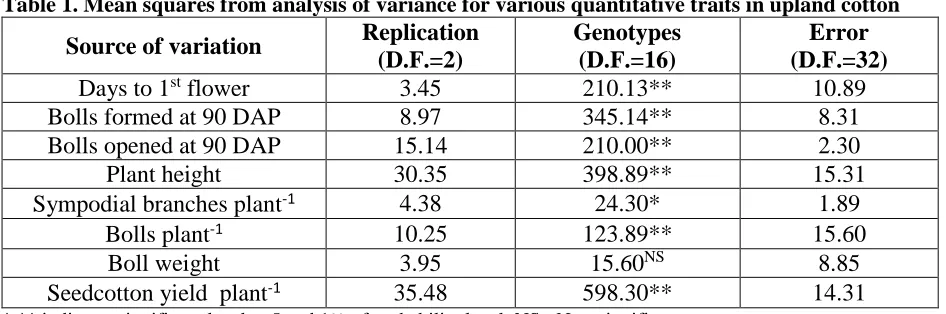
yield plant1 (g).The obtained mean squares from analysis of variances exhibited highly significant differences (P≤0.05) for all the studied traits among the assessed genotypes except that of boll weight, which was non-significant (Table 1). This reveals that examined genetic materials have value to be used in more breeding programs for the improvement of upland cotton in respect to fiber and yield. Kaleri et al.[2] also reported that a set Bt and non-Bt cotton genotypes differed highly significantly at P ≤0.01 of
probability level for plant height, 1st
sympodial node number, 1st effective boll
node number, sympodial branches plant-1,
bolls plant-1, boll weight, seed index,
Table 1. Mean squares from analysis of variance for various quantitative traits in upland cotton
Source of variation Replication (D.F.=2)
Genotypes (D.F.=16)
Error (D.F.=32)
Days to 1st flower 3.45 210.13** 10.89
Bolls formed at 90 DAP 8.97 345.14** 8.31
Bolls opened at 90 DAP 15.14 210.00** 2.30
Plant height 30.35 398.89** 15.31
Sympodial branches plant-1 4.38 24.30* 1.89
Bolls plant-1 10.25 123.89** 15.60
Boll weight 3.95 15.60NS 8.85
Seedcotton yield plant-1 35.48 598.30** 14.31
*,** indicates significant level at 5 and 1% of probability level; NS= Non-significant
With regard to GCA effects, among the five parents, Shahbaz recorded maximum (2.89)
GCA effects for days to 1st flower, followed
by CIM-496 (1.60), while Sindh-1 recorded maximum (1.25) GCA effects for bolls formed at 90 DAP and also showed maximum (3.00) GCA for bolls opened at 90 DAP. Whereas, Haridost gave maximum (1.95) GCA effects for plant height, followed by CIM-496 (1.25) for same trait; parent Sadori recorded highest (1.90) GCA
effects for sympodial branches plant-1 and also expressed the highest GCA effects (2.10) for seed cotton yield plant-1. Sindh-1 recorded maximum GCA (1.30) effects for bolls plant-1 and CIM-496 gave the highest GCA (0.45) for boll weight (Table 2). Similarly, Abro et al. [3] showed that the variety Sadori proved to be best general combiner for plant height, number of bolls plant-1 and seed cotton yield.
Table 2. General combining ability (GCA) of the parents for earliness and yield traits in upland cotton
Genotypes Shahbaz CIM-496 Sindh-1 Sadori Haridost S.E.(gi)
Days to 1st flower 2.89 1.60 0.89 -2.60 -1.78 0.10
Bolls formed at 90 DAP -0.45 -0.90 1.25 0.35 -0.25 0.05
Bolls opened at 90 DAP 1.15 2.80 3.00 -4.80 -2.15 0.78
Plant height -2.05 1.25 -2.25 0.90 1.95 0.65
Sympodia plant-1 -1.90 0.85 0.85 1.90 -1.10 0.45
Bolls plant-1 -1.70 0.65 1.30 0.35 -1.60 0.32
Boll weight 0.02 0.08 0.45 0.10 -0.65 0.005
Seedcotton yield plant-1 1.90 -2.80 0.80 2.10 -1.80 1.10
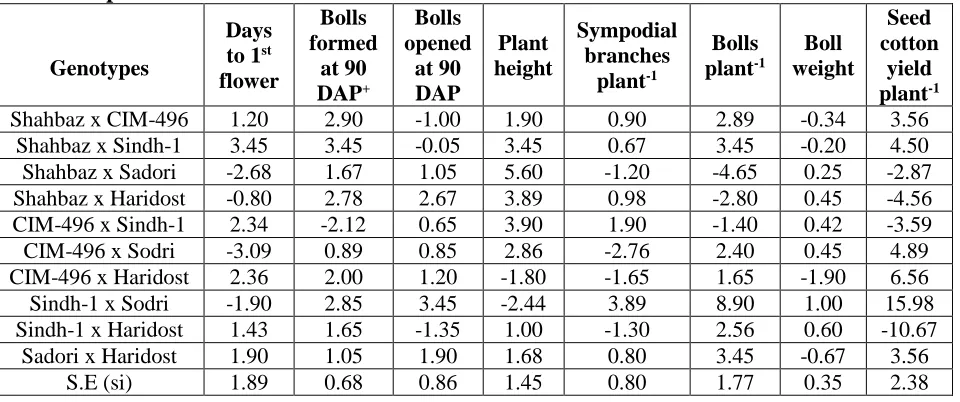
Regarding SCA effects, Shahbaz x Sindh-1 gave the higher (3.45) SCA effects for days to 1st flower and bolls formed at 90 DAP, while Sindh-1 x Sadori recorded high (3.45) SCA effects for boll opening at 90 DAP, followed by Shahbaz x Haridost (2.67). However, Shahbaz x Sadori produced high
(5.60) SCA effects for plant height, followed by CIM-496 x Sindh-1 (3.90) SCA effects for same trait and Sindh-1 x Sadori gave the
higher SCA effects (3.89,8.90,1.00
and15.98) for sympodial branches plant-1,
crosses (Table 3). Similar to our findings,
Baloch et al. [4] reported SCA estimates for
hybrids FH-901 x CIM-506, which
expressed maximum effects for ginning
outturn percentage (4.00) and micronaire value (0.33); NB-999 x CIM-497 for earliness (5.29) and staple length (1.69) and FH-901 x CIM-497 (16.17) for plant height.
Table 3. Specific combining ability (SCA) effects of the F1 hybrid for earliness and yield
traits in upland cotton
Genotypes
Days to 1st
flower
Bolls formed
at 90
DAP+
Bolls opened
at 90 DAP
Plant height
Sympodial branches
plant-1
Bolls plant-1
Boll weight
Seed cotton
yield plant-1
Shahbaz x CIM-496 1.20 2.90 -1.00 1.90 0.90 2.89 -0.34 3.56
Shahbaz x Sindh-1 3.45 3.45 -0.05 3.45 0.67 3.45 -0.20 4.50
Shahbaz x Sadori -2.68 1.67 1.05 5.60 -1.20 -4.65 0.25 -2.87
Shahbaz x Haridost -0.80 2.78 2.67 3.89 0.98 -2.80 0.45 -4.56
CIM-496 x Sindh-1 2.34 -2.12 0.65 3.90 1.90 -1.40 0.42 -3.59
CIM-496 x Sodri -3.09 0.89 0.85 2.86 -2.76 2.40 0.45 4.89
CIM-496 x Haridost 2.36 2.00 1.20 -1.80 -1.65 1.65 -1.90 6.56
Sindh-1 x Sodri -1.90 2.85 3.45 -2.44 3.89 8.90 1.00 15.98
Sindh-1 x Haridost 1.43 1.65 -1.35 1.00 -1.30 2.56 0.60 -10.67
Sadori x Haridost 1.90 1.05 1.90 1.68 0.80 3.45 -0.67 3.56
S.E (si) 1.89 0.68 0.86 1.45 0.80 1.77 0.35 2.38
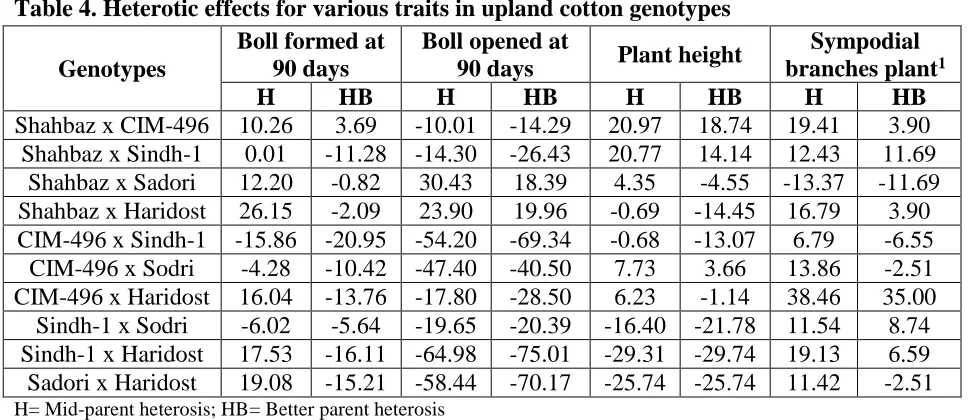
Taking heterotic effects which is mentioned in Table 4 and 5, Shahbaz x Sindh-1 manifested maximum (8.80% and 5.18%) of relative and better parent heterosis for days to 1st flower; Shahbaz x Haridost gave the maximum (26.15%) relative heterosis and Shahbaz x CIM-496 gave higher (3.69%) better parent heterosis for bolls formed at 90 DAP and Shahbaz x CIM-496 disclosed maximum (20.97%and 18.74%) relative and better parent heterosis for plant height. CIM-496 x Haridost recorded highest (38.46 and 35.00%) relative and mid parent heterosis, followed by Sindh-1 x Haridost (19.13% and 6.59%) and Shahbaz x Sindh-1 (12.43%
and 11.69%) relative and better parent
heterosis for sympodial branches plant-1,
Table 4. Heterotic effects for various traits in upland cotton genotypes
Genotypes
Boll formed at 90 days
Boll opened at
90 days Plant height
Sympodial branches plant1
H HB H HB H HB H HB
Shahbaz x CIM-496 10.26 3.69 -10.01 -14.29 20.97 18.74 19.41 3.90
Shahbaz x Sindh-1 0.01 -11.28 -14.30 -26.43 20.77 14.14 12.43 11.69
Shahbaz x Sadori 12.20 -0.82 30.43 18.39 4.35 -4.55 -13.37 -11.69
Shahbaz x Haridost 26.15 -2.09 23.90 19.96 -0.69 -14.45 16.79 3.90
CIM-496 x Sindh-1 -15.86 -20.95 -54.20 -69.34 -0.68 -13.07 6.79 -6.55
CIM-496 x Sodri -4.28 -10.42 -47.40 -40.50 7.73 3.66 13.86 -2.51
CIM-496 x Haridost 16.04 -13.76 -17.80 -28.50 6.23 -1.14 38.46 35.00
Sindh-1 x Sodri -6.02 -5.64 -19.65 -20.39 -16.40 -21.78 11.54 8.74
Sindh-1 x Haridost 17.53 -16.11 -64.98 -75.01 -29.31 -29.74 19.13 6.59
Sadori x Haridost 19.08 -15.21 -58.44 -70.17 -25.74 -25.74 11.42 -2.51
H= Mid-parent heterosis; HB= Better parent heterosis
Table 5. Heterotic effects for various traits in upland cotton genotypes
Genotypes Bolls plant
1 Boll weight Seed cotton
yield plant1
H HB H HB H HB
Shahbaz x CIM-496 -5.13 -6.98 -5.62 -6.73 29.27 17.46
Shahbaz x Sindh-1 33.81 18.75 -3.08 -4.71 27.70 6.27
Shahbaz x Sadori 27.51 6.49 1.00 0.00 42.91 33.61
Shahbaz x Haridost 41.61 40.48 1.08 -5.72 36.36 28.74
CIM-496 x Sindh-1 21.81 10.01 -5.37 -5.86 -35.70 -41.72
CIM-496 x Sodri -19.75 -31.90 -12.31 -14.19 -19.30 -30.96
CIM-496 x Haridost 1.95 0.77 -11.15 -16.21 7.32 -7.38
Sindh-1 x Sodri -20.00 -25.41 4.07 1.32 4.62 -17.46
Sindh-1 x Haridost 1.40 -9.38 17.65 11.50 17.08 -6.92
Sadori x Haridost 2.88 -13.52 16.79 7.92 35.27 33.86
H= Mid-parent heterosis; HB= Better parent heterosis
Conclusion
All the genotypes were highly significant for most of the traits, however, boll weight was non-significant. Among the genotypes Sindh-1 and Shahbaz were best combiners for days to 1st flower, bolls formed at 90 days after planting, bolls opened at 90 days after planting, plant height, sympodial branches plant1, bolls plant1, boll weight and
seed cotton yield plant1. Among the F1
hybrids the crosses Sadori x Sindh-1,
Shabazx Hari dost, Sadori x CIM-496 were
best specific combiners for all the characters studied. The F1 hybrids Shahbaz x Sindh-1, Sadori x Sindh-1, Sadori x Hari dost and Sadori x CIM-496 recorded higher heterotic effects for all the traits.
Authors’ contributions
materials/ analysis tools: SH Kaleri & AA Kaleri, Wrote the paper: AA Kaleri.
References
1. İlker E, Altınbaş M, Tosun M & Sakinoğlu ÇF (2008). Heterosis and genotypic variability for some yield and fiber properties in F2 generations of
two cotton (Gossypium spp.)
crosses. Ege Üniversitesi Ziraat
Fakültesi Dergisi 45 (3): 153-163 2. Kaleri AA, Baloch AW, Baloch M,
Wahocho NA, Abro TF, Jogi Q, Soomro AA, Marri A & Bhutto LA (2016). Heritability and correlation analysis in Bt and non-Bt cotton (Gossypium hirsutum L.) genotypes. http://dx.doi.org/10.19045/bspab.2016. 50114 Published by Bolan Society for
Pure and Applied Biology. Pure Appl.
Biol 5(4): 906-912
3. Abro S, Kandhro MM, Laghari S, Arain MA & Deho ZA (2009). Combining
ability and heterosis for yield
contributing traits in upland cotton (Gossypium hirsutum L.). Pak J Bot 41(4): 1769-1774.
4. Baloch AW, Ejaz M, Ahmad I, wasila H, Baloch MJ, Baloch GA, Yasir TA, Siddiq ur Rahman, Hayat S, Shah SNM
& Khan MA (2016).
http://dx.doi.org/10.19045/bspab.2016. 50114 Published by Bolan Society for
Pure and Applied Biology 906. Pure
Appl Biol 5(4): 906-912.
5. Dukre VB, Potdukhe NR, Neelam Dheva & Parmar JN (2007). Heterosis for yield, economic and morphological
traits in American cotton. Annals of
Plant Physiology 21(2): 236-239. 6. Zhang XG, Ni WC, Shen XL, Zhang B,