SMART WEB BASED APPLICATION FOR INTERNET DIRECT
CONSUMER TO CONSUMER TRADING
Mr. Jaya S Pujar
Lecture, Department of Computer Science & Engineering,Krishna Murthy Institute of Technology And Engineering, Ghatkesar
ABSTRACT
An online web application called Student-Trade has been developed. It is a state-of-the-art platform for direct consumer-to-consumer trading in the Internet. The platform is targeted for direct consumer-to-consumer trading among university students. The items for trading include books, electronics, sports equipment and tutorial materials. This paper is on the design intelligence of the Student-Trade web application. One objective is to help the user to decide on the selling price of his item when the item is being posted in the web application.The system integrates a hybrid neighbourhood search algorithm for determining the price of sale item when it is placed for trading in the Internet. Data mining techniques are explored for efficient processing of a vast amount of information in the database tables. In addition, the trading system would also have the intelligence of recommending items or products to a potential buyer given the previous purchase patterns.
Keywords—Price prediction, Product recommendation, Hybrid neighborhood search algorithm , Cosine method
I. INTRODUCTION
The rapid development of information technology has facilitated an elegant trading environment in the Internet. An online web application called Student-Trade has been developed. It is a state-of-the-art platform for direct consumer-to-consumer trading in the Internet. The platform is targeted for direct consumer-to-consumer trading among university students. It is developed using ASP.NET, the .NET framework, HTML, CSS and SQLServer. The objective is to help the user to decide on the selling price of the sale item. In addition, the web application can also have features of a recommender system. The decision support system is embedded with a hybrid neighbourhood search algorithm, with emphasis on solving a price-recommendation problem in a real-world internet trading platform. One specific feature is that the system can be made adaptive to the user.
II. PROBLEM STATEMENT
Buying and selling products to the desired customers/students is a challenging task in the current trading business and also there is a need of a platform for the students to perform transaction of goods with other students within a small social network.
An online web application called Student-Trade platform is targeted for direct consumer-to-consumer trading among university students.
METHODOLOGY
Figure 1.1:Architecture of the system
Figure 1.1 shows the architecture of the system the architecture, the seller uploads the items for sale and the cost of the uploaded item is predicted by the system using hybrid neighbourhood search algorithm. Buyer browses these uploaded items and places order for them. By using the transaction history of the buyer the system recommends items using similarity between the neighbours. The server holds the information about the sellers , buyers, previous traded items, current sale items, discount info etc.
The system has 3 modules. They are
A.ServercModule: The main functionality of this module is to predict the appropriate cost of the product based on the previous transaction history of the user. Another important function is to provide the recommendation of the product according to the student interest. The above mentioned functionality is achieved using following algorithms
We make use of “hybrid neighborhood search algorithm” for determining the price of sale item when it is placed for trading. Association Rules is used for the recommendations of products to students.
B.Development Module: This module describes the system we are developing. It takes the input i.e. the seller, buyer and products information and algorithms to predict the cost of the sale item as well as to recommend the products to buyers from the server. The system is developed and is then available for use by sellers, buyers and visitors.
C.Client Module: It is divided into 4 sub-modules.
Administrator : Administrator is the owner of the system having full authority and is the one who maintains the entire trading system.
Seller: Seller is a university student who places the products for selling and receives services from the trading system by logging in to the application by providing the login id and password given by the administrator and then uploads the product details and related features or attributes.
Buyer: Buyer is also a university student who purchases the products from the seller and the system recommends the products for the potential buyers based on their buying history.
Visitor: Visitor is the one who visits the trading system and has limited accessibility that is can view only certain functionalities like Home page, About us, Contact us, Services, View recent products and their cost details uploaded by sellers.
IV. IMPLEMENTATION
A.Algorithm for Price Prediction (Hybrid Neighborhood search algorithm)
and classify the attribute values to one of the predefined set of class.
B.Recommendation Process
The representation of user (student) information and the purchasing history of attractions by student need to be analyzed and modeled. Then generation of neighbor users (students) and similarity of students can be computed according to the buying history data and the collaborative filtering algorithm. A neighbor student list can be calculated on the basis of known
similarities. The generation of attraction
recommendations. Top-N attractions will recommended to the student according to the buying history of his neighbors.
V.EXPERIMENTAL RESULTS
Figure 2.1: System predicts the cost of product
Figure 2.1 shows the page where the system predicts the cost of the uploaded item and the student can set or reset the constraints for the product.
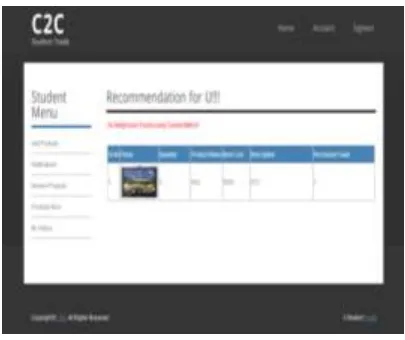
Figure 2.2: Recommendation of the product
Figure 2.2 shows the page that recommends the products for the buyers based on the buyer’s transaction history.
Figure 2.3: Student browse the product
Figure 2.3 shows the page for the student to browse the products uploaded by the Seller and can place order for the products.
CONCLUSIONS
item. For a buyer, the intelligent trading platform can gather information on his previous purchased items from the databases. Also, buyer can express his interests or post requests for certain desirable items. The recommender system would then recommend sale items to the potential buyer. Overall, the platform targeted for direct consumer-to-consumer trading would be more intelligent, simpler-to-use and more user friendly.
ACKNOWLEDGEMENTS
We would like to thank Mr. Ksahifulla, Senior Developer, DSoft System, Mysuru for his guidance and instructive comments on the content of this paper and for his valuable support. We would also like to thank Dr. Reshma Banu, HOD, Information Science and Engineering, GSSSIETW, Mysuru and also we would like to thank Mr. Chaya P, Assistant. Professor of Dept. of ISE GSSSIETW, Mysuru and also thank to all the staff members of the department for their constant support and co-operation.
REFERENCES
[1] “A Personalized Product Based Recommendation System Using Web Usage Mining and Semantic Web”, Sneha Y. S, G Mahadevan, and Madhura Prakash, International Journal of Computer Theory and Engineering Vol. 4, No. 2, April 2012,.
[2] “A Recommender System for Online Personalization in the WUM Applications”, Mehrdad Jalali, Norwati Mustapha, Ali Mamat, Md. Nasir B Sulaiman, Proceedings of the World Congress on Engineering and Computer Science 2009 Vol IIWCECS 2009, October 20-22, 2009, San Francisco, USA,.
[3] “Cancer Diagnosis using Data Mining Technology” Muhammad Shahbaz, Shoaib Faruq, Muhammad Shaheen, Syed Ather Masood, Life Science Journal, 2012;9(1.
[4]“Empirical Analysis of Predictive Algorithms for Collaborative
Filtering”John S. Breese, David Heckerman, Carl Kadie, International Journal of Computer Theory No. 2, April 2014.
[5] “Implementation of Decision Support System in Warehouse” C. Ajay Guru Dev, K.Balagi, International Journal of Mechanical And Production Engineering, ISSN: 2320-2092, Volume- 2, Issue-11, Nov.-2014, “Implementation of Decision Support System in Warehouse”.
[6] “Information filtering and information retrieval: Two sides of the same coin?” Nicholas J. Belkin and W. Bruce Croft, Communications of the ACM Dec 1992 v35 n12 p29(10),
[7] “Learning Collaborative Information Filters”Daniel Billsus and Michael J. Pazzani, International Journal of Mechanical Engineering,.
[8] “Memory-Based Weighted-Majority Prediction for Recommender Systems”Delgado, Joaquin and Ishii, Naohiro, Proceedings of the World Congress on Engineering and Computer Science,.
[9] “Adaptive Route Selection for Dynamic Route Guidance System
Based on Fuzzy-Neural Approaches” G. Pang, K. Takahashi, T. Yokota, H. Takenaga, International Journal of Computer Theory and Engineering.
[10] “Recommender Systems in E-Commerce” J. Ben Schafer, Joseph Konstan, John Riedl, International Journal of Scientific and Research Publications, Volume 6, Issue 1, January 2016.
Cooley, J. Srivastava, Communications of the ACM, Volume 43 Issue 8, Aug. 2000.
[12] , “A New Approach for on Line Recommender System in Web Usage Mining” S.K. Shinde, U.V. Kulkarni, International Conference on Advanced Computer Theory and Engineering, 2008. ICACTE '08, pp. 973- 977, 2008.
[13] “A Web Usage Mining Approach Based on LCS Algorithm in Online Predicting Recommendation Systems” M. Jalali, N. Mustapha, N.B. Sulaiman, A. Mamat, 12th International Conference on Information Visualisation, pp. 302-307, 2008
[14] “Research on the model of Integration with Semantic Web and Agent Personalized Recommendation System” X. Sui, S. Wang, Z. Li, , International Conference on Computer Supported Cooperative Work in Design, pp. 233 - 237, 2009.
[15] , “A Personalized Product Based Recommendation System Using Web Usage Mining and Semantic Web”, Y. S. Sneda, G. Mahadevan, M. Prakash, International Journal of Computer Theory and Engineering, Vol. 4, No. 2, April 2012.
[16] “A Decision Support System for Optimizing Dynamic Courier Routing Operation” C.Lin, K.L. Choy, G.T.S. Ho, H.Y. Lam, G.K.H. Pang, and K.S. Chin, Expert Systems with Applications,vol. 41,pp. 6917-6933, 2014.
[17] “A greedy look-ahead heuristic for the vehicle routing problem with time windows,” G. Ioannou, M. Kritikos, and G. Prastacos, Journal of the Operational Research Society, vol. 52(5), pp. 523–537, 2001.
[18] “Data Mining on Romanian Stock Market Using Neural Networks for Price Prediction, ” M. D. Nemes and A. Butoi, Informatica Economica, vol. 17, No. 3, pp. 125-136, 2013.
[19] “Variable neighborhood search,” N. Mladenovic´ and P. Hansen, Computers and
Operations Research, vol. 24(11), pp. 1097– 1100, 1997
[20] Neural Network: A Comprehensive Foundation. New Jersey: S. Haykin, Pearson Education, 1999.
[21] Biometric Authentication: A Machine Learning Approach, S.Y. Kung, M.W. Mak, and S.H. Lin, New Jersey: Prentice Hall, 2004.
[22]Principles of Artificial Neural Network, D. Graupe,World Scientific, 2013.
[23] www.ebay.co.uk
[24] www.gumtree.com
[25] www.iswapbooks.co.uk