THE CAMPAIGN OF 1938
The excavation of the American Zone of the Athenian Agora has been continued on the usual large scale, the eighth season of work covering a period of twenty-one weeks, from January 24 to June 18. The present Report, like those of previous years, will give a comprehensive, non-technical, well-illustrated account of the results of of the compaign. Each year as the work has progressed the problems arising from the expropriation of the large area of excavation and from the administration of the business and scientific departments of the work have become increasingly simple of solution. This happy result has been achieved by the devotion and efficiency of A. Adossides, the business manager of the organization, and by the skill and ability of the attorney, A. Kyriakides, who has successfully defended the interests of the Agora before the various courts to which proprietors in many cases have made appeal, as they are privileged to do under the terms of the Agora law. Since practically all the cases have now been adjudicated, it is opportune to record that decisions by judges of all ranks have been rendered with clarity, promptness, and full justice to all con- cerned. At the outset of this project few Athenians believed that the colossal task of expropriating some three hundred and sixty pieces of property in the heart of the city could be achieved within any reasonable time. That this has actually been accom- plished within the projected span of ten years is due to the efficient functioning of the Agora organization which has been constantly supported and assisted by the au- thorities of the Greek Government.
The constitution of the scientific staff of the excavations has been adequately described in previous annual Reports. Most of the members continued with the work during the current season. But Professor Caley, who established the chemical labora- tory which has proved a valuable adjunct in research and in the identification of the discoveries, was unable to leave again his duties at Princeton, and the position of research chemist was, therefore, filled for the season by Miss Marie Farnsworth, who is engaged in chemical research of somewhat similar character at the Fogg Art Museum in Cambridge. Miss Constance Curry withdrew from the Catalogue De- partment in order to resume her studies in America, and this vacancy was filled by the appointment of Miss Suzanne Halstead (now Mrs. John Young), a student enrolled in the American School. Miss Elisabeth Washburn, also a student of the School, was added to the staff of the Coin Department. The supervision of the workmen and of the practical management of the work was continued by the chief foreman, Sophokles Lekkas, and the corps of sub-foremen remained the same as last year. The number of workmen, which averaged 145 for the season, was considerably smaller than in previous years because of the shallower deposits of earth on the
American School of Classical Studies at Athens is collaborating with JSTOR to digitize, preserve, and extend access to
Hesperia
southern hillslopes where the major part of the work was concentrated. For the same reason the total amount of earth removed, 20,647 tons, was less than in the preceding season (30,000 tons).
The work of the present campaign was twofold in character: the excavation of several additional city blocks, and the minute investigation, in preparation for pub- lication, of a building (the Tholos) which had been previously cleared superficially. -Both -of these branches of the work produced important topographical results. The
= I | l I _ 11 a L...~~~~~~~~~~~~~~~~~~. ... ... ..
Fig. 1. Present Appearance of the West Side of the Agora
THE CAMPAIGN OF 1938 203
restoration has been drawn by J. Travlos on the basis of all evidence at present available (Fig. 2) in order to give a clear view of the west side of the Agora as it appeared after the building boom of the Pergamene period in the second century before Christ. Such substantially was the appearance of the site when Pausanias visited Athens in the middle of the second century after Christ, the damage wrought by Sulla in 86 B.C. having been repaired as promptly as possible after the Roman victory.
Pausanias entered the Agora in the northwest corner coming from the direction of the Dipylon and shortly reached a cross street leading to the south, finding near
* . . :: : .~~~~~~~~~~~~~~~~~~~~~~~~~~~~~~~~~~~~~~~~~~~~~~~~~~~~~~~~~~~~... ... . : ... . . . .:: . : . . . . ... . .: :
* . . ... ... . . . ... . ..~~~~~~~~~~~.. .... .... ...
Fig. 2. Reconstruction of the Buildings on the West Side. Drawing by J. Travlos
the junction of the streets the Altar of the Twelve Gods which served as a milestone for measuring distances from the city. The cross street passes in front of the public buildings on the west side which, as shown in the restoration, have been securely identified in succession from north to south as follows: the Stoa of Zeus with pro- jecting wings on the north and south ends; a small shrine dedicated probably to Zeus and Athena; the Temple of Apollo Patroos; a great stairway ascending to the Hephaisteion, situated on a terrace on the summit of the Kolonos Agoraios and surrounded by shrubbery; the Metroon south of the stairway; and behind the Metroon the Bouleuterion, of which only the roof appears in the restoration; then a gateway
THE CAMPAIGN OF 1938 205
AGORA BOU NDARY STONE
Just east of the Tholos the street forks into two branches and at this fork a boundary stone of white marble, dating from the sixth century before Christ, was found standing in its original position. The spot is marked A on the latest ground
Fig 4. Boundary Stone of the Agora
Themistokles of about 483 B.C.; it was completely concealed by the higher road level
of later classical times. The stone bears an inscription cut on a smoothed band across the top and down the right side with carefully made archaic letters of the latter part
..~~~~~~~~~~~~~~~~~~ . .... ~ ~ ~ ~ ~~~~~
. . ...
Fig. 5. Street of the Panathenaia Looking South
~~~~~~~~~~~~~I
.
.L
I__1
- 1-I
of the sixth century (Fig. 4). The inscription reads: h6pos etut Teg ayopaq " am
THE CAMPAIGN OF 1938 207
THE ELEUSINION
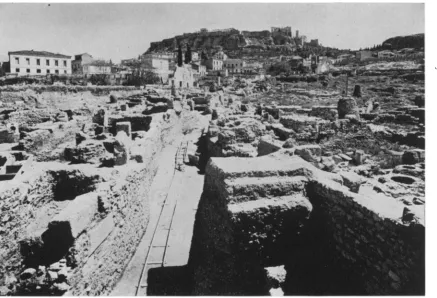
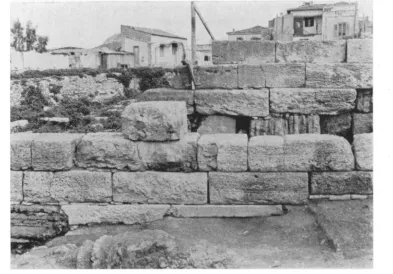
The main street from the Dipylon, from which the west cross street branched, passes the Altar of the Twelve Gods and, running through the northeastern part of the excavated area, ascends towards the Acropolis on the east side of the Agora, where it is preserved in places to its full width of about ten metres. It was paved with large blocks in the Roman period and was bordered by the Valerian Wall in the latter part of the third century after Christ. A view of the street looking south is given in Figure 5. This street is undoubtedly the famous " Dromos," the broad way along which the Panathenaic procession proceeded from the Ceramicus to the Acropolis. Confirmation of this view is provided by an inscription cut on the wall of the Acropolis near the Klepsydra, where the street bore west to pass around to the entrance of the Acropolis. The letters of this inscription, which is to be dated at about the end of the fourth century, are badly weathered but the last words are clearly legible: " The Street of the Panathenaia." High on the hillside, below the Acropolis walls, at a gentle curve in the road references in ancient authors (discussed by Judeich, Topographie2, pp. 287 ff.) designate as a pausing place for the procession the site of the Eleusinion, the sanctuary in Athens dedicated to the Eleusinian goddesses Demeter and Kore.
The excavations of the current season have produced much significant evidence indicating the proximity of the Eleusinion at a point which is topographically. in accord with the ancient references. Within a restricted area east of the street where it curves slightly to take a course which would pass between the Areopagus and the Acropolis (the point marked B on the plan), many marble blocks were found which bear inscribed dedications to Demeter and Kore or contain references to their sanc- tuary. One of the inscriptions is cut on an epistyle block of large size which was re-used in the construction of the Valerian Wall. Another dedication is on a huge marble statue base, measuring 1.57 m. long and 0.80 m. high, which was lying beneath the wall. Because of their great size and weight it is improbable that these blocks were removed far from their original positions. Another marble base from the wall bears a dedication to Demeter composed in two elegiac distichs (Inv. No. I 5484). The inscription, dated in the fifties of the fifth century before Christ, records the dedication to Demeter by her attendant (rpo'roXog) Lysistrate. Still another monu- ment (Inv. No. I 5323) which is to be associated with the Eleusinion is the base for a bronze statue of Syndromos, son of Kallikratides, which is inscribed with the record that the man was honored by the Senate and People of Athens in the Augustan age, because as agonothetes he had financed at his own expense the celebration of the Eleusinian games.
to " the goddesses " (Fig. 6: Inv. No. 1 5436); a decree of the year of the archon Nikokles, 302/1 B.C., which honors the taxiarchs for attending to the regulation of
orderly procedtire at the celebration of the festival of Demeter and bears the order that the stele be erected in the Eleusinion (Inv. No.- I 5228) ; and many pieces of the stele with the record of the sale of the confiscated property of Alcibiades and of the other mutilators of the Herms and profaners of the Mysteries, which was also set up in the Eleusinion. Such a cumulation of Eleusinian records within one restricted area is clearly indicative of the proximity of the sanctuary.
But even stronger proof of this proposition is furnished by the discovery in the same area of buried deposits of kernoi,
00 on of which is shown in Fig re 7 as it
appeared when excavated. A shallow pit was carefully cut in the bedrock and
g 6.was filled with the discarded vases. The
one illustrated in the picture was later
pef cOVered in part by blocks of the Valerian
Wall. Five such closed deposits of kernoi were found as well as other scattered pieces, the dates of burial ranging from
Stil fthe late fi th to the end of the fourth
centurybefo're Christ. The kernos is a vaseof ecuiar shape which was exclu-
n sively used faor the offering to Demeter
of the first fruits of the harvest. While
w the type of the vase is foairly uniform
t e size and e aborateness vary. ose from the buried deposits are of a cheap, common kind (Fig. 8). The interpreta- tion of these burials is apparent f rom the familiar custom practiced in Greek sanc- Fig. 6. Marble Eagle Dedicated to the Goddesses tuaries. When shrines became over- crowded with cheap votive objects the priests gathered up groups of offerings and carefully buried them within the confines of the precincts. The position of these votive deposits cons equently designates approxi- mately the site of the Eleusinion.
THE CAMPAIGN OF 1938 209
* _4 A_|._-Jr i
] ~ ~
.; _ 4LiN
4 _ l;1
_ . . : . . . . , E !~~~~~~~~~~~~~~~~~~~~~~~~~~~~~~~~~~~~~~~~~~~~~~~~~~~~~~~~~~~~~~~~~~~~~~~~~~~~~~~~~~~~~~~~~~~~~~~~~~~~~~~~~~~~~~~~~~~~~~~~~~~~~~~~~~~~~....
.,X'e ... :.
Fig. 7. Buried Deposit of Kernoi as Excavated
S g H W;lE
>Z~~~~~~~~~~~~~~~~~~~~~.JSe ... . ... S. $.l
~~~|.... -.: :NA... X .:
chariot and of the figure of Triptolemos and the lower half of a draped female figure standing behind the chariot (Fig. 9: Inv. No. S 1013). On the evidence of similar reliefs found at Eleusis itself the woman behind the chariot must be interpreted as Persephone, since Demeter stood in front of it. The second relief, which is done in equally fine style and technique, shows Demeter holding a torch with her head turned to the left towards Triptolemos who held a sceptre of which only the top is preserved.
Fig. 9. Fragmentary Relief of Persephone and Triptolemos
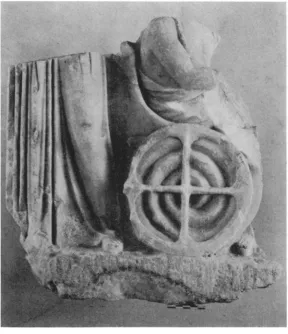
This fragment is similar to the first in scale and style, but the pieces vary in thickness, and it therefore seems unlikely that they come from the same plaque. On the third relief two draped women are represented, of whom the one on the left is standing and has a shield by her side and must therefore be interpreted as Athena; the one on the right is seated and by her side is the coil of a serpent so that she is presumably to be interpreted as Demeter.
THE CAMPAIGN OF 1938 211 in the area in question. It is therefore probable that the sanctuary itself lies directly opposite, on the west side of the street, in Section Beta Beta, which will be excavated during the next campaign. The close determination of the site of the Eleusinion and the definite establishment of the route of the Panathenaic procession are of the utmost value for our knowledge of the topography of the Agora. The tentative assignment of the sanctuary to a site next to the Enneakrounos, as was done on our earlier plans, must now be abandoned, and the previously accepted theory of its position far south- west of the Agora is quite untenable.
.... . . .... . . . .S . . . A.
Fig. 10. Byzantine Houses in Section Sigma
The major work of excavation of the current year was conducted in three city blocks in the southeastern part of the area designated as Sections Psi (,I'), Omega
the reports of the members of the staff in charge of the respective areas of excavation. A full report on the results of the exploration of the Tholos will be given by H. A. Thompson in a later supplement of this Journal.
SECTION SIGMA
For the third season excavation was continued in Section Sigma in the north- eastern part of the Zone under the supervision of R. H. Howland, and the work was not completed by the end of the year, much of the early classical strata remaining still unexplored. Progress was particularly slow in this area because of the presence of a large Byzantine settlement with rows of houses flanking a road on either side (Fig.
10). It was necessary to clear these houses carefully and then have the walls measured, drawn, photographed, and studied
.. ... . ...
... ... .. .... . *. . ....
..-... ... before the earlier strata below could be explored.
Two early wells were found in the area, . ... . one with contents of the second and third quar- ters of the seventh century before Christ, in- * 0j .cluding pottery of familiar Proto-attic type and * the oenochoe decorated with the hindquarters of
a lion, illustrated in Figure 24; the other con- taining a deposit dated in the first half of the
* *
asixth century. A Mycenaean terracotta figurine had found its way into the upper part of the . . ... filling of the sixth century well. It is intact except for its small crude head (Fig. 11: Inv. No. T 1653). Arms are not indicated but the breasts are clearly formed; the lower part of the
** figure is cylindrical in shape. It is decorated on
. ... ...front and back with wavy stripes painted in red on the buff ground. This type of figurine is not
Fig. 11. Mycenaean Figurine uncommon but it has not previously appeared in
THE CAMPAIGN OF 1938 213
lightning over Mt. Parnes. As soon as one was seen they started in procession to carry their offerings to the sanctuary at Delphi. If no flash occurred the procession
was postponed to the succeeding year. Whether the sacred way to Delphi coincided in its early stages with that to Eleusis is uncertain, but the fact of the erection of this marker would seem to point to a distinctive route.
A little additional exploration was made about the foundations of the large square building which has been mentioned in a previous Report (Hesperia, VI, 1937, p. 354), but a thorough investigation of the building has not yet been possible. The shape of the building, with its large central court surrounded by porticoes, suggests its use as some sort of market-place. The filling along the west wing gives a date at the end of the fifth century for its construction; it was destroyed in early Hellenistic times, before the date of the erection of the Stoa of Attalos.
The most interesting topographical discovery in this area is a long stoa wvhich runs across its north side in an east-wrest direction, and at its east end nearly touches the Stoa of Attalos, only sufficient space being left between the two for a passageway
2'2 metres wide. The foundation walls of the south side of this stoa were uncovered for a length of 30.50 metres; the north wall and the west end of the building have been cut by the roadbed of the Athens-Peiraeus railroad. This stoa was constructed in the late Hellenistic period and certainly after the disappearance of the rectangular building of the fifth century since it in part overlies the foundations of that building; it formed the boutndary of the eastern half of the northern side of the Agora. In order to uncover the north central boundary, which it is conjectured was formed by the famous Stoa Poikile, it vwould be necessary to excavate the strip of land on the north lying betwveen the railroad and Hadrian Street. The plan of the Greek Agora cannot be completed until its northern side has been uncovered, and in the meantime serious topographical problems will be left in suspense; but the land north of the rail- road lies outside of the limits of the American Zone and is not at present available for investigation.
SECTION PSI
This Section, which wvas excavated under the supervision of Eugene Vanderpool, is situated on the lower slope of the Areopagus in the southeastern part of the Zone. The deposit of earth over much of the area wvas shallow and in many places havoc had been wrought to ancient deposits by the intrusions of the cellars of modern houses. Early structural remains are scanty since the area lies south of the Agora proper, but the presence of many wells attests its use as a residential district. A small rect- angular building of the fourth century before Christ, measuring about five by seven metres, located near the centre of the area, is probably part of a private house.
There are, however, extensive remains of a building of the late Roman period Which covers almost the entire southern half of the Section and extends southward into Section Omega. The building contains rectangular rooms, corridors, and a
::.:..-r.... , peristyle court, and is too large and too
X: rmassive of construction for use as a
private house. A date for the erection of the building at the end of the fourth or the beginning of the fifth century after Christ is indicated by numerous ... . . ~~~~~~coins of the late f ourth and early fif th centuries which were found in a terra-
.. 1 11cotta drain leading from the northeast *
part and filled up during the early years of the building's existence. It was destoye inthe sixth century, as is proved by the evidence of pottery, lamps, and VTandal coins found in the destruc-
Fig. 12. Roof-tile with Dedication to Hephaistos
tion fill overlying it. The purpose for which this building was used has not yet been determined.
THE CAMPAIGN OF 1938 215
a broken meander below. A second bead-and-reel is painted on the projecting under surface. The letter epsilon, which appears on the back of the sima, indicates the fifth unit in a series, and shows that the tiles were prepared at the factory for placement
in specific positions on the roof. On the flat upper surface of the tile the dedication to Hephaistos is painted in large handsome red letters of the style of the late Hel- lenistic period. This is evidently a roof-tile from a building in the precinct of the Hephaisteion, which found its way into a distant well after some devastation of the city, probably that of the Herulians in 267 A.D.
SECTION OMEGA
The situation in Section Omega, of which the excavation was in charge of Miss Margaret Crosby, is similar to that noted in the adjoining Section Psi on the north. The area was occupied only by private houses until late in the Roman age, and deposits of all periods were more or less disturbed by successive subsequent intrusions. In spite of the steep slope of the hill to the north a considerable depth of earth was preserved in part of the area; in other parts cellars of modern houses had been cut in the bedrock, destroying all traces of earlier occupation. Apart from a few scattered prehistoric and other early sherds no evidence was secured for the habitation of the site before the end of the sixth century before Christ, but at least as early as that time a road, five metres wide, existed, and remained in use throughout antiquity, passing through the centre of the area from northeast to southwest. Just north of the west end of the road a grave dating from the end of the sixth century was uncovered; it still held some undisturbed deposit, including two black-figured lekythoi. This was presumably a burial made beneath a house floor. Northeast of the grave a well was cleared which had been filled up at the end of the fifth century. From it came pieces of large red-figured vases, one of which is decorated with the scene of the battle of the centaurs and Lapiths, and part of a small jug of the type used in the celebration of the Anthesteria, which is decorated with a curious motive in the form of an inverted amphora from the bottom of which extends a satyr's head. This pottery will presently be discussed in a forthcoming article by Miss Talcott.
filling so far excavated. Further investigation of the early history of this house will be necessary in a future campaign.
The house continued in use during Hellenistic times, and to that period belong three connecting cisterns and a well which served its occupants. The lowest filling of the well produced many comnpletely preserved lamps of types dated in the early part of the third century; the upper filling, which is contemporaneous with that of the cisterns, is sonmewhat later, dating from the second half of the century. From this upper filling came an official stamp of a police inspector named Xenokles (Fig. 13: Inv. No. SS 8080). This is a rectangular terracotta plaque with a length of 0.037 m., whichi had been attached to sonme object evidently inspected and approved by the police authorities. The stanmp bears the name of the inspector, his deme Perithoidai, and his title TEptvrOXapXog. This unusual word occurs in Thucydides (VIII, 92, 2) and is also epigraphically attested (I.G., 112, 204, lines 20-21, and 1193, line 2).
NScanty remains exist of the late Hellenistic and early Roman periods becauise of the dis- turanc ofearlier deposits wrought by the ex-
tensive building program of late Roman times,
but the presence of many wells and cisterns testifies to the more or less uninterrupted occupa- tion of the site. At the end of the fourth or early in the fifth century after Christ a large building
was erected on the northern side of the ancient
street which had continued in use throughout the centuries. This is the building wThich lies partly in Section Psi to the north. The plan of the
Fig. 13. Seal of Police Inspector building is without symmetry. Its main feature
Xenokles in the centre is a rectangular room, measuring eight by nine metres, which has an apse with three niches at its southern end. Northeast of this is a court, twelve nmetres wide, with a peristyle, of which the marble stylobate is in part wvell preserved. The walls are constructed of alternating courses of stone and brick set in mortar, except on the south w-here the wall of the building served also as the retaining wall of the street and is therefore built of conglonmerate blocks. The building continues east under the unexcavated edge of the area.
THE CAMPAIGN OF 1938 217
the Turkish and modern houses rested directly on late Roman filling in the north and southeast parts, on classical and Hellenistic filling in the centre, and on bedrock in the southwest.
SECTION ALPHA ALPHA
This Section, which lies east of Omega, was excavated under the supervision of R. S. Young. It includes an ancient city block, forty metres long from north to south, and twenty-three metres wide, which was occupied by private houses and
01~~4
:~~ A ~ ~~~~~~~~~~ ,..., _...?,?. j ~ ~ ~~~~~~~~~~~~~~~~~~~~~~~~
Fig. 14. Valerian Wall ith Marble Stele Used in Lowest Course
was bounded by four streets. On the east is the great Dromos, the main street of the Agora, which has already been described; on the west a narrow street runs parallel to the Dromos; on the north a street leads west from the Dromos; and the southern boundary is formed by a street about four metres wide, of which the continuation has been noted in Section Omega. The investigation of all these streets produced ample evidence to prove that they were in use at least as early as the beginning of the fifth century before Christ, and it seems, therefore, that this block was a resi-
dential unit f rom that time until the late Roman age.
the best preserved is one located in the southwest corner which was constructed in the fourth century before Christ. The house, which measures 11.70 m. from north to south and 10.70 m. from east to west, is arranged with three small rooms on each of the sides, grouped about a central room which has a hard floor made of pebbles and cement. This floor slopes slightly towards the west, from which side a drain leads to a large drain running under the west street. Remains of the bedding for a basin or tub are visible in the floor near the south wall of the room. It certainly served as a bath or a water-basin. The house was destroyed at the time of the sack of Sulla, but there is evidence of its re-use in the late Roman period.
Exploration of the east side of the area led to the uncovering of a retaining wall along the adjoining stretch of the Dromos. This wall, constructed of stones and cement, consists of four heavy piers, 1.70 m. thick, spaced at intervals of 3.50 m. to 4.00 m. and joined by a thinner wall of similar construction. The distance from this west edge of the street to the wall of the building bordering it on the east side is about eleven metres, but the actual width of the street itself may have been slightly less. The paving blocks of the Roman age had been removed from this stretch of the street, many of them for re-use in the Valerian Wall which was built along its east side at the end of the third century after Christ. In clearing the lower courses of the wall at this point a marble stele was revealed lying on bedrock at the bottom of the wall (Fig. 14). It lay lengthwise with one side visible from top to bottom so that it appeared to be a complete, full-sized stele; but after the blocks lying above it had been raised and the stele had been removed, it proved to be complete but only about half the usual width. The inscription gives a list of the names of ephebes of the tribe Oineis (Inv. No. I 5250). It is dated about 330 B.C.
on the basis of the shapes of the-letters and of the evidence provided by the names, and is important as giving the relative numbers of ephebes in the various demes of Oineis at this period.
A surprising discovery in this area was that of a large brick-lined vaulted tunnel which leads into the hillside sloping from north to south at a grade of about 3 to 1. The passageway, measuring 1.30 m. high and 0.53 m. wide, descends with low tread steps for a distance of twenty-nine metres, at which point the floor becomes flat and continues at that level for another seven metres. The floor is paved with tiles and beneath it a small terracotta conduit runs along the east side of the passage. At a point thirty-six metres from its mouth the tunnel opens into a tile-lined well, and, since the filling of the upper shaft of the well immediately collapsed, blocking the tunnel, further investigation was suspended for the present season. The date of the construction of the tunnel is in the early Roman period, and it seems probable that this elaborate engineering achievement, which has its counterpart in Section Iota Iota to the southeast, was part of the water-supply system of the period.
THE CAMPAIGN OF 1938 219
interesting and important material which the excavator has come to expect from them. The earliest well was filled in the late Geometric period, near the end of the eighth century, the contents including the oenochoe decorated with large concentric circles which is illustrated below (Fig. 21). Other fine vases came from deposits of the seventh and early sixth centuries, some of which will also be described later. A
.. ... .... . . .
Fig. 15. Kernos and Figurines from a Deposit of the Fourth Century
SECTION IOTA IOTA
Work in this area under the direction of A. W. Parsons was a continuation of that begun in the preceding season. The circular building noted last year has been found on further exploration to have an inner diameter of 7.75 m. and to have been built in the second half of the first century after Christ. The earlier blocks re- used in its walls do not come from an older structure on the site, but from a building wvith an interior diameter of 19 m. of which no trace exists in this area.
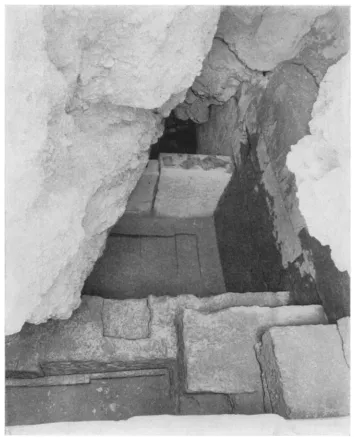
An elaborate underground system of water-works was revealed, which is similar in type to that existing in Section Alpha Alpha. A brick-lined, brick-vaulted passage leads into a small
chamber measuring 2.0Om. high, 1. 50i.
long, and 1.00 n. wide (Fig. 16). This chamber and another of about equal size to the south of it open out of the west side of a great brick-lined shaft which lies in the southeastern corner of the area. The shaft, which has a diameter of two metres, has been cleared to a depth of 24 m. below the level of bedrock, but the bottom had not been reached by the end of the season. The shaft was open in early Byzantine times to a depth of about fifteen metres, but below that, as far as excavation has extended, the filling is an accumulation of sand and silt washed in at a late Roman date. From this deposit came
THE CAMPAIGN OF 1938 221
remains beneath it might be revealed, the evidence for its date was confirmed by pieces of Turkish pottery of the seventeenth century found in its walls. Beneath the church the Roman pavement of the Dromos was preserved in good condition. Just at this point the Dromos is intersected by a cross street, six metres wide, which passes through the Valerian Wall by means of a gateway. It is not yet certain how far back this street dates but it existed as early as the Hellenistic age and continued in use through the Roman and Byzantine epochs, and until it was blocked by the building of the church in the Turkish period. The gateway, which is about 2.50 m. wide, has its original pavement in place, and a pivot hole for the gate is preserved on
the north side.
Among the many pieces of marble
found in the original filling between the . . .
..i
east and west faces of the Valerian Wall one fragnment is of special beauty and interest. This is part of a large archi- tectural block of Pentelic marble on
which elaborate decorations are painted. -.
The lef t end of the block is preserved,
on the face of which a striding lioness ... was painted, probably in yellow, against
a brilliant blue background (Fig. 17). This panel is bordered above and below by a narrow red stripe. Since the cof- fered undersurface of the block is deco- rated with a handsome palmette design the block was evidently intended to be visible from below as well as from in front, and therefore it was probably used as a lintel over a doorway. The style of the palmette and of the lioness
and the general workmanship of the Fig. 17. Lintel Block with Painted Lioness
piece point to a date in the latter part of the fifth century before Christ.
SECTION OMICRON ALPHA
; 4 '~~~~~~~~~~~~~~~~~-
to~ Zo 30
X
f
THE CAMPAIGN OF 1938 223
before Christ. Since three of the sixth century wells were filled with debris such as roof-tiles, mud-bricks, and fragments of wood, it is probable that they were filled on the occasion of the clearing up of the district on the retirement of the Persians after the sack of the city in 480 B.C. Some handsome black-figured vases from these
wells will be illustrated later in the section of this Report devoted to the description of the pottery.
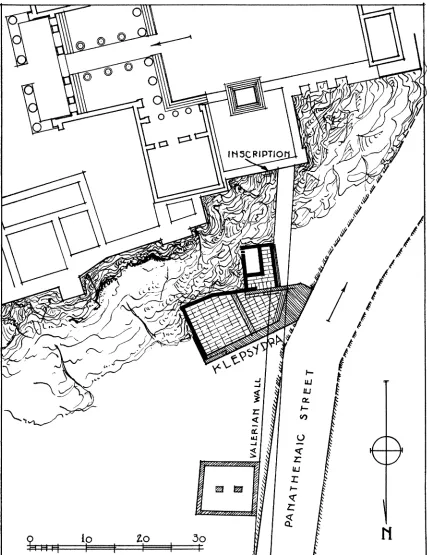
The investigation of the Klepsydra produced valuable information in regard to its construction and its chronology. The plan given in Figure 18 showATs the structure
Fig. 19. Fissure in Rock Opening into Upper Chamiiber of Klepsydra
campaign of King Alexander in Asia. The decree was passed in the archonship of Apollodoros, 319/8 B.C.; the anagrapheus (registrar) was Eukadmos, whose deme, which had not been previously known, is Anakaia.
fountain-housef. Her was unoee a sml retnua a... chme wit draw-basi
..g.R R INO
.. .. ... . ..
- --- ---i. - -- - - ---
Fig. 20. View of Interior of Upper Chamber of Klepsydra
The clearance of the filling in the mouth of the fissure, which dates from Roman
Imperial times, and of the area beneath it revealed much of the history of the
THE CAMPAIGN OF 1938 225
in olle corner, of which the top is level with the floor of poros blocks of the chamber. The south and xvest walls of the chamber, which are well preserved, are dated by
the nature and excellence of their construction, as well as by objects from the packing behind them, in the first 1half of the fifth cen-ttury before Christ, a date which is also suitable for the type of constr^uction seen in the w alls of the draw-basin. At that period, then, the fountain-house consisted of a great paved forecourt from which opened a small rectangular chamber, in one corner of Nrhich wvas a draw-basin protected by a grill or a wooden railing-. In the Hellenistic period this railing was replaced by a parapet of nmarble blocks and the clhamber wlas converted into an upper water-basin. Figure 20 gives a vTiewv looking down into the chamber froml the mouth of the fissure, with the Hellenistic marble parapet conspicUoUs in the centre of the picture. The marble block on the right is a re-used base for a statue of the sixth century before Christ, wvhich bears an inscribed dedication wvritten retrograde across the top edge.
At the time of the siege of Sulla (86 B.C.) the building was damaged and the
chamber-basin subsequently went out of use, for it was filled with a mass of debris resulting from the combat, such as lead sling-bullets, iron javelin heads, broken marbles anld roof-tiles, miany sherds of pottery, and fragments of Knnidian wine jars. The Knidian stamps and the latest Athenian pottery wvith them belong in the first quarter of the first century before Christ, and this date for the deposit is confirmed by the coins in the filling, of which the latest are three of Athens, New Style, dated about 88 B.C. Three others are of the type of the Newv Style dated from 229 to 30,
and one is of the Cleruchy of Delos dated after 166,B.C.
the Tholos and its neighborhood, which wvill be published in the near future, and also began his examination of the Odeion in preparation of the publication of that building. Supplementary work was also conducted in Section Eta, where the extensive walls of a large Byzantine settlement, after full study, photographing, and recording, were r-emoved under the supervision of Miss Alison Frantz. And Mrs. Dorothy Thompson resumed the clearance of a well and a cistern in Section Lambda Lambda, which had been left unfinished at the close of the previous season. Several interesting objects from these deposits will be described later.
Although the topographical results of the year did not necessitate any substantial additions to the ground plan of the area which is shown in its present state in Figure 3, they are unusually important for the following reasons: (1) the revelation for the first time in Athens of a complex of buildings of the archaic period; (2) the position of the boundary stone of the Agora of the sixth century before Christ; (3) the uncovering of an additional stretch of the great Dromaos, the route of the Panathenaic procession; (4) the determination of the approximate location of the Eleusinion. The outlined blank blocks appearing on the plan on the southern side of the area are those
which will be excavated during the next campaign.
POTTERY
The usuial abundance of pottery was secured during the year, and as in the past the best preserved vases were found in wells, of which the number seems to be almost inexhauistible. The prehistoric periods are represented only by sherds which are similar in type to the complete vases found last year and require no additional commentary. Likewise the large quantity of pottery of the later periods, Hellenistic and Roman, is essentially duplication of material already in hand, which has been sufficiently described in previous Reports. The present season, however, produced a rich harvest of well-preserved vases of the archaic period, which has heretofore been rather scantily represented in the Agora collection, and the following account will deal mainly with these vases.
THE CAMPAIGN OF 1938 227
.. ...
:.:4 ....
. . ...
I~~~~~~~~~~~~~~~~~~~~~~~~~~~~~~~~~~~~~~~~~~~~~~~~~~~~~~~~~~Z II~~~~~~~~M
Fig. 21. Late Geometric Oenochoe Fig. 22. Proto-attic Oenochoe.
Restored Painting by Piet de Jong
.~~~~~~~~~~~~~~~~~~~~~~~~~~~~~~~~~ ...
During the first half of the seventh century the Attic potters were trying to free themselves from the restraints of the linear laws of geometric design and were experimenting with floral and figurative combinations. An excellent illustration of this experimental stage of ceranmic development in Athens is provided by the decorative frieze of an oenochoe which is to be dated shortly before the middle of the century. A view of the vase is given in Figure 22 (Inv. No. P 12178), which is made from a
-restored painting by Piet de Jong, and Figure 23 shows a development of the
~~~~~~~~~~~~~~~~~~~~~~~~~~~~~~~~~.: :.:.. : ... ,:::.
decorative band, also drawn by de Jong. The decorations are done in black to dark brown color on the buff ground. At the neck and the base are broad bands of solid color, around the shoulder
s is a wavy line, and the frieze around
the body of the vase is set between borders above and below, each composed except fo rsrvdpne n n sd. of four narrow bands. The f rieze is
extraordinary for its selection of sub -
jects and for its lack of any symmetrical ... arrangement. On the extreme lef t are two vertical bands of variously designed meander patterns; these are followed by two different floral motives, of which 5, ~ ~ ~ ~ ~~~~~~te first is naturalistic in effect, while the second is a stylistic arrangement
. ...
of lotus blossoms
and their intertwined
stems. On the extreme right is a pair
1
of prancing horses, of which the second horse is represented only by his raised head and by the correct numiber of legs. In spite of the crudity of compositionFio 24. Another Proto-attic Oenochoe the artist gives ample evidence of origi- nality and imagination, and shows con- siderable facility in handling his technical equipment. The work, in fact, gives promise of the great development in ceramic design that was to occur during the succeeding century.
THE CA-MPAIGN OF 1938 229
occupied by the rear half of a lion, with small decorations in the corners. The bisected lion is symnmetrically placed in the panel and his body is finished in a neat curve: thus the artist had evidently planned this odd motive as an ornamental unit, btut fortunately such a perversion of artistic taste never survived the stage of experinmentation.
With the advent of the sixth century the black-figured technique becanme the popular style in Athens, and of this group two fine early examples Nvere secured from a well wvith a deposit dating from the late seventh and the early sixth century. One of these is an oenochoe decorated with
an archaic siren in a panel on one side: the other is an amphora which is covered vith black glaze except for a large panel on each side which is filled with the head and neck of a horse (Fig. 25: Inv. No. P 12526). The bridle straps, eye, ear, and the lines of the mnane are made by incisions. No traces of color are visible. Amphoras with this characteris-
tic type of decoration are not uncommon,
but this example is one of the earliest
of its class. Another black-figured vase found during the year, wvhich is earlier
than any other known Attic specimen of its type, dating from about the middle of the sixth century, is an alabastron, notable for the beauty and delicacy of its figurative decoration; this vase is the subject of a special study by Eugene Vanderpool published in this numuber of
Hcsperia.
Among the sixth century vases _ -
from a well in the centre of the Tholos
is a handsome black-figured pelike with Fig. 25. Black-figured Amphora. a decorative scene in a panel on each Restored Painting by Piet de Jong side. On the front a combat between
stone which he has clasped in his right hand. His embroidered cloak hangs on a branch behind him. Although the club and the quiver are the usual attributes of Herakles, the weapon carried by the youth, the double axe, and the manner in which his long hair is arranged are characteristics of Theseus, and the scene presumably illustrates one of the deeds of that hero. The decoration of the back panel of the vase, consisting of a group of Dionysos between two satyrs, is less carefully executed, and the scene depicted is less elaborate.
The same well, which continued in use until 480 B.C., produced a great many
complete or nearly complete vases, of which a selected group is illustrated in Figure 27. The objects from this rich deposit which have been catalogued are ten lamps of late sixth century type, two archaic terracotta female heads, a terra- cotta dove, a spindle whorl, a loom- weight, and eighty-nine vases, among which the following shapes are repre- sented: amphora, bowl, cup, hydria, jug, krater, kylix, lekythos, lid, oenochoe, olpe, pelike, pitcher, plate, psykter, pyxis, salt-cellar. Besides these objects twenty- five boxes of sherds were secured, from
|. 1 which eventually other vases will be put
together. All this material forms an important collection which can be dated I within rather close limits.
In the early part of the sixth cen- I tury Attic taste was strongly influenced by decorative motives introduced from the East, and birds and animals, often of fantastic type, appear in profusion
Fig. 26. Black-figured Pelike with Combat Scene, on the vases. A magnificent example of
Foot Missing
this orientalizing animal style of the first quarter of the sixth century is a large conical stand for a vase, 0.32 m. high,
i:
6.'.;.... .. j. .<. ... ... . .
*. :::.::....::. : ~~~~~~... .. s
..~~~~~~~~~~~~~~~~~~~~~~~~~. .... ....a..> . P
.X . .. .... .
t.~~~~~~~~~~~~~~~~~~~~ .... ..
of the first and second rows and by a flying eagle in the third. The well-preserved purple and white colors, which were used liberally on the figures, greatly enhance the richness of the general decorative scheme of this superb vase.
A fine black-figured amphora came from the same well deposit on the slope of the Acropolis which produced the stand. Rays extend from its base, and palmettes adorn the neck, while the body of the vase is decorated on each side by a group which is framed by palmettes in the four corners. On one side a quadriga is represented with the charioteer mounting the car (Fig. 29: Inv. No. P 13013). On the farther side of the horses stands a helmeted warrior who carries a shield and two
lspears; a large dog in front of the
horses has a raised forepaw and his head
turned back. On the other side of the vase is a group of three standing per- sons. A woman on the left, with hands raised, faces a warrior whose body is concealed by a large circular shield. Behind the sold'ier stands a draped man with white hair and beard, who holds a staff, while beside him is a dog with ~~~~
~~~his long pointed nose to the ground.
. .
... . Again in the case of this vase nmuch of
the purple and white colors used for decorative adjuncts has been preserved.
A neighboring well on the Acropo- lis hillside produced much coarse pottery, a little glazed ware, a two-stater weight, and a large fragment of a huge black- - ; - ; figured amphora which has its shoulder
: : - :: ;-:band decorated with scenes of the battle
Fig. 29. Black-figured Amphora. of the centaurs and Lapiths (Inv. No.
Restored Painting by Piet de Jong P 13126). Figure 30 gives de Jong's
THE CAMPAIGN OF 1938 233
beard. The Lapith of the second group is fully armed and with drawn sword is facing a centaur over the body of a fallen comrade. The centaur, who holds a heavy stone with both his hands, is represented with his grotesque head in profile. In the third group a centaur is trying to grasp, with his hairy arm extended, a warrior who holds shield and spear. The metal shoulder bands of this man's corselet have decorative terminals in the shape of panthers' heads. The vivacity and imagination displayed in the painting of this stereotyped theme cause the greater regret for the complete loss of the main paintings which decorated the body of this vase.
... . . ~~~~~~~~~~~~~~~~~~~~~~~~~~~~~~~~~~~~~~~~~~~~~~~~~~~~~~~~~~~~~~~~~~~~~...
i: .: :' .. {.,'. ',..,. '; 'S; . ' -'
.~~~~~~~~~~~~~~~~~~~~~~~... ...
- _ . ;::.w: :-::. a > .. =;c # o~~~~~~~~~~~~~~~~~~~~~~~~~~~~~~~~~~~~~~~~~~~~~~~~~~~~~~~~~~~~... . ...
o . F - - ' - B g- ;-l~~~~~~~~~~~~~~~~...
~~~~~~~~~~~~~~~~~~~.. '. .5..s . ,.... . ' W
~~~~~~~~~~~~~~~~~~~~~~~~~~~~~... ..: ..: .: :..::..:
.. .. .. .. . . ... . . .. ...~~~~~~~~~~~~~~~~~~~~~~~~~~~~~~~~~~~~~~~~~~~~~~~.. .. .. . .
.. . ... .. . .. ... ... .. ... . ... . ... ... ... ..
Fig. 30. Development of Decoration on Black-figured Amphora. Drawing by Piet de Jong
In spite of the uniformly careless workmanship in the painting of these groups, the liberal use of color provides a pleasing decorative effect.
An unusually interesting vase from one of the sixth century wells on the slope of the Acropolis is an amphora of the type called Fikellura. The new example exhibits the characteristic traits of the group. The shape is elongated, the mouth and shoulder handles are small, and the main decoration consists of a network of diamond-shaped
lozenges (Fig. 32: Inv. No. P 13009). An inverted lotus is painted between the
-' --- handles just below the rim, and stars
and rosettes adorn the shoulder. Below the diamond pattern is a narrow band of crescents, which are typically char- acteristic of this ware, and at the bottom . . .. are rays springing from the base. Since examples of this ware, which was manu-
factured probably somewhere in Asia
iVMinor, are rarely found in Greece, this
well-preserved specimen makes a wel- come addition to the Agora collection
... . of pottery.
The vases which have been de- scribed are the better preserved and more interesting of those which have
*.; been secured during the season, but
among the 2800 items of pottery cata- logued are many other important pieces which have necessarily been omitted, either because mending has been post- poned for a further sorting of sherds, or because the vssmror less repeat
tvpes previously described and illus- Fig. 31. Bl1ack-figured Amphora with
Equestrian Scene. trated. Enough has been shown, how-
Restored Painting by Piet de Jong ever, to emphasize the richness of this
excavation and the importance to the excavator of the existence of so many ancient wells.
SCULPTURE
The discoveries of the year in the field of sculpture are notable for some unusual
pieces and for the uncommonly good preservation of several of them. Although- Greek
THE CAMPAIGN OF 1938 235 Roman period. Only a small selected number of the 131 catalogued items can be described in this Report.
The earliest piece of sculpture so far found in the Agora is a marble statuette of Neolithic type (Fig. 33: Inv. No. S 1097). The female figure, which is con- spicuously steatopygous, is represented
in a twisted position with the upper part of the body facing front and the legs shown in side view. The best inter- pretation of the pose seems to be that of a figure lying on its stomach. In this position the height of the figure,is 0.09 m. and its length is 0.137 m. The head is missing and the upper arms are partly broken; the lower arms are folded across the chest. In type the figure resembles a Neolithic statuette in Cam- bridge (Wace and Thompson, Prehis- toric Thessaly, p. 170, fig. 115), but no parallel has been found for its curious twisted shape. The discovery of th_is statuette in the Agora is particularly interesting because of the many Neo- lithic vases which have been found in the area of the excavations.
A long period of time separates the statuette from the next piece of sculp- ture in point of age, an archaic head of a woman made of Island marble.(Fig. 34: Inv. No. S 1071). The nose, left eye, and chin are injured and the head is broken at the back, but the right side is well preserved. The face is round and
rather flat; the eyes are bulging; the _________
hair is arranged with terminal ringlets
on the forehead, and in long wavy curls Fig. 32. Fikellura Amphora.
at the back. The ear is small and grace- Restored Painting by Piet de Jong ful, and a large round earring is fas-
sixth century, was broken from a statue dedicated on the Acropolis, and that in some disaster it was thrown over the north wall and thence found its way into the late filling of the brick-lined shaft in Section Iota Iota, which has been mentioned above. Inasmuch as most sculptured heads from excavations are in a more or less damaged state, it is a pleasurable contrast to find a handsome head with its features lreserved intact. This is a large marble head of the mature bearded god Hermes, executed in archaic style with the hair arranged on the forehead in three rows of f ormal curls, and with a long wavy curl hanging down on each shoulder (Fig. 35: Tnv. No. S 1077). The nature of the break at the back indicates that the head had
surmounted a post, and it is identified by its resemblance to a head on a post, found at Pergamon, with the inscribed statement that it was the Hermes before the Gates by Alcamenes. Since the discovery of the statue at Pergamon many replicas of this famous work have been noted, but the new copy f rom the Agora is outstanding among them from the point of view both of preservation and of workmanship. Al- though it came from a cistern with a deposit dating from the early third century after Christ, it must be regarded as a product of
the early Roman period, or possibly even
0of the Greek period.
Quite different in type is the youthful, lithe, athletic Hermes, the messenger of the gods, who is represented by a small statue, about two-thirds life size, which is completely preserved except for the right Fig. 33. Marble Statuette hand and a bit of the wing of the caduceus
... ~ ~ ~ 4
4w.
to various works made under Praxitelean influence, such as the Hermes of Andros in Athens, the Hermes Belvedere in the Vatican, and the Hermes Farnese in the British Museum. This type of Hermes must be descended from some famous original work of the fourth century before Christ. The excellent technique of the Agora replica suggests that it was made in the Augustan period; the contents of the well from which it came prove that it was broken and thrown away at the end of the fifth century after Christ.
Herms are usually surmounted by the head of Hermes either bearded or
beardless, but sometimes they have the heads of other gods, particularly Diony-
_ sos. It is unusual to see a herm with l l 1:the l1 head of a woman, but such a herm |
was found in a well with Hellenistic l contents situated northeast of the He- phaisteion. The piece, which is complete except for a break at the bottom of the ~~~~ ~ hft, is 0.32 m. high (Fig. 37: Inv.
No. S 1086). There are no arms or projections at the shoulders, but the shaft is draped with a cloak hanging in stylized folds. The face of the woman is round; she has full cheeks and her hair is brushed back in waves f rom a central parting. Pausanias states (I,
14, 7; 19, 2) that the sanctuary of Aphrodite Ourania lay near the He-
phaisteion and that the image of the goddess was square like that of the herms. Therefore this marble herm
. .. . ... ... with a woman's head, found in a well
near the Hephaisteion, may be safely
identified as representing the type of Fig. 36. Statue of Hermes the statue of Aphrodite Ourania (for
the type see R. Lullies, Die Typen der griechischent Herme, p. 55). It is interesting to note that in spite of the careless
THE CAMPAIGN OF 1938 239
From the same well came a remarkably well preserved ivory cross-bar for a sword hilt (Fig. 38: Inv. No. BI 457). At the top is a cutting to receive the handle and at the bottom an opening where the blade was inserted. Along the upper edge is a scroll decoration made by incisions which
were filled with some metal, of which no traces remain. Since there is no stain about the edges of the incisions it is probable that the inlay was of gold rather than of silver. Such a gold design would harmonize handsomely with the beautiful polished surface of the ivory. The graining of the ivory proves that the piece was cut from a
tusk with a diameter of at least 118 mm., which . .
would indicate a large elephant or a mammoth. An extraordinary fact about the contents of this well is that they included the bones of between one hundred and two hundred new-born infants, and of more than eighty-five dogs. The com- bination in a single deposit of a statuette of Aphrodite Ourania, a magnificent and possibly ceremonial sword, and many bones of infants is certainly suggestive and recalls Pausanias' story that this sanctuary of Aphrodite was founded by Aegeus in order to propitiate the goddess who had condemned him to childlessness. Although infant sacrifice was not practiced in Greece, per-
haps infants who died at childbirth were dedi-
cated to the goddess as a symbolic sacrifice and a token survival of the original oriental ritual. Some reason must have existed for this mass accumulation of infants' bones, with very few bones of adults among them.
A small marble head of a youth is preserved in perfect condition (Fig. 39: Inv. No. S 1021). This head also originally surmounted a shaft, as is indicated by the squared corner of the post at the left shoulder. The modelling of the features
is but casually suggested and the surface of the Fig. 37. Herm of Aphrodite Ourania
marble has been much smoothed, but it does not
century before Christ. The features are
L 7 - *
~~~~~~~~~~~~~~~~~.. .... y* E ... ... ; fs S ... S;i- S ; i i-i .. . . ... ; i -C ;Ca - ;- Ald: ----
... ... .. .. . . :too idealistic for a portrait, and the head may represent the type of a victorious athlete or perhaps even the youthful Hermes himself.
A life-sized, miarble head of a woman vas found in the well f ro . ... .. which cane the statue of Hermes. It .:... . ...was broken in three pieces, but these join and make the head complete except
Fig. 38. Ivory Cross-bar for Sword Hilt .1 for somie chipping on the forehead, nose, ~~~~~and chin (Fig. 40 Tnv. No. S 1055). Since a diademi crowns the head and the features are of idealized type, this may be interpreted as the head of the god-
. ; it . :;; A C:. ; .#.- ... f f l ... . ! . . ^~~~~~~~~~~~~~~~~~~~~~~~~~~~~~~~~~~~~~~~~~~~~~~~~~~.. .. .. .
dess Hera. There is, however, little expression to the face, and the cheeks are quite devoid of modelling. This head
is an almost exact replica of the head ... of the Hera Barberini in the Vatican.
The similarities are conspicuous in the diadem, the arrangement of the hailr, the sharp line marking the transitioni f rom forehead to hair, the shape of the forehead, the sharply cut eyebrows and eyelids, the miouth with the thick under lip, and the shape of the chin. More over the preserved neck shows that the head was set on the body at a slight
angle to the left, like its position on the Z
Vatican statue. The prototype of the work represented by the Barberini Hera and other replicas has been attributed
to Alcamenes.
The head of a bearded man, larger than lif e size, was taken f rom a late Byzantine wall in Section Sigma (Fig.
41: Inv. No. S 1052). Draped over the
head is a veil, or an end of the cloak, f rom beneath the edges of which long
* ~ ~ ~ ~ ~ ~ ~ ~ ~ ~ ~ ~ ~ ~ ~ ~ ~ ~ ~ ~~~~~ ~~~~~~~~~~~~~~~~ ~ ~ ~ ~ ~ ~ ~ ~ ~ ~ ~ ~ ~ ~ ~ ~ ~~~~~~~~.. ....
.~~~~~~~.. ~ ~ ~ ~ ~ 5
..
moustache and a long, full curly beard. Although drill holes are conspicuous on beard and hair, the cheeks are well modelled and the features have a majestic benign
expression. This type of bearded head is used indiscriminately to portray Zeus,
.
.00 ....0:00 ,, t Poseidon, or Asklepios, but the veil on
the head is the sacerdotal symbol of an
0 Emperor when offering a sacrifice. It
EX 1 _therefore seems reasonable to interpret this head as that of a Roman Emperor
~ | who is represented in the aspect of one
of the major gods, perhaps Zeus. It is extraordinary and unexpected
_________,_________ .7 to find in the Agora pieces of sculpture
ML - m nin so good a state of preservation as
Fig. 42. Terracotta Hedgehog some of those here shown. Happy
chance has brought to the excavator rich fruit from a field which, it was supposed, had already been thoroughly harvested in ancient times, and though no signed piece from the hand of any of the great Greek sculptors has yet been found, many works repeat
and reflect the creations of the masters.
TERRACOTTAS
Many terracotta figurines are brought to light by the excavations as well as the moulds from which the figures were cast, and the presence of moulds in large numbers in one neighborhood obviously indicates the proximity of factories where the figurines were produced. Two interesting terracottas were taken from a filling deposit of the fourth century before Christ. One of these is a small hedgehog which has round knobs scattered over the body, three on each side and four along the spine (Fig. 42: Inv. No. T 1731). The knobs have in alternate arrangement either round holes or shallow grooves. It is difficult to conjecture a satis-
factory interpretation for them in spite of nu- Fig. 43. Plastic Vase Decorated with merous suggestions which have been made.