Raju. Manda et al., J. Sci. Res. Phar. 2015, 4(1), 1-5
Journal of
Scientific
Research in
Pharmacy
Review Article
Available online through
ISSN: 2277-9469
www.jsrponline.com
A Review: Microsponge a Novel New Drug Delivery System
Raju. Manda*, Dr. R. Suthakaran, Choppadandi. Mounika, Abhkishek chawan, R.K. Prasanna, Naresh. G
Teegala Ram Reddy College of Pharmacy, Meerpet Hyderabad-500097, Telangana- INDIA.
Received on: 04-11-2014; Revised and Accepted on: 28-12-2014
ABSTRACT
M
icrosponge is recent novel technique for control release and target specific drug delivery system. Therefore many scientist or researcher attracted towards the microsponge drug delivery system. Also Microsponge technology has been introduced in topical drug products to facilitate the controlled release of active drug into the skin in order to reduce systemic exposure and minimize local cutaneous reactions to active drugs. More and more developments in delivery systems are being integrated to optimize the efficacy and cost-effectiveness of the therapy.Microsponge technology offers entrapment of ingredients and is believed to contribute towardsreduced side effects, improved stability, increased elegance, and enhanced formulation flexibility.In addition, numerous studies have confirmed that microsponge systems are non-irritating, nonmutagenic,non-allergenic, and non-toxic. MDS technology is being used currently in cosmetics,over-the-counter (OTC) skin care, sunscreens and prescription products. One of the best feature ofmicrosponge is it is self-sterilizing. This review is focused on method of preparation,characterization and application of microsponge.Keywords:Microsponge, control release, target release, topical, over-the counter (OTC).
INTRODUCTION
M
icrosponges are polymeric delivery systems composed of porous microspheres. They are tiny sponge-like spherical particles with a large porous surface. Moreover, they may enhance stability, reduce side effects and modify drug release favorably. Microsponge technology has many favourable characteristics, which make it a versatile drug delivery vehicle. Microsponge Systems are based on microscopic, polymer-based microspheres that can suspend or entrap a wide variety of substances, and can then be incorporated into a formulated product such as a gel, cream, liquid or powder. MDS can provide increased efficacy for topically active agents with enhanced safety, extended product stability and improved aesthetic properties in an efficient manner[3].To control the delivery rate of active agents to a predetermined site in the human body has been one of the biggest challenges faced by Pharmaceutical scientists. Several predictable and reliable systems have been developed for systemic delivery of drugs under the heading of transdermal delivery system (TDS) using the skin as portal of entry. It has improved the efficacy and safety of many drugs that may be better administered through skin. But TDS is not practicable for delivery of materials whose final target is skin itself. Controlled release of drugs onto the epidermis with assurance that the drug remains primarily localized and does not enter the systemic circulation in significant amounts is a challenging area of research. Microsponges consist of non-collapsible structures with porous surface through which active ingredients are released in controlled manner. Depending upon the size, the total pore length may range up to 10 ft. and pore volume up to 1 ml/g. When applied to the skin, the microsponge drug delivery system (MDS) releases its active ingredient on a time mode and also in response to other stimuli such as rubbing, temperature, and pH Microsponges have the capacity to adsorb or load a high degree of active materials into the particle or onto its surface. Its large capacity for entrapment of actives up to 3 times its weight differentiates microsponges from other types of dermatological delivery systems[4].
Mostly microsponge is use for transdermal drug delivery system. Defining Microsponge: The Microsponge Delivery System
*Corresponding author:
Raju. MandaDepartment of Pharmaceutics and Drug Regulatory Affairs. Teegala Ram Reddy College of Pharmacy, Meerpet -500097 Telangana, India.; Cell :09966288297.
*E-Mail: [email protected]
(MDS) is a patented polymeric system consisting of porous microspheres. They are tiny sponge like spherical particles that consist of a myriad of interconnecting voids within a noncollapsible structure with a large porous surface through which active ingredient are released in a controlled manner. The size of the microsponges ranges from 5-300μm in diameter and a typical 25μm sphere can have up to 250000 pores and an internal pore structure equivalent to 10 feet in length, providing a total pore volume of about 1ml/g for extensive drug retention. The surface can be varied from 20 to 500 m /g and 2 pore volume range from 0.1 to 0.3cm /g. This results in a large reservoir within each 3 microsponge, which can be loaded with up to its own weight of active agent. The microsponge technology was developed by Won in 1987, and the original patents were assigned to Advanced Polymer Systems, Inc. This company developed a large number of variations of the procedures and those are applied to the cosmetic as well as over-the- counter (OTC) and prescription pharmaceutical products . At the current time, this interesting technology has been licensed to Cardinal Health, Inc., for use in topical products. The scanning electron microscopy of the microsponge particle reveals that its internal structure as the “bag of marbles”. The porosity is due to the interstitial spaces between the marbles. The interstitial pores can entrap many wide range of active ingredients such as emollients, fragrances, essential oils, sunscreens, infective and anti-inflammatory agents[8].
These entrapped microsponges may then integrated or formulated into product forms, such as creams, lotions, powders, soaps, capsules and tablets. When these products are applied the entrapped material gets delivered to the skin in a controlled time release pattern or a pre-programmed manner through the use of several different ‘triggers’, rubbing or pressing the Microsponge after it has been applied to the skin, elevates skin surface temperature introducing solvents for the entrapped materials such as water, alcohol or even perspiration and controlling the rate of evaporation. Active ingredients entrapped in the porous polymeric structure display altered behaviour, with respect to their release, which is restricted and prolonged[6].
Potential features or characteristic of microsponge drug delivery systems:
1. Microsponges show acceptable stability over pH ranging from 1 to 11 and at high temperatures (up to130°C).
2. Microsponges exhibit good compatibility with various vehicles and ingredients.
Raju. Manda et al., J. Sci. Res. Phar. 2015, 4(1), 1-5
4. Microsponges are characterized by free flowing properties. 5. The average pore size of microsponges is small (0.25 μm) in a
way to prevent the penetration of bacteria, thus they do not need sterilization or addition of preservatives.
6. Microsponges are allergenic, irritating, non-mutagenic and non-toxic.
7. Microsponges can absorb oil up to 6 times their weight without drying.
Benefit of microsponge drug delivery system:
1. Enhanced product performance. 2. Extended release.
3. Reduced irritation and hence improved patient Compliance. 4. Improved product elegancy.
5. Improved oil control as it can absorb oil up to 6 times its weight without drying.
6. Improved formulation flexibility.
7. Improved thermal, physical, and chemical stability. 8. Flexibility to develop novel product forms.
9. Microsponge systems are irritating, mutagenic, non-allergenic and non-toxic.
Characteristics of actives moieties that is entrapped into microsponges:
1. Active ingredients that are entrapped in microsponge can then be incorporated into many products such as creams, gels, powders, lotions and soaps.
2. Certain considerations are taken into account while, formulating the vehicle in order to achieve desired product characteristics:
3. It should be either fully miscible in monomer as well as capable of being made miscible by addition of small amount of a Water immiscible solvent.
4. It should be inert to monomers and should not increase the viscosity of the mixture during formulation.
5. It should be water immiscible or nearly only slightly soluble. 6. It should not collapse spherical structure of the
microsponges.
7. It should be stable in contact with polymerization catalyst and also in conditions of polymerization.
8. The solubility of actives in the vehicle must be limited. 9. If not, the vehicles will deplete the microsponges before the
application.
10. Not more than 10 to 12% w/w microsponges must be incorporated into the vehicle in order to avoid cosmetic problems.
11. Payload and polymer design of the microsponges for the active must be optimized for required release rate for given period of time.
Fig. 1: Structure of microsponge
Drug enclosed in microsponge drug delivery system:
• Ketoprofen • Benzyl peroxide • Retinol • Fluconazole • Ibuprofen • Tretinoin • Trolamine
Characteristics of Microsponge:
Microsponges formulations are stable over range of pH 1-11;
Microsponge formulations are stable at temperature up to 130°C;
Microsponge formulations are self-sterilizing as their average pore size o.25 μm where bacteria cannot penetrate;
Microsponge formulation have higher payload (50-60%), still free flowing and can be cost effective.
Method of preparation of microsponge:
Micro sponge’s drug delivery system can be prepared in two ways, one-step process or by two-step process that is liquid-liquid suspension polymerization and quasi emulsion solvent diffusion techniques based that is based on physicochemical properties of drug to be loaded.
1. Liquid-liquid suspension polymerization:
The porous microspheres are prepared by suspension polymerization method in liquid-liquid systems. In this method the monomers which are immiscible are first dissolved along with active ingredients in a suitable solvent monomer and are then dispersed in the aqueous phases which consist of additives like surfactant, suspending agents to facilitate formation of suspension. The polymerization is then activated by increasing temperature or irradiation or by addition of catalyst. The polymerization process continues the formation of a reservoir type of system with spherical structure. After the polymerization process the solvent is removed leaving the spherical structured porous microspheres, i.e., microsponges.
Raju. Manda et al., J. Sci. Res. Phar. 2015, 4(1), 1-5
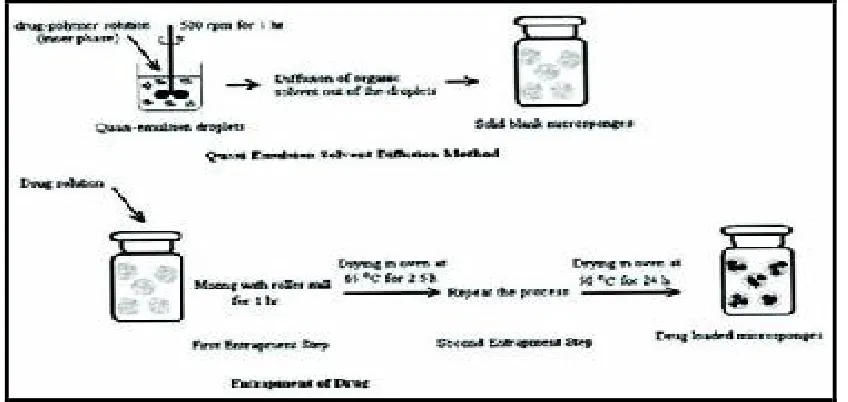
2. Quasi-emulsion solvent diffusion:Porous microspheres (microsponges) were also prepared by a quasi-emulsion solvent diffusion method (two-step process) using an internal phase containing polymer such as eudragit which is dissolved in ethyl alcohol. Then, the drug is slowly added to the polymer solution and dissolved under ultra-sonication at 35oC and
plasticizer such as triethylcitrate (TEC) was added in order to aid the plasticity. The inner phase is then poured into external phase containing polyvinyl alcohol and distilled water with continuous stirring for 2 hrs. Then, the 11 mixture was filtered to separate the microsponges. The product (microsponges) was washed and dried in an air- heated oven at 40°C for 12 hrs.
Fig. 3: Preparation of Microsponge by Quasi-emulsion solvent diffusion
Drug release mechanism of microsponge:
The active ingredient is added to the vehicle in an entrapped form. As the microsponge particles have an open structure (they do not have a continuous membrane surrounding them), the active is free to move in and out from the particles and into the vehicle until equilibrium is reached, when the vehicle becomes saturated. Once the finished product is applied to the skin, the active that is already in the vehicle will be absorbed into the skin, depleting the vehicle, which will become unsaturated, therefore, disturbing the equilibrium. This will start a flow of the active from the microsponge particle into the vehicle, and from it to the skin, until the vehicle is either dried or absorbed.
Even after that the microsponge particles retained on the surface of the stratum corneum will continue to gradually release the active to the skin, providing prolonged release over time. This proposed mechanism of action highlights the importance of formulating vehicles for use with microsponge entrapments. If the active is too soluble in the desired vehicle during compounding of the finished products, the products will not provide the desired benefits of gradual release. Instead they will behave as if the active was added to the vehicle in a free form. Therefore, while formulating microsponge entrapments, it is important to design a vehicle that has minimal solubilizing power for the actives. This principle is contrary to the conventional formulation principles usually applied to topical products. For these conventional systems it is normally recommended to maximize the solubility of the active in the vehicle.
Accelerated or Triggered by following mechanism: (і). Pressure triggered systems:
Microsponge releases the entrapped material when pressurized/rubbed.
(іі).Temperature triggered systems:
It is possible to modulate the release of substances from the microsponge by modulation of temperature. That is viscous sunscreens were show a higher release when exposed to higher temperatures.
(ііі).pH triggered systems:
Triggering the pH-based release of the active can be achieved by modifying the coating on the microsponge.
(іv).Solubility triggered system:
Microsponges loaded with water-soluble ingredients will release the ingredient in the presence of water. Perspiration can trigger the release rate of active ingredients.
Advantages over Conventional Formulations:
Conventional formulations of topical drugs are intended to work on the outer layers of the skin. Such products release their active ingredients upon application, producing a highly concentrated layer of active ingredient that is rapidly absorbed. When compared to the Microsponge system can prevent excessive Accumulation of ingredients within the epidermis and the dermis. Potentially, the Microsponge system can reduce significantly the irritation of effective drugs without reducing their efficacy. For example, by delivering the active ingredient gradually to the skin like MDS Benzoyl peroxide formulations have excellent efficacy with minimal irritation.
Advantages over Microencapsulation and Liposomes:
The MDS has advantages over other technologies like microencapsulation and liposomes. Microcapsules cannot usually control the release rate of actives. Once the Wall is ruptured the actives contained within microcapsules will be released. Liposomes suffer from lower payload, difficult formulation, limited chemical stability and microbial instability. While microsponge system in contrast to the above systems are stable over range of pH 1 to 11, temperature up to 130 0C ; compatible with most vehicles and ingredients; self sterilizing as average pore size is 0.25 μm where bacteria cannot penetrate; higher payload (50 to 60%), still free flowing and can be cost effective.
Evaluation of Microsponge: (i). Particle size determination:
Particle size analysis of loaded and unloaded microsponges can be performed by laser light diffractometry or any other suitable method. The values can be expressed for all formulations, size range. Cumulative percentage drug release from microsponges of different particle size will be plotted against time to study effect of particle size on drug release. Particles larger than PMμm can impart gritty feeling and hence particles of sizes between NM and 25μm are preferred to use in final topical formulation.
(ii). Morphology and surface topography of microsponges:
Raju. Manda et al., J. Sci. Res. Phar. 2015, 4(1), 1-5
(iii). Determination of loading efficiency and production yield:The loading efficiency (%) of the microsponges can be calculated according to the following equation:
Loading efficiency =Actual Drug Content in Microsponge / Therotical Drug Content
Theoretical Drug Content:
The production yield of the micro particles can be determined by calculating accurately the initial weight of the raw materials and the last weight of the microsponge obtained.
Production Yeild(PY) =Practical Mass of Microsponges × 100/ Therotical Mass
Theoretical mass (Polymer+drug).
(iv).Characterization of pore structure:
Pore volume and diameter are vital in controlling the intensity and duration of effectiveness of the active ingredient. Pore diameter also affects the migration of active ingredients from microsponges into the vehicle in which the material is dispersed. Mercury intrusion porosimetry can be employed to study effect of pore diameter and volume with rate of drug release from microsponges. Porosity parameters of microsponges such as intrusion extrusion isotherms pore size distribution, total pore surface area, average pore diameters, interstitial void volume, percent porosity, percent porosity filled, shape and morphology of the pores, bulk and apparent density can be determined by using mercury intrusion porosimetry.
(v). Polymer/monomer composition:
Factors such as microsphere size, drug loading, and polymer composition govern the drug release from microspheres. Polymer composition of the MDS can affect partition coefficient of the entrapped drug between the vehicle and the microsponge system and hence have direct influence on the release rate of entrapped drug. Release of drug from Microsponge systems of different polymer compositions can be studied by plotting cumulative % drug release against time.
(vi). Dissolution tests:
Dissolution release rate of microsponges can be studied by use of dissolution apparatus USP XXIII with a modified basket consisted of 5μm stainless steel mesh. The dissolution medium is selected while considering solubility of actives to ensure sink conditions. At various intervals the samples from the dissolution medium was analyzed by suitable analytical methods.
(vii). Determination of true density:
The true density of micro particles is measured using an ultra-pycnometer under helium gas and is calculated from a mean of repeated determinations
(viii). Resiliency (viscoelastic properties):
Resiliency (visco elastic properties) of microsponges can be modified to produce beadlets that is softer or firmer according to the needs of the final formulation. Increased cross-linking tends to slow down the rate of release.
(ix).Drug release from the semi solid dosage forms and drug deposition studies:
Drug release from the semi solid dosage forms are performed by the Franz- type static diffusion cells. In this epidermal side of the skin was exposed to ambient condition. While dermal side was kept facing the receptor solution. Receptor compartment containing 20 mL phosphate buffer pH 5.8 was thermostated at 32±0.5°C and stirred at 600 rpm. Skin was saturated with diffusion medium for 1 h before the application of sample. A 200-mg of sample was applied on the donor compartment. For determination of drug deposited in the skin, the diffusion cell was dismantled after a period of 4, 8, 16, and 24 h. The skin was carefully removed, and drug present on the skin surface was cleaned with distilled water.
( x).In-vitrodiffusion studies:
The in vitro diffusion studies of prepared microsponge gel were carried out in Keshary–Chien diffusion cell using through a cellophane membrane. 100 ml of phosphate buffer was used as receptor compartment, and then 500 mg of gel containing 10 mg of drug was spread uniformly on the membrane. The donor
compartment was kept in contact with a receptor compartment and the temperature was maintained at 37±0.50. The solution on the receptor side were stirred by externally driven Teflon coated magnetic bars at predetermined time intervals, pipette out 5 ml of solution from the receptor compartment and immediately replaced with the fresh 5 ml phosphate buffer. The drug concentration on the receptor fluid was determined spectrophotometrically against appropriate blank. The experiment was carried out in triplicate.
Safety Consideration:
1) Skin irritation studies in rabbits:
The scores for erythema totalled for intact and abraded skin for all rabbits at 24 and 72 hr. The primary irritation index was calculated based on the sum of the scored reactions divided by 24 (two scoring intervals multiplied by two test parameters multiplied by six rabbits).
2) Anti-inflammatory activity by ear edema measurement:
Experiments reported in this study were performed after approval by the Animal Ethics Committee of our College and were carried out in accordance with the CPCSA guidelines Anti inflammatory activity was done by Male Swiss mice (25–35 g) housed at 22±2 ºC under a 12 hr light/12-hr dark cycle and with access to food and water, which were performed during the light phase of the cycle. The animals were allowed to acclimate to the laboratory for at least 2 hr before testing and were used only once. Edema was induced in the right ear by topical application of 0.1mg/ear of croton oil dissolved in 20μL of acetone. In house gels of FA containing free, entrapped drug and marketed gel were applied topically simultaneously with the croton oil. Ear thickness was measured before and 6 hr after the induction of inflammation using a digital vernier caliper and reported.
3) Primary Eye Irritation Study (Unwashed Eyes):
Test substance is instilled into one eye of each of 6 rabbits (unwashed eyes), The cornea, iris, and conjunctiva tissue of the treated eyes are graded for irritation effects at 1, 24, 48 and 72 hr after instillation. Observation period may be extended for up to 21 days to evaluate the reversibility of the effects observed.
4) Other evaluation studies are:
Oral toxicity studies in rats, Mutagenicity in bacteria, allergenicity in guinea pigs, Compatibility studies by (TLC) thin layer chromatography.
The Microsponge Delivery System-A Novel Drug Delivery System:
The MDS has advantages over other technologies like microencapsulation and liposomes. Microcapsules cannot usually control the release rate of actives. Once the wall is ruptured the actives contained within microcapsules will be released. Liposomes suffer from lower payload, difficult formulation, limited chemical stability and microbial instability.
While microsponge system in contrast to the above systems are stable over range of pH 1 to 11, temperature up to 130 oC; compatible with most vehicles and ingredients; self sterilizing as average pore size is 0.25μm where bacteria cannot penetrate; higher payload (50 to 60%), still free flowing and can be cost effective.
Most liquid or soluble ingredients can be entrapped in the particles. Actives that can be entrapped in microsponges must meet following requirements:
1. It should be either fully miscible in monomer or capable of being made miscible by addition of small amount of a water immiscible solvent.
2. It should be water immiscible or at most only slightly soluble. 3. It should be inert to monomers. 4. It should be stable in contact
with polymerization catalyst and conditions of polymerization.
Advantages:
1. Controlled drug release
2. Site specific action produce on target organ 3. Enhanced drug stability
Raju. Manda et al., J. Sci. Res. Phar. 2015, 4(1), 1-5
CONCLUSIONT
he microsponge delivery technology of controlled release system in which active pharmaceutical ingredient is loaded in the macro porous beads and initiates reduction in side effects with improved therapeutic efficacy. Microsponge can be effectively incorporated into topical drug delivery system for retention of dosage form on skin, and also use for oral delivery of drugs using bio erodible polymers, especially for colon specific delivery and controlled release drug delivery system thus improving patient compliance by providing site specific drug delivery system and prolonging dosage intervals. This technology is being used currently in cosmetics, over-the-counter skin care, sunscreens, and prescription products. This kind of drug delivery technology may lead to a better understanding of the healing of several diseases. Hence, the microsponge-based drug delivery technology is likely to become a valuable drug delivery matrix substance for various therapeutic applications in the future.REFERENCES:
1. Shivani Nanda, Mandeep Kaur, Nikhil Sood, Sahil Nagpal. Microsponge drug delivery system: an overview, World Journal of Pharmacy and Pharmaceutical Sciences, 2012; 2(3): 1032-1043.
2. Aity, S., et al., Microsponges: A novel strategy for drug delivery system, J. Adv. Pharm. Technol. Res.,2010; 1(3): p. 90-283.
3. Chadawar V, and J. Shaji. Microsponge delivery system, Curr. Drug Deliv.,2007; 4(2): p. 9-123.
4. N.H. Aloorkar, A.S. Kulkarni, D.J. Ingale and R.A. Patil, Microsponges as Innovative Drug Delivery Systems, International Journal of pharmaceutical Sciences and Nonotechnology,2012; 5(1).
5. Anderson D.L., Cheng C.H., Nacht S. Flow Characteristics of Loosely Compacted Macroporous Microsponge(R) Polymeric Systems, Powder Technol.,1994; 78: 15-18. 6. Barkai A., Pathak V., Benita S. Polyacrylate (Eudragit retard)
microspheres for oral controlled release of nifedipine. I. Formulation design and process optimization, Drug Dev. Ind. Pharm.,1990; 16: 2057-2075.
7. Namrata Jadhav, Vruti Patel, Siddhesh Mungekar, Manisha Karpe, Vilasrao Kadam. Microsponge delivery system: an updated review, current status and future prospects, World Journal of Pharmacy and Pharmaceutical Sciences, 2(6): 6463-6485.
8. Embil K.,Nacht S. The Microsponge Delivery System (MDS): A topical delivery system with reduced irritancy incorporating multiple triggering mechanisms for the release of actives, J. Microencapsul.,1996; 3(5): 575-588. 9. Nacht S, Kantz M. The microsponge: A novel topical
programmable delivery system, Top Drug Deliv. Syst.,1992; 42: 299-325.
10. Won R: Method for delivering an active ingredient by controlled time release utilizing a novel delivery vehicle which can be prepared by a process utilizing the active ingredients as a Porogen,1987; US Patent No. 4690825. 11. Chadawar V., Shaji J. Microsponge Delivery System, Current
Drug Delivery,2007; 4: 123-129.
12. Hibah Aldawsari and Shaimaa M. Badr-Eldin. Microsponges as promising vehicle for drug delivery and targeting: Preparation, characterization and applications, African Journal of Pharmacy and Pharmacology, pp. 873-881. 13. Aritomi H, Yamasaki Y, Yamada K, Honda H, Koshi M.
Development of sustained release formulation of chlorpheniramine maleate using powder coated microsponges prepared by dry impact blending method, J. Pharm. Sci. Technol.,1996; 56(1): 49-56.
14. Jain V, Singh R. Design and characterization of colon-specific drug delivery system containing paracetamol microsponges, Arch. Pharm. Res.,2011; 34: 733-740.
15. Vyas SP, Khar RK. Targeted and controlled drug delivery: novel carrier systems, CBS Publications, 1st ed., New Delhi,
2002; 453.
16. D’souza J.I., More H.N. Topical Anti-Inflammatory Gels of Fluocinolone Acetonide Entrapped in Eudragit Based Microsponge Delivery System, Res. J. Pharm. Tech.,2008; 1(4): 502-506.
17. Neelam Jain, Pramod Kumar Sharma, Arunabha Banik, Recent advances on microsponge delivery system, International Journal of Pharmaceutical Sciences Review and Research,2011; 8(2).
How to cite this article:
Raju. Manda et al.,: A Review: Microsponge a Novel New Drug Delivery System, J. Sci. Res. Phar., 2015; 4(1): 1-5.
Conflict of interest:The authors have declared that no conflict of interest exists.