ISSN 2307-4523 (Print & Online)
© Global Society of Scientific Research and Researchers http://ijcjournal.org/
Feature Prioritization-A Novel Method for Prioritization
Sandhia Valsala
*University of Buraimi, Sultanate of Oman Email: [email protected]
Abstract
One of the most important activities during features engineering is the selection and prioritization of features
satisfying various explicit and implicit objectives and constraints. One of the most important steps in
incremental software development is the Selection and Prioritization of features satisfying various constraints
like stakeholder preference, resources, cost of development etc. As it is practically impossible to implement all
the available features in the coming release there is a need to prioritize and choose only those features satisfying
these technical and non-technical constraints? In addition, Stakeholder’s interest should also be considered in
selecting the features that has to be included in the current version. After analyzing the different prioritization
techniques, clearly understanding the drawbacks of traditional methods, the proposed algorithm for Feature
prioritization can handle multiple stakeholders, feature dependency; a large feature set and provides an ordering
of the generated optimum features.
Keywords: Features; Prioritization; Stakeholders; Dependency.
1.Introduction
In Incremental software development it is really a challenge to select the right group of features to be
implemented from among several or many available options. A feature can be defined as a demand, a need or a
description of what the system should do. For a product to be successful it’s important to include the right set of
features. The most appropriate group of features that can be selected for implementation largely depends on how
successfully feature prioritization is done on that product release. There are different feature prioritization
techniques available and it’s often a crucial decision to choose the most appropriate prioritization technique. It is
impossible to implement all the features in a release due to various constraints like time, budget and resources.
So choosing the best prioritization technique helps to isolate the most important features. When we develop
software, stakeholder’s needs and expectations should be given utmost attention.
---
We need to efficiently and effectively manage stakeholders’ system Features and produce a software system that
meets the expectations of both customers and users. But a question arises “Is it possible in real world?”.Given
stakeholder’s preference and other constraints it will not be possible to include all the features at the same time
in a system. Thus, project managers face a dilemma, how can we select a subset of the customers' Features and
still produce a system that meets their needs? Here comes the importance of Feature prioritization techniques or
feature prioritization techniques.
2.Literature Review
A number of researches has been done to analyze and evaluate software feature prioritization techniques .One of
the study [1] discusses an analysis of the following prioritization techniques namely AHP, SERUM, EVOLVE
and VOP and concludes that VOP is the best approach for Feature prioritization. Another study [2] on Feature
prioritization was carried out at three types of industries, to find out the most appropriate Features prioritization
technique that gives high level of satisfaction to the customer and it was found out that stakeholder preference is
the most important factor to be considered while prioritizing Features. Reference [3] does a systematic literature
study on various considerations that have influenced the prioritization of software Features, along with the
characterizations of Feature prioritization techniques. Reference [4] in his master’s thesis carried out a
systematic study of the following Feature prioritization techniques namely AHP, NA and Cumulative Voting. A
study [5] comparing six Feature prioritization techniques has been carried out by Ms Khari and Nikunj Kumar
and it was concluded that Value oriented Prioritization (VOP) gives the most accurate result when compared
with Analytic Hierarchy Process (AHP), Cumulative Voting (CV), Numerical Assignment Technique (NAT),
Binary Search Tree (BST) and Planning Game (PG). Reference [6] studies Feature prioritization techniques
used in Agile software development but focuses only on genetic algorithm based techniques and proposes a new
technique “Interactive Genetic Algorithm” that can produce a prioritized list satisfying all the constraints.
Siddiqui, Reference [7] does a comparative study on two Feature prioritization techniques namely AHP and
Planning Game and concludes PG as the most appropriate technique for Feature prioritization. Most of the
studies concentrated on prioritizing functional Features but the study [8] done by Saranya and Subha
concentrates on prioritization of nonfunctional Features. Three algorithms namely prioritization using
architectural feedback, NFR algorithm and Goal decomposition algorithm was studied and it was concluded that
NFR out rates the other two algorithms in prioritizing nonfunctional Features. Ma [9] did a systemic review of
Feature prioritization techniques that could prioritize medium to large scale Features. A novel approach of
Feature prioritization was discussed by Bajaj and Arora which evaluates various Features prioritization methods
with different characteristics and proposes a novel technique that could assist the managers to achieve better
customer satisfaction by selecting the most appropriate method for their application.
3.Comparison of various Feature Prioritization Techniques.
3.1. Requirement prioritization
A number of prioritization techniques are available in literature that uses a wide variety of factors in selecting
the features that need to be included in a release. Practically it is impossible to implement all the needed features
listed below are the major factors considered in feature prioritization.
Stakeholder Preference
System stakeholders are defined as “people or organizations who will be affected by the system and who have a
direct or indirect influence on the system Features”. Suppose we have n different stakeholders abbreviated by
s1, s2,… sn, where each stakeholder will be assigned a relative importance. Given are some Stakeholder’s
examples but are not limited to the following: user (novice, advanced, expert or other classifications of users),
manager (project, product), developer, or sales representatives.
Feature dependency
Features cannot be considered isolated and they share a complex relationship with other Features. The
relationship that exists between these Features is termed Feature dependencies. Previous studies have revealed
that 80% of the Features are interdependent and only a very few are standalone Features. The mere fact that
most of the Features are dependent on each other makes it one of the most important factor to be considered
while selecting or prioritizing Features. Identified in (Carlshamre and his colleagues 2001) literatures are the
three basic types of dependencies. These dependencies are listed below.
Implication: This dependency between Features says that given two Features i and j, Feature i needs Feature j to function but Feature j does not need Feature i to function. In other words the first Feature
needs the second one to function but the second one does not need first one to function.
Revenue-based: Two Features i and j are said to have revenue based dependency if Feature i influences the revenue of Feature j.
Cost-based : Two Features i and j are said to have cost based dependency if Feature i influences the cost of Feature j
4.Proposed Algorithm for Feature Prioritization
The proposed algorithm called the “Best_Choose Algorithm” uses two major factors in selecting the best
features to be included in the release.The first factor being the stakeholder preference and second being Feature
dependency.Stakeholder are the main people involved in the application who are directly involved in the
system.Feature dependency refers to the interdependency that exist between the Features.
Proposed Best_Choose Algorithm.
1. Accept the list of features to be implemented from the stakeholders
2. Group the Features based on dependency into Feature subsets
3. Elimainate all repeated Feature subset
5. Sort the Features based on stakeholder priority.
6. Choose the best Feature group for implementation.
The list of features to be implemented is the initial input .These features will be interdepenedent to each other.
In our simulation we are considering three types of depenedency namely Implication,Cost-Related and
Revenue–Related. Implication is denoted as IMP ,Cost-related dependency is represented as CT and Revenue
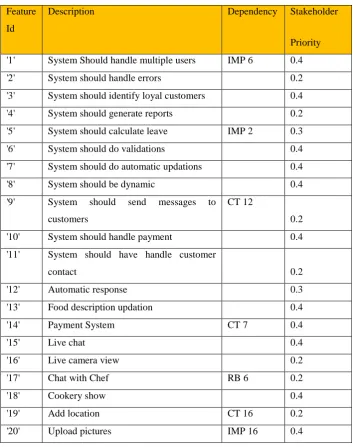
Releated dependency is represented as RT. A sample data set of 20 Features is used in this research as given in
Table 1. Stakeholders are categorized into different categories based on their positions. We have identified eight
Stakeholders category namely Project Manager, Project Lead, Team Head, Team Members, Users, Sales Team,
Representative and Software Supplier. The Table 2 shows the sample list of Stakeholders considered. These
stakeholders assign their priority score to each Feature with scores ranging from 1 to 5 where 5 denotes high
priority and 1 denotes lease priority as given in Table 3.
Table 1: Sample Data Set
Feature
Id
Description Dependency Stakeholder
Priority
'1' System Should handle multiple users IMP 6 0.4
'2' System should handle errors 0.2
'3' System should identify loyal customers 0.4
'4' System should generate reports 0.2
'5' System should calculate leave IMP 2 0.3
'6' System should do validations 0.4
'7' System should do automatic updations 0.4
'8' System should be dynamic 0.4
'9' System should send messages to
customers
CT 12
0.2
'10' System should handle payment 0.4
'11' System should have handle customer
contact 0.2
'12' Automatic response 0.3
'13' Food description updation 0.4
'14' Payment System CT 7 0.4
'15' Live chat 0.4
'16' Live camera view 0.2
'17' Chat with Chef RB 6 0.2
'18' Cookery show 0.4
'19' Add location CT 16 0.2
All the stakeholders will not have the same priority. So the stakeholders S1 –S8 were weighted using AHP from
a general project management perspective. A Matrix of pair-wise comparison of stakeholders on a nine-point
scale is done based on the Table 4 given. Weightings are used to discriminate between stakeholders. For greater
flexibility and objectivity these weightings are further calculated using the pairwise comparison method from
AHP.
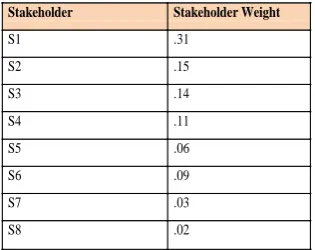
Table 2: Stakeholder categories
Table 3: Sample Stakeholder Assigned Values
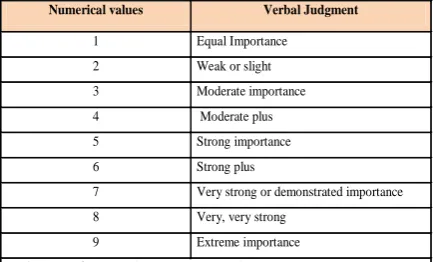
Table 4: Scale of absolute numbers
After representing the comparison matrix ,priorities are computed by finding the principal Eigen values and the
corresponding Eigen vector of the pairwise comparison matrix.
Stakeholder. No Stakeholder Categories
S1 Project Manager
S2 Project lead
S3 Team Head
S4 Team Members
S5 User
S6 Sales
S7 Representative
S8 Software Supplier
Stakeholder
Features
R1 R2 R3 R4 R5 R6 R7 R8 R9 R10 R11 R12 R13 R14 R15 R16 R17 R18 R19 R20 S1 5 1 4 1 1 3 5 5 1 4 1 1 3 5 4 1 1 4 1 5 S2 3 5 4 3 4 5 4 3 5 4 3 4 5 4 4 3 5 4 3 4 S3 4 2 4 2 3 3 3 4 2 4 2 3 3 3 4 2 2 4 2 3 S4 5 1 3 1 4 3 2 5 1 3 1 4 3 2 3 1 1 3 1 2 S5 3 3 4 3 5 3 1 3 3 4 3 5 3 1 4 3 3 4 3 1 S6 2 1 2 1 2 4 4 2 1 2 1 2 4 4 2 1 1 2 1 4 S7 1 2 5 3 3 2 3 1 2 5 3 3 2 3 5 3 2 5 3 3 S8 5 5 3 4 5 4 5 5 5 3 4 5 4 5 3 4 5 3 4 5
Numerical values Verbal Judgment
1 Equal Importance
2 Weak or slight
3 Moderate importance
4 Moderate plus
5 Strong importance
6 Strong plus
7 Very strong or demonstrated importance
8 Very, very strong
9 Extreme importance
The normalized principal Eigen vector is the priorities vector. To compute the priorities the following two steps
are to be carried out.
Normalize each column
Find average over each row
The stakeholder weightings are computed from the eigenvalues of the matrix shown in Table 5. The computed
stakeholder weightings is shown in the Table 5.The technique of averaging over normalized columns can be
used to approximate the eigenvalues.
The normalized principal Eigen vector [21] is also called priority vector. Since it is normalized, the sum of all
elements in priority vector is 1.
The priority vector shows relative weights among the considered stakeholders. Combining Stakeholder priority
value and the stakeholder’s Feature preference score, we arrive at Stakeholder Priority value for each Feature.
Stakeholder_ Feature priority for individual Features is calculated and represented in Table 7.
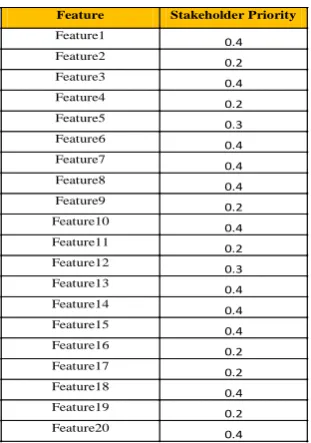
Combining the tables the final Feature priority is represented in Table 8.
Table 5: Matrix of pair-wise comparison of stakeholders on a Nine-point Scale of AHP
Table 6: Calculated Stakeholder Priority Stake
Holder
Stake Holder
S1 S2 S3 S4 S5 S6 S7 S8
S1 1 7 4 3 9 2 8 6
S2 1/7 1 3 2 8 2 7 5
S3 1/4 1/3 1 3 8 2 8 5
S4 1/3 1/2 1/3 1 7 2 7 6
S5 1/9 1/8 1/8 1/7 1 2 8 7
S6 1/2 1/2 1/2 1/2 1/2 1 9 7
S7 1/8 1/7 1/8 1/7 1/8 1/9 1 6
S8 1/6 1/5 1/5 1/6 1/7 1/7 1/6 1
Stakeholder Stakeholder Weight
S1 .31
S2 .15
S3 .14
S4 .11
S5 .06
S6 .09
S7 .03
Table 7: Stakeholder Priority for each feature
Table 8: Final Stakeholder Priority for features
Feature Stakeholder Priority
Feature1 0.4 Feature2 0.2 Feature3 0.4 Feature4 0.2 Feature5 0.3 Feature6 0.4 Feature7 0.4 Feature8 0.4 Feature9 0.2 Feature10 0.4 Feature11 0.2 Feature12 0.3 Feature13 0.4 Feature14 0.4 Feature15 0.4 Feature16 0.2 Feature17 0.2 Feature18 0.4 Feature19 0.2 Feature20 0.4
Stakeho
lder Features
F 1 F 2 F 3 F 4 F 5 F 6 F 7 F 8 F 9 F1 0 F1 1 F1 2 F1 3 F1 4 F1 5 F1 6 F1 7 F1 8 F1 9 F2 0
S1 1.
6 0. 3 1. 2 0. 3 0. 3 0. 9 1. 6 1. 6 0. 3 1. 2 0. 3 0. 3 0. 9 1. 6 1. 2 0. 3 0. 3 1. 2 0. 3 1. 6
S2 0.
5 0. 8 0. 6 0. 5 0. 6 0. 8 0. 6 0. 5 0. 8 0. 6 0. 5 0. 6 0. 8 0. 6 0. 6 0. 5 0. 8 0. 6 0. 5 0. 6
S3 0.
6 0. 3 0. 6 0. 3 0. 4 0. 4 0. 4 0. 6 0. 3 0. 6 0. 3 0. 4 0. 4 0. 4 0. 6 0. 3 0. 3 0. 6 0. 3 0. 4
S4 0.
3 0. 1 0. 2 0. 1 0. 2 0. 2 0. 1 0. 3 0. 1 0. 2 0. 1 0. 2 0. 2 0. 1 0. 2 0. 1 0. 1 0. 2 0. 1 0. 1
S5 0.
2 0. 2 0. 2 0. 2 0. 3 0. 2 0. 1 0. 2 0. 2 0. 2 0. 2 0. 3 0. 2 0. 1 0. 2 0. 2 0. 2 0. 2 0. 2 0. 1
S6 0.
2 0. 1 0. 2 0. 1 0. 2 0. 4 0. 4 0. 2 0. 1 0. 2 0. 1 0. 2 0. 4 0. 4 0. 2 0. 1 0. 1 0. 2 0. 1 0. 4
S7 0.
0 0. 1 0. 2 0. 1 0. 1 0. 1 0. 1 0. 0 0. 1 0. 2 0. 1 0. 1 0. 1 0. 1 0. 2 0. 1 0. 1 0. 2 0. 1 0. 1
S8 0.
On analyzing the Table -1 we can see various dependencies set. Given the sample dataset with Feature
dependencies and stakeholder priority ,the first step is to group the Features based on dependency.
STEP 1: Group the Feature based on dependency and thus form Feature Subsets. The following subsets are
generated after grouping the Features based on dependency and remove the redundant Feature subsets.
Table 9
STEP2: Compute the Stakeholder priority of the generated Feature subsets
Table 10
STEP3: Final Sorted Feature Set
Generated Feature Subset
Feature1, Feature6, Feature17
Feature2, Feature5
Feature3
Feature4
Feature5, Feature2
Feature7, Feature14
Feature8
Feature9, Feature12
Feature10
Feature11
Feature13
Feature15
Feature16, Feature19, Feature20
Feature18
Feature Subset Features in Subset Stakeholder Priority
FeatureSubset1 Feature1, Feature6, Feature17 1
FeatureSubset2 Feature2, Feature5 .5
FeatureSubset3 Feature3 .4
FeatureSubset4 Feature4 .2
FeatureSubset5 Feature5, Feature2 .5
FeatureSubset6 Feature7, Feature14 .8
FeatureSubset7 Feature8 .4
FeatureSubset8 Feature9, Feature12 .5
FeatureSubset9 Feature10 .4
FeatureSubset10 Feature11 .2
FeatureSubset11 Feature13 .4
FeatureSubset12 Feature15 .4
FeatureSubset13 Feature16, Feature19,
Feature20
.8
Table 11
STEP 4: Choose the Feature number of features for implementation
The given scenario requires 8 features to be selected and the resultant features based on the two selection factors
will be Feature1, Feature6, Feature17,Feature7, Feature14, Feature16, Feature19,Feature20.
5. Graphical Output
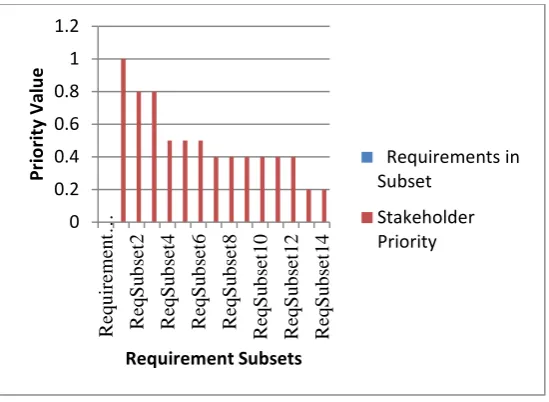
In order to make the output more presentable and easy to understand, we pictorially represent the generated
output using the following graphs. The first graph shows the computed stakeholder priority for each Feature.
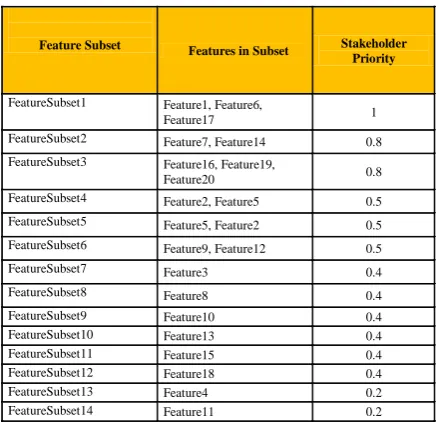
Figure 1: Computed stakeholder priority for each Feature Feature Subset Features in Subset Stakeholder
Priority
FeatureSubset1 Feature1, Feature6,
Feature17 1
FeatureSubset2 Feature7, Feature14 0.8
FeatureSubset3 Feature16, Feature19,
Feature20 0.8
FeatureSubset4 Feature2, Feature5 0.5 FeatureSubset5 Feature5, Feature2 0.5
FeatureSubset6 Feature9, Feature12 0.5
FeatureSubset7 Feature3 0.4
FeatureSubset8 Feature8 0.4 FeatureSubset9 Feature10 0.4 FeatureSubset10 Feature13 0.4 FeatureSubset11 Feature15 0.4 FeatureSubset12 Feature18 0.4 FeatureSubset13 Feature4 0.2 FeatureSubset14 Feature11 0.2
0 0.05 0.1 0.15 0.2 0.25 0.3 0.35
S1 S2 S3 S4 S5 S6 S7 S8 P
r i o r i t y
Stakeholder
Stakeholder Weight
Figure 2: Calculated Priority value of Feature Subset
Two main approaches of software development are iterative and incremental. The first and foremost process in
software development is Feature selection and prioritization. Feature prioritization is the process of ordering the
Features for implementation in a release [18]. Several Features will be available for implementation but it is
impossible to have them all implemented in the current release [17]. Choosing the best among them becomes a
crucial factor when this selection is subject to various constraints like cost, revenue, budget, and dependency.
Each release includes a set of Features satisfying certain constraints of the organization. There are so many
factors that are considered in the selection of Features like cost, effort, resources, time and stakeholder’s
preference. Different prioritization techniques consider different technical and non-technical factors for Feature
selection.After analyzing the different prioritization techniques, clearly understanding the drawbacks of
traditional methods,[19] the proposed algorithm for Feature prioritization can handle multiple stakeholders,
Feature dependency; a large Feature set and provides an ordering of the generated optimum Features.
6. Conclusion and Future Recommendations
We have identified taxonomy of selection factors that need to be considered during Feature prioritization. The
proposed algorithm for Feature prioritization can handle multiple stakeholders, feature dependency; a large
feature set and provides an ordering of the generated optimum features. The research can be further extended to
include the following. The research work can be further extended to include additional selection factors as the
existing model considers only two main factors for Feature prioritization namely stake holder preference and
Feature dependency. It can be further extended to include additional factors while performing prioritization.
References
[1] Aaqib Iqbal, Farhan M Khan, Shahbaz A Khan (2009). “A Critical Analysis of techniques for Feature
Prioritization and Open Research”, International Journal of Reviews in Computing, Vol. 1, No. 1.
[2] Shams ul Hassan , Salman Afsar Awan (2012) , “Software Engineering : Factors Affect on Feature
0 0.2 0.4 0.6 0.8 1 1.2
R
eq
u
ir
em
en
t…
R
eqS
ub
se
t2
R
eqS
ub
se
t4
R
eqS
ub
se
t6
R
eqS
ub
se
t8
R
eqS
ub
se
t10
R
eqS
ub
se
t12
R
eqS
ub
se
t14
Pr
io
rit
y V
alu
e
Requirement Subsets
Requirements in Subset
Prioritization”, Global Journal of Computer Science and Technology Software & Data Engineering
Volume 12 Issue 15 No 1
[3] Rahul Thakurta (2014),”Research Trends on Software Feature Prioritization”,International Journal of
Software Engineering and Its Applications Vol.8, No.6 (2014), pp.287-298.
[4] “A Systematic Review of Software Features Prioritization”, Thesis Report , School of Engineering
Blekinge Institute of Technology ,Sweden ,2006
[5] Manju Khari, Nikunj Kumar (2013) ,”Comparison of six prioritization techniques for software Features
, Journal of Global Research in Computer Science,Volume 4, No. 1, January 2013
[6] Nupoor Garg ,Neha Malhotra (2013) , “Prioritization of Features based upon Quality Approach and
Interactive Genetic Algorithm focused on Agile methodologies”, International Journal of Computer
Science & Communication Networks,Vol 3(2), 111-113
[7] Shadab Siddiqui, Dr.Mohd. Rizwan Beg, Shahin Fatima (2013 ),Effectiveness of Feature Prioritization
Using Analytical Hierarchy Process (AHP) And Planning Game (PG): A Comparative Study,
International Journal of Computer Science and Information Technologies, Vol. 4 (1) , 2013, 46 – 49.
[8] Saranya. B , Subha. R. , Dr. Palaniswami. S.(2014), “ A Survey on Prioritization Methodologies to
Prioritize Non-Functional Features”, International Journal of Computer Science and Business
Informatics, Vol. 12, No. 1
[9] “The Effectiveness of Features Prioritization Techniques for a Medium to Large Number of
Features”,Thesis Report , Auckland University,2009
[10] Kaur, G., and Bawa, S. (2013). “A survey of Feature prioritization methods”. Int. J. Eng.Res. Technol,
pp.958-962.
[11] Achimugu, P., Selamat, A., Ibrahim, R., and Mahrin, M. N. (2014). A Systematic Review of Software
Feature Prioritization Research. Information and Software Technology, Vol 56, pp.568-585.
[12] Thakurta, R. (2012). A framework for prioritization of quality Features for inclusion in a software
project. Softw. Qual. J., pp.573–597.
[13] Wohlin, C., and Aurum, A. (2005). What Is Important when Deciding to Include a Software.
Proceedings International Symposium on Software Engineering ,IEEE, (pp. 246-255). Austarlia.
[14] Voola, P., and Babu, A. (2013). Comparison of Features Prioritization TechniquesEmploying
Different Scales of Measurement. ACM SIGSOFT Software Engineering Notes, Vol 38, pp. 1-10.
Features selection and prioritization using SBSE approaches in Search Based Software Engineering
(Vol. 8084). Springer, Berlin Heidelberg.
[16] Meenakahi. (2014). Reengineering a Software Process by using Unified Foundation. International
Journal of Inventions in Computer Science and Engineering, Vol 1(3), pp.301-307.
[17] Srivastava, P. R., Sankaran, S., and Pandey, P. (2013). Optimal Software Release Policy Approach
Using Test Point Analysis and Module Prioritization. MIS Review, an International Journal, Vol 18(2),
pp.19-50.
[18] Sharma, C., Sabharwal, S., and Sibal, R. (2011). Applying Genetic Algorithm for Prioritization of Test
Case Scenarios Derived from UML Diagrams. International Journal of Computer Science, Vol 8(3),
pp.433-444.
[19] Elsayed, S., Sarker, R., and Essam, D. (2014). A new GA for solving Optimization Problems.
Elesevier, pp.57-69.
[20]. Dabbagh, M., and Lee, S. P. (2014). An Approach for Integrating the Prioritization of Functional and
Nonfunctional Features. The Scientific World Journal Volume, Article ID-737626, pp.1-12.