Centre
of
Excellence
for
Nuclear
Materials
Workshop
Materials
Innovation
for
Nuclear Optimized
Systems
December 5-7, 2012, CEA – INSTN Saclay, France
Christophe DOMAIN
EDF R&D (France)
Multiscale Modelling of Microstructure Evolution under
Radiation Damage of Steels Based on Atomistic to
Mesoscale Methods
Workshop
organized
by:
Christophe
GALLÉ,
CEA/MINOS,
Saclay
–
[email protected]
Workshop
Materials
Innovation
for
Nuclear
Optimized
Systems
December 5-7, 2012, CEA – INSTN Saclay, France
Multiscale Modelling of Microstructure Evolution under Radiation Damage
of Steels Based on Atomistic to Mesoscale Methods
Christophe DOMAIN
1, 21 EDF R&D - MMC (Moret sur Loing, France) 2
EDF-CNRS joint laboratory EM2VM (Study and Modeling of the Microstructure for Ageing of Materials)
Structural metallic materials used in nuclear facilities are submitted to irradiation which induce the creation of large amounts of point defects, which leads to modifications of the microstructure and the mechanical properties. In nuclear power plants, the main structural materials are: the pressure vessel (ferritic steels), the internal structure (austenitic steels).
In order to simulate the microstructure evolution with the objective to predict it, multiscale modelling tools are developed (Fig. 1). For this purpose different simulation methods are used and developed in order to treat the different physical phenomena occurring at different time scales and length scales:
ab initio, classical molecular dynamics, kinetic Monte Carlo, dislocation dynamics, phase field [1]. These simulations are very CPU demanding and take advantage of the development of High Performance Computing machines.
Finite elements
ab initio
Molecular dynamics
Mesoscopic
Multi-scale
modelling
1nm3
0 - ps
ns (10-30nm)3
cm3
µm3
h-year s - h
(30-100nm)3
m3
40 years
Micro-macro
Dislocation dynamics
Finite elements
ab initio
Molecular dynamics
Mesoscopic
Multi-scale
modelling
1nm3
0 - ps
ns (10-30nm)3
cm3
µm3
h-year s - h
(30-100nm)3
m3
40 years
Micro-macro
Dislocation dynamics
EPJ Web of Conferences 51, 02004 (2013) DOI: 10.1051/epjconf/20135102004
Workshop
Materials
Innovation
for
Nuclear
Optimized
Systems
December 5-7, 2012, CEA – INSTN Saclay, France
Fig. 1: Multiscale modelling scheme applied within the PERFORM-60 project to the pressure vessel and internal material microstructure.
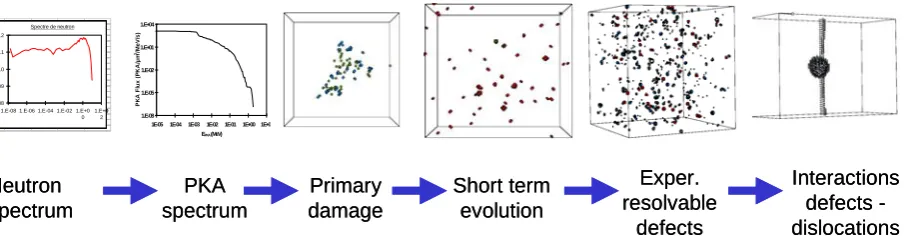
The microstructure evolution under irradiation is obtained starting from the neutron spectrum to obtain the primary damage (displacement cascades), followed by the evolution of the point defects formed and their accumulation (Fig. 2).
Spectre de neutron
1.E+08 1.E+09 1.E+10 1.E+11 1.E+12
1.E-08 1.E-06 1.E-04 1.E-02 1.E+0 0 1.E+0 2 F lu x (n /c m2 /s ) 1.E-08 1.E-05 1.E-02 1.E+01 1.E+04
1E-051E-041E-031E-021E-011E+00 1E+01 EPKA (MeV)
P K A F lu x ( P KA /µ m 3/M e V /s ) PWR Neutron spectrum PKA spectrum Primary damage Short term evolution Interactions defects -dislocations Exper. resolvable defects
Spectre de neutron
1.E+08 1.E+09 1.E+10 1.E+11 1.E+12
1.E-08 1.E-06 1.E-04 1.E-02 1.E+0 0 1.E+0 2 F lu x (n /c m2 /s ) 1.E-08 1.E-05 1.E-02 1.E+01 1.E+04
1E-051E-041E-031E-021E-011E+00 1E+01 EPKA (MeV)
P K A F lu x ( P KA /µ m 3/M e V /s ) PWR 1.E-08 1.E-05 1.E-02 1.E+01 1.E+04
1E-051E-041E-031E-021E-011E+00 1E+01 EPKA (MeV)
P K A F lu x ( P KA /µ m 3/M e V /s ) PWR Neutron spectrum PKA spectrum Primary damage Short term evolution Interactions defects -dislocations Exper. resolvable defects
Fig. 2: Microstructure modelling under irradiation.
The point defects created (vacancy and self interstitials) under irradiation often interact with the solute elements present in the materials. Solutes can precipitate and/or segregate on point defect clusters (loops or voids) or extended defects (dislocations, grain boundaries). These modifications of the microstructure affect directly the mechanical properties of the materials. Thus, modelling should take into account the most important solute elements in the chemical composition of the industrial alloys.
For the pressure vessel steels (for which an important international efforts is done in particular thanks to the PERFECT [2] and PERFORM-60 european projects) the evolution of the microstructure of dilute Fe alloys as complex as Fe-CuNiMnSiP-C under irradiation are modelled using a multiscale approach based on ab initio, molecular dynamics and kinetic Monte Carlo (KMC) simulations. In these atomic KMC simulations, both self interstitials and vacancies, isolated or in clusters, as well as carbon atoms are modelled [3]. The short term evolution of the microstructure is simulated. The medium to long term evolution of the microstructure is obtained by object KMC and cluster dynamics, considering a “grey” material. The interaction of some of these defects with dislocations are characterised by molecular dynamics in order to be used in mesoscopic dislocation dynamics. A similar approach is developed for austenitic materials modelled by a concentrated FeCrNi alloy (
γ
-Fe70Cr20Ni10). The thermal ageing (without irradiation) of FeCr alloys will also be presented.In the framework of the european projects dedicated to the pressure vessel steels and the austenitic steels, the multiscale modelling methods of the microstructure have been capitalised within two tools (RPV and INTERN) [4].
References
[1] C. S. Becquart, C. Domain, Metallurgical and Materials Transactions A 42 (2011) 852. [2] Spetial Issue: PERFECT project. Journal of Nuclear Materials, 406 (2010).
Multiscale Modelling of
Microstructure Evolution
under Radiation Damage of
Steels Based on Atomistic
to Mesoscale Methods
C. Domain
1
, C.S. Becquart
2
,
G. Adjanor
1
, G. Monnet
1
,
J.B. Piochaud
2
, R. Ngayam-Happy
1,2
1
EDF R&D
Dpt Matériaux & Mécanique des Composants
Les Renardieres, Moret sur Loing, France
2
UMET, Université de Lille 1
Villeneuve d’Ascq, France
F P 7 P r o je c t
F P 7 P r o j e c t
P E R F O R M 6 0
P E R F O R M 6 0
F P 7 P r o je c t
F P 7 P r o j e c t
P E R F O R M 6 0
P E R F O R M 6 0
Lifetime extension: Materials ageing
prediction
Lifetime extension: Materials ageing
prediction
•
To improve quantitative predictions
of ageing of irradiated structural
materials in nuclear power plants in
order to gain margins.
•
Challenge: to predict the evolution
of hundred of tons over more than
40 years based on physical
phenomena occurring at the
nanometer scale and picosecond
times (10
-12
s)
•
Construction and improvement of
multiscale modelling methods
allowing to better take into account
the material composition and
Microstructure evolution of Fe alloys under irradiation
RPV Fe ferritic alloys
- microstructure modelling
short & long term evolution
- plasticity
Austenitic alloys
- FeNiCr AKMC RIS modelling
30 ××××30 ××××140 nm3
Si P MnNi Cu
25 nm
2
5
n
m
8 nm
2
9
n
m
Si+P+Mn+Ni+Cu
3 nm
3 nm
[A. Volgin PhD
SAT@GPM Rouen ]
Finite elements
ab initio
Molecular dynamics
Mesoscopic
Multi-scale
modelling
+ experimental validation
1nm
30 - ps
ns
(10-30nm)
3cm
3µm
3h-year
s - h
(30-100nm)
3m
340 years
Micro-macro
Dislocation
dynamics
Barbu, CEA
Pareige, U. Rouen
F P 7 P r o je c t
F P 7 P r o j e c t
P E R F O R M 6 0
P E R F O R M 6 0
F P 7 P r o je c t
F P 7 P r o j e c t
P E R F O R M 6 0
P E R F O R M 6 0
Classical Molecular Dynamics
(atomic forces derived from empirical potentials)
System size
Elementary
Mecanisms
Time
1nm
3(10-30nm)
3(30-100nm)
3µm
3cm
3ns
s - h
h-
year
0 - ps
Finite Elements
ab initio
(forces and energies determined from the electronic structure -- Density
Functional Theory (DFT))
Mesoscopic
(grain, set of grains)
Kinetic Monte Carlo
(diffusion)
[Rate theory/cluster dynamics]
(cf. T Jourdan)
Dislocation Dynamics
001 100 1nn
1nn
0.4 µm
Microscopy and chemical analysis
Tomographic atom
probe
Prog. de surveillance
Positon
annhilation
SANS
AKMC
Solute interactions (Cu, Ni, Mn, Si)
(interface energies,
mixing energies …)
Ab initio
Solute diffusion by
- vacancy mechanisms
- interstitial mechanisms
Parameterisation
cohesive model
Experimental data and
Thermodynamical data
Experimental
validation:
TAP, SANS, SAXS, PA, TEP
εεεεFe-V_1nn εεεεFe-Si_2nn ) 2 ( ) ( ) 1 ( ) ( ) 2 ( ) ( ) 1 ( ) ( ) 2 ( ) ( ) 1 ( )
(
3
8
6
4
3
4
Fe Fe Fe Fe Fe X Fe X X X X Xmixing
E
=
−
ε
−−
ε
−+
ε
−+
ε
−−
ε
−−
ε
−) 2 ( ) ( ) 1 ( ) ( ) 2 ( ) ( ) 1 ( )
(
6
4
3
8
)
(
Z V Z V Z Z Z Z Zformation
V
E
=
ε
−+
ε
−−
ε
−−
ε
−) 1 ( ) ( ) 1 ( ) ( ) 1 ( ) ( ) 1 ( ) ( ) 1 ( )
(V X Fe V Fe X Fe Fe V X binding
E
−=
ε
−+
ε
−−
ε
−−
ε
−Objective:
Simulation formation of solute rich complexes
(observed by TAP) under irradiation
TAP, Pareige, U. Rouen
15x15x50 nm Cu
Mn
Ni Si
Atomistic Kinetic Monte Carlo (AKMC)
Atomistic Kinetic Monte Carlo (AKMC)
Treatment of multi-component systems on a rigid lattice
Substitutional elements
Interstitial elements
Diffusion by 1nn jumps
Via vacancies
Via interstitials
Jump Probability:
Residence Time Algorithm applied to all events
Vacancy and Interstitial jumps
Frenkel Pairs and Cascade flux for irradiation
Average time step:
−
=
Γ
kT
Ea
XX
ν
exp
∑
Γ
=
∆
k j jkt
,1
Environment dependant form of activation energy Ea
ν
X= attempt frequency
Γ1,1 Γ2,1
Γ2,2 Γ1,2
v1 v2
v3
Γ3,1
3,2
Γ
Γ1,1 Γ1,8 Γ2,1
Γ
2,7
Γ Γ
3,2
3,7
Γ1,1 Γ2,1
Γ2,2 Γ1,2
v1 v2
v3
Γ3,1
3,2
Γ
Γ1,1 Γ2,1
Γ2,2 Γ1,2
v1 v2
v3
Γ3,1
3,2
Γ
Γ1,1 Γ1,8 Γ2,1
Γ
2,7
Γ Γ
3,2
3,7
Γ1,1 Γ1,8 Γ2,1
Γ 2,7 Γ Γ 3,2 3,7
2
)
(
X
Ef
Ei
Ea
Ea
=
i+
−
Code: LAKIMOCA
AKMC irradiation simulation conditions
AKMC irradiation simulation conditions
For electron irradiation
: Frenkel Pair (FP) flux
For neutron irradiation
: flux of
• 20 keV and 100 keV cascades debris obtained by Molecular Dynamics
(R. Stoller, J. Nucl. Mater. 307-311 (2002) 935)
• Frenkel Pairs
surface
surface
cascades
Paires de Frenkel
Cascades
Paires de
Frenkel pairs
FrenkelPBC
PBC
Typical simulation box:
1.01
××××
10
-17cm
3boxes
Cohesive energy model (bcc)
Cohesive energy model (bcc)
2
)
(
X
Ef
Ei
Ea
Ea
=
i+
−
+
) ( 1 j nnTens l X E+
) ( 1 j i nnCompl dumb X
E −
• dumbbell - dumbbell
Eb (dumb - dumb) 1nn & 2nn
SIA:
)
( j k
mixed
l X X
E − Solute atoms Fe atom
εεεε
Fe-V_1nnε
Fe-Si_2nnVacancy:
FIA (C):
FIA
vacancy
solute
SIA
+
+
+
• solute - dumbbell
∑
∑
∑
∑
∑
−
+
−
+
+
−
+
=
i j j i j
l k j mixte l j nnTens l j i nnComp l f
dumb
E
E
dumb
X
E
X
E
X
X
E
dumb
dumb
E
, 1 1)
(
)
(
)
(
)
(
∑
∑
∑
∑
∑
∑
−+
−+
−+
−+
−+
−=
p i Y X n i X V m i X Fe l i V Fe k i V V j i Fe FeE
ε
(() )ε
(() )ε
(() )ε
(( ) )ε
(() )ε
(() )~ 100 ab initio data considered in the model
• RPV: 1nn and 2nn pair interactions
i = 1 or 2
X, Y = solute atoms
•
•
•
•
•
•
)
(
)
(
)
(
)
(
)
(
)
(
)
(
)
(
)
(
)
(
i
Y
X
i
Fe
Fe
i
Y
Fe
i
X
Fe
i
Y
X
liaison
E
−
=
ε
−
+
ε
−
−
ε
−
−
ε
−
Binary alloys
Ternary alloys…
Z = Fe or solute atom
)
1
(
)
(
)
1
(
)
(
)
1
(
)
(
)
1
(
)
(
)
1
(
)
(
lac
X
Fe
lac
Fe
X
Fe
Fe
lac
X
liaison
E
−
=
ε
−
+
ε
−
−
ε
−
−
ε
−
)
2
(
)
(
)
1
(
)
(
3
4
)
(
Z
Z
Z
Z
cohésion
Z
E
=
ε
−
+
ε
−
)
2
(
)
(
)
1
(
)
(
)
2
(
)
(
)
1
(
)
(
6
4
3
8
)
(
Z
lac
Z
lac
Z
Z
Z
Z
Z
formation
lac
E
=
ε
−
+
ε
−
−
ε
−
−
ε
−
)
(
)
(
)
(
)
(
)
(
)
(
)
(
)
(
2
i
lac
lac
i
Fe
Fe
i
lac
Fe
i
lac
lac
liaison
E
−
=
ε
−
−
ε
−
−
ε
−
)
2
(
)
(
)
1
(
)
(
)
2
(
)
(
)
1
(
)
(
)
2
(
)
(
)
1
(
)
(
)
100
(
int
erface
2
Fe
Fe
Fe
Fe
4
Fe
X
2
Fe
X
2
X
X
X
X
E
=
−
ε
−
−
ε
−
+
ε
−
+
ε
−
−
ε
−
−
ε
−
)
2
(
)
(
)
1
(
)
(
)
2
(
)
(
)
1
(
)
(
)
2
(
)
(
)
1
(
)
(
3
8
6
4
3
4
Fe
Fe
Fe
Fe
Fe
X
Fe
X
X
X
X
X
mélange
E
=
−
ε
−
−
ε
−
+
ε
−
+
ε
−
−
ε
−
−
ε
−
Ab initio data
Parameters
ε
Fe-Cu_1nn
ε
Si-Si_2nn
Adjustment on thermal annealing experiment
686+19 Fe atoms PAW GGA 300 eV - 1 kpoints
BGL run
512 CPU - ~24h
001100 1nn
1nn
Fe-C
Local magnetic moment (µB)
Fe Cu Ni Mn
Si -0,2
0 0,2 0,4 0,6 0,8 1 1,2
Fe-CuNiMnSi
Phys. Rev. B 69 (2004) 144112
Phys. Rev. B 65 (2002) 024103
Nucl. Inst. Meth. Phys. Res. B:
DFT:
Fe-0.2Cu-0.53Ni-1.26Mn-0.63Si (at.%) at 300°C
Flux: 6.5 10
-5dpa.s
-1Dose: 1.3 10
-3dpa
V-solute complex
SIA-solute complexes
Small solute clusters
SIA
Cu
Si
Mn
Cu
Si
Mn
Cu
Si
Mn
Ni
Cu
Si
Mn
Cu
Si
Mn
Cu
Si
Mn
Ni
Ni
V
Point defect clusters = germs for precipitation
Neutron irradiation of FeCuNiMnSi alloys
Medium term evolution by atomic Kinetic Monte Carlo
0 5 10 15 20 25
1 7 13 19 25 31 37 43 49 55 61 67 73 79
R
ép
ar
tit
io
n
d
es
e
sp
èc
es
Numéro de l'amas
SIA Vac P Ni Mn Si Cu
•
The biggest solute clusters are associated with PD clusters
−
In agreement with induced segregation mechanism to account for solute clusters formation
•
Clusters associated with interstitial clusters are enriched in Mn, and P/Ni
•
Clusters associated with vacancy clusters are enriched in Si/Cu/Mn (mostly) and Ni
•
I-Solute complexes
>>>>
V-Solute complexes
Cluster ID
V-Solute
SIA-Solute
Pure solute
Fe – CuMnNiSiP (at.%) alloys
All Solute clusters
AKMC
Simulation
Average composition
(nb solute & vac & int / cluster)
Solute clusters
Atom Probe [Meslin et al.]
Experimental results
0 20 40 60 80Fe - Cu Fe - Mn Fe - MnNi Fe - CuMnNi 16M ND5
N o m b re m o y e n p a r a m a s P Ni Mn Si Cu 62 mdpa 62 mdpa 100 mdpa 62 mdpa 62 mdpa 0 5 10 15
Fe - Cu Fe - Mn Fe - M nNi Fe - CuMnNi Fe
-CuMnNiSiP P Ni Mn Si Cu 5,1 mdpa 24,33 mdpa 18,53 mdpa 18,09 mdpa 14,38 mdpa 0 10 20 30 40
Fe - Cu Fe - M n Fe - M nNi Fe - CuMnNi Fe -CuM nNiSiP N o m b re m o y e n p a r a m a s SIA Vac P Ni Mn Si Cu 5,1 mdpa 18,09 mdpa 18,53 mdpa 0 5 10 15 20
Fe - Cu Fe - Mn Fe - MnNi Fe - CuMnNi Fe -CuMnNiSiP N o m b re m o y e n p a r a m a s SIA Vac P Ni Mn Si Cu 5,1 mdpa 24,33 mdpa 18,53 mdpa 18,09 mdpa 14,38 mdpa 0 5 10 15
Fe - Cu Fe - Mn Fe - M nNi Fe - CuMnNi Fe -CuMnNiSiP N o m b re m o y e n p a r a m a s SIA Vac P Ni Mn Si Cu 5,1 mdpa
24,33 mdpa 18,53 mdpa 18,09 mdpa 14,38 mdpa
Vacancy
X
Y
X
Y
X
Y
SIA
SIA
Compressive atoms
Tensile atoms
∑
∑
∑
∑
∑
−
+
−
+
+
−
+
=
i j j i j
l k j mixte l j nnTens l j i nnComp l f
dumb
E
E
dumb
X
E
X
E
X
X
E
dumb
dumb
E
, 1 1)
(
)
(
)
(
)
(
∑
∑
∑
∑
∑
∑
−+
−+
−+
−+
−+
−=
p i Y X n i X V m i X Fe l i V Fe k i V V j i Fe FeE
ε
(( ) )ε
(( ) )ε
(( ) )ε
(( ) )ε
(( ) )ε
(( ) )1nn (and 2nn) pair interactions
(no reliable FeNiCr EAM
potentials for thermodynamical
and defect properties)
FeNiCr interaction parameters
adjustment on DFT data (
Fe
70
Ni
10
Cr
20
)
Cohesive energies
X-X terms
Binding energies in dilute
γ
-Fe
X-Y terms
Chemical interactions in the Bulk
Vacancy-solute interactions
Fe
Ni
Cr
TNES & RIS profil
TNES results:
RIS results:
Cr enrichment
Cr depletion
Ni depletion
Ni enrichment
→
Coherent with experimental results
TNES
RIS
Long term microstructure
modelling Object Kinetic Monte Carlo
Objects:
- vacancy
- self interstitial
- dilute solute (with vacancy interactions)
- sink (e.g. grain boundaries, …)
- trap (e.g. impurities, …)
- dislocation
- foreign interstitial atoms
He in austenitic alloys
C or N in ferritic or austenitic alloys
Annihilation
Interstitial loop
Emission
Interstitial cluster
Vacancy cluster Traps
Electrons
Neutrons
Frenkel pairs
cascade +
Emission
+ +
Recombination
200nm PBC or surface
dislocation
He cluster
Mixed He vacancy cluster
SIA-Loop
Nanovoi
d
Solute
clusters
P-segregatio
n
Ma
trix
Da
ma
ge
Precipitatio
n
Se
gr
eg
ati
on
Annihilation
Interstitial loop
Emission
Interstitial cluster
Vacancy cluster traps
Vacancy loop
+ Emission
Migration
+
Recombination
>300nm PBC or surface
sinks dislocation
Input required:
Mobility: diffusion coefficient
Local interaction rules: Interaction and binding energies
Long term simulation of the microstructure under
irradiation of Fe by object kinetic Monte Carlo
1E+23 1E+24 1E+25 1E+26
0.0001 0.001 0.01 0.1 1
set 1 PBC set 2a PBC set 3a PBC experimental min max
D
e
n
s
it
y
(
m
-3
)
0.0009 0.009
0.23
0 0.5 1 1.5 2 2.5 3 3.5
(param Set II)
7 10
-11dpa/s
7 10
-5dpa/s
DEFECT POPULATION at 0.1 dpa
343K
Long term simulation of the microstructure:
Atom-meso transition
Meso-continuum transition
Homogenization
Mechanical properties
RVE
mechanics
Physics modeling
Irrad. microstructure
10 nm
Dislocation-defect
10 µm
Collective dislocation behavior
10 µm
Critical stress for (110) screw dislocation (temperature, strain rate)
0 100 200 300 400 500
0 100 200 300 400
T (K)
MD Simulations
Experiments
Critical Stress (MPa)
[Domain et al.]
Critical stress for (112) edge dislocation (temperature, strain rate )
0
200
400
600
800
0
50
100
150
200
Τ (Κ)
τ
c(MPa)
Antitwinning direction
Twinning direction
[Terentyev et al.]Screw core structure: compact
ab initio
EAM: Mendelev03
EAM: Ackland04
0
25
50
75
100
125
150
1
Alloy Friction
Forest dislocation
Carbides
Shear stress (MPa)
Lath geometry
Initial state
2
voids
Irradiated state
CRSS
∆
Irradiation strengthening in RPV
R
P
V
-2
o
r
IN
T
E
R
N
-1
CONVOLVE
LONG_TERM
IRRAD
HARD
neutron spectrum
temperature
+ composition
composition
+ mobility rules and diffusion coefficients
+ energetics of clusters
+ sinks densities
+ time steps and total irradiation time
pinning forces of the clusters
+ slip system
+ shear modulus
∆τ
∆τ
∆τ
∆τ
(t)
pka spectrum
source term
clusters distributions f(t)
RPV-2
INTERN-1
Integration: RPV & INTERN plateforms
F P 7 P r o je c t
F P 7 P r o j e c t
P E R F O R M 6 0
P E R F O R M 6 0
F P 7 P r o je c t
F P 7 P r o j e c t
P E R F O R M 6 0
P E R F O R M 6 0
Dislocation dynamics cristalline law of Fe
alloys (at low temperature)
−
=
kT
G
l
l
b
T
scs appc D screw
)
(
∆
exp
)
,
(
2 2τ
ν
τ
υ
b
v
(
,
T
)
b
ed
s
(
,
T
)
s
ed
s
sc
s
sc
s
ρ
τ
ρ
υ
τ
γ
&
=
+
Orowan Law for plastic flow
DD velocity of scew dislo
−
=
∑
c
s
u
su
s
s
g
K
a
b
ρ
ρ
γ
ρ
&
&
∆
∆
−
=
o
s
eff
o
o
s
sc
c
D
s
sc
s
kT
G
kT
G
l
l
b
τ
τ
υ
ρ
γ
4
2
exp
sinh
3
&
Dislocation density evolution law
[Naamane, Monnet, Devincre]
0
100
200
300
0
10
20
30
40
50
50K
350K
250K
200K
150K
100K
γ
(%)
Stress (MPa)
[Kuramoto 1979]