IJEDR1701103
International Journal of Engineering Development and Research (www.ijedr.org)658
Low cost real time wireless cardiac abnormalities
detection using Lab VIEW
Bhoomika Khambalkar1, Chirag Dalal2
1, 2 Department of Instrumentation and Control Engineering, Dharmsinh Desai University, Nadiad, Gujarat, India
________________________________________________________________________________________________________
Abstract- Real time wireless ECG transmission has been a great help for physicians. Patient can be monitored from distance, but some barriers still hold back for low cost, noise reduction and compact portable device. In this paper the prime goal is to develop a low cost wireless ECG detection system and removal of noise and base wander in transferring ECG data from the patients to physician. The ECG data of the patient will be captured by the tablet through Bluetooth and same data will be transferred remotely to Cardiac Monitoring Center (CMC) through Data Socket feature of Lab VIEW and if any, abnormalities like arrhythmia, is detected in data by CMC, then doctor will be communicated for same by CMC .Real time ECG data will be sent to physician for analysis using Data Socket/LAN connection. It uses Lab VIEW software for monitoring and noise elimination of the received signals. The system mainly consists of disc electrodes, digital circuits and embedded system, GSM module (i.e., SIM900) and software (i.e., Lab VIEW). Previously the methods used were bulky and not patient friendly. The proposed system aims at providing amplified and filtered signal with easy patient monitoring which is cost effective, patient friendly and accessible anywhere, anytime remotely.
Index Terms-ECG, Cardiac Monitoring Center, Lab VIEW, Data Socket, LAN connection, arrhythmia, GSM module.
________________________________________________________________________________________________________
I. INTRODUCTION
At present, heart disease is one of serious diseases that may threaten human life. Electrocardiogram (ECG) is a recording of the electrical activity on the body surface generated by the heart. ECG measurement information is collected by disc electrodes placed at designated location on the body [2]. It plays an important role in the prevention, diagnosis of abnormalities and rescue of patients [5]. The progress has been made in the development of wireless monitoring and alarming system for abnormal conditions of heart.
Using biomedical telemetry, wireless communication technologies and intelligent e-health spaces can be created, accelerating the extensive deployment of sensor technology in tomorrow's telemedicine services. Telemedicine is the use of medical information exchanged from one site to another via electronic communication to improve patients’ health status. This technology combines telecommunication and information technology for medical purposes. It gives a new way to deliver health care services when the distance between the doctor and patient is significantly away [3] .Tele Patient Monitoring System is one of the telemedicine, which always needs improvement to make it better. It reduces cost by enabling in-home monitoring of patients, eliminating the need for utilization of expensive facilities, and reducing the need for transportation of patients to physicians and medical centers [4]. Previously, the available medical monitoring systems were generally bulky and thus uncomfortable to be carried by patients. Patient monitoring using wireless sensor network has a greater potential in the future in order to achieve the best performance in health care services. Because of the advances in wireless communication and embedded computation technologies, remote health monitoring and telemedicine topics become a very active research area recently. Therefore, developing low-cost, portable and wearable remote health monitoring systems provides us better way to keep analyzed by physicians without visiting hospital.
IJEDR1701103
International Journal of Engineering Development and Research (www.ijedr.org)659
Figure 1: Functional block diagramII. SYSTEM DESIGN AND DEVELOPMENT
The development of this monitoring system mainly comprises of three parts - namely acquiring and transmitting ECG signal, monitoring and analysis and alert system
Figure 2 shows the flow diagram of the system, in which digital circuits and embedded system like ATmega328 an 8 bit microcontroller with an instrumentation amplifier ADS1292R ECG breakout shield, HC-05 Bluetooth module, GSM/GPRS module, tablet and software Lab VIEW is being used.
In this paper the ECG signal of the patient will be captured by the electrodes, these bio signals will be amplified with high gain instrumentation amplifier and the data will be transmitted continuously to the Cardiac Monitoring Center. Every patient will be given particular identification number along with the device. In CMC, patients’ data will be recorded and compared to the standard ECG signal values, if there is any deviation of recorded data from standard ECG data, system will alert physician with patient’s identification number. As identification number is entered into the software, it will search the data of that particular ID number from the database and will display past personal details, medication information also physician can analyze the real time ECG signals of the patient and assist the user accordingly based on the severity.
Block diagram
Figure 2: Flow diagram
a. Acquiring and transmitting ECG signal:
Electrodes are placed on human body to capture small electrical voltage produced by contracting muscle due to each heartbeat. Electrode gel is being applied to the disc electrodes in order to cancel out artifacts. The ECG signal obtained by the electrodes is in the range of 1 to 5mV. Due to the weak voltage level, the signal is fed into an instrumentation amplifier ADS1292R ECG Shield to amplify and filter the acquired signal. The amplified signal is then fed into the analog to digital converter circuit for conversion. Digital output of the converter is sent to patient’s terminal. The digital data is then read and stored and the data packet is transferred to tablet via Bluetooth and sets up a full duplex communication. This received signal is sent to the Cardiac Monitoring Centre through Data Socket Server.
b. Monitoring and Analysis:
IJEDR1701103
International Journal of Engineering Development and Research (www.ijedr.org)660
patients’ terminal. Physician will enter the ID number of that patient and fetch previous history from the database of his system. He will undergo analysis of the live ECG signals and if any abnormality is detected then he will intimate patient by sending message through GSM/GPRS technology incorporated at his system.c. Alert system:
The message is sent by the physician through GSM/GPRS technology is received by the patient having GSM cell phone or Laptop with SMS gateway (as shown in block diagram)
III. HARDWARE
The hardware developed acquires ECG signal from the disc electrodes attached in AVR bipolar lead connection, heart rate of the individual by digital circuits and embedded system known as ADS1292R ECG Breakout Shield and then transfers the data through Bluetooth to the tablet. From here the real time data is being continuously sent to cardiac care monitoring via Data Socket Server where data is being monitored. If an emergency situation occurs, the data is sent to the physician’s computer system Data Socket Server/LAN connection. The development of this low cost hardware system enables us long term storing of the medical parameters, real time transferring of the data to the CMC and alarming of the related institutions on an emergency situation. In this way, patients obtain more freedom while they are doing their daily activities.
a. Instrumentation amplifier
The electrocardiogram is a technique of acquiring bio electric currents generated by heart. Physicians can evaluate the conditions of patients’ heart from ECG and perform further diagnosis. ECG records are obtained by sampling bioelectric signals sensed by 3 electrodes known as leads. This signals obtained are low potential signals hence signals are amplified using instrumentation amplifier. The signal amplifying system used in developing hardware is ADS1292R ECG Breakout Shield
It is a two channel, simultaneous sampling, 24-bit, data rates up to 8 k SPS, delta-sigma (ΔΣ) analog-to-digital converter (ADC) with a built-in programmable gain amplifier (PGA), internal reference, and respiration measurement. The ADS1292R chip incorporates all of the features that are commonly required in portable, low-power medical electrocardiogram (ECG).With high levels of integration and exceptional performance, the ADS1292R enable the creation of scalable medical instrumentation systems at significantly reduced size, power, and overall cost
Figure 3: ECG system using proposed model
IV. SOFTWARE
IJEDR1701103
International Journal of Engineering Development and Research (www.ijedr.org)661
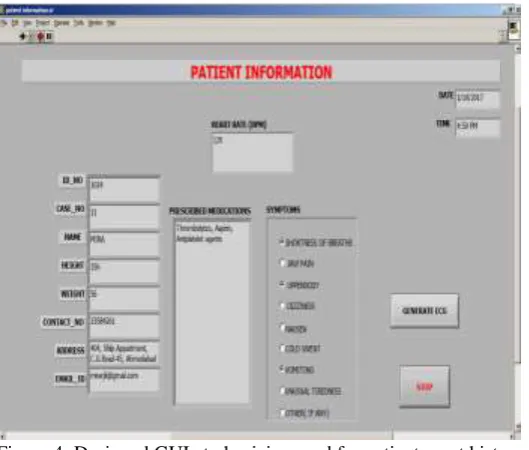
Figure 4: Designed GUI at physicians end for patients past historyAs soon as physician enters the ID no. of the patient he will be able to see above information related to that patient
a. Processing and noise cancellation:
ECG signal is a low voltage bio signal of approximately 1mV. It needs to be amplified and processed for diagnosing purpose. This weak signal is prone to be affected by various types of artifacts such as power line interference, electrode contact noise, motion artifacts, muscle contraction, base line drift, reversal leads, instrumental noise generated by electronic devices. Noise cancellation is required as it reduces the perceived quality or intelligibility of the signal. ECG electrodes are directly connected to the instrumentation amplifier ADS1292R ECG shield. It has programmable gain, high CMRR (-150db), low input bias current (200pA), low offset current and high data rate (125 SPS to 8k SPS). Now the amplified signal received at the physician end has large amount of noise as shown in figure
Figure 5: ECG signal (with noise)
IJEDR1701103
International Journal of Engineering Development and Research (www.ijedr.org)662
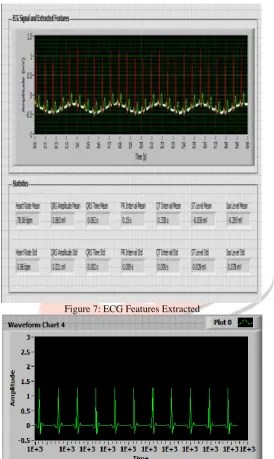
Figure 6: rectified outputAfter wavelet is analyzed, signals are merged, processed, denoised, a detrended. Then R-R interval peak is detected, heart rate is calculated and information is transferred. Lab VIEW Biomedical Toolkit in PC provides a sample compression express VI for compressing the unwanted signals and ECG Feature Extractor VI and a ECG Feature Extractor application as shown in figure, for users to extract ECG features. Hence by using this toolkit we can detect the abnormality in the received ECG signal if any of the ECG features like R position, R amplitude, QRS onset, QRS offset, P onset, P offset, T onset and T offset is detected
Figure 7: ECG Features Extracted
Figure 8: Processed Denoised normal ECG signal
IJEDR1701103
International Journal of Engineering Development and Research (www.ijedr.org)663
Figure 10: Lab VIEW program for Noise reduction of received ECG signalb. Heart Rate calculation:
Figure 11: Lab VIEW program for Heart Rate calculation.
Along with ECG monitoring the heart rate data is equally important in detecting any abnormality related to heart. Here is the program designed to read live heart rate (BPM) of patient. If heart beat level does not fall within the permissible limit the system is used to alert the person supervising the heartbeat rate of the patient and turns on the LED light as soon as the heartbeat level of the patient does not fall within the normal heart beat level set.
IJEDR1701103
International Journal of Engineering Development and Research (www.ijedr.org)664
c.Data Socket Server or online signal transmission
Data Socket for Lab VIEW simplifies live data exchange between different applications on one computer or between computers connected through a network. Although a variety of different technologies exist today to share data between applications, including TCP/IP and dynamic data exchange (DDE), most of these tools are not targeted for live data transfer to multiple clients. With TCP/IP, you have to convert your data into an unstructured stream of bytes in the broadcasting application and then parse the stream of bytes back into its original format in subscribing applications. Data Socket, however, simplifies live data transfer. It implements an easy-to-use, high-performance programming interface that is designed specifically for sharing and publishing live data in measurement and automation applications. In addition, it features inter application connectivity, rich data types, and security to make sharing data easy. It is a lightweight, stand-alone component with which programs using the Data Socket API can broadcast live measurement data at high rates across the Internet to several remote clients concurrently.
Data Socket Server simplifies network TCP programming by automatically managing connections to clients. Broadcasting data with the Data Socket Server (DSS) requires three modes – a publisher, the DSS, and a subscriber. A publishing application uses the Data Socket API to write data to the server. A subscribing application uses the Data Socket API to read data from the server. Both the publishing and the subscribing applications are “clients” of the DSS. The three modes can reside on the same machine,
but more often the three actions run on different machines. The ability to run the DSS on another machine improves performance and provides security by isolating network connections from your measurement application.
Figure 13: Data Socket Server transferring live data at remote location
Here we are using data transfer between two VIs - the VI in the tablet at patient end and VI at CMC through DSTP (Data Socket Transfer Protocol). Physician will receive live data of the patient and if any abnormality is detected after analysis he will send message to the patient (as shown below) from his system through GSM/GPRS module
Figure 14: Message sent by the Physician to patient on detecting abnormality.
IJEDR1701103
International Journal of Engineering Development and Research (www.ijedr.org)665
Figure 15: Recorded ECG data of the patientV. LIMITATIONS OF DATA SOCKET SERVER
As it is implemented now, by default DSTP transfers the most recent data on the server to the subscribers of the measurement data. In other words, subscribers are not guaranteed to receive every instance of data that gets published on the server. If the publisher is writing data to the server at a faster rate than the server is sending data to its subscribers, the subscribers might not get previously published data. This might seem to be a shortcoming of DSTP However the data loss can be minimized or even eliminated by buffering data at the client and/or the server. DSTP now offers both client-side and server-side data buffering. Client-side buffering can be configured through URL options, while server-side buffering can be configured through the Data Socket Server Diagnostic dialog box in the server.
Although Data Socket Technology provides an interactive means for performing an experiment over the Internet, it has some limitations. The client PC should also have the Lab VIEW software along with the VIs used for an experiment. Any change in VI in the server PC needs to be manually transported to the client PC as well.
VI. RESULTS
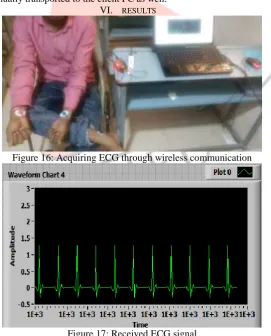
Figure 16: Acquiring ECG through wireless communication
Figure 17: Received ECG signal
VII. CONCLUSION
IJEDR1701103
International Journal of Engineering Development and Research (www.ijedr.org)666
the monitoring system is enhanced and which provides real time continuous monitoring of the patient enabling the physician to be aware of the cardiac functioning of the patient at a distance.ACKNOWLEDGMENT
The authors are thankful to Department of Instrumentation and Control, Dharmsinh Desai University, Nadiad, India to provide facilities.
REFERENCES
[1] Nandagopal, Dr.V., Maheswari, Dr.V. and Kannan, C. (2016) Newly Constructed Real Time ECG Monitoring System Using LabView. Circuits and Systems, 7, 4227-4235. http://dx.doi.org/10.4236/cs.2016.713347 Received: May 6, 2016 Accepted: May 20, 2016 Published: November 29, 2016.
[2] Akshay Kenjale, Ajaykumar Yadav, Amit Khandagale, Pooja Chaudhari ,Trupti Mate” Labview based ECG Monitoring System”(2016) International Journal of Scientific Engineering and Applied Science (IJSEAS).
[3] Allada Tirupathi Rao, M.Gopi, M.V.S.S.Prasad “Real Time ECG Signal Transmission for Remote Monitoring”
International Journal Of Engineering Development and Research | IJEDR
[4] M. B. I. Reaz “Tele-Health ECG Monitoring System: A Low Cost Approach” Saudi Association for Health Informatics.
[5] P.Khanja, S.Wattanasirichaigoon, J.Natwichai, L.Ramingwong, S.Noimanee “A web base system for ECG data transferred using ZIGBEE /IEEE technology” International Symposium on Biomedical Engineering (ISBME 2008).
[6] Manisha Shelar, Jaykaran Singh, Mukesh Tiwari “Wireless Patient Health Monitoring System” International Journal of Computer Applications.
[7] Ufoaroh S.U , Oranugo C.O, Uchechukwu M.E “Heartbeat monitoring and alert system using GSM technology”(2015)
International Journal of Engineering Research and General Science.
Abbreviations ECG Electrocardiogram
CMC Cardiac Monitoring Centre LAN Local Area Network
GSM Global System for Mobile communication DSS Data Socket Server