7286
Smart Forest: An IoT Based Forest Safety And
Conservation System
Purushottam Rohidas Patil, Vinay Tila Patil
Abstract: Governments especially in semi-arid regions of the world designate areas of forests as forest reserves to kindle rainfall, reduce wind attrition, stem the tide of logging and halt the infringement of the desert. Therefore, in India and many other countries, forest reserves enjoy judicial and/or constitutional protection under a legal system. After air and water, forests are the next most important resources of nature on earth. They essentially support life on earth by absorbing carbon dioxide and releasing oxygen, thereby maintaining balance in the gaseous atmosphere and also in the completion of the hydrological cycle to cause rainfall. Forests are sources of food, medicine, timber, and many other products. They play protective roles against soil erosion, drought, floods, intense radiation, etc. Forest also performs accessory functions which include the role of forests in recreation, aesthetics and as the habitat of diverse wildlife. The six major operations that are essential in monitoring the forest are proposed in this paper, namely tree cutting detection (Logging), fire detection, human detection, location detection, Soil Moisture detection and temperature using vibration sensor, fire sensor, Passive Infrared Sensor (PIR), GPS sensor, Soil Moisture sensor, temperature sensor respectively. The proposed IoT based forest Security system works in two parts, first to collect sensors data from tree sites. Secondly, a Python-based system where receive, process, analyze, sends SMS and Location of the affected site to concerned security persons, employees or forest officers. This system will support E-Governance in the forestry sector.
Index Terms: Anti-logging, Conservation of Forest, Forest security, wildlife, ecological balance. —————————— ——————————
1
.I
NTRODUCTIONGlobally as well as nationally, current drive on high economic growth and development involving urbanization, industrialization, and development, pressure on precarious forest resources becomes critical. This necessitated the need for constant watch on forest resources in all its multifarious activities like Conservation, Production, Protection, and Management. Forest Conservation is increasingly being viewed as a powerful instrument in sequestering carbon and thereby offset adverse climate change. The manual monitoring of the forest to prevent unauthorized activities is a practically difficult job [1]. Forest reserves are thus areas of forests that are reserved and managed for conservation and to provide special opportunities for study or research (Usman and Adefalu, 2010) [2]. It is based on the above importance UN-mandated that 25% of the surface area of every country should be conserved under permanent forest cover as the minimum ecological requirement for the socio-economic survival of the country (Bugaje, 2007). It complies with the above mandate that forest and forest reserves are found in different countries of the world [3]. Nandurbar is the newly constituted district in the state of Maharashtra (India). It lies between 73° 47’ and 74° 47’ East longitude and 21° 0’ and 22° 3’ North latitude; Satpura hill ranges falls in the district from East to the West. As much as 65% of the population of the district is tribal. The major sources of income or earning for tribal community is agriculture, but the land surface in hill area is major problem for cultivation, so most of the people prefers to plant fruit trees like Mango
(Mangifera indica), Custard apples, Medicinal and herbal plants like Amla (Phyllanthus Emblica), Aloe Vera (Korphad), Bramhi, Indica , Babul (Acacia nilotica), Nilgiri (Eucalyptus), Mahoo (Madhuka latifolia) and high-cost plants like Sagwan (Tectona grandis) widely used in making household furniture, Bamboo [4]. As per the figures from the Department of Forest, Toranmal wildlife sanctuary, the rate of logging of trees is increasing day by day causing illegal activities like smuggling of timber wood, firewood and costly trees like Sagwan in a nearby area of boundary region of states Gujarat and Madhya Pradesh.
2. L
ITERATURES
URVEYAnil Kulkarni, Ajay Khandare, Mandar Malve (2014) designed a system for wireless sensor networks for protecting high-cost trees in remote jungles from fire and poaching[5].
Narhari, Kotkar (2014) implemented a system using Flex sensor and Zigbee which able to restrict the smuggling of trees in a forest where the human being not able to provide security. Such a system used in the forest where the tree is costly and their protection is an important fact. Shridevi Soma, Swamy Sudha (Jan. 2019) implemented an automatic system for controlling deforestation using IoT and GSM detect four illegal activities using IOT technology compared to past research and observed good results for all types of detection carried out. They proposed another novel idea by introducing a Wi-Fi router between the employee and the forest officer. This Wi-Fi router provides communication between the employee and forest officer when case network is disabled [6]. Department of Forest Government of Maharashtra, in its mission of greening of Maharashtra after having planted 2.18 crore seedling in a day in 2016, has planted 13 crore in 2017 rains, and has taken the task of planting 13 crore seedling in 2018 and another 33 crores in 2019, thereby planting 50 crore spread over the years of Maharashtra.To successfully achieve the mandate and for proper administration and management Department has 14 Forest Circles constituting 61 Forest Divisions The Dhule Forest Circle is the Western Marathawada Region most Forest Circle of the state of Maharashtra. It has been divided into Five Territorial ————————————————
Purushottam Rohidas Patil is currently working as Associate Professor at PSGVPM’s D.N.Patel College of Engineering, Shahada , M.S. (425409).He pursued Ph.D. in Computer Science and Engineering. Mob: 9890824117 9. E-mail: [email protected]
7287 Divisions, viz, Dhule, Jalgaon, Nandurbar, and Yawal. Table
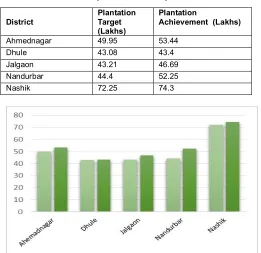
1 shows 13 cr. Plantation Achievement in the Nashik region ( 1 July to 31 July 2018)
TABLE I: 13 CR.PLANTATION ACHIEVEMENT (NASHIK DIVISION)
Fig. 1 Plantation Achievement
Realizing this need State Government decided to undertake the project ‘Integrated e-Governance’, The Core Activities included Forest Management, Forest Protection, Land Management, Production, Wild-life, and Research & Extension. To achieve the deliverables 3 phase strategy was decided.
Phase-I: - LAN & WAN Connectivity to secure intranet communication,
Phase-II: - Applications to be developed for in-house use & Phase-III: Decision support system (DSS) by creating a Command & Control System and GIS for Forest Monitoring and Research Development.
2.1 Government Policies
As per Government Resolution 26th February 2010, approved the creation of an independent medicinal plant conservation and development branch under FDCM (Forest Development Corporation of Maharashtra Ltd.), about 4.00 lac of medicinal plant seedlings were raised in 2009-10 & 2010-11 under the United Nations Development Programme (UNDP) the project funded by Govt. of India (GOI) for the distribution through State Govt. Departments like Forest, Social Forestry and Agriculture [7].
The medicinal plants' species such as Gulvel, Kalmegh, and Sarpagandha plantations are raised in Nashik Region during 2009, 2010 and 2012 spots of rain over an area of 125.600 ha. Through Centre Sector Schemes of NMPB, New Delhi. The Medicinal Plant Branch of FDCM Ltd. has
carried out ex-situ plantation activities over an area of 748.100 ha. And planted 82,62,656 seedlings of medicinal plants species.(2009 to 2015) The Amazon rainforest is an ecological marvel. It's twice the size of India, according to the World Wildlife Fund, and it's the largest remaining tropical rainforest in the world. It's home to at least 10% of the world's biodiversity, produces 20% of the world's oxygen and helps regulate the temperature of the whole planet [8]. In August 2019, Amazon rainforest fire topic trending topic in the world. As per the Brazils research center, nearly 40000 fires detected in 2019, there is a 77 % increase from the same period last year. As per the information available regarding MREGS ( Mahatma Gandhi Rural Employability Guarantee Scheme 8/29/2015) Circle: Dhule, Division: Nandurbar on Forest Departments website location longitude E 73° 37'24.96'', Altitude N 21° 8’08.16” Shows the Number of trees as per Google earth picture (Fig 2) and Present image dated 02/10/2019(Fig.3) [9].
Fig 2: Google Earth Satellite Image ( 08/29/2015)
Fig 3: Google Earth Satellite Image (02/10/2019)
3.
E
XISTINGS
YSTEM3.1 Prof. Nagashree C. et al designed the Anti-Smuggling of trees was using flex sensors and ZigBee [10]. Every tree will be equipped with one small electronics unit which
District
Plantation Target (Lakhs)
Plantation
Achievement (Lakhs)
Ahmednagar 49.95 53.44
Dhule 43.08 43.4
Jalgaon 43.21 46.69
Nandurbar 44.4 52.25
7288 consists of MicroController, Flex Sensor and Zigbee
module. Tree cutting will be detected by flex sensors. A server unit cutting trees will be shown in the VB front end. Communication between the trees and servers will be done by Zigbee modules.
Drawbacks:
Wireless Communication in this system used ZigBee Module which is very slow and has a lesser range than Wi-Fi Module which is used in the Proposed System.
Flex Sensors are merely sensors but tilt sensors are inclinometers (which are used to measure slope or elevation and readouts apart from just signals).
The existing system is not practically implemented.
3.2. Ghousia Sultana B et al implemented Anti-poaching alarm system for trees in forest using wireless sensor networks, the system uses three sensors tilt sensor (to detect the inclination of tree when it's being cut), temperature sensor (to detect forest fires), sound sensor (for effective detection of illegal logging i.e. even the sounds generated while axing the tree are also sensed). Data generated from these sensors is continuously monitored with the aid of the Blynk App. Concerning the sensors, their output devices are activated through a relay switch. For a tilt sensor and sound sensor, a buzzer is activated and for a temperature sensor, a water pump is activated. Generated data is stored in the Blynk Server over the Wi-Fi module. Forest officials are notified when an event occurs so that appropriate action can be taken [11].
Drawbacks:
1. Blink server pricing is a little high 2. Systems Feature Limitations 3. Data Analysis can't be performed 4. GPS unavailable
4.
P
ROPOSEDS
YSTEM:
Now a days, the IoT system development have many alternatives like programming languages (java, Python, etc.), operating system (Embedded Linux, Mac OS, etc.). The system under study in this paper possesses the technical details as follows.
4.1 Raspberry Pi: The Raspberry Pi is, effectively, a mini-computer on one board. It comes with a dedicated processor, memory, graphics driver and I/O. Its boards run a specially designed version of the Linux OS. Raspberry Pi is a low-cost computing platform. The goal of the Raspberry Pi Foundation is to make computing available to everyone globally to help them to learn to program. Since its initial release in 2012, the Raspberry Pi has seen several enhancements in terms of the amount of RAM, CPU power, peripheral support, and support for networking protocols. The latest version, Raspberry Pi 3, was announced in February 2016. It comes with a 1.2GHz 64-bit quad-core ARMv8 CPU, 1GB RAM, built-in wireless/Bluetooth support and much more. This amount of computing power is more than sufficient to run your applications and to program them using a variety of programming tools/environments. In this article, let’s get started with programming on the Raspberry Pi using one of the most popular languages in the world, Python.
4.2 Python: It is one of the most popular languages in the world and has been around for more than two decades. It is heavily used in academic environments and is a widely supported platform in modern applications, especially utilities, and desktop and Web applications. Python is highly recommended as a language that is easy for newcomers to programming. With its easy-to-read syntax, the introduction is gentle and the overall experience much better for a newbie. The latest version of the bundled with both Python 3.3 and Python 2.x tools. Python 3.x is the latest version of the Python language and is recommended by the
Raspberry Pi Foundation.
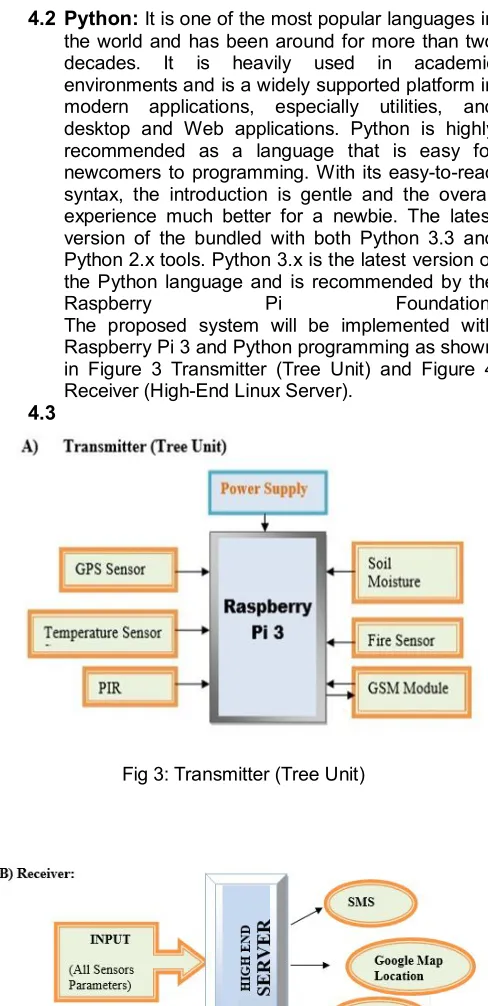
The proposed system will be implemented with Raspberry Pi 3 and Python programming as shown in Figure 3 Transmitter (Tree Unit) and Figure 4 Receiver (High-End Linux Server).
4.3
Fig 3: Transmitter (Tree Unit)
Fig 4: Receiver (High end Server)
4.3 Why Python?
As per the TIOBE index, python is the programming language of the year in 2018, with a rating of 10.020%, it is also the 3rd most popular language in 2019.
7289 The Language is simple and can be easily deployed. Its
large community helps in providing help and libraries as and when required. It is the ideal language for data intensive application.
4.4 Ubuntu for IoT:
The survey conducted by IoT developers in year 2019 Ubuntu was the top choice for IoT developers. Flashing Ubuntu Server on a Raspberry Pi 2, 3 or 4.will have a fully-fledged development or production environment , since 18.04.2 the Linux-firmware and linux-firmware-raspi2 packages now contain the necessary files for the built-in WiFi on the Pi 3B, 3B+, and 4B.
mkdir wifi-firmware cd wifi-firmware # Pi 3B
wget https://github.com/RPi-Distro/firmware-nonfree/raw/master/brcm/brcmfmac43430-sdio.bin wget
https://github.com/RPi-Distro/firmware-nonfree/raw/master/brcm/brcmfmac43430-sdio.clm_blob wget
https://github.com/RPi-Distro/firmware-nonfree/raw/master/brcm/brcmfmac43430-sdio.txt # Pi 3B+ and 4
wget https://github.com/RPi-Distro/firmware-nonfree/raw/master/brcm/brcmfmac43455-sdio.bin wget
https://github.com/RPi-Distro/firmware-nonfree/raw/master/brcm/brcmfmac43455-sdio.clm_blob wget
https://github.com/RPi-Distro/firmware-nonfree/raw/master/brcm/brcmfmac43455-sdio.txt sudo cp *sdio* /lib/firmware/brcm/
cd ..
Reboot the machine.
Use dpkg-divert to stop these files being overwritten on package updates.
4.5 Advantages & Disadvantages
Advantages of IoT Devices
Least human effort because IoT communicates with one another and does most of the tasks for us.
It saves a lot of time as it lessens human efforts made by Security guards /Supervisors.
It improves various security aspects due to the interconnection of the devices and platforms together.
Devices or Resources uses optimized.
One of the top advantages of IoT is saving money. If the process of the category and monitoring device is less than the amount saved, then the IoT will be very widely adopted technology worldwide.
Python is open source and well suited for Linux Platform.
Disadvantages of IoT Devices
Due to the interconnection, security measures might become trouble and lead to network attacks.
Privacy might get attacked even when the active participation of the user is less. The IoT system gathers substantial personal data with maximum details.
The designing, maintenance, and development of an IoT
device is quite a complex process.
Advantages of the Proposed System
Data captures at source of origin
Reliability & Easy to maintain
Scalability to encompass information of all key
Stakeholders
Secure access and rights-based access to stakeholders Standardization and integration of applications & data Business intelligence for analysis & decision making
5. E
XPECTEDO
UTCOMES Forests are essential for survival and sustenance of life. They are the source of many direct and indirect benefits and need to be managed in such a way that extraction of benefits does not deplete the resource. Their growth should be optimized so that greater benefits are derived from them.
Smart Forest system implementation at Satpuda Forest will progress many parameters like:
Conservation of forest, Production of Timber wood, Firewood, Bamboo creates income sources for tribal community
Medicinal and fruit plants survival and uses
Prevent Smuggling of the Costlier tree-like Sagwan
Forest Fire Alarm
Ecosystem Balance
Data Analysis help in Decision making for Govt. and NGO’s.
Wildlife conservation
Preventing Wild animals’ arrivals in villages and agriculture land saves mankind and crops as well.
Maintaining Soil moisture level
Support E-Governance.
6. C
ONCLUSIONThe proposed system will be able to restrict the smuggling of trees in the forest when /where the department of forest unable to provide security. Wildlife conservation and ecosystem balance can be achieved. Fire and poaching may be minimized. Implementation of The IoT technology from lab to land.
REFERENCES
[1] Ms. Manasa j.,ms. Harshitha r Et al.,” Forest monitoring system based on gprs and powered by IoT”, Sapthagiri college of engineering, bengaluru, Project reference no.: 40s_be_2312.
[2] Usman B.A,Adefalu L.L,” Nigerian forestry, wildlife and protected areas: Status report,Department of Geography, Faculty of Business andSocial Sciences,University of Ilorin.
[3] Suleiman Iguda Ladan,” Forests And Forest Reserves As Security Threats In Northern Nigeria”, European Scientific Journal December 2014 edition vol.10, No.35 ISSN: 1857 – 7881
[4] Patil H.M ,”Ethnobotanical Notes on Satpura Hills of Nandurbar,District, Maharashtra, India”, Research Journal of Recent Sciences , Vol. 1(ISC-2011), 326-328 (2012), ISSN 2277 - 2502
7290 poaching‟ „InternationalSeminar on Sandalwood:
Current Trends and Future Prospects, Feb 2014, pp.68-73.
[6] Shridevi. Soma, Swamy Sudha,”An Automatic System For Controlling Deforestation Using IoT And GSM”, ISBN: 978-93-88775-00-7,January 2019.
[7] St.Annual Report And Accounts 2013-14 , Forest Development Corporation Of Maharashtra Limited (Govt. Of Maharashtra Enterprise.
[8] https://www.nytimes.com/2019/08/23/world/america s/ amazon-fire-brazil-bolsonaro. html
[9] http://www.mahaforest.nic.in/satbased_map_view.p hp
[10] Ghousia Sultana B, Jagadish R, Prof Nagashree C ,” Iot Based Anti-Poaching Alarm System For Trees In Forest Using Wireless Sensor Networks”, International Journal of Advanced Research in Computer Science (ISSN: 0976-5697), Volume 9, Special Issue No. 3, May 2018.