DEVELOPMENT OF COMPOSITE MATERIAL USING
COCONUT SHELL PARTICLES AND BAGASSE
PARTICLES IN PROPORTION BY THEIR WEIGHT
AND ESTIMATION OF MECHANICAL STRENGTHS
OF THE SAME
Mule Dattatraya Shashikant
1,
Kumbhojkar A.A
2,
Amod P. Shrotri
3 1ME Student,
2,3Associate Professor Mechanical Dept., PVPIT Budhgaon ,Shivaji University (India)
ABSTRACT
The microstructure and the chemical compositions of coconut shell and bagasse have been discovered at
different levels and their mechanical properties are also revealed by the scientists. Keeping these discoveries
and innovations in one hand, a new composite material using coconut shell and bagasse particles both together
with a resin binder, is proposed for engineering applications especially in furniture industries, which can be a
potentially substitute for the present materials.
Keywords: Biowaste Composites , Coconut Shell Composites , Composites, Furniture Materials.
I. INTRODUCTION
Composite materials are those in the mechanical, chemical and other properties of two or more different
materials are combined to enhance them. The composite materials have their distinct properties and behavior
under the different working conditions. Different composites are developed by using the agro waste material
such as the bagasse fibres, fibres from leaves of different trees. Composites from coconut shell particles are also
developed. The possibility of the developing the composites by using both coconut shell particles and bagasse
particles together is proposed. The compressive strength of the coconut shell particles and the tensile strength of
the bagasse particles is tried to combine in the composite.
As the wood or furniture industry has very huge demand for the light weight and high strength material. Also
the cost is of prime importance. Thus there is possibility to develop such materials. Today we are using the
plywood sheets and laminates in this industry, and the factor of weight and cost is playing an important role.
Hence there is a scope to develop a new composite material using agro waste such as coconut shell particles and
sugar cane waste particles, estimation of mechanical strengths of such material and also to explore possibility of
finding out alternative composite for existing material used in furniture industries.
Previously work has been done on the composites which consists of the coconut shell particles with varying the
particle size and their proportions by weight in the matrix. Similarly the work has been done on the composites
Purpose of this paper is to explore an idea of developing the new composite using the very common materials, a
coconut shell and bagasse. This paper can open new ways of thoughts and guidelines to develop the composite
material.
II. LITERATURE SURVEY
Michael P. Wolcott Karl Englund [1] They did the work on Wood Plastic Composites and their production
technologies. They made sure that such composite can be prepared tested and advantageously utilized in the
different areas of industries. They suggested the technologies to produce the wood plastic composites such as
the extrusion and compounding and also their impact on the mechanical properties. They wrote that ―When
synthetic and mineral fibers are used, machine wear and damage of processing equipment is much higher than
with wood filler. Fiber damage during processing is greatly reduced when wood is utilized, which allows for
recycling production waste without compromising quality‖. Similarly there is possibility of enhancing the
quality of the material by using the particulate fillers in the matrix.
S. Husseinsyah and M. Mostapha [2] The Authors have studied the effect of natural lignocellulosics on the
mechanical properties of polymers .In their work they found that the tensile strength of the polymer composites,
Young’s modulus and the water absorption is increased with increase in the percentage of coconut shell
particles in the composite
J. Olumuyiwa Agunsoye [3] et al, The coconut shell particles were used as the reinforcement in the polymer
matrix and composite was fromed by compacting low density polyethylene matrix with 5% -25% volume
fraction coconut shell particles. The mechanical properties such as the tensile strength , hardness was tested and
found satisfactory. Their study explains the potential of agro-based waste fiber in Nigeria as an alternative
particulate material for the development of a new composite.. This literature also shows that there is possibility
of combining the different particulates in the composites.
Mohammad Dahmardeh Ghalehno et al [4] ―Experimental particleboard from bagasse and industrial wood
particles‖ have studied and estimated the modulus of elasticity and modulus of rupture of a composite
developed by using the bagasse with varying proportions. They carried out the manufacturing and tests as per
the standard DIN 68763. This study was made with 40% bagasse 11% resin in the surface layers. Different
experiments were designed for the different percentages of shelling ratio, resin content and press time. It is
concluded that with increase in the percentage of bagasse the modulus of elasticity increases. This also shows
the effect of shelling ratio, resin content and pressing time on the mechanical strengths.
Bhaskar J & V K Singh [5] These authors formed the resin composites using the coconut shell particles in the
sizes of 200 t0 800 micrometre by wt% of 20, 25, 30 and 35. They investigated that the compressive strength
and water absorption property depends upon the size of the coconut particles. Though the strengths are
increased but the elongation decreases. Thus there is possibility of improvement of these qualities by adding
the other particulates in combination of the coconut shell powder.
Balraj Bhaskar More [6] The author has studied the hardness and water absorption of the coconut husk, he made
sieve analysis water absorption test ans the testing of compressive strength of the blocks of size of 10 x 6 x 4
coconut shell particles are coated, compressive strength of the blocks is enhanced and the composite can
effectively be employed in the construction industries.
A.Balaji et al [7] The authors threw spot light on the uses of natural fibres used in the fibre reinforced
composites. They also emphasize on the use of these composites in the automotive industries. In this work they
suggested the suitable matrixes for the natural fibres in the broad categories like thermosetting thermoplastics
rubber and natural polymers. They gave an idea about the composition of bagasse, its mechanical and the
thermal properties and its analysis. Their review paper, ―Bagasse Fiber – The Future Biocomposite Material: A
Review‖, have clarified the use and recent development of bagasse fibers reinforced polymer composites, types
of matrix, processing methods, and modification of the fiber and its applications. This paper shows the
opportunity for development of the composites using bagasse fibers. Also creates possibility of use of the
bagasse particles in composites.
III. PROPOSED WORK
Scope
1.1.1 It is proposed to develop the composite material using the coconut shell particles along with the sugar
cane waste bagasse particles using the suitable binder in different proportions by weight.
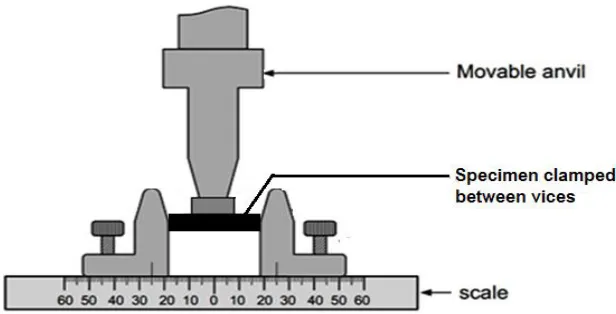
1.1.2 To develop a setup for determination of bending strength of specimen on UTM as shown in the Fig. 1
1.1.3 To measure its bending, tensile and compressive strength for different compositions by weight.
1.1.4 To compare the mechanical strengths of developed composite with the corresponding mechanical
strengths of material presently used in the furniture industries.
IV. METHODOLOGY
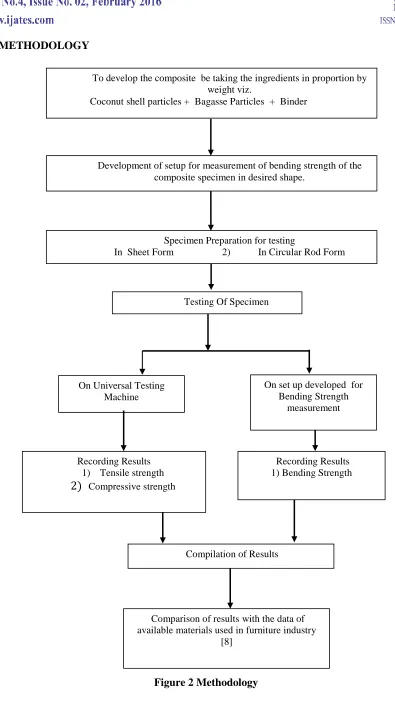
Figure 2 Methodology
To develop the composite be taking the ingredients in proportion by weight viz.
Coconut shell particles + Bagasse Particles + Binder
Specimen Preparation for testing
In Sheet Form 2) In Circular Rod Form
Development of setup for measurement of bending strength of the composite specimen in desired shape.
Testing Of Specimen
On Universal Testing Machine
On set up developed for Bending Strength
measurement
Recording Results 1) Tensile strength
2)
Compressive strengthRecording Results 1) Bending Strength
Compilation of Results
Comparison of results with the data of available materials used in furniture industry
The Fig. 2 shows flow chart which gives an idea of the methodology to be used for carrying out the
dissertation work. Which is further explained as under.
4.1 The raw material for the composite i.e. the coconut shell particles and the bagasse particles and obtained
from the sources which are the manufacturer of these. If the coconut shell particles if not made available
readily it is obtained by crushing the shell of coconut.
4.2 Suitable binder such as the Epoxy resin and hardeners are readily available in the market that is purchased.
4.3 Using the weighing machine the coconut shell particles and the bagasse particles are taken in proportion by
their weight such as (Experiment I) 30% and 70% (Experiment II ) 40% and 60 % respectively.
4.4 These raw materials are mixed with the binders and cured for sufficient time to obtain the required bonding.
This is visually and touch inspected manually.
4.5 Tensile test can be carried out on the universal testing machine as a regular practice. The set up for carrying
out the bending test is prepared by using two clamps or vices to hold the test specimen and a central load
can be applied on it by the movable anvil on universal testing machine.
4.6 Test specimens are prepared by appropriate methods such as rolling and extrusion in the form of sheet and
circular rods with the help of industrial experts.
4.7 The test specimens as tested for their tensile strength and compressive strength on the universal testing
machine. Bending test is also carried out to estimate the tensile test.
4.8 The results of these test are compiled together in order to prepare the experimental data for the comparison
with the available data.
4.9 The compiled experimental results are then compared with the data available and from the data obtained for
the wood handbook for the materials which are popularly used in the furniture industries.
V. CONCLUSION
Different composites prepared from the agro waste such as coconut shell and bagasse individually, and there is
no evidence of composite produced by using the coconut shell particles and sugar cane waste bagasse both
together. Thus there is possibility of development of composite material which can be an alternative for wood
and plywood used in the furniture industry using the agro waste coconut shell particles and bagasse together.
This new composite can be an economical option for various available composites materials for particle boards.
VI. ACKNOWLEDGEMENT
It gives me immense pleasure to express my deep sense of gratitude to my guide Assistant professor
Kumbhojkar A.A. for his guidance, motivation, constant inspiration and above all for his ever co-operating
attitude that enabled me to publish me this review paper. I am extremely thankful to Assistant professor Harge
C.G., Head of Mechanical Engineering Department Dr. Satishchandra V Joshi principal PVPIT Budhagon , for
the help and advice. I express my sincere gratitude to Assistant Professor Kshrotri A.P. for their support and
help during writing and publishing this paper. I am greatly thankful to all staff members and lab assistants of the
REFERENCES
Journal Papers
[1]. Michael P. Wolcott Karl England. A Technology Review of Wood Plastic Composite 33rd International
Particleboard / Composite Material Symposium, 103-111 (1999)
[2] S. Husseinsyah and M. Mostapha The Effect of Filler Content on Properties of Coconut Shell Filled
Polyester Composites. Malaysian Polymer Journal, Vol. 6, No. 1, p 87-97, 2011.
[3] J. Olumuyiwa Agunsoye, Talabi S. Isaac, Sanni O. Samuel Study of Mechanical Behaviour of Coconut
Shell Reinforced Polymer Matrix Composite Received February 21, 2012; revised March 30, 2012;
accepted April 22, 2012.
[4] Mohammad DahmardehGhalehno, Morteza Nazerian, Ali Bayatkashkoli Journal Experimental
particleboard from bagasse and industrial wood particles International Journal of Agriculture and Crop
Sciences. IJACS/2013/5-15/1626-1631 ISSN 2227-670X ©2013 IJACS
[5] Bhaskar J and V K Singh. J. Material and Environmental Science., 4(1) 113-118 (2013)
[6] Balraj Bhaskar More. Merits Of C4 (Coated Coconut Cover Crush) Block Over Aggregate Block
International Journal Of Civil Engineering And Technology (IJCIET). ISSN 0976 – 6308 (Print) ISSN
0976 – 6316(Online) Volume 4, Issue 4, July-August 98-105 (2013)
[7] A.Balaji, B. Karthikeyan, and C. Sundar Raj Bagasse Fiber – The Future Biocomposite Material: A
Review International Journal of ChemTech Research CODEN (USA): IJCRGG ISSN: 0974-4290 Vol.7,
No.01, 223-233, 2014-2015
Books:
[8] Forest Products Laboratory. Wood handbook—Wood as an engineering material. General Technical
Report FPL-GTR-190. Madison, WI: U.S. Department of Agriculture, Forest Service, Forest Products