Selective adherence to antihypertensive medications
as a patient-driven means to preserving sexual
potency
Corrine I Voils1,2
Margarete Sandelowski3 Philipp Dahm4,5
Rachel Blouin1
Hayden B Bosworth1,2 Eugene Z Oddone1,2 Karen E Steinhauser1,2
1Center for Health Services Research in Primary Care, Durham Veterans Affairs Medical Center, Durham, NC, USA; 2Department of Medicine, Duke University Medical Center, Durham, NC, USA; 3School of Nursing, University of North Carolina at Chapel Hill, Chapel Hill, NC, USA; 4Gainesville Veterans Affairs Medical Center, Gainesville, FL, USA; 5Department of Urology, University of Florida, Gainesville, FL, USA
Correspondence: Corrine I Voils Veterans Affairs Medical Center (152), 508 Fulton St., Durham, NC 27705, USA Tel +1 919 286 0411 Ext 5196 Fax +1 919 416 5836 Email [email protected]
Objective: To describe hypertensive patients’ experiences with sexual side effects and their consequences for antihypertensive medication adherence.
Methods: Data were from a study conducted to identify facilitators of and barriers to adher-ence to blood pressure-lowering regimens. Participants were 38 married and unmarried veterans with a diagnosis of hypertension and 13 female spouses. Eight patient and four spouse focus groups were conducted. A directed approach to content analysis was used to determine the facilitators of and barriers to adherence. For this report, all discussion concerning the topic of sexual relations was extracted.
Results: Male patients viewed sexual intercourse as a high priority and felt that a lack of sexual intercourse was unnatural. They pursued strategies to preserve their potency, includ-ing discontinuinclud-ing or selectively adherinclud-ing to their medications and obtaininclud-ing treatments for impotence. In contrast, spouses felt that sexual intercourse was a low priority and that a lack of sexual intercourse was natural. They discouraged their husbands from seeking treatments for impotence.
Conclusion: Although the primary study was not designed to explore issues of sexual function, the issue emerged spontaneously in the majority of discussions, indicating that sexuality is important in this context for both male patients and their spouses. Physicians should address sexual side effects of antihypertensive medications with patients, ideally involving spouses.
Keywords: hypertension, sexual side effects, antihypertensive medication, adherence, blood pressure
Despite the positive effects of pharmacological, diet, and exercise interventions to reduce blood pressure (BP), less than one-third of hypertensive patients achieve adequate BP control as defi ned by Joint National Committee VII guidelines (Burt et al 1995; Hajjar and Kotchen 2003). A major barrier to adequate BP control is patient nonadherence to medication and failure to institute recommended lifestyle changes. An estimated 20%–80% of patients diagnosed with hypertension do not take their medications as pre-scribed (Dunbar-Jacob et al 1995; Ogden et al 2006), and nearly 75% of Americans do not adhere to recommended hypertension lifestyle changes such as the DASH (Dietary Approaches to Stop Hypertension) diet (Brownell et al 1986; Mellen et al 2008).
wish to take medication indefi nitely or may simply forget to take their medications at times (Svensson et al 2000). Com-mon reasons related to the medications include patients’ beliefs about the necessity or effi cacy of the medication, dosing frequency, regimen complexity, and side effects (Svensson et al 2000; Safren et al 2001; Benson and Britten 2002; Ogedegbe et al 2004).
Previous studies are limited because researchers have conceptualized side effects in a uniform fashion, rather than distinguishing different side effects and how they may affect adherence. Patients may be willing to live with some side effects and not others and, therefore, some side effects may have an impact on adherence to a greater degree.
Another limitation is that in previous studies, the role that spouses play has not been investigated. Although it is often assumed that spouses enhance adherence, spouses can also do things to decrease adherence, such as nagging, punishing the spouse for engaging in undesired behaviors, or requesting the spouse to engage in a specifi c behavior (Umberson 1987; Tucker and Mueller 2000). Thus, spouses may infl uence whether patients live with specifi c side effects or pursue avenues to ameliorate them.
In this paper, the results are reported of a secondary data analysis of older hypertensive patients’ experiences with sexual side effects and their consequences for antihy-pertensive medication adherence. We report also spouses’ perceptions of the effect of sexual side effects on patients. Understanding patients’ experiences with sexual side effects and medication adherence can help identify opportunities for clinical intervention.
Methods
Design, setting, and participants
The data for this study were obtained from a larger study designed to understand the spouses’ role in the self-management of hypertension. The larger study was approved by the Institutional Review Board at the Durham Veterans Affairs Medical Center. We mailed recruitment letters to a random sample of 233 patients diagnosed with hypertension (ICD-9 code 401.9) receiving care from the Durham Veterans Affairs Medical Center. Approximately two weeks later, a research assistant attempted to reach patients by telephone. We were able to contact 66 patients, of whom 38 (37 males, 1 female) were scheduled for a focus group. Patients who agreed were asked if they had a spouse or signifi cant other who would be willing to participate in a separate focus group. The research assistant spoke to 24 female spouses, of whom 13 were scheduled for a focus group.
Data collection
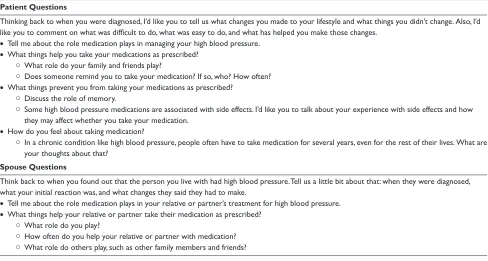
Eight patient groups were convened, with an average of 4 patients per group. Four spouse groups were convened, with an average of 3 spouses per group. A female social worker moderated the patient groups, and a female social psycholo-gist moderated the spouse groups, which occurred concur-rently in a different room. After obtaining informed consent, the moderator administered a demographic questionnaire to assess biological sex, race, age, and marital status. The moderator began each discussion by asking which changes patients were asked to make at and since diagnosis. As the discussion unfolded, the moderator asked what was easy or diffi cult about making those changes and about the spouses’ role. Participants were probed about medication, diet, exer-cise, and stress. Participants spontaneously mentioned sexual side effects when discussing medications. Accordingly, the medication questions from the patient and spouse moderator guides are shown in Table 1. To ensure exhaustiveness of responses, we conducted patient and spouse groups until the-matic saturation was obtained (Strauss and Corbin 1998).
Data analysis
All discussions were audiotaped and transcribed. We used a directed approach to content analysis to determine the facili-tators of and barriers to adherence (Hsieh and Shannon 2005). The directed approach is appropriate when some research exists about a phenomenon, but a researcher wishes to obtain more descriptive information. In coding the transcripts, one team member generated one or more descriptive labels to describe elements of adherence. A second team member generated descriptive labels for a subset of the transcripts. The coding scheme was fi nalized through discussion. Then, the coding scheme was applied to all transcripts by one team member. Across all transcripts, a list of twenty elements was generated, one of which was sexual relations. For the current analysis, we extracted all discussions associated with sexual relations as a factor infl uencing medication adherence. We report the most representative quotes in a case-oriented fashion (by age, race, and marital status) to show the range of individuals who espoused these views.
Results
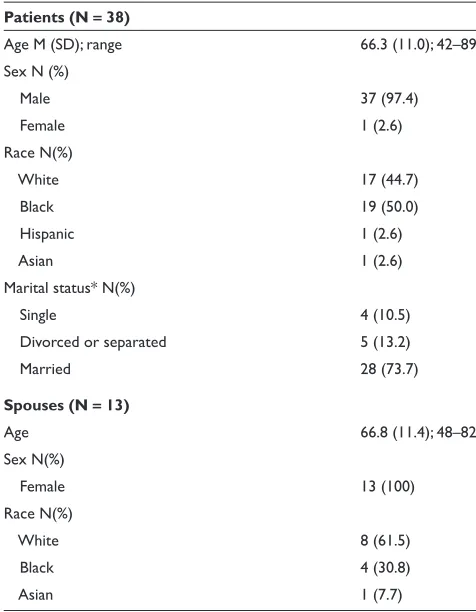
All but one patient were male, 45% were white, 50% were black, and 74% were married (see Table 2). All spouses were female, 62% were white, and 31% were black.
Table 1 Patient and spouse questions about medication Patient Questions
Thinking back to when you were diagnosed, I’d like you to tell us what changes you made to your lifestyle and what things you didn’t change. Also, I’d like you to comment on what was diffi cult to do, what was easy to do, and what has helped you make those changes.
• Tell me about the role medication plays in managing your high blood pressure.
• What things help you take your medications as prescribed?
{ What role do your family and friends play?
{ Does someone remind you to take your medication? If so, who? How often?
• What things prevent you from taking your medications as prescribed?
{ Discuss the role of memory.
{ Some high blood pressure medications are associated with side effects. I’d like you to talk about your experience with side effects and how
they may affect whether you take your medication.
• How do you feel about taking medication?
{ In a chronic condition like high blood pressure, people often have to take medication for several years, even for the rest of their lives. What are
your thoughts about that? Spouse Questions
Think back to when you found out that the person you live with had high blood pressure. Tell us a little bit about that: when they were diagnosed, what your initial reaction was, and what changes they said they had to make.
• Tell me about the role medication plays in your relative or partner’s treatment for high blood pressure.
• What things help your relative or partner take their medication as prescribed?
{ What role do you play?
{ How often do you help your relative or partner with medication?
{ What role do others play, such as other family members and friends?
patient; she contributed to the discussion) and 3 of the 4 spouse groups. These groups were similar in composition to those groups in which sexual relations was not discussed in number of participants per group, race, age, and, for patients, marital status. Patient and spouse themes are shown in Table 3.
Patients’ views
The male patients felt that sexual activity reduced stress caused by high blood pressure. As a 71-year-old, white, married man said: “If you don’t get a full balance, it will send your blood pressure sky high. Sex lowers your blood pressure at times.” A 73-year-old, black, separated man said: “I think that’s [sexual intercourse] what I need. I think my blood pressure would go down to about 110/60.”
Along with the belief that sexual intercourse would lower blood pressure were the views that sexual intercourse was a high priority and that a lack of sexual intercourse was unnatural. As a 51-year-old, black, married man observed: “I’ll be honest with you. It [sexual intercourse] is part of your makeup. It’s part of your physical make up, part of your spiritual make up, it’s part of your mental make up, and you need to get you some. And I have learned that. And don’t stress yourself out by not. I’m too old for that.”
Patients felt that antihypertensive medications interfered with their desire and ability to have sexual intercourse. This perception made patients, married and unmarried, pursue strategies to preserve sexual function. One strategy was
to ask their providers for phosphodiesterase-5 (PDE-5) inhibitors. Not all patients did this, however. For example, the 73-year-old, black, separated man commented that “the medications wreak havoc on the libido” but would not take a PDE-5 inhibitor. He believed that: “Viagra is a rattlesnake. I know people who have died from taking it.”
A second strategy was to obtain a penile implant, as discussed by two male patients. One of them, a 71-year-old, white, married man, reported being “happy to say I wore it out after 7 years” and had the implant replaced.
The most commonly discussed strategies concerned use of antihypertensive medication. These strategies took two forms. First, patients would discontinue their medication and later ask the physician for a medication without sexual side effects, as indicated by a 53-year-old, black, married man: “I did stop one time because it was interfering with my sex life, and I’m a married man and I couldn’t have that. So I stopped taking it until I got a chance to come back to the doctor.”
Although the dominant view among patients was that selective adherence to preserve sexual activity was acceptable and even necessary, a few male patients felt that the tradeoff was not worth it. That is, they felt that there would be serious consequences if they did not adhere and, therefore, continued to take their medication as prescribed.
Spouses’ views
Spouses in our study confi rmed that men were bothered by sexual side effects of the antihypertensive medications.
A 79-year-old, white, married woman described it as “probably the most serious side effect of the medication.” In contrast to patients, however, spouses portrayed sexual intercourse as a low priority, with a lack of sexual intercourse as a natural consequence of aging, emerging health problems, and many years of marriage. A 63-year-old black, married woman, noted: “He feels like he’s supposed to be just like he was in 1960 when we got married, and I can’t convince him that he’s not [another woman chuckles knowingly]. He’s 70-years-old now, and I’m 63. And I mean, you know, hey! Once a year is all right, you know [laughs]? I’m serious! But he hasn’t accepted that, and I can tell he hasn’t.”
Similarly, the 79-year-old, white, married woman indi-cated that her marriage had not been affected by the sexual dysfunction, as she noted: “That hasn’t affected our marriage, as I can see. As a matter of fact, we seem to be very close. Maybe the older we’ve gotten, the closer we’ve gotten, more maybe dependent on each other.”
Instead of focusing on the sexual effects of medications, spouses thought their husbands should focus on their health and longevity. As the 63-year-old black, married woman observed: “Just be thankful that you’re still alive! Don’t dwell on what you can or can’t do.”
A 53-year-old, black, married woman tried to persuade her husband to discuss impotence with his physician, but he was ashamed to do so: “Since he started this medication, you know, he doesn’t want to talk about it. His sexual func-tion goes down, but he doesn’t want to talk about it. It is a personal thing and he won’t talk about it. But I told him that, you know, when the doctor asks you, ‘Have you had any changes?’ or, ‘Can you sleep?’ You have to tell your doctor what is going on. He knew that’s one of the side effects. He’s kind of ashamed about talking about it.”
Although the dominant idea among spouses was that sexual intercourse was a low priority and that a decrease in the frequency of sexual intercourse was natural, there was one exception. The 63-year-old black, married woman was bothered by the decrease in sexual activity, but she did not want to admit that to her husband. As she reported: “I say I’m doing okay, I’m alright, don’t worry about me. Maybe sometimes I have to lie, but it’s okay too. The Lord knows about that [chuckles]. Because I don’t want to do anything that’s going to upset him and cause his blood pressure to go up higher. So sometimes I pretend. It’s not that often, but sometimes I have to pretend that I’m okay.”
This spouse saw herself as insulating him against further stress, which would cause his blood pressure to rise: “If it’s going to make him well and feel good and blood pressure Table 3 Patient and spouse themes regarding sexual function and
adherence
Patient themes Spouse themes
Sexual intercourse is a high priority
Sexual intercourse is a low priority
Decrease in the frequency of sexual intercourse is abnormal
Decrease in the frequency of sexual intercourse is normal
Seeking treatment for impotence Discouraging patients from taking PDE-5 inhibitors
Selectively adhering to antihypertensive medications to preserve sexual function
Discouraging patients from skipping their antihypertensive medications
Table 2 Patient and spouse characteristics Patients (N = 38)
Age M (SD); range 66.3 (11.0); 42–89
Sex N (%)
Male 37 (97.4)
Female 1 (2.6)
Race N(%)
White 17 (44.7)
Black 19 (50.0)
Hispanic 1 (2.6)
Asian 1 (2.6)
Marital status* N(%)
Single 4 (10.5)
Divorced or separated 5 (13.2)
Married 28 (73.7)
Spouses (N = 13)
Age 66.8 (11.4); 48–82
Sex N(%)
Female 13 (100)
Race N(%)
White 8 (61.5)
Black 4 (30.8)
Asian 1 (7.7)
stay down, yes, I will lie and say I’m okay. Don’t worry about me.”
Whereas some male patients were willing to take PDE-5 inhibitors to maintain sexual function, all spouses who men-tioned these medications indicated that they were unnatural and unnecessary. The 63-year-old black, married woman described how she squelched her husband’s attempt to obtain a PDE-5 inhibitor, as follows: “Evidently the doctor asked him something about his sex drive. And I was called in, and the doctor asked me what I thought about him getting Viagra. Don’t need this stuff ! Because I had heard that it caused cancer! You know, if you’re going to take something that’s going to make you have something that you don’t already have, why take it? Don’t fi x it if it’s not broke [laughter]. So I said that’s out! No Viagra comes to our house.”
She also noted that PDE-5 inhibitors were unnatural: “I feel that if it’s not natural, I don’t need it. You know, if he’s not able to perform like he has in the past or like he thinks he ought to have, I don’t need anything to boost him up. I mean, that’s artifi cial. That’s not being him.”
Discussion
In our study, male veteran patients with hypertension were bothered by impotence, which they attributed to their anti-hypertensive medications. Moreover, they viewed sexual intercourse as a high priority and as a natural, expected part of life. Accordingly, they engaged in strategies that allowed them to have sexual intercourse, including discontinuing their antihypertensive medications, selectively adhering to their antihypertensive medications, or obtaining treatment for impotence (ie, PDE-5 inhibitors or penile implants). In contrast to patients, spouses felt that sexual intercourse was not a high priority and that a decrease in sexual activity over time was natural. Moreover, spouses discouraged their hus-bands from taking PDE-5 inhibitors to treat impotence.
These fi ndings extend previous research on adherence to antihypertensive medications in several ways. In most studies, side effects have been treated uniformly, with little attempt made to understand the different side effects and the ways in which they may affect adherence. Patients may be able to live with some side effects, but not with others. There were men in our study who were unwilling to live with impotence; consequently, some discontinued or selectively adhered to their antihypertensive medications. The men who pursued the latter strategy approached antihypertensive medications the way they would PDE-5 inhibitors; that is, on a dose-by-dose basis according to their expectations for having a sexual encounter. Men were bothered because they
lost the ability to do something they enjoyed and that made them feel intimate with their partners.
Our fi ndings add to the literature on medication adher-ence for asymptomatic chronic diseases such as hyperten-sion (Osterberg and Blaschke 2005), which indicates that adherence is particularly challenging when patients do not feel symptoms and when the medications may make them feel worse. Men may not feel sick or experience symptoms of elevated blood pressure, but they will feel the effects of impotence. Persuading them to forego sexual activity, a high priority for them, in exchange for the possibility that they will not have a coronary event or stroke in the future may, therefore, be a challenging task. Occasionally missing or delaying a dose in order to have sexual intercourse may not pose a substantial cardiovascular risk. Yet, discontinuing a medication altogether can have perilous consequences. About 15% of nonelective hospital admissions in the elderly are due to nonadherence to medications (Wyatt et al 2004), and strokes may occur due to discontinuation of antihyperten-sive medications. Although one participant returned to his physician to ask for a different medication, not all patients will do this.
A strength of this study was the inclusion of female spouses, which allowed us to learn about the extent to which they agreed or disagreed with male patients. Spouses felt that men should prioritize reducing cardiovascular risk over main-taining potency. To spouses, the cost of nonadherence—a potential cardiovascular event or death—was greater than the benefi t of maintaining a sexual relationship.
was expected. Finally, as this study was exploratory rather than confi rmatory, it was not intended to generalize to all veterans or patients with hypertension. Rather, it was intended to uncover some of the diffi culties that hypertensive patients have with medication adherence. To address these limitations, future research might employ survey methods to determine the prevalence of these views and the extent to which sexual dysfunction negatively impacts adherence in both men and women. Future research might also explore why spouses of men with hypertension may oppose treatment for sexual dysfunction (eg, is it due to fear of a heart attack?).
These findings may have practical implications for healthcare providers who treat men with hypertension. Discontinuation rates of antihypertensive agents are high, ranging from 30% to 40% over one year (Elliott et al 2007). A portion of those individuals may be discontinuing because of sexual side effects. Because preserving sexual function is important to many men, and some men may be embarrassed to bring up socially sensitive issues, clinicians should ask hypertensive patients about their experience with sexual side effects. Clinicians must then decide whether the impo-tence is caused by the medications, hypertension, or other common underlying diseases such as diabetes mellitus. For some patients, clinicians may be able to prescribe a different medication class in the hope that sexual function returns. For patients with comorbid conditions, this may not be possible due to their health or interactions with other medications. In such cases, clinicians may consider prescribing a PDE-5 inhibitor when there are no contraindications. Yet, as we learned in this study, this solution may be unacceptable to some spouses. Therefore, clinicians might consider involving spouses in conversations directly or encouraging patients to discuss treatment options with their spouses before deciding on a course of action.
Acknowledgments
We would like to express our sincere thanks to Felicia McCant, MSW for moderating the patient focus groups. This research was supported by a career Development Award (# MRP 04-216-1) to the fi rst author and a research grant (CIP 21-011) from the Health Services Research and
Development service of the Department of Veterans Affairs. The views expressed in this article are those of the authors and do not necessarily represent the views of the Department of Veterans Affairs. The authors report no confl icts of interest in this work.
References
Benson J, Britten N. 2002. Patients’ decisions about whether or not to take antihypertensive drugs: Qualitative study. BMJ, 325:873-7.
Brownell KD, Marlatt GA, Lichtenstein E, et al. 1986. Understanding and preventing relapse. Am Psychol, 41:765–82.
Burt VL, Whelton P, Roccella EJ, et al. 1995. Prevalence of hyperten-sion in the US adult population: Results from the Third National Health and Nutrition Examination Survey, 1988–1991. Hypertension, 25:305–13.
Dunbar-Jacob J, Burkem L, Pucyynski S. 1995. Clinical assessment and management of adherence to medical regimens. In: Nicassio P (ed). Managing chronic illness: A biopsychosocial perspective. Washington, DC, American Psychological Association, pp. 313–49.
Elliott WJ, Plauschinat CA, Skrepnek GH, et al. 2007. Persistence, adherence, and risk of discontinuation associated with commonly prescribed antihypertensive drug monotherapies. J Am Board Fam Med, 20:72–80.
Hajjar I, Kotchen TA. 2003. Trends in prevalence, awareness, treatment, and control of hypertension in the United States, 1988–2000. JAMA, 290:199–206.
Hsieh H-F, Shannon SE. 2005. Three approaches to qualitative content analysis. Qual Health Res, 15:1277–88.
Mellen PB, Gao SK, Vitolins MZ, et al. 2008. Deteriorating dietary habits among adults with hypertension: DASH dietary accordance, NHANES 1988–1994 and 1999–2004. Arch Intern Med, 168:308–14.
Ogden CL, Carroll MD, Curtin LR, et al. 2006. Prevalence of overweight and obesity in the United States, 1999–2004. JAMA, 295:1549–55. Ogedegbe G, Harrison M, Robbins L, et al. 2004. Barriers and facilitators of
medication adherence in hypertensive African Americans: A qualitative study. Ethn Dis, 14:3–12.
Osterberg L, Blaschke T. 2005. Adherence to medication. N Engl J Med, 353:487–97.
Safren SA, Otto MW, Worth JL, et al. 2001. Two strategies to increase adherence to HIV antiretroviral medication: Life-Steps and medication monitoring. Behav Res Ther, 39:1151–62.
Strauss A, Corbin J. 1998. Basics of qualitative research: Techniques and pro-cedures for developing grounded theory. Thousand Oaks, CA: Sage. Svensson S, Kjellgren KI, Ahlner J, et al. 2000. Reasons for adherence with
antihypertensive medication. Int J Cardiol, 76:157–63.
Tucker JS, Mueller JS. 2000. Spouses’ social control of health behaviors: Use and effectiveness of specifi c strategies. Pers Soc Psychol Bull, 26:1120–30.
Umberson D. 1987. Family status and health behaviors: Social control as a dimension of social integration. J Health Soc Behav, 28:306–19. Wyatt GE, Longshore D, Chin D, et al. 2004. The effi cacy of an integrated