Selective Cloud Point Extraction and Preconcentration of
Copper by the Use of Dithizone as a Complexing Agent
Manzoori L., Jamshid*+
Department of Analytical Chemistry, Faculty of Chemistry, University of Tabriz, Tabriz, I.R. IRAN
Karim-Nezhad, Ghasem
Department of Chemistry, University of Payam Noor, Khoy, I.R. IRAN
ABSTRACT:The aim of this work was to develop a selective cloud point extraction method for the separation andpreconcentration of copper(II) prior to spectrophotometric determination. For this purpose dithizone was used as acomplexing agent and the experimental solution was acidified with sulfuric acid. Triton X-114 was used as a surfactant and after phase separation, based on the cloud point of the mixture, the rich phase was diduted with tetrahydrofuran (THF) and the enriched analyte determined by spectrophotometric analysis. The chemical and thermodynamic variables affecting the complexation and phase separation were optimized. Calibration plot of absorbance vs. concentration was linear within the range of 15-250 ng ml-1 Cu( II ) the limit of detection being 4.6 ng ml-1. The proposed procedure was successfully applied to the determination of copper in liver samples.
KEY WORDS :
Cloud point extraction, Spectrophotometry, Copper, Dithizone.
INTRODUCTION
Copper is a nutritionally essential metal and is widely distributedin nature[1-3].There is agreatneed to develop a simple, sensitive, selective and inexpensive method for the determination and continuous monitoring of Cu levels in environmental and biological specimens [2, 4, 5].
Electrothermal atomic absorption spectrometry (ETAAS) and inductively coupled plasma mass spectrometry (ICP-MS) are the most commonly used techniques in the determination of trace levels of metals, but the use of more accessible instruments such as spectrophotometer is important for the determination of
trace metals. Its availability, simplicity of use, speed, precison and the accuracy of the technique still make the spectrophotometric methods an attractive alternative [6,7]. Major difficulties involved in determination of trace metals by spectrophotometric analysis are the lack of selectivity and sensitivity, requiring separation and preconcentration of the samples to be analysed. The classical liquid-liquid extraction and separation methods are usually time consuming, labor extensive and require relatively large volumes of high purity solvents. In addition there is concern regarding the disposal of the *To whom correspondence should be addressed.
+E-mail: manzoori@ tabrizu.ac.ir
solvents used. Cloud point extraction (CPE) is an attractive technique that reduces the consumption of the solvent, extraction time and the disposal costs [6,8-20]. Cloud point methodology has been used for the extraction and preconcentrations of metal ions after the formation of sparingly water soluble complexes. Watanable, et al. [21] used phenolic derivatives of Pyridylazo)and 2-(2-thiazolylazo) and Wang, et al. [22] used dodecylphenyl-methyl-β-diketone (LIX 54) for the loud point extraction of copper. These ligands are not selective for copper making it necessary to use, masking reagents .
Dithizone has been widely used in the presence of differentsurfactants,forspectrophotometric determination of some metal ions [ 23, 24]. It is known that dithizone is highly selectivie for extraction of copper under acidic conditions [25]. The aim of this study was the use of dithizone and Triton X-114 for selective cloud point extraction and preconcentration of copper prior to its spectrophotometric determination.
EXPERIMENTAL
Apparatus
A Shimadzu (Kyoto, Japan) (Model 265FW) UV-VIS spectrophotometer with 1cm optical path cell was used for the measurements of absorbance. A thermostated bath (Tokyo Rikakikai LTD, Japan) Model UA-1, maintained at the desired temperature, was used for cloud point preconcentration experiments and phase separation was assisted using a centrifuge (Hettich) in 15 ml calibrated centrifuge tubes (Superior, Germany). A Shimadzu (Kyoto, Japan) Model AA-670G atomic absorption spectrometer with deuterium lamp background correction and a copper hollow cathode lamp were used for comparing the results.
Reagents
The nonionic surfactant Triton X-114, was obtained from Sigma (St. Louis, MO, USA) and was used without further purification. A stock standard solution of Cu (II) at a concentration of 1000 µg ml-1 was prepared from
pure CuSO4. 5H2O (E. Merck, Darmstadt, Germany).
Working standard solutions were made by appropriate dilution of the stock standard solution. A solution of 1×10⁻³ mol l-1 dithizone (E. Merck) was prepared by
dissolving appropriate amounts of this reagent in tetrahydroforan (E. Merck). A 4M of sulfuric acid (E. Merck) was prepared in water. All other reagents were of
analytical grade and all solutions were prepared in triply distilled water. The materials and vessels used for trace analysis were kept in sulfochromic acid mixture at least 1h and subsequently washed four times with triply distilled water before use.
Cloud point preconcentration procedure
For the cloud point extraction, to the aliquots of the standard or sample solution, 0.8 ml Triton X-114 (1% V/V), 0.1 ml dithizone (1×10⁻³ mol l-1) and 0.5 ml of 4
mol l-1 sulfuric acid were added and the volumes were
made up to 10 ml. The mixtures were kept for 10 min in the thermostated bath at 40 ˚C. Separation of the two phases was accomplished by centrifugation for 10 min at 3500 rpm. On cooling in an ice acetone mixture (5 min), the surfactant rich phase became viscous. The aqueous phase was then separated completely by a 5 ml syringe centered in the tube. The surfactant phase in the tube was dissolved by adding 1 ml of THF. The absorbance of the resultant solution was measured in a micro cuvette against a blank at 552 nm.
Real samples
Appropriate amounts of wet liver of cow were dried at 100 ˚C. After cooling, the sample was powdered. Two hundred milligrams of the powdered sample was placed in a 50 ml beaker, and 8 ml of concentrated HNO3 and
HClO4 mixture (2:1) was added. The beaker was covered
with a watch glass and allowed to stand overnight. The contents in the beaker were heated on a hot plate (100˚C, 15 min, 150˚C, 10 min). The watch glass was removed and the acid evaporated to dryness at 150˚C. To the obtained white residue, 8 ml of HClO4 was added, and
the mixture was heated at 160˚C to dryness. All of the heating processes were carried out under a hood with necessary precautions. Ten milliliters of 1 M HCl were added, and the contents were heated at 150˚C for 1 min. The resulted clear solution was neutralized by a 3 M NaOH solution and the volume was made up to 50 ml in a volumetric flask. Aliquots (6 ml) of these solutions were subjected to cloud point separation according to the mentioned procedure.
RESULTS AND DISCUSSION
Absorption spectrum of copper complex
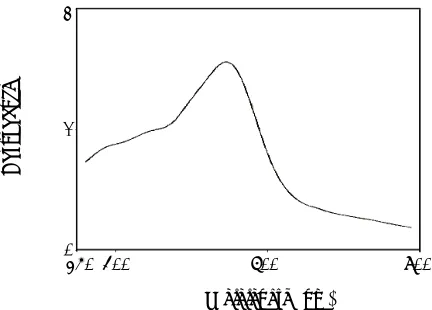
blank at the maximum absorbance for the complex (552 nm) is shown in Fig. 1.
Stability of dithizone
Dithizone has a poor stability in most solvents and thus the solution should be prepared freshly before each analysis and this may be considered as a disadvantage for the method. We used THF as solvent for preparing solution of dithizone. The changes in the absorption spectrum of a 5×10⁻⁶ M solution of dithizone in THF
with time is shown in Fig. 2. The solution seems to be reasonably stable over a period of 60 min in the condition of laboratory. We also investigated the stability of dithizone in the condition that the solutions were kept in refrigerator. The investigation showed that in this condition dithizone is stable for at least 4 weeks and there is no need to prepare it freshly.
Effect of sulfuric acid concentration on extraction recovery of Cu(II)
Cloud point extraction of copper(II) dithizonate was performed in acidic condition such as H2SO4 and HNO3.
Results showed dithizone is stable in the presence of H2SO4 while the presence of strong oxidizing acids such
as HNO3 could decompose dithizone. Cloud point
extraction of copper was studied in different concen-trations, from 0.001 to 1.5 mol l-1 of sulfuric acid. Results
(Fig. 3) indicate that for sulfuric acid concentrations below 1 mol l-1, recovery of copper is close to 100%.
However, with sulfuric acid concentrations over 1 mol l-1,
the surfactant rich phase can not be separated from the aqueous solution. Hence a concentration of 0.2 mol l-1
H2SO4 was chosen for subsequent experiments.
Effect of dithizone concentration on extraction of Cu(II) The extraction recovery as a function of the dithizone concentration is shown in Fig. 4. For this study, 10 ml of a solution containing 200 ng ml-1 Cu(II) in 0.08%
(V/V) Triton X-114 and 0.2 mol l-1 sulfuric acid plus
various amounts of dithizone were subjected to the cloud point preconcentration process. For this copper concentration, ~100% extraction of Cu(II) is achieved above a dithizone concentration of 8×10⁻⁶ mol l-1. A
concentration of 1×10⁻⁵ mol l-1 dithizonewas chosen for
subsequent experiments.
Fig. 1: The absorption spectrum of copper (II) dithizonate in the final extracted and diluted phase.
Fig. 2: Change in the absorption spectrum of 5×10⁻⁶ mol l-1
solution of dithizone in THF with time. a = 0, b = 15, c = 30, d = 45, and e = 60 min.
Fig. 3: Effect of sulfuric acid concentration on the extraction
recovery of copper(II). Conditions: 200 ng ml-1 Cu(II), 0.08%
(V/V) Triton X-114, 1×10⁻⁵ mol l-1 dithizone.
120
100
80
60
40
20
0
Extraction reco
very
(%
)
0.001 0.01 0.1 1 10 Sulfuric acid concentration (mol 1-1) 2
1
0
Ab
so
rb
an
ce
350 400 600 800
Welelength (nm)
2
1
0
Ab
so
rb
an
ce
350 400 600 800
Fig. 4: Effect of Dithizone concentration on the extraction
recovery of copper(II). Conditions: 200 ng ml-1 Cu(II), 0.08%
(V/V) Traiton X-114, 0.2 M sulfuric acid.
Effect of Triton X-114 concentration on extraction recovery of Cu(II)
Triton X-114 was chosen for the formation of the surfactant rich phase. The low cloud point temperature and high density of the surfactant rich phase, facilitates phase separation by centrifugation.Fig. 5 highlights the effect of the surfactant concentration in the range of 0.02 - 0.1% (V/V) on the extraction recovery. Triton X-114 was found to quantitatively extract the Cu-dithizone complex from aqueous sample at surfactant concentrations above 0.04%, using a single step extraction procedure. A concentration of 0.08% Triton X-114 was chosen for subsequent experiments.
Selection of the dilution agent for the surfactant rich phase
Different solvents such as methanol, ethanol and THF were tried to select among them the one that can completely dissolve the surfactant rich phase and the extracted materials (complex of copper and excess of dithizone) and give the best sensitivity. The best results were obtained with the use of THF, therefore, it was chosen as the diluent for further experiments.
Effect of equilibration temperature and time
It is desirable to have the shortest incubation time and the lowest possible equilibration temperature, which com-promisecompletionofthereaction and efficient separation
Fig. 5: Effect of Triton X-114 concentration on the extraction
recovery of copper (II). Conditions: 200 ng ml-1 Cu(II), 1×10⁻⁵
mol 1-1 dithizone, 0.2 M sulfuric acid.
ofthephases.Thevariationof the extraction recovery with the temperature was studied in the range of 25 – 90 ˚C. The results showed excellent recovery for equilibration temperaturefrom40to70˚C.Thedependence of extraction efficiency upon incubation time was also studied in the range of 5-20 min. An incubation time of 10minwas optimal for quantitative extraction of copper(II).
Selectivity of the method for copper
Dithizone is known to be fairly selective for copper at pH< 1, and only palladium, platinum, gold, mercury and silver can be extracted with copper in acidic solution [23]. The concentration of palladium, platinum, gold, mercury and silver is usually very low in most biological samples and thus they have no interference in the extraction and determination of copper.
Characteristics of the method
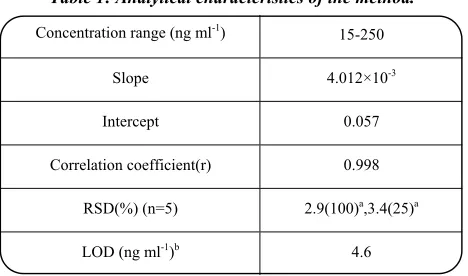
Table 1 shows the analytical characteristics of the method. In the optimum experimental conditions, the calibration curve for copper was linear from 15 to 250 ng ml-1 and the limit of detection was sufficiently low.
Further improvement is also feasible, either by precon-centrating larger amounts of the sample solution or diluting the surfactant rich phase to a smaller volume of the THF solution.
APPLICATION
In order to confirm the usefulness of this proposed 120
100
80
60
40
20
0
Extraction reco
very
(%
)
0 2 4 6 8 10 12 14 16
Dithizone concentration (10-6 mol 1-1)
120
100
80
60
40
20
0
Extraction reco
very
(%
)
0.02 0.04 0.06 0.08 0.1 0.12
Table 1: Analytical characteristics of the method.
Concentration range (ng ml-1)
15-250
Slope 4.012×10⁻³
Intercept 0.057
Correlation coefficient(r) 0.998
RSD(%) (n=5) 2.9(100)a,3.4(25)a
LOD (ng ml-1)b 4.6
a) Values in parentheses are the copperconcentrations(ngml-1)
for which the RSD was obtained.
b) Limit of detection. Calculated as three times the standard deviation(3σ) of the blank signal.
Table 2:Determination of copper in some cow liver samples.
Sample Cu (µg g-1)b
Proposed method a AAS a
A 52.3±2.5 53.8±0.8
B 80.5±3.4 79.1±1.1
C 65.0±2.8 63.5±0.9
a) Mean of three experiment ± standard deviation. b) Concentration in dried liver sample.
method, it was applied for the determination of copper in some liver samples. The results in Table 2 show that the proposed method can be successfully applied to the determination of copper in biological samples. The results of analyses by the developed method were found to be in good agreement with those obtained by AAS.
CONCLUSIONS
The combined advantages of the cloud point methodology and the selectivity of the dithizone as a ligand for Cu(II) in acidic conditions were utilized for spectrophotometric determination of copper in liver samples. The method is simple, clean, safe, inexpensive, selective and sensitive. It can be used as an alternative to other analytical methods for the determination of copper in the biological samples. The method gives a good limit of detection and solvent-free extraction of the element from its initial matrix following a single step extraction procedure without any interferences.
Received : 17th February 2004 ; Accepted : 26th April 2005
REFERENCES
[1] Ahmed, M.J., Jahan I., Banoo, S., Anal. Sci., 18, 805 (2002).
[2] Richter, P., Toral, M.I., Tapia, A.E., Fuenzalida, E., Analyst, 122, 1045 (1997).
[3] Toral, M.I., Richter, P., Rodriguez, C. , Talanta 45, 147 (1997).
[4] Yamini, Y., Tamaddon, A., Talanta, 49, 119 (1999). [5] Shamsipur, M., Avanes, A., Rofouei, M.K., Sharghi,
H., Aghapour, G., Talanta, 54, 863 (2001).
[6] Sombra, L., Luconi, M., Fernanda Silva, M., Olsina, R.A., Fernandez, L., Analyst, 126, 1172 (2001). [7] Dalmon, O., Tufekci, M., Nohut, S., Guner, S.,
Karabocek, S., J. Pharm. Biomed. Anal., 27, 183 (2002).
[8] Manzoori, J. L., Karim-Nezhad, G., Anal. Sci., 19, 579 (2003).
[9] Manzoori, J.L., Karim-Nezhad, G., Anal. Chim. Acta,
484, 155 (2003).
[10] Manzoori, J.L., Bavili-Tabrizi, A., Anal. Chim. Acta,
470, 215 (2002).
[11] Manzoori, J.L., Bavili-Tabrizi, A., Microchim. Acta,
141, 201 (2003).
[12] Silva, M.F., Fernandez, L., Olsina, R.A., Stacchiola, D., Anal. Chim. Acta., 342, 229 (1997).
[13] Silva, M.F., Fernandez, L.P., Olsina, R.A., Analyst,
123, 1803 (1998).
[14] Fernandez, A. E., Ferrera, Z. S., Rodrinuez, J. J. S., Analyst, 124, 487 (1999).
[15] Carabias - Martinez, R., Rodriguez - Gonzalo, E., Dominguez - Alvarez, J., Hernandez - Mendez, J., Anal. Chem., 71, 2468 (1999).
[16] Laespada, M. E. F., Pavon, J. L. P., Cordero, B. M., Analyst, 118, 209 (1993).
[17] Igarashi, S., Endo, K., Anal. Chim. Acta, 320, 133 (1996).
[18] Oliveros, M. C. C., Jimenez de Blas, O., Pavon, J.L.P., Cordero, B.M., J.Anal.At. Spectrom., 13, 547 (1998).
[19] Mesquita da Silva, M.A., Frescura, V.L.A., Nome Aguilera, F.J., Curtius, A.J., J. Anal. At. Spectrom.,
13, 1369 (1998).
[21] Watanabe, H., Saitoh, T., Kamidate, T., Haraguchi, H., Mikrochim. Acta, 106, 83 (1992).
[22] Wang, C.H., Martin, D.F., Martin, B.B., J. Environ. Sci. Health A, 31,1101 (1996).
[23] Fiedler, H. D., Westrup, J.L., Souza, A.J., Pavei, A.D., Chagas, C.U., Nome, F., Talanta, 64, 190 (2004).
[24] Singh, H.B., Kumar, B., Sharma, R.L., Analyst, 114, 853 (1989).