43
Prashant Tiwari
Assistant Professor, Institute of Business Management, GLA University, Mathura Email: [email protected]
Shiv Kant Tiwari
Assistant Professor, Institute of Business Management, GLA University, Mathura Email: [email protected]
Trilok Pratap Singh
Assistant Professor, Institute of Business Management, GLA University, Mathura Email: [email protected]
ABSTRACT
The words “Electronic Commerce” and “Internet marketing” are now normally used by business houses and consumers around the world as markets are recognizing the available opportunities for exchange function in the on-line business environment (Karakaya and Charlton, 2001). With the rapid change in the |information technology, the frequency of human–computer interactions increases, which regards trust as an important factor between users and websites (Johnson, Bardhi & Dunn, 2008). Ajzen (1988) divided trust in technology into trusting beliefs and trusting intentions. This increasing frequency of human – computer interaction has paved the way for the banking industry to provide services to the banking customers online but also banks has to ensure about the expected quality of services can be delivered or not. According to Internet World Stats, India has occupied the third largest country in number of internet users around the world following China and USA on first and second positions despite having a less internet penetration rate as low as 8.5 percent. In the previous literature, it has been observed that retaining customers in online service is very difficult. Therefore, this research study aims at understanding the services quality factors and their effect on the satisfaction of customers in case of e-banking.
Keywords: E- Service quality, customer satisfaction, E-banking services 1. INTRODUCTION
44
different electronic and online channels that are acting as a substitute for traditional brick-and-mortar branch networks (Suoranta and Mattila, 2004).
With the introduction of latest technology and technological advancements in every field, internet has become the root for every business and other practices of business firms, delivery of service quality through electronic route for online trade becomes very vital issues for business houses dealing in service industry.
As technology changes the competitive scenario and the environment of the financial services industry, innovations in telecommunications are playing a significant role in the banking industry. Over the last few decades, and with the growth of e- banking in the upfront of banking industry, banks and financial institutions have paved the way into the next technological frontier: mobile access (Mallat et al., 2004).
The internet banking has changed the entire perspective the way world should see it. Now a days, it has been regarded as “need to have“ rather than “nice to have” service. E-banking, therefore now has become an integral part for the developed and developing economy because of its capacity to provide cheapest services to the customers of banks. Not only these services are cost effective and result oriented but also provides a greater sense of satisfaction to customers in time saving and ease of use.
2. LITERATURE REVIEW
Technological advancements in the banking industry has been a principal source of competitiveness among the various banks and financial institutions. The use of technology has opened the ways for the banks to reduce their costs and achieve higher productivity and efficient customer relationships(Lee, Kwon and Schumann, 2005).Majority of the banks providing services around the world in developed and developing countries are using internet banking to cater to the needs and services of their customers. Yang (2001) and Zeithaml(2002), suggested that online services greatly affects the banks and customers relationship as far as customers trust is positive towards banks, therefore the banks should pay more attention on these-service parameters.
45
banks. One of the important feature of online banking is not only that it provides services from anywhere but also minimizes and reduces the idle time of customers that is one of the dominating way in the traditional banking system where customers has to wait rigorously in queue.(Milne and Boza, 1999) commented and state one of the basic problem of going online in case of banking is that customers lacks face to face communications, which sometimes in turns the customers to develop a mistrust in banking and customer relationship.
Due to the speedy expansion of Internet banking services, various researches have been conducted for measuring the impact of internet banking service quality in the banks in India. Internet banking has opened various opportunities for the banks as well as for the customers to use the banking facilities and services timely and cost effectively. The era of e banking in India has started with the use of ATM (Automatic Teller Machines) (Titrade Cristina and et al., 2008). E banking is also referred to as Internet banking, virtual banking or online banking (Mobarek, 2007). Internet Banking has seen the very rapid growth in the last decade in a growing economy like India. Therefore, it has paved the way for many researchers focusing on conceptualizing, measuring and studying the internet banking service quality.
As explained by Lewis and Booms (1983), service quality as “a measure of how well a delivered service matches the customers’ expectations” .In other words, it refers to the difference of customer’s perception of what product will provide and the actual delivery. Various researchers have identified various dimensions for measuring service quality in banks. Johnston (1995) talked about various dimensions and again Johnston (1997) has verified and given that online customers consider reliability and trust/security the dominating factors, and responsiveness, communications and competencies behind them.
Many of the researches has identified that the various quality dimensions in physical/ traditional banking are not prominent in e service quality for banking. Keeping online banking as a delivery channel of banking service, service quality dimension such as cleanliness or physical appeal or interiors of the bank may have negligible applicability for online banking users. Zeithaml et al., (2000) proposed 11 factors to measure e-service quality and Yang et al., (2004) proposed 6 e-service quality parameters. Parasuraman et al., (2005) later on, came up with ES-QUAL consisting of 4 factors used for measuring e service quality including with 22 items.
46
providers. Incase of online services , there is no personal touch and interaction between the service provider and consumer, therefore , this lack in personal commitment too. A satisfied customer may be regarded as an unpaid brand ambassador. But on the contrary, if the service delivered by the organization fall below of expectation, then customers remain dissatisfied and may be a great threat to the positive word of mouth publicity (Zeithaml, Berry, & Parasuraman, 1996). Satisfaction level of customer is an evaluation that is formed by comparing the actual services taken delivered and expected level of services (Oliver, 1980).
In banking, which is always regarded as a relationship of trust and personalization, the deficiency of personal touch with the bankers, paved the requirement to understand the importance of technology and service quality for the satisfaction of the customers. Therefore, Bankers should have the information on how to retain their customers and ultimately how to make customers aware of the satisfaction level and finally converting them to satisfied customer, specifically in terms of online service quality, and in internet banking, satisfaction of customers should be treated on priority. “Customer satisfaction is a collective outcome of perception, evaluation and psychological reactions to the consumption experience with a product/service” (Saha and Zoha, 2005).
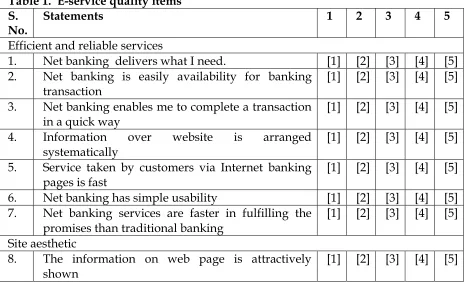
Table 1. E-service quality items S.
No.
Statements 1 2 3 4 5
Efficient and reliable services
1. Net banking delivers what I need. [1] [2] [3] [4] [5] 2. Net banking is easily availability for banking
transaction [1] [2] [3] [4] [5]
3. Net banking enables me to complete a transaction in a quick way
[1] [2] [3] [4] [5] 4. Information over website is arranged
systematically [1] [2] [3] [4] [5]
5. Service taken by customers via Internet banking pages is fast
[1] [2] [3] [4] [5] 6. Net banking has simple usability [1] [2] [3] [4] [5] 7. Net banking services are faster in fulfilling the
promises than traditional banking [1] [2] [3] [4] [5] Site aesthetic
8. The information on web page is attractively shown
47
3. OBJECTIVES OF THE STUDY
In the previous literature, it has been observed that retaining customers in online service is very difficult. Therefore, this research study aims at understanding the services quality factors and their effect on the satisfaction of customers in case of e-banking .
9. The available information on webpage is well organized
[1] [2] [3] [4] [5] 10. The info on the webpage is easy in understanding [1] [2] [3] [4] [5] 11. The e-banking website, its layout and colors are
visually pleasing [1] [2] [3] [4] [5]
Responsiveness
12. Net banking provides me with quick responses [1] [2] [3] [4] [5] 13. Net banking website handles customers request
quickly. [1] [2] [3] [4] [5]
14. Net banking Quickly resolves online transaction
problems [1] [2] [3] [4] [5]
15. Net banking provides suggestions incase of errors
and unprocessed transactions [1] [2] [3] [4] [5] 16. Net banking provides solutions to my problems
promptly. [1] [2] [3] [4] [5]
Fulfillment
17. Arrangement of Internet banking services are easy to follow
[1] [2] [3] [4] [5] 18. the services being delivered are exactly the ones
which are promised [1] [2] [3] [4] [5]
19. Net banking portion of website works smoothly [1] [2] [3] [4] [5] 20. Internet banking transactions are always accurate [1] [2] [3] [4] [5] 21. Net banking quickly processes what I request. [1] [2] [3] [4] [5] Security/ trust
22. No disclosure of Customers personal Information [1] [2] [3] [4] [5] 23. Feel safe in internet banking transactions [1] [2] [3] [4] [5] 24. I am having confidence in the e-banking service [1] [2] [3] [4] [5] Satisfaction
25. I am delighted with my online banking services [1] [2] [3] [4] [5] 26. Transacting online is a enjoyable experience [1] [2] [3] [4] [5] 27. Net banking services are enjoyable [1] [2] [3] [4] [5] 28. Overall, net banking services provides me high
48
4. RESEARCH METHODOLOGY
A survey method has been largely used to collect fresh data from the suitable population (Cooper and Schindler, 2013). We investigated the past researches to identify valid measures for this study and adapted prominent existing scales to understand the effect of e-service quality dimensions. With the aim to attain the objectives of this study, fresh data is collected using the questionnaires consisting : Part -1 of the questions including Demographics and e- banking usage services. Parts- 2 of the questionnaire included noticeable variables i.e. efficient and reliable services, site aesthetic, responsiveness, fulfillment, security and satisfaction which again sub- divided into 28 statements which directly related to e-service quality and satisfaction level. Respondents responses has been collected with the help of 5 point Likert scale. The samples were taken for the study and included 100 customers who use internet banking belonging to various banks of Mathura region. The samples collected were selected by using Convenience sampling technique wherein these respondents were selected from the population of the different age groups included in population.
5. DATA ANALYSIS AND INTERPRETATION
Primary data was taken from 100 respondents. Out of 100, 10 questions were not taken for the purpose of the study. 90 percent was the response rate used in this study. The incomplete and inaccurate replies are dismissed to have better proximity values in results. After collecting the raw data, the reliability of the questionnaire is measured and verified by using Cronbach's alpha. In order to find out the objectives, factor analysis technique is applied using SPSS 19.0
Table- 2. Factor Loading and Reliability test for study’s variables
S.
No. Statements
Factor Loadin g
Cronb ach’s Alpha Efficient and reliable services
1. Net banking delivers what I need. 0.709 0.889 2. Net banking is easily availability for banking transaction 0.805
3. Net banking enables me to complete a transaction in a
quick way 0.885
4. Information over website is arranged systematically 0.787 5. Service taken by customers via Internet banking pages is
fast
49
7. Net banking services are faster in fulfilling the promises
than traditional banking 0.885
Site aesthetic
8. The information on web page is attractively shown 0.821 0.722 9. The available information on webpage is well organized 0.759
10. The info on the webpage is easy in understanding 0.673 11. The e-banking website, its layout and colors are visually
pleasing 0.764
Responsiveness
12. Net banking provides me with quick responses 0.681 0.772 13. Net banking website handles customers request quickly. 0.781
14. Net banking Quickly resolves online transaction
problems 0.785
15. Net banking provides suggestions incase of errors and
unprocessed transactions 0.678
16. Net banking provides solutions to my problems
promptly. 0.634
Fulfillment
17. Arrangement of Internet banking services are easy to
follow 0.887 0.695
18. the services being delivered are exactly the ones which
are promised 0.881
19. Net banking portion of website works smoothly 0.776 20. Internet banking transactions are always accurate 0.692 21. Net banking quickly processes what I request. 0.743 Security
22. No disclosure of Customers personal Information 0.691 0.878 23. Feel safe in internet banking transactions 0.725
24. I am having confidence in the e-banking service 0.781 Satisfaction
25. I am delighted with my online banking services 0.887 0.886 26. Transacting online is a enjoyable experience 0.766
27. Net banking services are enjoyable 0.735 28. Overall, net banking services provides me high sense of
satisfaction. 0.805
50 Table 3: Model Description
Model R R Square Adjusted
R Square Std Error of Estimate
1 .678a 0.523 0.316 0.22180
Table 8 is Y = 1.365 + 0.23X is defined by Regression Linear equation which shows, the influence by various other factors.
Table 4: Model Summary Model Unstandardized
Coefficients Standardized Coefficients T Sig. 5% Confidence Interval (Constant a)
X B Std Error. Beta -0.05
5
3.022
1.365
0.230 0.655 0.211 0.534 2.011 2.122 0.044 0.051 0.021 0.811
a. Dependent Variable: Y
6. DISCUSSION
EFA (exploratory factor analysis) technique was applied on the various E-service quality dimensions. The measurement and analysis of the instrument was carry on the raw data from the replies of the respondents showed a 2-factor solution. The 2-factor solutions explained 68.4% of variance. Also, Procedures of principal component and varimax were taken to conclude the dimension of orthogonal factor. The criterion of 1.0 was apply in order to get the factor extraction whereas loadings of 0.40 were applied for item inclusion (Hair et al., 1995). To measure the effect of independent variable to the dependent variable, x (e-service quality) on y (customer satisfaction), Determination Co-efficient is used. The result of this study depicts that the e- service quality has affected 53.4% on the customer satisfaction, while the remaining 46.6 remained unaffected. The links between e-service quality factors and their effects on customer satisfaction are commendable for more depth reflection (Rod et al., 2009). Also, a greater in depth factors can also be studied for further investigation in order for banks to understand the effects and usability more effectively (Patsiotis et al., 2012).
7. CONCLUSION
51
The study has shown that the two factors security/trust and efficient and reliable services has been the factors which respondents have felt the most important one. Besides these factors, other factors like site aesthetics, responsiveness and fulfillment also affected the customers satisfaction in online banking. Hence, we can conclude that service quality has significant impact on the satisfaction of online user in e-banking services.
References
Acharya, R., Kagan, A., Lingam, S., & Gray, K. (2011). Impact Of Website Usability On Performance: A Heuristic Evaluation Of Community Bank Homepage Implementation. Journal Of Business & Economics Research (JBER), 6(6). http://dx.doi.org/10.19030/jber.v6i6.2439
Ajzen, I. (1991). The theory of planned behavior. Organizational Behavior And Human Decision Processes, 50(2), 179-211. http://dx.doi.org/10.1016/0749-5978(91)90020-t
Boehm, M. (2008). Determining the impact of internet channel use on a customer's lifetime. Journal Of Interactive Marketing, 22(3), 2-22. http://dx.doi.org/10.1002/dir.20114
Cristina, T., Beatrice, C., & Florentina, P. (2008). E-Banking–Impact, Risks, Security. ANALELE UNIVERSITĂŢII DIN ORADEA, 1532.
Johnson, D., Bardhi, F., & Dunn, D. (2008). Understanding how technology paradoxes affect customer satisfaction with self-service technology: The role of performance ambiguity and trust in technology. Psychology And Marketing, 25(5), 416-443. http://dx.doi.org/10.1002/mar.20218
Johnston, R. (1995). The determinants of service quality: satisfiers and dissatisfiers. International Journal Of Service Industry Management, 6(5), 53-71. http://dx.doi.org/10.1108/09564239510101536
Karakaya, F., & Charlton, E. (2001). Electronic commerce: current and future practices. Managerial Finance, 27(7), 42-53. http://dx.doi.org/10.1108/03074350110767286
Lee, E. J., Kwon, K. N., & Schumann, D. W. (2005). Segmenting the non-adopter category in the diffusion of internet banking. International Journal of Bank Marketing, 23(5), 414-437.
Lewis, R. C., & Booms, B. H. (1983). The marketing aspects of service quality. Emerging perspectives on services marketing, 65(4), 99-107.
Mallat, N., Rossi, M., & Tuunainen, V. (2004). Mobile banking services. Communications Of The ACM, 47(5), 42. http://dx.doi.org/10.1145/986213.986236
52
Mobarek, A. E-Banking Practices and Customer Satisfaction - A Case Study
in Botswana. SSRN Electronic Journal.
http://dx.doi.org/10.2139/ssrn.1011112
Oliver, R. (1980). A Cognitive Model of the Antecedents and Consequences of Satisfaction Decisions. Journal Of Marketing Research, 17(4), 460. http://dx.doi.org/10.2307/3150499
Parasuraman, A., Zeithaml, V., & Berry, L. (1985). A Conceptual Model of Service Quality and Its Implications for Future Research. Journal Of Marketing, 49(4), 41. http://dx.doi.org/10.2307/1251430
Parasuraman, A., Zeithaml, V., & Malhotra, A. (2005). E-S-QUAL. Journal Of Service Research, 7(3), 213-233. http://dx.doi.org/10.1177/1094670504271156
Patsiotis, A., Hughes, T., & Webber, D. (2012). Adopters and non‐adopters of internet banking: a segmentation study. International Journal Of Bank Marketing, 30(1), 20-42. http://dx.doi.org/10.1108/02652321211195686 Rod, M., Ashill, N., Shao, J., & Carruthers, J. (2009). An examination of the
relationship between service quality dimensions, overall internet banking service quality and customer satisfaction. Marketing Intelligence & Planning, 27(1), 103-126. http://dx.doi.org/10.1108/02634500910928344 Saha, P., & Zhao, Y. (2005). Relationship between online service quality and
customer satisfaction: a study in internet banking.
Suoranta, M., & Mattila, M. (2004). Mobile banking and consumer behaviour: New insights into the diffusion pattern. Journal Of Financial Services Marketing, 8(4), 354-366. http://dx.doi.org/10.1057/palgrave.fsm.4770132
Yang, Z. (2001, May). Consumer perceptions of service quality in Internet-based electronic commerce. In Proceedings of the EMAC Conference (Vol. 811).
Yang, Z., & Jun, M. (2002). Consumer perception of e-service quality: from internet purchaser and non-purchaser perspectives. Journal of Business strategies, 19(1), 19.
Zeithaml, V., Berry, L., & Parasuraman, A. (1996). The Behavioral Consequences of Service Quality. Journal Of Marketing, 60(2), 31. http://dx.doi.org/10.2307/1251929
Zeithaml, V. A., Parasuraman, A., & Malhotra, A. (2000). Conceptual Framework for understanding e-service quality: Implications for future research and managerial practice.