Injuries
from
Fireworks
Lawrence R. Berger, MD, MPH, Summers Kalishman, BA, and Frederick P. Rivara, MD, MPH
From the Department of Pediatrics, University of New Mexico, Albuquerque, and Departments of Community Medicine and Pediatrics, University of Tennessee, Memphis
ABSTRACT. In 1983, there were more than 8,200 victims
of fireworks-related injuries treated in US emergency
rooms. Half of those injured were children less than 15
years of age, and 1 1 % of the injuries resulted in hospital-ization. The eyes are the body part most often injured,
followed by hands and fingers. Burns account for the
majority of injuries. Every type of fireworks legally avail-able has resulted in serious injury or death. Firecrackers, bottle rockets, and sparklers contribute to the most hos-pitalizations. States that allow a wide variety of fireworks to be sold for personal use have a rate of fireworks-related fires 50 times greater than states that strictly limit the availability of fireworks. The rate of fireworks-related
injuries is more than seven times greater in the less
restrictive states. Pediatrics 1985;75:877-882; fireworks,
childhood injuries, accidents.
More than 8,200 victims of fireworks-related
in-juries were treated in US emergency rooms in 1983.
Half of those injured were children less than 15
years of age, and 11% of the injuries resulted in
hospitalization.’ Despite these statistics, to our
knowledge there has been no previous review of the fireworks problem in the pediatric literature.
BACKGROUND
Fireworks are defined as devices “designed for
the purpose of producing a visible or audible effect by combustion, deflagration or detonation.”2 Under the Child Protection Act of 1966, the federal
gov-ernment imposed a ban on large, exploding
fire-works containing more than 130 mg (2 grains) of
explosive material. Mail-order kits to build such
fireworks were also banned.3
Received for publication April 23, 1984; accepted Aug 2, 1984. Reprint requests to (L.R.B.) Department of Pediatrics, Sarge
Building, University of New Mexico School of Medicine,
Albu-querque, NM 87131.
PEDIATRICS (ISSN 0031 4005). Copyright © 1985 by the American Academy of Pediatrics.
The US Consumer Product Safety Commission
(CPSC) was given responsibility for regulating
fine-works under the Federal Hazardous Substances
Act. In 1973, the National Society for the
Preven-tion of Blindness (NSPB) proposed to the CPSC a
total ban on the sale of fireworks for personal use.
Their proposal was supported by the American
Academy of Pediatrics, American Public Health
Association, Fire Marshals Association of North
America, National Fire Protection Association, and
other groups. In response, the Commission enacted in 1974 a temporary ban on all fireworks and bottle
rockets. The ban was rescinded in the same year.
After further review, the CPSC issued a final set of regulations which became effective on Dec 6, 1976.
Under the 1976 regulations, which remain in
force, any firecracker containing more than 50 mg
(0.77 grains) of explosive material is banned. Aerial
devices, such as skyrockets and shells, may still
contain up to 130 mg of charge. Other regulations
prohibit the use of the more poisonous or highly
reactive chemicals; set standards for fuses, tube
strength, and sticks for rockets; establish base
di-mensions for standing fireworks (such as cones and
fountains); and provide other specifications to re-duce product malfunction.
Fireworks are classified by the CPSC as follows:
Class B devices, which include cherry bombs,
M-80s, and large firecrackers, are banned. Allowable
“class C” devices include fountains and California
candles (which emit showers of sparks); Roman
candles (which shoot out a series of flaming balls); rockets with sticks; and helicopter- and missile-type rockets; sparklers; smoke devices; and miscel-laneous other types (Fig 1). The class C fireworks
were allowed for sale because the CPSC believed
that quality control and mandatory labeling
re-quirements would provide adequate protection of
the public.
State laws govern the sale and use of class C or
Sky Rocket Bottle Roman Missile Spike Cone
withStick Rocket Candle Rocket Fountain Fountain
Fig 1. Major types of fireworks.
‘I, 4)
.c
U
C
ban on the sale and use of common fireworks. Ten states allow the sale and use of all class C fireworks
or have no statewide fireworks control laws. The
remaining states allow some, but not all, class C
fireworks.
FIREWORKS-RELATED INJURIES
Estimates of fireworks-related injuries are made
by the CPSC based on their National Electronic
Injury Surveillance System (NEISS). The system involves a statistical sample of 73 emergency rooms located throughout the country. Personnel in these
hospitals encode consumer-product-related
inju-ries, including sociodemographic characteristics of the victims, circumstances and nature of injuries, and category of product involved. The estimated numbers of fireworks-related injuries treated in US
emergency rooms based on NEISS data are shown
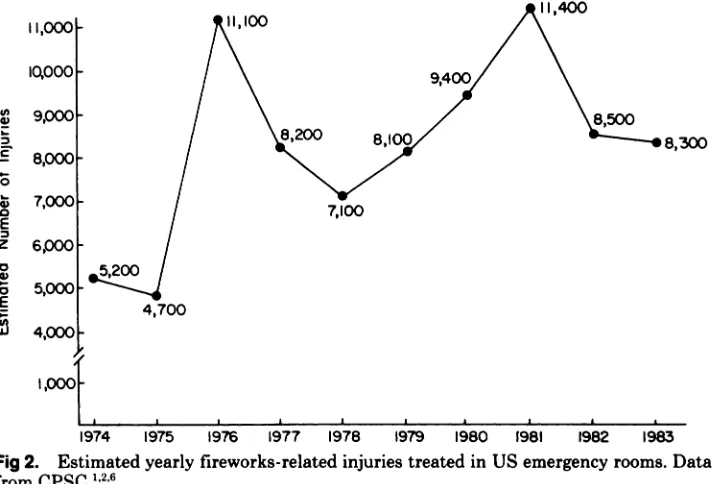
in Fig 21,26 The dramatic increase in 1976 was
clearly an undesirable by-product of the Bicenten-nial celebrations. Because only about 40% of inju-nies are treated in emergency rooms,7 one can esti-mate that overall there were approximately 21,000 victims of fireworks-related injuries in 1983.
The characteristics of the injury victims are pre-sented in Table 1. Half of the injuries occurred in children less than 15 years of age. The eyes are the
body part most often injured, with hands and
fin-gers second. Burns account for 59% of all injuries.’
CIRCUMSTANCES OF INJURY
In 1981, the most common types of fireworks
causing injuries were firecrackers (more than 60% ofwhich were small, class C), followed by sparklers, bottle rockets, Roman candles, and cone or base fountains.6 An in-depth investigation of 175
fire-works-related injuries in 1973 revealed that injuries ranged from burned fingers to death.8 Class C
(a!-lowable, “safe and sane”) fireworks caused 116 of
the 175 injuries. Firecrackers, bottle rockets, and sparklers contributed to the most hospitalizations. Bottle rocket injuries primarily involved the eyes. Serious injuries from sparklers were always burns,
usually to preteenage children, and most often
be-cause their clothing ignited (spark!ers can reach
temperatures of more than 537.8#{176}C [1,000#{176}F]). Descriptions of individual incidents from the in-depth investigation reveal why fireworks are so dangerous to children. A 10-year-old boy suffered
third-degree burns over 25% of his body when he
dropped a small firecracker into a can of lantern
fluid. Another boy had third-degree burns to his
fingers after he emptied the powder from four or
five firecrackers, then lit the material causing an explosion. An 11-year-old boy suffered burns to his eye when a firecracker he lit did not ignite until he returned to examine it, at which time it exploded. A 7-year-old girl suffered second-degree burns to her body after playing with a sparkler that ignited her nightgown.
The frequency of eye injuries has made fireworks
a major concern for the National Society for the
Prevention of Blindness. The Texas affiliate of the National Society for the Prevention of Blindness
surveyed that state’s ophthalmologists in 1977.
Sixty of them reported having treated 106 eye
in-juries related to fireworks. More than half of the
injuries were caused by bottle rockets, and 57% of
these resulted in either impaired or total loss of
vision. Bottle rockets and firecrackers were the
most common cause of eye injuries in a 1976 survey conducted in Arkansas.#{176}
In 4) C 0 4) .0 E
z
4) 0 E974 975 i#{232}76 977 978 979 1980 1981 982 1983
Fig 2. Estimated yearly fireworks-related injuries treated in US emergency rooms. Data from CPSC.”6
TABLE 1. Characteristics of Children with
Fireworks-Related Injuries (N = 8,544)*
Age 0-14 yr 15-24 yr >24 yr % 51 32 17 72 28 59 25 4 12 22 17 16 6 39 11,000 Ii,I00 1,400 IQ000 9,000 8,000 7,000 6,000 5,000 4,000 1,000
F
Sex Male Female Type of injuryBurn
Lacerations/contusions/abrasions Foreign body
Other
Body part involved Eye
Hand/finger Face
Other head and neck All other
* Data from US Consumer Product Safety Commission.’
been reported. Firecrackers were associated with
50% of all fireworks-related injuries during the 1981 holiday period.6 Sixty-three percent (2,200) of these injuries were associated with class C firecrackers.
Sparklers and bottle rockets accounted for 42% of
the injuries associated with other common
fire-works, the highest level of reported injuries from these devices since 1974.
EFFECTIVENESS OF RESTRICTIVE STATE FIREWORKS LAWS
One would expect that states prohibiting the sale
of all or most fireworks would have the fewest
injuries. Fireworks distributors have argued that
restrictive laws result in increased injuries because
they encourage use of more dangerous homemade
and illegal devices. To test this hypothesis, we
compared rates of fireworks events among states with different intensities of fireworks regulation. Injury data from the NEISS reports are not useful for this purpose because participating emergency rooms have been chosen to represent a national sample. They do not allow state-by-state
compari-sons. New Mexico, for example, is a state that
allows most class C fireworks but does not have a
single emergency room participating in the NEISS
system. The National Fire Protection Association, on the other hand, solicited fireworks information
from state fire marshals around the country. Only
the most severe injuries are reported to the
Na-tional Fire Protection Association, that is, those involving amputations, hospitalizations, or death. Figs 3 and 4 are based on the National Fire
Protec-tion Association data from 1977. They show that
the rate of fireworks-related fires was nearly 50
times greater in states allowing many class C
fire-works compared with rates in states having a ban
or only allowing the use of snakes and/or sparklers. The rate of fireworks-related injuries was more than seven times greater in the states that allowed a wide variety of class C fireworks.
To further explore this hypothesis, a computer
printout of deaths from homemade or illegal
fire-works was obtained from the CPSC. This file was
generated independently of the NEISS system. In
the years 1973 through 1980, 33 such deaths were
identified. Twenty-five of the deaths occurred in
23.4
Rate of Fires
Per Million Population
25.0
20.0
15.0
0.0
5.0
0.5
9.5
Rate of Injuries
Per Million Population
0.0
8.0
6.0
4.0
2.0
-0.C.
c- States with Ban or Snakes/Sparklers Only F 1 States Allowing Other Class C Fireworks
Fig 3. Rates of fireworks-related fires (1977) in states that have restrictive laws compared with states that allow wide variety of common fireworks.
t-N:-.N States with Ban or Snakes/Sparkiers Only
I IStates Allowing Other Class C Fireworks
Fig 4. Rates of fireworks-related injuries ( 1977) in states that have restrictive laws compared with states that allow wide variety of common fireworks.
whereas eight deaths occurred in states that ban all fireworks for personal use. This yields a death rate of 20 per million population v 1 1 per million in states that ban all fireworks for personal use.
Additional evidence for the effectiveness of
re-stnictive laws comes from an Arkansas survey on
ocular injuries resulting from fireworks.’0 Arkansas
has no statewide fireworks law. West Virginia and
Georgia regulate fireworks through the use of the
“Model Law,” a law designed in 1974 by the
Na-tional Fire Protection Association to prohibit the
sale or use of all class C fireworks. In 1980, the rate of ocular fireworks-related injuries in Arkansas
over the Fourth of July holiday was seven times
greater than in West Virginia and 3.5 times greater than in Georgia during the same time period.
When Washington State legalized the sale of small firecrackers, aerial devices, and other class C fireworks in 1982, there was a 126% increase in the
number of fireworks-related injuries treated in
emergency rooms over the Fourth of July holiday.7
CONCLUSION
In addition to the human costs, the economic
impact of fireworks is distinctly negative. In New Mexico in 1980, there was an estimated $250,000
in property damage and $60,000 in medical costs
spent in the treatment of children with fireworks-inflicted injuries. A 1982 survey in California re-ported a total dollar loss for fireworks-related fires alone of $1,431,000.”
Precautionary labeling and improved quality con-trol has not been an adequate approach to the prevention of injuries caused by fireworks. The
most frequent victims of fireworks, children less
than 15 years of age, cannot be expected to read
and follow label directions. Efforts by the fireworks
industry to educate children about the dangers of
fireworks are sometimes frighteningly counterpro-ductive (Fig 5).
The freedom to purchase explosive devices, in-cluding fireworks, is not one of the fundamental freedoms guaranteed by our Constitution.’2 There
are many safer ways of celebrating the Fourth of
July than exposing people to the dangers of the
personal use of fireworks.
The data provided in this report were not avail-able to the CPSC during the deliberations that led to the 1976 regulations. In view of the prevalence of fireworks-related injuries, especially among chil-dren, a reevaluation of existing standards is war-ranted. A nationwide ban on all fireworks for
per-sonal use would certainly be opposed by the same
interests that fought this proposal in the mid-1970s. A ban on all firecrackers and aerial devices, how-ever, is a compromise position that would lead to a noticeable reduction of injuries caused by fireworks. It is far easier to enforce a law that bans all fire-crackers and aerial devices than one that allows firecrackers of a specified length or explosive
com-position, or allows some classes of rockets and
candles but not others.
In the absence of an effort on the national level,
pediatricians can advocate similar restrictions in
ust
cVtt16’ O1VLYI#,4
CI.EAR A/7%.E4AWAY
PIWM ht5 4VD
8ull-D/bt;$
iVIVFR CARRY
pIR,woRj<s
/i4’ ‘Rr ae
sr
1h1 /1/MIPI.- OR
Oh4
ccwmiN,Rs
u&iir 0S4/LY O#/
I7MMA t/Ma
f#N MO’K B4C
tXJ/CK4YO.4c’F
FasE % /66/reD!-/Jw1w7’aI9EK5rMo
1w,t C4I(t
)WR t-4teg
Fig 5. Frames from fireworks industry information booklet for children entitled, “Enjoy
Fireworks Safely.” Last cartoon illustrates how to make a pipe bomb, while caption
informs readers who don’t understand fireworks directions to consult their dealer.
Nevada New Mexico Washington
sale and use of all class C
Mississippi Missouri South Dakota Tennessee
fireworks laws (except on county
Table 2. Detailed information on state and local
statutes can be obtained by contacting state fire
marshals.
Recommendations for counseling parents living
in areas that allow the sale of fireworks for personal use are summarized in Table 3#{149}14
TABLE 2. State Fireworks Regulations*
I. States that ban sale and use of all class C fireworks:
Arizona New Jersey
Connecticut New York
Delaware North Carolina
Georgia Ohio
Massachusetts Rhode Island
Minnesota Vermont
New Hampshire West Virginia
II. States that allow only sparklers and/or snakes: Colorado (sparklers)
Florida (sparklers) Illinois (sparklers)
Iowa (snakes and sparklers) Maine (sparklers)
Maryland (sparklers)
Oregon (snakes and sparklers) Pennsylvania (sparklers) Utah (sparklers)
Wisconsin (snakes and sparklers)
III. States that allow class C fireworks as specified by state law:
District of Columbia North Dakota
Idaho Oklahoma
Indiana South Carolina
Kentucky Texas
Michigan Virginia
Montana Wyoming
IV. States that allow class C fireworks as approved by enforcing authority of the state:
California Kansas Nebraska
V. States that allow the (ordinary) fireworks:
Alaska Alabama Arkansas
Louisiana
VI. States having no level):
Hawaii
* Data from National Fire Protection Association.5
C fireworks.’3 Information on injuries and costs
provided to the fire marshall in New Mexico in
1981 resulted in a statewide ban on bottle rockets.
A list of fireworks laws by states is provided in
TABLE 3. Recommendations to Parents Regarding
Personal Fireworks*
Do not allow younger children to play with fireworks under any circumstances. Remember that fireworks are not toys for children. The sparkler, considered by many the ideal “safe” fireworks for the young, burns at very high temperatures and can easily ignite cloth-ing. Children cannot appreciate the danger involved and cannot act correctly in case of an emergency. If you permit older children to use fireworks, be sure
they use them only under close adult supervision. Do not allow any running or horseplay while they are being used.
Before using any fireworks, read and follow all warning
instructions printed on the label.
Light fireworks outdoors in a clear area away from
houses and flammable materials (gasoline cans, etc).
Keep a bucket of water nearby for emergencies and for dousing fireworks that do not go off.
Do not try to relight or handle malfunctioning
fire-works. Soak them with water and throw away.
Be sure other people are out of range before lighting fireworks.
Never ignite fireworks in a container, especially a glass or metal container.
Store fireworks in a dry, cool place. Check instructions for special storage directions.
* Data from US Consumer Product Safety Commission.’4
ACKNOWLEDGMENT
This research was supported, in part, by grant no.
2-D28-PE-16012-05 from the Department of Health and
Human Services for Residency Training in General Pe-diatrics.
The authors are grateful to the Consumer Product
Safety Commission and the National Fire Protection
illus-trations; and to Ruth Schluter and Pug Burge for editorial assistance.
REFERENCES
1. Fireworks, SAS Estimates Report: NationalElectronic Injury Surveillance System Hazard Identification and Analysis. US
Consumer Product Safety Commission, National Injury In-formation Clearinghouse, 1982
2. Kale D, Harwood B: Fireworks Injuries: 1979-1980. US Consumer Product Safety Commission, Division of Program Analysis, 1980
3. Conkling JA: New federal standards for class C fireworks.
Fire May 1977, p 27
4. Rules and regulations 22931, part 1507: Fireworks devices.
Federal Register, 41(June 8):111
5. National Fire Protection Association: The 1984 Fire
Alma-nec. Quincy, MA, NFPA, 1983, pp 778-779
6. Kale D, Harwood B: Fireworks Injuries: 1981. US Consumer
Product Safety Commission, Division of Hazard Analysis,
Table 2
7. Kobayashi JM: Fireworks-related injuries. MMWR 1983;
35:285-286
8. Hazard Analysis of Fireworks Injuries. US Consumer
Prod-uct Safety Commission, Bureau of Epidemiology, 1973
9. Wilson RS: Fireworks blindness in Arkansas. J Arkansas Med Soc 1976;72:357-359
10. Wilson RS: Ocular fireworks injuries and blindness: An
analysis of 154 cases and a three-state survey comparing the effectiveness of model law regulation. Ophthalmology
1982;89:291-297
11. Fireworks incidents and injuries in California. Fire J 1983;77:70-73
12. Berger LR: Regulation versus individual liberties in injury
prevention: The case of motorcycle helmets, in Bergman AB (ed): Preventing Childhood Injuries (Ross Roundtable). Ross Laboratories, Columbus, OH, 1982
13. Berger LR: The pediatrician’s role in child advocacy. Adv
Pediatr 1982;29:273-291
14. Fireworks: Product safety fact sheet No. 12. US Consumer Product Safety Commission, 1980
CHANGING FACES
Feminist folklore has it that virtually all images of women in advertising are
sexist. Fear and loathing of the advertising industry has sometimes reached
such a pitch that no presentation of a woman in any television commercial
seems acceptable. The complaint has been that she is always a stereotype,
usually a dumb housewife, and if she is an executive then her very independence is some kind of turn-on. She is always beautiful, never plain or plump. But it’s
time
to
look again. Recently there have been some startling changes.A study of television commercials suggests that the old, hated housewife is definitely on the way out. She does not spend all day comparing her kitchen floor with those of her neighbours, discussing the whiteness of her wash, agonising over stains; or at least not often. She gets out of the house, and not just down to the supermarket. She jogs, plays tennis, studies, enjoys herself and is seen to get satisfaction out of life that does not depend upon the approval of her husband and children.
Submitted by Student
From Toynbee P: How the adman’s woman broke out of the kitchen and started living again.