I
NDIANA
H
EALTH
C
OVERAGE
P
ROGRAMS
P
RO VI DER
R
EFERENCE
M
O DULE
Transportation
Services
L I B R A R Y R E F E R E N C E N U M B E R : P R O M O D 0 0 0 5 0 P U B L I S H E D : F E B R U A R Y 2 5 , 2 0 1 6
P O L I C I E S A N D P R O C E D U R E S A S O F O C T O B E R 1 , 2 0 1 5 V E R S I O N : 1 . 0
Revision History
Version Date Reason for Revisions Completed By1.0 Policies and procedures current as of October 1, 2015
Published: February 25, 2016
Table of Contents
Introduction ... 1
Level of Service Rendered Versus Level of Response ... 1
Advanced Life Support (ALS) Ambulance Service ... 1
Basic Life Support (BLS) Ambulance Service ... 2
Commercial or Common Ambulatory Service (CAS) Transportation ... 2
Nonambulatory Service (NAS) Transportation (Wheelchair Van) ... 2
Member Copayments ... 3
Exemptions to Copayments for Transportation Services ... 3
Federal Guidelines Regarding Inability to Afford Copayment ... 4
Retroactive Eligibility ... 4
Definition of a Trip ... 4
Multiple Levels of Service for Same-Day Trips ... 5
Multiple Destinations ... 5
Twenty One-Way-Trip Limitation and Exemptions ... 5
Emergency Transportation Services ... 5
Hospital Admission or Discharge ... 6
Members on Renal Dialysis or Members Residing in Nursing Homes ... 6
Accompanying Parent or Attendant ... 6
Additional Attendant ... 7
Transportation Origin and Destination Modifiers ... 7
Mileage ... 7
Covered Mileage ... 7
Mileage Units and Rounding ... 8
Multiple Passengers ... 8
Accompanying Parent or Attendant ... 9
Additional Attendant ... 10
Waiting Time ... 10
Ambulance Transportation Services ... 11
Ambulance Mileage ... 12
Neonatal Ambulance Transportation ... 12
Pediatric and Neonatal Critical Care During Interfacility Transportation ... 12
Oxygen and Oxygen Supplies ... 12
Package C Ambulance Transportation ... 12
Rotary Air Ambulance Transportation ... 13
Prior Authorization for Rotary Air Ambulance Transportation ... 13
Medical Necessity for Rotary Air Ambulance Transportation ... 13
Special Circumstances ... 14
Base Rate and Mileage for Rotary Air Ambulance Transportation ... 15
Taxi Service ... 15
Prior Authorization for Transportation Services ... 15
Noncovered Transportation Services ... 16
Documentation Requirements for Transportation Services ... 17
Transportation Diagnosis Coding ... 18
MRT Reimbursement for Transportation ... 18
Transportation Code Sets by Provider Specialty ... 18
Common Carrier – Ambulatory ... 19
Common Carrier – Nonambulatory ... 19
Ambulance (ALS and BLS) ... 20
Air Ambulance ... 21
Taxi ... 21
Family Member ... 22
Transportation Services
Note: For policy information regarding coverage of transportation services, see theMedical Policy Manual at indianamedicaid.com.
Introduction
The Indiana Health Coverage Programs (IHCP) reimburses for transportation of members to or from an IHCP-covered service, subject to the guidelines and limitations described in this document.
Providers must enroll in the IHCP and obtain a separate provider number to bill transportation services. The Provider Enrollment module includes detailed information about IHCP enrollment and certification requirements and responsibilities for transportation providers. The IHCP may refer providers who fail to maintain the required documentation to the appropriate governing agencies.
All transportation services must be billed on the CMS-1500 claim form or 837P transaction. Specific billing information for transportation services is provided in this document. For general information about claim form submission and processing, see the Claim Submission and Processingmodule.
Note: The managed care entity (MCE) is responsible for transportation services for members enrolled in managed care programs, including Healthy Indiana Plan (HIP), Hoosier Care Connect, and Hoosier Healthwise. Providers must contact the appropriate MCE for more information about transportation guidelines. For MCE contact information, see the IHCP Quick Reference Guide available at indianamedicaid.com.
Level of Service Rendered Versus Level of Response
Providers must bill all transportation services according to the level of service rendered and not according to the provider’s level of response or vehicle type.
Advanced Life Support (ALS) Ambulance Service
Indiana Code IC 16-18-2-7 and the Indiana Emergency Medical Services Commission (EMSC) define advanced life support (ALS) as follows:
Care given at the scene of an accident, act of terrorism, or illness, care given during transport, or care given at the hospital by a paramedic, emergency medical technician-intermediate, and care that is more advanced than the care usually provided by an emergency medical technician or an emergency medical technician-basic advanced.
The term advanced life support may include any of the following acts of care:
Defibrillation
Endotracheal intubation
Parenteral injection of appropriate medications
Electrocardiogram interpretationThe IHCP provides reimbursement for medically necessary emergency and nonemergency ALS ambulance services when the level of service rendered meets the EMSC definition of ALS.
Note: In accordance with IC 16-31-3-1, vehicles and staff that provide emergency services must be certified by the EMSC to be eligible for reimbursement for transports involving either advanced life support (ALS) or basic life support (BLS) services.
Basic Life Support (BLS) Ambulance Service
IC 16-18-2-33.5 defines basic life support (BLS) as follows:
Assessment of emergency patients
Administration of oxygen
Use of mechanical breathing devices
Application of antishock trousers
Performance of cardiopulmonary resuscitation (CPR)
Application of dressings and bandage materials
Application of splinting and immobilization devices
Use of lifting and moving devices to ensure safe transport
Use of an automatic or semiautomatic defibrillator
Administration of epinephrine through an auto-injectorThe EMSC has provided in Indiana Administrative Code836 IAC 1-1-1(12)(K) that an emergency medical technician-basic advanced may perform electrocardiogram interpretation, manual external defibrillation, and intravenous fluid therapy. BLS services do not include invasive medical care techniques or advanced life support.
The IHCP provides reimbursement for medically necessary emergency and nonemergency BLS ambulance services when the level of service rendered meets the EMSC definition of BLS.
Commercial or Common Ambulatory Service (CAS) Transportation
The IHCP provides reimbursement for transportation of ambulatory (walking) members to or from an IHCP-covered service. Commercial or common ambulatory service (CAS) transportation may be provided in any type of vehicle; however, providers must bill all transportation services according to the level of service rendered. For example, if an ambulance provides transportation of an ambulatory member but no ALS or BLS services are medically necessary for the transport of the member, the ambulance provider must bill the CAS charges. For CAS transportation, providers can bill separately for base rate, waiting time, and mileage, and receive reimbursement.
Nonambulatory Service (NAS) Transportation (Wheelchair Van)
The IHCP reimburses for nonambulatory services (NAS) or wheelchair services when a member must travel in a wheelchair to or from an IHCP-covered service. Providers must bill claims for ambulatory members transported in a vehicle equipped to transport nonambulatory members according to the CAS level of service and rate, and they must not bill according to the vehicle type. For NAS transportation, providers can bill separately for base rate, waiting time, and mileage, and receive reimbursement.
Transportation Services
Member Copayments
The IHCP requires a copayment for transportation services. 405 IAC 5-30-2 provides that, in accordance with IC 12-15-6, a copayment will be required for transportation services as follows:
(1) The copayment shall be made by the recipient and collected by the provider at the time the service is rendered. Medicaid reimbursement to the provider shall be adjusted to reflect the copayment amount for which the recipient is liable.
(2) In accordance with Code of Federal Regulations42 CFR 447.15, effective October 1, 1991, not including tertiary citations therein, the provider may not deny services to any eligible
individual on account of the individual's inability to pay the copayment amount. Under this federal requirement, this service guarantee does not apply to an individual who is able to pay, nor does an individual’s inability to pay eliminate his or her liability for the copayment.
(3) The provider shall collect from the recipient a copayment amount equal to the following: (A) Fifty cents ($0.50) for services for which Medicaid pays ten dollars ($10) or less. (B) One dollar ($1) for services for which Medicaid pays ten dollars and one cent ($10.01) to fifty dollars ($50).
(C) Two dollars ($2) for services for which Medicaid pays fifty dollars and one cent ($50.01) or more.
(D) No copayment will be required for an accompanying adult traveling with a minor recipient or for an attendant.
(4) The following transportation services are exempt from the copayment requirement: (A) Emergency ambulance services.
(B) Services furnished to individuals less than eighteen (18) years of age. (C) Services furnished to pregnant women.
(D) Services furnished to individuals who are inpatients in hospitals, nursing facilities, intermediate care facilities for the mentally retarded,* or other medical institutions.
* Intermediate care facilities for the mentally retarded are now referred to as intermediate
care facilities for individuals with intellectual disability.
The IHCP determines the member’s copayment amount based on the reimbursement for the base rate or loading fee only. No copayment is required for an accompanying parent or attendant. Transportation providers may collect a copayment amount from the IHCP member equal to those listed in Table 1.
Table 1 – Transportation Copayments
Transportation Service Member Copayment
Transportation services that pay $10.00 or less $0.50 each one way trip Transportation services that pay $10.01 to $50.00 $1.00 each one way trip Transportation services that pay $50.01 or more $2.00 each one way trip
Exemptions to Copayments for Transportation Services
The IHCP exempts the following services from the copayment requirement:
Emergency ambulance services
Services furnished to members younger than 18 years old
Services furnished to members who are in hospitals, nursing facilities, intermediate care facilities for individuals with intellectual disability (ICFs/IID), or other medical institutions (including instances where a provider transports a member for the purpose of admission or discharge)
Members of the Indiana Breast and Cervical Cancer Program (regulation 42 CFR 447.56)Note: Contact the appropriate MCE for information about transportation copayment requirements for managed care members.
Federal Guidelines Regarding Inability to Afford Copayment
42 CFR 447.15 mandates that a provider may not refuse to provide services to a recipient who cannot afford the copayment. IHCP policy is that the member remains liable to the provider for the copayment, and the provider may take action to collect it. The provider may bill the member for that amount and take action to collect the delinquent amount in the same manner that the provider collects delinquent amounts from private-pay customers.
Providers may set office policies for delinquent payment of incurred expenses, including copayments. The policy must apply to private-pay patients as well as IHCP members. The policy should reflect that the provider will not continue serving a member who has not made a payment on past due bills for “X” months, has unpaid bills exceeding “Y” dollars, and has refused to arrange for or not complied with a plan to reimburse the expenses. Notification of the policy must be done in the same manner that notification is made to private-pay customers.
Retroactive Eligibility
If a member becomes retroactively eligible for IHCP coverage and notifies the provider of retroactive eligibility, the provider must follow guidelines outlined in the Member Eligibility and Benefit Coverage
module. When notified of member eligibility, the provider must refund any payments by the member for covered services (other than the IHCP Package C copayments) rendered on or after the eligibility effective date.
Definition of a Trip
For billing purposes, the IHCP defines a trip as transporting a member from the initial point of pickup to the drop-off point at the final destination. Transportation must be the least expensive type of transportation available that meets the medical needs of the member. Providers must bill trips according to the level of service rendered and not according to the vehicle type. Providers must bill for all transportation services provided to the same member on the same date of service on one claim form.
Note: In the Units field on the CMS-1500 or Service Unit Count field on the 837P, the provider must use a 1 with the base unit code to indicate a one-way trip and a 2 to indicate a two-way trip. The provider must use the transportation modifiers to indicate the place of origin and destination for each service.
If the provider makes a round trip for the same member, same date of service, and same level of base code, the provider should submit both runs on the same detail with two units of service to indicate a round trip. Additionally, the provider must bill all mileage for the trip on the one detail with the total number of miles associated for the round trip.
Transportation Services
Multiple Levels of Service for Same-Day Trips
If the provider transports a member on the same date of service but with different trip levels (for example, the to trip was a CAS trip, and the return trip was an NAS trip with mileage for each base), the provider must bill these base trips on two different claim forms with the corresponding mileage for each base.
Multiple Destinations
If the provider transports a member to multiple points in succession, the provider cannot bill for a trip between each point of the destination. The following examples explain this concept:
Example 1: A vehicle picks up a member at home and transports the member to the physician’s office. This is a one-way trip.
Example 2: A vehicle picks up a member from home and transports the member to the physician’s office. The provider leaves, and later the same vehicle picks up the member from the physician’s office and transports the member back to the member’s home. This is considered two one-way trips.
Example 3: A vehicle picks up the member from the physician’s office and transports the member to the laboratory for a blood draw, waits outside the laboratory for the member, and then transports the member home. This is a one-way trip, even though there was a stop along the way. A stop along the way is not considered a separate trip.
Example 4: A vehicle picks up Member A at the member’s home and begins to transport Member A to the dialysis center. Along the way, the vehicle stops to pick up Member B at a nursing home and transports Member A and Member B to the dialysis center. The stop at the nursing home is not considered a separate trip, and the transportation of Member A from home to the dialysis center is considered a one-way trip.Note: Table 5 includes information about the policy for multiple passengers.
Twenty One-Way-Trip Limitation and Exemptions
The IHCP limits transportation to 20 one-way trips per member, per rolling 12-month period. (See the
Definition of a Trip section for a full explanation of how the IHCP defines a trip.)
Providers must request prior authorization (PA) for members who exceed the 20 one-way trips if the member requires frequent medical intervention. Examples of situations that require frequent medical intervention include, but are not limited to, prenatal care, chemotherapy, and certain other therapy services. The IHCP does not approve additional trips for routine medical services. Providers must document and demonstrate, through the PA process, the medical necessity for additional trips.
However, some services are exempt from the 20 one-way trip limitation. The following sections include information about those services.
Emergency Transportation Services
Emergency ambulance transportation is exempt from the 20 one-way trip limitation. Providers must indicate that the transportation was an emergency by using the Y indicator in field 24C on the CMS-1500
Hospital Admission or Discharge
Transportation services for transporting a member to a hospital for admission or for transporting the member home following discharge from the hospital are exempt from the 20 one-way trip limitation. This includes interhospital transportation when the member is discharged from one hospital for the purpose of admission to another hospital. Providers must use the transportation modifiers to indicate the place of origin and destination for each service.
Note: Transporting an IHCP member to or from a hospital for any reason unrelated to an admission or discharge is not exempt from the 20-trip limitation.
Members on Renal Dialysis or Members Residing in Nursing
Homes
Members on renal dialysis and members residing in nursing homes are exempt from the 20 one-way trip limitation. Providers must file claims for members undergoing dialysis or members in nursing homes with one of the diagnosis codes listed in Table 2. Enter the diagnosis code on the CMS-1500 claim formor 837P electronic transaction, and place a 1 in field 24E of the CMS-1500 claim form or the Diagnosis Code Pointer on the 837P to indicate that the first diagnosis code applies.
Table 2 – Diagnosis Codes for Transportation of Renal Dialysis Patients and Patients
Residing in Nursing Homes
ICD-10 Code Usage
Z02.89 Encounter for other administrative examinations (Nursing Home Resident) Z49.01 Encounter for fit/adjst of extracorporeal dialysis catheter
Z49.31 Encounter for adequacy testing for hemodialysis Z49.32 Encounter for adequacy testing for peritoneal dialysis
ICD-9 Code Usage
V56.0, V56.1, or V56.8 Patient undergoing renal dialysis V70.5 Patient residing in nursing facility
Note: Use ICD-10 codes for dates of service on or after October 1, 2015.
Note: The IHCP requires transportation providers to complete field 24E on the claim form only for claims being submitted for dialysis or nursing home patients. Failure to complete this field correctly may result in the IHCP denying the claim when the member meets the 20 one-way trip limitation.
The aforementioned renal dialysis and nursing facility diagnosis codes must be used only when appropriate and medically necessary. These diagnosis codes should not be used to circumvent the PA process required for trips exceeding the 20 one-way trip limitation.
Accompanying Parent or Attendant
Procedure codes for accompanying parent or attendant are not applied to the member’s 20 one-way trip limitation. Prior authorization is required for an accompanying parent or attendant only when the trip exceeds 50 miles one way.
Transportation Services
Additional Attendant
Procedure codes A0424 – Extra ambulance attendant, ground (ALS or BLS) or air (fixed or rotary winged)
and A0130 U6 – Non-emergency transportation: wheelchair van, additional attendant are not applied to the member’s 20 one-way trip limitation. Prior authorization is required for procedure codes A0424 and A0130 U6 when the trip exceeds 50 miles one way.
Transportation Origin and Destination Modifiers
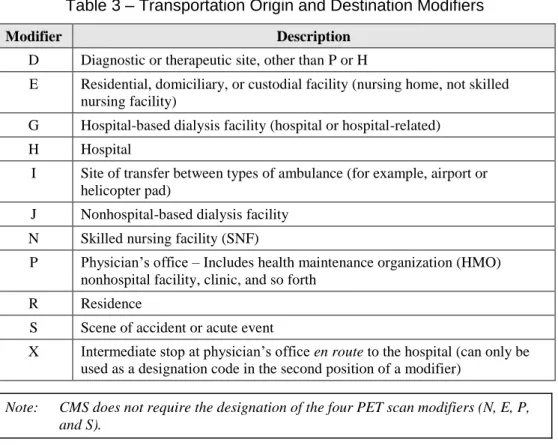
When billing transportation procedure codes, append both origin and destination modifiers. The first character indicates the transport’s place of origin, and the second character indicates the destination. Table 3 lists the modifiers used for transportation. These modifiers are not used in PA requests.
Table 3 – Transportation Origin and Destination Modifiers
Modifier Description
D Diagnostic or therapeutic site, other than P or H
E Residential, domiciliary, or custodial facility (nursing home, not skilled nursing facility)
G Hospital-based dialysis facility (hospital or hospital-related) H Hospital
I Site of transfer between types of ambulance (for example, airport or helicopter pad)
J Nonhospital-based dialysis facility N Skilled nursing facility (SNF)
P Physician’s office – Includes health maintenance organization (HMO) nonhospital facility, clinic, and so forth
R Residence
S Scene of accident or acute event
X Intermediate stop at physician’s office en route to the hospital (can only be used as a designation code in the second position of a modifier)
Note: CMS does not require the designation of the four PET scan modifiers (N, E, P, and S).
Mileage
The IHCP expects transportation providers to transport members along the shortest, most efficient route to and from a destination. All transportation providers must document mileage on the driver’s ticket using odometer readings or mapping software programs.
Covered Mileage
The IHCP reimburses for mileage, in addition to the base rate, under the following circumstances:
The IHCP reimburses ambulance providers for loaded mileage for each mile of the trip regardless of the type or level of service being billed.
The IHCP reimburses CAS and NAS providers for loaded mileage when they transport a member more than 10 miles one way.
The IHCP does not reimburse taxi providers for mileage and does not require them to submit mileage with their claims. However, providers must document mileage on the driver’s ticket using odometer readings or mapping software, as outlined in the Documentation Requirements for Transportation Services section.
Although the IHCP automatically deducts the first 10 miles of a CAS or NAS trip from each one-way trip, CAS and NAS providers must bill for all mileage (including the first 10 miles) to ensure proper reimbursement. For trips less than 10 miles, the IHCP does not require the provider to bill mileage; however, if the provider does bill mileage, the IHCP processes the mileage as a denied line item.
For trips and associated mileage in excess of 50 miles one way, the IHCP requires PA. If the provider has not obtained PA, the IHCP denies reimbursement for mileage, the base rate, and any othertransportation services related to the trip. Providers must bill for all transportation services provided to the same member on the same date of service on one claim form.
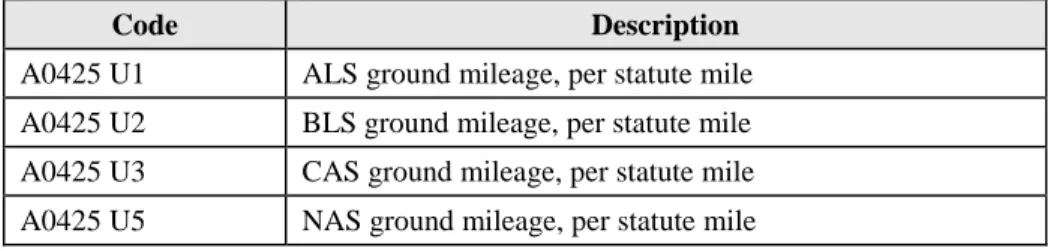
Providers must use procedure code A0425 and the appropriate U modifier for transportation services in conjunction with ALS, BLS, CAS, or NAS base rates to report mileage. Providers must not fragment mileage. Providers must submit mileage for round trips on one detail line using the appropriate code listed in Table 4.
Procedure code S0215 – Nonemergency transportation; mileage, per mile is nonreimbursable. Providers must bill the appropriate mileage code listed in Table 4.In addition, providers must not report procedure code S0215 with the codes listed in Table 4 to avoid IHCP reimbursing them incorrectly.
Table 4 – Mileage Procedure Codes and Descriptions
Code Description
A0425 U1 ALS ground mileage, per statute mile A0425 U2 BLS ground mileage, per statute mile A0425 U3 CAS ground mileage, per statute mile A0425 U5 NAS ground mileage, per statute mile
Mileage Units and Rounding
Providers must bill the IHCP for whole units only. For partial mileage units, round to the nearest whole unit. For example, if the provider transports a member between 15.5 miles and 16.0 miles, the provider must bill 16 miles. If the provider transports the member between 15.0 and 15.4 miles, the provider must bill 15 miles.
Multiple Passengers
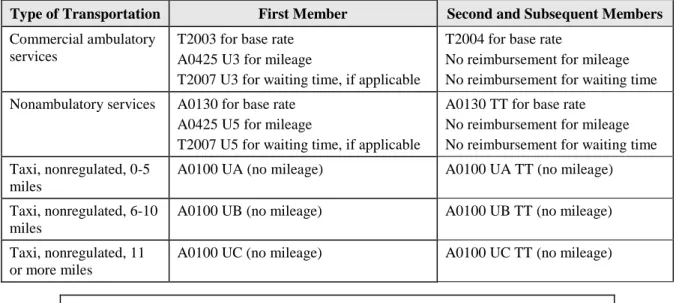
When providers transport two or more members simultaneously from the same county to the same vicinity for medical services, the IHCP reimburses for the second and subsequent member transported for medical services in a single CAS or NAS vehicle at one-half the base rate. The IHCP reimburses the full base code, mileage, and waiting time for the first member only. For example, providers should bill no mileage in conjunction withT2004 – Nonemergency transport; commercial carrier, multipass provided to more than one patient in the same setting.
Transportation Services
The IHCP does not provide reimbursement for multiple passengers in ambulances or family member vehicles. The IHCP does not provide additional reimbursement for multiple passengers when the billing provider does not bill non-IHCP customers for these services. Table 5 shows the correct coding methods for multiple passengers.
Table 5 – Coding Transportation for Multiple Passengers
Type of Transportation First Member Second and Subsequent Members
Commercial ambulatory services
T2003 for base rate A0425 U3 for mileage
T2007 U3 for waiting time, if applicable
T2004 for base rate
No reimbursement for mileage No reimbursement for waiting time Nonambulatory services A0130 for base rate
A0425 U5 for mileage
T2007 U5 for waiting time, if applicable
A0130 TT for base rate No reimbursement for mileage No reimbursement for waiting time Taxi, nonregulated, 0-5
miles
A0100 UA (no mileage) A0100 UA TT (no mileage)
Taxi, nonregulated, 6-10 miles
A0100 UB (no mileage) A0100 UB TT (no mileage)
Taxi, nonregulated, 11 or more miles
A0100 UC (no mileage) A0100 UC TT (no mileage)
Note: PA for a base code includes the base code and the multiple-passenger code that corresponds to the approved base code. When last-minute changes in scheduling modify the service from a single passenger to a multiple passenger, the provider must use the appropriate code.
Accompanying Parent or Attendant
When members younger than 18 years of age need an adult to accompany them to a medical service, or when adult members need an attendant to travel or stay with them due to medical necessity, the provider should bill the appropriate accompanying parent or attendant code.
The following are guidelines for billing the accompanying parent or attendant codes:
Bill the procedure code for the base rate and the accompanying parent or attendant under the IHCP member identification number (RID).
The IHCP does not provide additional reimbursement for accompanying parent or attendant when the billing provider does not bill non-IHCP customers for like services.
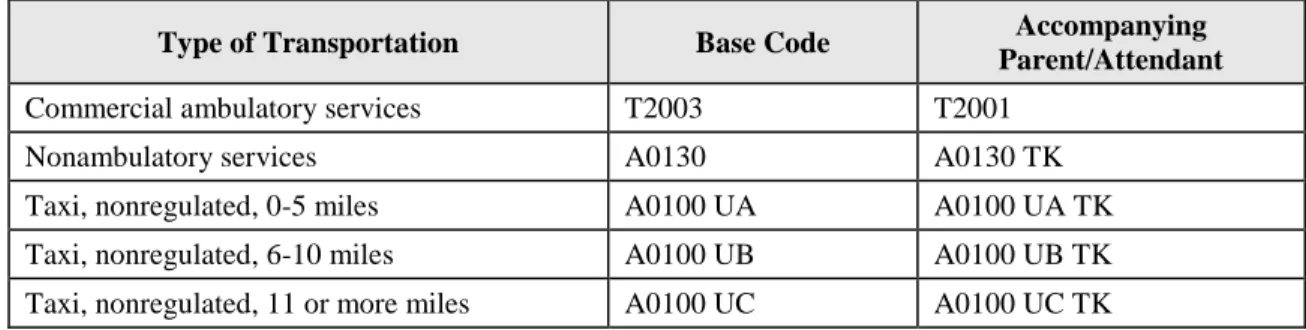
The provider must maintain documentation on the driver’s ticket to support that the accompanying parent or attendant was transported with the IHCP member. This documentation must include the name, signature, and relation of the accompanying parent or attendant.Table 6 lists the base codes and the applicable accompanying parent or attendant code. The provider must bill the base code and the accompanying parent or attendant code using the member’s information.
Table 6 – Procedure Codes for Accompanying Parent or Attendant
Type of Transportation Base Code Accompanying Parent/Attendant
Commercial ambulatory services T2003 T2001 Nonambulatory services A0130 A0130 TK Taxi, nonregulated, 0-5 miles A0100 UA A0100 UA TK Taxi, nonregulated, 6-10 miles A0100 UB A0100 UB TK Taxi, nonregulated, 11 or more miles A0100 UC A0100 UC TK
Additional Attendant
Transportation providers sometimes need to employ an additional attendant to help load a member. In situations where the driver cannot load the member without help, such as when a wheelchair-bound member lives upstairs and the residence has no wheelchair ramp, the provider needs an additional attendant. This code is not subject to the 20-trip limit; however, if the trip exceeds 50 miles one way, the IHCP requires prior authorization for all procedure codes, including additional attendant codes. The additional attendant who assists must be an employee of the billing provider and is not required to remain for the trip.
Providers must document the need for an additional attendant on the driver’s ticket. The IHCP may subject the documentation to postpayment review. The IHCP limits the number of additional attendants to a maximum of two extra units, although usually one attendant is sufficient. The IHCP limits reimbursement for an additional attendant to NAS or wheelchair van and ambulance transportation. For ambulance providers, the additional attendant is the third or fourth attendant, because the IHCP requires ambulances to have two attendants.
Table 7 – Procedure Codes for an Additional Attendant
Type of Transportation Procedure Code Description
Nonambulatory or wheelchair van
transportation A0130 U6
Nonambulatory transportation;
wheelchair van, U6 = additional attendant Ambulance transportation (ALS and
BLS) A0424
Extra ambulance attendant, ground (ALS or BLS) or air (fixed or rotary winged); (requires medical review)
Waiting Time
The IHCP reimburses for waiting time in excess of 30 minutes only when the provider parks the vehicle outside the medical service provider, awaiting the return of the member to the vehicle, and if the member is transported 50 miles or more one way. The provider must obtain PA for all codes associated with trips of 50 miles or more one way, including waiting time. The IHCP does not cover the first 30 minutes of waiting time; however, the provider must include the total waiting time or the IHCP cannot pay the claim
appropriately.
For all procedure codes that providers use to bill waiting time, providers should use one unit of service for every 30 minutes of waiting time. When providers wait between 15 to 30 minutes, they should round up the partial 30-minute increments to the next unit. For example, if providers wait 45 minutes, they should bill the units of service as two, or 2.0. For partial 30-minute increments of less than 15 minutes, providers must round down. For example, if providers wait one hour and 10 minutes, providers must bill the units of
Transportation Services
service for waiting time as two, or 2.0. Providers must maintain documentation, including start and stop times, on the driver’s ticket to support the waiting time billed.
Ambulance Transportation Services
The IHCP covers emergency and nonemergency ALS and BLS ambulance transport services. (See the
Level of Service Rendered Versus Level of Responsesection for definitions.)
The IHCP covers ALS services only when the level of service is medically necessary and BLS services are not appropriate due to the medical conditions of the member being transported. Ambulance providers must bill the IHCP according to the level of service rendered. The following examples explain the level-of-service policy:
Example 1: ALS personnel and ambulance respond to a call. On arrival, the personnel find the member needs emergency medical transport but no ALS services. In this case, the provider must use the BLS emergency transport code. Subsequently, if no emergency is present, providers must use thenonemergency BLS ambulance transport code to transport the member.
Example 2: An ambulance responds to a call to transport a member to a scheduled appointment. On arrival, the ambulance personnel discover that a CAS service or wheelchair van can transport the member. The ambulance provider can either call for the appropriate vehicle or transport the patient in the ambulance. If the ambulance provider transports the member, the provider must bill the IHCP for the appropriate CAS or NAS transportation codes.Table 13 includes a complete listing of ambulance transportation codes. The procedure codes listed in Tables 8 and 9 are valid for ambulance providers to bill for CAS or NAS level of service. Ambulance providers must bill the most appropriate CAS or NAS code listed in Tables 8 and 9 if the level of service does not meet the EMSC definition of ALS or BLS services. (See theAmbulance Mileage section for information about billing for mileage.)
Table 8 – Valid CAS Procedure Codes for Ambulance Providers
Procedure Code Description
T2003 Nonemergency transportation, encounter/trip
T2007 U3 Transportation waiting time, air ambulance and nonemergency vehicle, one-half (1/2) hour increments; CAS
Table 9 – Valid NAS Procedure Codes for Ambulance Providers
Procedure Code Description
A0130 Nonemergency transportation, wheelchair van
A0130 U6 Nonemergency transportation, wheelchair van base rate; additional attendant T2007 U5 Transportation waiting time, air ambulance and nonemergency vehicle, one-half
(1/2) hour increments; NAS
The IHCP exempts emergency ambulance services from the 20 one-way trip limitation. See the
Twenty One-Way-Trip Limitation and Exemptions section of this document for details.
Note: The IHCP requires PA for air ambulance and interstate transportation services. In addition, the IHCP requires PA for any transportation services provided by a provider located in an out-of-state, nondesignated area. (See the Out-of-State Providers module for more information.)
Ambulance Mileage
The IHCP reimburses for each mile of the trip only for loaded ambulance mileage. The provider’s documentation must contain mileage from mapping software or odometer readings indicating starting and ending trip mileage. Providers must use A0425 U1 – Ground mileage, per statute mile; ALS or A0425 U2 –
Ground mileage, per statute mile; BLS to bill ambulance mileage. The IHCP uses U1 and U2 modifiers to differentiate between ALS and BLS mileage. The IHCP denies claims billed without the U1 or U2 modifier and requires providers to resubmit the claim with the appropriate modifier.
Neonatal Ambulance Transportation
The IHCP makes reimbursement available for specialized neonatal ambulance services especially equipped for interhospital transfers of high-risk or premature infants only when the member has been discharged from one hospital for admission to another hospital. Providers must use procedure code A0225 –
Ambulance service, neonatal transport, base rate, emergency transport, one way only for neonatal ambulance transport.
Pediatric and Neonatal Critical Care During Interfacility
Transportation
The IHCP provides coverage for critical care during a pediatric or neonatal interfacility transport. The following restrictions apply:
The patient must be 24 months of age or younger.
The patient must be in critical condition, as determined by a physician using the following guidelines: – Patient has a critical illness or injury that acutely impairs one or more vital organ systems. – Imminent or life-threatening deterioration of the patient’s condition is highly probable duringtransport.
This service must be rendered by a physician or a neonatal nurse practitioner (NNP).This coverage applies to all IHCP programs, subject to limitations established for certain benefit packages, for dates of service on or after January 1, 2015.
Oxygen and Oxygen Supplies
Providers must not bill procedure code A0422 – Ambulance (ALS or BLS) oxygen, and oxygen supplies, life sustaining situation with ALS codes A0426, A0427, and A0433. These base codes for ALS transport include the reimbursement for supplies and oxygen in an ALS situation.
Providers can bill procedure code A0422 with BLS codes A0428 or A0429, if medically necessary. Emergency medical technicians (EMTs) and paramedics must document the medical necessity for oxygen use in the medical record maintained by the provider.
Package C Ambulance Transportation
Hoosier Healthwise Package C members are eligible to receive emergency ambulance services, subject to the prudent layperson definition of emergency in 407 IAC 1-1-6 and a copayment of $10. The IHCP covers nonemergency ambulance transportation between medical facilities when ordered by the treating physician.
Transportation Services
Rotary Air Ambulance Transportation
Rotary air ambulance is furnished when the member’s medical condition is such that transportby ground ambulance, in whole or in part, is not appropriate.
Generally, transport by rotary wing air ambulance may be necessary because the member’s condition requires rapid transport to a treatment facility, and great distances or other obstacles preclude such rapid delivery by ground transport to the nearest appropriate facility. Transport by rotary wing air ambulance may also be necessary because the member is inaccessible by a ground or water vehicle.
Transportation by air ambulance is covered only for transport to a hospital. Air ambulance services are not covered for transport to a facility that is not an acute care hospital. Transport to a nursing facility, a physician’s office, or a beneficiary’s home by rotary air ambulance is not reimbursable.
Prior Authorization for Rotary Air Ambulance Transportation
Prior authorization (PA) is required for air ambulance services. The IHCP acknowledges that PA for rotary air transport can be requested after services have been rendered, due to the nature of the services. A PA request must include a brief description of the care and description of the clinical circumstances
necessitating the need for the transportation. Providers must indicate the transportation was an emergency by using the Y indicator in field 24C on the CMS-1500 or in the Emergency Indicator on the 837P.
Medical Necessity for Rotary Air Ambulance Transportation
Rotary air ambulance transport is a covered service when the member has a potentially life-threatening condition that does not permit the use of another form of transportation. The IHCP reimburses rotary air transportation services to a hospital facility under medically appropriate circumstances. Medical necessity is established only when the member’s condition is such that the time needed to transport a member by ground, or the instability of transportation by ground, poses a threat to the member’s survival or seriously endangers the member’s health.
The following list includes examples of medical conditions in which rapid transport may be necessary. This list does not guarantee reimbursement nor is it intended to be all inclusive. Diagnosis alone does not serve as justification for reimbursement.
Intracranial bleeding requiring neurosurgical intervention
Cardiogenic shock
Burns requiring treatment in a burn center
Conditions requiring treatment in a Hyperbaric Oxygen Unit
Multiple severe injuries
Life-threatening traumaAir transport must be to the nearest suitable hospital. If the air transport was medically necessary but the member could have been treated at a nearer hospital than one to which they were transported, the air transportation mileage reimbursement is limited to the rate for the distance from the point of pickup to the nearer hospital.
Special Circumstances
Additional information concerning rotary air transportation coverage and billing follows for three special circumstances – hospital-to-hospital transfers, patient expiration, and bad weather.
Hospital-to-Hospital Transfer
Air ambulance transport is covered for transfer of a patient from one hospital to another if the medical appropriateness criteria is met, for example, transportation by ground ambulance would endanger the member’s health, and the transferring hospital does not have adequate facilities to provide the medical services needed by the patient. Examples of such specialized medical services that are generally not available at all types of facilities may include, but are not limited to, burn care, cardiac care, trauma care, and critical care.
A patient transported from one hospital to another hospital is covered only if the hospital to which the patient is transferred is the nearest one with appropriate facilities. Reimbursement is not available for transport from a hospital capable of treating the patient because the patient or family prefers a specific hospital or physician.
When a Medicaid recipient is admitted to a hospital, it may become necessary to transport the patient to another hospital for specialized services while the patient maintains inpatient status with the original hospital. Transportation of the patient in this instance is not a separately billable Medicaid transportation service. Payment for the transportation of a patient while still in inpatient status is not payable apart from the inpatient payment for the original inpatient hospital stay. For billing and cost reporting purposes, the admitting hospital should record the services obtained at the other hospital, including transport of the patient, in the appropriate ancillary cost center relating to the services obtained. Providers must not use revenue code 54X (Ambulance) for this transportation service.
Patient Expiration
When the member expires, the IHCP payment amount depends on the time at which the member is pronounced dead by an individual authorized by the State to make such pronouncements. If the member is pronounced dead before takeoff to point of pickup, with notice to the dispatcher and time to abort the flight, no payment is made. This includes scenarios in which the air ambulance has taxied to the runway or has been cleared for takeoff, but has not actually taken off.
If the member is pronounced dead after takeoff to point of pickup, but before the member is loaded, the appropriate air base rate (A0431) with no mileage is reimbursed. The provider should use the QL modifier when submitting such a claim: A0431 QL – Ambulance service, conventional air service, transport, one way (rotary wing); if the member is pronounced dead after takeoff to point of pickup, but before the member is loaded. If the provider bills a mileage code in conjunction with a base rate and QL modifier, the mileage code is denied with the following audit 6194 explanation: Mileage is not payable with this service. When the member is pronounced dead after being loaded onboard but before or on arrival at the receiving facility, the provider may bill for the air ambulance base rate and mileage as if the member had not expired.
Bad Weather
Providers should note that if the flight is aborted due to bad weather or other circumstance beyond the pilot’s control any time before the beneficiary is loaded onboard, that is, before or after takeoff to point of pickup, the IHCP will not reimburse for the flight. If the flight is aborted due to bad weather after the beneficiary is loaded, the appropriate base and mileage codes may be reimbursed.
Transportation Services
Base Rate and Mileage for Rotary Air Ambulance Transportation
The IHCP provides reimbursement for a base rate and mileage for rotary air ambulance transportation. The base rate and mileage are reimbursed at the lower of the usual and customary charge or the
IHCP-established maximum fee. The base rate is an all-inclusive rate including coverage of treatments and services that are an integral part of care while in transit; it includes but is not limited to oxygen, drugs, supplies, reusable devices and equipment, and extra attendants. Table 10 shows Healthcare Common Procedure Coding System (HCPCS) codes for rotary air ambulances services.
Table 10 – Rotary Air Ambulance Codes
Procedure Code Description
A0431 Ambulance service, conventional air services, transport, one way (rotary wing) A0436 Rotary wing air mileage, per statute mile
The air ambulance mileage rate is calculated to the nearest suitable hospital per actual loaded (patient onboard) miles flown and is expressed in statute miles (not nautical miles). Transportation providers are expected to transport members along the shortest, most efficient route to the nearest suitable hospital. All rotary air transportation providers must document mileage on the trip ticket. Providers must bill the IHCP for whole units only. Partial mileage units must be rounded to the nearest whole unit. For example, if the provider transports a member between 15.5 miles and 16.0 miles, the provider must bill 16 miles. If the provider transports the member between 15.0 and 15.4 miles, the provider must bill 15 miles.
Providers are reminded that additional reimbursement is not available for multiple passengers in a rotary air ambulance, nor is separate reimbursement available for an accompanying parent or attendant in a rotary air ambulance.
Taxi Service
Taxi providers transport ambulatory members and may operate under authority from a local governing body (city taxi or livery license). Taxi providers whose rates are regulated by local ordinance must bill the metered or zoned rate, as established by local ordinance, and the IHCP reimburses them up to the
maximum allowable fee. The IHCP reimburses taxi providers whose rates are not regulated by local ordinance at the lower of their submitted charge or the maximum allowable fee based on trip length. The IHCP does not separately reimburse taxi providers for mileage above the maximum allowable rate for the trip; however, providers must have mileage documented on the driver’s ticket by odometer readings or mapping software.
Prior Authorization for Transportation Services
Specific criteria pertaining to PA of transportation services are found in 405 IAC 5-30. The following PA requirements should be used as a guideline for determining procedures requiring PA, but the Indiana Administrative Code (IAC) is the primary reference.
The IHCP requires PA for the following transportation services:
Trips exceeding 20 one-way trips per member, per rolling 12-month period, with certain exceptions as described in the Twenty One-Way-Trip Limitation and Exemptionssection
Trips of 50 miles or more one way, including all codes associated with the trip (wait time, parent or attendant, additional attendant, and mileage)
Interstate transportation or transportation services rendered by a provider located out-of-state in a nondesignated area
Train or bus services These services require prior authorization by the local county office of the FSSA Division of Family Resources (DFR) in which the member resides, not the IHCP office or contractor.
Airline or air ambulance services
Family member services These services require prior authorization by the county office of the FSSA DFR in which the member resides, not the IHCP office or contractor.
When submitting a PA request in writing, the following information should be noted on or attached to a properly completed Indiana Health Coverage Programs Prior Authorization Request Form, which is available on the Forms page at indianamedicaid.com:
Proper procedure codes for the requested services
Member’s age
Type of service required (such as NAS, CAS, or taxi)– The member’s condition must support the level of service requested.
Reason for and destination of service (such as dialysis or physical therapy treatments at county hospital or community health clinic)
Frequency of service and treatment per the physician’s order (such as twice a week)
Duration of service and treatment per the physician’s order (such as three months)
Total mileage for each trip (such as 129 miles)
Total waiting time for each trip (such as two hours)PA requests must include a brief description of the anticipated care and of the clinical circumstances necessitating the need for the transportation.
The IHCP may grant PA up to one year following the date of service
Note: For managed care members, authorizations for transportation services are the responsibility of the MCE. Additional information about MCE authorization procedures can be directed to the MCE at the telephone number provided through the IHCP Automated Voice Response (AVR) system, Web interChange, or electronic 270/271 transaction. Another resource is the IHCP Quick
Reference Guide at indianamedicaid.com. The appropriate MCE reviews the PA requests and sends copies of the decisions to the members and the rendering providers.
Noncovered Transportation Services
The IHCP does not reimburse for the following transportation services:
One-way trips exceeding 20 per member, per rolling 12-month period, unless the provider documents medical necessity for additional trips through the PA process (For exceptions, see the Twenty One-Way-Trip Limitation and Exemptionssection of this document.)
Trips of 50 miles or more one way, unless the provider obtains PATransportation Services
Nonemergency transportation provided by any of the following: – A volunteer with no vested or personal interest in the member – An interested individual or neighbor of the member– A caseworker or social worker
Ancillary, nonemergency transportation charges including, but not limited to, the following: – Parking fees– Tolls
– Member meals or lodging – Escort meals or lodging
Disposable medical supplies, other than oxygen, provided by a transportation provider
Transfer of durable medical equipment, either from the member’s residence to place of storage or from the place of storage to the member’s residence
Use of red lights and siren for an emergency ambulance call
All interhospital transportation services, except when the member has been discharged from one hospital for admission to another hospital
Delivery services for prescribed drugs, including transporting a member to or from a pharmacy to pick up a prescribed drugDocumentation Requirements for Transportation
Services
Providers must support each claim with the following documentation on the driver’s ticket or run sheet:
Complete date of service; including day, month, and year of service, such as 9/30/15
Complete member name and address of pickup, including street address, city, county, state, and ZIP Code
Member identification number
Member signature, and if the member is unable to sign, the driver should document that “the patient was unable to sign” and list the reason for the inability
Waiting time; including the actual start and stop time of the waiting period, such as wait time from 1 p.m. to 3:20 p.m.
Complete service provider’s name and address, including street address, city, county, state, and ZIP CodeNote: If the service provider’s name is abbreviated on the driver’s ticket, the provider must document the complete provider name or maintain a facility abbreviation listing. This helps expedite the postpayment review process.
Name of the driver who provided transportation service
Vehicle odometer reading at the beginning and end of each trip or mileage from mapping software, including the date that the provider performed the transportation service and the specific starting and destination addressNote: All providers, including taxi providers, must document mileage using either odometer readings or mapping software. Taxi providers must document the distance traveled to support the metered or zoned rate or mileage code billed.
Indication of a one-way or round trip
Indication of CAS or NAS transportation
Name and relationship of any accompanying parent or attendant to support the accompanying parent or attendant code billed, if applicableNote: When providers bill an attendant or parent as part of the transport, the parent or attendant must also sign the driver’s ticket.
Providers are responsible for verifying that they are transporting the member to or from a covered service. Providers are responsible for maintaining documentation that supports each transport and service provided. Transportation providers put themselves at risk of recoupment of payment if they do not maintain the required documentation or cannot verify covered services.
Transportation Diagnosis Coding
Transportation providers should bill ICD-10 diagnosis code R69 – Illness, unspecified as the primary diagnosis code for claim submissions when the actual diagnosis is not known. For claims prior to
October 1, 2015, the ICD-9 diagnosis code 7999 is used. Claims submitted without a valid diagnosis code will be denied.
MRT Reimbursement for Transportation
The Medical Review Team (MRT) program reimburses for transportation services, in cases of financial hardship, when no transportation is available for medically necessary examinations or tests; however, the provider must contact the MRT to obtain approval before rendering the service.
Only the following transportation codes are authorized for most MRT trips:
T2003 SE – Nonemergency transportation, encounter/trip; $10 each way, regardless of vehicle type
T2007 SE – Transportation waiting time, air ambulance and nonemergency vehicles, one-half (1/2)hour increments; $4.50
A0425 SE – Ground mileage, per statute mile; $1.25Transportation Code Sets by Provider Specialty
The IHCP limits transportation providers to specific codes based on the provider specialty listed on the provider enrollment file. Tables 11 through 17 list the procedure codes allowed for each provider specialty under provider type 26 – Transportation.
Transportation Services
Common Carrier – Ambulatory
Table 11 – Procedure Code Set for Provider Specialty 264 – Common Carrier
(Ambulatory)
Procedure Code Description
A0425 SE Ground mileage, per statue mile; State and/or federally-funded programs/service A0425 U3 Ground mileage, per statute mile; CAS
T2001 Nonemergency transportation, patient attendant/escort T2003 Nonemergency transportation, encounter/trip
T2003 SE Nonemergency transportation, encounter/trip; State and/or federally-funded programs/service
T2004 Nonemergency transport, commercial carrier, multi-pass
T2007 SE Transportation waiting time, air ambulance and nonemergency vehicle, one-half (1/2) hour increments; State and/or federally-funded programs/service
T2007 U3 Transportation waiting time, air ambulance and nonemergency vehicle, one-half (1/2) hour increments; CAS
Note: Providers must indicate the origin and destination modifiers with the base rate and mileage procedure codes.
Common Carrier – Nonambulatory
Note: For ambulatory members transported in a vehicle equipped to transport nonambulatory members, providers must bill according to the CAS level of service and rate, and not bill according to the vehicle type. CAS codes are listed in Table 11, and NAS codes are listed in Table 12.
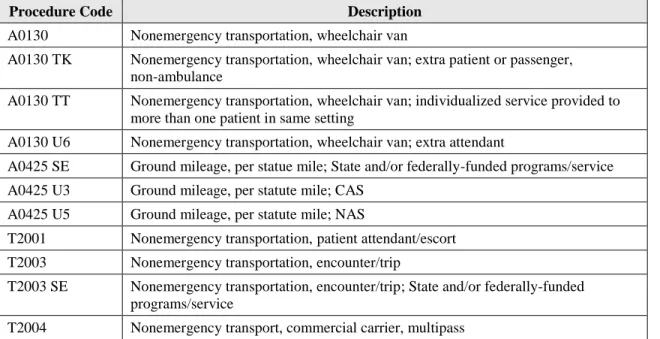
Table 12 – Procedure Code Set for Provider Specialty 265 – Common Carrier
(Nonambulatory)
Procedure Code Description
A0130 Nonemergency transportation, wheelchair van
A0130 TK Nonemergency transportation, wheelchair van; extra patient or passenger, non-ambulance
A0130 TT Nonemergency transportation, wheelchair van; individualized service provided to more than one patient in same setting
A0130 U6 Nonemergency transportation, wheelchair van; extra attendant
A0425 SE Ground mileage, per statue mile; State and/or federally-funded programs/service A0425 U3 Ground mileage, per statute mile; CAS
A0425 U5 Ground mileage, per statute mile; NAS
T2001 Nonemergency transportation, patient attendant/escort T2003 Nonemergency transportation, encounter/trip
T2003 SE Nonemergency transportation, encounter/trip; State and/or federally-funded programs/service
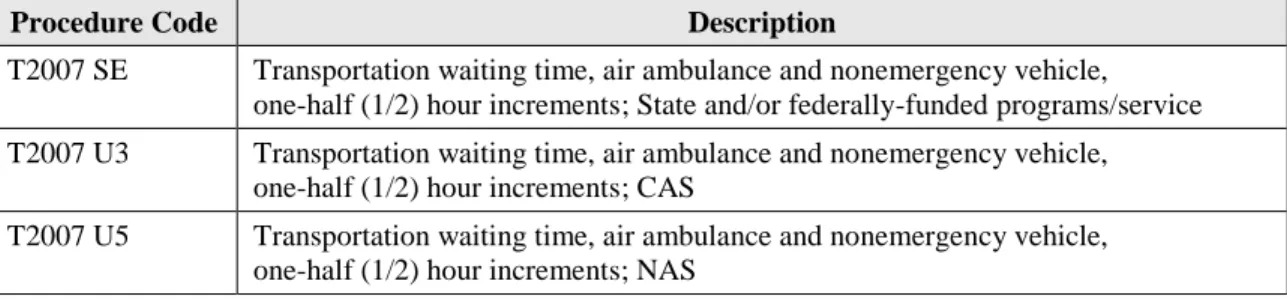
Procedure Code Description
T2007 SE Transportation waiting time, air ambulance and nonemergency vehicle, one-half (1/2) hour increments; State and/or federally-funded programs/service T2007 U3 Transportation waiting time, air ambulance and nonemergency vehicle,
one-half (1/2) hour increments; CAS
T2007 U5 Transportation waiting time, air ambulance and nonemergency vehicle, one-half (1/2) hour increments; NAS
Ambulance (ALS and BLS)
Note: Providers must bill transportation according to the level of service rendered. Therefore, the ambulance provider specialty code set (Table 13) includes applicable CAS and NAS codes from Table 11 and Table 12.
Table 13 – Procedure Code Set for Provider Specialty 260 – Ambulance (ALS and BLS)
Procedure Code Description
A0130 Nonemergency transportation, wheelchair van
A0130 U6 Nonemergency transportation, wheelchair van; extra attendant
A0225 Ambulance service, neonatal transport, base rate, emergency transport, one way A0420 U1 Ambulance waiting time (ALS or BLS), one-half (1/2) hour increments; ALS A0420 U2 Ambulance waiting time (ALS or BLS), one-half (1/2) hour increments; BLS A0422 Ambulance (ALS and BLS) oxygen and oxygen supplies, life-sustaining situation A0424 Extra ambulance attendant, ground (ALS or BLS) or air (fixed or rotary wing);
(requires medical review)
A0425 SE Ground mileage, per statue mile; State and/or federally-funded programs/service A0425 U1 Ground mileage, per statute mile; ALS
A0425 U2 Ground mileage, per statute mile; BLS A0425 U3 Ground mileage, per statute mile; CAS A0425 U5 Ground mileage, per statute mile; NAS
A0426 Ambulance service, advanced life support, nonemergency transport, level 1 (ALS 1)
A0427 Ambulance service, advanced life support, emergency transport, level 1 (ALS 1-emergency)
A0428 Ambulance service, basic life support, nonemergency transport, (BLS) A0429 Ambulance service, basic life support, emergency transport (BLS, emergency) A0433 Advanced life support, level 2 (ALS 2)
Transportation Services
Procedure Code Description
T2003 Nonemergency transportation, encounter/trip
T2003 SE Nonemergency transportation, encounter/trip; State and/or federally-funded programs/service
T2007 SE Transportation waiting time, air ambulance and nonemergency vehicle, one-half (1/2) hour increments; State and/or federally-funded programs/service
T2007 U3 (Use this code for waiting time when the transport is a CAS level of service.)
Transportation waiting time, air ambulance and nonemergency vehicle, one-half (1/2) hour increments; CAS
T2007 U5 (Use this code for waiting time when the transport is a NAS level of service.)
Transportation waiting time, air ambulance and nonemergency vehicle, one-half (1/2) hour increments; NAS
Air Ambulance
Table 14 – Procedure Code Set for Provider Specialty 261 – Air Ambulance
Procedure Code Description
A0140 Nonemergency transportation and air travel (private or commercial), intra- or interstate
A0422 Ambulance (ALS or BLS) oxygen and oxygen supplies, life sustaining situation A0424 Extra ambulance attendant, ground (ALS or BLS) or air (fixed or rotary winged);
(requires medical review)
A0430 Ambulance service, conventional air services transport, one way (fixed wing) A0431 Ambulance service, conventional air services, transport, one way (rotary wing) A0431 QL Ambulance service, conventional air services, transport, one way (rotary wing);
Signify patient death after take-off A0436 Rotary wing air mileage, per statute mile A0999 Unlisted ambulance service
Taxi
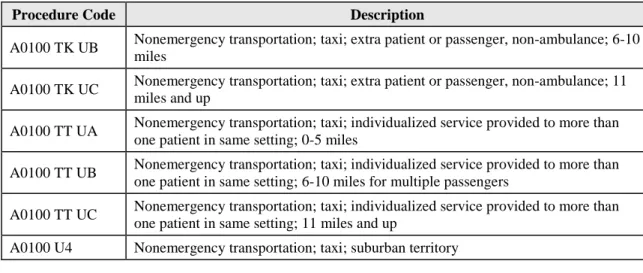
Table 15 – Procedure Code Set for Provider Specialty 263 – Taxi
Procedure Code Description
A0100 UA Nonemergency transportation; taxi; 0-5 miles A0100 UB Nonemergency transportation; taxi; 6-10 miles A0100 UC Nonemergency transportation; taxi; 11miles and up
A0100 TK UA Nonemergency transportation; taxi; extra patient or passenger, non-ambulance; 0-5 miles
Procedure Code Description
A0100 TK UB Nonemergency transportation; taxi; extra patient or passenger, non-ambulance; 6-10 miles
A0100 TK UC Nonemergency transportation; taxi; extra patient or passenger, non-ambulance; 11 miles and up
A0100 TT UA Nonemergency transportation; taxi; individualized service provided to more than one patient in same setting; 0-5 miles
A0100 TT UB Nonemergency transportation; taxi; individualized service provided to more than one patient in same setting; 6-10 miles for multiple passengers
A0100 TT UC Nonemergency transportation; taxi; individualized service provided to more than one patient in same setting; 11 miles and up
A0100 U4 Nonemergency transportation; taxi; suburban territory
Family Member
Table 16 – Procedure Code Set for Provider Specialty 266 – Family Member
Procedure Code Description
A0090 Nonemergency transportation, per mile – vehicle provided by individual (family member, self, neighbor) with vested interest
Bus
Table 17 – Procedure Code Set for Provider Specialty 262 – Bus
Procedure Code Description