Congestion Managed Multicast Routing
in Wireless Mesh Network
Bhupendra Kumar Gupta
1, Srikanta Patnaik
2, Ajit Kumar Nayak
3, Manas Kumar Mallick
4124Departement of Computer Science & Engineering, Siksha ‘O’ Anusandhan University, India 3
Departement of Computer Science & Information Technology, Siksha ‘O’ Anusandhan University, India
Abstract: To provide broad band connectivity to the mobile users and to build a self-structured network, where it is not possible to have wired network, “Wireless Mesh Networks” are the most vital suitable technology. Routing in Wireless Mesh Networks is a multi-objective nonlinear optimization problem with some constraints. We explore multicast routing for least-cost, delay-sensitive and congestion-sensitive in optimizing the routing in Wireless mesh networks (WMNs). In this work different parameters are associated like edge cost, edge delay and edge congestion. The aim is to create a tree traversing which the set of target nodes are spanned, so as to make the cost and congestion to be minimum with a bounded delay over the path between every pair of source and destination. Since searching optimal routing satisfying multi constraints concurrently is an NP complete problem, we have presented a competent estimated algorithm certified with experimental results, which shows that the performance of presented algorithm is nearly optimum.
Keywords: Wireless Mesh Networks, Routing protocol, traffic, Congestion, delay bound.
1.
Introduction
In order to broadband access over Internet and to share network resources by civic and organization consumers, wireless mesh networks (WMNs) delivers a cost effective way that uses multi-hop networking technique[1,2,3]. Intermediary hops in the mesh networks of WMNs complete the routing by passing data from point to point by using forwarding decisions and also boost the signal. WMNs have numerous benefits, such as small scalable, robustness,[4] hassle-free network maintenance, consistent service etc. Recently quite a lot of evolving networks applications built on WMNs architecture have been set up. For instance, the Portsmouth Realtime Travel Information (PORTAL) -ambitions at providing real-time travel information to the customers [5]. One more application is in civic security, which in order to offer mobility support, consistently, with flexibility, and high bandwidth, adds demand for wireless network connectivity. As WMNs mainly provides broadband services satisfying heterogeneous QoS desires. Therefore QoS is one of the most basic requirements and in case of WMNs this is the highly constraints requirements of a user. For the improvement of QoS in WMNs different changes has been done in routing protocols of WMNs.
The network topology in WMNs varying constantly. Many trees are used in Mesh based network protocols, to facilitate the delivery of the packets to every receiver via distinct paths. Existence of multiple path increases the protections against the topology changes. There is different scenario for multicast in WMNs. In our approach we assume that each access point sends it’s traffic flow to more than one mesh router i.e. we can say it’s a type of multicasting host in routing the flows from source to destination gateway mesh
router with the following optimization goal: delay optimization, cost optimization and congestion optimization. This paper aims at finding the optimal multicast route in wireless mesh networks fulfilling the issues:- minimum congestion, endwise delay constraint is fulfilled, least cost. An optimal MCMT is a tree originated at some source node that covers the destinations node set and the total delays along the route between the source and every destination is restricted and is not exceeded by delay constant D and sum total of the cost over the links in the tree spanning the destinations is minimum and such that each edge used must satisfies the congestion constraint described. In the experimental and result part we have discussed, the efficiency of MCMT which consider three parameters cost, delay bound and congestion is more closer to the optimal solution compared to modified KMB [6].
2.
Literature review
Routing in WMNs is a vital in the performance evaluation of wireless mesh network. A lot of analysis has been conducted for the development of routing scheme that can optimize the throughput of WMNs whereas satisfying different matrices. In earlier optimization technique network delay and cost optimization are been the two important optimization goals taken into consideration as distinct problem in multicast routing. Delay optimization is described as follows. The optimum delay solution in a WMNs modeled as G=<V,E>where vertices set V denotes mesh nodes and E denotes the links in the network so that the total amount of delays in the route between source and destinations becomes minimum. Dijkstra’s shortest path algorithm [7] can be used to create the shortest route between the source and target nodes which offers the optimal result for optimization of delay.
multiparty connections problem from two approaches. First, designing the multicast rout whose computation time is least. And then, multiple communications are combined into one route. Optimization on both cost and delay[16] was only addressed by Kabda and Jaffe taking both as identical function and their results becomes false if the two functions are different. Verma and Ferrari [17]design a process to construct path that account for constraint delay in unicast networks. Kompella Pasquale and Polyzos [18] discussed the optimization of multicast routing taking both cost and bounded delay as a matrices. Rakesh Matam and Somanath Tripathy[19] discusses Multicast Routing in WMNs. Khalid Mahmood, Babar Nazir, Iftikhar Ahmad Khan and Nadir Shah [20] studied the existing cost metrics and proposed a genetic algorithm technique for routing in WMN. Ahmed Al-Saadi, Rossitza Setchi and Yulia Hicks [21] discusses a new heterogeneous routing protocol and a routing algorithm based on reinforcement learning called cognitive heterogeneous routing are proposed to select the appropriate transmission technology based on parameters from each network. The proposed heterogeneous network overcomes the problems of sending packets over long paths, island nodes, and interference in WMNs and increases the overall capacity of the combined network by utilizing unlicensed frequency bands instead of buying more license frequency bands for LTE. Celso Barbosa Carvalho and José Ferreira de Rezende [22] discusses WMNs scenarios with routers able to adapt communication channel width; therefore, we propose a metric implemented in the network layer in order to increase the end-to-end capacity of routes, and consequently increase the network capacity. Metric values are used to establish the routing flows; conduct channel assignment, select the width of each channel and choose, due to the existing interference, the amount of transmission radios used in each link.
Here our aim is to construct a tree rooted at the source s spanned over the destination set S considering cost, bounded delay and congestion as the matrices.
This paper is organized as follows: In section-3we give a proper statement of the Multi Constraint Multicast Tree problem and specify the technique which we use for problem solving. Section-4 describes the pseudo code for MCMT algorithm. Section-5 describes experiments for the performance evaluation of the algorithm. The results of the experiments are discussed in Section-6and section-7describes the conclusions.
3.
Multicast Scenario in Wireless Mesh
Networks
In WMNs, a high speed routers equipped with advance antennas forms a mesh backbone and these mesh routers backbone is connected to the internet using access point which are considered as traffic control gateway gates between internet and WMNs. These control gates are known as gateway.
In WMNs the sender and receiver for a multicast group are the internet host and mesh host.
Sender Mesh host, Receiver or access point Internet host:
In this case the sender uses access point its serving access point. The source sends data to access point which in-turn multicast these data to the receivers. Here access point is again a receiver in this multicast group which receives the data from receivers and sends it back to the sender.
Sender Mesh Host, Receiver Mesh Host:
In this case it is needed to first build a multicast routing tree with sender as the source node. The sender first sends a message to the concern access point to give the information about the Group ID and its IP. The form request will be sent be receiver to its related access point which has the multicast group ID. Access point responds to the message and informs the receiver about the sender’s IP address. After getting the IP address of the sender, from the access point, the receiver runs the SPTM protocol to construct a route from the sender to the receiver.
Sender Internet Host, Receiver Mesh Host:
In this framework first the mesh host sends a join request to the connected access point. It sends an acknowledgement to the mesh host that it is ready to be the root of the multicast tree in the backbone. Then two senders begin to send the data to the access point which in turn multi casted by the access point using established multicast tree.
Therefore multicast routing is the most critical point in WMNs and needs to be optimized. Based on the founding optimal solution the multicast routing has been classified into 3 groups:
1. Heuristic optimization algorithm. 2. Meta Heuristic optimization. 3. Mathematical optimization.
Generally multicast routing algorithms have been studied developed using heuristic method.
Our aim is to design a routing technique that optimizes the traffic flow from the access point to the gateway in WMNs. In our approach we assume that each access point sends it’s traffic flow to more than one mesh router i.e. we can say it’s a type of multicasting host in routing the flows from source to destination gateway mesh router it must consider the following optimization goal:
1. Delay optimization 2. Cost optimization 3. Congestion optimization.
Delay optimization:
Here mesh network is modeled as a graph where the vertices set represent mesh nodes and the edge set represents communication links in the network. Delay is a function such that is a positive constant. Optimizing the delay means, minimizing the sum total of all the delays over the links in the route between source and destination.
Cost optimization:
Here mesh network is modeled as a graph where the vertices set represent mesh nodes and the edge set represents communication links in the network. Cost is a function such that a +ve real constant. Optimizing the cost means minimizing the sum total of cost over the edges in the tree spanning the destination set.
Congestion optimization:
Here mesh network is modeled as a graph
where the vertices set represent mesh nodes and the
Multi Constraint Multicast Tree Problem (MCMT):
The Multi Constraint Multicast Tree Problem is given below:- The graph represents a mesh network with the above described Delay, Cost and Congestion Optimization goal.
In the above defined graph the multicast is defined using following five factors: a source node, a target node set , a delay constraint function , a cost function and a congestion function . An optimal MCMT is a tree originated at that covers the destinations set and the total delays along the route between the source and every destination is restricted and is not exceeded by and sum total of the cost over the links in the tree spanning the destinations is minimum and such that each edge used must satisfies the congestion constraint described above.
4.
The Definition of Multi Constraint Multi
Cast Routing
4.1 Network and interference model
The wireless mesh network model which we have considered is represented hierarchically, in which the data from mobile clients aggregated at the local access points which in turn communicate with the mesh router forming the mesh backbone which in turn forward it to the gateway access point which is connected to the Internet. Here mesh nodes are the gateway access point, mesh routers and local access point.
The mathematical model of the described mesh network is as follows. The entire mesh network is modeled as a graph
such that represent the mesh node and
some of nodes is the gateway access point connecting to the Internet via wired connection. In the graph an edge
represent that the mesh node represented by
can transmit the mesh node represented by directly without an intermediate node. Here we have taken assumption that the transmission range and the interference range where is a constant, for every mesh node is uniform. represents the distance between the nodes and . An edge exist if . The edge length is represented by and the capacity of the edge is represented as i.e. a maximum of bits can be carried in one second by the edge. The congestion is the ratio of the flow over the edge to its capacity i.e.
where represent the flow over the edge and is the capacity of the edge.
4.2 Problem Formulation
This paper aims at finding the optimal multicast route in wireless mesh networks fulfilling the issues:-
1. Minimum congestion
2. Endwise delay constraint is fulfilled 3. least cost.
The Multi Constraint Multicast Tree is defined as follows. Mesh backbone network is modeled as a graph
with a cost function and a delay
function and such that is a congestion function. In order to express the problem
some earlier explanations are needed. In the above defined graph the multicast is described using following five parameters: a source node , a target node set , a delay constraint function , a cost function and a congestion function . An optimal MCMT is a tree originated at that covers the destinations set and the total delays along the route between the source and every destination is restricted and is not exceeded by D and sum total of the cost over the links in the tree spanning the destinations is minimum and such that each edge used must satisfies the congestion constraint described above.
The above MCMT is NP-complete but here we have written heuristic algorithm to construct a solution which is approximately optimal and is built on approximation algorithm of Steiner tree by Berman, Kou, and Markowsy[23].
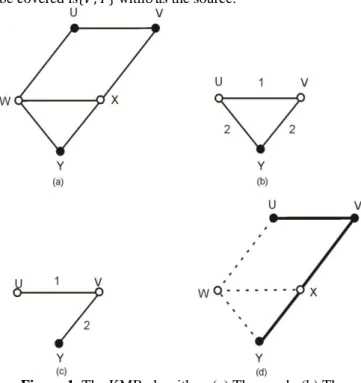
First the KMB algorithm is described and demonstrated in figure-1 where all the edges in the graph are assumed to be of cost and delay of unit amount. The destination node set to be covered is with as the source.
Figure 1. The KMB algorithm. (a) The graph. (b) The closure. (c) The MST. (d) The Spanned tree. STEP I:
G is a given graph as in (figure-1.a).A complete graph on the set is constructed such that is the path with least cost between node and (figure-1.b). STEP II:
From a minimum spanning tree is constructed (figure-1.c).
STEP III:
The links in are then extended to the edges in , that set up the least cost path of (figure-1.d).
The above KMB algorithm does not essentially yield a MCMT. But, we have added constraints at every step which guarantee that it produces an MCMT.
path subjected to the delay of the path being less than such that each edge in the path must obey the congestion constraint. Suppose be the cost on the edge , be the delay and be the congestion over the , be the cost of shortest path between and having delay .
and
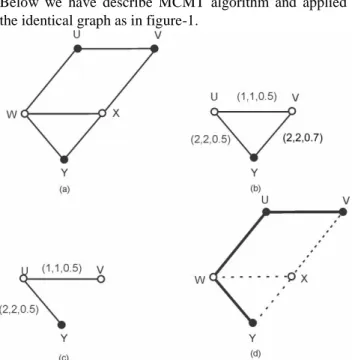
Below we have describe MCMT algorithm and applied on the identical graph as in figure-1.
Figure 2. The MCMT algorithm. (a) The graph. (b) The closure graph. (c) The MST. (d) The constrained multicast
tree. STEP I:
G is a given graph as in (figure-2.a).A complete graph on the set is constructed such that is the path with least cost between node and (figure-2.b). The path delay, path cost and congestionis represented on the links in the graph.
STEP II:
A constrained minimum spanning tree T of (figure-2.c) using Prims technique [24] is constructed, with the following critical measure Cn and congestion factor that decides the particular edge is added or subtracted at every iteration.
where
STEP III:
The links in are then extended to the edges in , that set up the route with least cost in (figure-2.d).
In the above algorithm the critical measures balance is the
selection of the edge with least cost against its delay leftover. The probability that same route can be used for data sending depends on the residual delay i.e. the delay leftover.
/* Pseudo code for MCMT algorithm *
*input: network topology
*output: set containing all the *destination nodes with source
* = mesh network topology
*model
* = source node
* = destination set
* = delay bound
* */
/* *
*it is assumed that cheapest constraint path have
* been found between all nodes and is represented
* by * */
;
;
;
/* *
* tillevery node in have been covered
* */
[ ]< & <1 )
{
} }
} } }
5.
Experiments and Results
To determine the average case performance of MCMT algorithm is ran on a number of graphs generated randomly. The optimum solution is first found by computing all constrained spanning tree and selecting the tree with least cost. Then using MCMT heuristic algorithm a constraint multicast tree is generated. At last we formed constrained spanning tree thru arbitrarily selecting edges till solution was obtained. Then the cost is compared in all of the above three cases in terms of two measures—
i. Average normalized distances - average normalized
distances represented by , and
where
and
The average normalized distance indicate percentage, above the optimal cost incurred using MCMT. Less the percentage of average normalized distance better the performance of the algorithm.
ii. Efficiency – efficiency is a measure which is used to rank MCMT algorithm stuck between the optimal solution(best) and random solution(worst) performances.
where
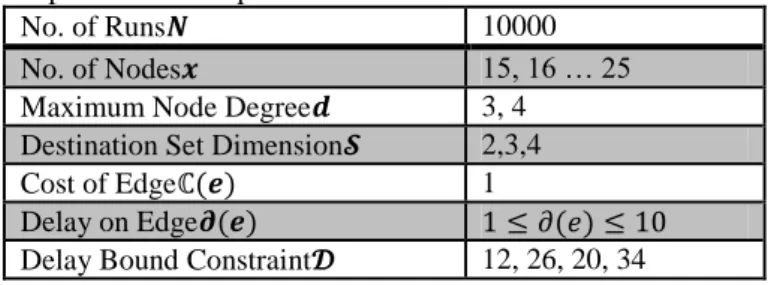
A number of diverse sized graphs were tried. The factors based on which the graphs are generated are given below— Each graph must have at least one solution. The degree of each node in the graph must be between 1 and a maximum value. Every edge had a cost of one unit and associated with a delay of a random value from the set . Several destination set of different sizes were considered. Different delay constraints were also tried. The different parameters for the experiment are given in table 1.
Table 1. Experimental Parameters Experimental Setup:
No. of Runs 10000
No. of Nodes 15, 16 … 25
Maximum Node Degree 3, 4
Destination Set Dimension 2,3,4
Cost of Edge 1
Delay on Edge
Delay Bound Constraint 12, 26, 20, 34
We have set up an irrepressible forwarding mesh network approach that protects a multicast session in wireless mesh networks. In a multicast session in irrepressible forwarding mesh network every source-destination pair has at least two node disjoint path connecting the source and destination simultaneously. Because of which failure of any intermediate node or a single link in an irrepressible forwarding mesh network won’t interrupt the multicast session .The following small network topology given in figure 3(a) demonstrate the concept of irrepressible forwarding mesh network. In the given example there is one source node represented by , three intermediate nodes represented by , and two destination nodes represented by . Here as both are in the transmission range of only one broadcast transmission from is sufficient for nodes . Successively the packets are further broadcasted
to and to and to
.The above given four broadcast
transmission establishes an irrepressible forwarding mesh network comprises two node disjoint route for every source destination pair as given in figure 3(b).In the given example
is linked by both and
, and is linked by both and
as shown in figure 3(c).
(a) (b) (c) Figure 3. Irrepressible forwarding mesh
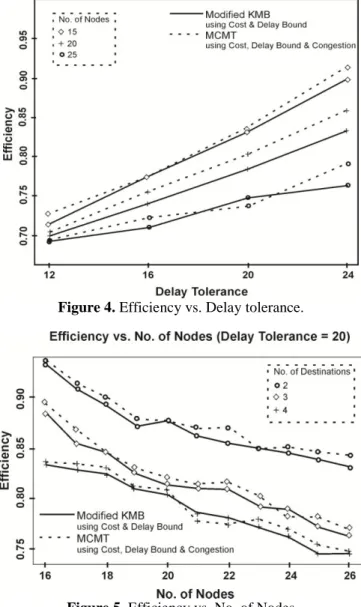
Figure 4. Efficiency vs. Delay tolerance.
Figure 5. Efficiency vs. No. of Nodes
Figure 6. Average Normalized Distance(%) vs. No. of nodes.
Figure 7. Efficiency vs. No. of failure nodes
Figure 8. End-to End Delay vs. failure nodes rate in %
6.
Conclusions
Searching for the optimum route satisfying multi constraint concurrently in wireless mesh network is an NP complete problem. We have considered the multicasting problem with the constraint cost, delay and congestion. Here one source routing based solution has been assumed. The cost of multicast is minimized with guaranteeing the delay in between source and destination and with the edges in the path has least congestion in the proposed MCMT algorithm. The result shows that this exploratory algorithm has good performance when compared with the optimal solution. Since the mobile nodes have some limitations such as inadequate power, if it has multicast requirements, it simply directed the requirements to its neighboring mesh router which search an optimum path and then sent the path to the source node. Our future interests are to expand the competence by adding more new matrices.
References
[1] Vijaya Kumar Gurram, C shoba Bindu,“A New Method of User Association in Wireless Mesh Networks”, International Journal of Communication Networks and Information Security (IJCNIS), Vol. 9, No. 1, pp. 12-21, 2017.
[2] Akyildiz, I.F. Xudong Wang; “A survey on wireless mesh networks,” Communications Magazine, IEEE Vol. 43, No.9, pp.S23 - S30, 2005.
[3] Jean Louis Ebongue Kedieng Fendji, Jean Michel Nlong, “Rural Wireless Mesh Network: A Design Methodology”, in Int. J. Communications, Network and System Sciences, vol. 8, No. 1,pp.1-9,2015.
Transactions on Wireless Communications, Vol.15, No.2 pp.928–930, 2016.
[5] Yichiet Aun, Selvakumar Manickam and Shankar Karuppayah, “A Review on Features’ Robustness in High Diversity Mobile Traffic Classifications”, International Journal of Communication Networks and Information Security (IJCNIS), Vol. 9, No. 2, pp. 294-304, 2017.
[6] R. Bruno, M. Conti, and E. Gregori, “Mesh Network: Commodity Multihop Ad Hoc Networks”, Communications Magazine, IEEE, Vol. 43, No. 3, pp. 123- 131, 2005.
[7] E. W. Dijkstra, “A note on two problems in connexion with graphs,” Numerische Mathematik, vol. 1, pp. 269-271, 1959. [8] S. Hakimi, “Steiner’s problem in graphs and its implications,”
Networks, vol. 1,N.2, pp. 113-133, 1971.
[9] Richard M. Karp, “Reducibility among combinatorial problems,”Complexityof Computer Computations,Vol.40,No. 4, pp. 85-103, 1972.
[10]L. Kou, G. Markowsky, and L. Berman, “A fast algorithm for Steiner trees,” Acta Informatica, Vol. 15, No.2, pp. 141-145, 1981.
[11]V. Rayward-Smith, “The computation of nearly minimal Steiner trees in graphs,” Intl. J. Math. Educ. Sc:.Tech., vol. 14, no. 1, pp. 15-23, 1983.
[12]H. Takahashi and A. Matsuyama, “An approximate solution for the Steiner problem in graphs,” Math.Japonica, Vol. 6, No.6, pp. 573-577, 1980.
[13]D. Wall, Mechanisms for Broadcast and Selective Broadcast. PhD thesis, Elect. Engin. Dept., Stanford University, Jun 1980.
[14]B. Waxman, “Routing of multipoint connections,” IEEE J. on Selected Areas in Comm., vol. 6,No. 9, pp. 1617-1622, 1988. [15]C.H. Chow, “On multicast path finding algorithms,” Proc. of
IEEE INFOCOMM, pp. 1274-1283, 1990.
[16]B. Kadaba and J. Jaffe, “Routing to multiple destinations in computer networks,” IEEE Trans. on Comm., vol. 31, No. 3,pp. 343-351, 1983.
[17]D. Ferrari and D. Verma, “A scheme for realtime channel establishment in wide-area networks,” IEEE J. on Selected Areas in Comm., vol. 8, No.5,pp. 368-379, 1990.
[18]A. Raniwala and T. Chiueh, “Architecture and algorithms for an IEEE 802.11 based multi-channel wireless mesh network”, in Proc. of IEEE INFOCOM, Vol. 3, 2005.
[19]Rakesh Matam and Somanath Tripathy, “Secure Multicast Routing Algorithm for Wireless Mesh Networks”,in Journal of Computer Networks and Communications Volume 2016 (2016), Article ID 1563464.
[20]Khalid Mahmood,Babar Nazir, ftikhar Ahmad Khan and Nadir Shah, “Search-based routing in wireless mesh networks”,EURASIP journal on Wireless Communications and Networking”, Vol.14, No. 19,on pp.1 -15, 2017.
[21]Ahmed Al-Saadi, Rossitza Setchi and Yulia Hicks, “Routing Protocol for Heterogeneus Wireless Mesh Networks”, IEEE Transations on Vehicular Technology, volume 65,No.12, pp. 9773-9786, 2016.
[22]Celso Barbosa Carvalho and José Ferreira de Rezende, “Routing for capacity improvement in Multichannel-Width Multi-Radio Wireless Mesh Networks”, International Journal of Communication Networks and Information Security (IJCNIS), Vol. 7, No. 3, pp. 197-206, 2015.
[23]M. Alicherry, R. Bhatia and L. Li, ”Joint channel assignment and routing for throughput optimization in multi-radio wireless mesh networks”, Proc. of ACM MobiCom, pp.58-72 2005.
[24]M. Kodialam and T. Nandagopal, “Characterizing the capacity region in multi-radio multi-channel wireless mesh networks”, in Proc. of IEEE WiMesh, pp. 73-87,2005.
[25] J. Tang, G. Xue, and W. Zhang, “Maximum throughput and fair bandwidth allocation in multi- channel wireless mesh networks”, in Proc. of IEEE INFOCOM, pp.68-77,2006.