G00219770
Additional Tools for a World-Class ERP
Infrastructure
Published: 28 October 2011 Analyst(s): Pat Phelan, Derek Prior
This research provides a guide to the infrastructure elements that are
needed (to varying degrees of depth and scope) for ERP implementations
and postimplementation support, but aren't always explained or offered by
the ERP vendor. Application leaders and IT managers should use this
research to identify areas where tools can improve ERP manageability and
total cost of ownership (TCO).
Key Findings
■ Gartner clients frequently say that their ERP sales representatives claimed that no extra
infrastructure management tools were needed for their ERP projects. However, in reality, clients needed many additional tools.
■ In some cases, additional tools are optional; however, in other cases, they are mandatory to
achieve a complete implementation.
■ Gartner receives many inquiries regarding advice about tools utilized by other ERP users. ■ Infrastructure management tools often are not planned for as part of the ERP life cycle, or
included in the budget for TCO.
Recommendations
■ Enterprises planning an ERP implementation should also plan and budget for infrastructure
management tools to lower their cost of ERP ownership, and to improve the application's availability and manageability.
■ Enterprises that have ERP projects with more than 300 concurrent users should consider where
additional infrastructure management tools (beyond those that come with the ERP stack) would enable a single view of their entire infrastructure, or streamline the efficiency of their application administration and operations teams.
■ As part of the selection process, enterprises should determine the performance overhead that's
needed by each tool, as well as its ongoing support cost. Predicting ROI from a tool investment is hampered by the lack of real savings data.
Analysis
System administrators on ERP implementation projects often ask Gartner whether they should invest in tools to manage their ERP applications and underlying infrastructures. If so, then they also ask about the support areas where tools would provide value, and what types of tools they should investigate. Many enterprises realize too late in their projects that additional tools are required to have an integrated view of the complete ERP solution, including the ERP application, hardware platform, operating system, database and network components.
Which Projects Need Extra Tools?
Small ERP projects (with fewer than 300 concurrent users) are often less complex, and may have a smaller impact on the information and data integration, IT infrastructure, and IT services that support the project. Therefore, these projects are less likely to need additional infrastructure management tools, beyond what is supplied with the ERP stack. The size of the application portfolio also impacts the need for infrastructure tools and services. The smaller the application footprint, the fewer tools needed to manage it, and vice versa.
Larger projects in terms of user workload invariably are more complex, and, as a matter of policy, enterprises often insist on a more automated and process-driven approach to managing their complete infrastructures — within the ERP application, as well as between the ERP and non-ERP applications. Such projects will need several infrastructure management tools, due to the greater impact on the enterprise's IT infrastructure and IT services. However, any ERP project in which IT operations is outsourced won't need these tools, other than those for monitoring the delivery of the outsourcer's SLAs.
Which Tools?
A wide range of management tools has evolved to form part of the ERP ecosystem. ERP vendors have recognized the importance of these tools, especially in areas such as backup/restore, job scheduling and others. Consequently, ERP vendors have enacted formal programs to test and certify the product interfaces. Under ERP vendors' software partner programs, third-party applications, interfaces and software tools are formally tested to ensure that they conform to
interfacing standards for the vendors' products. However, the ERP vendors don't take responsibility for any environmental changes needed to run the tools. For example, infrastructure management tools may impose a system performance penalty. Additional server resources, such as CPU, disk and memory, aren't in scope for the ERP-vendor-provided sizing estimates.
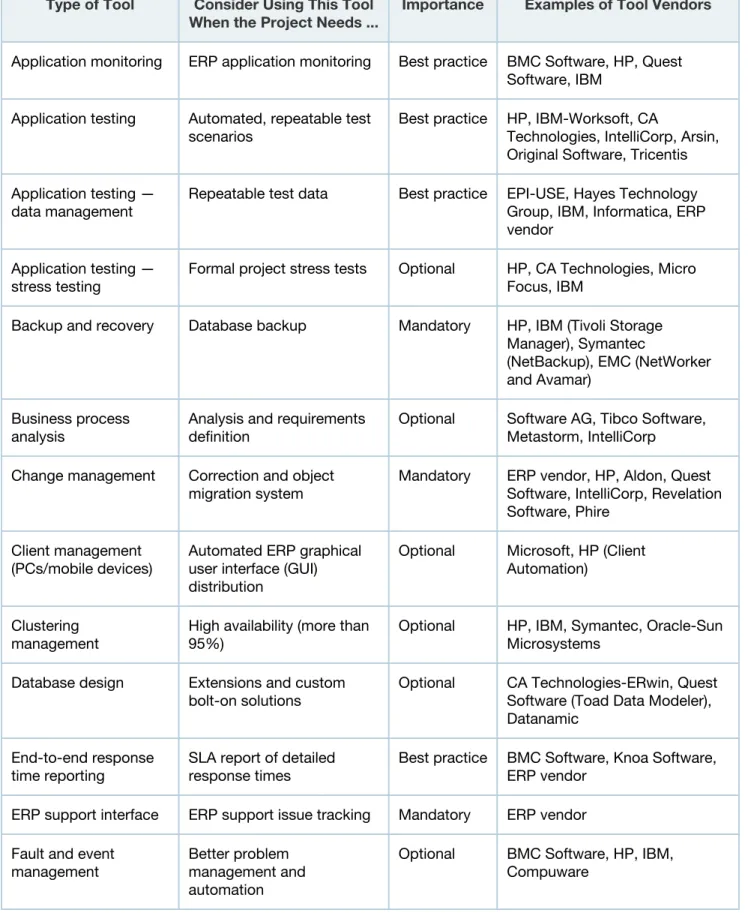
■ An example of the kinds of tools available for ERP infrastructure management. Although you
need some knowledge of each required tool during the infrastructure design phase, most of the tools are first used during the implementation phase of the ERP life cycle.
■ Criteria to determine whether a tool will be needed in a given infrastructure management area,
as well as a sample of vendors that provide each type of tool. For a complete list of certified third-party vendors, see the ERP vendor's website. Several infrastructure management tool vendors provide more than one type of tool.
■ The relative importance of each type of tool, and identifies particular areas of Gartner best
practices. Importance is defined as follows:
■ Mandatory: a tool that is always a prerequisite to a complete, reliable ERP infrastructure ■ Best practice: a tool that has a major impact on improving the overall reliability and
cost-effectiveness of the ERP infrastructure
■ Optional: a tool with the potential to improve the reliability and cost-effectiveness of the
Table 1. Guide to ERP Infrastructure Management Tools Used During Implementation
Type of Tool Consider Using This Tool
When the Project Needs ... Importance Examples of Tool Vendors
Application monitoring ERP application monitoring Best practice BMC Software, HP, Quest Software, IBM
Application testing Automated, repeatable test scenarios
Best practice HP, IBM-Worksoft, CA
Technologies, IntelliCorp, Arsin, Original Software, Tricentis
Application testing — data management
Repeatable test data Best practice EPI-USE, Hayes Technology Group, IBM, Informatica, ERP vendor
Application testing — stress testing
Formal project stress tests Optional HP, CA Technologies, Micro Focus, IBM
Backup and recovery Database backup Mandatory HP, IBM (Tivoli Storage Manager), Symantec
(NetBackup), EMC (NetWorker and Avamar)
Business process analysis
Analysis and requirements definition
Optional Software AG, Tibco Software, Metastorm, IntelliCorp
Change management Correction and object migration system
Mandatory ERP vendor, HP, Aldon, Quest Software, IntelliCorp, Revelation Software, Phire
Client management (PCs/mobile devices)
Automated ERP graphical user interface (GUI) distribution
Optional Microsoft, HP (Client Automation)
Clustering management
High availability (more than 95%)
Optional HP, IBM, Symantec, Oracle-Sun Microsystems
Database design Extensions and custom bolt-on solutions
Optional CA Technologies-ERwin, Quest Software (Toad Data Modeler), Datanamic
End-to-end response time reporting
SLA report of detailed response times
Best practice BMC Software, Knoa Software, ERP vendor
Type of Tool Consider Using This Tool
When the Project Needs ... Importance Examples of Tool Vendors
Fax integration Fax integration Optional Fenestrae, OpenText (RightFax)
Infrastructure configuration management and provisioning
Server provisioning and configuration, and application release automation
Optional HP, IBM Tivoli, BMC Software, CA Technologies, Microsoft
Job scheduling Detailed batch job management
Best practice UC4 Software, IBM, ASG, Redwood Software
Middleware management
Cross-product integration Optional ERP vendor, IBM, Microsoft, Tibco Software, Software AG
Network management Large, in-house network management
Optional HP, IBM, CA Technologies, NetScout Systems
Operating system monitoring
Detailed operating system monitoring
Optional IBM, Oracle-Sun Microsystems, Red Hat
Output management Report distribution management
Optional Macro 4, LogRhythm
Remote control Remote desktop session management
Optional Microsoft, Symantec, LANDesk
Requirements management
Complex requirements management
Optional IBM-Telelogic, iRise
Security management Secure external access to systems
Best practice ArcSight, IBM, Cisco, Symantec, Virtual Forge
Security testing Formal project security testing
Optional HP, IBM, Onapsis, TestPro
Service-level reporting Business SLA reporting Optional Knoa Software, ERP vendor
Software metering User authentication management
Optional ERP vendor
Storage management Storage device management
Optional EMC-Softworks, NetApp, HP, CA Technologies
Type of Tool Consider Using This Tool
When the Project Needs ... Importance Examples of Tool Vendors
Workload balancing Multiple ERP instances on one server
Optional IBM, HP, Citrix Systems-Aurema
Source: Gartner (October 2011)
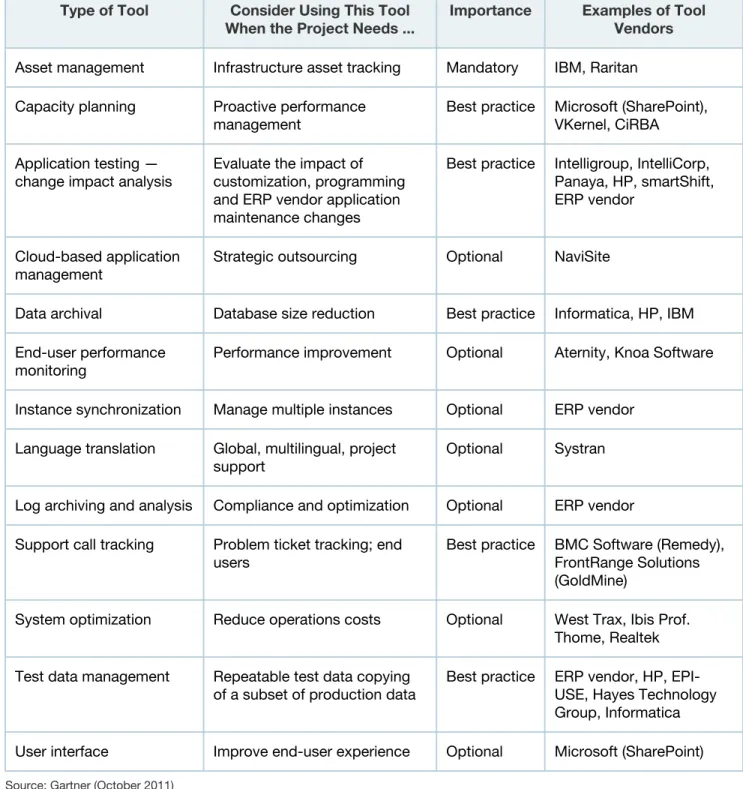
Infrastructure management tools that represent Gartner best practices have a very high impact on the operational efficiency of the operations team, enable the team to be highly proactive and/or enable the team to deliver an exemplary level of customer service. These Gartner best-practice attributes are required to build and operate ERP infrastructures that are considered world-class. Use Table 1 as a guide to planning your investments in ERP infrastructure management tools. These investments will lower the cost of ownership of the ERP infrastructure, and will improve its overall performance and availability. This is significant for enterprises that intend to deploy multiple business applications or instances from the vendor's suite, because this will multiply the number of technology components (e.g., servers) required in the ERP infrastructure. All these servers, storage media and other infrastructure components must integrate and be managed as one entity.
Other benefits of using the right tools include more efficient use of the application administration and operations teams, and the capability to provide the business with a world-class ERP
infrastructure that maximizes the performance, availability and manageability of the ERP
application. The list of vendors in Table 1 is for guidance only, and is not a list of recommended vendors or a best-of-breed list. The tools listed for the implementation phase will also be used (in many cases) after the system has been moved into the production operations phase.
The tools listed in Table 2 are additional tools that become relevant once the application enters the production operations phase. Before deploying these tools, ensure that you optimize your generic IT support processes for incident management, problem management and change management.
Table 2. Guide to ERP Infrastructure Management Tools Used During Production Operations
Type of Tool Consider Using This Tool
When the Project Needs ... Importance Examples of ToolVendors
Asset management Infrastructure asset tracking Mandatory IBM, Raritan
Capacity planning Proactive performance management
Best practice Microsoft (SharePoint), VKernel, CiRBA
Application testing — change impact analysis
Evaluate the impact of customization, programming and ERP vendor application maintenance changes
Best practice Intelligroup, IntelliCorp, Panaya, HP, smartShift, ERP vendor
Cloud-based application management
Strategic outsourcing Optional NaviSite
Data archival Database size reduction Best practice Informatica, HP, IBM
End-user performance monitoring
Performance improvement Optional Aternity, Knoa Software
Instance synchronization Manage multiple instances Optional ERP vendor
Language translation Global, multilingual, project support
Optional Systran
Log archiving and analysis Compliance and optimization Optional ERP vendor
Support call tracking Problem ticket tracking; end users
Best practice BMC Software (Remedy), FrontRange Solutions (GoldMine)
System optimization Reduce operations costs Optional West Trax, Ibis Prof. Thome, Realtek
Test data management Repeatable test data copying of a subset of production data
Best practice ERP vendor, HP, EPI-USE, Hayes Technology Group, Informatica
User interface Improve end-user experience Optional Microsoft (SharePoint)
Source: Gartner (October 2011)
Recommended Reading
"Cool Vendors in Data Center Infrastructure Management Tools, 2011" "Cool Vendors in IT Asset Management, 2011"
"Cool Vendors in Infrastructure Protection, 2011"
"Cool Vendors in Identity and Access Management, 2011" "Cool Vendors in User and Data Security, 2011"
"Cool Vendors in IT Operations Management, 2011" "Cool Vendors in the SAP Ecosystem, 2011"
"Cool Vendors in Application Services, 2011" "Cool Vendors in Release Management, 2011"
"Server Provisioning Automation: Vendor Landscape"
Regional Headquarters
Corporate Headquarters
56 Top Gallant Road Stamford, CT 06902-7700 USA +1 203 964 0096 Japan Headquarters Gartner Japan Ltd. Aobadai Hills, 6F 7-7, Aobadai, 4-chome Meguro-ku, Tokyo 153-0042 JAPAN +81 3 3481 3670 European Headquarters Tamesis The Glanty Egham Surrey, TW20 9AW UNITED KINGDOM +44 1784 431611
Latin America Headquarters
Gartner do Brazil
Av. das Nações Unidas, 12551 9° andar—World Trade Center 04578-903—São Paulo SP BRAZIL
+55 11 3443 1509
Asia/Pacific Headquarters
Gartner Australasia Pty. Ltd. Level 9, 141 Walker Street North Sydney
New South Wales 2060 AUSTRALIA
+61 2 9459 4600
© 2011 Gartner, Inc. and/or its affiliates. All rights reserved. Gartner is a registered trademark of Gartner, Inc. or its affiliates. This publication may not be reproduced or distributed in any form without Gartner’s prior written permission. The information contained in this publication has been obtained from sources believed to be reliable. Gartner disclaims all warranties as to the accuracy, completeness or adequacy of such information and shall have no liability for errors, omissions or inadequacies in such information. This publication consists of the opinions of Gartner’s research organization and should not be construed as statements of fact. The opinions expressed herein are subject to change without notice. Although Gartner research may include a discussion of related legal issues, Gartner does not provide legal advice or services and its research should not be construed or used as such. Gartner is a public company, and its
shareholders may include firms and funds that have financial interests in entities covered in Gartner research. Gartner’s Board of Directors may include senior managers of these firms or funds. Gartner research is produced independently by its research organization without input or influence from these firms, funds or their managers. For further information on the independence and integrity of Gartner research, see “Guiding Principles on Independence and Objectivity” on its website, http://www.gartner.com/technology/about/