Dimensioning Methodologies for the
BroadbandLoop Access Network
Susana Sargento, Rui Valadas, Amaro de Sousa
University of Aveiro / Institute of Telecommunications, 3810 Aveiro, Portugal
Abstract. This paper presents methodologies for dimensioning access networks based on ATM technology, taking as a case study the Passive Optical Access Network (PON) being developed as part of the Broadband Loop (BBL) project, from the European Program ACTS - Advanced Communications Technology and Services.
1. Introduction
The BroadbandLoop (BBL) network [1] is a full-service access network, based on ATM technology, which provides for a graceful introduction of fiber into the local loop when the bandwidth demand increases. This network is being developed within BBL project, from the European program ACTS - Advanced Communications Technology and Services (ACTS 038).
The deployment of multi-service broadband access networks is severely constrained by cost factors. A key issue to be discussed is whether or not signalling functions should be included in the network elements. The signalling raises the price of the system but allows for more efficient resource management strategies. In an ATM based access network, the resources can be managed through the use of Virtual Paths (VPs). Different solutions impose different requirements in terms of signalling functions.
The dimensioning of an ATM network is determined by the network topology, the resource management strategy and the service characteristics [2]. We assume fixed routing and service segregation in VPs. In this case, the dimensioning of each service can be partitioned in two levels. Call level dimensioning determines the number of circuits required to achieve a specified Grade-of-Service (GoS). Cell level dimensioning determines the bandwidth to be allocated to each circuit, in order to achieve a specified cell level Quality-of-Service (QoS). In this paper we present methodologies for dimensioning the BBL network under different resource management strategies. Section 2 presents the BBL network and the supported services. Section 3 proposes the resource management strategies under study. Section 4 and section 5 present the call level and cell level dimensioning methods. In order to illustrate the dimensioning methods, some case studies are discussed in section 6.
2. BroadbandLoop System and Supported Services
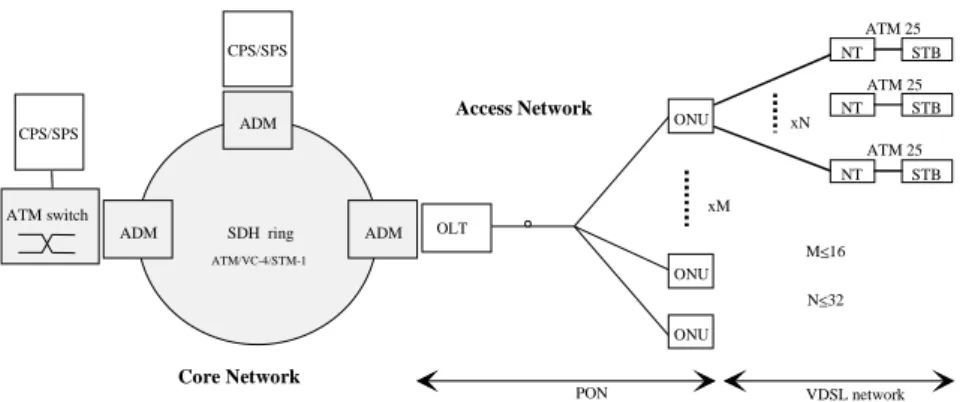
The BBL system is an ATM access network [3] [4] targeted to connect end-user terminals to the ATM transport network. The BBL system is separable in core and access network (Figure 1), each one using different transmission technologies.
The core network is based on an SDH (Synchronous Digital Hierarchy) ring with an ATM switch and one OLT (Optical Line Termination) attached. In the general case, the system can include several access networks and the SDH ring provides connectivity between the access networks and the ATM switch. This connectivity is implemented between the ATM switch
and the OLT by means of SDH VC-4 containers (155 Mb/s). We will refer to the ATM switch as the OAS (Outside ATM Switch).
The access network consists of an OLT that performs the adaptation between the core network and the access network, a single Optical Distribution Network (ODN) based on a PON (Passive Optical Network), up to 16 Optical Network Units (ONUs) and point-to-point connections between each ONU output and a Network Terminator (NT) using VDSL (Very high bit rate Digital Subscriber Line) copper technology. Each ONU is able to serve a maximum of 32 Set Top Boxes (STBs) via Network Terminations (NTs). Thus each PON accepts a maximum of 512 end-users. We assume that only a percentage of these users may be subscribing a given service; this is the service penetration.
The optical part of the access network is an upgradeable system that enables operators to match more closely their network investments with the traffic they need to support. In the downstream direction, the basic system broadcasts a baseband ATM stream of 155.52 Mb/s. All ONUs receive the stream and, depending on the VPI/VCI values of each cell, forward them to the final destination or discard them. Therefore, the bandwidth allocated to each ONU is configurable at the ATM level. In the upstream direction, the basic system uses Sub-Carrier Multiplexing (SCM) in the OLT receiver and each ONU transmits an ATM stream of 9.72 Mb/s in its own sub-carrier. The system can be upgraded both in upstream and downstream directions with modules of 51.84 Mb/s using also SCM. Each upgrade module adds this bandwidth between the OLT and the ONU that is upgraded. Upgrades can be installed whenever the operator requires.
In the copper part of the access network, there are two types of FTTC (fiber-to-the-curb) ONUs that differ on the bandwidth of the VDSL lines. The symmetrical ONUs have VDSL lines with 13 Mb/s in both directions. The asymmetrical ONUs have VDSL lines of 51.5 Mb/s in the downstream and 1.6 Mb/s bandwidth in the upstream direction. These values were defined not only because of technical reasons (low-cost hardware components that are available for these line rates) but also for the system to be able to provide both symmetric and asymmetric type of services.
Within the BBL project, a set of services were selected for consideration in the dimensioning of the BBL system. These services [3] were grouped in residential and business: residential services are Fast Internet Access (FIA), MPEG-2 Video-on-Demand (VoD), MPEG-2 Digital Video Broadcast (DVB); business services are Fast Internet Access (FIA), Video-Conference (Vc) and LAN-to-LAN Interconnection (LLI).
Different service characteristics impose different requirements in the network dimensioning procedures. All services are considered real-time which means that some bandwidth should be reserved for each service to guarantee the specified QoS. For this purpose services can be classified in conversational versus retrieval, switched versus permanent and symmetrical
versus asymmetrical. In retrieval services (FIA, VoD, DVB), VCCs are requested from an
ADM
ADM OLT
ATM switch
SDH ring
ATM/VC-4/STM-1
CPS/SPS
CPS/SPS
Access Network
ADM
ONU
ONU
PON VDSL network
xM
ONU xN
STB NT
STB NT
STB NT
Core Network
ATM 25
ATM 25
ATM 25
M≤16
N≤32
user attached to the PON to an outside destination. In conversational services (Vc, LLI), VCCs can also be requested between users internal to the PON. In switched services (FIA, VoD and Vc), calls are established on-demand by the ATM control plane while in permanent
services (DVB and LLI) circuits between peers are always available and configured at the management plane. Switched services require dimensioning at call level. In symmetric
services (Vc and LLI) VCCs require the same resources in both directions, and in asymmetric
services (FIA, VoD and DVB) much more resources are requested in the downstream direction than in the upstream direction. Note that residential services are all asymmetric and business services are mainly symmetric. Consequently, a symmetrical VDSL interface is adequate for business users while asymmetric VDSL interfaces are adequate for residential users. We consider that symmetric ONUs are used only for business services and the asymmetric ONUs are used only for residential services.
3. Resource Management Strategies
There are two important issues related to resource management: how VPCs are configured and how VCCs (either permanent or switched) are multiplexed within the same VPC or between different VPCs. In terms of VPC configuration, one aspect that has direct impact on the cost of the system is whether or not resource management mechanisms, namely CAC (Call Admission Control) and UPC (Usage Parameter Control), are implemented in the different network elements. We propose three different VPC design strategies:
• VPCs between each ONU and an outside ATM switch (Figure 2.a). This strategy can be used when no CAC functions are available on the OLT and ONUs. This is a tunnelling solution where there must be a different VPC between each attached terminal and the OAS in order to enable it to identify the cells from each terminal. We assume that there are UPC functions in the ONUs, configurable at the management plane, to prevent non-contracted traffic generated by terminals to influence the QoS of other communications.
• VPCs between each ONU and the OLT (Figure 2.b) and an extra VPC between the OLT and an outside ATM switch to support communications with the outside. This strategy is used when there are CAC functions implemented only in OLT. For each ONU, there must be a different VPC between each attached terminal and the OLT in order to enable the OLT to identify the cells from each terminal. Like in the previous strategy, we assume that there are UPC functions in the ONU. However, it is possible to consider (since OLT and ONUs are from the same manufacturer) the implementation of UPC functions in the ONUs at the control plane, i.e. each request for a call establishment (from an user terminal) is received at the OLT (through the appropriate VPC) that sets up the appropriate UPC parameters on the ONU (using perhaps a proprietary solution) before confirming to the terminal the call establishment.
• VPCs between each ONU pair (Figure 2.c) and extra VPCs between each ONU and an outside ATM switch to support communications with the outside. This strategy is suitable when there are CAC (and UPC) functions only in the ONUs. In this case, OLT acts just as a VP cross-connect.
Another alternative is to have CAC functions implemented in both ONU and OLTs. The 2nd VPC design strategy also applies and the dimensioning procedures can be reused with minor modifications.
In terms of VCC multiplexing, BBL system is designed with four output buffers per interface in both the OLT and ONUs. Thus each service can be allocated a distinct buffer
allowing the set-up of a logical network with reserved resources per service (with any of the VPC design strategies presented above).
4. Call Level Dimensioning
The call level dimensioning calculates the number of circuits in each VP required to provide a specified GoS. We have considered the call blocking probability as the GoS parameter. The system can be modelled at call level through a multidimensional birth-death process, where the state of the system corresponds to the number of calls in progress for each traffic class. A traffic class is determined by the origin-destination pair, the route, the bandwidth per call and the traffic intensity. The origin-destination pairs can be two ONUs, one ONU and the OLT, one OLT and the OAS or one ONU and the OAS. We assume the following symmetry condition: the percentage of traffic that goes out of the PON (and of each ONU) is the same that goes into the PON (and of each ONU). In some cases, the model can be simplified to allow the exact calculation of the blocking probability (e.g. through the Erlang B formula). In other cases, the complexity associated with the resolution of the multidimensional birth-death process, makes it necessary to resort to reduced load approximations.
In practice users are arbitrarily distributed by the 16 ONUs of a PON. The impact in terms of dimensioning can be studied by considering two extreme cases: (i) users equally distributed in the 16 ONUs (maxONUs - here the bandwidth in the connections ONU ↔ OLT is minimum but the number of needed ONUs is maximum) and (ii) users distributed in the minimum number of required ONUs (minONUs - here the bandwidth in the connections ONU ↔ OLT is maximum but the number of required ONUs is minimum).
OLT
ONU 1
x32
USER1
ONU 2
x32
USERx
USERy
USERz
N≤16 ONU N
x32
USERt
USERM M ≤16 x 32 Outside
a)
OLT
ONU 1
x32
USER1
ONU 2
x32
USERx
USERy
USERz
N≤16 ONU N
x32
USERt
USERM M ≤ 16 x 32 Outside
b)
OLT
ONU 1
x32
USER1
ONU 2
x32
USERx
USERy
USERz
N≤16 ONU N
x32
USERt
USERM M ≤16 x 32 Outside
c)
Figure 2 – a) VP connections between each ONU and an outside ATM switch; b) VP connections between each ONU and the OLT; c) VP connections between each ONU pair
VP connections between each ONU and an outside ATM switch
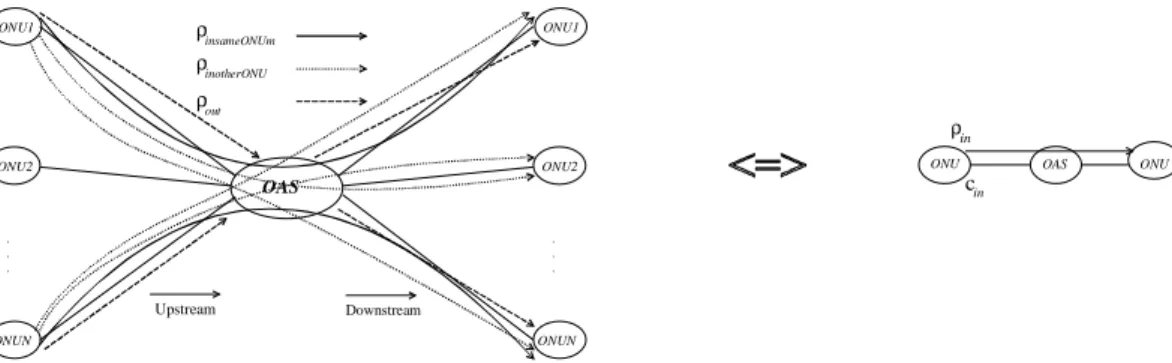
Figure 3 shows the different types of traffic classes in the maxONUs case. The OLT is only a cross-connect, thus it is not represented in the figure. One end-user may establish a connection with another one in the same ONU (ρinsameONU), in another ONU (ρinotherONU), or in another PON (ρout). The traffic that leaves or enters each ONU is the same and given by ρin = ρinsameONU+(N-1)ρinotherONU+ρout. In the case of retrieval services, only the traffic classes from the ONU to the OAS and vice-versa exist. Here we make the assumption that call blocking in the upstream and downstream directions are independent. Thus for these services ρin = ρout. For each origin there are 17 possible destinations (16 internal to the PON and one external). Thus there is a total of 272 traffic classes. However, due to the symmetry of the system this is equivalent to a single class with offered traffic ρin sharing a single resource with cin circuits. Therefore, the Erlang B formula can be used. We will denote the Erlang B formula by ErB(ρ,
c), where ρ is the traffic intensity and c the number of circuits. The number of circuits cin (in the connection between the OLT and the ONU) and cout (in the connection between the OLT and the outside) can be derived from GoS = ErB(ρin,cin) and cout = N× cin.
Figure 4 shows the traffic classes in the minONUs case. There are two types of ONUs: type
m (with the maximum number of users, offering a total load of ρinm) and type r (with the remaining users, offering a total load of ρinr). This is the j-th ONU in Figure 4. There are also two types of VPs: type m (from a type m ONU to the OAS and vice-versa), with cinm circuits, and type r (from a type r ONU to the OAS and vice-versa), with cinr circuits. The traffic that goes out of an ONU of type m will be less than the same traffic in the maxONU case. The Erlang B formula can be used in type m VPs provided that:
OAS
ONU1
ONUN ONU2
. . .
ONU1
ONUN ONU2
. . .
Upstream Downstream
ONU OAS ONU
ρinsameONUm ρinotherONU
ρout
ρin
cin
Figure 3 – Traffic classes in the 1st strategy and equivalent model (maxONUs).
OAS
ONU1m
ONUjr ONU2m
. . .
ONU1m
ONUjr ONU2m
. . .
ρinsameONUm
ρinotherONUm
ρoutm1
ρinotherONUmr ρoutm2
ρinsameONUr ρoutr1
ρinotherONUrm ρoutr2
ONU1 ONU1 OAS ρinm
ONU j ρ
inr
ONU j
. . .
. . .
Upstream Downstream cinr
cinm
(
)
(
)
21
2 2
outm rm
inotherONU m
inotherONU insameONUm
outm mr
inotherONU m
inotherONU insameONUm
j j
ρ ρ
ρ ρ
ρ ρ
ρ ρ
+ +
− + =
= +
+ −
+
and in type r VPs provided that:
( )
1 inotherONUrm our1 insameONUm( )
1 inotherONUmr outr2insameONUm j ρ ρ ρ j ρ ρ
ρ + − + = + − +
Since, due to symmetry, ρoutm1 = ρoutm2 and ρoutr1 = ρoutr2 its remains that ρinotherONUmr = ρinotherONUrm This condition is only true for PONs with 4, 8, 12 and 16 ONUs. The number of circuits in type m and type r VPs and in the connection between the OLT and the OAS can be calculated from GoS = ErB(ρinm,cinm), GoS = ErB(ρinr,cinr) and cout = (j-1)×cinm+cinr.
A PON with a number of ONUs different than the previous one, will have to be dimensioned through a reduced load approximation, as described in [4]. This system is asymmetric because the traffic that goes out of an ONU is different from the traffic that goes into an ONU of the same type, thus preventing the use of the ErlangB formula. Again, in the case of retrieval services, only the traffic classes from the ONU to the OAS and vice-versa exist. Here the Erlang B formula can always be used provided that the symmetry conditions,
ρoutm1 = ρoutm2 and ρoutr1 = ρoutr2, hold.
VP connections between each ONU and the OLT
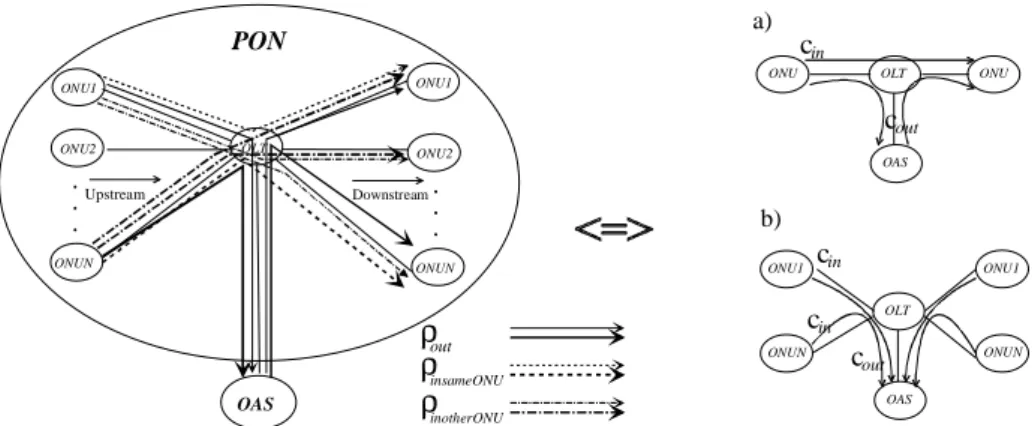
In this case all traffic classes cross two VPs. The simplified model is shown in Figure 5. An upstream VP is shared by traffic classes that will be switched to VPs with different capacities, one VP with cout circuits to the OAS and another with cin to the destination ONU. This is also the case for downstream VPs. It is no longer possible to use the Erlang B formula and we have to resort to a reduced load approximation. The (approximate) blocking probabilities of internal (ONU ↔ OLT) and external (OLT ↔ OAS) VPs are:
(
)
(
) (
)
(
)
[
insameONU in out out inotherONU in in]
in ErB L L N L ,c
L = ρ 1− + ρ 1− + −1 ρ 1−
(
)
[
out in out]
out ErB N L ,c
L = ×ρ 1−
and the call blocking probabilities in each class are Bout = 1-(1-Lin)(1-Lout) and Bin = 1-(1-Lin)2. In the case of retrieval services, the network topology reduces to a tree and exact blocking probabilities can be obtained through a convolutional algorithm [5]. The minONUs case uses similar dimensioning methods [4].
ρout
ρinsameONU
OAS
ONU1
OLT ONU2
ONU1
ONU2
PON
ONUN ONUN
. . .
. . .
ρinotherONU
Upstream Downstream
ONU OLT ONU cin
OAS cout
ONUN ONU1
OLT
OAS
cout ONUN
ONU1 cin
cin
a)
b)
Figure 5 – Traffic classes in the 2nd strategy and equivalent model for a) conversational and b) retrieval services (maxONUs)
VP connections between each ONU pair
In this strategy, each traffic class has reserved resources end-to-end. Therefore the ErlangB formula can be used in all cases. There are two types of VPs: internal (ONU ↔ ONU) requiring cinVP circuits and external (ONU ↔ OAS), requiring coutVP circuits. The number of circuits in each VP can be calculated from ErB(ρinotherONU , cinVP) and ErB(ρout , coutVP). Finally, the number of circuits (required by each service) in the OLT ↔ ONU links is cin = (N-1) × cinVP + coutVP and in the OLT ↔ OAS links is cout = N×coutVP.
5. Cell Level Dimensioning
We consider two bandwidth allocation methods: at the Peak Bit Rate (PBR) and using effective bandwidths. PBR allocation assumes that the traffic source is always transmitting at maximum rate. The effective bandwidth is the bandwidth per source when statistical multiplexing is taken into account. In general, it depends on the number of sources, on the source model, on the buffer capacity and on the cell level QoS parameters. We use an effective bandwidth model based on large deviations theory that considers de cell loss ratio as the QoS parameter [6]. This model is additive (i.e., the bandwidth per source is independent of the number of sources), applies to multiple services and can be extended to feed-forward networks [7] (i.e., the effective bandwidth in a cascade of multiplexing buffers is never higher than the effective bandwidth at the entry buffer). This result is required for the 2nd VPC design strategy. In the 1st and 3rd VPC design strategies there is statistical multiplexing in the ONUs an in the OAS. In the 2nd one, all the network equipments have statistical multiplexing: the OAS, the OLT and the ONUs.
6. Case studies
The dimensioning of the BBL access network consists in determining the number of VC-4 containers in each PON and (if required) the number of upgrade units (both in downstream and upstream directions), for the specified values of service penetration and quality of service (at call and cell level).
We have considered three different scenarios: (i) a residential scenario where all users connected to the system have residential profile, (ii) a business scenario where all users have a business profile and (iii) a mixed residential and business scenario. We assume that traffic in LLI is a mixture of the following services: Fast File Exchange, Fast Fax and POTS [10]. Table 1 lists the call and cell level parameters considered for the selected services. Traffic sources were assumed to be represented at cell level by an IDP (Interrupted Deterministic Process), defined by the PBR, the number of cells in the ON state (burst length) and the percentage of time in the ON state (utilisation). At the call level, the arrival process was assumed to be Poisson with rate BHCA (Busy Hour Call Attempt), and the call duration was assumed to be exponentially distributed with mean MCD (Mean Call Duration).
Figure 6 shows some results for the case of a mixed scenario with 4 business ONUs, the 1st VPC design strategy, maxONUs distribution of users, 25% of calls are between end-users in different PONs and with 4 LLI connections in each ONU. To compare the PBR and the effective bandwidth allocation methods we also used services with an utilisation 3 times lower than the ones defined in Table 1 (denoted Bursty in the figure). The figure shows the required upgrade modules for specific values of service penetration (assuming the same value for all services). With an increase in the service penetration, the number of VC-4 containers and upgrade modules increases. Also with an increase in the GoS values, the number of admissible calls increases, which decreases the required upgrade modules. The number of VC-4 containers is large, because in this VPC design strategy there is no statistical multiplexing in the OLT and all communications cross the connection between the OLT and the OAS. Since the residential services are asymmetric it is difficult to find the need for upgrading the residential ONUs in the upstream direction. This is the case of this example: the required upgrades are all for business ONUs. In the downstream direction, upgrades are required in both types of ONUs. The use of effective bandwidth allocation decreases the number of required modules. More bursty services (with lower utilisation factors) result in a higher waste of resources when PBR allocation is used. For example, the number of VC-4 containers for a service penetration of 100% and a GoS of 0.1% is 7 with PBR allocation, 6 with effective bandwidth and 5 with effective bandwidth and bursty services.
0.25 0.5
0.75 1
VC-4 EfBw Bursty, GoS=10% VC-4 EfBw Bursty, GoS=0.1%
VC-4 EfBw, GoS=0.1% VC-4 PBR, GoS=0.1% 0 1 2 3 4 5 6 7 Nu m b er o f V C -4 c ont a ine rs Service Penetration 0.25 0.5 0.75 1
Down Res EfBw Bursty, GoS=0.1% Down Res EfBw, GoS=0.1%
Down Res PBR, GoS=0.1% 9 10 11 12 R e s ide nt ia l d o w n st ream u p g rad e m odule s Service Penetration 0.25 0.5 0.75 1
Down Bus EfBw Bursty, GoS=0.1% Down Bus EfBw, GoS=0.1%
Down Bus PBR, GoS=0.1% 0 1 2 3 4 Bu sin ess downs tr e a m upgr a d e module s Service Penetration 0.25 0.5 0.75 1
Up Bus EfBw Bursty, GoS=0.1% Up Bus EfBw, GoS=0.1%
Up Bus PBR, GoS=0.1% 0 1 2 3 4 B u sin ess u p s tr eam upgr a d e modul e s Service Penetration
Figure 6 - VC-4 containers, residential and business downstream, and business upstream upgrade modules in a mixed scenario with the 1st strategy (max ONUs)
0.25 0.5
0.75 1
Down Bus PBR, GoS=0.1% Up Bus PBR, GoS=0.1%
VC-4 containers PBR, GoS=0.1% Down Res PBR, GoS=0.1%
0 2 4 6 8 10 12 U pgra d e m odule s Service Penetration
Figure 7 - Modules in a mixed scenario with the 1st strategy (min ONUs) Table 1 - Service traffic parameters at the call and cell level
Services
Services Traffic Parameters VoD [8] IA VD LLI Vc
Traffic Parameters VoD [9] IA VD LLI Vc [10] PBR (Mb/s) (downstream) 6 2 4 * 0.384
MCD (sec) 7200 4 -- * 3600 Burst length ON (cells) 417 10 [9] -- * 27
BHCA (calls/hour) 0.03 30 -- * 0.5 Utilisation (%) 66.(6) 50 100 * 66.(6)
PBR (Mb/s) (upstream) 0.128 0.128 -- * 0.384
* presented in Table 4
Traffic parameters of the LAN to LAN Interconnection services
Direction of traffic Traffic parameters Fast File Exchange Fast Fax POTS
MCD (sec) 5 5 100
Call
level BHCA (calls/hour) 0.1 2.5 3.6
Burst length ON (cells) 10 -- --
Utilisation (%) 50 100 100
Downstream/ Upstream
Cell level
Figure 7 shows some results for the same case described before but with the users distributed in the minimum number of ONUs. With a small service penetration, the bandwidth requirements are lower than the ones with the users equally distributed by the 16 ONUs. For example, for a service penetration of 25% and a GoS of 0.1 %, 12 downstream upgrade modules are required when users are equally distributed by the 16 ONUs and only 2 when users are concentrated in the minimum number of ONUs.
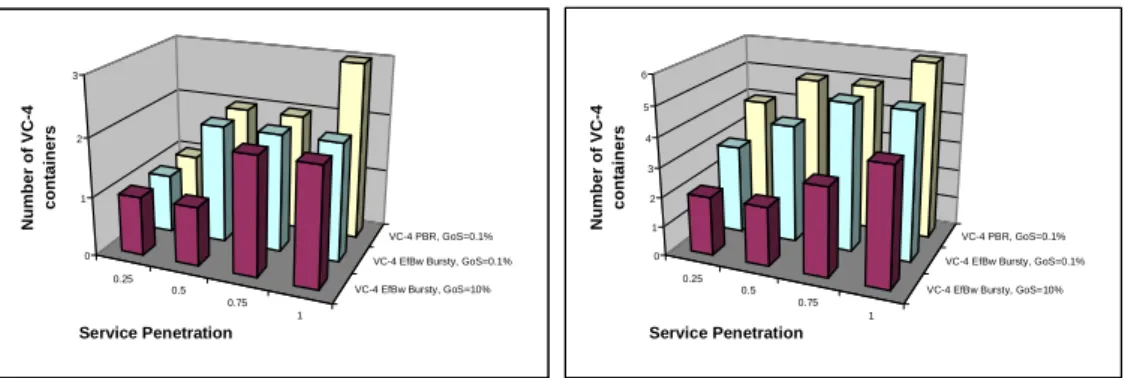
Figure 8 shows the number of VC-4 containers required in the 2nd and the 3rd strategies, respectively. In the 2nd strategy this number decreases, not only because of the statistical multiplexing at the OLT, but also because traffic internal to the PON is not required to go to the OAS. In the 3rd strategy the existence of a VP per traffic class and the lack of statistical multiplexing in the OLT increases the number of VC-4 containers. For example, for a service penetration of 100%, a GoS of 0.1% and PBR allocation, the 1st strategy requires 7 VC-4 containers, the 2nd requires 3 and the 3rd requires 6.
7. Conclusions
Methodologies for dimensioning the BroadBandLoop ATM access network under different resource management strategies were presented. The network topology and the service characteristics were seen to allow several simplifications in the call and cell level dimensioning processes. The dimensioning procedures were illustrated through some case studies.
References
[1] N. Andersen, P. Nordeste, A. Duarte, H. Lassen, A. Ekblad, A. Pach and K. Amborski, BBL: A Full-Service Access Network for Residential and Small Business Users, IEEE Comm. Mag.35 (1997) 88-93.
[2] R. Valadas, Dimensioning and Resource Management of ATM Networks, Proc. of the 7th IFIP/ICCC Intl. Conf. on Information Networks and Data Communications, Aveiro, Portugal (1998) 209-220.
[3] S. Sargento, A. Sousa and R. Valadas, ACTS 0038 – BroadbandLoop – Deliverable 1.2.7 – Real Traffic Sources: Observation and Modelling, 1998.
[4] S. Sargento, A. Sousa and R. Valadas, ACTS 0038 – BroadbandLoop – Deliverable 1.2.9 - Comparison of Simulation and Observation Results, 1999.
[5] D. Tsang and K. Ross, Algorithms to Determine Exact Blocking Probabilities for Multirate Tree Networks, IEEE Transactions on Communications38 (1990) 1266-1271.
[6] G. Kesidis, J. Walrand and C. Cheng-Shang, Effective Bandwidths for Multiclass Markov Fluids and Other ATM Sources, IEEE/ACM Transactions on Networking4 (1993).
[7] J. Walrand, private communication, 1998.
[8] D. Le Gall, MPEG: A Video Compression Standard for Multimedia Applications, Comm. of the ACM 34
(1991).
0.25 0.5
0.75 1
VC-4 EfBw Bursty, GoS=10% VC-4 EfBw Bursty, GoS=0.1%
VC-4 PBR, GoS=0.1% 0
1 2 3
Num
b
e
r of V
C
-4
c
ont
a
ine
rs
Service Penetration
0.25 0.5
0.75 1
VC-4 EfBw Bursty, GoS=10% VC-4 EfBw Bursty, GoS=0.1%
VC-4 PBR, GoS=0.1% 0
1 2 3 4 5 6
Num
b
e
r of V
C
-4
c
ont
a
ine
rs
Service Penetration
[9] J. Gonçalves, P. Fonseca, A. Sousa, R. Valadas and R. Coelho, ACTS 0038 – BroadbandLoop – Deliverable 1.2.2 - Network Modelling simulation Results, 1997.
[10] E. Jaunart and P. Crahay, ATM Super PON Dimensioning for Future Residential and Business Demand, BELGACOM R&D.