Third Edition
editors
Julia Bluestone
Rebecca Chase
Enriquito R. Lu
Jhpiego is an international, non-profit health organization affiliated with The Johns Hopkins University. For nearly 40 years, Jhpiego has empowered front-line health workers by designing and implementing effective, low-cost, hands-on solutions to strengthen the delivery of health care services for women and their families. By putting evidence-based health innovations into everyday practice, Jhpiego works to break down barriers to high-quality health care for the world’s most vulnerable populations.
Copyright © 2006 by Jhpiego. All rights reserved. Reprinted April 2008. Published by:
Jhpiego Brown’s Wharf 1615 Thames Street
Baltimore, Maryland 21231-3492, USA http://www.jhpiego.org
The Capacity Project is an innovative global initiative funded by the United States Agency for International Development (USAID). The Capacity Project applies proven and promising approaches to improve the quality and use of priority health care services in developing countries by:
• Improving workforce planning and policy making;
• Developing better education and training systems for the workforce; and • Strengthening systems to support workforce performance.
Led by IntraHealth International, the Capacity Project partnership includes: Emerging Markets Group, Ltd. (EMG); Interchurch Medical Assistance, Inc. (IMA); Jhpiego; Liverpool Associates in Tropical Health (LATH); Management Sciences for Health (MSH); Program for Appropriate Technology in Health (PATH); and Training Resources Group, Inc. (TRG). http://www.capacityproject.org
Editors: Julia Bluestone Rebecca Chase Enriquito R. Lu Editorial
Assistance: Dana Lewison Melissa McCormick Cover Design: Youngae Kim Graphic
Assistance
and Layout: Youngae Kim
Deborah Raynor
Jamie Wolfe
Illustrations: New figures 5-1 to 5-5 (in Chapter 5) and D-1 to D-7 (in Appendix D) were created by Kimberly Battista.
This reference manual is based on the following two publications:
IUD Guidelines for Family Planning Service Programs: A Problem-Solving Reference Manual(Third Field-Test Draft for Pakistan), by Lu R, Bluestone J, Chase R, and Lewison D (eds). Copyright © 2005 by Jhpiego. All rights reserved.
IUD Guidelines for Family Planning Service Programs: A Problem-Solving Reference Manual, 2nd ed, by McIntosh N,
Kinzie B, and Blouse A (eds). Copyright © 1998 by Jhpiego. All rights reserved.
TRADEMARKS: All brand and product names are trademarks or registered trademarks of their respective companies.
TABLE OF CONTENTS
Abbreviations and Acronyms ... vii
Preface ... ix
Acknowledgments... xi
How This Learning Package Is Intended to Be Used ... xii
CHAPTER ONE: INTRODUCTION TO INTRAUTERINE CONTRACEPTIVE DEVICES
Background ...1-1
Basic Information about the IUD...1-3
Addressing Common Misconceptions about the IUD ...1-6
Overview of the WHO Medical Eligibility Criteria...1-8
Overview of Quality IUD Services ...1-14
CHAPTER TWO: FAMILY PLANNING EDUCATION AND COUNSELING
Background ...2-1
Tips for Effective Education...2-3
Tips for Effective Counseling...2-4
The Counseling Process ...2-5
CHAPTER THREE: INFECTION PREVENTION
Background ...3-1
Overview of Infection Prevention for General Clinical Practice ...3-2
Specific Infection Prevention Tips for IUD Insertion or Removal...3-10
CHAPTER FOUR: CLIENT ASSESSMENT
Background ...4-1
Assessment ...4-2
Next Steps ...4-15
CHAPTER FIVE: IUD INSERTION AND REMOVAL
Background ...5-1
Essential Supplies ...5-2
IUD Insertion...5-4
IUD Removal ...5-15
CHAPTER SIX: FOLLOW-UP CARE AND MANAGEMENT OF POTENTIAL PROBLEMS
Background ...6-1
Follow-Up Visits...6-2
Management of Potential Problems ...6-5
PREVENTION PROCESSES
APPENDIX B: IUD CHECKLISTS
APPENDIX C: INSTRUCTIONS FOR LOADING THE REGULAR COPPER T 380A IN ITS
STERILE PACKAGE
APPENDIX D: INSTRUCTIONS FOR LOADING THE TCU 380A WITH SAFE LOAD IN ITS
STERILE PACKAGE
BIBLIOGRAPHY
TABLES, FIGURES, AND TEXTBOXES
TABLES
Table 1-1.
Categories Based on the WHO MEC for Contraceptive Use ... 1-9
Table 2-1.
The GATHER Technique ... 2-7
Table 3-1.
Steps in Processing Instruments, Gloves, and Other Items Used
in IUD Services... 3-13
Table 4-1.
Targeted History and Follow-Up for Potential IUD Users ... 4-4
Table 4-2.
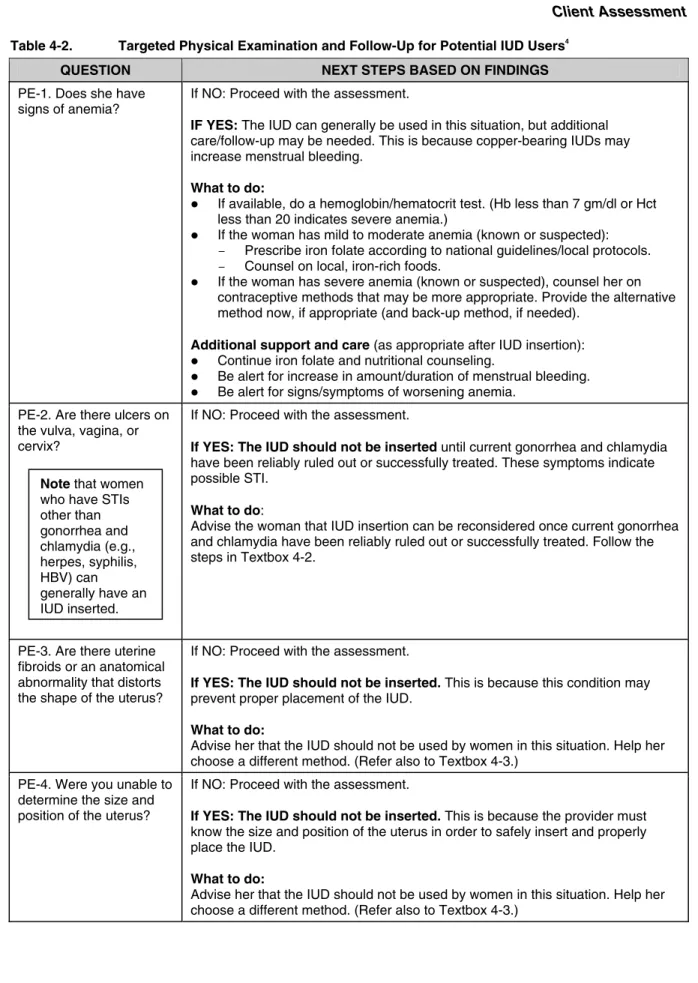
Targeted Physical Examination and Follow-Up
for Potential IUD Users... 4-13
Table 5-1.
Key Messages for Women Who Have Just Had an IUD Inserted ... 5-13
Table A-1.
Preparing Dilute Chlorine Solution from Liquid Bleach
(Sodium Hypochlorite Solution) for Decontamination and HLD... A-2
Table A-2.
Preparing Dilute Chlorine Solution from Dry Powder ... A-3
Table A-3.
Advantages and Disadvantages of Commonly Used Chemicals
Approved for Use in HLD ... A-4
Table A-4.
Preparing and Using Chemical Disinfectants ... A-5
FIGURES
Figure 1-1.
Copper T 380A IUD ... 1-3
Figure 1-2.
Copper T 380A IUD Inside the Uterus... 1-3
Figure 1-3.
Flowchart Showing General Steps Involved in IUD Insertion ... 1-15
Figure 3-1.
Processing Surgical Instruments, Gloves, and Other Items ... 3-5
Figure 5-1.
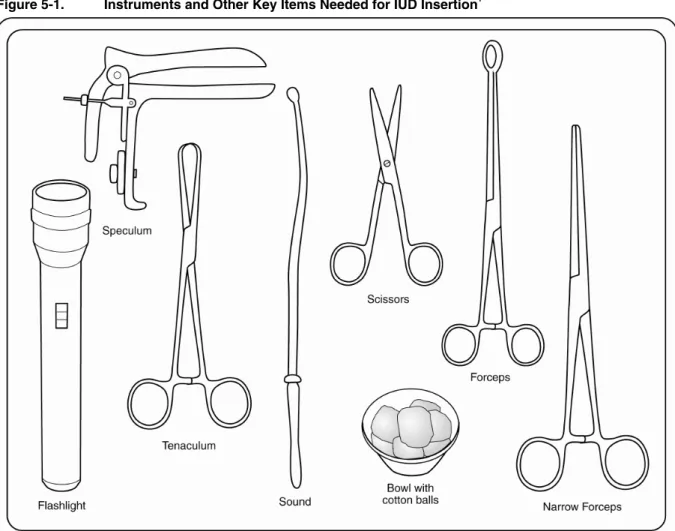
Instruments and Other Key Items Needed for IUD Insertion ... 5-3
Figure 5-2.
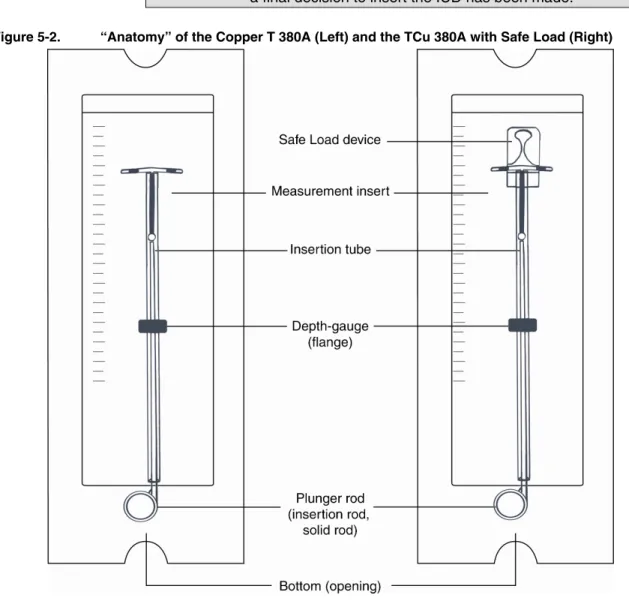
“Anatomy” of the Copper T 380A and the TCu 380A with Safe Load ... 5-4
Figure 5-5.
Inserting the Loaded IUD ... 5-10
Figure C-1.
Vertical Stem of T Fully inside Insertion Tube ... C-1
Figure C-2a.
Placing White Plunger Rod inside Insertion Tube ... C-2
Figure C-2b.
Plunger Rod almost Touching Bottom of T ... C-2
Figure C-3.
Positioning IUD and Bending Arms of T ... C-2
Figure C-4.
Inserting Folded IUD Arms into Insertion Tube ... C-3
Figure C-5.
Using Blue Depth-Gauge to Set Depth of Uterus on Insertion Tube ... C-4
Figure C-6.
IUD Fully Loaded in Insertion Tube ... C-4
Figure D-1.
Vertical Stem of T Fully inside Insertion Tube ... D-1
Figure D-2a.
Placing White Plunger Rod inside Insertion Tube ... D-2
Figure D-2b.
Plunger Rod almost Touching Bottom of T ... D-2
Figure D-3a.
Stabilizing Safe Load Device... D-3
Figure D-3b.
Pushing Arms of T into Safe Load Device... D-3
Figure D-4.
Pulling Insertion Tube out of Safe Load Device ... D-3
Figure D-5.
Introducing Arms of T into Insertion Tube ... D-3
Figure D-6.
Removing IUD from Safe Load Device ... D-4
Figure D-7.
Using Blue Depth-Gauge to Set Depth of Uterus on Insertion Tube ... D-4
Textbox 1-1.
Immediate Postpartum IUD Insertion: An Opportunity Too Good to
Pass Up? ... 1-12
Textbox 1-2.
Screening for STIs Where Laboratory Testing Is Not Available ... 1-13
Textbox 2-1.
Client Rights ... 2-2
Textbox 2-2.
Enhancing Client Understanding/Retention of Information... 2-4
Textbox 2-3.
Tips for Group Education ... 2-4
Textbox 2-4.
Client Messages about Basic Attributes of the IUD... 2-10
Textbox 2-5.
Responding to Rumors and Myths about the IUD ... 2-11
Textbox 3-1.
General Guidelines for Processing Instruments, Gloves,
and Other Items... 3-6
Textbox 3-2.
How to High-Level Disinfect Surgical Gloves by Steaming ... 3-9
Textbox 4-1.
Self-Assessment Tool for “Very High Individual Risk” of Gonorrhea
or Chlamydia ... 4-10
Textbox 4-2.
Support and Care for Women Who Might Have Gonorrhea
or Chlamydia ... 4-15
Textbox 4-3.
What to Do if the Woman Is Not Currently Eligible for IUD Use ... 4-16
Textbox 5-1.
PAINS: Warning Signs for IUD Users... 5-15
Textbox 5-3.
Guidelines for Switching to Another Contraceptive Method and Need
for Back-Up Methods... 5-18
Textbox 6-1.
Follow-Up for Women Who Are Dissatisfied with the IUD... 6-3
Textbox 6-2.
Follow-Up for Women Experiencing Menstrual Changes... 6-3
Textbox A-1.
Formula for Making Dilute Chlorine Solution from
Concentrated Solution ... A-2
Textbox A-2.
Formula for Making Dilute Chlorine Solution from Dry Powder ... A-3
ABBREVIATIONS AND ACRONYMS
AIDS
acquired immunodeficiency syndrome
ARHP
Association of Reproductive Health Professionals
ARV
antiretroviral
therapy
CDC
Centers for Disease Control and Prevention
cm
centimeter
COC
combined oral contraceptive
Cu
copper
DHS
demographic health survey
FHI
Family Health International
g gram
GATHER
greet, ask, tell, help, explain, return visit/refer
Hb hemoglobin
HBV
Hepatitis
B
virus
Hct hematocrit
HIV
human immunodeficiency virus
HLD
high-level
disinfection
or
high-level disinfected
IM
intramuscular
IUD
intrauterine
contraceptive
device
LMP
last menstrual period
LNG-IUS
levonorgestrel intrauterine system
MEC medical
eligibility
criteria
mg
milligram
mm
millimeter
NSAID
non-steroidal anti-inflammatory drug
PAINS
period-related problems or pregnancy symptoms;
abdominal pain or pain during intercourse; infections or
unusual vaginal discharge; not feeling well, fever, chills;
string problems
PID pelvic
inflammatory
disease
STI
sexually transmitted infection
TCu 380A
Copper T 380A IUD
USAID
United States Agency for International Development
USFDA
United States Food and Drug Administration
PREFACE
Results of recent studies and literature reviews have confirmed that the
intrauterine contraceptive device (IUD) is a safe and highly effective,
long-term, reversible contraceptive method, and that health risks
associated with the method are negligible. This growing body of
evidence challenges some long-standing misconceptions about the
IUD, and has led to many important changes in global practices and
recommendations. Based on the World Health Organization’s latest
medical eligibility criteria for use of copper-bearing IUDs,
most
women can generally use the IUD
, including (but not limited to):
Women who have never been pregnant before
Women with a history of ectopic pregnancy
Women who are HIV-infected and are clinically well
Women who have AIDS and are on antiretroviral therapy and
clinically well
Women with a history of pelvic inflammatory disease (assuming
no known current risk factors for gonorrhea or chlamydia)
Women who have a sexually transmitted infection (STI) other than
gonorrhea or chlamydia (assuming no known current risk factors
for these STIs)
Women who live in areas with a high prevalence of STIs
(assuming no known current risk factors for gonorrhea or
chlamydia)
Thus, there is a worldwide resurgence of interest in this method, as
well as an increased demand for well-trained staff who exhibit
up-to-date knowledge, attitudes, and skills in providing IUD services. In
response to this need, JHPIEGO has updated and revised its
IUD
Guidelines for Family Planning Service Programs
learning package,
which includes this reference manual and all of the materials needed to
conduct a competency-based, inservice training course for service
providers (see also How This Learning Package Is Intended to Be
Used).
Specific objectives of this learning package are to provide up-to-date,
essential information about—and help develop and strengthen skills
in—the following areas:
Basic information about the Copper T 380A (e.g., mechanism of
action, effectiveness, effective life, side effects, health benefits and
potential health risks), as well as common misconceptions
of copper-bearing IUDs, and how they are applied in clinical
practice
Education and counseling of potential IUD clients and IUD users
Simple, cost-effective infection prevention practices that should be
used in providing IUD services to minimize the risk of infection
and disease transmission for clients and health care staff
Assessment (including a targeted history and physical examination)
of potential IUD users to determine whether they are eligible for
IUD use
Step-by-step procedures for the safe and gentle insertion and
removal of the Copper T 380A (regular or with Safe Load)
Routine follow-up care of IUD users, as well as management of
side effects and other potential problems associated with IUD use
Note
:
There are several different types of IUDs available on the market.
Two commonly available IUDs are the Copper T 380A (regular and with
Safe Load) and the Multiload Cu375, both copper-bearing IUDs. This
learning package focuses on the knowledge and skills needed to provide
services for the Copper T 380A; however, supplemental materials for
Multiload Cu375 are also provided in the Trainer’s Notebook.
ACKNOWLEDGMENTS
This is the third edition of
IUD
Guidelines for Family Planning
Programs: A Problem-Solving Reference Manual
. It and the
accompanying learning resource package were revised to reflect recent
changes in the World Health Organization’s
Medical Eligibility
Criteria for Contraceptive Use
, Third Edition (WHO 2004). This
revision was completed for the Capacity Project through support
provided by the United States Agency for International Development,
under the terms of Award No. GPO-A-00-04-00026-00; and would not
have been possible without initial support provided by Constella
Futures (formerly Futures Group)/Key Social Marketing Pakistan
Program, also through support provided by the U.S. Agency for
International Development, under the terms of Award No.
391-A-00-0301017-00. The views expressed in this publication are those of
JHPIEGO and do not necessarily reflect the views of the U.S. Agency
for International Development or the United States Government.
Publications that were most helpful in this revision were:
Family
Planning: A Global Handbook for Providers
(WHO and Johns
Hopkins Bloomberg School of Public Health/Center for
Communication Programs 2006), and
Contraceptive Technology
, 18th
Edition (Hatcher et al. 2004). These and other key publications are
specifically cited throughout the manual, and fully referenced in the
bibliography.
JHPIEGO would like to thank the following individuals for their
review and other valuable contributions to the development of this
document:
Nabeel Akram, JHPIEGO/Pakistan
Roy Jacobstein, EngenderHealth/ACQUIRE
Peter Johnson, JHPIEGO
Tom Milroy, IntraHealth/CAPACITY
Roberto Rivera, Family Health International
Lois Schaefer, U.S. Agency for International Development
Cathy Solter, Pathfinder
Ushma Upadhyay, Center for Communication Programs/INFO
Project
The Maximizing Access and Quality Initiative IUD (MAQ/IUD)
working group also provided some valuable tools and input.
IS INTENDED TO BE USED
With the resurgence of interest in the IUD comes an increased need for
providers who have knowledge, skill, and overall competency in
providing quality IUD services. To help address this need, JHPIEGO
has updated and revised its
IUD Guidelines for Family Planning
Service Programs
learning package, which includes a problem-solving
reference manual, notebook for trainers, handbook for participants, and
presentation graphics—all of the materials needed to conduct a
competency-based, inservice training course for service providers.
The reference manual is a concise, up-to-date, evidence-based resource
intended for use by family planning service providers, clinical
managers or supervisors, and clinical trainers. Chapter 1 contains
up-to-date, essential information about the Copper T 380A, as well as the
World Health Organization’s latest recommendations about the use of
copper-bearing IUDs. The rest of the manual is arranged sequentially
according to the usual way in which clients are cared for—starting
with family planning education and counseling for potential IUD users
(Chapter 2) and infection prevention practices used in IUD services
(Chapter 3), which provide a foundation for and are integrated with all
other aspects of care; continuing with assessment of potential IUD
users (Chapter 4) and insertion or removal of the IUD (Chapter 5); and
ending with routine follow-up of IUD users, as well as management of
potential problems associated with IUD use (Chapter 6).
Although the manual can be used in the context of IUD service
delivery, it is designed to work primarily as a reference document
during clinical training. The course outline, exercises, and other course
materials are specifically keyed to work with the manual, which
becomes a “common ground” for trainers and participant-providers as
they navigate together through the course.
JHPIEGO’s
IUD Guidelines for Family Planning Service Programs
learning
package is part of the
IUD Toolkit
—a comprehensive, online resource that
offers the best available knowledge and practices on how to develop and
expand IUD services in reproductive health programs (compiled by members
of the IUD Subcommittee of USAID’s Maximizing Access and Quality
Initiative). http://www.maqweb.org/iudtoolkit/index.shtml
Providers play a
pivotal role in the
IUD's availability
and use. Providers
not only conduct
IUD counseling,
insertion, and
removal, they serve
as “gatekeepers”
whose attitudes and
actions influence
whether and how
clients use IUDs.
~ From Essential Knowledge about the IUD, in the IUD Toolkit
ONE
INTRODUCTION TO INTRAUTERINE
CONTRACEPTIVE DEVICES
BACKGROUND
For more than 30 years, women throughout the world have been using
the intrauterine contraceptive device (IUD) as their method of
contraception. It is, in fact, the most commonly used reversible method
among married women of reproductive age worldwide. According to
recent estimates, almost one in five (or 153 million) married
contraceptive users is currently using the IUD (Salem 2006).
The popularity of the IUD may be due in part to the high level of
satisfaction among IUD users. Women who use the IUD are more
satisfied with their choice of contraception than are those using other
reversible methods (99% versus 91% for pill users), according to
research conducted in the United States (Forrest 1996). Data compiled
from a US-based study and an international World Health Organization
(WHO) study suggested that about 92% of women are still using the
Copper T 380A at 1 year after insertion (Association of Reproductive
Health Professionals [ARHP] 2004). Formative research shows that
some attributes that IUD users like most about the method are that it:
Offers highly effective, long-term protection against pregnancy,
with immediate return to fertility upon removal;
Has no hormonal side effects;
Is inexpensive over time (no costs after initial cost); and
Is convenient—does not require daily action on the part of the user,
or repeated clinic visits for supplies (Rivera et al. 2006).
Despite the overall popularity of the IUD, the bulk of IUD use is
concentrated in relatively few countries. Most notable among these is
China, where almost 92 million (or 60%) of the world’s married IUD
users reside. In many countries in Eastern Europe, Central Asia, the
Near East, and North Africa, at least half of the women who use
contraception use the IUD. In other parts of the world, however, the
IUD is among the least used methods. In India, for example, 3% of
married women of reproductive age are IUD users; in North America,
that percentage is even lower at 2% (Salem 2006).
Old Myths, New Research
One of the main reasons that the IUD is under-used in some parts of
the world may be that clinicians and potential IUD clients lack
Worldwide, almost
one in five married
women who use
contraception uses
the IUD.
accurate, up-to-date information about the IUD. As a result, they base
their decisions about whether to provide or use the IUD on myths and
misconceptions about the method, rather than on the latest scientific
evidence. A review of obstetric textbooks published in the United
Kingdom and United States concluded that the disadvantages of the
IUD tend to be exaggerated, while the advantages are often understated
(Espey and Ogbourn 2002). In another study, similar misinformation
was found in about half of consumer-oriented websites (Weiss and
Moore 2003). The labeling on some IUD packages also helps
perpetuate under-use of the IUD by suggesting overly restrictive
criteria for who can use the method (ARHP 2004).
Results of recent studies, however, confirm that the IUD is a safe and
extremely effective contraceptive method that is appropriate for use by
most women—including those who are under 20 years of age, are
nulliparous or nulligravid, are HIV-infected or have AIDS but are
clinically well and on antiretroviral (ARV) therapy, or have a history
of pelvic inflammatory disease (PID) or ectopic pregnancy. The studies
also establish the negligibility of associated risks. This growing body
of evidence has led to important changes in the WHO medical
eligibility criteria (MEC) for contraceptive use, which suggest that the
advantages of IUD use generally outweigh the risks for most women,
even in the presence of many conditions previously thought to be
precautions or contraindications to IUD use (such as those listed
above). Thus, the IUD is re-emerging as an excellent choice for most
women seeking long-term, reversible contraceptive protection.
Research to Practice
Although the new research is promising, it will take time for practice
to catch up, as there is a lack of providers trained and/or skilled and
confident in delivering IUD services, especially in countries where
demand for IUDs has been historically low. This reference manual and
the accompanying courseware have been updated and revised
specifically to help address this need. Together, these materials aim to
provide clinicians, clinic managers, and clinical trainers with the latest,
essential information on the IUD as well as the skills needed to deliver
the full range of quality IUD services. The manual is arranged
sequentially according to the usual way in which clients are cared
for—starting with family planning education and counseling (Chapter 2)
and infection prevention practices (Chapter 3), which provide a
foundation for and are integrated with all other aspects of care;
continuing with client assessment (Chapter 4) and insertion (or
removal) of the IUD (Chapter 5); and ending with routine follow-up of
IUD users, as well as management of potential problems associated
with IUD use (Chapter 6).
Recent studies
confirm that the IUD
is a safe and
extremely effective
contraceptive
method that is
appropriate for use
by
most
women.
BASIC INFORMATION ABOUT THE IUD
Types of IUDs
Common types of IUDs available worldwide are as follows:
Copper-bearing, which includes the Copper T 380A (TCu 380A,
TCu 380A with Safe Load; and TCu 200C), the Multiload (MLCu
250 and Cu375), and the Nova T
Medicated with a steroid hormone, such as Mirena®, the
levonorgestrel-releasing intrauterine system (LNG-IUS)
The Copper T 380A
The main IUD featured in this learning package is the Copper T 380A
(or Copper T), which is:
widely used;
well known for its effectiveness, ease of insertion and removal,
wide margin of safety, acceptability to clients, and low cost; and
effective for at least 12 years.
Information is also provided on the TCu 380A with “Safe Load,”
which is a type of Copper T that comes with a device that makes it
easier to load in its sterile package.
The Copper T 380A looks like the letter “T” and contains barium
sulfate so that it can be seen via X-ray. As shown in Figure 1-1, there
are small copper bands on each “arm” of the T, which ensure that
copper is released high in the fundus of the uterus (Figure 1-2). The
“stem” is also wound with copper wire. A thin polyethylene string is
attached to the bottom of the stem for easy removal.
Figure 1-1. Copper T 380A IUD1
Figure 1-2. Copper T 380A IUD Inside the Uterus1
1
Source: The Population Council and the Program for Appropriate Technology in Health (PATH) 1989.
Note
: All
mentions of the
IUD in this
learning package
refer to the
Copper T 380A
(regular or Safe
Load) unless
otherwise
indicated. All
mentions of the
Copper T or
Copper T 380A
refer to both the
regular and Safe
Load varieties
unless otherwise
indicated.
For more information about the “anatomy” of the IUDs and their
packaging, as well as the associated terminology, see page 5-3 and 5-4.
Mechanism of Action
Copper-bearing IUDs, such as the Copper T, act primarily by
preventing fertilization (Rivera et al. 1999). Copper ions decrease
sperm motility and function by altering the uterine and tubal fluid
environment, thus preventing sperm from reaching the fallopian tube
and fertilizing the egg.
Effectiveness
The IUD is a highly effective form of long-term, reversible
contraception, with an associated failure (pregnancy) rate of less than
1% (0.8%) in the first year of use (Trussell 2004a). In a long-term,
international study sponsored by the WHO, the average annual failure
rate was 0.4% or less, and the average cumulative failure rate over the
course of 12 years was 2.2%, which is comparable to that of tubal
sterilization (United Nations Development Programme et al. 1997).
Service providers can tell their family planning clients that the IUD is
the most effective, reversible contraceptive currently available.
Effective Life
The latest scientific evidence shows that the Copper T 380A is effective
for at least 12 years (United Nations Development Programme et al.
1997), although the US Food and Drug Administration (USFDA) has
approved it for only 10 years (as of this printing). Clients who have had
a Copper T inserted should be advised that it should be replaced or
removed 12 years from the date of insertion.
A Word about Shelf Life
According to the USFDA, the
shelf life
of each presterilized Copper T 380A
insertion package is 7 years. It is important to note that the expiration date
on the IUD package refers only to the shelf life of the sterility of the package,
and not to the contraceptive effectiveness of the IUD itself. This means that
even if an IUD is inserted on the day before the expiration date (provided
the package is not torn or damaged), it is still effective for the full lifespan of
contraceptive efficacy—in other words, the Copper T 380A would be
effective for a full 12 years from that date. On the expiration date, the IUD
should be discarded.
Return to Fertility
A woman’s fertility returns immediately after an IUD is removed
(Andersson et al. 1992; Belhadj et al. 1986). This message should be made
very clear to clients having an IUD removed: unless they want to get
pregnant, they should have another IUD inserted immediately after
Side Effects
A common side effect of copper-bearing IUDs is menstrual changes.
Use of the Copper T has been associated with an increase of up to
about 50% in the duration/amount of menstrual bleeding, and this is
the most common reason for removal (Penney et al. 2004). Changes in
bleeding patterns, such as spotting/light bleeding (between periods),
may also occur in the first few weeks. Finally, some women may
experience discomfort or cramping during IUD insertion (Grimes
2004) and for the next several days.
Cramping/pain and changes in bleeding amount/patterns usually are not
harmful for the woman and often subside within the first few months
after IUD insertion. Women should be advised of this common side
effect before IUD insertion, and assessed for and counseled about it if
needed afterward. Non-steroidal anti-inflammatory drugs (NSAID) can
lessen symptoms (WHO 2004b), and good counseling can encourage
continued use of the method (Backman et al. 2002; Zetina-Lozano 1983).
Health Benefits and Potential Health Risks
Nonhormonal IUDs, such as the Copper T, may protect against
endometrial and cervical cancer (Hubacher and Grimes 2002).
Potential health risks associated with the IUD, which are uncommon or
rare, are discussed below.
Uterine perforation—Perforation of the uterus during IUD insertion
has been shown to be rare, with fewer than 1.5 perforations per
1000 insertions occurring in large clinical trials (United Nations
Development Programme et al. 1997; Trieman et al. 1995). This
minimal risk is associated with level of provider skill and
experience (Harrison-Woolrych et al. 2003). When the IUD is
inserted by a skilled provider, the risk has been shown to be as low
as 1 per 1000 insertions (WHO 1987) and 1 per 770–1600
insertions (Nelson 2000). If perforation occurs, the risk of serious
complications is low and the need for surgical intervention rare
(Penney et al. 2004).
Expulsion—Although IUD failure is rare, expulsion is the most
common cause (ARHP 2004). In the first year of IUD use, 2–8% of
women spontaneously expel their IUDs (Trieman et al. 1995).
Several factors influence the risk of expulsion—the most important
of which is the skill and experience of the provider (Chi 1993).
Another important factor is timing. Expulsion is most likely to
occur within the first 3 months postinsertion and is more common
in women who are nulliparous, have severe dysmenorrhea, or have
heavy menstrual flow (Zhang et al. 1992). The risk of expulsion is
higher (11–25% after 12 months of use) when the IUD is inserted
immediately after childbirth (more than 10 minutes but less than
48 hours after delivery of the placenta) (Trieman et al. 1995), and
higher when inserted immediately after a second-trimester abortion
(Grimes, Schulz, and Stanwood 2002). Correct insertion, with the
IUD placed high in the uterine fundus, is thought to reduce the
chances of expulsion.
Infection
—
According to the latest research, the risk of upper
genital tract infection among IUD users is less than 1%, which is
much lower than previously thought. This minimal risk is highest
within the first 20 days after IUD insertion, and is thought to be
related to insertion technique (due to lack of proper infection
prevention practices) rather than to the IUD itself (Hatcher et al.
2004). After the first 20 days, the risk of infection among IUD
users appears to be comparable to that among non-IUD users
(Hatcher et al. 2004).
ADDRESSING COMMON MISCONCEPTIONS ABOUT THE IUD
As previously mentioned, many misconceptions about the IUD remain
despite scientific evidence to the contrary. The following section
presents recent research to refute some of these misconceptions, while
providing a basis for new recommendations and practices related to
intrauterine contraception.
The IUD
does
not
act as an
abortifacient.
Studies suggest that the IUD prevents pregnancy
primarily by preventing fertilization rather than
inhibiting implantation of the fertilized egg
(Rivera et al. 1999; Alvarez et al. 1988; Segal et
al. 1985). This is particularly true of the
copper-bearing IUDs.
The IUD
does
not
increase
a woman’s risk of ectopic
pregnancy.
The absolute number of
ectopic pregnancies
among IUD users is
much lower than that
among the general
population.
The IUD reduces the risk of ectopic pregnancy by
preventing pregnancy. Because IUDs are so
effective at preventing pregnancy, they also offer
excellent protection against ectopic pregnancy.
Women who use copper-bearing IUDs are 91%
less likely than women using no contraception to
have an ectopic pregnancy (Sivin 1991).
The following points should also be considered:
zIn the unlikely event that an IUD user does
become pregnant, that pregnancy is more
likely to be ectopic than is a pregnancy in a
nonuser because the IUD offers less protection
against ectopic than intrauterine pregnancy
(Nelson 2000). Ectopic pregnancy is a serious
condition that requires emergency care.
zA pregnancy occurring in an IUD user is
much more likely to be normal than ectopic
(6
−
8%). (This 6
−
8% is out of the very small
number of women who get pregnant with an
IUD in place.)
The IUD
does
not
increase
a woman’s risk of ectopic
pregnancy.
(
continued
)
z
Among IUDs, the Copper T 380A and
Multiload Cu375 are lowest in rates of ectopic
pregnancy (WHO 1987). A long-term study of
women using the Copper T 380A found the
rate to be less than 1 (0.09%) per 100 women
at 1 year, and less than 1 (0.89%) per 100
women at 10 years (Ganacharya, Bhattoa, and
Batar 2003).
z
Women with a history of ectopic pregnancy
can use the IUD with no restrictions.
The IUD
does
not
cause
PID, nor does the IUD
need to be removed to
treat PID.
Strict randomized controlled trials and literature
reviews reveal that PID among IUD users is rare
(ARHP 2004; Grimes 2000). Early studies that
reported a link between PID and IUD use were
flawed and poorly designed. Inappropriate groups
were used for comparison, infection in IUD users
was over-diagnosed, and there was a lack of
control for confounding factors (Buchan et al.
1990; Vessey et al. 1981).
Here are some important points about PID and the
IUD based on more recent research:
z
During the first 3
−
4 weeks after IUD
insertion, there is a slight increase in the risk
of PID among IUD users compared to
non-IUD users,
but it is still rare
(less than
7/1000 cases). After that, an IUD user appears
to be no more likely to develop PID than a
non-IUD user (Farley et al. 1992).
zPID in IUD users is caused by the STIs
gonorrhea and chlamydia, not the IUD itself
(Darney 2001; Grimes 2000). However, the
risk is still very low, with an estimated 3 cases
per 1000 insertions in settings with a high
prevalence (10%) of these STIs (Shelton
2001).
z
If PID occurs, the infection can be treated
while the IUD is kept in place, if the woman
so desires. Studies have shown that removing
the IUD does not have an impact on the
clinical course of the infection. If the infection
responds to treatment within 72 hours, the IUD
does not need to be removed (WHO 2004b).
zRandomized controlled trials and cohort studies
reveal that the monofilament string does not
increase the risk of PID (Grimes 2000).
zWomen who have a history of PID can
generally use the IUD (the advantages
generally outweigh the risks), provided their
current risk for STIs is low.
The IUD
does
not
cause
infertility.
Infertility caused by tubal damage is associated not
with IUD use, but with chlamydia (current infection
or—as indicated by the presence of antibodies—
past infection) (Hubacher et al. 2001). Moreover,
there is an immediate return to fertility after an IUD
has been removed (Belhadj et al. 1986). In one
study, 100% of women who desired pregnancy (97
of 97) conceived within 39 months of IUD removal
(Skjeldestad and Bratt 1988).
The IUD
is
suitable
for use
in nulliparous women.
Nulliparous women can generally use the IUD (the
advantages generally outweigh the risks). In theory,
the smaller size of a nulligravid uterus may increase
the risk of expulsion, whereas uterine enlargement,
even if due to an abortion, may promote successful
IUD use (Hatcher et al. 2004). Expulsion rates tend
to be slightly higher in nulliparous women
compared to parous women (Grimes 2004).
The IUD
can
be
safely used
by HIV-infected women
who are clinically well.
HIV-infected women who are clinically well can
generally use the IUD (the advantages generally
outweigh the risks). A large study in Nairobi
showed that HIV-infected women had no
significant increase in the risk of complications,
including infection in early months, than
HIV-negative women (Sinei et al. 2001). In another
study of HIV-infected and HIV-negative IUD users
with a low risk of STI, no differences were found in
overall or infection-related complications between
the two groups (Sinei et al. 1998).
The IUD
does
not
increase
the risk of HIV
transmission.
There is no current evidence that use of the IUD in
HIV-infected women leads to increased risk of HIV
transmission. Studies have shown that among
HIV-infected women using the IUD, there is no increase
in viral shedding and no statistically significant
increase in HIV transmission to male partners
(ARHP 2004; Richardson et al. 1999).
The IUD
does not
interfere
with ARV therapy.
Women who have AIDS, are on ARV therapy, and
are clinically well can generally use the IUD
(advantages generally outweigh the risks). Because
it is a non-hormonal family planning method, the
IUD is not affected by liver enzymes and will not
interfere with or be affected by ARV therapy
(ARHP 2004; Hatcher et al. 2004).
OVERVIEW OF THE WHO MEDICAL ELIGIBILITY CRITERIA
The WHO MEC for contraceptive use (first issued: 1996; revised:
2000, 2003, 2004) help providers assist clients in weighing the risks
and advantages of different family planning methods relative to
specific “conditions.” A condition is either a biologic characteristic
Remember
:
Most women can
generally use the
IUD.
(e.g., age, reproductive history) or a known medical condition (e.g.,
HIV, diabetes, anemia) that may have an impact on the effectiveness or
safety of a given contraceptive. In the WHO system, a woman’s
eligibility for using a specific method falls into one of four categories,
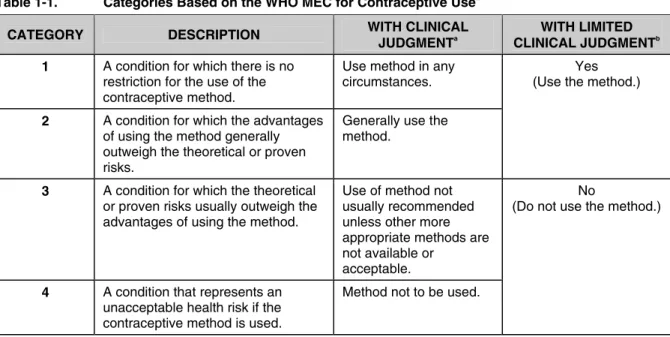
depending on the presence/absence of various condition(s). These
categories are summarized in Table 1-1.
Table 1-1. Categories Based on the WHO MEC for Contraceptive Use2
CATEGORY DESCRIPTION WITH CLINICAL
JUDGMENTa
WITH LIMITED
CLINICAL JUDGMENTb
1 A condition for which there is no restriction for the use of the contraceptive method.
Use method in any circumstances.
2 A condition for which the advantages of using the method generally outweigh the theoretical or proven risks.
Generally use the method.
Yes (Use the method.)
3 A condition for which the theoretical or proven risks usually outweigh the advantages of using the method.
Use of method not usually recommended unless other more appropriate methods are not available or
acceptable.
4 A condition that represents an unacceptable health risk if the contraceptive method is used.
Method not to be used.
No
(Do not use the method.)
a
In care situations where resources for clinical judgment are in place (e.g., availability of skilled care, access to a wide range of services), the four-category framework corresponds to four possible determinations of whether a woman can use an IUD.
b
In care situations where resources for clinical judgment are limited (e.g., community-based services), the four-category framework is simplified into two possible determinations of whether a woman can use an IUD.
Sometimes a given condition is considered one category for
initiating
use (i.e., insertion) and another for
continuing
use. For example, a
woman with PID should not have an IUD inserted (Category 4), but
can continue to use an IUD already in place while receiving
appropriate treatment (Category 2), if she so desires.
2
Adapted from: WHO 2004a. (Footnotes a and b added per the present publication.)
Any risk posed by
a method should
be weighed against
the risk posed by
unintended
pregnancy on a
case-by-case basis.
Note
: WHO’s four-category system is intended to be used in the context of clinical judgment. This
means that the provider has the knowledge, skills, and resources necessary to determine whether
the benefits of using an IUD outweigh the risks for a particular woman. This capacity is especially
important when there may be some question about whether the IUD is an appropriate choice for a
particular woman. For example, a provider may—after considering all the factors involved—
determine that one woman who is anemic is a good candidate for IUD use, but advise another
woman with anemia (e.g., if it is severe) to consider other, more appropriate methods. In making
this determination, the provider may consider and weigh factors such as:
z
Risks posed by the method versus those posed by an unintended pregnancy
z
Severity of the woman’s condition, and whether she is undergoing adequate treatment
z
Presence of other conditions
z
The woman’s understanding of any special risks involved
z
Access to additional services and follow-up care, as needed
z
Availability/acceptability of other contraceptive methods
z
Any other circumstances or factors that may be relevant
In situations in which the provider does not have the knowledge, skills, or resources necessary to
make such determinations, the four categories can be simplified into two, as shown in the far right
column of Table 1-1. In the context of this simplified system, women with Category 1 and 2
conditions can use the IUD, and women with Category 3 and 4 conditions can not. Or, the provider
may refer a woman to a higher level facility if there is some question about whether she can use
the IUD.
Following are considerations for using the IUD based on the WHO
MEC (all are adapted from WHO 2004a).
These considerations apply
to all copper-bearing IUDs, and refer to both insertion and
continuation of the IUD unless otherwise indicated.
See the end of
the manual for a quick-reference chart summarizing the WHO MEC
for use of copper-bearing IUDs.
CATEGORY 1
: Women with Category 1 conditions
can use the IUD
with no restrictions
. Women with conditions that fall into this
category include, but are not limited to, the following:
Reproductive
zWomen with a history of ectopic pregnancy.
zWomen who are immediately following a
first-trimester abortion (spontaneous or induced),
provided there is no evidence of infection.
zWomen who are 4 weeks or more postpartum,
provided there is no evidence of infection.
zWomen who have benign ovarian tumors (or
cysts) or uterine fibroids that do not distort the
uterine cavity.
STIs/
Genital Tract Infections
z
Women with a genital tract infection that is not
sexually transmitted, such as vaginitis (e.g.,
bacterial vaginosis, candida albicans).
zWomen who have a history of PID with a
subsequent pregnancy (assuming there are no
known current risk factors for STIs).
z
Women who have breast disease, including breast
cancer.
z
Women who have viral hepatitis or malaria.
zWomen who have diabetes, hypertension, or
“uncomplicated” valvular heart disease.
zWomen who smoke or are obese.
CATEGORY 2
: The following women
can generally use the IUD
(the advantages generally outweigh the risks), although additional
care/follow-up may be needed:
Reproductive
zWomen who are less than 20 years of age (and
nulliparous) or are nulliparous, as there is a
slightly greater risk of expulsion due to the
smaller size of the uterus.
z
Women with heavy/prolonged or painful
menstruation, endometriosis, or severe
dysmenorrhea, although they may wish to
consider another family planning method, as
heavier menstrual bleeding and cramping are
common side effects of the IUD.
z
Women who are immediately following a
second-trimester abortion (spontaneous or induced),
provided there is no evidence of infection.
However, the IUD should be inserted only by a
specially trained provider
(because of the
increased risk of expulsion).
z
Women who are less than 48 hours postpartum,
provided there is no evidence of infection.
However, the IUD should be inserted only by a
specially trained provider
(because of the
increased risk of expulsion). For more
information about immediate postpartum IUD
insertion, see Textbox 1-1.
z
Women who have anatomical abnormalities of
the reproductive tract that do not distort the
uterine cavity in a way that might interfere with
IUD insertion or placement (e.g., cervical
stenosis).
STIs
Important: The IUD
does not provide protection against HIV and other STIs; those at risk should be encouraged to use condoms.
z
Women who have STIs other than gonorrhea or
chlamydia (e.g., herpes, syphilis).
z
Women who are at risk for STIs other than
gonorrhea or chlamydia (e.g., HIV, herpes,
syphilis, hepatitis).
z
Women who have a history of PID without a
subsequent pregnancy (assuming there are no
known current risk factors for STIs).
HIV/AIDS
zWomen who are HIV-infected and are clinically
well.
z
Women who have AIDS, are on ARV therapy,
and are clinically well.
General
zWomen who have complicated valvular heart
disease (e.g., artificial shunts, rheumatic heart
disease), although prophylactic antibiotics are
advised for IUD insertion to prevent endocarditis.
zWomen with anemia (including thalassemia,
sickle cell disease, and iron-deficiency anemia),
although there is some concern about increased
menstrual blood loss with copper-bearing IUDs.
Textbox 1-1. Immediate Postpartum IUD Insertion: An Opportunity Too Good to Pass Up?
Immediate postpartum insertion of IUDs is safe, effective, and convenient for women (Sevki et al. 2005). And for many women who rarely access health care services, the insertion of an IUD immediately postpartum represents a good opportunity to help them control their fertility options. Other advantages of immediate postpartum insertion include high motivation on the part of the client, as well as the assurance that she is not pregnant. The popularity of immediate postpartum IUD insertion in countries as diverse as China, Mexico, and Egypt supports the feasibility and acceptability of this approach (Grimes et al. 2003).
IUDs can be inserted any time in the first 48 hours after birth (as well as at 4 weeks or more after childbirth), provided there is no evidence of infection (Muller et al. 2005). IUDs inserted within 10 minutes of delivery of the placenta have a much lower risk of expulsion than those inserted later in the postpartum period, although the expulsion rate is still higher than for interval insertions (about 42 days after childbirth) (Grimes et al. 2003). Additional considerations for immediate postpartum IUD insertion include the following:
z A woman should be counseled and make a decision about immediate postpartum IUD insertion during the antenatal period, so that insertion may occur within 10 minutes of delivery. This discussion/decision should not be imposed immediately postpartum.
z Because correct provider insertion technique has a large influence on retention rates after immediate postpartum insertion, providers who perform this procedure must receive special training (Bonilla et al. 2005).
z Early follow-up may be important in identifying spontaneous IUD expulsions following immediate postpartum insertions.
CATEGORY 3
: For the following women, use
of the IUD is not
recommended
(the risks generally outweigh the advantages); they
should use a different method unless no other is available or
acceptable:
Reproductive
zWomen who are 48 hours to less than 4 weeks
postpartum.
z
Women with benign trophoblastic disease.
zWomen who have ovarian cancer should not
have an IUD
inserted
(although they are
Category 2 for
continuation
).
STIs
zWomen who have a high individual risk for
gonorrhea or chlamydia should not have an IUD
inserted
(although they are Category 2 for
continuation
). See Textbox 1-2.
HIV/AIDS
zWomen who have AIDS but are not on ARV
therapy should not have an IUD
inserted
(although they are Category 2 for
continuation
).
Textbox 1-2. Screening for STIs Where Laboratory Testing Is Not Available3
Laboratory tests for STIs could contribute to safer use of IUDs (WHO 2004b), WHO notes, but such tests usually are not feasible for lack of facilities, equipment, and trained personnel (WHO 2003). Programs and providers need to balance the risks of not performing the tests against the benefits of making the IUD available (WHO 2004b). Refusing women the choice of IUDs in the absence of laboratory tests for STIs would deny the great majority a method they could use safely and would create an unnecessary medical barrier.
Since STI tests usually are not available, WHO guidance considers STI risk assessment and physical examination essential to safe use of IUDs (WHO 2004). Risk assessment conventionally has been based on the client’s answers to a provider’s questions about her and her partner’s sexual behavior. Having the client assess her own risk of STIs is another approach.a
While risk assessment seems focused on whether a woman might get an STI in the future, its real purpose as far as IUD insertion is concerned is to gauge whether she might have a gonorrheal or chlamydial infection now, which would rule out IUD insertion.b
a
Both methods are covered in Chapter 4.
b
In such cases, the IUD should not be inserted until current infection with gonorrhea or chlamydia is ruled out or successfully treated.
3
CATEGORY 4
: The following women
should not use the IUD
:
Reproductive
zWomen who are pregnant.
z
Women who have infection or signs/symptoms of
infection within 6 weeks postpartum (puerperal
sepsis), or immediately following an abortion
(immediate post-septic abortion).
z
Women with malignant trophoblastic disease.
zWomen with cervical or endometrial/uterine
cancer should not have an IUD
inserted
(although
they are Category 2 for
continuation
while
awaiting evaluation).
z
Women who have anatomical abnormalities of the
reproductive tract or uterine fibroids that distort
the uterine cavity in a way that might interfere
with IUD insertion or placement.
z
Women who have pelvic tuberculosis.
z
Women with unexplained vaginal bleeding should
not have an IUD
inserted
(although they are
Category 2 for
continuation
while awaiting
evaluation).
STIs
zWomen who have current PID, purulent cervicitis,
chlamydia, or gonorrhea should not have an IUD
inserted
(although they are Category 2 for
continuation
while awaiting evaluation or
undergoing treatment). See Textbox 1-2.
OVERVIEW OF QUALITY IUD SERVICES
Figure 1-3 provides an overview of the steps involved in the provision
of IUD services, demonstrating the general sequence and scope of care.
Figure 1-3. Flowchart Showing General Steps Involved in IUD Insertion
General/
abdominal
exam
Bimanual
exam
Speculum
exam
Treat woman
and partner
as appropriate
Schedule
follow-up
visit for
reassessment
and possible
IUD insertion
Cleanse
cervix
Apply
tenaculum
Sound
uterus
Load IUD in
sterile
package
Set gauge to
sounded
depth
Gently insert
IUD
If positive (purulent discharge) If negativeMedical
history
Counseling:
•
General
•
Method-specific
(no purulent discharge)Post-insertion
counseling
In considering the figure above, please note the following:
Positive or abnormal findings identified through the client
assessment may redirect the flow of services.
For illustrative
purposes, a purulent cervical discharge, which may indicate
gonorrhea or chlamydia, represents the pivotal finding in this
flowchart—that is, the finding that “disqualifies” a woman for IUD
insertion at this time. (Again, women who have a purulent cervical
discharge should not have an IUD inserted until gonorrhea and
chlamydia have been ruled out or successfully treated.) There are a
few other characteristics and conditions (in addition to purulent
cervical discharge) that may be identified through the assessment
which can also affect a woman’s eligibility for IUD insertion.
The bimanual examination should be performed before the
speculum examination for most IUD candidates.
Normally, a
speculum examination is completed before the bimanual
examination. However, in most potential IUD users, this would
mean two speculum insertions (one for the speculum examination;
another, after the bimanual examination, for IUD insertion), which
can be unpleasant for the woman. The following guidelines have
been developed especially for the IUD candidate:
If findings from the history and visual inspection are normal
(infection is
not
suspected),
perform the bimanual examination
first
and the speculum examination second; then, with the
speculum still in place, proceed directly to sounding the uterus
and IUD insertion.
If findings from the history or visual inspection are not normal
(infection is suspected),
perform the speculum examination first
and the bimanual examination second. Proceed to sounding the
uterus and IUD insertion
only
if appropriate.
IUD insertion may immediately follow the speculum
examination, provided that the woman
is eligible for IUD use at
this time. In many of the settings to which this manual is geared,
assessment and IUD insertion will happen at the same visit.
Throughout all aspects of care provision, the provider and
other health care staff, as appropriate, should adhere to basic
principles of quality care
, including:
Ensuring that the room/site is adequate for IUD services, and
that essential equipment and supplies are available and ready
for use.
Respecting client rights in all interactions with the woman and
her partner.
Incorporating education and counseling as appropriate
Incorporating infection prevention practices as appropriate
throughout the visit.
Basing decisions about whether a woman can or can not use an
IUD on the latest scientific evidence available, not personal
opinion or tradition.
Providing IUD services based on knowledge, skills, and
attitudes that are consistent with the latest scientific evidence
available and recommended practices.
Recognizing when a woman requires services that are beyond
the capacity of the provider or the facility to adequately
address, and referring her to a higher level of care when
needed.
TWO
FAMILY PLANNING EDUCATION
AND COUNSELING
BACKGROUND
All couples and individuals have a right to make their own decisions
about family planning and birth spacing. They also have a right to the
accurate, up-to-date information they need to make those decisions
responsibly, as well as access to a full range of safe and reliable
contraceptive options. Family planning education and counseling play a
central role in empowering clients to exercise these and other basic rights
(Textbox 2-1), and should be conducted in a manner that aids client
choice, and does not persuade, pressure, or induce a person to use a
particular method.
Key objectives
of education and counseling for potential IUD clients
are to:
Provide clients with the information they need to make an informed
decision about their reproductive health and contraceptive options;
Help them select a contraceptive method that is well suited to their
individual needs and circumstances, with which they can be
satisfied; and
Provide them with the information they need to use their chosen
method safely and effectively.
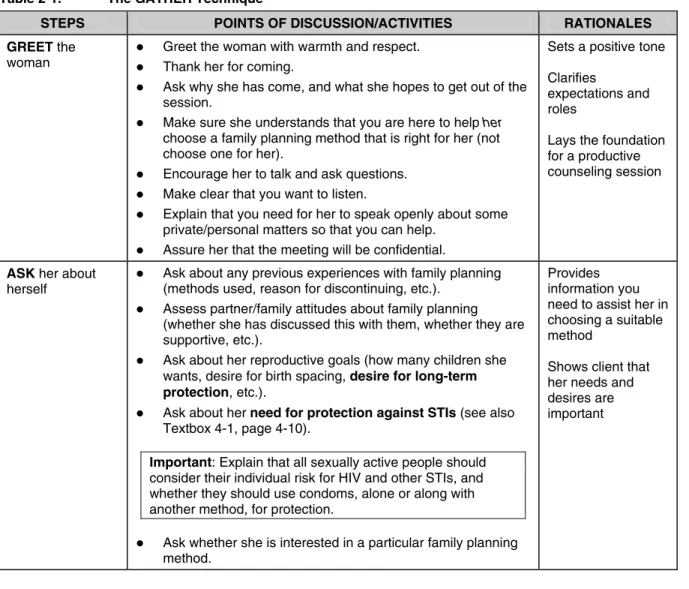
This chapter provides some basic tips on education but focuses mainly
on the counseling process, which includes an educational component.
Although counseling may seem time-consuming, it may ultimately save
time—and reduce overall costs—by increasing users’ satisfaction with
and correct use of their contraceptive methods. For potential IUD users,
good preinsertion counseling about side effects has been shown to
improve continuation rates (Backman et al. 2002; Zetina-Lozano 1983).
Much of the information included here is general, providing a review
of key concepts and practices that apply in general family planning
education and counseling. Messages that are more relevant or specific
to IUD services are highlighted near the end of chapter (starting with
Table 2-1, page 2-7), and expanded upon in subsequent chapters where
appropriate.
In settings where
women lack
awareness about
IUDs or where
misinformation
about the method is
very prevalent,
quality education
and counseling are
critical to
overcoming barriers
to IUD use.
Textbox 2-1. Client Rights1
Regardless of ethnic origin, socioeconomic status, religion, marital status, or political beliefs, every member of the community who is of reproductive age should be considered a potential client of family planning services. In providing these services, the health care staff should work together to ensure that the following rights of each client are observed and protected:
Right to information about family planning:Family planning programs should assist people in the practice
of informed, free choice by providing unbiased information, education, and counseling, as well as an adequate range of contraceptive methods.
Right to decide which method to use:Clients should be able to obtain the method they have decided to use,
if available and appropriate. The client has the right to decide when to start, stop, or switch methods at any time and for any reason.
Right to kindness and respect: Clients also have the right to be treated with kindness, and to discuss their
concerns in an environment in which they feel respected, safe, and confident.
Right to a safe and comfortable environment: A client should be physically safe and comfortable when
receiving family planning services. To a certain extent, this is related to the adequacy of service delivery facilities (e.g., proper ventilation, lighting, seating, toilet facilities). The time the client spends at the facility to receive requested services should be reasonable.
Right to confidentiality: The client should be assured that her conversation with a counselor or other service
provider is confidential and will not be overheard by other people. She should also know her medical records are secure.
Right to privacy: When a client is undergoing a physical examination, it should be carried out in an
environment and a manner in which her right to bodily privacy is respected. The client should also be informed of the role of each person in the room (e.g., individuals undergoing training, supervisors, instructors,
researchers).
Right to refuse any examination, procedure, or treatment: A client should know in advance what is going to
be done and why, and has the right to then refuse it.
Right to appropriate referral and follow-up:The client has a right to be referred to a higher level of care if
any conditions require evaluation or treatment that is beyond the capacity/capability of the facility to provide. A client also has a right to information about any condition requiring referral or follow-up, and about the care that is needed.
Right to continuity of services: The services provided to a client should not be discontinued unless a
decision to do so is made jointly between the provider and the client. In particular, a client’s access to other services should not depend on the continuation or refusal of contraceptive services.
Right to express her views about services received: A client’s opinions on the quality of services (whether
complimentary or negative), together with her suggestions for changes in service provision, should be viewed positively in a program’s ongoing effort to monitor, evaluate, and improve its services.
1