Int. J. Food System Dynamics 10 (4), 2019, 347-360
DOI: http://dx.doi.org/10.18461/ijfsd.v10i4.23Value Beyond Price: End User Value Chain Analysis
Emmanuella Ellis, Ebenezer Miezah Kwofie, and Michael Ngadi
Department of Bioresource Engineering, McGill University, Ste-Anne-de-Bellevue, QC, Canada[email protected]; [email protected]; [email protected] Received February 2019, accepted July 2019, available online August 2019
ABSTRACT
Uniqueness does not lead to value addition, if it is not valuable to the consumer. A supplier’s value chain activity is inherently dependent on the satisfaction it provides to consumers in addressing their needs. This is particularly important since the supplier’s product is the input in the consumers’ value chain. Therefore, this article presents a methodological framework of value-chain concept and analysis that is tailored to revealing and understanding consumer needs by ensuring that the consumer is the focus of the analysis. The framework proposes to view the consumer beyond just a buyer by understanding its own value chain within which the product fits in. This is achieved by defining the consumption chain and assessing the consumers experience wit h the product. It therefore goes beyond analyzing the factors affecting the availability and prices of food products to more subtle value elements including acceptability, utilization, physical and nutritional quality of food. Following that, it introduces the consumer into the supply chain by realigning production processes based on identified consumer requirements. The framework focuses on getting the product value chain to focus on providing consumer value by identifying areas where activities can be adjusted to have a greater influence on the consumption chain.
Keywords: consumer focused analysis; end consumer value chain; end user value chain analysis framework; agri-food chain
1
Introduction
Production and manufacturing companies are focused on being both efficient and effective (Thublier et al. 2010). Creating value is presently focused on the customer (Band 1980) thereby resulting in a shift in the definition of value from the financial perspective to the consumer. On the path to providing more value or delivering maximum value, the consumer is currently being viewed as the starting point of the entire process (Thublier et al. 2010). This is particularly important because producers and suppliers are rewarded not only for providing a product but for the performance of the activities in providing the product. Demand drives the market (Christopher, 1998) and thus production, processing and marketing approaches should be focused on consumer needs and not manufacturing capability (Thublier et al. 2010) . This has not been observed to be the focus of analysis along most value chains particularly food value chains.
Food consumed by individuals go through a set of processes before getting to their tables. The processes and stages that the food goes through, in conjunction with the series of agents that work together to provide the consumer with the product is known as the value chain. Value chain analysis (VCA) in the agri-food sector have been centered mainly on the current state of food availability, price s, accessibility and the factors that maybe hindering such achievements. The analysis is therefore centered on cost analysis, chain structure, political, institutional and governance framework of the chain, product and financial flow, challenges and linkages (Wilson 2015; USAID 2015; Sharma et al. 2010; Asiedu et al. 2015; Babu and Verma 2010). Nevertheless, the actual consumption of such foods goes beyond its availability to demand factors largely influenced by consumer needs and preferences. Thus, consumer acceptability of food products based on preference, experience with the product, and, physical and nutritional quality of the food present at the point of purchase and at consumption play a key role.
Meeting the needs of consumers requires making available products that provides them with more value (enhancing the benefits of the product beyond price). However, providing more value for consumers is directly in relation to meeting their preferences and specific needs with desired product attributes. This will require food value chains (FVC) to transform its activities to meet consumer demands which is dependent on the focus and approach by which FVCs are analysed. There is hardly any study that focuses on the consumers’ needs and activities before and after purchase of the product as a component in VCA. VCA do not undertake the analysis from the end consumer need-based perspective.
The focus of the analysis is usually on the supply chain rather than from the demand chain. Assessing the chain from the end consumer’s consumption chain helps to better improve the activities of the supply chain by focusing on the people along and at the end of the chain. This further takes into consideration not only how the product gets to the consumer but what product (in terms of quality, safety and nutritional content) gets to the consumer. Value creation along the food chain for the consumer is very dependent on what product is being brought to the market especially within this period where consumers are becoming more aware and conscious of what is eaten (Hawkes and Ruel, 2011). This takes the focus of value chain analysis beyond profitability and affordability to meeting the actual value needs of the consumer beyond the price ( acceptability, utilization, physical and nutritional quality of food).
Though a consumer demonstrates his appreciation of value for a product by the willingness to pay an amount for it, it is essential to note that the product is being purchased to derive a more direct value or satisfaction. Consumers usually perceive value more differently than the product’s actual monetary value thus a need to assess value beyond price by evaluating the end user consumption chain. Understanding the consumer’s defined value in satisfaction and the process in which it is attained can aid in increased value creation through process optimization and product development by suppliers. This can be achieved by evaluating the different activities undertaken by the consumer, the processes within each activity and its effect on the value expected to be received by the consumer.
Based on these facts this article poses a couple of questions in relation to the position and role of the consumer in the value chain and the implications for future design of the value chain framework. The article starts by examining the current focus of value chain analysis based on which opportunities for improvement can be determined. The article intends to propose a value chain approach in which value chain actors can establish profitable opportunities by identifying and implementing ways of adding more value to the consumers. It therefore seeks to formulate a new FVCA methodological framework from an end consumer perspective. The framework will aid in understanding consumer choices, existing and changing preferences and consumption experience. Such assessments are fed back into the chain to help food value chains to align their activities to meeting consumer needs. It serves as a guide to determine how the activities along the value chain are either
2
Overview of value chain
The definition and concept of value chain has been in existence for quite sometime but was promoted by Porter (1985) in the conceptualisation of the value chain of manufactured products. However, there are still numerous definitions and applications of value chain by different authors. This shows how perspectives concerning markets and industry have evolved over time. The focus of Porter’s work was to achieve competitive advantage by assessing the activities that create value at the firm level.
After the popularisation of the concept by Porter, it has been applied in other areas such as professional services, industries and organisation organisations (Kaplinsky, 2004; FIAS, 2007). It has been applied widely in literature in fields such as economics, agriculture, business, engineering and others. It has been applied to recognise innovative products and processes, reduce waste and costs, evaluate bottlenecks impeding productivity and highlight opportunities for increased performance (Webber and L abaste, 2010). Value chain analysis have also been applied to studies involving food and agricultural products. These studies focus on different objectives; macro level information, supply chain efficiency, cost efficiency, resource and capacity constraints, operations and planning, understanding physical, economic and informational activities, profitability, governance structures etc. (Macfadyen et al. 2012; Sinh et al. 2014; Anane-Taabeah et al. 2016; Lie et al. 2012; Jaligot et al. 2016; Nguyen, 2014; Hara, 2014). Although the concept of value chain analysis has its consumers at the core, most value chain analysis and chain strategies have not succeeded in addressing consumer value. Researchers paid much attention to quantity-cost-delivery improvement. The main trend among these empirical studies is an assessment of the value chain from the producer/production perspective. Studies have not been conducted from a consumer perspective in the quest to provide more value for the consumer (Dekker, 2003; Zokaei and Simons, 2006).
Value chain analysis is being approached with the notion that effective supply chain and cost efficiency will lead to adequate consumer satisfaction. This approach is not adequate because there is the loss of consumer focus which will result in production activities which do not meet the shifts in consumer expectations (Walters and Rinbird 2004; Thublier et al. 2010). Therefore, there is a need to incorporate the consumer into the model by trying to understand and analyse the demand market.
Although, the concept of VCA has been widely adopted, developed and used, it still has the potential to be developed even further. There are different gabs that can be viewed as opportunities for further development of VCA approaches. Firstly, there should be an expansion of the boundary of analysis. Analysis should go beyond supplier-supplier to supplier through to final use and disposal of the product. Secondly, production and productivity which is often the focus should be improved through an unders tanding of the consumption end of the chain. Value assessment and estimation should be on consumer perceived value derived from the product beyond the price. This will require the assessment of non-monetary value elements which could be social, environmental and nutritional related. Thirdly, most VCA techniques are focused on understanding the cost behaviour and not going further to determine the sources of differentiation. Lastly, value is viewed and assessed as flowing from the consumer to the producer in monetary terms as opposed to a two-way flow. Value also flows to the consumer in a non-monetary way though often ignored in VCAs.
The increased attention to consumer satisfaction has resulted in the design and proposal of new VCA frameworks and strategies which shifts from an industrial focus. These are relatively few and not tailored to agri-food industry and, even though they exist, there is still room for new approaches to compliment existing ones. A discussion of the consumer-based value chain analysis frameworks, their differences and respective drawbacks are presented below. The frameworks considered in this article include on the models of Porter (1985); Walter and Rainbird (2006); Lord Sainsbury of Turville (2007); Thublier et al. (2010) and McMilla n and Grath (2013).
2.1 Porter’s model
Porter’s idea was based on two forms of competitive advantage in business model s. The advantage created from providing consumers with a unique product from that of competitors or by producing a produ ct at the least possible cost. Porter argues that breaking down a firm’s processes into its core activities enables the identification of the firm’s source of competitive advantage. Each firm’s value chain has nine generic groups of activities which it performs. The activities are linked to each other and to other activities in the other value chains and are mainly categorised as primary and supporting activities. The value chain analysis focuses on how the firm performs each of its value activities, the economics involved in determining its cost relative to its competitors and how it addresses the needs of consumers. The primary focus is on the benefits accruing to the participants especially companies: effective value chains generate profits (Thublier et al. 2010).
2.2 Lord Sainsbury of Turville’s model
Lord Sainsbury of Turville (2007) has an approach quite similar to Porter (1985) however, a linear and less complex approach is adopted. Also, research and development is included as one of the activities in the value chain. The author noted that competitive advantage is dependent on an in-depth understanding of the value chain and its linkages.
2.3 Walters and Rainbird’s model
Contrary to Porter (1985) and Lord Sainsbury of Turville (2007), Walter s and Rainbird (2006) take a different approach towards value chain analysis. The authors defined value chain as the combination of supply and demand chain based on an argument that “the value chain is an integrated management activity that first explores and understands markets that appear attractive; second, identifies the industry drivers and resource requirements through processes such as market opportunity analysis ; third, considers the potential organizational alternatives that are likely to prove to be successful in achiev ing realistic marketing and financial objectives”. The supply and demand chain are independent elements of the value chain, both of which are competitive necessities since it is useless to produce a wrong product and worthless of an innovation cannot be implemented. The supply chain is basically designed based on the demand chain towards the goal of gaining competitive advantage. Walter and Rainsbird’s (2006) model suggest that by undertaking a customer value analysis, information on value drivers, customer socioeconomic and demographic characteristics can be obtained based on which a value proposition can be made. The value proposition is then applied to make necessary production and coordination decisions to provide products which meet the needs and prefer ences of the consumer.
2.4 Thublier’s model
Thublier et al. (2010) presented a value chain approach which tried to satisfy both the end consumer and the corporate expectations by integrating supply and demand chain processes. Supply chain was defined as be ing concerned with logistics, material, information and cash flow and value chain as being related to the identification and managing of the sources of value to achieve competitive advantage. The demand chain was considered as the entity that provides the information needed to drive changes in both chains. The author was in agreement with Walters and Rainbird’s (2006) definition of value chain as being the combination of supply and demand chain. However, a distinction was made with respect to the kinds of v alue chain based on the buyer. Thereby, separating value chain into industry value chain and consumer value chain because each had different value perspectives. The industry value chain stresses on efficiency and costs control while the consumer focuses more on intangible benefits, social and emotional benefits.
2.5 Food Process Innovation Unit’s model
The Food Process Innovation Unit (FPIU) at Cardiff University developed a food value chain analysis methodology which is centered on analysing supply activities in relation to consumer value (Simons et al. 2004). The methodology draws upon the concept of lean thinking, value stream mapping and value chain analysis (Zokaei and Simons 2006). The methodology follows a number of steps; understanding the lean and VCA concepts, selection of a product for mapping, mapping of the product chain from farm to delivery point, identify consumer value, identify key performance indicators, formulate a framework for strategic opportunities and mapping out a future state of the supply chain. The concept follows that of Walters and Rainbird’s (2006) and Thublier et al. (2010) by focusing on intangible value elements such as time. All three authors focus on the end consumer’s needs at the point of delivery or sale. It is however structured for application in the food industry.
2.6 MacMillan and McGrath Consumption Chain
MacMillan and McGrath (1997) asserted to the fact that creating more value for the consumer was based on understanding the customer’s entire experience with the product. The consumption chain was coined as a term to indicate a map of the customer’s entire experience with the product after which an analysis can be made by addressing questions on what, where, who, when, and how the product is used. The information gathered from such as evaluation in trying to find a unique way to deliver value at each step aids in creating a new product or service. Differentiation can be obtained by evaluating the consumption chain based on which new market opportunities can be generated. Models and their respective drawbacks
3
Models and their respective drawbacks
3.1 Porter’s model
In Porter’s model, the customer is usually not the focus of the analysis and the analysis is made from the perspective of the supplier with cost, efficiency and manufacturing capacity as the focus of analysis. The focus being on competitive advantage. An approach of research, development and design has to be included in the value chain analysis framework as an initial step based on which a critical assessment of the product/service value chain can be undertaken. Value can only be created when value needs are met which can only be discovered and realised through research and evaluation. If a value chain does not follow the concept of assessing the chain from the customer’s perspective, then most research on value chain analysis for different products are being undertaken from the wrong angle. This is because most research still focuses only on the supply side of the chain with no emphasis to the consumer.
3.2 Lord Sainsbury of Turville’s Model
Though research, development and design were included as an initial step in the value chain model, its focus was not on the product/service market. It is assessed more from a manufacturing perspective rather than a customer perspective (Thublier et al. 2010).
3.3 Walters &Rainbird’s Model
In seeking to introduce the customer into the model, the approach used by the authors had a focus on both the customer and the supplier. The focus of the analysis was on the customer to obtain information based on which the suppliers’ chain can be critically evaluated. However, it is a complex model to apply and there is no distinction between the customer and the consumer (Thublier et al. 2010). More importantly, though the demand component was included in the analysis, the author did no t differentiate between the different types of buyers. This has a significant influence on the way a demand chain assessment is made and in turn a value chain analysis due to the different value expectations from both buyers.
3.4 Thublier’s value chain model
Taking the argument further, the author made the distinction between customers and consumers by defining customers as intermediaries along the chain who purchase for retail or manufacturing purposes and therefore are not the end users of the product who are referred to as the consumers. Walters & Rainbird (2006) and Thublier et al. (2010) introduce the demand chain concept as a way on making the consumer the center of the value chain. However, to adequately assess a product chain from a consumer’s pers pective will require treating the consumer not only as a purchaser where demand chain assessment becomes marketing oriented. Understanding how the consumer uses the product and the activities performed with it after purchase is essential to providing more value for the consumer. The consumer’s value chain should therefore be the guide to a demand chain assessment based on which supply chain activities can be undertaken.
However, like all the other authors, the fact that the end consumer has its own value ch ain with respect to how the product is actually utilized is ignored. It is positioned at the end of the chain where other value beyond price centers only on the purchasing and relational experience in building trust and loyalty.
3.5 FPIU’s model
Though the end consumer value is considered. The focus is value attributes at the point of purchase such as on timely delivery as with Walters and Rainbird (2006) and Thublier et al. (2010). However, there are more insight to be gained from understanding the end consumers consumption chain when assessing value addition activities. Product differentiation and competitive advantage is sourced from such an analysis.
3.6 McMillan and McGrath Gunther Rita’s Model
Based on the view that the value chain should be assessed from the consumer’s perspective, the author produced a framework which focuses more on the consumer’s journey through purchasing to disposal of the product. However, the model like that of Porter and Lord Sainsbury focus on only one side of the chain. Its either only on the supplier as with the latter or only the consumer as with the former respectively. Due to this, the link between the consumer chain and the supplier chain is not clearly presented and the different kinds of evaluation that is needed to be undertaken by the supplier after analysing the consumer chain is not clearly and specifically laid out.
The model does not provide detailed information on how to assess the actual use of the product. Consumers purchase a product to derive some value from it beyond price. Thus, understanding the activities performed which the product fit, the value derived from its use at each point and the factors negatively or positively influencing the value derived, is necessary. More value can only be created for consum ers by defining the value derived from the product and measuring that value. This provides information on whether consumers are deriving maximum value as expected from the product and how more value can be created or enhanced. For instance, consumers purchase food to derive an ultimate value of nutrition from it, however, they also require the value of convenience where it takes them less time to prepare the food. To be able to adequately address the need of convenience and provide more value in that sense for consumers, there is a need to define the value (time requirement) and measure it (how long does it take to cook the food produce). By understanding this, value can be created by the product value chain through the introduction of foods on the market t hat require less time for preparation.
Assessing value derivation based on an understanding of how the product is utilized has tremendous implication on suppliers’ activities with the goal of value addition, consumer satisfaction and competitive advantage. The model has also been made in such a way that it applies more easily to customers than consumers. Even with consumers, it is related more to products which require little or no further activity or processing such as those which require installation.
In summary, the models discussed above which introduce the consumer perspective focus on the consumer as a purchaser and do not distinguish the buyers. In the case where a distinction is made, the end consumer is often ignored and the evaluation of consumer satisfaction focuses on customer service level requirements (affordability, purchasing and relational experience). The models do not also clearly define the link between consumer requirement and translating it into product value chain activities. Based on the drawbacks observed a new framework for value chain analysis can be designed to address the different components. The framework better realigns the consumer value for specific product features to value chain activities. It improves product value chain focus by introducing an assessment of the end consumer. A value chain approach is applied to understand how to satisfy the needs of different groups of consumers because it’s a structured method which enables adequate mapping of their experience with the product. It allows for a systematic way of analysing each activity in the consumption chain and as well each activity in the product chain in relation to consumer value.
4
Development of the end user driven value chain model (EUVC Model)
4.1 Concept of Model: Quantifying Consumer Value or Satisfaction
Based on the ideas proposed by different authors and the drawbacks observed from their respective models, this article proposes a new value chain analysis framework which seeks to address the drawbacks stated above in relation to the previously discussed models. To adequately create value that meet the needs of consumers, product value chain should be viewed as being made up of three different tiers, the supply side, demand side and consumption side. Here, the demand side focuses at the marketing stage which depends on the interactions at the point of sale (purchasing and relationship activities) while the consumption side focuses on how the consumer uses the product. Also, it is essential to define the value derived from the use of the product and quantify that value as an initial and critical step to value addition. According to Lord Sainsbury of Turville (2007), there is a need for a research component in the activities along a product value chain. The article proposes that the research component should be focused on the consumption tier of the value chain. Porter’s idea of breaking down a firm’s processes into its core activities is applied in assessing each tier to identify the sources of value and value creation. The model is also set up with emphasis on the distinction between the different groups of buyers (consumers and customers).
4.2 A new value chain: End user driven value chain
Supply and Demand Chain approaches are directed towards different goals. The supply chain is key on fulfilling demand of physical products through channel efficiency (Ming 2015). The demand chain focuses on a strategy of improving the product chain with the customer at the centre (Walters and Rainbird , 2004). However, maximum value is attained when value demanded, and satisfaction expected by the consumer, is provided by the producer/supplier in the highest amount possible. Thereby, value of a product is maximum when supply chain performance and demand satisfaction are reached. By focusing thereby on the consumer, a new conceptual model for value chain can be made. This article proposes four different steps that should be undertaken.
4.2.1 Redefine the position and role of the buyer
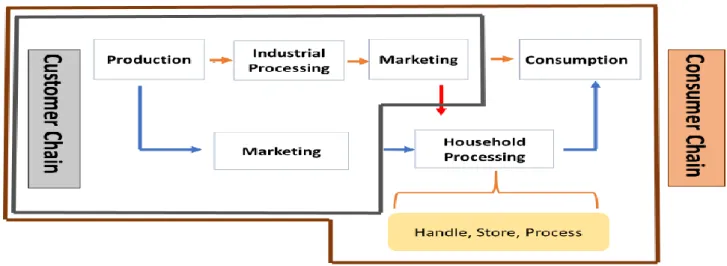
The consumer is positioned at the marketing stage and ignored at the consumption stage of the chain. The consumer is only viewed as a purchaser although, there are a number of processes that the product purchased goes during consumption to derive value. This maybe because, majority of value chain related studies have confused the concept of customer and consumer, thereby maybe assessing the chain incompletely. Customers refers to distributors, retailers and cybermediaries who require consistency, speed, quality and cost. Consumers on the other hand focus not just on functional criteria but on intangible emotional and social considerations as well (De Chernatony 1998; Baker 2003). The consumer should be seen as an agent in the chain who performs his own set of activities with the good purchased to derive some satisfaction based on his definition of value. In creating a product and assessing value, it is necessary to define the different kinds of demand based on the different buyers. This article defines the buyer under three different categories (fig. 1).
Buyer 1: Not the end user, purchases mainly to retail or manufacturing use. Usually an intermediary between its supplier and the end user.
Figure 1. Typical product/service chain: Distinguishing between Customer and Consumer
Buyer 2: The end user of the product, purchases for private/personal or non-manufacturing use. Require products with more intangible ‘emotional and social’ benefits (Kano 1984).
i. Consumer 1: Purchases products that require little or no further processing for use. For example, purchasing a television which does not require further processing to obtain a new product.
ii. Consumer 2: Purchases product which require further processing into a final product from which the desired value will be derived e.g. purchasing raw food items.
All through the article, the framework focuses on Consumer 1 and 2, although it can be applied to buyer 1 as well to reveal more subtle value elements.
4.2.2 Redefine value
Value is the perceived preference for a product, the perception of the degree of the importance of an o bject to one’s need and satisfaction derived from the use of a product as well as the evaluation of those product attributes, attribute performances, and consequences arising from use that facilitate (or block) achieving the customer’s goals and purposes in use situations (Woodruff, 1997). Value addition centres on providing a distinct feature (increasing the opportunities to create more value by the end user), maintaining the original value of the product (usually with respect to agri-food produce), reducing costs and waste and, reducing risk. This should not only be along the supplier’s chain but also obtained along the end users ’ chain. Value chains mostly focused on the first level of value. There are three concentric layers of value defined by Clemmer ( 1990). The first layer is the product value where the focus is providing a source of supply. The second focuses on providing services that surround the product such as warranty service. The third value is focused on enhancing the experience surrounding the produce, so that though the product is the carrier of the value, it is actually secondary to the value obtained from the utilization of the product. It is an enhanced service to make the consumer effective or successful and not just satisfied. For instance, by providing consumers with nutritionally dense food, nutrition and health becomes the real value after consumption while the food is secondary.
This brings into focus the different tiers (supply, demand and consumption tier) earlier stated and how eac h is linked to providing value for the consumer.
Thus, in assessing the value obtained by the consumer, it should be determined if maximum value is being derived from the use of the product as they should and how that can be improved. Beyond value identification, should be value measurement. Quantifying value derived from the use of the product is a key element in the efforts to provide more value for consumers and increase their level of satisfaction with the use of the produce. You can only improve what you can measure.
4.2.3 Defining the consumption chain
Based on the new position and redefinition of the consumer in this article, it is essential to present a value chain which would present a clearer picture of the consumer and his position in the product value chain. This is being done to include the consumption stage which has been largely ignored into the product value chain more clearly. The activities within the consumption stage should be the ultimate guide in assessing the supply chain and performing activities to respond to the consumer needs.
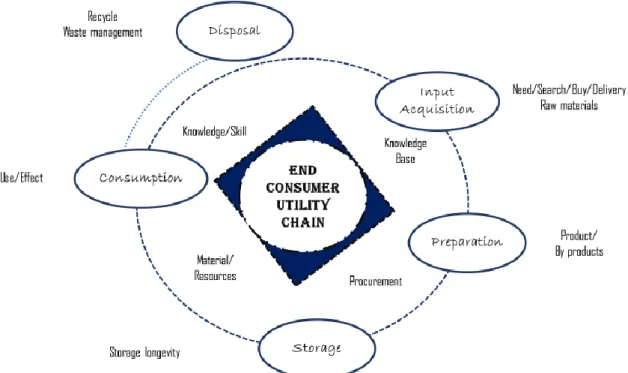
Figure 2. End consumer utility chain
This article proposes the end consumer utility chain which is defined as the activities performed by a consumer during and after purchasing of the product to derive value or satisfaction from a purchased product. The end consumer utility chain (figure 2) is embodied in the consumption chain of a product value chain. The end consumer utility chain is an important component in the end user driven value chain model because it aids in clearly distinguishing buyers. It also introduces the consumer into the value chain and understanding the consumers experience with the product. It’s a method that can be used to identify and predict consumer requirements more accurately and consumer value from the consumers perspective. It also goes beyond simply listening to consumers to identifying features which can be transformed into measurable and useful product value chain components and valued product attributes. It aids the evaluation o f the product after it is purchased and leaves the supply chain into the consumer’s chain. It is at this point where utilization of the product, variations in physical and nutritional quality attributes and their consumer acceptable levels are assessed.
4.2.4 Map out the value chain including the end consumer utility chain
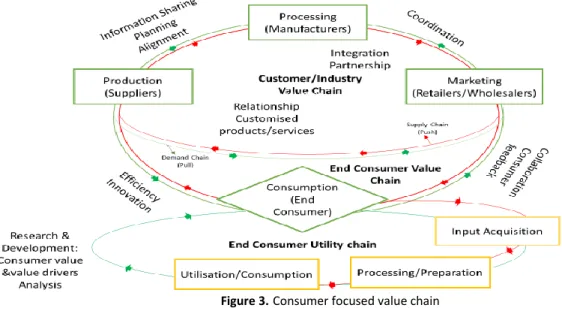
A consumer-focused value chain map which incorporates the end consumer utility chain and distinguishing the consumer and the customer is presented in figure 3. It also distinguishes the demand and supply chains through the linkages. Supply chain then focuses its capabilities on shaping, satisfying and sustaining the demand. The end consumer utility chain defines demand and value needs of the consumer that should feed into a demand chain
Figure 3.Consumer focused value chain
5
Development of Strategy for aligning consumer value with product value chain activities
5.1 Introduction
Along every product chain, consumers pull for the produce and push money to the suppliers while suppliers push the produce and pull for money. Instead of focusing on pushing the produce to consumers, there is a need to get them to pull for the produce by providing them with products that meet their current and future needs. To achieve this there is a need to identify the pull factors before production/processing/marketing activities are undertaken. Such information cannot be gathered adequately only from customer and consumer interface or feedback This will require a more in-depth analysis of the processes and activities the product goes through before and as its being utilized. The different components of consideration are presented in Table 1 as a guideline in performing a consumer-focused value chain assessment and pictorial flow of the analysis presented in Fig 5.
Figure 5. Flow of the End user Value Chain Analysis
5.2 Key components of the End User VCA: Realigning consumer value to product value chain activities
The overall concept of the End User VCA centers around the determination and estimation of the actual value (benefits) derived by the consumer, identification of the potential benefits for the c onsumer and, identification and implementation of strategies to close the gap. The measurement of value is undertaken at each of the three main stages of the End user value chain for different purposes. At the consumption stage of the chain, value is measured to determine actual and desired value (benefits) obtained by the end consumer and the customer as well as the factors influencing it. At the demand stage, potential ways of adding more value for the consumer is
identified. The proposed value adding components are clearly specified or measured if possible, to ensure that it is significantly different from the benefits already being obtained by the consumer. At the Supply stage, value is produced based on information from the demand stage and assessed to ensure that production goals of providing consumers with more value have been adequately met. The three stages address the following questions;
a) What satisfaction/value are consumers currently deriving from the use of the product, what challenges do they face with product use and what value is needed/desired for?
b) What factors are responsible for providing consumer’s desired value?
c) How can profitable operations along the value chain be unlocked by providing the desired value?
5.3 End Consumer Utility Chain: Capturing consumer requirements/value
In assessing the consumption stage (which is the end consumers utility chain) it is essential to measure the satisfaction derived from the consumption of the good by measuring the usefulness obtained from the good. This would involve determining and measuring the current value derived from the use of the product. This cannot be effectively done without walking through the end consumer utility chain or customer chain to determine the use, trade-offs, value derived and opportunities for value addition. However, measuring this value will depend on clearly defining the kind of satisfaction to be derived which is dependent on the product. This determines the scale of measurement which would also differ. Some of the quality a ttributes can be determined objectively or subjectively and thus the measurement methods could take the form of surveys (consumer response and ratings), instrumental methods and sensory methods of analysis.
For instance, if the value to be derived from the purchase and consumption of a food product are defined as nutrition, safety and convenience, then they can be measured. Nutrition can be measured as the levels of specific nutrients available in a particular food at point of purchase and at consumption, s afety as the absence of harmful materials, or convenience as energy use or time required for its processing and, application in wide array of functions. While these may be three important dimensions of consumer satisfaction with respect to food to be incorporated into value chain operations, it may differ for some foods. Other product value attributes desired by consumers could include shelf life, texture (crispiness, chewiness, hardness), color, flavor, freshness etc. There should be acceptable values of these attributes which should be measured not just identifies to quantify what consumers want. After measuring, they can be controlled within acceptable limits per consumer preference.
The different forms of assessment to perform when studying the end consumer chain include;
1) An assessment to determine what consumers prefer and how they rank different food products and qualities within a food product through assigning scores. The factors influencing their preference for one product over the other and the value expected to be derived from the use of a specific or different product. This answers the question, what do they do with the product, how do they use it, why do they use it that way and what challenges could they be facing.
2) Identify and assess the different activities, processes performed, and resources (time, energy, etc.) used for each process during the utilization of the good and the factors influencing the different activities performed.
3) Based on a specified satisfaction (value), a quantified amount of satisfaction can be measured as discussed above. This forms the basis of examining how and if potential satisfaction from the good is can obtained. This is made based on the assumption that for the consumer, more is always better. The factors and activities which the consumer performs in which the product fits are likely to increase or reduce expected satisfaction (value) derived from the use of the good and should be assessed. By understanding the activities and their relation to the defined value obtained, value addition options can be identified which are tailored not only to the product but the process. For instance, introducing a food processing technique or equipment which helps to improve on the preparation activity of a particular product. In this case there is no change to the product but the process. e.g. microwaves in warming food faster.
5.4 Demand Assessment: Translating consumer requirements into product features
Identification of potential value will involve defining different value adding options after the end user/customer analysis, quantifying them and placing economic values on each value adding option. The different value adding options in the quantified form as much as possible are offered to consumers to determine how much more they will be willing to pay for the new or added value. This is necessary to determine which option consumers are more willing or less willing to pay for. In doing this, the product can be treated as a bundle since it can provide more than one type of satisfaction (value) e.g. nutrition and convenience. There is a need to assess how
determining how to create more value for consumers. Instead of making such decisions based only on industry capacities and time frames, this information can enable industries to make sound and profitable trade offs. This would translate into undertaking supply chain activities which does not only meet consumer satisfaction but profitable for the industry as well. At this stage, it is best to produce a visual representation of the value chain under study to have a holistic view. Lastly, value propositions are made based on the overall assessments to create more value for consumers, get a premium price and competitive advantage on the market. Then areas along the supply chain where transformations need to be made to achieve value propositions are then identified.
5.5 Supply Chain: Translating consumer requirements into product value chain activities
The supply chain makes use of the information gathered from different stages of the chain to formulate production goals with the consumer as the central focus. The goal is to align its production activities to product features proposed based on the demand chain assessment and to the consumer requirements obtained from the end user utility assessment. It is the stage of the end user value chain where activities physically bridge the gap between the potential and actual value in giving the consumer a product or service. It involves determining how supply activities are impacting consumer value preference and how they can be adjusted to meet consumer requirements. This is also done in a profitable way by giving consumers what they willing to pay for based on fore knowledge. It’s a way of shaping a product that creates demand for itself. The most direct contact a supplier can have with a consumer/customer is through the product. Thus, it’s a means of creating demand not only through awareness but allowing the product to pull consumers. Final measurement of the added value being provided is undertaken at this stage to ensure that the value proposition has been addressed adequately and consumers are receiving what they are paying for.
6
Discussion and Conclusion
Value chain analysis from the consumer perspective can provide information that can change the dynamics of the value chain, by identifying the opportunities for product value addition through improvements in technologies and techniques. This is dependent not only on collaboration with consumers to address complains but also on qualitative and quantitative (scientific) research. The End user value chain model presented in this article moves away from the traditional value chain model which is usually centered on the manufacturing to one that depends on end consumers. It also sets itself apart from supply chain approaches and other consumer-based models by clearly distinguishing between buyers, shifting from supply consumer-based VCA, undertakes a consumer analysis that goes beyond marketing and search attributes by including measurable and controllable non -monetary/intangible elements. It also includes a consumption stage which is often overlooked and defines its place in the product value chain.
It provides an easy and systematic way of identifying consumer value and translating it into the product value chain activities which is mostly difficult to achieve. The information gathered from the end consumer value chain is used as a yard stick in assessing the performance of the product chain. Activities which do not add value for the consumer or reduces expected value can easily be captured. The framework places consumers and their value preferences at the core of the product value chain operations. It helps to link consumer value to the specific consumption chain activity and then the related product value chain activity to provide more value for consumers by enhancing value at each stage of the consumers chain. Further since its not based only on feedback from consumers, but a walk through the consumption chain, suppliers are able to identify subtle value elements and exceed consumer requirements. The component of measuring objective quality attributes resource use (time and energy) introduces the different disciplines into the agri-food sector such as food engineering and nutrition coupled with economics when assessing the costs and benefit of value proposition strategies come to play.
Although the model is focused on the agri-food value chain, it can be applied to other product value chains. There is a need to step outside the product value chain to the product consumption chain to understand h ow value is measured. Based on this, products that meet and exceed consumer expectations can be created and sold for the benefit of value chain actors and consumers.
Acknowledgements
The authors gratefully acknowledge the International Fund for Agricultura l Development (IFAD) for providing financial assistance through IFAD project grant 2000000974.
References
Anane-Taabeah, G., Quagrainie, K. K., and Amisah, S. (2016). Assessment of farmed tilapia value chain in Ghana.
Aquaculture International, 24: 903–919.
Asiedu, B., Failler, P., and Beynes, Y. (2015). Enhancing aquaculture development: mapping the tilapia aquaculture value chain in Ghana. Reviews in Aquaculture, 7:1–9. doi: 10.1111/raq.12103.
Babu, D., Verma, N. K. (2010). Value Chains of Milk and Milk Products in Organised Sector of Tamil Nadu — A Comparative Analysis,” Agricultural Economics Research Review, 23: 479-486.
Baker, S. (2003). New Consumer Marketing: Managing a Living Demand System. John Wiley and Sons Chichester. doi:10.1057/palgrave.im.4340200.
Banks, J., Blundell, R., and Lewbel, A. (1997). Quadratic Engel curves and consumer demand. Review of Economics and Statistics, 124(4): 527-539.
Bidogeza, Jean C., Afari-Sefa, V., Endamana, D., Tenkouano, A., and Quentin, K. G. (2016). Value chain analysis of vegetables in the humid tropics of Cameroon. Invited paper presented at the 5th International Conference of the African Association of Agricultural Economists, September 23-26, 2016, Addis Ababa, Ethiopia.
Carpentier, A., Guyomard, H. (2001). Unconditional elasticities in two-stage demand systems: An approximate solution. American Journal of Agricultural Economics, 83:222–229.
Catron, J., Stainback, A. G., Dwivedi, P., and Lhotka, J. M. (2013). Bioenergy Development in Kentucky: A SWOT-ANP Analysis. Forest Policy and Economics, 28: 38-43.
Christopher, M. (1998). Logistics and Supply Chain Management. Financial Times, London. Clemmer, J. (1990). The Three Rings of Perceived Value. The Canadian Manager, 15(2): 12-15.
De Chernatony, L., MacDonald, M. (1998). Creating Powerful Brands. Butterworth Heinemann, Oxford.
Dekker, H. C. (2003). Value chain analysis in interfirm relationships: a field study. Management Accounting Research,
13(1): 1-23.
Deng, L., Wang, R., Dong, T., Feng, J., and Weisong, M. (2016). Assessing the table grape supply chain performance in China – a value chain analysis perspective. British Food Journal, 118 (5): 1129 – 1145.
De Silva, D.A.M (2011). Value Chain of Fish and Fishery Products: Origin, Functions and Application in Developed and Developing Country Markets. FAO, Rome.
Ecker, O. (2009). Economics of Micronutrient Malnutrition: The Demand for Nutrients in Sub-Saharan Africa. Unpublished PhD thesis, University of Hohenheim.
Evans, J.R., Berman, B. (2001). Conceptualizing and Operationalizing the Business-to- Business Value Chain. Industrial
Marketing Management, 30: 135-148.
Fan, S.G., Wailes E. J., and Cramer, G. L. (1995). Household demand in rural China: a two-stage LES-AIDS model.
American Journal of Agricultural Economics, 77: 54–62.
FIAS (2007). Moving toward Competitiveness: A Value Chain Approach. The Investment Climate. Advisory Service, Washington, D.C.
Folke, C., Carpenter, R. S., Walker, H. B., Scheffer, M., Chapin, T., and Rockström, J. (2010). Resilience thinking: integrating resilience, adaptability and transformability. Ecology and Society, 15(4): 1-20.
Hara, M. M. (2014). Analysis of South African Commercial Traditional Linefish Snoek Value Chain. Marine Resource Economics, 29 (3): 279-299.
Herforth, A. (2012). Guiding Principles for Linking Agriculture and Nutrition: Synthesis from 10 development institutions. Report for the Food and Agriculture Organization of the United Nations. Rome, Italy: FAO.
Hawkes, C., Ruel, M. (2011). Value Chains for Nutrition. Prepared for the IFPRI 2020 international conference, Leveraging Agriculture for Improving Nutrition and Health, February 10–12, 2011, New Delhi, India.
Jaligot, R., Wilson, C. D., Cheeseman, R. C., Shaker, B., and Stretz, J. (2016). Applying Value Chain Analysis to Informal Sector Recycling: A case study of Zabaleen. Resource, Conservation and Recycling, 114: 80-91.
Kaplinsky R., Morris, M. (2001). A handbook for value chain research. International Development Research Centre (IDRC), Ottawa, Canada.
Kurttila, M., Pesonen, M., Kangas, J., and Kajanus, M. (2000). Utilizing the analytic hierarchy process (AHP) in SWOT analysis: A hybrid method and its application to a forest certification case. Forest Policy and Economics, 1: 41-52. Langabeer, J., Rose, J. (2001). Creating Demand Driven Supply Chains. Chandos Publishing, Oxford.
Lie, H., Rich, M. K., Kurwijila, R. L., and Jervell, M. A. (2012). Improving Smallholder Livelihoods Through Local Value Chain Development: A Case Study of Goat Milk Yogurt in Tanzania. International Food and Agribusiness Management Review, 15 (3): 55-86.
Lord Sainsbury of Turville (2007). The Race to the Top – a Review of Government’s Science and Innovation Policies. HM Treasury, London.
Macfadyen, G., Nasr-Alla, A. M., Al-Kenawy, D., Fathi, M., Hebicha, H., Diab, M. A., Hussein, M. S., Abou-Zeid, R. M., and El-Naggar, G. (2012). Value-chain analysis – an assessment methodology to estimate Egyptian aquaculture sector performance. Aquaculture, 362: 18-27.
MacMillan, I. C., McGrath, R. G. (1997). Discover Your Products' Hidden Potential. Harvard Business Review, 76: 58. Min, H. (2015). The Essentials of Supply Chain Management: New Business Concept and application. Pearson FT Press,
U.S.A.
Muhammad, M. I., Ali, S., Rehman, U. H., Iqbal, J., and Qureshi, J. M. (2015). Accumulation and economic growth: Empirical evidence from Pakistan economy. Journal of Economics and Sustainable Development, 6(15): 27-35. Muzar, R., Musoke, H. K., Nakimbugwe, D., Vasanthakaalam, H., and Ugen, M. (2011). Enhancing Nutritional Value and
Marketability of Beans through Research and Strengthening Key Value Chain Stakeholders in Uganda. Internal Food Policy Research Institute, 2020 Conference Note 1, Washington DC.
Nguyen, T. L. (2014). Cocoa Value Chain Analysis: A Case Study of Ben Tre& Tien Giang Provinces in Vietnam. Unpublished Bachelor Thesis, Department of Economics and Business, Kalamazoo College, U.S.A.
Nikodinoska, N., Buonocore, E., Paletto, A., and Franzese, P. P. (2017). Wood-Based Bioenergy Value Chain in Mountain Urban Districts: An Integrate Environmental Accounting Framework. Applied Energy :197-210.
Pollak, R. A., Wales, T. (1992). Demand System Specification and Estimation. Oxford University Press, Oxford.
Porter, M. (1985). Competitive Strategy Creating and Sustaining Superior Performance. The Free Press, New York, NY. Sharma, K., Pathania, M. S., and Harbans L. (2010). Value Chain Analysis and Financial Viability of Agro-Processing
Industries in Himachal Pradesh. Agricultural Economics Research Review, 23: 515-522.
Simons, D.W., Francis, M., and Jones, T. D. (2004). Food value chain analysis in Doukidis, G.J. and Vrechopoulos, A.P. (Eds), Consumer Driven Electronic Transformation. Springer, Berlin: 179-92.
Sinh, X. L., Navy H. and Pomeroy, S. R. (2014). Value Chain of Snakehead Fish in the Lower Mekong Basin of Cambodia and Vietnam. Aquaculture Economics and Management 18: 76-96.
Sitko, N. J., Chapoto, A., Kabwe, S., Tembo, S., Hichaambwa, M., Lubinda, R., Chiwawa, H., Mataa, M., Heck, S., and Nthani, D. (2011). Technical compendium descriptive agricultural statistics and analysis for Zambia. Working Paper No. 52. Lusaka, Zambia: Food security research Project.Thublier, F., Hanby T. and Shi, Y. (2010). Value Chain = Supply Chain + Demand Chain: New Approaches to Creating and Capturing Sustainable Value. Institute for Manufacturing University of Cambridge, Cambridge, CB3 0FS, UK.
USAID (2012). Burundi Legume/Bean Value Chain Rapid Analysis. Country Report – Burundi. USAID (2015). French Bean Value Chain Analysis. Country Report- Kenya.
Walters, D., Lancaster, G. (2000). Implementing Value Strategy through the Value Chain. Management Decision, 38(3): 160-187.
Walters, D., Rainbird, M. (2004). The demand chain as an integral component of the value chain. Journal of Consumer Marketing, 21(7): 465-475.
Walters D., Rainbird, M. (2006). Strategic operations management: a value chain approach. Basingstoke, Palgrave Macmillan, UK.
Webber, M. C., Labaste, P. (2010). Building competitiveness in Africa’s agriculture- A guide to value chain concepts and applications. The International Bank for Reconstruction and Development, The World Bank, Washington, D. C. Wilson, T. R. (2015). The Soyabean Value Chain in Tanzania: A Report from the Southern Highlands Food Systems
Programme. Food and Agriculture Organisation of the Unite Nations (FAO): Rome.
Woodruff, R. B. (1997). Customer Value: The Next Source for Competitive Advantage. Journal of the Academy of Marketing Science, 25: 139–153.
Zokaei, K. A., Simons, D. W. (2006). Value chain analysis in consumer focus improvement. A case study of the UK ed meat industry. The International Journal of Logistics Management17, (2):141-162
Appendix
Table 1.
Value Chain Analysis Components
End-Consumer Utility Chain Analysis (applicable to the customer value chain) Demand and Purchasing
decisions
-Identify consumer purchasing decisions
-Consumer socioeconomic and demographic characteristics -Sources of information on product and alternative products - delivery and payment services
End consumer utility chain characteristics
-Map out the activities along the consumption chain
-Identify resources allocation and use for each activity (time, energy, materials) -Assess challenges and benefits with utilization of products
End user consumption chain analysis
-Processes performed within each activity (how is the product used) -Quantity of resources used for each activity
Value assessment -Identify and define the expected value to be derived with the use of the product -Assess what and how value is derived at each point along the chain
-Measure and quantify value derived with the use of product Consumer expectations,
preferences and trade offs
-Assess consumer preference and value expectations
-Assess trade-off with consumer decision and choices with respect to quality, and sustainability considerations.
Opportunities for value addition
- Explore more ways to create and maintain value Demand Chain management
Buyer and buyer value Identification
-Categorise buyers
-Specify current value consumer and/or customer, challenges, expectations and opportunities for value addition
Establish value
proposition
Define value adding options to be delivered to end consumer and/or customer Evaluate value delivery
options
-Quantify value options and place economic values on each to determine the importance of each to the consumer
-Identify distinct inputs, techniques required to provide different value options -Estimate revenue, cost, capacity requirements and market value with each option -Assess trade-offs with each option
-Assess returns to industry stakeholders
Assess industry
capabilities
-Identify required resources, processes, techniques, capabilities, investments, risks -Identify the role of different internal or external agents in value delivery
Strategy development -Map out strategy for achieving value proposition Supply chain management
Supply Chain Strategy -Identify supply chain structure, agents and product characteristics -Identify value options and optimal product value chain structure. -Product/service development
Planning -Categorise supply chain activities into those that are negatively impacting, positively impacting or not contributing anything to consumer value
-Determine activities which require transformation, identify actors who can provide the needed inputs/services required to align activities to consumer requirements.
Value production
(dependent on individual supply chain actors)
-Selection of processes for production of value-added products
-Quality control (Include in house testing of added value to ensure that they meet consumer expectation).
Value delivery -Marketing and distribution